
Pool plumbing in Dubai: what we do
- Diagnosing a pump that will not prime, loses prime, leaks, makes noise, hums or trips, and saying which part is at fault before anything is replaced.
- Filter and valve work: multiport valves, filter connections, pressure gauges and the backwash line.
- Tracing leaks in pool pipework with pressure tests and, where the line allows, location equipment, and telling you whether the water is going from the pipes or from the shell.
- Top-up and auto-fill lines: level valves, float valves and the backflow protection on the fill line.
- Fountain, pond and water feature pumps and pipework.
- A written note of the readings, the parts changed and the tests, with a plant-room photograph.
- Emergency visits. We answer calls and send a plumber 24 hours a day, 7 days a week, and we do not promise an arrival time.
Neighbouring topics have their own pages. How a pump curve is read, how a pump is sized, how a motor is tested for insulation, and why running dry harms a pump are on submersible, borehole and sump pump repair. Surface boosters are on booster pump installation and repair, garden zones on irrigation system repair, and backflow protection on backflow prevention. The meter test and who is responsible for a leak are on leak detection and pipe leak repair, and the isolating valves on valve repair and replacement. This page is about the plumbing that moves a pool's water. The pool shell, the tiles and the water chemistry are a pool specialist's work, and we do not carry them out.
Which part is at fault? A decision guide
| What you see | Suspect first | Section |
|---|---|---|
| The pump will not prime, or bubbles show in the strainer basket | Low water level, a lid o-ring, or an air leak on the suction side | Pump faults |
| Bubbles stream from the return fittings into the pool | An air leak in the suction side | Pump faults |
| Water drips under the pump between the motor and the wet end | The mechanical seal | Pump faults |
| Screeching, grinding, rattling or gurgling | Bearings, debris in the impeller, loose mounts or air in the housing | Pump faults |
| The pump hums but does not turn, or trips | The start capacitor, an electrical fault or overheating | Pump faults |
| Weak return flow and a high filter gauge | A dirty filter, a full strainer basket or a blocked impeller | Filters and valves |
| The level drops each day | Evaporation, a pipe leak or a shell leak | Leaks |
| The level drops only with the pump running, or only with it off | Pressure-side or suction-side pipework | Leaks |
| A wet patch near the plant room or along a pipe run | A leak in the pipework | Leaks |
| The level rises, or water runs to the drain | The top-up valve or the float | Top-up and auto-fill |
| A water bill much higher than usual | A pool leak or top-up fault, or somewhere else | Leaks |
What pool plumbing is
| Part | What it does and what to know |
|---|---|
| Skimmers and suction pipework | Draw water from the surface to the pump. An air leak anywhere on this side shows as bubbles and lost prime |
| Main drain | A suction point at the bottom of the pool. It is a place a pool can leak, and a safety item we do not alter |
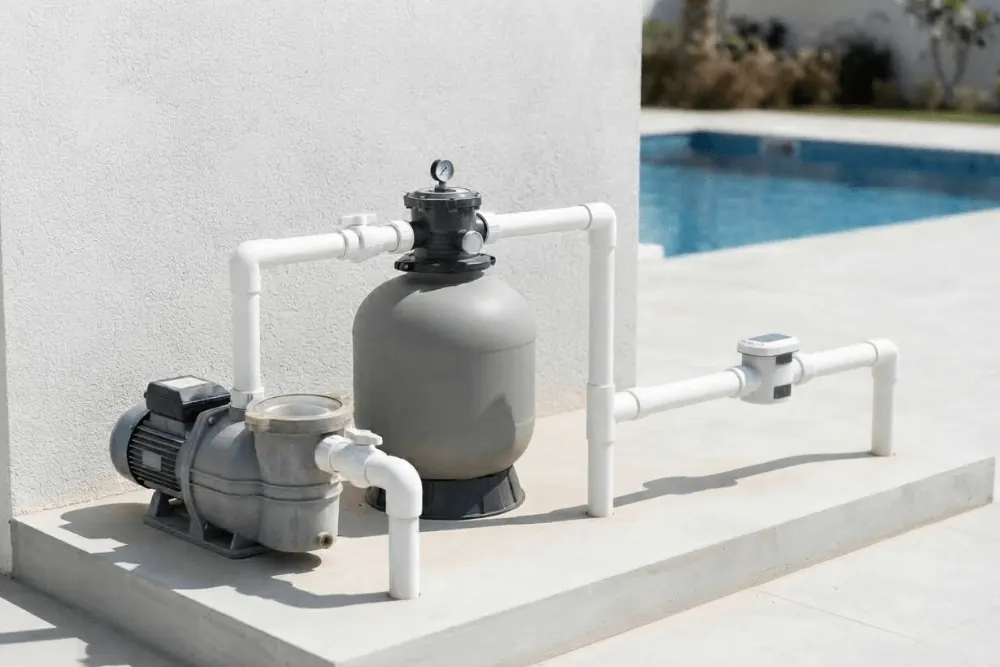
| Pump and strainer basket | Moves the water. The basket catches debris before the impeller |
| Filter | Sand, cartridge or DE. A gauge on top shows the pressure across it |
| Multiport valve | Sets the flow for filtering, backwash, rinse, waste and recirculate |
| Return fittings | Send filtered water back into the pool. Bubbles here point to an air leak on the suction side |
| Balance tank | Found on some pools, where a tank evens out the level between the pool and the pump. Its float valve is a common top-up point |
| Backwash and waste line | Carries flushed water to a drain. Where it goes is set by the drainage layout |
| Fill line and level valve | Tops the pool up from the supply, with backflow protection |
| Heater, chlorinator and other connections | Fitted in the return line. Their electrical side is not covered by this page |
A pool is built to drawings that show its plumbing and electrical layout, the pump room and the drainage route for backwash water. That is what the plumbing looks like on paper, and it is the first thing we ask to see.
Circulation: how much water the pump has to move
A pool pump has to turn the whole volume of the pool through the filter several times a day, against the resistance of the pipes, the filter and the valves. A pump that is too small leaves the water dull and the filter underused. A pump that is too large wastes electricity and can push the filter harder than it likes. The way to read a pump curve and find a duty point is on the submersible pump page, and it applies to a surface pool pump too.
- Run time. Pools run longer in summer and shorter in winter. A timer set to the season saves electricity without hurting the water.
- Speed. A variable-speed pump can run slowly for ordinary filtration and faster for backwashing or a suction cleaner. Because power rises steeply with speed, a slower pump uses much less energy. How much depends on the pump, so ask for its datasheet.
We check the datasheet of the pump fitted and the pressure at the filter before we say a pump is too small or too large.
Pump faults: priming, air leaks, seals, noise and the motor
A pump that will not prime or loses prime
Switch the pump off at the supply, fill the housing with water, refit the lid hand-tight and switch on. Water should move in 30 to 60 seconds, and if the pump has not primed in 2 minutes, switch off and repeat. The usual causes are:
- a low pool level, below the middle of the skimmer opening;
- a worn, dry or pinched lid o-ring, or a loose lid;
- a blocked impeller;
- closed valves;
- a suction-side leak at a union, a valve, the housing or the skimmer.
A pump that loses prime when it is off points to a slow suction-side air leak, or to water draining back.
Air bubbles moving through the strainer pot mean the leak is on the suction side, before or at the pump. A stream of bubbles from the return fittings into the pool is the same sign. The common culprits are a low water level, a cracked or warped strainer lid o-ring, a pinched union gasket, worn gaskets on the pump drain plugs, brittle or failed glue joints in PVC fittings, pinholes in a vacuum hose and leaks in underground lines.
To find the leak, run water over each suspect joint while the pump runs and watch the strainer pot: the bubbles change when the leak is wetted. Before opening anything, switch the pump off at the breaker, release the filter's air relief valve to take the pressure off where it has one, and raise the water to at least halfway up the skimmer. For bubbles that persist, the underground lines need a pressure test by a plumber.
Dry running
Never run the pump dry for more than a few minutes, because it can destroy the mechanical seal and warp the housing. The mechanism for a submersible, where the water around the motor carries the heat, is on the submersible pump page. A surface pool pump is a different machine, and we do not carry the cooling explanation over.
Seal leaks
A leak under the pump, between the motor and the wet end, is a failed mechanical seal. Left running, water can reach the motor bearings, so switch the pump off and call.
Noise
A noisy pool pump usually has air in the suction line, a blocked strainer basket or worn motor bearings. A rough, gurgling sound points to air or a low water level at the skimmer. A rattle or grinding points to the bearings or to debris in the impeller. Switch it off and check the basket and the water level first. Screeching means stop at once, because a failing bearing can seize the motor.
The motor that hums, will not start or trips
- Hums and does not spin. Points to a failed start capacitor. It is replaced with the same microfarad rating, and a capacitor holds a charge even when the pump is unplugged, so it is a job for someone who knows how to discharge it.
- Trips at once. May mean a short in the motor, the cable or the connections. Do not keep resetting it. This is where a pool pump becomes an electrical job, and we isolate and test before we touch it.
- Trips after running. Points to overheating from poor ventilation or failing internal parts. Where there is a reset button, let the motor cool for 30 minutes first.
The insulation test on a submersible motor is on the submersible pump page, and the instrument and limits there are for submersible motors. We follow the manufacturer's instructions and the isolation steps above.
Filters and valves
The three filter types
| DE | Cartridge | Sand | |
|---|---|---|---|
| How it works | Diatomaceous earth grids | A spun polyester element | A tank about three-quarters full of sand or glass media |
| Cleaning | Backwash, then take apart and rinse the grids and manifold | Take apart and rinse with a spray nozzle, soaking in filter cleaner if oily | Backwash |
| What to know | Finest filtration, and DE powder is re-added after cleaning | No backwash water to dispose of | Simple, and the sand wears out and is replaced over the years |
When to backwash
Record the pressure gauge reading with the filter clean. Backwash or clean when the gauge has risen by about 0.3 to 0.5 bar above that clean reading. Without the clean reading, a gauge number means nothing, so the first job on any filter is to record it.
The multiport valve
- Filter. The normal setting. Water goes down through the media and returns to the pool.
- Backwash. Reverses the flow to flush debris to waste.
- Rinse. Follows backwash, settles the media and sends the remaining dirty water to waste.
- Waste. Bypasses the filter and sends water straight to the drain, for vacuuming after algae treatment or lowering the level.
- Recirculate. Bypasses the filter and returns water to the pool.
- Closed. Stops all flow to the filter and the pool.
- Winterize. For closing a pool for the season, which is rarely used in Dubai.
The caution is the same on every position: turn the pump off before changing the setting, and press the handle down before turning it.
Where the backwash goes
Waste and backwash water has to go somewhere. The route on your approved drawings is the route to use, and a written question to the master developer or your community management settles it where the drawings are missing. We do not point a waste line at a street gully.
Leaks: pipe, plant room or shell
Evaporation in Dubai is large
In summer heat and wind, an uncovered pool can lose several millimetres of depth a day to evaporation alone. Take 5 mm on a pool with a 40 m² surface: that is 40 × 0.005 = 0.2 m³, or 200 litres a day. A falling level is not by itself a sign of a leak, so a test has to separate the two. A pool cover cuts evaporation sharply.
The bucket test
- Stand a bucket on the second step, part-submerged, and fill it until its level roughly matches the pool's.
- Mark both levels, inside the bucket and on the pool wall or tile.
- Leave the pool for 24 hours with the pump running normally, and no swimming, backwashing or topping up.
- Compare. Equal loss in both means evaporation. A noticeably larger loss from the pool means a leak.
A difference of a few millimetres is measurement error, and a large loss in a day points to a leak. A hot, dry, breezy week can lower an uncovered pool by several millimetres a day with no leak at all.
Pump on and pump off
Repeat the test with the pump off for 24 hours, and compare. That separates pipework from shell.
| Result | What it suggests |
|---|---|
| Loss with the pump on, steady with it off | The pressure side: the return lines or the equipment pad |
| More loss with the pump off | The suction side, or a shell leak below the waterline |
| The same loss either way | Points to the structure and not the plumbing |
There is also a level clue: if the level stopped dropping at some point, the leak is at that height, because water stops escaping below it. A dye test, with leak-finding dye released close to a suspect surface, is for the shell and fittings: light niche conduits, skimmer throat seams, return fittings, the main drain, the tile line and steps.
Pressure testing the lines
A pressure test plugs the line at the pool end, connects a rig at the equipment pad, pressurises to a conservative working pressure and watches the gauge. A line that holds is sound, and one that bleeds down is broken somewhere between the ends. Over-pressurising PVC can cause violent failure, so the pressure comes from the pipe's rating and not from a guess. The test identifies the faulty line and not the break, and locating a break under concrete or lawn takes acoustic equipment or digging. We do the test with the pool end plugged and the pressure kept to what the pipe is rated for, and a customer should not try it.
The water bill and what the meter shows
A pool's top-up draws water in bursts, so a leaking pool fed by a level valve may not look like a continuous flow to a leak alert on the meter. The pool's own checks are how it is caught. The meter test and the question of who pays are on leak detection and outdoor tap repair, and we do not repeat them.
Top-up and auto-fill
A pool that loses water to evaporation has to be topped up, by hand or by a level valve.
For the plumbing, the issue is the fill line. A level valve that sticks open shows as a rising level or constant overflow, and one that sticks shut shows as a falling level with the pump losing prime. The fill line also needs backflow protection, an air gap or a check device, so pool water cannot be drawn back into the drinking supply. We check the valve, the float, the position of the outlet and the overflow before we look elsewhere.
Fountains, ponds and water features
A fountain or pond pump is a small circulation system: a pump, pipework, a fill line and a power supply. The fill line needs the same backflow protection as a pool. The tests above apply: priming, air leaks, seals and the bucket test.
Dubai summer and pool plumbing
Heat is the biggest strain on a Dubai pool's plumbing. Water in the pipes and the plant room gets warm, pumps run longer and motors work in a hot room. A pump house with no ventilation shortens the life of the motor, and a motor that trips on heat in the afternoon may run fine in the evening. Exposed pipes and fittings in sun become brittle over the years, and a PVC pipe that was fine at five years can crack at ten. Warm water also grows algae faster, so the filter works harder and the gauge climbs sooner. If a pump is cutting out on hot afternoons, tell us the time it happens and whether the plant room is shaded or ventilated, because that decides whether the fault is the motor or the room.
The plant room: what a tidy one looks like
A good pool plant room has the pump and filter on a dry, level base with room to open the strainer lid and reach the valves. Each valve is labelled, the pipes are supported and clear of the floor, there is a floor drain or a slope so a leak runs away from the electrics, and the electrical switchgear is well above any water. The gauge is readable, and the backwash line is plain to see. If yours is crowded, damp or hard to reach, the cause of the next fault is probably there, and we tell you what to change. A few small fixes, such as labelling valves and lifting a pump off a wet floor, make every later visit quicker and safer.
When to call us and when to call a pool specialist
We handle the plumbing that moves the water: the pump, the filter connections, the valves, the pipes and the fill line. A pool specialist handles the shell, the tiles, the surface, the water chemistry and the structure. Many faults sit between the two, such as a falling level that could be a pipe or a crack. That is why we run the tests first. If they point to the pipes, we repair them. If they point to the shell, we tell you plainly and you call the specialist, and our test results give them a head start.
Maintenance schedule
These are typical intervals for pool pumps and filters. We write the intervals that fit your equipment on the handover note.
| Item | Typical interval |
|---|---|
| Strainer basket | Look at it weekly and empty it when it is part full |
| Lid o-ring | Check each time the lid is opened, and lubricate with a silicone product, never petroleum jelly |
| Filter pressure gauge | Read it weekly against the clean reading |
| Cartridge filter | Rinse when the gauge rises, and replace when worn |
| Sand filter | Backwash when the gauge rises. Replace the sand every few years |
| DE filter | Backwash, then recharge. Strip and clean the grids once or twice a year |
| Mechanical seal and bearings | On symptoms: a drip or a noise |
| Level valve and float | Look at them each season |
Permission in Dubai: landlord and community
Cleaning a strainer, changing an o-ring or a seal, or replacing a pump with the same model is maintenance. A new pool, a changed layout, new pipework or a different fill arrangement is a change to the property.
Where a pool job falls:
| Job | Starting point |
|---|---|
| Cleaning, o-rings, seals and like-for-like part swaps | Maintenance. Tell the landlord in writing if you rent |
| Replacing a pump or motor with the same rating | The same |
| A different pump, a variable-speed pump, or a new filter type | A change to the pool's plant. Written consent from the landlord, and a question to the community |
| New or moved pipework, a new fill line, or a changed drainage route | A change to the plumbing layout on the drawings. Written consent, and the master developer or community management as they require |
| Opening paving or the deck to trace a leak | The landlord, and the community management where the plot belongs to a community |
| Anything touching the pool shell or its structure | A pool specialist, and the same consent |
We cannot say whether your pool or community needs a certificate for a particular job. The master developer or owners' association can, and a request in writing is cheaper than a stopped job. Tell us what your building or community asks for and we work to it.
Warranty and the handover
What you should have when the job is finished:
- A written note: which part failed, what was replaced, and the make, model and serial number of the pump, motor, filter, valve and any controller or level valve.
- The readings. Supply voltage and running current against the nameplate where the pump was tested.
- The valve map. Each valve and each multiport position labelled, and the route of the waste line.
- The result of any pressure test or bucket test, with the date, the time, the starting levels and the loss.
- Before and after photographs of the plant room, the pump, the filter, the valves and any pipe that was opened.
- The removed part, shown to you or kept for you if you ask.
- A test: the pump primed and run, the lid and unions watched for bubbles and drips, and the return flow checked.
- Intervals for the strainer, the o-ring, the seal and the filter, and a revisit date where the cause needed one.
- FAM's workmanship warranty, in writing. The warranty runs for 30 days and covers our labour only. Parts carry the manufacturer's warranty only.
How we work
- You tell us what is happening on WhatsApp: what the pump does, what the level does, when it started, what the filter gauge reads, and whether you own, rent or manage the property. A photograph of the plant room and the gauge saves a visit.
- We check on the visit from the water outward: the level, the skimmer, the strainer, the lid o-ring, the unions, the pump, the filter gauge, the multiport valve and the fill line. The visit fee is AED 50 + VAT, credited if the work goes ahead.
- We find the part that failed before we propose a fix, and tell you whether it is air, the seal, the motor, the filter, the valve, the pipe or the evaporation.
- We give options and a price in writing: a repair, a replacement part, a pressure test or a leak-location survey, with what each leaves untouched.
- Check permission. In a rented or managed property, ask the landlord or building management whether they need to approve this work before the visit.
- We make the repair, protect the deck and the plant room and keep the area dry.
- We test and hand over the note, the readings, the valve map and the photographs.
Where we work in Dubai
We cover all of Dubai, including Dubai Marina, JBR, Downtown Dubai, Business Bay, Jumeirah Lakes Towers, Palm Jumeirah, Al Barsha, Jumeirah Village Circle, Dubai Hills, Mirdif, Deira and Al Quoz. See the full list of areas.
How much does pool plumbing repair cost in Dubai?
We do not publish a starting price for this job. We give a written price after we find the fault, with the options. Prices exclude 5% VAT.
What sets the price on a pool plumbing job
- Access. A buried or paved pipe costs more to reach than a pump in a plant room, and locating a break under concrete or lawn takes equipment or digging.
- The filter. The three filter types are priced differently, and a DE filter has more to clean than a cartridge.
- The pump. A seal or capacitor is a small repair, and a new pump or motor is a larger one, with a variable-speed pump costing more than a fixed-speed one.
- Leak location. Pressure testing a line is quicker than tracing a break to a point.
- Making good. Paving, deck or planting reinstated after opening.
Pool plumbing FAQs
Why does my pool pump lose prime?
Check the level, the lid and its o-ring first, then run a hose over each connection while watching the lid. Air bubbles in the strainer pot mean a suction-side leak. If the pump loses prime only when it is off, a slow air leak or water draining back is the likely cause.
Why does water drip from under my pool pump?
A leak between the motor and the wet end is a failed mechanical seal, and that water can reach the motor bearings if it is left running. Switch the pump off and call us.
Why is my pool pump noisy?
Switch the pump off for screeching or grinding, because a failing bearing can seize the motor. A gurgle points to air or a low level at the skimmer, and a rattle to debris in the impeller or loose mounts. Check the basket and the level first.
How do I tell a leak from evaporation?
Use the bucket test: a bucket on the second step with its level matched to the pool, both marked, left for 24 hours with the pump running. Equal loss is evaporation, and a noticeably larger loss from the pool is a leak. In Dubai some loss is expected, since an uncovered pool can lose several millimetres of depth a day in summer.
Is the leak in the pipes or the shell?
The pump-on and pump-off test points the way. More loss with the pump on means the pressure side, more loss with it off means the suction side or a shell leak, and the same loss either way points to the structure. A pressure test of each line confirms a pipe leak. Shell leaks go to a pool specialist.
How often should I backwash?
Record the clean gauge reading first, then backwash when the gauge rises by about 0.3 to 0.5 bar above it. No fixed interval applies to every pool, so we go by the gauge.
Where can I discharge backwash water in Dubai?
Use the route on your approved drawings. If they are missing, ask the master developer or your community management in writing. We do not point a waste line at a street gully.
Can you change my pool's suction outlets or drain covers?
No. Those are safety items and part of the pool's design, and we do not alter them. Ask your pool designer.
Who pays if the pump fails in a rented villa?
It depends on your agreement and the cause. Wear and tear is often the landlord's, and damage the tenant caused is the tenant's. Tell the landlord in writing before the work.
How much does pool plumbing repair cost in Dubai?
It depends on the part that failed, the access and the pump. We give a written price after we find the fault, with the options, excluding 5% VAT.
Book pool plumbing repair in Dubai
Tell us what the pump does, what the level does, when it started, what the filter gauge reads, and whether you own or rent. Photographs of the plant room, the gauge and the pump label help. If water is running to waste or the pump is overheating, switch the pump off at the supply and call. We will find the part that failed, give you the options and a price in writing, make the repair, and hand over a note with the readings.
WhatsApp: +971 55 407 7427 · Request a quote
Visit us: Office 871, Oasis Mall, Al Quoz 1, Dubai, UAE
Related services: Submersible and borehole pumps · Booster pump · Irrigation systems · Backflow prevention · Leak detection · Pipe leak repair · Valve repair and replacement · Outdoor tap repair