
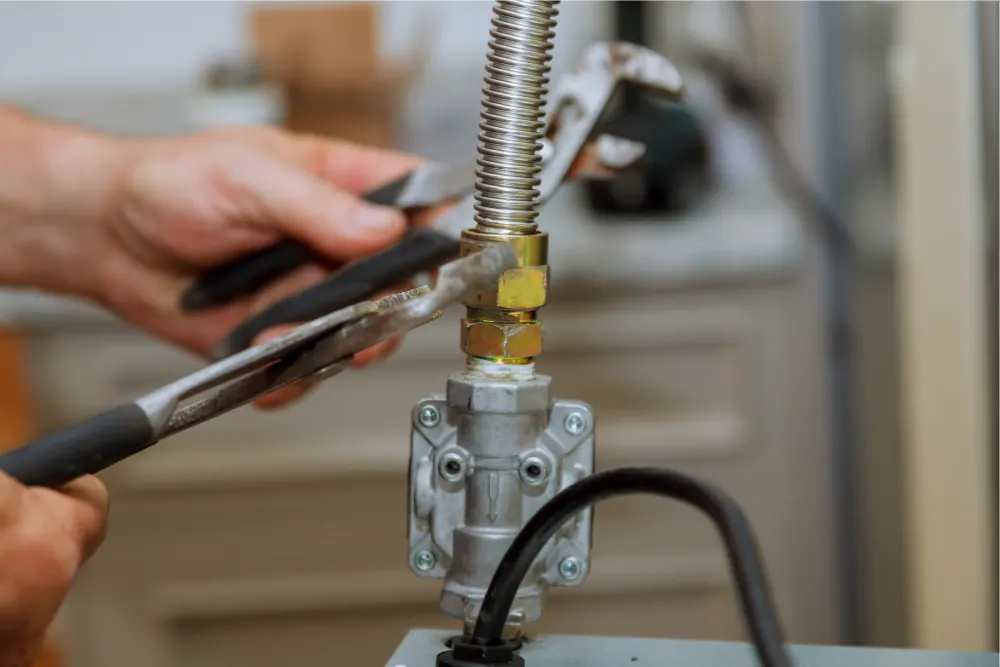
Valve repair and replacement in Dubai: what we do
- Main shut-off valve replacement. Seized, leaking or failing main valves, replaced with a valve that closes.
- Isolation valves. Fitted on each bathroom, kitchen, heater, pump, tank and appliance branch, so one repair does not mean the whole property is without water.
- Angle stops. The small valves behind basins, taps and toilets.
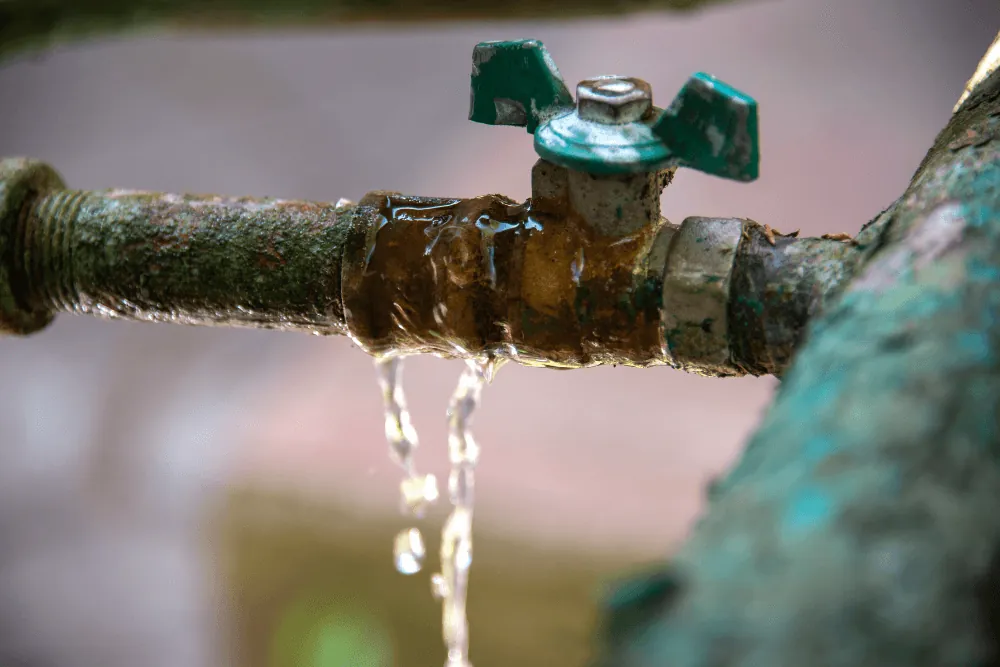
- Leaking valves. Stem and packing leaks, body leaks and valves that drip when closed.
- Check valves. Non-return valves on pump lines and appliance feeds.
- Ball, gate and globe valves. Replacement in the right type and size for the line.
- Valve audit. We find, test and label every valve, and tell you which ones are due.
Neighbouring topics have their own pages. Pressure-reducing valves are on our pressure valves page, and devices that stop dirty water flowing back are on our backflow prevention page. Joints and threads are on our pipe fittings page, flexible connectors on our hoses page, and replacing pipe on our repiping page. Banging pipes are on our low water pressure page, pumps on our booster pump page, and tank float valves on our water tank installation page. A tap that drips is on our tap repair page.
Valve types and what each is for
| Valve | How it works | Best for | Watch-point |
|---|---|---|---|
| Ball valve | A ball with a hole through it turns a quarter turn | Main shut-off, isolation and branch valves | Not for throttling. A half-open ball valve wears its seat. The handle shows the position |
| Gate valve | A wheel raises or lowers a gate across the pipe | Fully open or fully closed duty | Corrosion can stop it opening or closing fully, and a badly corroded stem can break. Partial opening causes vibration and damage |
| Globe valve | A plug sits on a seat inside a body shaped like a globe | Throttling and flow control | Restricts flow even fully open, so it is a poor choice for a main |
| Angle stop | A small quarter-turn or screw valve behind a basin, tap or toilet | Isolating one fixture | Seals and packing wear. Old ones seize and drip at the body |
| Check valve (non-return) | A flap or spring closes against reverse flow | Pump discharge lines and appliance feeds | Fitted the wrong way it blocks flow. Debris holds it open |
| Float valve | A ball and arm that stops a tank filling | Water tanks | Covered on our water tank installation page |
| Pressure reducing valve | Holds a lower pressure downstream | Buildings and villas with high supply pressure | Covered on our pressure valves page |
Ball or gate: which to fit
Both close a line. They differ in how they wear.
| Ball valve | Gate valve | |
|---|---|---|
| Operation | Quarter turn. Position is visible from the handle | Several turns of a wheel |
| Sealing | Seals tightly and quickly | Seals by pressing the gate on its seats, which can leave a weep if the seats are scaled |
| Wear | Lasts well, and keeps working after years of disuse | Corrodes inside and can stop closing, and the stem can break if forced |
| Partial opening | Not recommended | Not recommended |
| Space | Compact | Needs room for the wheel |
In most plumbing positions a ball valve is the better choice, because it seals more tightly and lasts longer.
Our default is a ball valve for isolation and main shut-off, because the handle shows its position and it turns a quarter. We fit a gate valve where the design or the existing line calls for one.
Signs a valve is failing
| What you see | Possible cause | What to do |
|---|---|---|
| Stiff handle, or it will not turn | Mineral buildup, corrosion or worn packing. Stuck valves follow long periods of inactivity | Do not force it. WhatsApp us |
| Drip from the valve body or threads | A cracked body, loose joint or failed seal | Replace the valve or re-make the joint |
| Water trickles when the valve is shut | A damaged seat or ball | Replace |
| Low flow with the valve fully open | Debris, a partly closed valve or a globe valve in the line | Check the valve before the pipe. See low water pressure |
| Cracked handle or body | Mechanical damage or age | Replace |
A valve that has never been operated cannot be trusted to operate. If you have not turned a valve in years, treat it as unproven.
Repair or replace
Some valve faults are a ten-minute repair. Others mean the valve has finished.
| Fault | Repair | Replace when |
|---|---|---|
| Stiff operation | Gentle cycling to break loose deposits | It will not move without force, or the stem is corroded |
| Leak at the stem or handle | Tighten the packing nut a little, or replace the packing | The packing is replaced and it leaks again, or the stem is corroded |
| Drip from the body or a joint | Re-make the joint with new sealant, if the body is sound | The body is cracked, pitted or corroded |
| Water passes when closed | Clean the seat, if debris is the cause | The seat or ball is damaged |
| Angle stop | Packing tightened or replaced | Older stops, corroded stops, or any that drip at the body |
| Check valve that chatters or leaks back | Clean the seat, and check the pump or the pressure that makes it chatter | The flap or spring is worn |
Over-tightening is the common mistake. Do not force a stuck valve, because it can break the stem, crack the valve or cause a leak in the supply line. A valve that has to be forced is a valve that is being replaced.
The deciding factor is what the valve protects, not the part price. An angle stop is cheap and quick to swap, so rebuilding a dripping one is hard to justify. A main valve that has been forced or has leaked at the body is replaced, because it is the one valve you cannot afford to fail. A valve on a pump line is replaced with the type that suits the duty.
The main shut-off valve in Dubai
The main shut-off is the valve that stops all water to the property. It is the first thing to close in a burst, and the last thing anyone checks. In Dubai there are three questions: which valve is yours, who is responsible for it, and what happens if it will not close.
Villas: valves at the meter
A villa's supply usually enters at the compound wall through a meter with a valve on each side. The points that matter for valves:
- Valves either side of the meter. These belong to the meter installation. They are meant to stay fully open in normal use and are not for regulating flow.
- The valve you use in an emergency. That is the consumer-side stopcock after the meter, or the valve at the tank, not the valves on the meter itself.
- A valve near the tank. Many villas have a gate valve near the storage tank, sometimes in a separate chamber with a cover. Find it, and label it.
- No branches before the tank. A supply line that feeds the tank directly, without taps or bypasses on the way, is easier to isolate and to trace.
- Pressure. Where the pressure is high, a pressure reducing valve is fitted after the meter. See our pressure valves page.
- Materials. Valves are of good quality, corrosion-resistant and suitable for drinking water.
These points describe the usual arrangement and do not cover every old villa's internal valves. We do not alter valves on the meter side of your supply without the supplier's agreement.
Flats: which valve is yours
A flat has a valve, or several, that isolate the unit from the building's risers. They may be in a riser cupboard, a service shaft, behind a panel or near the entrance. In general the building's risers and common valves belong to the building, so closing or replacing one affects other units. Ask management which valve is yours, and have it labelled. We do not work on riser valves without management.
Who is responsible
The valves on the meter side belong to the water supplier. Everything after the meter is the property's. A tenancy contract can allocate minor repairs. For a seized main, tell the landlord in writing, with our findings, before replacement. This is general information, not legal advice.
A burst after the meter is yours to isolate: close the nearest valve and call a plumber. See our emergency plumber page.
The first minutes of a burst or spray
Closing the right valve fast limits the damage. This order is our own practice, not a published procedure:
- Close the nearest valve upstream of the leak: the angle stop for a fixture, the branch valve for a bathroom, the heater valve for a heater.
- If you do not know which valve that is, close the main.
- Switch off the water heater and any pump so neither runs dry or keeps pushing water into the leak.
- Open the lowest tap to let the pipe drain and relieve the pressure behind the break.
- Keep clear of wet electrics. Do not stand in water to reach a socket or board. If a switch is dry and reachable, turn off the circuit for the wet area.
- Photograph the damage and the valve positions before cleaning up. Dated photos are useful evidence in a damage claim.
- Call a plumber, and tell the landlord or management in writing.
If the main will not close
- Do not force it. Excess force can break the stem, crack the valve or cause a leak in the supply line. A broken main valve with the water still on is a worse problem than a stiff one.
- Close the nearest valve downstream of the problem: the angle stop, the branch valve or the heater valve.
- Switch off the water heater and, if the pump is running, the pump, so neither runs dry or keeps feeding the leak.
- WhatsApp us. A seized main is replaced, and replacement needs the supply upstream isolated. In a villa the options are the tank-side gate valve, if the main sits downstream of it, or the valves at the meter, which are on the supplier's side and need its agreement. In a flat it means a riser valve or the building's isolation, which management controls.
How we replace a main valve
- Plan the water-off window with you and, in a flat, with management. Tell everyone who shares the supply, and make sure the heater and any pump are off before the water goes.
- Isolate upstream and confirm the isolation holds before cutting or unscrewing anything.
- Drain the line and remove the old valve.
- Fit a new valve of the right type. A full-port ball valve is our default. A globe valve is a poor choice for a main, because it restricts the flow even when fully open.
- Match size, thread and joint to the pipe. Thread and sealing detail is on our pipe fittings page.
- Fit a union beside the valve where the pipe layout allows, so the valve can be replaced later without cutting pipe.
- Open slowly rather than all at once, so the line refills without a sudden surge, and check every joint for drips.
- Test the valve by closing and reopening it, then check again for drips after the line has been in use for a while.
- Label the valve and show you the open and closed positions. A ball valve handle parallel to the pipe is open and perpendicular is closed.
Where a property needs valves
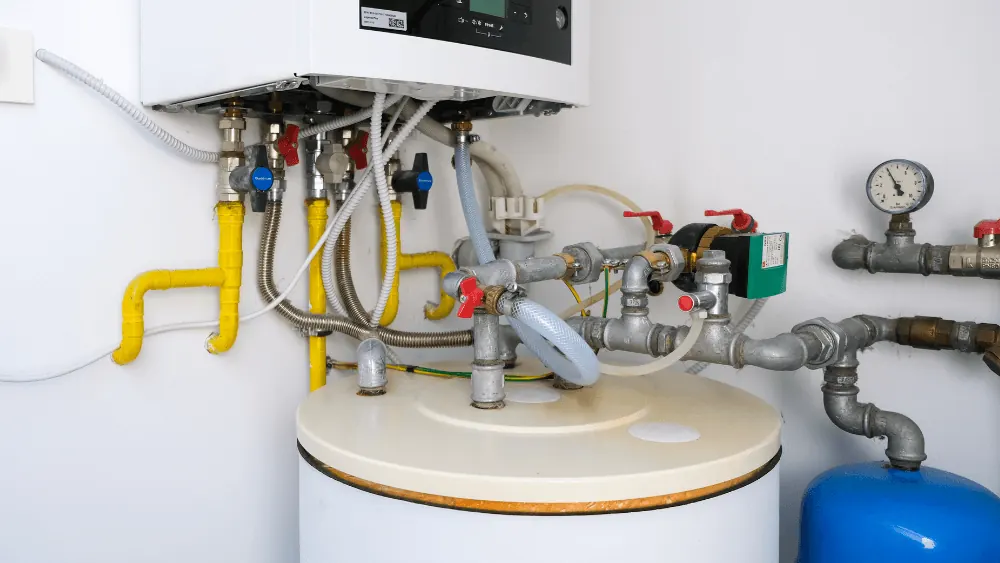
A single main is not enough. The aim is to shut off the part you are working on and leave the rest running.
| Position | Why a valve belongs there |
|---|---|
| The main entry point | Stops all water to the property |
| Tank outlet | Lets the tank be isolated from the house for repair. See water tank installation |
| Tank inlet, beside the float valve | Lets the float valve be serviced without draining the supply line |
| Pump inlet and outlet | Lets the pump be removed. A check valve on the discharge stops water draining back. See booster pump |
| Each bathroom or kitchen branch | Shuts off one wet area. This is the valve most properties lack |
| Each fixture | An angle stop behind every basin, tap and toilet |
| Washing machine and dishwasher | A tap or valve for each, with the hose behind it. See hoses |
| Garden or irrigation line | Keeps an outdoor leak from draining the whole property |
Branch valves turn a whole-property shutdown into a single-room one, which is why we suggest them wherever a bathroom or kitchen has none. If you are reworking the pipes, the cheapest time to fit them is during the repipe. See repiping.
Check valves
A check valve lets water pass in one direction and closes against reverse flow.
Three practical points:
- Orientation matters. Look for the arrow on the body. A check valve fitted the wrong way blocks the flow it was meant to allow.
- Find the cause before replacing. Match the type, size and orientation, and find the root cause first, because fitting the same part without fixing the cause may only delay the next failure.
- Chatter and slam. A check valve that chatters or slams shut points to the pump, the pressure or the pipework around it, and a quieter spring-loaded type may suit the line better.
A check valve is a flow-direction device. Equipment that protects drinking water from contamination is a separate subject, covered on our backflow prevention page.
Valves and water hammer
Banging pipes after a tap or valve closes come from a sudden stop in moving water. The most common trigger is a quickly closing valve, and the effect is stronger for electric valves that shut fast, such as solenoids. Closing manual valves slowly helps.
For valves, that gives three rules:
- Close slowly. A quarter-turn ball valve can be shut fast enough to bang, so close it with a steady hand.
- A fast valve needs an arrestor. Where a solenoid or a quick-closing valve cannot be slowed, a water hammer arrestor beside it absorbs the shock. See water hammer arrestor.
- Loose pipes make the noise worse. Securing pipe clips and fitting arrestors are covered on our low water pressure page.
Materials, ratings and size
- Brass. Most small valves are brass. Brass can lose its zinc in some water and fail from the inside, as our pipe fittings page explains. For concealed valves we ask for dezincification-resistant brass.
- Ratings. A valve has a pressure rating and a temperature rating, marked on the body or handle. A valve at a water heater must be rated for hot water.
- Size. Valves are named by the pipe size they fit, in inches, with threaded, compression or soldered ends. Match the valve to the pipe, not the other way round.
- Port. A reduced-port ball valve narrows the opening, so for a main or a pump line we ask for full-port.
- Suitability. Valves on drinking water should be suitable for it. We ask for the datasheet.
Choosing a replacement valve
A valve that is the wrong match fails early or leaks at the joint. This is the checklist we work through.
| Check | What we confirm | Why |
|---|---|---|
| Size | Matches the pipe, not the old valve's handle | A wrong size forces an adapter, which is one more joint to leak |
| End connection | Threaded, compression or soldered, matching the pipe material | Mixed metals and wrong threads are covered on the pipe fittings page |
| Rating | Pressure and temperature marked on the body or handle | A heater valve must take hot water |
| Material | Brass of dezincification-resistant grade for concealed positions | Hidden valves cannot be inspected, and corrosion-resistant valves suitable for drinking water are the right choice |
| Handle and clearance | Lever has room to swing a full quarter turn, and a wheel can be reached | A valve nobody can operate in an emergency does not count |
| Access | An access panel where the valve is concealed | The next person can reach it without opening a wall |
| Paperwork | Datasheet or marking kept for the record | Gives the next plumber the rating and size at a glance |
Exercising valves
A valve that is never moved is more likely to seize.
- Why. Stuck valves follow long periods of inactivity, and valves behind toilets, sinks, washers and heaters may sit untouched for years.
- Ball valves are valued for their longevity and keep working after years of disuse, but even they should be moved now and then.
- Gate valves corrode and seize if they are never moved.
Our recommendation is to exercise every valve once or twice a year, slowly, and to look for drips afterwards. Do not force a valve that does not move. Tell us, and we replace it before it is needed in a hurry.
Making a valve map
We offer to find, test and label every valve in a property:
- Photograph each valve and record what it controls.
- Tag it with the area it serves.
- Note its type, size and condition, and whether it closes.
- Draw a simple plan of the property with valve positions marked.
- Record the main and the branches so a plumber, a tenant or a security guard can find them in an emergency.
A map costs little to make and saves the minutes that matter the first time a pipe bursts.
Landlords, tenants and building permission
- A single valve in your unit. An angle stop or a branch valve is routine maintenance, and we tell the landlord or agent afterwards.
- The unit main. Replacement needs the building's isolation and the landlord's agreement.
- Riser valves and common-area valves. These belong to the building. Management arranges the work.
- Meter-side valves. The meter installation belongs to the water supplier.
A seized main is a safety item. If the landlord is slow to respond, written notice with photos and our findings is the record you need.
Where we repair and replace valves in Dubai
We cover all of Dubai, including Dubai Marina, JBR, Downtown Dubai, Business Bay, Jumeirah Lakes Towers, Palm Jumeirah, Al Barsha, Jumeirah Village Circle, Dubai Hills, Mirdif, Deira and Al Quoz. See the full list of areas.
Fitting a valve into a line that has none
Adding a valve to an existing pipe is a small job when the water can be isolated, and a larger one when it cannot. How we do it depends on the pipe.
- Copper or metal pipe. A section is cut out, and the valve is fitted with the right ends, usually with a union so the valve can be removed later.
- Plastic pipe. A valve with ends that suit the pipe system is fitted with the maker's joint method. Mixing materials needs the correct adapter, and a thread into plastic is made with care so it does not crack.
- A pipe in the wall. The wall is opened at the smallest point, or the valve is fitted where the pipe is already exposed, such as in a cupboard or a shaft.
- A line that cannot be isolated. We close a higher valve, and where there is none, we plan the work with building management so the whole supply can be shut for a short time.
- After fitting. The line is refilled slowly, every joint is checked for drips, the valve is closed and opened, and the handle position is labelled.
A valve is only worth fitting if people can reach it, so we choose the position with you and add an access panel where the valve would otherwise be buried.
Keeping a valve schedule
A property with many valves is easier to manage when each one is recorded. A simple list can include the position of each valve, the pipe it controls, its type and size, and its condition. A tag on the valve with a number and a label is even better. When a leak starts, the person who knows which valve to close has a big advantage.
A good schedule also lists the date each valve was last turned, so a valve that has not moved in years can be exercised before the day it is needed. Keep a copy with the property file and another on a phone.
What we do on a valve visit
We locate each valve and test it for operation and leaks. We note which are stiff, which weep and which are broken. We quote repairs or replacements and fix the price on WhatsApp before we start. Prices exclude 5% VAT.
A valve that cannot be isolated
Sometimes the valve you need to close is the one that has failed, and you cannot isolate the section. In a flat, close the main valve at the meter or the riser, if you can reach it, and tell building management. In a villa, close the main valve at the tank or the incoming line. If no valve works, switch off the pump and call us. We work out a plan to isolate the section, replace the failed valve and fit an additional valve so the problem does not recur.
How much does valve repair and replacement cost in Dubai?
The price follows the valve and the shutdown.
- Call-out and diagnosis. Finding which valve is the problem.
- The valve. Type, size, material and rating. A main valve costs more than an angle stop.
- Isolation. A valve that can be isolated locally is quick. One that needs the building's riser or the whole property off takes planning.
- Access. A valve behind tile or in a shaft costs more to reach.
- Extras. A union, a new branch valve, labelling or a valve map.
- The visit. The visit fee is AED 50 + VAT, credited if the work goes ahead.
We do not publish a starting price for this job. Send a photo on WhatsApp and we give you a fixed price before we start. Prices exclude 5% VAT.
Valve repair and replacement FAQs
Why won't my main water valve turn?
Mineral buildup, corrosion or worn packing, often after long periods without use. Do not force a stuck valve, because that can break the stem, crack the valve or cause a leak. Close the nearest valve downstream and WhatsApp us. A seized main is replaced, not wrestled.
Can I fix a leaking valve by tightening it?
A little, sometimes. If the leak is at the stem, tightening the packing nut by about an eighth to a quarter turn can stop it. Over-tightening can crack the valve or crush the washer. If it still leaks, the packing is replaced. If it keeps leaking or is corroded, the valve is replaced.
Should my main be a ball valve or a gate valve?
A ball valve is our default for a main, because it turns a quarter and shows its position. Ball valves keep working after years of disuse, and gate valves can corrode and stop closing. Where the design or the existing line calls for a gate valve, such as the tank-side valve in many villas, we fit one.
How often should I move my valves?
We recommend once or twice a year, slowly, checking for drips afterwards. Do not force a stiff valve.
Which valve controls the water to my flat?
Ask management, close it once to confirm it works, and have it labelled. We can find and map your valves.
Can I close the valves at the meter?
The valves either side of the meter are meant to stay fully open in normal use and are not for regulating flow. Use the consumer-side stopcock after the meter, and ask the water supplier or us before touching the valves on the meter side.
Why does water still trickle when my valve is closed?
The seat or ball is damaged, or debris is holding the valve off its seat. We try cleaning first and replace the valve if the seat is scored.
Can you replace a valve without my landlord's permission?
An angle stop or a branch valve is routine, and we inform the landlord or agent. Replacing a unit main needs the building's isolation and the landlord's agreement, and riser valves belong to the building. A seized main is a safety item, so tell the landlord in writing.
What does a check valve do, and why does mine chatter?
It lets water flow one way and closes against reverse flow. The cause may be the valve, the pump or the pressure around it, so we find the cause before replacing it.
How much does valve repair and replacement cost in Dubai?
We do not publish a starting price for this job. Send a photo on WhatsApp and we give you a fixed price before we start. Prices exclude 5% VAT.
Can you fit valves so I can shut off one bathroom at a time?
Yes. A branch valve on each bathroom, the kitchen and the heater turns a whole-property shutdown into a single-room one. They are cheapest to add during other pipework, and we label each one.
Book a valve repair or replacement in Dubai
Tell us which valve it is, what it does and where it sits: main, bathroom, heater, pump, tank or appliance. A photo of the valve and the pipe on either side helps. If it is leaking or will not close, close the nearest valve downstream and WhatsApp us. We will send a plumber to test it, repair or replace it, and label the result.
WhatsApp: +971 55 407 7427 · Request a quote
Visit us: Office 871, Oasis Mall, Al Quoz 1, Dubai, UAE
Related services: Pressure valves · Backflow prevention · Pipe fittings · Hoses · Low water pressure · Emergency plumber