
Irrigation system repair in Dubai: what we do
- Finding why a zone does not water, will not stop, waters unevenly or leaves wet and dry spots, and saying which part is at fault before anything is replaced.
- Repairing and replacing solenoid valves, diaphragms, valve boxes, filters, pressure regulators, sprinkler heads, nozzles, drip lateral lines and emitters.
- Testing the controller and its wiring, including the voltage at the controller and at the valve, and replacing a controller or its battery.
- Tracing and repairing leaks in irrigation pipe, and telling you whether a high bill comes from the system or from somewhere else.
- Installing new drip and sprinkler zones, or extending an existing system for new beds, planters and lawns.
- Checking the supply side: the pressure, the filter, the backflow protection and whether a tank, a pump or treated water feeds the system.
- A written note of what was found, what was changed and a zone chart.
Neighbouring topics have their own pages. Outside taps, hoses and hose vacuum breakers are on outdoor tap repair. Backflow protection is on backflow prevention, and the pump that gives a garden its pressure on booster pump installation and repair. A borehole as a water source is on submersible, borehole and sump pump repair. The meter test and who is responsible for a leak are on leak detection and pipe leak repair, and the tank that may feed the system on water tank installation. We repeat none of that here, and this page is about the irrigation system itself.
Which part is at fault? A decision guide
| What you see | Suspect first | Section |
|---|---|---|
| One zone does not come on | The controller output, the wiring, the solenoid, or a blocked valve | Faults and diagnosis |
| A zone will not shut off | Debris or a worn diaphragm in the valve, a failed solenoid, or the flow control setting | Faults and diagnosis |
| Sprays are weak or the water barely reaches the edge | Low pressure, a dirty filter, a leak, too many heads on the zone, or a failed regulator | Pressure and flow |
| A fine mist instead of drops | Pressure above what the spray body is made for | Pressure and flow |
| A head does not rise | Debris in the stem, low pressure, or grass and soil blocking it | Faults and diagnosis |
| Drip plants wilt while others thrive | Clogged emitters, a kinked line, a dirty filter or wrong pressure | Faults and diagnosis |
| A wet or soft patch that appears at the same place | A leak in the line, a leaking valve or a broken head | Leaks, wet spots and bills |
| The bill is high and no tap is leaking | The irrigation line, or the supply before the system | Leaks, wet spots and bills |
| The system waters at the wrong time or for the wrong time | The controller schedule, its battery or a rain sensor | Scheduling and water use |
| Irrigation fed from a tank or treated water keeps failing | The filter, the pump or what is in the water | The water source |
System types
A garden can combine them on different zones. Each type works at its own pressure and flow, so each sits on its own zone.
| Type | Where it is used | What to know |
|---|---|---|
| Pop-up spray heads | Small lawns and groundcover | Fine spray over a short radius, typically at 1.4 to 2 bar. A mist means the pressure is too high for the head |
| Rotors | Larger lawns | Throw a jet over a long radius at about 2.8 to 4 bar, and use much more water per head than sprays |
| Drip lines and emitters | Beds, shrubs, trees and planters | Low pressure and low flow at the root. Need a filter and a regulator, and the lines can clog |
| Bubblers | Single trees and large shrubs | A small controlled flow at the base of the plant |
The components
- The supply and backflow protection. Backflow is on backflow prevention.
- The pressure regulator. A regulator is needed when the source pressure is higher than the components are rated for.
- The controller or timer. Confirm it runs each zone for the intended time, and that its battery is working. A flat battery loses the program.
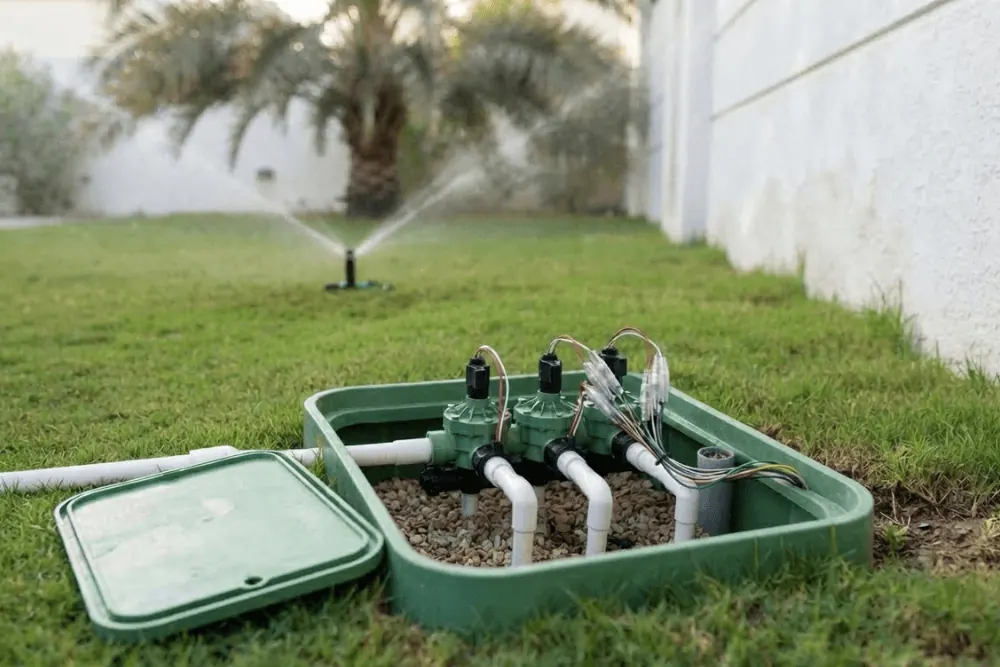
- Solenoid valves in a valve box. Each zone has a valve.
- Air and vacuum release valves, and flush ends. Place air and vacuum release valves at high points and at the ends of long runs, and fit a flush port or a clamped end at the end of each drip lateral so the line can be cleared.
How a zone runs
The controller sends a low-voltage signal on a wire to a zone's solenoid. The solenoid lets the valve open and water flows to the heads or the drip laterals. No signal points to the controller or the wire, a signal with no water points to the solenoid or the valve, and water with a poor spray points to the pressure, the filter or the heads.
The water source: mains, tank, treated water or a borehole
What feeds the system decides which faults you see.
- The potable supply. A system on the mains takes its pressure from the supply and is billed with the rest of the home's water. Pressure is covered in the pressure section below.
- A tank and pump. A villa pump can also serve the garden or irrigation. See booster pump, irrigation pump and water tank installation.
- Treated sewage effluent (TSE). Treated wastewater is supplied for landscape irrigation in some communities. Ask your community management whether it is available to your plot.
- A borehole. The approvals are on submersible, borehole and sump pump repair.
Treated water for gardens
Treated water is not drinking water, and it behaves differently in the system. It is suited to ornamental planting and lawns, and not to vegetables. It can carry salts and fine solids, and some of what is in it is concentrated enough to block filters, nozzles and emitters, so a system fed that way needs its filters cleaned more often. Not every plant tolerates it, so check with your landscaper.
For a repair, the point is what is in the water. A system on treated water that keeps failing is a reason to look at the filter first. TSE and potable water must stay apart, and the physical separation is covered on backflow prevention.
Scheduling, water use and the Dubai advice
A controller left on a summer program is the first thing to check when a garden is wet in a cooler month. Water early in the morning or after sunset, so less of it evaporates, and avoid midday in summer, when much of the water is lost to the heat before the roots take it up. Water less often and for longer so roots go deep, adjust the zones for shade and sun, and check for leaks every month. Change the controller with the season: in the hottest months keep run times short and early, in cooler months cut the number of days, and skip a day after rain. A rain sensor on the controller prevents watering in the rain. We set run times by zone, because a lawn zone, a shrub zone and a drip zone take different amounts. Plant needs come from your landscaper.
Pressure and flow
Low pressure in a sprinkler zone has a short list of causes: closed or partly closed valves, leaks, too many heads on a zone, undersized pipe, dirty filters and a failed regulator. The checks are to confirm valves are fully open, look for leaks or soggy spots, clean the nozzle filters, check drip tubing for kinks, and measure static and dynamic pressure. Misting is caused by high pressure and is fixed with a regulator or pressure-regulated spray bodies.
Static pressure is the pressure with the water still, and dynamic pressure is the pressure with the zone running. The two differ, and a big drop between them points to flow restriction. The pump that gives a Dubai villa its pressure is on the booster pump page and the loss of pressure through the house on low water pressure.
Faults and diagnosis
| Fault | What to know | What we check |
|---|---|---|
| Zone will not shut off | Debris in the diaphragm, a worn diaphragm, solenoid failure or a wrong flow control setting | The valve internals |
| Head does not pop up | Debris in the stem, low zone pressure, grass or soil blocking the head, a broken riser or pipe | The head by hand, then the zone pressure |
| Clogged nozzles | Debris, mineral build-up, dirty or damaged screens, infrequent flushing | Remove and rinse the nozzle, clean the filter, flush the zone |
| Spray where it should not go | Spray should reach the planted area only, not the house, paving or street | Head aim and height |
The valve that will not open
Turn on the supply and test the valve by hand at the valve: turning the solenoid counter-clockwise a quarter to a half turn opens the valve manually. Open any master valve. Check that flow control is adjusted. At the controller screw terminals, a 24 volt system should read about 24 to 28 volts AC. Then measure at the wire splice at the valve, and if the controller's output is proper there, the solenoid is the fault and is replaced. Compare the wire gauge and run length with the valve maker's maximum distance chart, because a long run on thin wire drops the voltage. To tell a wiring fault from a controller fault, swap the valve wires with a known working valve in the same box and swap controller wires with a known working wire.
We take the figures from the manufacturer's chart for the valve fitted.
Drip lines
Minerals in the water can build up in emitters, and Dubai's water and treated water both leave deposits over time. Flush the end of each lateral before spring use and periodically after that, and clean the filter. We write the interval on the handover note from what we find in the lines.
Leaks, wet spots and bills
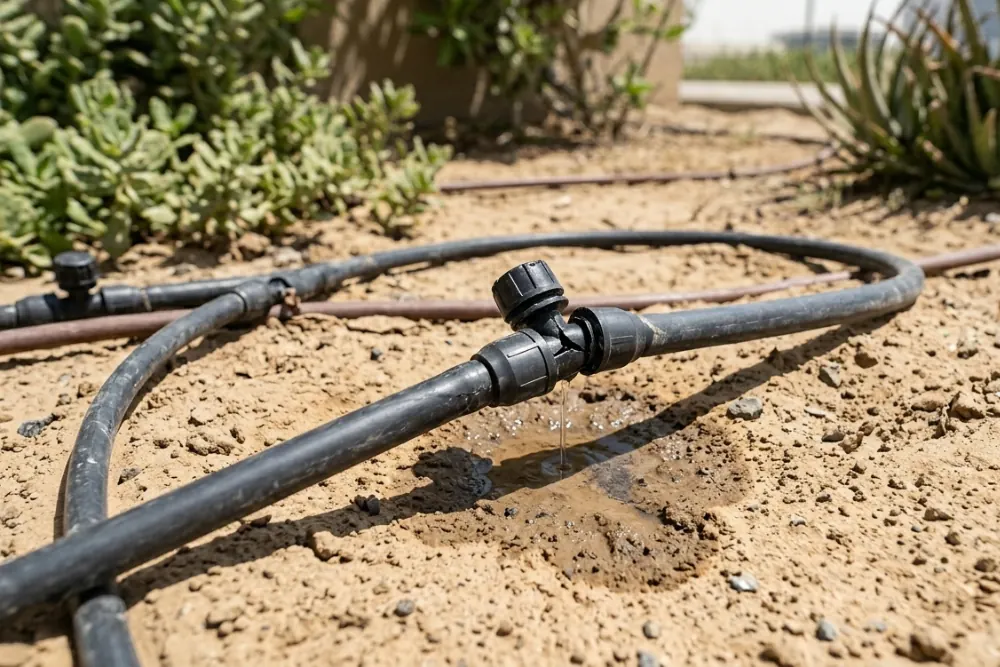
A wet patch that appears at the same place is a clue. A leak in an irrigation line and an over-watered zone look alike from the surface, and a test separates them. Close the garden isolating valve and watch the meter, as the leak detection page sets out. If the meter stops, the leak is in the irrigation. If it keeps moving, the leak is elsewhere. Who is responsible for a leak before and after the meter is on outdoor tap repair and pipe leak repair, and we do not repeat it.
A zone chart and a meter test narrow the search before any digging, and we locate the leak before we open the ground.
Backflow and the irrigation connection
An irrigation line can draw soil and fertiliser water back into the supply if pressure drops. We check that a backflow preventer is fitted on the supply, that it is in a position the manufacturer allows, and that a second non-potable supply such as treated water is not connected to the drinking water.
Maintenance schedule
- Periodically. Clean screen filters by hand or by back-flush, and flush the end of each lateral.
- Before summer. Check head aim and height, the rain sensor, the controller battery and the program.
- When the seasons change. Review the run times. A summer program left running in a cooler month waters too much.
- After landscaping work. New planting, resurfacing and digging can break laterals or bury heads.
- Sun and age. Heads, risers and exposed drip tubing in full sun can crack and need replacing.
We write the ones that fit your system on the handover.
The valve box: what is in it and what goes wrong
The valve box is the heart of the system, and it is the part owners never open. In it sit the solenoid valves, one for each zone, the low-voltage wires that reach them, and often a filter and a regulator. The common faults are wire splices that have corroded because they were joined without a waterproof connector, a box that has filled with soil or water so the solenoids sit wet, ants and insects nesting in the box and chewing insulation, and a lid that has cracked in the sun and let in a lawnmower. We open the box, clean it out, remake any splice in a waterproof connector, label each valve to its zone, and set the lid so it can be lifted without digging. A box that is easy to find and open is a box that gets looked at.
Roots, sand and sun
Three things in a Dubai garden wear out an irrigation system faster than the plumbing itself. Roots find the damp around a leaking joint and grow into the pipe, so a small weep becomes a blocked line. Sand and dust blow into a tank vent and reach the filters, so a tank-fed system needs its filters cleaned more often than a mains-fed one. And sun cracks exposed plastic: risers, heads, drip tube and valve box lids all go brittle after a few summers. We replace what is cracked, bury or shade the pipe where we can, and put a screen on the tank vent where it is missing. See water tank installation.
After the landscaper has been
Landscaping work is a common cause of irrigation faults. A new bed, a paving job or a tree planted over a lateral can cut a pipe, bury a head or change the coverage. After any landscaping work, run each zone and walk the garden: look for heads buried under mulch, sprays blocked by new plants, wet patches where a pipe was cut and zones that now water paving. Tell the landscaper where the valve box and the main line are before work starts, and ask them to call you if they find a pipe that is not on the plan. A zone chart makes that conversation easy.
Making a zone chart
A zone chart is a simple sketch of the garden with each zone numbered and its valve marked. For each zone, write the type of head, what it waters, how long it runs and how often. Draw the main line from the supply to the valve box, with the position of the filter and the isolating valve. Photograph the box with the labelled valves. Keep a copy in the house and send one to us, so a fault can be traced without a dig. A chart takes half an hour to make and saves far more when a zone fails or a pipe is cut.
Palms, trees and large shrubs
Mature palms and trees need a lot of water less often, and a spray head is a poor way to give it. Bubblers or a ring of drip line round the base put the water where the roots are and reduce loss to the air. A palm sitting in a lawn zone gets either too little or, from the lawn's short frequent cycles, too much surface water and not enough depth. We suggest a separate zone for trees, so they can run long and rarely while the lawn runs short and often. Your landscaper knows the species, and we fit what they ask for.
Permission in Dubai: landlord, community and authority
Cleaning a filter, replacing a head or a solenoid, or resetting a controller is maintenance. A new zone, a new trench, a new connection to the supply or a treated-water connection is a change to the property.
The fuller account of the landlord and tenant points is on our shower installation and water heater installation pages. This is general information and not legal advice. Where an irrigation job falls:
| Job | Starting point |
|---|---|
| Repairing a broken lateral or main in an existing bed | Maintenance. Keep a note of where the ground was opened |
| A new zone, an extension, or a new valve box | A change to the landscape. Written consent from the landlord, and the master developer where the community governs gardens |
| A connection to treated water | The landlord first, then whatever your community requires |
| A borehole for the garden | An approval first, covered on the borehole page |
| Opening a boundary wall or a common-area planter to run pipe | The landlord, and the master developer or owners' association |
We cannot say whether your community needs a certificate for a particular job. The master developer or owners' association can, and a request in writing is cheaper than a stopped job. Water that runs off a garden into the street is a nuisance for neighbours, so aim the heads at the planting.
Warranty and the handover
What you should have when the job is finished:
- A written note: which part failed, what was replaced, and the make and model of any valve, controller, filter, regulator, head or emitter fitted.
- A zone chart: each zone, the valve that serves it, the beds or lawn it waters and the type of head or emitter.
- The controller program: run times and days for each zone, the date it was set, and the battery type.
- The location of the valve box, the filter, the flush ends and the isolating valve so you can shut the system off yourself.
- Before and after photographs of the valve box, the repair and the route of any pipe that was opened or laid. Buried or mulched laterals are harder to inspect, so a photograph of the route is how the next person finds it.
- The removed part, shown to you or kept for you if you ask.
- A test: each zone run in turn, the sprays watched for coverage and the lines checked for leaks, with a revisit date where the cause needed one.
- Intervals for the filter, the flush and the program review, with the reason for each.
- FAM's workmanship warranty, in writing. The warranty runs for 30 days and covers our labour only. Parts carry the manufacturer's warranty only.
How we work
- You tell us what is happening on WhatsApp: which zone, what it does, when it started, what feeds the system and whether you own, rent or manage the property. A photograph of the controller and the valve box saves a visit.
- We check on the visit from the controller outward: the program, the output at the controller, the voltage at the valve, the valve, the filter, the pressure and the heads or emitters. The visit fee is AED 50 + VAT, credited if the work goes ahead.
- We find the part that failed before we propose a fix, and tell you whether it is the controller, the wire, the solenoid, the valve, the pipe, the pressure or the schedule.
- We give options and a price in writing: a repair, a replacement part, a new zone or a change to the program, with what each leaves untouched.
- Check permission. In a rented or managed property, ask the landlord or building management whether they need to approve this work before the visit.
- We make the repair, protect the planting and keep the area tidy.
- We test and hand over the note, the zone chart, the program and the photographs.
Where we work in Dubai
We cover all of Dubai, including Dubai Marina, JBR, Downtown Dubai, Business Bay, Jumeirah Lakes Towers, Palm Jumeirah, Al Barsha, Jumeirah Village Circle, Dubai Hills, Mirdif, Deira and Al Quoz. See the full list of areas.
Walking the system to find a fault
A garden system has many parts, and a short walk shows more than guessing from the house. Do it when the system is running, early in the morning.
- Start at the source. Is the tank full, the supply open and the pump running? Look at the pressure gauge if there is one.
- Look at the controller. Is the time correct, the day set and the zones active? A power cut resets many controllers.
- Go to the valve box. Open it and look for water, wet soil, insects or a cracked solenoid. Note which valve belongs to which zone.
- Run each zone for a minute and watch the heads. Do all pop up? Do they turn? Is the spray even?
- Look for wet patches where nothing should be wet, and dry patches where the lawn is brown.
- Listen for hissing along the pipe. A leak makes a sound, especially in a quiet garden.
- Check the filter at the start of each zone. A clogged filter is a common cause of weak flow.
Keep notes with the date. A pattern of failing zones shows where the problem is.
Drip lines for plants and hedges
A drip line puts water at the root, with less loss to evaporation than a spray. It suits shrubs, hedges, trees and pots. The faults are different from a spray system. The emitters block with scale or grit, the line is chewed by animals or damaged by a spade, and the ends are left open. A pressure regulator and a filter at the start keep the system healthy. A flush valve at the end of each line lets you clear grit. Check the line by looking for a wet spot at each plant, and no wet spots between.
What to tell us
Send photos of the controller, the valve box and the problem area. Tell us the type of system, the water source and when it last worked properly. A short video of the zone running helps. We diagnose, quote and fix the work on the plumbing side, and tell you what is a controller or a landscape matter. Prices exclude 5% VAT, and the price is fixed on WhatsApp before work starts.
How much does irrigation system repair cost in Dubai?
A repair costs less than a new system, and a new zone costs by size. The price follows what failed and how hard it is to reach.
What sets the price on an irrigation job
- The part. A solenoid, a diaphragm, a head or a filter costs a small amount. A controller, a regulator or a valve costs more.
- Access. Buried or mulched laterals are harder to inspect, and a leak under paving or planting costs more to reach.
- Zones. A new system or an extension is priced by the number of zones and the size of the area.
- The supply. A backflow device, a regulator or a filter adds parts.
We do not publish a starting price for this job. Send a photo on WhatsApp and we give you a fixed price after we find the fault, with the options. Prices exclude 5% VAT.
Irrigation system FAQs
Why won't one sprinkler zone turn on?
Work from the controller outward. Check the program and the output at the controller, then the voltage at the valve. If the voltage is right at the valve and it still does not open, the solenoid is replaced. If the voltage is low or missing, the fault is in the wire or the controller.
Why does a zone keep running after the controller stops?
The usual causes are debris in the valve diaphragm, a worn diaphragm, a failed solenoid or an incorrect flow control setting. The valve is opened with the supply off, cleaned and the diaphragm replaced if worn.
Why are the drip plants dry when the sprinklers work?
Check the end of each lateral for flow, clean the filter and check the pressure. A clogged emitter, a kinked or cut line, a blocked filter or low pressure are the usual causes.
Why is the spray weak, or a mist?
A weak spray means low pressure or a restriction: a dirty filter, a leak, too many heads on the zone or a failed regulator. A mist means the pressure is too high for the head. We measure static and dynamic pressure before changing parts.
When should I water in Dubai?
Water early in the morning or after sunset, so less evaporates. Midday watering loses much of the water to the heat before the roots take it up. Drip lines can run in the early hours, and lawns do better with shorter, more frequent cycles in summer. If you use treated or tank water, check that it is suitable for your plants.
Can I use treated water for my garden?
In some communities, for ornamental planting and lawns, and not for vegetables. It can carry salts and fine solids that block filters and emitters, and the supply must stay separate from drinking water. Ask your community management whether it is available to your plot, and see the treated-water section above.
Do I need permission to add an irrigation zone?
In a rented home, yes: get the landlord's written consent. Many communities also ask for the master developer's approval for landscape changes. Get both in writing before a new zone, a trench or a new connection.
Who pays for an irrigation repair in a rented villa?
It depends on the contract and on whether the part failed from age or from misuse. The garden's irrigation is often the tenant's to maintain, and the contract can say otherwise. Tell the landlord in writing before the work. This is not legal advice.
How much does irrigation system repair cost in Dubai?
It depends on what failed and how hard it is to reach. We give a written price after we find the fault, with the options, excluding 5% VAT.
Book irrigation system repair in Dubai
Tell us which zone fails, what it does, when it started, what feeds the system, and whether you own or rent. Photographs of the controller, the valve box and the wet or dry area help. If a zone will not stop, close the garden isolating valve if there is one and call. We will find the part that failed, give you the options and a price in writing, make the repair, and hand over a note with a zone chart.
WhatsApp: +971 55 407 7427 · Request a quote
Visit us: Office 871, Oasis Mall, Al Quoz 1, Dubai, UAE
Related services: Outdoor tap repair · Backflow prevention · Booster pump · Irrigation pump · Submersible and borehole pumps · Leak detection · Pipe leak repair · Valve repair and replacement · Water tank installation