
Signs you may have a hidden water leak
The table matches each sign you notice to a possible cause and a next step.
| What you notice | What it may mean | What to do |
|---|---|---|
| Water bill higher than usual, with no change in how you live | A leak somewhere after the meter | Do the meter test below |
| Water meter moves when every tap and appliance is off | A confirmed leak on your side of the meter | WhatsApp us, and close the main valve if it is fast |
| Damp or cold patch on a wall | A leaking pipe in or behind the wall | Photograph it, mark the edge, and WhatsApp us |
| Brown or yellow stain on a ceiling, growing | A leak from the floor above, a pipe in the ceiling void, or a heater | Switch off the heater, and WhatsApp us |
| Peeling paint, bubbling plaster or a musty smell | Moisture inside the wall or floor | WhatsApp us before the damage spreads |
| Floor tiles that feel warm or damp, or lift at the edges | A leak under the floor, or a leaking hot pipe | WhatsApp us |
| Sound of running water when everything is off | A running toilet, tank float or leaking pipe | Check toilets and the tank, then WhatsApp us |
| Weak water pressure that gets worse | A leak that loses pressure along the line | WhatsApp us |
| Wet ground or a soggy patch in the garden | A leak in an underground line or irrigation pipe | Close the garden valve, and WhatsApp us |
| Pool water level dropping faster than evaporation | A leak in the pool body or its pipework | WhatsApp us |
One sign is a reason to check. Two together are a reason to call. If your meter shows flow with everything off, you already have the answer: there is a leak, and the job is to find it.
Leak detection in Dubai: do the meter test first
The meter test needs no tools and shows whether water is moving through your pipes. Running it twice a year is a sound habit: switch off all water devices and check the meter.
- Stop all water use. Turn off taps, showers, the washing machine, dishwasher, irrigation and any water feature. Make sure nobody flushes a toilet.
- Find your meter. In a flat it is usually in a meter room or a riser cupboard, and in a villa near the boundary or the front of the plot. If you cannot find yours, ask your building management or the water utility.
- Read the meter. Note the full reading, including the small digits or the moving dial, and the time.
- Wait with all water off. Ten minutes shows a fast leak. For a slow leak, wait several hours, overnight if you can, and see the note below on how long to wait.
- Read it again. If the reading has changed, or a small dial or flow indicator is spinning, water is moving through your pipes, and there is a leak.
If you have a smart meter, check your account for readings and any high-usage alert.
How long to wait. It depends on the meter and the leak.
- Dial meter: note the position of the hand, wait 10 minutes and look again.
- Digital meter: watch the flow screen for at least ten flashes.
- For a slow leak: wait 30 minutes for tanks and cisterns to finish filling, read the meter, then leave all water off for three to six hours and read again.
A short wait can catch a fast leak and miss a slow one, so a longer gap between readings tests for slower leaks, and a reading taken after the cistern has stopped refilling avoids a false result.
Two things that can trick the test. A toilet cistern refilling every few minutes will move the meter, and so will an automatic water feature or a heater that tops itself up from a tank. If you suspect either, turn off their supply and repeat the test. A leak that stops when you close one valve is already narrowed down.
Who is responsible, the utility or you?
The water utility's responsibility for connections and maintenance ends at the meter, and internal connections after the meter are the customer's responsibility. A leak that shows on the meter test is therefore a leak in your property's pipes. Who pays for the repair, tenant or landlord, is a tenancy question covered in the apartments section below. A leak in the street or on the supply side before the meter is the utility's job, and it should be reported to the utility.
Reading your water meter
A meter test works only if you can read the meter. Meter designs differ.
- A dial meter has a row of digits and a small round dial, sometimes a star or triangle, that turns when any water flows. If that small dial moves while all taps are off, water is flowing.
- A digital meter shows a number and sometimes a flow symbol, such as a droplet or a tap. A flow symbol that stays on with everything off signals a leak.
- A smart meter records usage that you can view in an app or online.
Check the unit printed on the meter face. Most read in cubic metres, where 1 cubic metre is 1,000 litres.
Estimating how big the leak is
Take two readings with all water off, and measure the time between them. A worked example with illustrative readings: the meter reads 125.430 cubic metres at 10:00 pm and 125.442 at 6:00 am. That is 0.012 cubic metres, or 12 litres, over eight hours, which is 1.5 litres an hour or 36 litres a day. A small leak, but a real one, and still worth fixing before it grows.
A leak that moves the meter within a few minutes is a larger loss and needs faster action. Send us both readings and the times, and we can tell you how urgent it is.
Quick checks before you call
If the meter moves, these checks can narrow the source. They are safe to do yourself.
- Toilet dye test. Add 2 or 3 drops of food colouring to the tank, wait 15 to 30 minutes, and check whether the bowl water changes colour. Do not flush during the wait. Colour in the bowl means water is leaking past the flush seal. A leaking toilet can waste water all day without a visible drip. See toilet repair.
- Close the isolating valve to each appliance, one at a time, and re-test the meter. If the meter stops, that appliance or its hose is the leak.
- Check the water heater. Look for drips from the relief valve pipe and the base of the tank. A leaking relief valve can feed a steady drain. See water heater repair.
- Check taps, showerheads and hoses. A dripping tap or a split flexible hose under a sink adds up over weeks.
- Check the water tank, if you have one. A float valve that sticks keeps the tank overflowing, and a cracked tank or loose connection loses water silently. See float valve and overflow repair.
- Check outside. Look at garden taps, irrigation valves and the area around pool equipment for wet ground.
If you shut off supply to everything you can and the meter still moves, the leak is in the pipework itself, inside a wall, ceiling, floor or underground. That is where detection starts.
Where hidden leaks happen in Dubai homes
Tanks, bathrooms, kitchens and pools are common leak locations, and ageing and poor maintenance cause leaks in taps, pipes, toilet tanks and water heaters. In practice, these are the leaks we trace.
Pipes inside walls
Supply pipes run behind tiles and plaster to bathrooms and kitchens. A pinhole in a pipe, a failed joint, or a pipe damaged by a nail or drill leaks slowly into the wall. Signs include a damp patch, a stain or a cold wall surface. The pipe's material, its age and the water's chemistry all affect how fast it corrodes.
Pipes under floors and slabs
In flats and villas, pipes can run in a screed under the tiles or in the slab. A leak here soaks the floor, warms or cools tiles, and can appear in the room below. It is the hardest leak to find by looking, so we trace it with instruments. See also pipe leak repair.
Bathrooms and wet areas
Showers and bathrooms combine pipework, drains and waterproofing. A leak can come from the supply, the waste, a cracked tray, a failed sealant joint or damaged waterproofing under the tiles. We separate these causes so we repair the one that is actually failing.
Ceiling leaks
A stain on the ceiling in a flat can come from the unit above, from a pipe in the ceiling void, from a water heater in the false ceiling, or from an air-conditioning drain line, which is not a plumbing fault. We trace the source and say so if the fault is the air-conditioning, so you call the right trade. See ceiling and wall leaks.
Water heaters and tanks
A leaking heater or a failing tank connection can run for weeks without a visible puddle, especially in a ceiling void or a tank room. The relief valve pipe on a heater is a common source of drips.
Underground lines in villas
Villas have underground supply lines from the meter to the house, the tank and the garden. A leak here can waste large amounts of water without any sign above ground except a bill, a damp patch or a pressure drop. We locate it using instruments before any digging.
Swimming pools, irrigation and water features
Pool pipework, filter connections, irrigation lines and fountain pumps all hold pressurised water. A leak on any of these lowers the water level or soaks the ground. See irrigation systems and pool plumbing and pump repair.
Drain and waste leaks
A leak on the waste side only runs when you use a fixture, and the water is not clean. It causes damp, smell and stains without any change in your meter. If your meter is steady but you have damp, the leak may be on a waste pipe. See drain unblocking.
How urgent is your leak?
| Situation | Urgency | What to do |
|---|---|---|
| Burst pipe, water running freely, or water near electrics | Now | Close the main valve, switch off affected electrics, WhatsApp us |
| Water through a ceiling, or into a neighbour's flat | Today | Stop the water if you can, WhatsApp us, and photograph the damage |
| Meter moves quickly with everything off | Today or tomorrow | Close the main valve at night and when away, and WhatsApp us |
| Slow meter movement, a growing damp patch or stain | This week | WhatsApp us, and mark the edge of the stain with a pencil and date |
| Dripping tap or a running toilet | Soon | Book a repair, and use the isolating valve in the meantime |
Three examples of how a detection visit goes
These are illustrations, not real jobs, written to show how the methods fit together.
A damp patch on a bathroom wall. The wall behind the shower feels cool and the paint is bubbling. The meter test shows a slow movement. We close each bathroom supply in turn and find the meter stops when the shower line is closed. A thermal scan shows a cold strip in the wall, and a pressure test on that line confirms it drops. We open one tile, find a failed joint, replace it, pressure-test it again and leave the wall ready for tiling.
A ceiling stain in a flat. A brown stain appears on a bedroom ceiling. The meter is steady, so the leak is not on your supply. We check the unit above through the building manager, and find the stain's moisture pattern follows the line of the air-conditioning drain, not a water pipe. We report it so the right trade can fix it. The detection saved a plumbing repair that was not needed.
A high bill in a villa. The monthly bill has nearly doubled. The meter test shows steady movement with the house taps off. Closing the valve to the garden stops the meter. We trace the irrigation line, find a cracked pipe under a flower bed, and repair it. The leak was never in the house.
A tank that never stops. A villa's bill creeps up and the meter moves slowly overnight. The taps are fine. At the roof tank we find the float valve stuck open and the overflow pipe running down a wall behind a planter, where no one looks. We replace the valve, clear the overflow so it can be seen from the garden and show the owner what a running overflow looks like.
Get ready for a leak detection visit
A little preparation shortens the visit and improves the result.
- Note your meter readings and times from the meter test, plus recent bills.
- Tell us the history. Mention recent renovation, a new heater, a tank repair, or any earlier leak.
- Clear access. Move furniture from the damp wall, empty the cupboard under the sink, and make sure we can reach the meter, tank room and any access panels.
- Arrange building access. In an apartment, tell the building management, and check whether a permit is needed for work in shared areas.
- Mark the damp. Draw a pencil line around the edge of a stain or damp patch and write the date, so we can see whether it is growing.
- Do not repaint or retile yet. Covering the damage hides the evidence and traps moisture.
- Switch off nothing unnecessarily. We may need the water on to test, so wait for our instructions unless water is flooding.
How we find a hidden leak without breaking walls
A good leak detection visit follows an order. We rule things out, narrow the area, confirm the spot, and only then open the surface.
- Listen to your history. When did it start? Where is the damp? Did the bill change? Was there recent building work, a heater replacement or a tank repair? The answers narrow the search.
- Confirm there is a leak. We repeat the meter test, and shut off sections of the system one at a time to see which part stops the flow. This divides the property into zones.
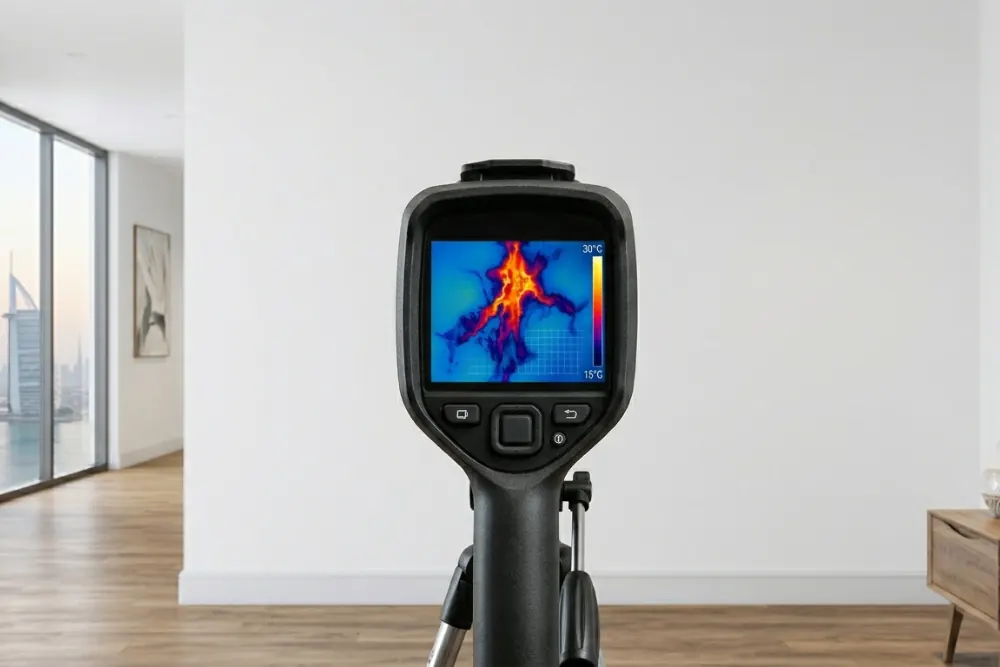
- Scan the surface. We use a moisture meter on walls and floors and, where suitable, a thermal imaging camera to see temperature patterns that suggest wet or cold zones.
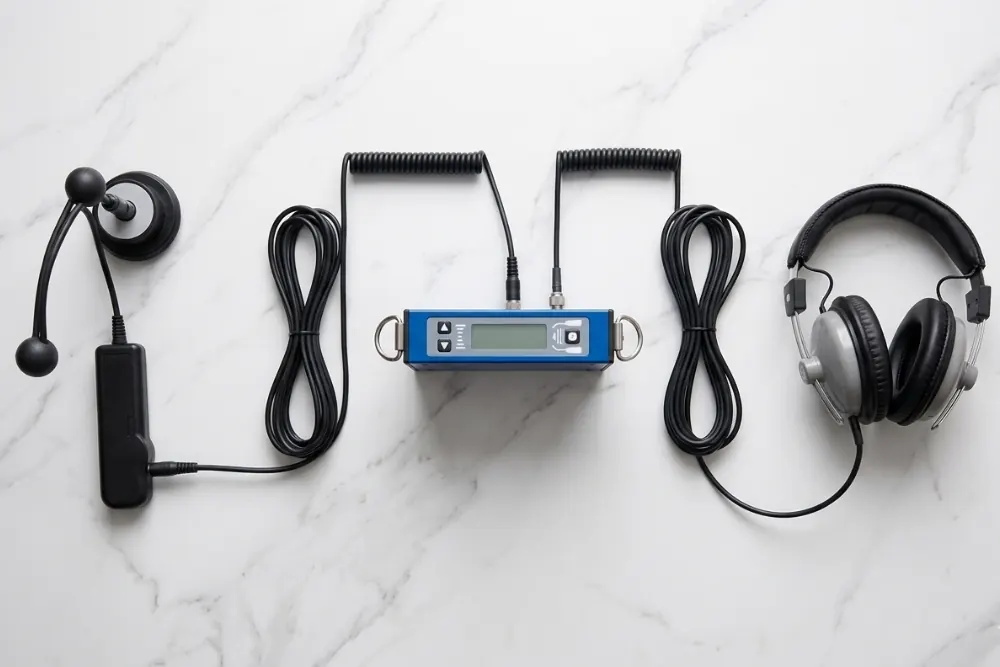
- Pinpoint the leak. Depending on the pipe and the location, we use listening equipment, a pressure test, tracer gas, or a drain camera.
- Confirm before opening. We mark the spot and check it a second way where we can. The opening is then as small as the pipe allows.
- Report what we found. You get a clear description, photos and the repair options.
Leak detection methods and when each one works
No single tool finds every leak. Each one suits a different pipe, material and location.
| Method | How it works | Best for | Limits |
|---|---|---|---|
| Meter and valve test | Isolates zones and watches the meter | Confirming a leak and the zone it is in | Does not give the exact spot |
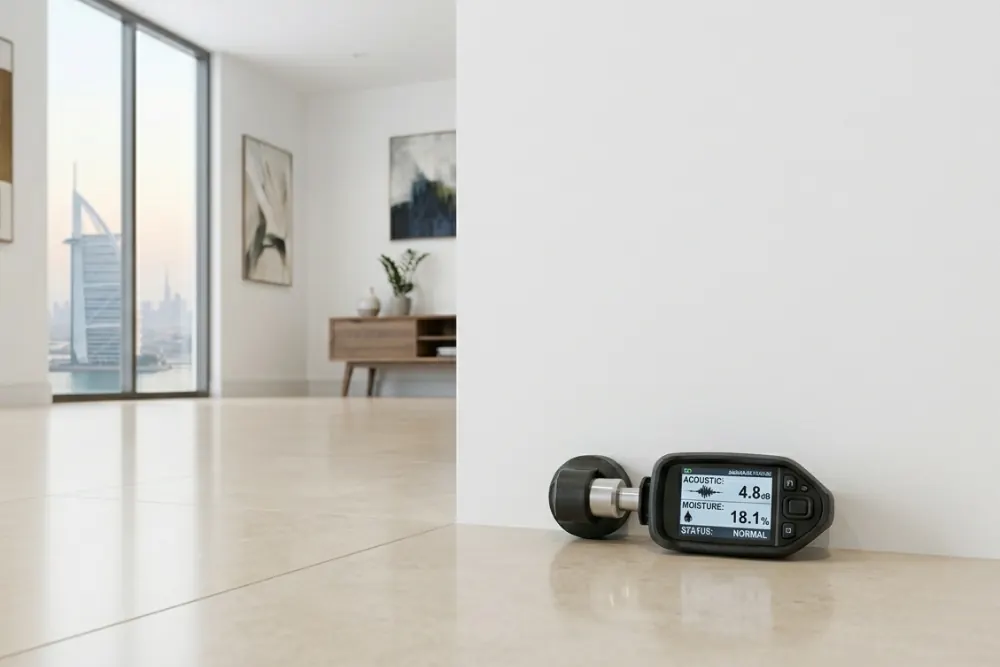
| Moisture meter | Measures moisture in walls and floors | Mapping damp areas, checking if a wall is wet | Shows water, not always its source |
| Thermal imaging camera | Shows surface temperature differences | Hot water leaks, wet patches behind walls, tracing a pipe route | Cold-water leaks can be subtle; result depends on conditions |
| Acoustic listening | Listens for the sound of water escaping a pressurised pipe | Pressurised supply pipes in walls, slabs and underground | Background noise and some pipe materials reduce accuracy |
| Pressure test | Isolates a pipe section, pressurises it and watches for a drop | Confirming a leak on a specific line | Does not locate the leak on its own |
| Tracer gas | Fills the pipe with harmless gas and detects it where it escapes | Buried and hard-to-locate leaks | Needs the line to be isolated and filled |
| Drain camera | Pushes a camera through a drain | Waste-pipe leaks, cracks and joints | Only works on drain pipes |
| Dye test | Colours water to see where it appears | Toilets, shower trays, baths, drains | Only for leaks that can be seen with dye |
We use more than one method where we can before we open a wall, because each has blind spots.
Why we confirm before opening anything
A wrong opening means two repairs instead of one, so the aim is a small opening in the right place. If a leak is under a tiled floor, we aim to open one tile, not the room. If the leak is in a wall, we open a small section at the pipe, not a long strip.
After we find the leak
Once the leak is located, we choose the repair that causes the least disruption.
- Repair the pipe or joint. For a pinhole, a failed fitting or a cracked section, we cut out the damaged part and replace it with a new section and fittings suited to the pipe. See pipe leak repair.
- Re-route the pipe. If a pipe in a slab or wall is failing along its length, replacing it as a new run on the surface or in a different route may cost less than repeated repairs. See repiping and pipe replacement.
- Replace a fixture, valve or heater. If the leak is from a tap, valve, hose, heater or tank, we repair or replace the part.
- Repair a waste pipe or tray. For shower trays, waste joints or waterproofing failures, we fix the failed component and test it before closing.
- Test under pressure. Before closing any opening, we pressurise the repaired section and check it holds.
We explain the repair options and the price before we start. If the repair needs a different trade, such as tiling, plastering, painting or waterproofing, we tell you so you can arrange it.
Why a high water bill needs a check, not a guess
A bill that rises with no change in use is one sign. Before you assume the meter is wrong, check three things.
- Your own use. Guests, a new appliance, a filled pool or irrigation in a dry month all raise consumption.
- The meter test. If the meter moves with everything off, the cause is a leak.
- Your bill and app history. Compare the same period in previous years. Some utility accounts offer a high-usage alert, so check whether yours has one set up.
A thin stream that runs all day and all night adds up fast: one litre a minute is 1,440 litres a day, or about 43,000 litres a month. If the meter test shows a leak, act this week, not next month.
Leaks in apartments: neighbours, landlords and documents
Leaks in a flat can involve more than one party, so the paperwork matters as much as the repair.
- Your unit's pipes and the shared pipes are different cases. The utility's responsibility ends at the meter. For pipes inside the flat, the tenancy contract decides whether tenant or landlord pays.
- Stopping the water comes first, whoever pays, so we stop the leak first and write down the diagnosis.
- Ask for a report. A report with photos, readings and a description is useful for your landlord, your building management and your insurer.
Check your tenancy contract for repair responsibilities, and tell your landlord or property manager early.
Leaks in villas: tanks, underground lines, pools and gardens
A villa has more water systems than a flat, and each one can leak.
- Underground supply line. A leak between the meter and the house or tank wastes water out of sight. Signs are wet ground, an unexplained bill, low pressure, or a meter that moves with everything off. We locate it with instruments before any excavation.
- Underground and roof tanks. Cracks, faulty floats and loose connections cause overflows and losses. See water tank installation and repair.
- Pool and its plant room. Pipes, valves and the pump can leak. We check connections and pressure before blaming the pool shell.
- Irrigation and garden taps. A broken sprinkler pipe or a stuck valve runs when nobody is looking. A garden that is wet in the same spot every day is a clue.
- Outbuildings, maid's room and driveway. Separate supplies to annexes can leak without affecting the house.
Leak detection for offices, shops and restaurants
A business has the same leaks as a home, plus a few extra problems. Washrooms with heavy use put more cycles on flush valves and taps. Pantries and kitchens add dishwashers, water dispensers and grease traps. Fit-outs hide pipes behind new walls and ceilings, so a leak can run for a long time before anyone sees it.
We check each zone separately and give you a written record for your landlord, building management or fit-out contractor. For restaurants, a smell or damp near a floor drain may be a full grease trap rather than a supply leak, and we tell you which. See grease trap cleaning and plumbing maintenance contracts.
Damp, mould and damage: what to do while you wait
Water that stays in a wall or floor keeps causing damage after the leak is fixed. Dry the area and treat the cause.
- Stop the leak first. Drying a wall that is still wet does nothing.
- Ventilate the area. Open windows and run fans where it is safe to do so.
- Remove soaked material. Wet insulation, carpet and loose plaster hold moisture. Take out what you can safely remove.
- Keep electrics away. Water near sockets, lights or the distribution board is a hazard. Switch off the affected circuit if water has reached it, and do not touch wet electrics.
- Photograph everything. Take dated photos for your landlord, building management or insurer.
- Watch for return. If a stain or damp patch returns after drying, the leak may not be fully fixed, or there is a second source.
Damp conditions can lead to mould growth, which is a reason to dry the area quickly. If mould has already formed on a large area or you have health concerns, get specialist advice.
Leaks near electrics and what that changes
Water and electricity share walls and ceilings in every home, and a hidden leak often runs behind a socket, a light fitting or a distribution board. If a ceiling light is dripping, a socket feels damp, a breaker keeps tripping or a wall is wet near wiring, switch off the affected circuit at the board, keep away from the wet area and do not touch wet fittings. We do not test for a leak with a live circuit under a wet ceiling. Where the pipe route crosses wiring, we arrange our own electricians to isolate the circuit before we open the surface, and to check it is dry and safe before it goes back on. A leak that has reached the distribution board is an emergency, and the main switch comes before the main water valve if it is safe to reach. See emergency plumber.
What a leak report from us contains
A leak report is the page you hand to a landlord, a building manager or an insurer. Ours gives the date and the address, the readings from the meter test with their times, a plain description of where the leak is and what causes it, the methods used to confirm it, photographs of the area before any opening, the repair options with a fixed price for each, and what other trades will be needed afterwards. We write it so that someone who was not there can follow it. If the cause turns out not to be a plumbing fault, such as an air-conditioning drain, we say so and name the trade to call.
What not to do
- Do not break open a wall or floor to look for the pipe. You may miss, and then you have two repairs.
- Do not ignore a small drip. A small leak becomes a large one, and slow leaks damage structure out of sight.
- Do not seal the damp with paint. Paint over a wet wall peels and hides the problem.
- Do not use sealant or tape as a permanent fix on a pressurised pipe. It may hold briefly, but it fails.
- Do not keep running a heater or appliance that is leaking. Switch it off and isolate its water.
- Do not wait for the bill. A bill reaches you weeks after the leak starts.
Emergency water leak
A burst pipe, water pouring from a ceiling, or a leak near electrics cannot wait.
- Close the main water valve. Know where it is before you need it.
- Switch off the water heater and, if water is near electrics, the affected circuit. Do not stand in water to reach a board.
- Contain the water. Use towels and buckets, and move furniture and rugs.
- Take photos and a short video.
- Call or WhatsApp us with your area and what you see.
For other urgent faults, see our emergency plumber page.
How much does leak detection cost in Dubai?
We quote the price before we start. The cost depends on what we have to do to find the leak, not on a standard list.
- Size of the property and the number of zones to test. A single bathroom takes less time than a villa.
- Where the leak is. A leak in an accessible pipe is quicker than one in a slab or underground.
- Methods needed. A meter and moisture check is lighter than a tracer gas or full pressure test.
- Access. Furniture, ceilings and locked rooms add time.
- Whether repair is included. Detection finds the leak. Repair is a separate job.
We do not publish a starting price for this job. Send a photo on WhatsApp and we give you a fixed price before we start. Prices exclude 5% VAT.
Check your home for leaks twice a year
A short routine finds most leaks while they are small. The meter test is worth doing twice a year, and you can add the rest at the same time.
- Do the meter test with all water off.
- Check toilets with the dye test.
- Look under sinks and basins for damp, drips or corroded fittings.
- Check washing machine and dishwasher hoses for cracks, bulges and drips.
- Look at the water heater, including the relief valve pipe and the base.
- Walk around the ceilings and walls for new stains, bubbling paint or a musty smell.
- Check the water tank and float for overflow and sound.
- In a villa, check garden taps, irrigation valves and pool equipment for wet ground.
- Photograph the meter reading each time, so you can compare.
Where we detect leaks in Dubai
We cover all of Dubai, including Dubai Marina, JBR, Downtown Dubai, Business Bay, Jumeirah Lakes Towers, Palm Jumeirah, Al Barsha, Jumeirah Village Circle, Dubai Hills, Mirdif, Deira and Al Quoz. See the full list of areas.
Leak detection FAQs
How do I know if I have a hidden leak?
Do the meter test: turn off all water and check whether the meter reading changes. A rising bill, a damp wall or a ceiling stain are other signs.
Can you find a leak without breaking the wall?
That is the aim. We narrow the leak down with the methods in the table and open only the spot that needs it. A pipe in a slab needs an opening to confirm and repair.
How long does leak detection take?
It depends on the property and where the leak is. A single bathroom or a visible stain can be traced in a visit, and a villa with several zones, underground lines or a pool has more to test than one room. We tell you what to expect when we see the property.
Do you repair the leak as well?
Yes. We find the leak first, then give you the repair options and a price in writing before we start. If the repair leaves a wall or floor that needs tiling, plastering or painting, other trades are needed afterwards, and we tell you so you can arrange them.
Is the leak in my pipe or the building's?
The utility's responsibility ends at the meter, so a leak after the meter is in your property's pipes. In a flat, who pays depends on the tenancy contract and on whether the leak is in your unit or the shared pipes. Our written diagnosis names where the leak is, which you can pass on to your landlord or building management.
Will my insurance cover it?
Policies differ, so check yours. Keep our report, photos and invoice for any claim. We are not insurance advisers.
Do you find leaks in swimming pools and irrigation?
We check pipework, pumps, valves and irrigation lines. For leaks in the pool shell itself, we tell you what we find and refer you to a pool specialist if needed.
How often should I run the meter test?
A leak test twice a year is a good habit: switch off all water devices and check the meter. If the meter is still running, there is a leak. The wait between readings is covered in the meter test section above.
What should I do while I wait for a plumber?
Close the main water valve if water is escaping freely, switch off the water heater and, if water is near electrics, the affected circuit, contain the water, and take photos and a short video. The full list is in the emergency section above.
Do you offer a guarantee?
Yes. We give a 30-day workmanship warranty on our labour. Parts carry the manufacturer's warranty only.
Book leak detection in Dubai
Tell us what you have noticed. We will send a plumber to find the source.
WhatsApp: +971 55 407 7427 · Request a quote
Visit us: Office 871, Oasis Mall, Al Quoz 1, Dubai, UAE
Related services: Pipe leak repair · Ceiling and wall leaks · Water heater repair · Water tank installation and repair · Emergency plumber