
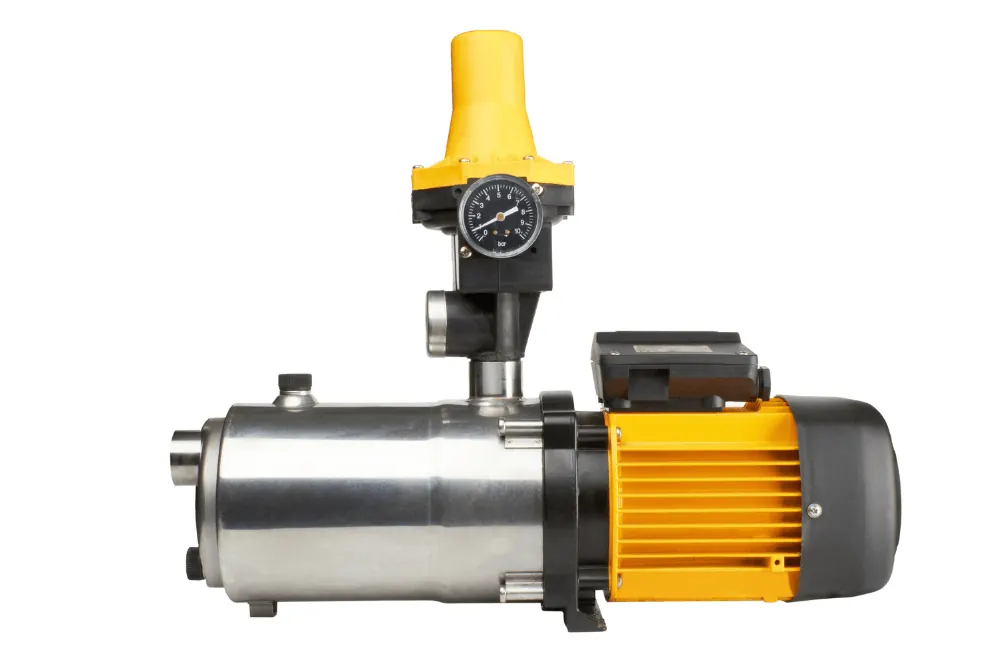
Booster pump installation in Dubai: do you need one?
A booster pump raises the pressure of water that is already in your pipes or in a tank. It solves one problem: pressure that is low because of the supply, the tank or the height of the building. It does nothing for a blocked aerator, a leak, a closed valve or a failing regulator.
A pump may be the right answer when:
- The gauge reads low all the time, and the cause is not a restriction. A booster on the main line is the right fix when incoming pressure is low all the time.
- You are on a top floor of a gravity-fed building, or a tank-fed villa where the tank cannot give enough pressure. See the gravity-head table on our low water pressure page.
- A new shower, a second bathroom or irrigation needs more pressure than the system gives.
- A water treatment unit, such as a reverse osmosis system, needs a minimum inlet pressure.
A pump is the wrong answer when:
- One or two fixtures are weak and the rest are fine.
- The meter moves with everything off, which points to a leak.
- The regulator is failing or set too low.
- A filter, valve or pipe is the restriction.
If you are not sure which applies, start with the diagnosis on our low water pressure page. This page is about the pump itself: the types, how we size one, how it is fitted, and how it is repaired.
Types of booster pump
Booster pumps differ in how they start, how they hold pressure and how many pumps share the work. The type depends on the property and how water is used.
| Type | How it works | Where it fits |
|---|---|---|
| Fixed-speed set with pressure vessel | A pressure switch starts the pump when pressure drops and stops it when pressure recovers. A vessel holds a small volume of water to smooth the cycles | Villas and flats where demand is steady and cost matters |
| Flow-switch (on-demand) pump | The pump starts when it senses flow, and stops when flow stops | Single-outlet or small supplies, such as a shower |
| Variable-speed (constant-pressure) set | A controller changes the motor speed to hold a set pressure as demand changes | Homes and buildings with changing demand and several outlets |
| Twin or multi-pump set | Two or more pumps share the load or take turns | Larger properties where a stopped pump cannot be allowed |
| Multi-stage pump | Several impellers in series build higher pressure | Higher elevations, longer pipe runs, or a bigger pressure gap |
| Small inlet booster for a treatment unit | A compact pump on the inlet of a filter or RO unit | Treatment equipment that needs a minimum inlet pressure |
How the pump is controlled
A pressure switch or sensor starts and stops the pump on pressure. A float switch in a tank stops the pump when the water level is too low. A set can use both: the pressure control for normal running and the float as protection.
Fixed speed or variable speed
A fixed-speed pump runs at full speed whenever it runs. It is simple and easy to repair, but it starts and stops as demand changes. A variable-speed set changes its motor speed to hold pressure, and it costs more and has electronics that need a specialist when they fail.
For a home with a few bathrooms and steady use, either can work. For a larger villa, a building or a property with irrigation and several outlets running at once, constant pressure is the more comfortable choice. We recommend after measuring.
What is in a booster set
Knowing the parts makes faults and quotes easier to follow.
- The pump and motor. The pump turns the motor's rotation into pressure through one or more impellers.
- The pressure switch or controller. It starts and stops the pump from pressure readings.
- The pressure vessel. A tank with an air-filled chamber separated from the water by a diaphragm. It absorbs small demands, so the pump does not start for every cup of water.
- Non-return valve. It stops water flowing backwards through the pump when it stops.
- Isolation valves. One on each side of the pump so it can be removed without draining the property.
- Pressure gauge. It shows what the pump is doing.
- Dry-run protection. A float, level or pressure sensor that stops the pump when there is no water to pump.
- Flexible connectors. They stop pump vibration passing into the pipework.
- Strainer. It catches debris on the suction side.
- Electrical protection. An isolator, overload protection and an RCD.
A set missing its non-return valve, vessel or dry-run protection will work for a while and fail early.
How we size a booster pump
A pump is chosen from two numbers: how much water the property needs at once, and how much pressure it has to add. Sizing from a guess is the most common reason a new pump disappoints.
Step 1: Flow, in litres per minute
Flow is the volume the pump must deliver. The difference: flow is the volume delivered in litres per minute, pressure is the force of delivery in bar, and both depend on the size and condition of the pipework.
- Measure the flow of the main fixtures with a bucket and a timer: fill 10 litres and divide by the time in minutes.
- Decide what runs at the same time. Two showers and a kitchen tap is a realistic peak for a family home. An irrigation zone running alongside adds to it.
- Add the flows of those fixtures. That is the flow the pump should deliver at the required pressure.
Step 2: Pressure, in bar
- Read the pressure at the point of use with a gauge when the system is under load.
- Decide the target. Most homes do best between about 2.8 and 4.1 bar.
- Subtract the current reading from the target to find the boost needed.
- Allow for height only if you read the gauge lower down. A reading taken at the outlet already includes the height. A reading taken at ground level needs about 0.1 bar added for each metre up to the highest outlet.
A worked example
A villa has a tank and a transfer pump. A gauge on the upstairs bathroom shows 1.2 bar with a shower running. The owner wants 3 bar at the shower.
- Flow: Measured flows are 10 litres a minute for each shower, 8 for a kitchen tap and 12 for a washing machine. The realistic peak is two showers and the kitchen tap together: 10 + 10 + 8 = 28 litres a minute.
- Pressure: 3.0 minus 1.2 is a boost of 1.8 bar at the shower. The 1.2 bar was read at the shower itself, so the height is already counted. Friction in the pipes grows with flow, so we allow some margin and look for a pump that gives a little over 1.8 bar at 30 litres a minute.
Pumps are rated by a flow and pressure pair, shown on a curve, not by one number. A home needs only a small part of what a large pump can deliver. The measurements in our example are invented to show the method, and yours will differ.
Things that change the answer
- Pipe size and length. Narrow or long pipes lose pressure to friction, so the pump has to overcome them.
- Suction conditions. A pump taking water from a tank below it behaves differently from one taking water from a pressurised main.
- The highest and furthest outlet. The pump has to satisfy the worst case, not the average.
- Future use. An extra bathroom or irrigation changes the flow.
Why oversizing is not safer
A pump much larger than the demand can push pressure past what the pipes and fittings need. A correctly sized pump gives the pressure you want without going over it.
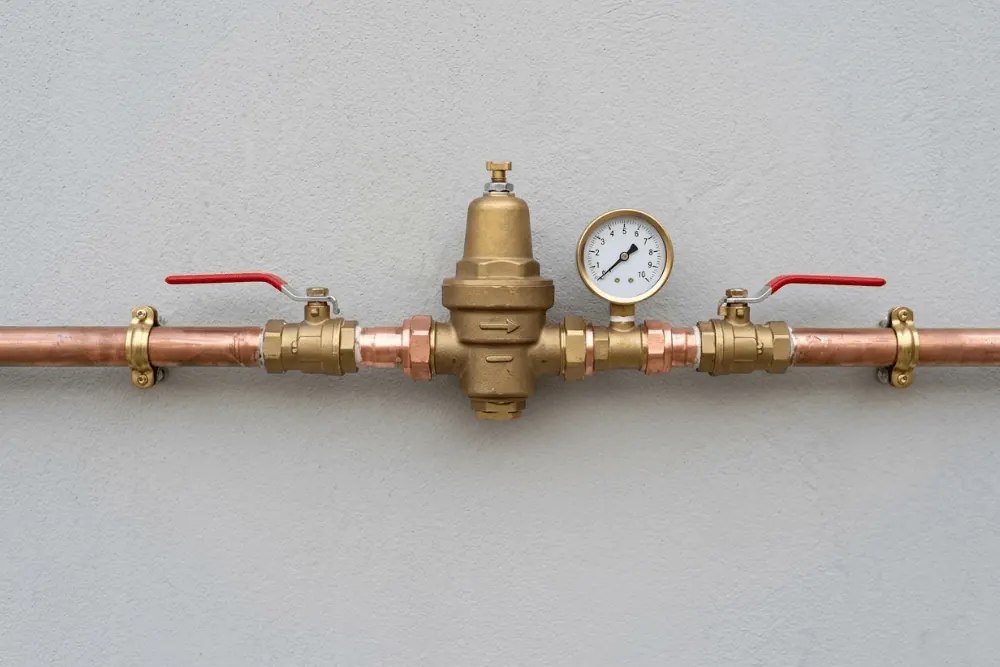
Booster pump installation: what we fit and how
A good installation is mostly about what goes around the pump. These are the points we cover on an installation.
Where the pump goes
- Close to the tank or supply, on a firm, level base. Poor installation, missing support and damp shorten a pump's life.
- In a space with ventilation, so the motor can shed heat.
- Dry, and clear of splashes, with room to service it.
- Away from bedrooms and living walls where possible, with a vibration pad or flexible connectors, because pumps hum and pass vibration into pipes.
- With enough room to remove the pump without taking the pipework apart.
The suction side
A pump pulls water in and pushes it out. Most pump problems start on the suction side.
- Short, straight, full-size suction pipe, as large as the pump inlet or larger.
- No air traps, which means the pipe rises steadily toward the pump and has no high spots.
- A strainer to catch debris before it reaches the impeller.
- Tight joints, because a suction leak draws in air, and air makes pumps noisy and weak.
- Tank outlet above the sediment layer, so the pump does not suck up debris.
The discharge side
- A non-return valve after the pump.
- An isolation valve on each side.
- A pressure gauge where it can be read.
- The pressure vessel, connected so that it sees system pressure.
- A flexible connector to cut vibration.
Dry-run protection
We fit the protection that suits your set: a float or level switch in the tank, or a pressure or flow sensor that stops the pump when there is no water. If you have an existing pump with none, adding it is a short job that can save the pump.
The electrical side
- A dedicated supply or a proper connection to an existing circuit with the capacity.
- An isolator within reach of the pump.
- Overload protection for the motor.
- An RCD on the circuit.
- Correct earthing.
We do the plumbing and tell you if the electrical side needs an electrician. Our own electricians make the electrical connection.
The tank, if there is one
For a tank-fed pump, we check the tank. The float valve should shut off at the right level, the outlet should be clear and the tank clean. A pump on a half-empty or dirty tank will under-perform or wear fast. See water tank installation and repair and water tank cleaning.
Flats and permissions
In a flat, check with building management before fitting a pump. Some buildings need approval, and some limit working hours and noise. Even where a pump boosts only your unit, tell management first. Tell us what your building asks for and we work to it.
Setting the pump up: commissioning
A pump that is fitted but not set up properly is half installed. These are the settings and checks that make the difference.
Pressure settings
- Cut-in pressure. The pressure at which the pump starts. It must be high enough to hold the target pressure at the highest outlet.
- Cut-out pressure. The pressure at which it stops. A cut-out set too high means the pump never reaches it and runs non-stop.
- Gap between the two. A very small gap makes the pump start and stop more often.
Vessel precharge
The air side of the pressure vessel is set with the system pressure released. A common rule is to charge the vessel about 0.2 bar below the cut-in pressure. The manual for your vessel will give the figure. A vessel with the wrong precharge makes the pump cycle.
Starts per hour
Starts should not exceed about 20 per hour. We run the pump, use water at a typical rate, and count the starts. More than that points to a vessel, a setting or a leak.
Run-on timer
On some sets a run-on timer keeps the pump running briefly after demand stops. We check it, and we leave the manufacturer's setting unless there is a reason to change it.
Pressure reducing valve interaction
If a pressure reducing valve is fitted after the pump, the pump's cut-in must be above the valve's set point. If it is not, the valve hunts and causes pressure fluctuations. We check the order of settings when a regulator is in the line.
Handover
We leave you with:
- The settings we chose.
- Readings at the highest outlet before and after.
- The location of the isolator and isolation valves.
- What the pump should sound like, and what is abnormal.
- A service interval.
Booster pump problems: symptoms, causes and fixes
A pump tells you what is wrong through the way it sounds and behaves. Match what you see to the table, and send us the details.
| What you notice | Likely cause | The fix |
|---|---|---|
| Pump starts and stops every few seconds (short cycling) | Vessel with wrong or lost air precharge, a ruptured vessel diaphragm, a leak, or a cut-in and cut-out too close together | Recharge or replace the vessel, find the leak, reset the pressure settings |
| Pump runs non-stop and never reaches pressure | Cut-out set too high, a leak, worn impeller, air in the suction pipe, or a blocked strainer or suction line | Reset the cut-out, find the leak, clear the suction, repair the pump |
| Pump hums but does not turn | A seized pump, a failed capacitor or a stuck impeller | Do not keep powering it. WhatsApp us |
| Pump does not start | No power, a tripped breaker or RCD, a failed pressure switch or controller, a float switch holding it off, or a burnt motor | Check power and protection, test the switch and float, repair or replace |
| Pump runs but flow is weak | Worn impeller, air lock, blocked strainer, a closed valve, or low water in the tank | Clear and prime, replace the worn part, fill the tank |
| Loud grinding or rattling | Worn bearings, a damaged impeller, or running dry | Stop the pump. Replace bearings or the pump |
| Whining or humming that is louder than before | Cavitation from a restricted suction, vibration from a loose base, or a worn bearing | Clear the suction, secure the base, replace the part |
| Water leaking from the pump body or shaft | A worn shaft seal, a loose joint, or a cracked housing | Replace the seal or joint, or the pump |
| Water dripping from the pressure vessel | A failed vessel or its connection | Replace the vessel |
| Pressure swings up and down | A failing controller or switch, a vessel problem, or a regulator hunting against the pump's settings | Test and replace the control, check the order of settings |
| Pump trips the breaker | A short in the motor, a damaged cable, water in the terminal box, or an overloaded motor | Do not reset repeatedly. WhatsApp us |
Why short cycling matters
A pump that starts and stops rapidly wears its motor, switch and seals far faster than one that runs for longer, steady periods. Starts should not exceed 20 per hour. If your pump is clicking on and off every few seconds when water is not being used, the cause points to the vessel, a leak or the settings.
Why a pump that runs dry is a problem
A pump that runs with no water in it overheats. Bearings and the shaft seal can be damaged. If the tank was empty and the pump kept running, the seal may now leak, even if the pump still works. We inspect for this before returning it to service.
Noise
A booster pump makes some noise, and it should be steady. A change in the sound is the warning. A new rattle, grind or high whine means stop and call. Possible causes are a worn bearing or a suction problem, and running on can make it worse.
Booster pump repair: what we repair and what we replace
We repair when the pump body and motor are sound.
| Part | What it does | Repair or replace |
|---|---|---|
| Pressure switch | Starts and stops the pump on pressure | Replace. Cheap and quick |
| Pressure vessel | Smooths the cycles | Recharge if the diaphragm is sound, replace if it has failed |
| Capacitor | Helps a single-phase motor start | Replace |
| Shaft seal | Keeps water from escaping along the shaft | Replace |
| Impeller | Creates the pressure | Replace if worn or damaged |
| Bearings | Support the shaft | Replace |
| Non-return valve | Stops backflow | Replace |
| Float or level switch | Protects against running dry | Replace |
| Controller or inverter | Runs a variable-speed set | Test, then replace or send for repair |
| Motor | Drives the pump | Rewind or replace if burnt |
| Whole pump | The complete unit | Replace when the repair costs near the price of a new pump, or parts are not available |
Motors can burn out, impellers can wear and pressure switches can fail, and early failure usually traces back to poor installation, undersized parts or moisture. When a pump fails young, we look at why before fitting a part, because a part fitted into the same fault fails again.
Repair or replace
| Situation | Repair or replace |
|---|---|
| Switch, capacitor, seal or vessel fault on a sound pump | Repair |
| Pump failed once, installed correctly, within its working life | Repair |
| Motor burnt out | Replace the motor or the pump, depending on cost |
| Housing cracked | Replace |
| Pump keeps failing from running dry, with no protection fitted | Repair and add protection |
| Pump undersized for the property | Replace with the right size |
| Parts for the model are no longer available | Replace |
| Noise or vibration from a worn pump of known age | Repair if the cost is low, replace if not |
We give you both prices on the day, so you can choose.
What happens on a repair visit
- We ask about the symptoms. What it sounds like, when it started, and what changed.
- We check the basics: power and protection, tank level, valves, strainer and suction side.
- We read the pressures at the pump and at an outlet, and count the starts.
- We check the vessel precharge, with the system pressure released.
- We tell you the cause and the price before we replace anything. The price is fixed before we start and changes only if you add work.
- We repair or replace, and set the pressures.
- We test under load and leave you the readings.
Pumps in villas, flats and commercial buildings
Who owns the pump, and who is responsible for it, changes with the property.
Villas
A villa pump is yours. It may sit between a tank and the taps, or on the supply to an upper floor, the garden or irrigation. Because the pump is yours, so is its protection and servicing. Check:
- The tank's float valve and level. A pump that runs dry is the common reason a villa pump fails.
- Irrigation and garden taps on the same pump, which can change the flow it needs.
- The pump's position and shelter. An outdoor pump needs a cover that keeps off water and shade for the motor.
- A leak on the line. A pump feeding a leaking line runs more and wears faster. See leak detection.
Flats with their own pump
Some flats have a pump serving only that unit. It still lives in a building, so check with management before fitting or changing it. The pump must be dry, ventilated and quiet enough for the neighbours.
Building booster sets
A building may have a shared booster set that serves all the units. A fault in a building set affects everyone. You report it to building management, who call their contractor. We can inspect the unit's side and give you a written note that your pipework and fixtures are sound, which helps management locate the fault.
If your building has a booster set and your unit's pressure is still low, ask management for the pump's recent service record before buying a pump of your own.
Booster sets for shops, offices and restaurants
Commercial premises depend on steady water. A booster pump stopping means no water at the basins, the kitchen or the toilets.
- Twin sets keep one pump running while the other is repaired.
- Constant-pressure sets suit changing demand, such as lunch service.
- Regular checks. A plumbing maintenance contract can schedule them, and a dated record shows a slow decline. We offer maintenance contracts priced per building. Ask for a quote on WhatsApp.
- Out-of-hours work is possible where the business cannot lose water in opening hours.
Looking after a booster pump
Pumps run unattended, so a simple routine keeps them healthy.
| How often | What to check |
|---|---|
| Every week or two | Listen for any change in sound. Look for drips and damp under and around the pump |
| Every month | Read the gauge. Note the cut-in and cut-out pressures and the time between starts |
| Every few months | Clean the strainer. Check the tank float, level and cleanliness if there is a tank |
| Every year | Have the vessel precharge checked, the non-return valve and dry-run protection tested, the seals and bearings inspected, and electrical connections checked |
The intervals are our advice. Your pump manual may give its own, and where it does, follow it.
Keep a note of the gauge readings when the pump is healthy, so you have something to compare against later. A shift in cut-in or cut-out, or in the time between starts, is an early warning.
What not to do
- Do not run the pump dry. If the tank is empty or the suction is blocked, switch it off.
- Do not keep resetting a tripped breaker. It is telling you something is wrong.
- Do not open the electrical box to look. Water and mains do not mix.
- Do not raise the pressure setting to chase more pressure. You may push the system past what the pipes and fittings tolerate.
- Do not fit a bigger pump without measuring the flow and the pipework.
- Do not ignore a new noise. It is the cheapest warning you will get.
- Do not cut out the non-return valve or the float to save money.
- Do not leave a leak. A pump feeding a leak runs constantly and wears out.
How much does a booster pump cost in Dubai?
We quote the price before we start. The cost depends on what is needed.
- Type and size of pump. A single fixed-speed pump costs less than a twin variable-speed set.
- The brand and the availability of parts.
- Pipework. New suction and discharge pipe, valves and a vessel add to the job.
- Electrical work. A new circuit, isolator or RCD.
- Access. A pump room, a roof or a tight cupboard takes longer.
- Tank work. A new float valve or cleaning, if needed for a reliable supply.
- For a repair: the parts, and how many are needed.
We do not publish a starting price for this job. Send a photo on WhatsApp and we give you a fixed price before we start. Prices exclude 5% VAT.
Where we install and repair booster pumps in Dubai
We cover all of Dubai, including Dubai Marina, JBR, Downtown Dubai, Business Bay, Jumeirah Lakes Towers, Palm Jumeirah, Al Barsha, Jumeirah Village Circle, Dubai Hills, Mirdif, Deira and Al Quoz. See the full list of areas.
Booster pump FAQs
Do I need a booster pump?
Only if the pressure is low all the time and the cause is not a leak, a closed valve, a blocked fixture or a failing regulator. We measure first. A top floor on a gravity feed, or a tank-fed villa that cannot reach the pressure you want, are the usual real cases.
What size booster pump do I need?
The size follows from two numbers: the flow you need at the same time and the pressure you have to add. We measure the flow of your main fixtures, decide what runs together, and read the pressure at the outlet. Then we choose a pump whose curve delivers that flow at that pressure.
Why does my booster pump keep starting and stopping?
The pressure vessel may have lost its air charge, or its diaphragm may have failed, or there is a leak, or the cut-in and cut-out are set too close. Starts should not exceed 20 per hour.
Why is my booster pump running all the time?
The cut-out may be set higher than the pump can reach, there may be a leak, the impeller may be worn, or air may be in the suction line. Switch it off if the tank is empty, and WhatsApp us.
Why is my booster pump so noisy?
A new grinding or rattling noise can mean worn bearings. A whine can mean a restricted suction or a loose base. Stop the pump if the noise is new and loud.
How long does a booster pump last?
There is no fixed life, because the pump, the installation and the use all count. Pumps that run dry, cycle constantly or sit in damp, unventilated spaces fail earlier.
Can I install a booster pump myself?
The plumbing is straightforward for someone experienced, but the sizing, the protection and the electrical connection matter. A wrongly sized or unprotected pump can fail within months. In a flat, check with management first.
Does a booster pump increase my water bill?
It uses electricity to run. It does not add water to your supply, but a leak on the line loses more water at higher pressure, so fix leaks before you fit a pump.
Do you repair pumps you did not install?
Yes. Tell us the make and model from the nameplate, and send a photo.
What does the warranty cover on a booster pump?
Our installation labour carries a 30-day workmanship warranty. The pump, the controller and the vessel carry the manufacturer's warranty only, and a pump that ran dry or was run with a bridged switch may not be covered by it. We keep the model and serial number on your handover record.
Book a booster pump installation or repair in Dubai
Tell us what the pressure is doing and what pump you have, if any. Send a photo of the pump and its nameplate. We will send a plumber to measure, size and fit it, or to find the fault.
WhatsApp: +971 55 407 7427 · Request a quote
Visit us: Office 871, Oasis Mall, Al Quoz 1, Dubai, UAE
Related services: Low water pressure fix · Water tank installation and repair · Water tank cleaning · Pressure reducing valves · Leak detection · Emergency plumber