
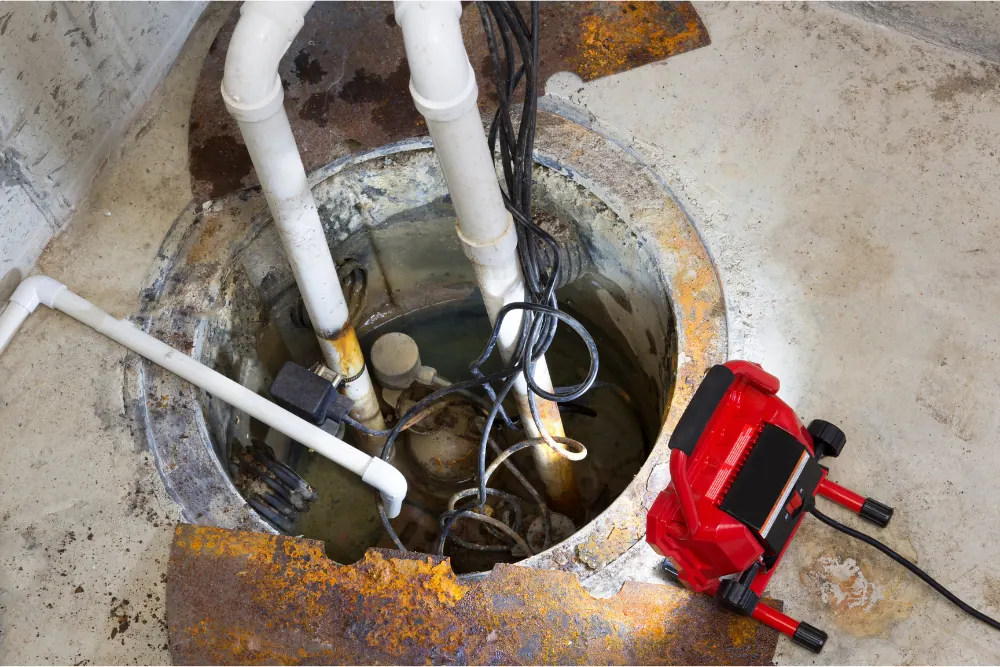
Submersible pump repair in Dubai: what we do
- Diagnosing a pump that will not start, trips its overload, runs without delivering water, or cycles on and off, from the surface first and from the pit or borehole second.
- Testing the motor and cable, including insulation resistance to earth, winding resistance and the supply voltage at the starter. Our own electricians handle the electrical side.
- Replacing a float switch, check valve, impeller, seal, cable joint or controller where the pump can be repaired, and a whole pump where it cannot.
- Sizing a replacement pump from the flow and head the job needs, and reading the pump curve with you.
- Sump and drainage pumps in basements, car park pits and plant rooms, and sewage pumps in lift-station chambers.
- Borehole pumps, including pulling and refitting the pump on its pipe and cable, and telling you who to ask before any work that touches the well.
- A written note of the readings, what was changed and what was tested.
- Emergency visits. We answer calls and send a plumber 24 hours a day, 7 days a week, and we do not promise an arrival time.
Neighbouring topics have their own pages. Surface booster pumps, pressure vessels and short cycling are on booster pump installation and repair, and the tank, its float valve and the transfer pump's switches are on water tank installation and water tank cleaning. Septic tanks and treatment plants are on septic tank and STP, the sewer gas hazard on sewer line repair, and gullies and chambers on manhole and gully. Leaks and the meter test are on leak detection, and isolating and non-return valves on valve repair and replacement. We repeat none of that here, and this page is about the pump that sits below the water.
Which part is at fault? A decision guide
| What you see | Suspect first | Section |
|---|---|---|
| The pump does not start and the starter or control box is dead | Supply, fuse or breaker, control box, then cable or motor | Faults and diagnosis |
| The pump hums or starts and the overload trips | A bound pump from sand or misalignment, a motor or cable fault, low or high voltage | Faults and diagnosis |
| The pump runs but delivers little or no water | Low water level, a blocked intake screen, worn pump parts, a stuck check valve | Faults and diagnosis |
| The pump starts too often | Pressure switch, check valve, a leak in the system, a pressure tank with the wrong air charge | Faults and diagnosis |
| A sump pump runs and the pit stays full, or the pit never empties | Float switch stuck, check valve stuck, a blocked discharge line, an undersized pump | Basement sumps |
| A sewage pump keeps blocking | Rags and wipes knitting together, or the wrong impeller type for the waste | Sewage pumps |
| The water from a borehole is cloudy or sandy | Sand or silt in the borehole, which can also bind the pump | Faults and diagnosis |
| A tank pump runs dry or does not stop | The float switches in the tank | Tank transfer pumps |
| The pump works but you want to change or deepen the well | Approval from whoever governs the property comes first | Borehole approvals |
Pump types and how they work
A submersible pump is a pump and its motor in one sealed unit that sits in the liquid. Its motor is in a sealed, waterproof casing. The unit is lowered on a rope or a chain with a discharge pipe above it, and a cable carries the power. The kinds below are the ones we are asked to repair.
| Type | What it moves | What to know |
|---|---|---|
| Borehole pump | Clean groundwater from a well | A long, narrow multistage unit that hangs on its pipe below the water level. Pulling it is a lifting job |
| Sump or drainage pump | Clean or dirty water from a pit | Switched by a float, and fitted with a check valve in the discharge |
| Sewage pump | Wastewater with soft solids | A standard sewage pump passes soft solids without cutting them |
| Grinder pump | Wastewater with solids that are cut up | Grinds solids to a slurry that goes through small pipe |
| Tank transfer pump | Water from one tank to another or to a header | See the tank pages. Selection and the float switches are on water tank installation |
The parts you will hear about
- The motor and its casing. The motor is sealed, and its lead assembly has to be undamaged and the shaft free to turn.
- The cable. It is tied to the discharge pipe at regular intervals, and sealed against water. Hanging a pump by its cable puts stress on it and can cause a short circuit.
- The rope or chain. The suspension rope goes on the pump's mounts or eyes. The weight is on the rope, not the cable.
- The check valve. Fitted in the discharge pipe if the pump does not have one built in.
- The controller or control box. Smaller two-wire motors have the starting components inside and connect to the pressure switch, and three-wire motors need an external control box.
- Dry-run protection. Some pumps include it with a control unit.
Sizing: flow, head and the pump curve
A pump is chosen by two numbers and a graph. Flow is the volume per minute or per hour the job needs. Head is the height the pump must lift the water plus the resistance of the pipe. The curve is the manufacturer's graph of how the two trade against each other for one pump.
The vertical axis of the curve is head in metres and the horizontal axis is flow in litres per minute. Where the flow is zero is the shut-off head, and where the head is zero is the maximum flow. Total head is the vertical lift plus the friction losses in the pipe, hose and fittings, and every bend and valve adds a little. To find the duty point, work out the total head, move across to the curve, and drop down to read the flow.
Two points decide a purchase:
- Read the curve, not the headline. A pump sold on its maximum flow delivers less than that at any real head, because the curve falls.
- Count the friction. A long, narrow or bent run costs head, and a larger pipe is often cheaper than a bigger pump.
The rest of the sizing is local. The depth of the water, the length and size of the discharge pipe, the height to the tank or the drain, and the daily volume come from your site. In a borehole, the daily volume can also meet a limit set by the approvals that apply to the well (covered below). We take the duty point from the pump curve on the pump's own datasheet and give you the duty point in writing. We do not size from the horsepower on a label.
Installation depth, cooling flow and dry running
Where a pump sits decides how long it lives.
- Clear of the bottom. Know the exact depth of the borehole first, and hang the pump well above the bottom, so it does not draw in sand and silt and is never lowered onto the bottom.
- Full of water before it starts. Let the pump fill with water, then connect power, then run a test and check flow, pressure and the clarity of the water in a clear glass.
- Water moving past the motor. The motor is cooled by water flowing past it, and the maker states a minimum flow past the motor. A flow sleeve is fitted when the flow is insufficient, in open water, in rock wells, in top-feeding wells and when the motor is set in the screen.
- Starts. Motors have limits on starts per day and a minimum run time to dissipate starting heat, and larger motors need longer between starts. The pump's own datasheet states them, and we check the controls against them.
- Thrust. The motors are designed primarily for shaft-up operation. Upthrust is acceptable for short periods at each start, and continuous upthrust wears the thrust bearing.
Dry running and drawdown
A submersible is cooled by the water around it, so a pump that is not covered has no way to shed heat. Dry running can destroy the motor, and dry-run protection is worth fitting. The pump runs, the level falls, the pump uncovers, and the motor overheats, so a motor that has run dry may need replacing, and the level in the well needs attention as well.
Drawdown is the fall in water level while the pump runs. The level has to be measured while the pump is running and again once it has rested, because a reading taken before the pump starts says nothing about where the water will stand after an hour.
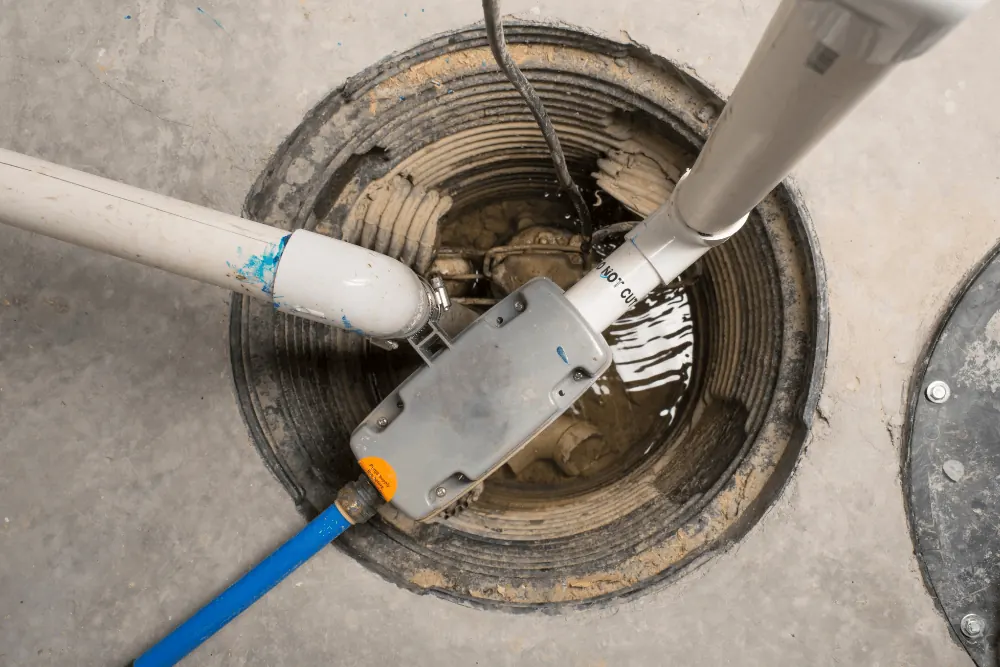
Faults and diagnosis
| Symptom | What to know | Check first |
|---|---|---|
| The motor does not start | A defective cable, motor, control box or wiring | Supply voltage at the starter, then the control box, then the cable and motor by measurement |
| The motor starts too often | Pressure switch, check valve, tank air charge, leaks | The pressure switch setting, the check valve, the tank's air charge and the pipework for leaks |
| The pump runs continuously | Welded switch contacts, low well level, worn pump parts, a blocked intake screen, a stuck check valve | The level in the well, the screen, the check valve and the switch contacts |
| The overload trips | A bound pump, a motor or cable fault, wrong voltage | Voltage, then current against the nameplate, then insulation resistance |
| Little or no water at the tap | Worn pump parts, low level, a blocked intake, a stuck valve | The flow against the pump curve and the level in the well |
Two measurements narrow the cause quickly.
- Voltage. The supply should be close to the nameplate. A supply that is well off can damage the windings, and the pump should not run until the supply is corrected.
- Current. If the current is above the nameplate, or the legs of a three-phase supply draw unevenly, the breaker contacts, terminals and cable are checked and the winding and insulation resistance measured again.
Testing the motor and the cable
The tests need the pump isolated and are work for a qualified person. Our electricians do them.
| Test | Instrument | What the reading says |
|---|---|---|
| Insulation resistance | A megohmmeter, from each lead to earth | A gradual fall as the cable enters water is expected. A sudden drop points to cable, splice or motor lead damage |
| Winding resistance | An ohmmeter or megohmmeter on a low scale, between the leads | A low reading on any lead means the motor may be shorted. A high reading means a poor cable joint or an open winding. Mixed readings mean the leads may be mixed up. Normal readings with the colours correct mean the windings are not damaged |
We record the reading, the instrument's test voltage and whether the cable was attached, and compare it with the pump maker's datasheet.
Other failures
- A damaged cable or joint. Poor sealing of the cable lets water into the lead and causes leaks.
- A blocked intake screen or a clogged borehole. A borehole needs cleaning from time to time, and at once if it is clogged.
- A stuck check valve. Swing-type check valves are generally poor choices on a submersible discharge. A spring-loaded type is used instead.
Lifting and testing a pump safely
- Isolate before testing. Turn off the power and disconnect the drop cable leads in the control box or starter before any insulation test. The pump is isolated at the supply before it is lifted, and the isolation is kept in place by the person doing the work.
- Lift on the rope, not the cable. The pump hangs on a rope or chain from its eyes. Suspending it by its cable causes stress and can cause a short circuit.
- Run it only in water. Dry running can destroy the motor. Any test run is done with the pump covered by water.
- Use a contactor on a three-phase pump. It is connected through a contactor, wired by our electricians.
- Test the sump by pouring. Pour water slowly into the pit, confirm that the switch starts the pump, watch the level drop, listen for a clean shutoff and confirm that water leaves through the discharge line. Fit a union above the check valve so the valve can be removed.
- Do not enter a pit or chamber. A pump in a sewage chamber is lifted on its chain from the surface, and no one climbs in to free it.
Borehole approvals in Dubai
A borehole is not an ordinary part of a building, and the pump is part of what is controlled. A well can have limits on how much water may be taken, on its depth and on its equipment, and drilling, deepening or changing one is not something to do on your own say-so. This is general information, not legal advice. The points that touch a pump job:
| Point | What to know |
|---|---|
| Approval before changes | Drilling, deepening or changing a well and its equipment needs approval from whoever governs the property. Ask the landlord, the community or building management first, and ask what approvals exist for the well |
| What the approval may state | The location, depth, purpose, a daily limit on extraction, and the pump and meter specifications |
| Meter | Where a meter is required, its reading is the record of what is extracted |
| Water quality | A well can have salinity or contamination problems, and a water test tells you what the pump is lifting |
What this means for a pump job: replacing a pump with a different rating changes what the well is set up for, so ask before you buy it, and tell us what your property asks for and we work to it.
Salinity matters for a pump job because salty water attacks pump parts and pipes, and a water test tells you what the pump is lifting. See water quality testing.
Basement sumps, car park pits and floods
Basement and car park pits fill in heavy rain and after pipe bursts, and the sump pump is what keeps them dry.
- What a sump pump is for. It lifts water from a pit to a discharge point. Ejector systems use a sealed holding tank and vent pipes to direct gases outside. A sump pump lasts longer with testing and a clean pit, and less where grit or debris gets in.
- Testing. Pour water into the pit a few times a year, and confirm the pump starts and empties it. Testing matters more than which design you own.
- Where the discharge goes in Dubai. Pumping to a street gully or a drain needs a written answer first. Clean rainwater and wastewater go to different networks, and wastewater must never be pumped to the rainwater side. A landlord, building management or the master developer holds the drainage layout.
Sewage pumps and non-clog impellers
A sewage pump moves waste, so the impeller and the passage matter more than they do for clean water.
| Kind | What to know |
|---|---|
| Standard sewage pump | A wide free passage with no cutting. It passes soft solids |
| Grinder pump | Grinds solids to a slurry that goes through smaller pipe |
Free passage differs between makers, so read the datasheet for the pump you have. A pump that blocks repeatedly with the same material points to the waste, the impeller type or the pit design, and the answer is to find which before replacing the pump.
For the sewer side, see sewer line repair and septic tank and STP.
Tank transfer pumps
A submersible in a tank pumps clean water from one tank to another or to a header. The float switches, the tank layout and the transfer pump's control are on water tank installation, and cleaning is on water tank cleaning. For the pressure side after the tank, see booster pump installation and repair. Such a pump sits in water that someone will drink or wash with, so its repair and removal belong with the tank's cleaning and are not a stand-alone job.
Maintenance schedule
- Boreholes. Have the borehole and screen checked from time to time, and at once if the water turns sandy or the flow drops.
- Backup power. Test a backup battery if the pit has one, and have an ejector pump inspected by a professional once a year.
- Float switches and check valves. Test them a few times a year in a sump by pouring water into the pit.
We write the intervals that apply to your pump on the handover note.
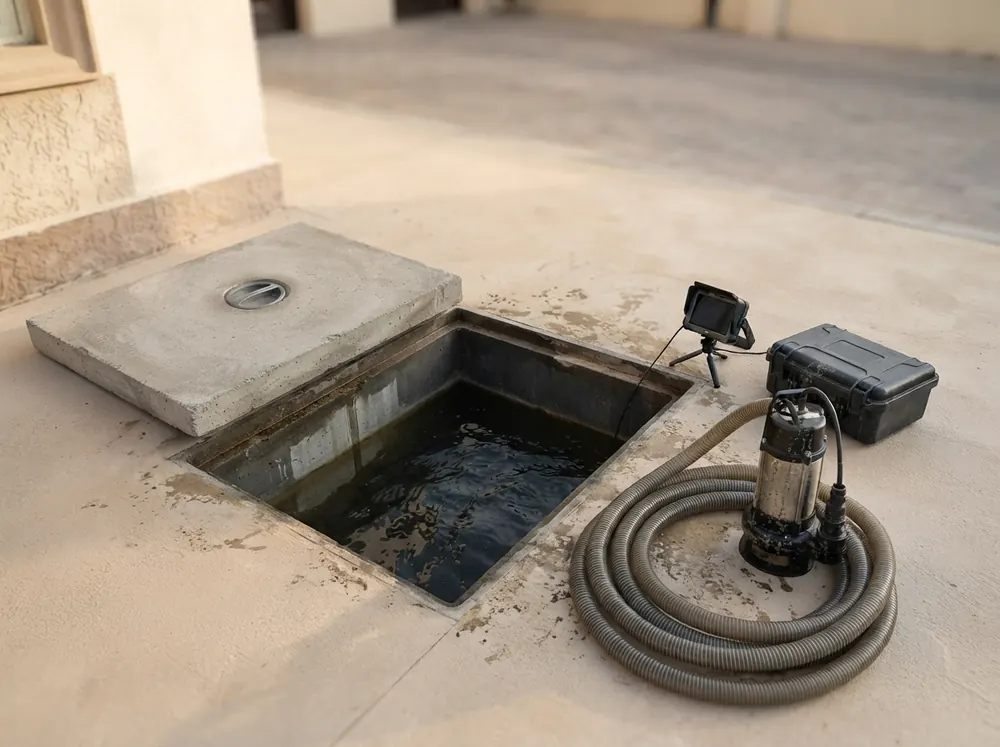
Permission in Dubai: landlord and building
Cleaning a float switch or replacing a pump with the same unit in a sump is maintenance. A new pump, a new discharge route, a change to a well or a trench for a cable is a change to the property, and a borehole needs more care. This is general information, not legal advice. Where a pump job falls:
| Job | Starting point |
|---|---|
| Replacing a failed sump or sewage pump with the same rating | Maintenance. Tell the landlord, and tell the building's facility management if the pit is in a common area |
| A larger pump, a new discharge line or a new route for the water | A change to the property. Written consent from the landlord, and building management or the master developer. Where the water goes is also a question for the drainage layout |
| A borehole pump, a new well, or any change to a well or its equipment | Ask the landlord and the community or building management first, and ask what approvals exist for the well |
We cannot say whether your building needs a certificate for a particular job. Building management can, and a request in writing is cheaper than a stopped job. Tell us what your building asks for and we work to it.
Warranty and the handover
What you should have when the job is finished:
- A written note: which part failed, what was replaced, and the make, model and serial number of the pump, motor, float switch, check valve and controller.
- The readings. Supply voltage, running current against the nameplate, and insulation resistance with the instrument's test voltage and whether the cable was attached.
- The setting. The depth the pump hangs at, the float switch levels, the check valve position and the discharge route.
- The curve. The pump's datasheet and the duty point it was chosen for, in litres per minute and metres of head.
- Before and after photographs of the pit or wellhead, the pump, the cable and any removed part.
- The removed part, shown to you or kept for you if you ask.
- For a borehole, the well record. The note gives you the pump details and readings to keep with the well's records.
- The intervals for the next inspection or test.
- FAM's workmanship warranty, in writing. The warranty runs for 30 days and covers our labour only. Parts carry the manufacturer's warranty only.
How we work
- You tell us what is happening on WhatsApp: what type of pump, where it sits, what it does when switched on, when it started, and whether you own, rent or manage the property. A photograph of the pump label, the control box and the pit or wellhead saves a visit.
- We visit with the supply isolated and check the supply voltage, the control box, the float switch, the discharge line, the check valve and the cable, and the level in the pit or well. The visit fee is AED 50 + VAT, credited if the work goes ahead.
- We measure before we propose a fix, and tell you which part failed and which measurements showed it. A pump that has to come out of a borehole or a sewage pit is lifted only after the cause is narrowed.
- We give options and a price in writing: a repair, a replacement pump with its curve, or a change to the controls, with what each leaves untouched.
- Check permission. In a rented or managed property, ask the landlord or building management whether they need to approve this work before the visit.
- We make the repair, protect the surfaces and keep the area dry.
- We test and hand over the readings, the settings, the photographs and the part details, with a revisit date where the cause needed one.
Where we work in Dubai
We cover all of Dubai, including Dubai Marina, JBR, Downtown Dubai, Business Bay, Jumeirah Lakes Towers, Palm Jumeirah, Al Barsha, Jumeirah Village Circle, Dubai Hills, Mirdif, Deira and Al Quoz. See the full list of areas.
Cable, joints and the control panel
The cable is the part that fails quietly. A submersible pump hangs on its own cable, and the cable runs through water, past sharp edges and through a joint to the supply. We check three things at every visit. The first is the cable itself: nicks, kinks or a hard, cracked sheath mean water can reach the copper, and a damaged cable is replaced and not taped. The second is every joint under water, which has to be made with a proper waterproof kit and not insulation tape. The third is the panel on the surface, with the overload protection set for the pump's own rating and the earth connection tight. A pump is never lifted or lowered by its cable, because that pulls on the joint at the pump. Our own electricians test the insulation of the cable and the motor before a pump is put back in the water, since a motor that has taken water can trip a breaker or give a shock.
How much does submersible pump repair cost in Dubai?
The price depends on the pump and the job, and no two pits or wells are alike.
What sets the price on a pump job
- The fault. A float switch, a check valve, a cable joint, a seal, an impeller or a whole pump are different jobs at different prices.
- The pump. Type, power, flow and head, and the brand, if a replacement is needed.
- Depth and access. A borehole pump on a long pipe takes more lifting than a sump pump in a shallow pit.
- Electrical work. Testing, the starter, the control box and the cable.
- Approvals. A borehole may carry approvals and fees from the property or community.
- Safety. Confined-space precautions around a sewage chamber.
We do not publish a starting price for this job. Send a photo on WhatsApp and we give you a fixed price before we start. Prices exclude 5% VAT.
Submersible pump FAQs
Why does my submersible pump run but deliver little or no water?
Start with the water level and the screen, then the check valve, then worn pump parts. A pump that runs dry can be damaged, so we do not run it uncovered to test it.
Why does the pump trip its overload?
A bound pump, a motor or cable fault, or the wrong voltage. We measure voltage and current before we pull the pump.
Can a sump pump handle sewage?
Not a clean-water sump pump. Sewage, cutter and grinder pumps are built differently for solids. See the sewage section above.
How do I test a submersible motor?
With the supply isolated and the leads disconnected at the control box, a megohmmeter is connected from each lead to earth, and the winding resistance is measured with an ohmmeter. It is work for a qualified person, and our electricians do it.
Do I need approval to repair or replace a borehole pump in Dubai?
Possibly. A well can have approvals that state its pump and daily limit, so a like-for-like repair is one thing and a different rating is another. Ask the landlord or community first and tell us what they say.
Where can I pump basement or car park water to in Dubai?
Not to a drain you have not checked. Clean water and wastewater go to different networks, and wastewater must never go to the rainwater side. Get a written answer from building management or the master developer before you point a discharge line at a gully.
How long does a submersible pump last?
It depends on the water, how often it starts, whether it runs dry and the supply voltage. A pump that trips, loses flow or starts and stops often should be pulled and checked. Keep the water level above the pump at all times.
Who pays if a pump fails in a rented property?
It depends on your contract. By default the landlord maintains the building's systems unless the contract says otherwise. Tell the landlord in writing before the work. This is not legal advice.
How much does submersible pump repair cost in Dubai?
We give a fixed price on WhatsApp after we find the fault, with the options. Prices exclude 5% VAT.
Book submersible pump repair in Dubai
Tell us what type of pump it is, where it sits, what it does when switched on, when it started and whether you own or rent. Photographs of the pump label, the control box and the pit or wellhead help. If the pump has stopped and a pit is filling, isolate the supply to the pump and call. We will measure before we pull anything, give you the options and a price in writing, make the repair, and hand over a note with the readings.
WhatsApp: +971 55 407 7427 · Request a quote
Visit us: Office 871, Oasis Mall, Al Quoz 1, Dubai, UAE
Related services: Booster pump · Low water pressure · Water tank installation · Water tank cleaning · Septic tank and STP · Sewer line repair · Manhole and gully · Valve repair and replacement · Leak detection