
Cistern and flush repair in Dubai: what we do
- Replacing fill valves and flush valves in visible and concealed cisterns, matched to the cistern's make and model.
- Repairing the flush button, plate and linkage: the rod, cable or air tube between the plate and the valve, and the plate itself.
- Setting the water level and the flush volume where the valve has an adjustment.
- Diagnosing a cistern that is loud, sweats, refills by itself, or flushes weakly, and saying which of the three mechanisms is at fault.
- Replacing a cracked or worn cistern, or the whole toilet where the parts cannot be matched.
- Opening a service access in a concealed-cistern wall where the plate opening is too small, subject to the building's approval. Our own team does the civil work and the finish.
- A written note of what was found, the make and model of each part fitted, and the test result.
- Emergency visits. We answer calls and send a plumber 24 hours a day, 7 days a week, and we do not promise an arrival time.
Neighbouring topics have their own pages. The causes of a running toilet, the dye test, base leaks and loose pans are on toilet repair, new and replacement toilets and flush volumes on toilet installation, blocked bowls on toilet unblocking, sprays and shattaf hoses on bidet and health faucet fitting, and urinals and squat pans on urinal. Drinking-water backflow into a supply pipe is on backflow prevention. We repeat none of that here, and this page goes into the parts inside the cistern and behind the plate.
Which mechanism is at fault? A decision guide
The right-hand column sends you to the section on that part. If you have not yet confirmed that the cistern leaks into the bowl, the dye test on the toilet repair page does it.
| What you notice | Mechanism to suspect | Section |
|---|---|---|
| The button is loose, rattles, or moves and nothing flushes | The actuator: rod, cable or air tube | Flush actuators |
| The flush starts and stops early, or a half flush does not clear | The flush valve, its seat or its volume setting | Flush valves |
| Water trickles into the bowl after the flush has finished | The flush valve seal, which is worn, dirty or scaled | Flush valves |
| The cistern fills too high, too low, slowly, or with a hiss | The fill valve and its level setting | Fill valves |
| A loud refill | The fill valve type or the supply pressure | Noise |
| The outside of the cistern is wet all over and the dye test is clear | Condensation | Condensation |
| A part will not come out through the plate opening | Access | Flush plate and service opening |
| A replacement part does not fit | Identification | Matching parts |
Cistern types and what each asks of a repair
The cistern's position decides how the flush water reaches the pan, and how easily a part can be reached.
| Type | Where it sits | What it means for a repair |
|---|---|---|
| High-level | Mounted high on the wall, with a pipe down to the pan | Old style. The parts are reached from above, and a chain or a lever works the flush |
| Low-level | On the wall just above the pan, with a short pipe | The lid lifts off, and the parts are in plain view |
| Close-coupled | Bolted straight onto the back of the pan | The most common visible type. The lid lifts off. Replacing the whole cistern means lifting it off the pan, with a new seal and bolts |
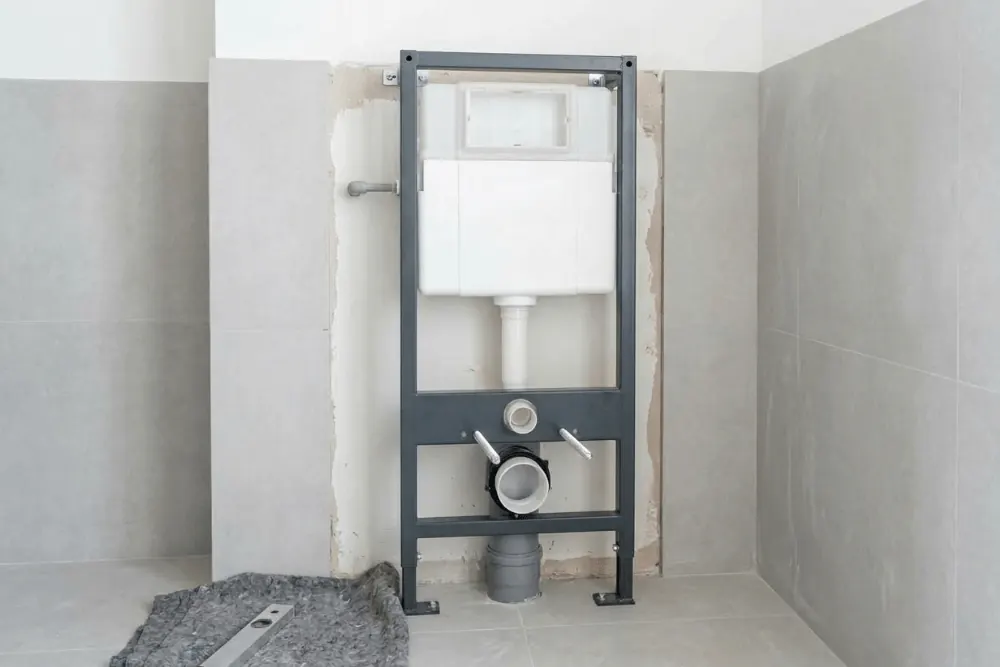
| Concealed | Inside the wall or a frame, with only a flush plate showing | The parts are reached through the plate opening, which limits what can be fitted. Common in Dubai flats and hotels |
| Back-to-wall with a hidden cistern | A pan against a panel, cistern behind it | As concealed, with a service panel or plate for access |
Concealed cisterns are common in Dubai apartments and fit-outs, and they are the case where a small repair can become a big one if the opening is too small for the new part. We deal with that in the access section below.
Flush valve designs: flapper, drop valve, dual flush
The flush valve is the seal at the bottom of the cistern. It lifts to release the water, and it must close tightly afterwards.
| Design | How it works | What fails |
|---|---|---|
| Flapper | A rubber flap hinged at the overflow tube lifts and falls back | The rubber hardens or warps and stops sealing, or the chain is too tight or too slack |
| Drop valve (canister) | A cylinder lifts up around the overflow tube | The base seal wears, or the cylinder sticks on scale |
| Siphon | Water is drawn out through a diaphragm and a bell | The diaphragm splits, which gives a weak flush that does not complete |
| Dual flush | Two buttons or two press depths give a full or a part flush | A valve with two outlets to seal has two places to leak, so a dual-flush cistern that trickles is a reason to check the valve before the fill valve |
Dual-flush volumes
A dual-flush valve has a full flush and a part flush, and many valves let the volumes be adjusted inside a range. We do not choose a volume for you. The pair in your cistern is on its data sheet or the valve body, and the volume that matters is the one the valve is set to, so we check it and record it when we leave. A cistern that now flushes weakly may have had its part-flush volume turned down, or its valve worn, and we tell you which. We do not claim a saving for a particular setting. Fitting a modern valve in an old cistern can cut the water used per flush, and we say plainly when a swap saves little.
Fill valves: types, level settings and what each one fails at
The fill valve refills the cistern after a flush and shuts off at a set level.
| Fill valve | What to know | Faults to expect |
|---|---|---|
| Float-arm (ball) valve | An arm with a float ball lifts and closes the inlet | The arm bends, the washer wears, the ball fills with water and sinks, so the level creeps up and the overflow runs |
| Cylinder float valve | A float slides up and down the valve body | The float sticks on scale, or the seal wears |
| Diaphragm valve | A rubber diaphragm opens and closes the inlet | The diaphragm hardens or tears, which gives a trickle or a failure to shut |
| Side-entry and bottom-entry | The same valves, with the inlet on the side or below the cistern | The entry affects only the pipework and the access under the cistern |
A running cistern that never stops means the valve is not shutting, which is cured by resetting the float, cleaning the seat or replacing a worn seal or diaphragm. A slow refill means a partly closed isolating valve, a blocked inlet filter or limescale, and the cure is to clean, or replace the valve.
The water level
The overflow pipe is the cistern's safety exit, and the water must stop below its top edge with a margin.
- The water level mark is on the valve body or the cistern wall, and the maker's instruction sets the figure.
- Where there is no mark, we set the level clearly below the top of the overflow, and no lower than the flush needs.
- A level that sits against the overflow lip means the valve is not shutting or is set too high.
Each cistern is different, so we set the level by the mark and test it, and we record the level we set.
Dubai context
Supply pressure in a Dubai building varies, from a roof tank feeding the top floors to a booster set feeding the lower ones. A fill valve that is quiet and correct at one pressure can hiss or shut off slowly at another, and a valve rated for a narrow pressure range may not suit a building with swings. So we ask where you live and, where it matters, we measure the pressure at the cistern inlet before we choose the valve.
Air gaps and backflow at the cistern inlet
A cistern is filled from the drinking-water supply, and water in a cistern should never be able to return to it. The principle is an air gap: the inlet of the fill valve discharges above the water level in the cistern, with open air between the two, so that if the supply pressure falls, water cannot be drawn back from the cistern into the pipes.
What that means for a fill valve swap:
- The valve outlet must sit above the highest water level. A fill valve that is lowered into the water, or one with a hose that ends below the surface, is a backflow route.
- The overflow must be clear and large enough to carry the full inlet flow if the valve fails to shut, so the cistern cannot flood the room, and the pipe must not be blocked, kinked or full of fittings.
- No submerged joints. The inlet joint and any fitting must stay above the waterline.
- No silencer tube or fitting that dips the supply below the water level, since it breaks the air gap.
- Hot water is not connected to a cistern inlet without a plan, and an anti-sweat connection is dealt with in the condensation section.
A fill valve is a backflow barrier as well as a float valve, and replacing one is a plumbing alteration on the supply side. We therefore replace a fill valve with one matched to the cistern's overflow and water level, and we check that the outlet discharges above the water. The wider supply-side question, including hoses and check valves on sprays, is on the backflow prevention page. That page is about drinking water backing up a supply pipe, and a cistern inlet is a different job.
Flush actuators: mechanical, pneumatic and sensor
The button or lever must tell the flush valve to open.
| System | How it works | What to know |
|---|---|---|
| Mechanical | A rod, lever or cable pushes or pulls the flush valve open | Parts are simple and widely available. Wear shows as a loose button, a clunk on use or a firmer press, and a rod or cable can slip or break |
| Pneumatic | Pressing the button compresses a small pocket of air in a sealed tube. The air reaches the valve and moves a diaphragm or piston that lifts it. Releasing the button lets the pressure drop and the valve close | Quiet, a light press, and the button can be placed away from the cistern. The weak points are the rubber bellows, the seals and the air tube. A tube that is kinked, loose or split gives a button that does nothing or needs two presses |
| Sensor (electronic) | A sensor on the plate or the wall triggers a solenoid or motor | Needs batteries or a power supply. Faults split between the electrical side and the water side |
For a failed flush mechanism, the repair is to realign or replace the button, lever, cable or actuator, and where the fault is inside the cistern, the internal parts.
We do not quote a life for any part, because wear depends on use, water quality and how often it is flushed. A pneumatic plate on a concealed cistern is the case in which a call-out costs more, because the fault is behind a tiled wall, so we ask in advance whether your plate is pneumatic. A sensor fault that is electrical is for our electricians, and FAM has its own.
The flush plate and the service opening
A concealed cistern is reached through the flush plate or a service panel, and what you find behind it decides what can be repaired from there.
- Close the water at the isolating valve near the inlet pipe or at the mains.
- Locate the flush plate or access panel, above the bowl or in the wall.
- Remove it. Push-to-release plates pop out when one side is pressed, others are screwed or clipped, and some access panels need an Allen key.
- Remove the inner panel or frame, which is clipped in but may be held by the flush rods. Turn it to release it.
- Photograph each component before taking it out.
Many concealed cisterns are designed so that the valves can be installed and removed through the service opening, so a faulty fill or flush valve is no reason to replace the cistern. The catch is the part that does not come out, which the next section deals with.
When the new part is wider than the opening
A common problem is a concealed cistern, tiled in, with access only by lifting the flush plate, and a replacement valve whose top is thin and fits through the gap but whose wider bottom does not. Forcing the part, or cutting out half a tile and the board to make room, is not where we start.
The lesson is that the part and the opening must be checked against each other before the part is ordered. We measure the opening and ask for the make, model and photographs before we visit, so that the valve we bring can be taken out and put in through that opening. Cutting a tiled wall is a decision for the owner and the building, and the permission section below covers it. Our own team does the civil work and the finish if the wall has to be opened.
Matching parts: how a cistern part is identified
Cisterns differ in size and design, and a part that is the wrong size fails at once.
A cistern in a flat is often made by one maker and fitted as part of a set with a pan, and where the cistern is a make that is no longer sold, the fill and flush valves may still be sold as spares, or may not. Some cisterns can only be bought with the pan, so the price of a replacement cistern depends on whether the whole toilet is replaced.
The make and model decide, and a photograph is the fastest way to establish them. When you message us, send the plate, the cistern lid or the opening behind the plate, any maker's name or number visible, and a note of whether the plate has rods, a cable or a thin air tube. The cistern's series matters too, since a maker may offer several valve sizes for different depths of concealed cistern. If the part is no longer made, the choice is between a universal replacement, a different cistern, or the whole toilet, and we explain the price of each. The repair-or-replace table on the toilet repair page covers the decision for the whole toilet.
Condensation on the cistern
A cistern that is wet on the outside and has a clear dye test is sweating. Cold water in the tank cools the ceramic or plastic below the dew point of the room air, so moisture from the air settles on it. The factors are high humidity, for example from hot showers, a cold supply, poor ventilation, and frequent flushing, which adds cold water to the tank.
- Check for a leak first. A constantly refilling tank makes condensation far worse. A dye test with a 30-minute wait shows it.
- Ventilation: a working extractor fan helps most, since the cause is humid air.
- Tank liner: foam panels or liner kits. Rigid foam inside the tank must not interfere with the float.
- Drip tray under the cistern, and flushing after the shower and not during it.
- Anti-sweat valve: mixes a small amount of hot water into the cold supply to warm the tank water above the dew point. It must be installed in the position the maker states, and a failure could send hot water to a cold tap.
A damp patch at a concealed cistern may be condensation, a leak at the valve, or a leak in the supply pipe, and the only way to tell them apart is to look, so we do not treat a damp wall as condensation until the supply and valves have been checked. Where it is condensation, an anti-sweat valve is a hot-water connection on a cold supply, and so a plumbing alteration that needs the landlord's consent and the building's approval.
Noise: where each sound comes from
| Sound | What to know |
|---|---|
| A hiss while it is not filling | The fill valve is not fully closed. A trickle of water is getting past the seal |
| A loud rush or whistle on refill | The valve is the type that is loud, or the supply pressure is high, or the isolating valve is partly closed |
| A knock or bang as the valve shuts | Water hammer. See water hammer arrestor |
| A clunk on a mechanical flush | A worn rod, cable or linkage |
| Gurgling in the drain | Not a cistern fault. See drain repair |
Quiet-fill valves reduce refill noise, and a refill that has become louder than it was is a reason to look at the valve.
Scale and water quality in Dubai
Scale forms where water is heated or evaporates, and mineral-rich water leaves deposits in pipes and toilet tanks over time. Building tanks and old pipework add their own deposits and sediment.
Scale can cause a sticking float, a blocked inlet filter and a seal that no longer closes, but a cold cistern gets less of it than a hot water system does, so we do not treat every fault as scale. We keep the removed part and show it to you, so you can see what was wrong.
Repair the valve, replace the cistern, or replace the toilet
A worn valve is the cheapest part of the system, and the question is whether anything else justifies a bigger job. A defective fill or flush valve is not a reason to replace an older cistern.
| Situation | Starting point |
|---|---|
| One failed valve in a sound cistern, with parts available | Replace the valve |
| A cracked cistern, or a cracked lid on a close-coupled one | Replace the cistern or the lid, if the make is available |
| A cistern whose parts are no longer made, and the opening cannot take a universal valve | Replace the cistern, or the toilet |
| A concealed cistern with a failing frame, tank or repeated leaks inside the wall | Open the wall and replace the cistern and frame. A larger job with a finish to restore |
| A very old toilet with several faults | Replace the toilet. See toilet installation |
We tell you which it is on the day, with the cost of each, and we leave the choice to you and your landlord.
Permission in Dubai: who decides on a cistern repair
Replacing a fill valve through the flush plate is maintenance. Cutting into a tiled wall, changing the flush plate for a different design, or adding a hot-water connection is a change to the property. This is general information, not legal advice. The fuller account of the landlord and tenant points is on our shower installation and water heater installation pages. Where a cistern job falls:
| Job | Starting point |
|---|---|
| Replacing a fill valve, a flush valve or a seal | Maintenance. Tell the landlord and agree who pays |
| Replacing a button, rod or air tube behind the plate | Maintenance. Tell the landlord |
| Changing the flush plate for a different design | Visible change. Tell the landlord first |
| Opening a tiled wall to reach the cistern | A change to the structure and finish. Landlord and building management first |
| Replacing a concealed cistern or its frame | A larger change. Landlord, building and, where the wall is shared, the building's management |
| Fitting an anti-sweat valve | An alteration to the hot and cold supply. Consent and approval first |
We cannot say whether your building needs a certificate for a particular job. Building management can, and a request in writing is cheaper than a stopped job. Tell us what your building asks for and we work to it.
Warranty and the handover
What you should have when the job is finished:
- A written note: the fault found, which of the three mechanisms it was in, what was replaced and what was left.
- The make, model and part number of each part fitted, and of the cistern if it could be read, so the next repair starts from a record.
- The level and volumes set: the water level and, on a dual-flush valve, the large and small flush settings.
- Photographs of the cistern interior or the plate opening, before and after.
- The removed part, shown to you or kept for you if you ask.
- A test: several flushes on each button, a refill watched to the end, and the overflow checked dry.
- Any damage found or caused, with its position and a photograph.
- A revisit date where the cause was not certain, and the reason.
- FAM's workmanship warranty, in writing. The warranty runs for 30 days and covers our labour only. Parts carry the manufacturer's warranty only.
How we work
- You tell us what is happening on WhatsApp: what you hear and see, when it started, and whether you own, rent or manage the building. Photographs of the plate and the cistern save a visit.
- We identify the mechanism from the plate, the opening and your description: mechanical or pneumatic, visible or concealed, and which valve design. The visit fee is AED 50 + VAT, credited if the work goes ahead.
- We check the part before the visit where the make is known, including whether it will pass through the opening.
- We give options and a price in writing: a valve, a plate or actuator part, a cistern, or the toilet, with what each leaves untouched.
- Check permission. In a rented or managed property, ask the landlord or building management whether they need to approve this work before the visit.
- We make the repair, protect the floor and fittings, and keep the air gap and the overflow clear.
- We test and hand over the written note, photographs and part details, with a revisit date where the cause needed one.
Where we work in Dubai
We cover all of Dubai, including Dubai Marina, JBR, Downtown Dubai, Business Bay, Jumeirah Lakes Towers, Palm Jumeirah, Al Barsha, Jumeirah Village Circle, Dubai Hills, Mirdif, Deira and Al Quoz. See the full list of areas.
How much does cistern repair cost in Dubai?
The price follows the mechanism at fault and how easily it is reached.
What sets the price on a cistern repair
- Access. A visible cistern is a short job. A concealed one, reached through a small plate, takes longer, and one that needs the wall opened is priced separately.
- The part. A universal fill valve and a make-specific flush valve are different prices, and a part no longer made may mean a new cistern.
- Whether the toilet must be lifted. Replacing a close-coupled cistern needs a pan seal and coupling kit.
- Whether the fault is electrical. A sensor plate has a power side, which our electricians deal with.
- The visit. The visit fee is AED 50 + VAT, credited if the work goes ahead.
Basic leak repair, such as a flush mechanism, from AED 145 + VAT. For a replacement cistern or a concealed one, we do not publish a starting price. Send a photo on WhatsApp and we give you a fixed price before we start. Prices exclude 5% VAT.
Cistern and flush repair FAQs
What is the difference between a fill valve and a flush valve?
The fill valve refills the cistern and shuts off at a set level. The flush valve is the seal at the bottom that lifts to release the water and must close tightly afterwards. A fill valve fault shows as a hiss, a wrong level or an overflow, and a flush valve fault as a trickle into the bowl after the flush or a weak flush. See the decision guide above.
Can a concealed cistern be repaired without breaking the wall?
Often yes. In many concealed cisterns the valves are reached through the flush plate opening. We cannot say before seeing the make and the opening, and we ask for photographs first. If the wall has to be opened, we tell you and agree it with you and the building first.
Why does my flush plate need two presses?
On a pneumatic plate, the air tube may be loose or split, or the bellows worn, so the press does not move enough air. On a mechanical plate, a rod or cable that has slipped or stretched does the same. We check which system you have first.
Why does my cistern sweat, and is it a leak?
A clear dye test with a 30-minute wait separates it from a leak, and a constantly refilling tank makes sweating worse. A damp patch at a concealed cistern can also be a leak, so we look before we treat it as condensation. See the condensation section for the fixes.
How do I know which replacement valve fits?
By the cistern's make and model. Send photographs of the plate, the opening and any name or number, and tell us whether the plate has rods, a cable or an air tube.
Are dual-flush cisterns more likely to leak?
A valve with two outlets to seal has two places to leak, and a dual-flush cistern that trickles is a reason to check the flush valve first. The cause is usually a worn seal or limescale on the seat.
Why is my cistern loud when it refills?
Quiet-fill valves reduce refill noise. A refill that has become louder points to the valve, and a partly closed isolating valve or high supply pressure can add to it.
Does a replacement fill valve need an air gap?
The cistern should keep an air gap between the valve outlet and the water level, so that water cannot be drawn back into the supply. We fit a valve that suits the cistern's overflow and water level, and that discharges above the water. See the air-gap section above.
Who pays for a cistern repair in a rented flat in Dubai?
By default the landlord maintains the property unless your contract says otherwise. Tell the landlord in writing before the work. This is not legal advice.
How much does cistern repair cost in Dubai?
Basic leak repair, such as a flush mechanism, from AED 145 + VAT. For other jobs we give a written price after identifying the mechanism, with the options. Prices exclude 5% VAT.
Book cistern and flush repair in Dubai
Tell us what you see and hear, when it started, whether the cistern is visible or concealed, and whether you own or rent. Send photographs of the flush plate, the opening behind it if it lifts off easily, and any name or number. If water is running onto the floor, close the isolating valve and call. We will identify the mechanism, give you the options and a price in writing, make the repair, and hand over a note with the part details and photographs.
WhatsApp: +971 55 407 7427 · Request a quote
Visit us: Office 871, Oasis Mall, Al Quoz 1, Dubai, UAE
Related services: Toilet repair · Toilet installation · Toilet unblocking · Bidet and health faucet · Urinal · Backflow prevention · Leak detection