
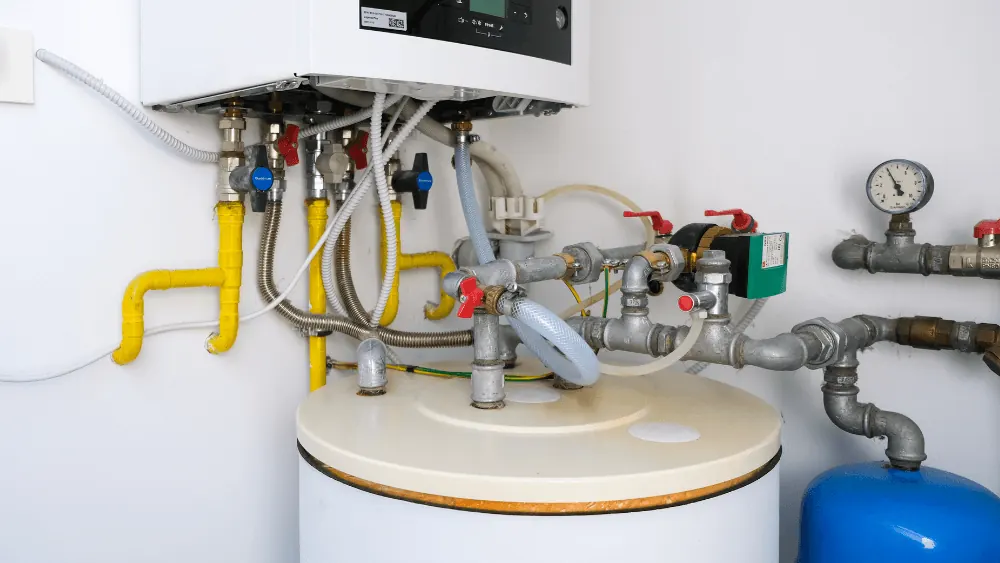
Water heater installation in Dubai: what we do
- Electric storage heater installation and replacement. New or like-for-like, vertical or horizontal, sized to the household.
- Siting and mounting. A position that can be reached for service, a fixing that carries the full weight, and a tray where a leak would cause damage.
- Cold feed and hot outlet. Isolation valve, non-return valve, union and pipework to the heater's inlet and outlet.
- Safety valves. The temperature and pressure relief valve and its discharge line, and expansion control where it applies.
- Pressure control. A pressure reducing valve where the supply pressure calls for one.
- Electrical connection. To the heater's rated load, with the disconnection and earthing the heater needs, by our own electricians.
- Commissioning and testing. Filled before power, relief valve tested, joints checked, temperature set and measured.
- Removal of the old heater, including draining a tank that may be in a ceiling void.
- A written handover with the heater's model, capacity, rating and settings.
- Emergency visits. We answer calls and send a plumber 24 hours a day, 7 days a week, and we do not promise an arrival time. We do not do gas work.
Neighbouring topics have their own pages. Faults in an existing heater, including elements, thermostats, leaks and tripping breakers, are on our water heater repair page and, for parts, element and thermostat replacement. Other heater types are on the tankless, solar, heat pump and boiler pages, and the overview is on water heaters. What the heater has to supply is on our shower installation and bathtub pages.
Which heater: the types
The types differ in where they heat the water, where they store it, and what they need around them.
| Type | How it works | What it needs | More on |
|---|---|---|---|
| Electric storage (vertical or horizontal) | An insulated tank with one or more electric elements and a thermostat | A power supply for its rating, a cold feed, a position that carries a full tank, and a relief line | This page |
| Instant or tankless | Heats water as it flows, with no storage | A power supply sized to the flow, and enough flow to switch it on | Tankless water heaters |
| Solar | Collectors heat water stored in a tank, with a backup element | A roof position, a loop to the tank, and a backup supply | Solar water heaters |
| Heat pump | Moves heat from the air into a storage tank | An installation space, an electrical supply and a condensate route | Heat pump water heaters |
| Boiler or central system | A larger heater serving several outlets | A plant space, pipework and controls | Boiler repair |
| Shared building hot water | Supplied from a central plant by the building | Nothing at the flat except the connection | Not an installation we carry out. Ask building management |
Most of this page applies to an electric storage heater, since the valves, support and electrical points are the same questions for any heater with a tank. The other pages cover what is specific to each type.
Choosing the size
A heater that is too small runs out. A heater that is too large costs more, takes more room and weighs more, and can mean higher energy bills because it heats water you do not use. Published sizing charts differ from one source to another, because they assume different showers, climates and habits. As a rough guide for a Dubai home:
| Household | Typical storage heater |
|---|---|
| 1 to 2 people | 50 litres |
| 3 to 4 people | 80 to 100 litres |
| 5 to 6 people | 120 to 150 litres |
| Larger households, or several bathrooms | 200 litres or more, or more than one heater |
| Tight spaces such as under a bench | Small units of 25 to 50 litres |
These are starting points and not fixed answers. Our water heaters page explains how litres, kilowatts and incoming water temperature turn into showers.
The first-hour method
A more careful method is to add up what the household draws in its busiest hour. For example, three showers at about 60 litres each, plus a shave and some hand washing, comes to roughly 200 litres of mixed water. Because a shower mixes hot tank water with cold, a tank gives more than its litres in mixed water, as the overview page shows.
For a Dubai household, ask four things:
- How many people use hot water in the same hour, for example the morning?
- What is the biggest single draw? A bath is a large one. See our bathtub page, which sets out fill time and capacity. A rain head draws more than a standard head. See shower installation.
- How often is hot water used back to back? Two baths in a row need more storage than one.
- How much room is there? A cupboard or a ceiling void may set the maximum size before the household's demand does.
The incoming water temperature matters for the heater's work. Water in rooftop tanks is already warm in summer. A heater has less to do in summer and more in winter, so we size for the cooler months.
Where the heater goes
The position of a heater is decided by access, support and what happens if it leaks.
| Point | What to know |
|---|---|
| Accessible location | The heater must be reachable for service, with room to reach the valves, the anode and the drain |
| Support | A bracket or base made for the full weight, fixed to a wall or floor that can carry it |
| Air circulation | Room around the heater and, where the surface may get wet, air movement to keep it dry |
| Tray | A tray under the heater, piped to a visible drain, where a leak would damage a ceiling, a floor or a unit below |
| Distance to the outlet | The shorter the hot run to the bathroom, the less water and heat wasted |
| Maker's clearances | Heaters have required clearances from walls and from the removal route for the element or the tank |
The ceiling void problem
Many Dubai flats put the heater in the ceiling void above a bathroom. That position conflicts with the usual rule that a heater should be reachable without a ladder. We do not treat this as a reason to refuse the job. We treat it as a reason to plan the access. In practice:
- The hatch must be large enough to remove the tank, not only to see it.
- A tray with a drain line sits under the heater so that a leak runs to a visible place, not into the board. Our repair page makes the same point.
- The relief line needs a visible discharge point, and a void gives none of its own. See the relief line section.
- The support is the building's structure and not the ceiling board.
If the void cannot give reachable access, a heater in a different position is better than a heater nobody can reach. See water heater repair for the repair-side view of the same position.
Weight and fixing
The data sheet for your heater gives its own weights, and the fixing is chosen for the full figure, with the tank full of water. A wall-mounted heater needs a bracket and a wall that can hold it. A masonry wall and a lightweight partition are different jobs, and we check which we have before any fixing goes in.
The connections and valves around a storage heater
A heater is a pressure vessel with a heat source. The valves around it are what keep an ordinary fault from becoming a burst tank or a flooded ceiling.
| Part | What it does | What to know |
|---|---|---|
| Isolation valve | Shuts the cold feed so the heater can be removed or serviced | On the cold inlet, within reach. See valve repair and replacement |
| Non-return valve | Stops hot water flowing back into the cold supply | Close to the inlet. See backflow prevention |
| Pressure reducing valve | Lowers a high supply pressure to what the heater is rated for | Where the supply pressure is above the heater's rating. See pressure reducing valves |
| Expansion control | Takes up the extra volume as water heats, where the heater is a closed system | Where a non-return valve makes the system closed |
| Temperature and pressure relief valve | Opens if the tank gets too hot or too high in pressure | On the heater. Never blocked or capped |
| Discharge (relief) line | Carries the relief valve's discharge to a safe place | See below |
Pressure: two figures that are not the same thing
A heater is rated for a working pressure, printed on its label. A building's supply pressure is a separate figure. Where the supply is higher than the heater is rated for, a pressure reducing valve goes ahead of it. See pressure reducing valves. The heater's own rating and the supply pressure are checked separately. Pressure at the heater differs from building to building and from floor to floor, so we measure at the heater and do not assume it.
The relief line: where the water goes
The relief valve opens when the tank is too hot or too high in pressure. It then has to discharge somewhere safe. The drain line from the valve must be unobstructed, fall continuously to a safe discharge point, and be placed so that discharge causes no nuisance, injury or building damage. It should not discharge into a tray.
Two points follow:
- The tray and the relief line do different jobs. The tray catches a leak from the tank. The relief line carries the valve's discharge to a visible, safe place. They are separate, and the line does not end in the tray.
- A relief line that ends inside a ceiling void is a hidden leak. In a heater above a bathroom, the line has to go to a place where a discharge can be seen and where it harms nothing. If it cannot, the position of the heater is the problem.
Connecting to the existing pipes
Plastic pipe and fittings are not used between the isolating valve and the heater's inlet. We use metal for that short length, and we follow the heater's own instructions for the outlet. Joints and fittings, including how metals and plastics are joined, are on our pipe fittings page, and flexible connectors on hoses. If the pipes are old, they are checked for scale and corrosion before the heater is connected to them. See repiping.
The electrical connection
An electric storage heater is a fixed load on a circuit, and the connection is part of the installation. The usual requirements:
- Supply. A single-phase supply for a household storage heater.
- Disconnection. A means of disconnection in the fixed wiring, such as a double-pole isolator, within reach of the heater.
- Terminals. Live and neutral to the terminal block, and earth to the earth terminal.
- Isolation. The supply is isolated before the cover comes off.
- Fill first. The heater is full before the power is switched on.
How we check the circuit
A heater draws a steady, heavy load for long periods, so the circuit has to be right before the heater goes on. Our tankless water heater page sets out supply needs for the larger loads. What we do:
- Read the heater's label for its power in watts or kW and its voltage.
- Check the existing circuit, its breaker, its cable and its isolator, against that rating.
- Use our own electricians where the work goes beyond connecting a heater to a suitable existing supply.
- Check earthing and the disconnection before the heater is energised.
Electrical faults in a heater, such as an element that trips the breaker, are on our water heater repair and element and thermostat pages.
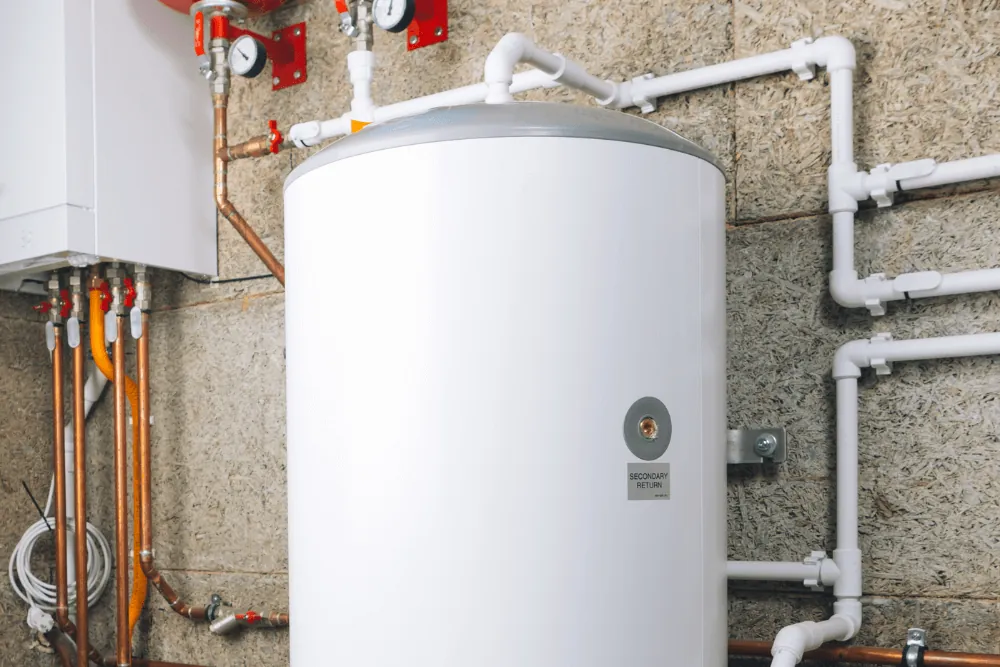
Scale, the anode and what to plan at installation
A heater installed without a plan for scale starts failing early, and the plan costs little to make at the start. Our repair page covers the faults. At installation, the points are:
- Know the water. A hardness and scaling reading at your tap says whether a water softener is worth installing ahead of the heater.
- Leave room for service. The anode and the drain valve are the parts that need reaching. A heater boxed in so that its anode cannot be pulled is a heater whose anode will not be checked.
- Fit a drain point. A heater with a drain valve that can be reached allows sediment to be flushed.
- Record the installation date and model, so the first anode check is on the calendar.
Temperature setting and scald safety
Water at 60°C burns in seconds, and a young child's skin burns faster than an adult's. Two things work together:
- The heater's setting. Around 60°C is common, because water held too cool in a tank can grow bacteria. A higher setting raises the scald risk and needs a lower tap temperature to compensate.
- Mixing at the tap. A thermostatic mixer or an anti-scald valve limits the outlet to a safe temperature, whatever the tank holds.
Where there is no mixing valve, a lower heater setting protects children, and where there is one, the heater can run hotter without the outlet doing so. We set the thermostat with you at commissioning, record it, and fit thermostatic mixers where the household calls for them. See shower installation and bathtub.
Hot pipes and recirculation
Hot water loses heat in the pipe between the heater and the tap. Insulating the hot line reduces that loss and is covered on our pipe insulation page.
A recirculation loop keeps hot water moving through the pipes so that taps far from the heater run hot sooner. It adds a pump and a return pipe, and it keeps the pipe warm continuously, which loses heat. It suits a long run between the heater and a distant bathroom, and it is a poor fit where the heater sits next to the outlet. We discuss it on the visit when the distance is large.
Replacing an old heater, or installing a new one
The two jobs share the same connections but start from different places.
| Job | What is different | What we check |
|---|---|---|
| Like-for-like replacement | Same position, similar size, existing pipes and circuit | Whether the old valves, brackets and relief line are fit to keep. We replace the relief and expansion valves with the heater |
| Replacement in a different position | New pipe runs, possibly a new circuit and relief route | Access, support and the discharge point |
| Larger or different type | The load, the weight and the pipework change | The circuit rating, the fixing and the supply |
| First heater in a property | Everything is new | Cold feed, hot run, circuit, drain, permission |
Removing the old heater
An old tank is heavy and may be full. We isolate the supply and the power, drain the tank to a safe point, and lower it out. In a ceiling void that means access we have planned, as above. The old heater is removed from site. Keep the old heater's label, which our water heater repair page uses to read the capacity, rating and manufacture date.
Commissioning: filling, testing and handover
- Open the hot taps, open the inlet slowly, and close each tap once the air has cleared.
- Check the heater is full before power goes on. An element energised without water around it can burn out.
- Lift the relief valve's easing lever for about 10 seconds, confirm that water discharges, then lower it gently.
Then our own checks:
- Every joint under pressure, the valves, unions, the inlet and the outlet.
- The relief line, to confirm that it runs clear and ends where it should.
- The electrical supply, and the heater heating.
- The thermostat setting, and the temperature at a tap, measured.
- The tray and its drain, with water run to confirm the tray drains.
- A written note of the heater's brand, model, capacity, rating, serial number and manufacture date, the settings, and the date of installation.
Permission in Dubai: who decides on a new heater
Installing or replacing a heater in a rented flat involves the landlord first, and the building second. Where a heater job falls:
| Job | Starting point |
|---|---|
| Replacing a failed heater with a similar one | A repair. Tell the landlord first and get their decision in writing. Our repair page makes the same point |
| Upgrading to a larger or different type at your request | An alteration. Written landlord consent, and building management |
| New position, new circuit, or roof-mounted unit | Written landlord consent and building management |
Tell us what your building asks for and we work to it.
Warranty and the handover
What you should have when the job is finished:
- A written note of what was installed: brand, model, capacity, power rating, serial number and manufacture date, the thermostat setting, and the tests we ran.
- The manufacturer's warranty terms. These are the manufacturer's and not ours. We note the model and manufacture date from the heater's label for any warranty claim.
- Photographs of the connections, the relief line and the tray before the heater is closed in.
- The date of the first anode and valve check. Many makers say to lift the relief valve's lever about every six months and to replace the valve at intervals set in the manual. Your heater's manual gives its own.
- FAM's workmanship warranty, in writing. The warranty runs for 30 days and covers our labour only. Parts carry the manufacturer's warranty only.
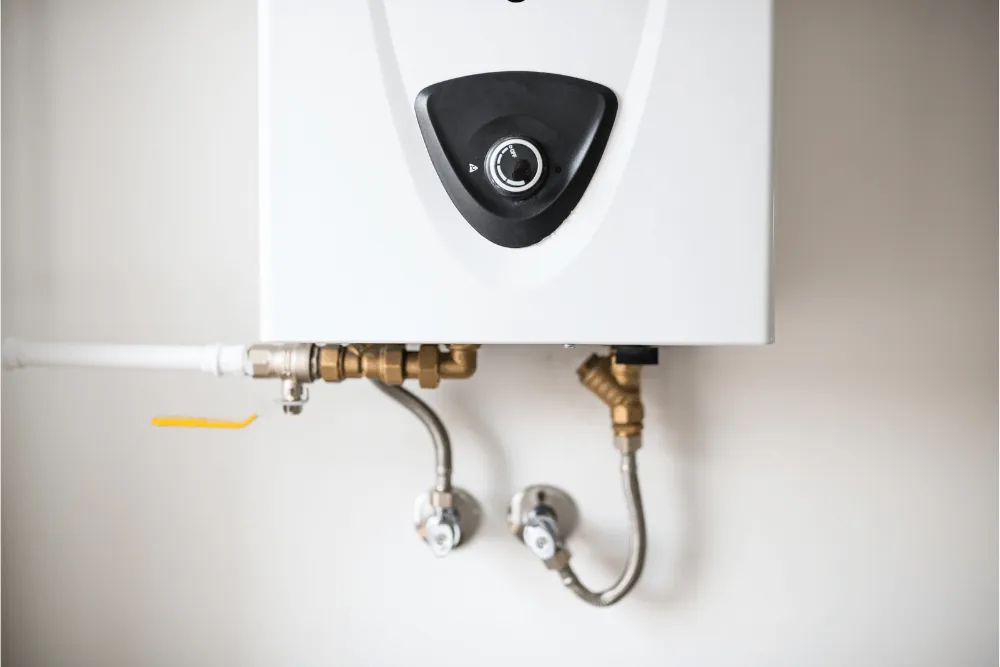
How we install a water heater
- You tell us what you have and what you want, and send photos of the old heater and its label, the space and the nearest bathroom on WhatsApp. Include the model of any heater you have already bought.
- We visit, check the position, the access, the support, the supply and the circuit, and measure. The visit fee is AED 50 + VAT, credited if the work goes ahead.
- We give options and a price in writing, with the heater size and type we recommend and why.
- Check permission. In a rented or managed property, ask the landlord or building management whether they need to approve this work before the visit.
- We install, with the isolation valve, non-return valve, relief valve and line, tray and electrical connection, and test as above.
- We hand over the written note, show you the isolation valve and the relief lever, and take the old heater away.
Where we work in Dubai
We cover all of Dubai, including Dubai Marina, JBR, Downtown Dubai, Business Bay, Jumeirah Lakes Towers, Palm Jumeirah, Al Barsha, Jumeirah Village Circle, Dubai Hills, Mirdif, Deira and Al Quoz. See the full list of areas.
Installation mistakes we are called to correct
- No tray or drain under a heater in a ceiling void, so the first leak comes through the ceiling.
- A relief line that ends in the void, in a tray or capped. A discharge goes nowhere safe.
- A bracket chosen for the empty weight. A full tank pulls it from the wall.
- No isolation valve, so changing the heater means shutting the whole property.
- Old safety valves reused on a new heater.
- Power switched on before the tank was full. The element burns out in minutes.
- A heater boxed in so the anode and the drain cannot be reached.
- A circuit never checked against the new heater's rating, which can mean a hot cable or a breaker that keeps tripping.
- No record of the setting, so nobody knows what the thermostat was left at.
Before the installer arrives
A little preparation shortens the visit.
- Clear the space around the old heater and the route to it, and cover floors on the way out.
- Make sure the hatch can be opened and a ladder can stand below it.
- Tell the building if the lift needs booking for carrying a tank.
- Have the new heater on site if you bought it, with its box, manual and warranty card.
- Know where the isolator and the main water valve are, and tell us if either is stuck.
- Keep the old heater's label for the record of capacity and rating.
Making room for the heater and its service
A heater fitted in a tight cupboard is hard to service, and a heater that is hard to service is neglected. Leave clear space below for the pipework and a drain, space above for removing the cover, and a clear path for the pipes to the relief valve outlet. Check that the floor or the wall can hold the weight of a full tank. In a flat, check where water would go if the tank leaked, and consider a drain tray with a pipe to a safe outlet. Fit isolation valves on both pipes, so the heater can be changed without shutting off the whole property. We check these on the visit and fix the price on WhatsApp before we start. Prices exclude 5% VAT.
How much does water heater installation cost in Dubai?
The price follows the heater, the position and what has to be built around it.
- The heater. Its type, capacity, brand and warranty. If you supply your own, tell us before you buy so the size, rating and connections are checked first.
- Labour for the installation. Mounting, connections and commissioning.
- Valves and fittings. Isolation valve, non-return valve, relief valve and line, expansion control, pressure reducing valve and unions.
- The tray and its drain, for a heater where a leak would cause damage.
- Electrical work. A new or upgraded circuit, an isolator, or the connection only.
- Access. A ladder, a larger hatch, or opening a ceiling.
- Removal and disposal of the old heater.
- Pipe insulation or repiping, if the existing pipework needs it.
- Water treatment, if a softener is added ahead of the heater.
- Building fees. Any fees charged by the building management are separate from our price.
We do not publish a starting price for this job. Send a photo on WhatsApp and we give you a fixed price before we start. Prices exclude 5% VAT.
Water heater installation FAQs
What size water heater do I need?
Size it on the busiest hour's use, not only on the head count. As a rough guide, 50 litres suits one or two people and 80 to 100 litres suits three or four. We size on use, and tell you why.
Does a water heater need a relief valve and a discharge pipe?
Yes. The relief valve opens when the tank is too hot or too high in pressure, and the discharge line carries that water to a safe place. The line must fall continuously and must not end in a blocked spot or a tray. Your heater's manual sets what applies to your model.
Can you put the heater in the ceiling void?
Yes, with a plan for the access: a hatch big enough to remove the tank, a tray with a drain, a relief line that ends somewhere visible, and a support taken by the structure. A heater should be reachable without a ladder where possible, so a void is a compromise and not an ideal.
How much does a full heater weigh?
The heater's data sheet gives its empty weight, and a litre of water weighs a kilogram, so an 80-litre heater adds 80 kg when full. The fixing is chosen for the full figure.
Why do I need an isolation valve and a non-return valve?
The isolation valve lets the heater be shut off and removed without shutting off the property. The non-return valve stops hot water flowing back into the cold supply.
Do I need an electrician for a new heater?
An electric heater is a fixed load on a circuit, and the connection needs checking against its rating. FAM has its own electricians. We check the circuit against the heater's label, and where the circuit needs changing, we do that too.
Who sets the temperature after installation?
We set it when we commission the heater, test it at a tap and tell you what we left it at. After that, adjusting it is covered on our water heater thermostat page.
Who pays for a new heater in a rented flat?
That is settled between you and your landlord, and your contract is the place to look. Tell the landlord first. An upgrade at your request is an alteration that needs written consent.
Can you replace my heater without changing the valves?
We replace the relief valve and, where fitted, the expansion valve with the heater, because a new heater should not rely on old safety valves. The isolation valve and unions are reused only if they are sound.
What happens to the old heater?
We isolate the supply and the power, drain the tank to a safe point, lower it out and remove it from site. In a ceiling void the access is planned before the work. Keep the old heater's label until the new one is in, since it records the capacity and rating.
How much does water heater installation cost in Dubai?
The price follows the heater, the position and what has to be built around it. We do not publish a starting price for this job. Send a photo of the old heater and the space on WhatsApp and we give you a fixed price before we start. Prices exclude 5% VAT.
Book a water heater installation in Dubai
Tell us what heater you have now, what you want, where it sits, and whether you rent or own. Photos of the heater, its label and the space help. If the old heater is leaking, close its cold feed and switch off its power, and call. We will plan the access and the connections, install and test, and give you a written note.
WhatsApp: +971 55 407 7427 · Request a quote
Visit us: Office 871, Oasis Mall, Al Quoz 1, Dubai, UAE
Related services: Water heater repair · Element and thermostat · Tankless water heater · Solar water heater · Heat pump water heater · Pressure reducing valves · Emergency plumber