
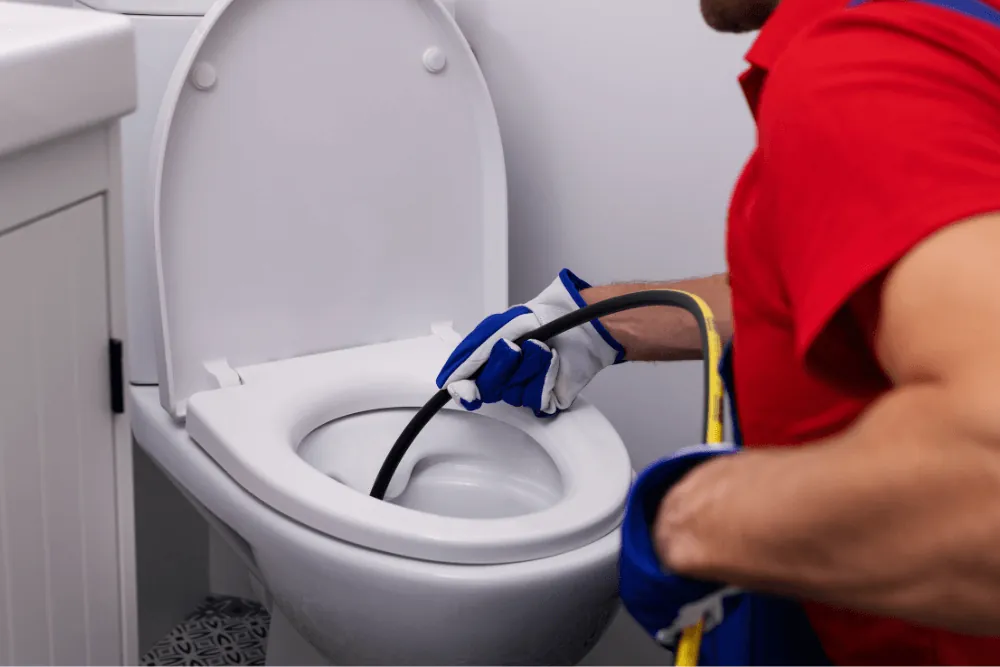
Is it the toilet or the drain? Read what the bowl is doing
The first question decides everything else: is the blockage in this toilet, or in a pipe that other fixtures also use? The bowl's behaviour answers it.
| What happens | What it points to | What to do |
|---|---|---|
| Bowl fills to the rim after a flush, then sinks slowly | A partial blockage in the trap or just beyond it | Plunge, then try the steps below |
| Bowl fills and stays full, with no movement | A full blockage in the trap or the pipe right behind it | Do not flush again. Plunge, or WhatsApp us |
| Flush starts strongly, then the water stalls and rises | A blockage a short way down the branch pipe | Plunge once. If it fails, WhatsApp us |
| Gurgling or bubbling in the bowl when you run a basin or shower | Shared drain restricted, so air is being pushed back through the trap | WhatsApp us. A plunger will not reach it |
| Water rises in the shower or bath drain when you flush | The shared branch pipe is blocked, and the toilet is pushing water into it | Stop using the toilet. WhatsApp us |
| Several toilets in the home are slow at once | A blocked branch, stack or external line | WhatsApp us |
| Flush is weak but nothing rises | A cistern or flush fault, not a blockage | See toilet repair |
| Toilet blocks again within days of clearing | Something further down the line, or a habit that needs changing | Read the section on repeat blockages below |
One blocked toilet with no other symptoms points to a local blockage you can try to clear. Any sign that another fixture is reacting points to a shared pipe, and the response is to stop flushing and call.
The first two minutes: stop the overflow
If the bowl is rising after a flush, act before you try to clear anything. These steps keep the situation from getting worse.
- Do not flush again. The cistern holds enough water to overflow a full bowl. Each extra flush adds to the problem.
- Stop more water entering the bowl. Lift the cistern lid, if it is a visible cistern, and push the flapper down to hold it closed.
- Close the isolation valve. It is the small valve on the pipe feeding the cistern, at floor level behind or beside the toilet. Turn it clockwise until it stops.
- Put towels or a bath mat around the base. If it does overflow, the water should meet cloth, not tiles.
- Keep children and pets out of the bathroom until it is cleared and cleaned.
On a concealed cistern, you cannot reach the flapper. Close the isolation valve if you can find it, or shut the main supply to the bathroom or the flat, and WhatsApp us.
Why toilets block
A toilet blocks because something is too bulky, too absorbent or too tough to pass through its trap. The trap is the curved passage built into the bowl that holds water to seal out drain smells. It is narrow, and it turns, which is why items that fit down the drain in a straight pipe get stuck here.
Too much toilet paper
Paper is designed to break down, but a large wad in one flush can clog the trap before it has softened.
Wipes, including "flushable" wipes
Wipes build up out of sight, because they do not break down. Toilet paper falls apart in water within moments, and a wipe is made of fibres that hold together. A wipe that is labelled flushable behaves the same way in a household drain, and wipes are among the most common things we pull out of blocked toilets and lines.
A wipe leaves the toilet, catches on a rough joint or a bend further along, and builds up with the next one.
Sanitary products, nappies and cotton items
Sanitary pads, tampons, nappies, cotton buds and cotton pads swell or hold together in water. They lodge in the trap or the branch pipe and collect other material around them.
Objects dropped or pushed in
Toys, razors, phones, hair ties and bottle caps cause sudden, total blockages. A plunger may not move them, and pushing can wedge them further in. Retrieval is the first job. See the section on lifting the toilet below.
Mineral build-up
Scale can narrow the trap and the jets under the rim over the years. A toilet that is slow to clear even with normal use may have a narrowed passage that needs descaling.
Low-flush toilets
A low-volume flush has less water to carry paper along the pipe, so heavy loads and extra paper can stall.
A blockage that is not in the toilet
Branch pipes, vertical stacks and external drains can restrict from further along. The toilet then shows the symptom, but the cause sits elsewhere. Signs are other fixtures reacting, a smell, or repeat blockages after the toilet has been cleared. This is where our drain unblocking service takes over.
How to unblock a toilet yourself, step by step
A single-toilet blockage is where to start with a plunger. This sequence goes from the least risky tool to the most, and each step has a point at which you should stop.
Step 1: Use the right plunger
A toilet needs a plunger designed for its shape. A flat sink plunger is made for flat surfaces and seals badly in a bowl.
The flange is the extra rubber sleeve below the cup. It fits into the bowl's outlet and gives the seal you need.
Step 2: Get the water level right
The cup must be covered with water for the plunger to push water, not air. If the bowl is nearly empty, add water from a bucket until the cup is submerged. If the bowl is close to the rim, take some out first so it does not splash over when you plunge.
Step 3: Seal and plunge
Lower the plunger at an angle so the cup fills with water, then seat it over the outlet and make a firm seal.
- Push down gently first. This forces air out of the cup instead of into the bowl.
- Plunge with steady, firm strokes for 20 to 30 seconds, keeping the seal.
- Finish with a sharp pull to break the seal and draw the blockage back towards the bowl.
- Break the seal and look. If the water drains away, the blockage has moved.
- Test with a bucket of water poured into the bowl, instead of flushing, so you do not add a full cistern to a bowl that may still be blocked.
If the water drops and then rises again within a minute, the blockage has only shifted. Repeat the sequence up to three times. If it has not cleared after three rounds, stop. More force is more risk.
Step 4: Hot water and dish soap for soft blockages
If the blockage looks like a mass of paper, add a squirt of dish soap and then a pot of hot (not boiling) water. Pour from waist height into the bowl and let it work. The soap lubricates, and the heat softens paper.
Use hot water from the tap or kettle, never boiling. Boiling water can crack porcelain, especially a cold bowl.
Step 5: Use a toilet auger
A toilet auger, also called a closet auger, is a short, flexible cable inside a bent tube with a protective end that sits against the porcelain. It reaches into the trap, hooks or breaks up what is there, and does not scratch the bowl.
- Seat the curved end in the bowl outlet.
- Wind the handle slowly to feed the cable in. When you feel resistance, keep turning gently to catch or break the blockage.
- Pull back and bring whatever you have caught out of the trap, since pushing it further down may jam it in the pipe.
- Test with water before flushing.
- Clean and disinfect the auger after use, and wear gloves.
If you do not own an auger, it is a reasonable point to WhatsApp us.
Where to stop
Stop and WhatsApp us if any of these happen:
- Three rounds of plunging have not moved the water.
- The auger meets a hard stop, or the cable will not advance.
- Something you pull out is not paper or waste, such as a toy, which means more may be in there.
- Other fixtures start to gurgle or back up.
- The toilet is wall-hung, and plunging seems to make the pan move.
- You see water at the base of the toilet after plunging.
What not to use on a blocked toilet
Some methods make the problem worse or damage the toilet. Avoid these.
- Drain chemicals. A bowl full of strong chemical is unsafe to plunge or work on, because it can splash onto skin and eyes. If the chemical fails, we have to work in a bowl of harsh liquid, and it can attack the seals and the pipe.
- A wire coat hanger. It scratches porcelain and can wedge the blockage tighter.
- Boiling water. It risks cracking the pan.
- Repeated flushing. Each flush adds a cisternful of water to a bowl that cannot clear it.
- Baking soda and vinegar. They fizz, but a solid mass in a trap needs a plunger or an auger.
- Forcing the cable or pushing hard. Moving a blockage from the trap into the pipe turns a toilet problem into a drain problem.
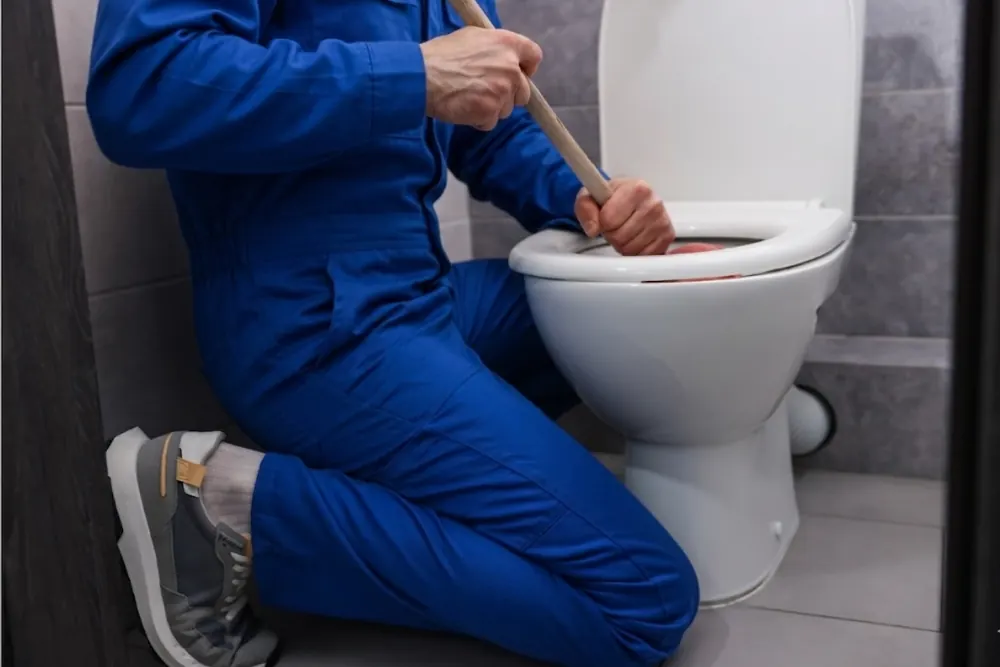
When to call a plumber instead
WhatsApp us straight away if:
- The bowl has been full for more than a few minutes with no movement.
- Sewage is coming up through a floor drain, a shower or a basin.
- You can smell sewage that does not clear.
- The toilet blocks again within days.
- You have no other working toilet in the home.
- Water has reached a neighbour's ceiling or a shared area.
How FAM unblocks a toilet
We start by finding where the blockage is, then choose the least invasive tool that will reach it. The aim is to clear the blockage without scratching the pan, breaking the seal under it, or pushing the problem further into the pipe.
| Method | What it does | When we use it |
|---|---|---|
| Flange plunger | Moves a soft blockage with pressure and suction | Paper blockages and first attempts |
| Toilet auger | Hooks or breaks up a blockage in the trap without touching the porcelain | Wipes, cloth and objects lodged in the trap |
| Drain machine or snake through an access point | Clears the branch pipe beyond the toilet | When the trap is clear but the line is restricted |
| Camera inspection | Shows what the blockage is and where | Repeat blockages, unknown objects, shared lines |
| High-pressure jetting | Cuts through heavy build-up and washes the pipe | Scale, grease and silt in the branch or external line |
| Lifting the toilet | Gives direct access to the outlet and the flange | A dropped object, or a blockage the auger cannot reach |
What a visit looks like
- We ask what happened. When it blocked, what went down, and whether any other fixture is affected.
- We check the symptoms in the bowl and on the other fixtures to place the blockage.
- We protect the floor and put down covers before we start.
- We clear it with the plunger or auger first, and move to other tools only if that fails.
- We test. Several flushes, a check of the other fixtures, and a look at the base for leaks.
- We tell you what we found and what to avoid, with a photo of the item if we recovered one.
A simple paper blockage is a short job. A blockage caused by an object, or one that sits in the branch pipe, takes longer.
When the toilet has to be lifted
Some blockages cannot be reached through the bowl. A hard object, such as a toy, a razor or a phone, can sit in the trap or just beyond it, where an auger either cannot hook it or pushes it deeper. In that case, the safe way is to lift the toilet.
The sequence is the same as for a seal replacement:
- Close the isolation valve, flush to empty the cistern and disconnect the supply.
- Unbolt the toilet and lift it clear.
- Clear the outlet and the pipe directly, and retrieve the object.
- Inspect the floor flange and the pipe.
- Refit the toilet with a new seal and check for leaks.
The pan is checked for chips and cracks at the same time. For seal and base faults, see our toilet repair page.
Different toilets block in different ways
Not every toilet is a floor-standing pan with a cistern on the back. How it is built changes what you should and should not do.
Wall-hung toilets and concealed cisterns
A wall-hung pan is bolted to a frame inside the wall. It has the same trap as a floor-standing pan, so the causes are the same, but you should plunge with gentler strokes and watch the pan for movement. A pan that shifts, or water at the junction with the wall, means stop. The frame and the connection to the waste pipe sit behind the wall, and forcing them can start a leak you cannot see.
A concealed cistern also removes the flapper trick from the first two minutes. Close the isolation valve, or the bathroom's supply, instead.
Floor-level and squat toilets
Squat toilets sit at floor level and are built differently from a seated bowl, so a bowl plunger may not seal on one. Tell us which type you have and send a photo before you try force. See our page on urinal and squat toilet plumbing for these.
Bidet sprays and hoses
A health faucet or bidet spray hangs beside the toilet on a hose. If it is left running or the head is jammed open, it adds water to a blocked bowl. Close its valve too. See bidet and health faucet fitting.
Commercial flushometer toilets
Some offices, shops and public toilets use a flushometer valve, a pressure-fed valve that delivers each flush straight from the supply, with no cistern. They block in the same way, but the valve adds a second fault: water that keeps moving in the bowl without a flush means the valve needs repair or replacement. After the supply is turned back on, flush once or twice to clear air and check the valve. See the commercial section below.
Blockages that keep coming back
A toilet that blocks once is an incident. A toilet that keeps blocking has a cause that has not been removed.
What a repeat blockage can mean
- A habit. Wipes, too much paper, hygiene products or a child flushing toys. Changing it is the only fix.
- Something left behind. A partial blockage that was cleared from the trap but still sits in the branch pipe collects each new load.
- A narrowed trap or outlet. Scale reduces the passage, and normal use stalls.
- A rough or damaged pipe joint. A lip, a root intrusion in a villa, or a sagging section of pipe catches paper and wipes.
- A shared line problem. If other fixtures slow down with the toilet, the line is the cause.
- A flush that is too weak. A cistern that is not delivering its full volume, or a worn flush valve, does not carry waste along the pipe. See toilet repair.
How we find the cause
We ask what has changed. A new tenant, a baby in the home, or a change from one type of paper to another all matter. Then we test the toilet's own flush, check the other fixtures, and, for repeat jobs, run a camera into the branch to see the pipe. A camera shows a wipe mass, a joint that has slipped, or scale, and then we know what to fix.
If the cause is in the pipe, we clear it, and if it is a damaged section we quote the repair. Jetting a pipe that is damaged or collapsing can make it worse, so we look first. See drain jetting for when jetting is the right tool.
Apartments: shared stacks, neighbours and who pays
In a flat, your toilet's waste pipe joins a vertical stack that serves other units. The stack is a shared pipe, so a blockage in it is a matter for building management and not for one tenant. A blockage in your own toilet branch is the unit's to clear, and who pays inside a rented unit is a tenancy question. The two show up differently.
Is it your toilet or the stack?
- Only your toilet is affected and the others in your flat work: this points to a local blockage.
- Everything in your flat is slow, or water backs up in the lowest fixture, such as a floor drain or shower: this points to your branch or the stack.
- Neighbours report the same problem, or toilets overflow when a neighbour flushes or runs a washing machine: this points to the stack. Tell building management at once.
If the stack is the cause, stop using the toilet, inform your management, and keep records. We can check your branch and confirm in writing that it is clear, which helps when the building has to act.
Who pays
A blocked toilet cleared with a plunger or auger is routine. A blocked or damaged branch or stack is infrastructure.
What to do:
- Report in writing to your landlord or property manager if the cause is not your use.
- Keep our invoice and any report that identifies the cause.
- Do not flush while the stack is blocked. An overflow into the unit below can lead to a claim for the damage, so check your contract and insurance.
- If water reached a neighbour, photograph it, tell management, and stop the source first.
We are plumbers, not legal advisers, so check your own contract.
Villas: external lines, septic tanks and STPs
In a villa, the toilet's waste leaves the house through an underground line to a manhole, a sewer connection or a tank. A blockage outside shows up inside.
- Toilets slow to flush with no sign of a blockage inside, and an overflowing gully or manhole nearby, point to the external line.
- Smell near the manhole cover points to a restricted line.
- Tree and plant roots can enter pipe joints over time.
- A full septic tank or STP can make every fixture slow, and the fix is emptying and servicing, not unblocking a toilet. See septic tank cleaning, and septic tank and STP for the system.
For external lines, we use a camera and jetting or a drain machine to clear the line. See sewer line repair and cleaning.
Offices, shops and restaurants
A commercial toilet serves many people and runs all day, and some have a flushometer valve. A blockage closes the facility, and customers or staff notice at once.
- Provide bins in every cubicle and clear signs about what not to flush. Wipes, paper towels and hygiene products do not break down in a drain, which is what the bins are for.
- Use the same rules for staff and visitors. Paper towels do not break down in a drain.
- Report phantom flushing, where a toilet flushes without use. Flushes caused by pressure changes in a building should be investigated by a plumber.
- Keep one toilet working if you can, and tell us how many are affected.
We schedule work outside opening hours where we can. For several sites or a block of toilets, a plumbing maintenance contract can schedule regular checks. We offer maintenance contracts priced per building. Ask for a quote on WhatsApp.
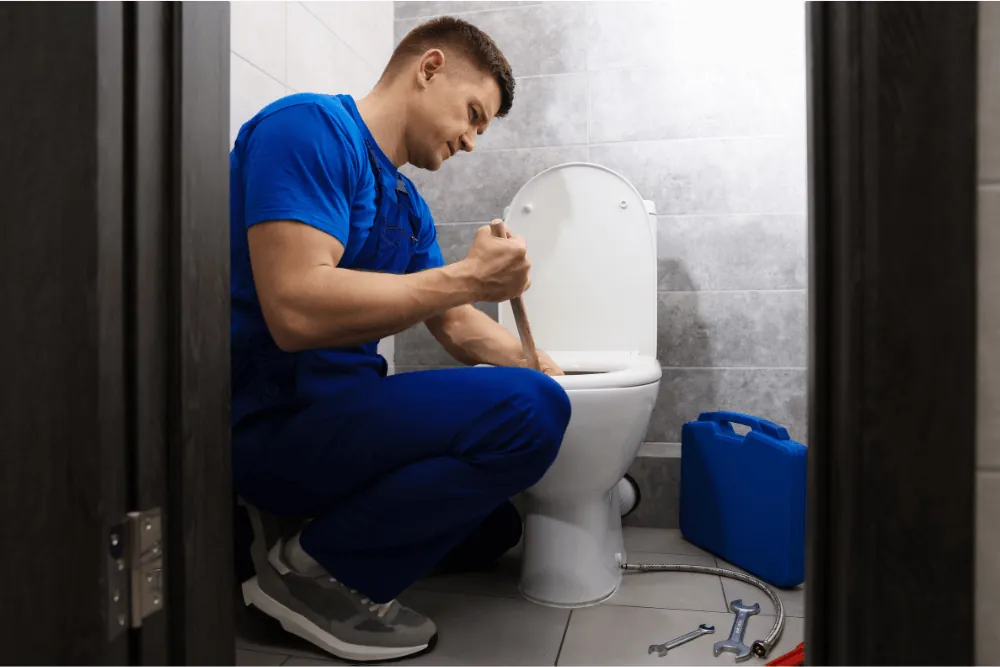
What we do to stop it happening again
Clearing a blockage is half the job. Before we leave, we look at why it happened and what you can change.
- Look at what came out. A mass of wipes, a toy or a wad of paper each have a different cause, and we show you what we found.
- Check the flush. A cistern that gives a weak flush does not carry waste along the pipe, and a blockage that returns can be a flush fault in disguise. We check the water level and the valve.
- Check the other fixtures. We run the basin and shower while flushing, and listen for gurgling that points to a shared pipe.
- Check the trap and the bowl. Scale around the jets or in the trap narrows the passage and makes paper stall.
- Tell you plainly if it will return. If the cause is a pipe defect further down, we say so, and we do not pretend a plunger fixed it.
- Leave a note on what to do next time, including where the isolation valve is and when to stop and call.
After the blockage: clean up safely
A toilet overflow leaves dirty water on the floor, and it needs proper cleaning.
- Wear gloves and keep children and pets away.
- Ventilate the room.
- Mop up with towels you can wash on a hot cycle or throw away.
- Clean the floor, the base and the toilet with a bathroom disinfectant, and rinse.
- Dry the area, including under any mat or carpet. Remove carpets or rugs that were soaked.
- Wash your hands before touching anything else.
- Check the ceiling below if you live above another unit.
Do not mix disinfectants or cleaning products, and do not pour a drain chemical after a blockage has cleared.
What can go down a toilet
The simplest prevention is a short rule. Toilet paper and human waste go down the toilet. Everything else goes in the bin.
| Goes down the toilet | Goes in the bin |
|---|---|
| Human waste | Wipes, including ones sold as flushable |
| Toilet paper | Sanitary pads, tampons and applicators |
| Water | Nappies and cotton buds |
| Cotton pads, tissues and paper towels | |
| Hair, floss and razors | |
| Cooking oil, grease and food | |
| Medicines | |
| Toys and other objects |
Many wipe packets carry a "do not flush" symbol. If a packet carries it, bin the wipe. If a packet says flushable, bin it anyway, because wipes do not break down the way paper does.
Habits that keep toilets clear
- Keep a lidded bin in every bathroom, including guest bathrooms.
- Flush in two goes after heavy use, instead of using lots of paper at once.
- Teach children that only paper goes down.
- Tell guests and domestic staff where the bin is and what it is for. A sign in the bathroom does the job.
- Hang the bidet spray back on its holder after use, so it does not hang into the bowl.
- Do not flush a cleaning cloth or a dish brush head.
Emergency toilet blockage
A blocked toilet cannot wait when it is the only toilet in the property, when it is overflowing, or when sewage is coming up elsewhere. Close the isolation valve, keep the area clear, and call or message us. A photo of the bowl and the fixtures nearby helps us understand the situation before we arrive.
We answer calls and send a plumber 24 hours a day, 7 days a week, and we do not promise an arrival time. Our emergency plumber page has the details on out-of-hours work.
How much does toilet unblocking cost in Dubai?
We quote the price before we start. The cost depends on where the blockage is and what it takes to reach it.
- Where the blockage sits. The trap is quick to reach, and a branch pipe or an external line takes more time and equipment.
- What caused it. Paper is simpler than an object that needs the toilet lifted.
- Which tools are needed. A plunger or auger visit costs less than a camera inspection or jetting.
- Type of toilet. A wall-hung or concealed system takes more care than a floor-standing pan.
- Whether the toilet has to be lifted and refitted, which includes a new seal.
- Access. A locked room, a high-rise building with access rules, or a stack that needs management consent adds time.
- The visit. The visit fee is AED 50 + VAT, credited if the work goes ahead.
We do not publish a starting price for this job. Send a photo on WhatsApp and we give you a fixed price before we start. Prices exclude 5% VAT.
Where we unblock toilets in Dubai
We cover all of Dubai, including Dubai Marina, JBR, Downtown Dubai, Business Bay, Jumeirah Lakes Towers, Palm Jumeirah, Al Barsha, Jumeirah Village Circle, Dubai Hills, Mirdif, Deira and Al Quoz. See the full list of areas.
Toilet unblocking FAQs
How do I unblock a toilet quickly?
Stop the water by closing the flapper or the isolation valve, then plunge with a flange plunger that is covered in water. Use steady strokes for 20 to 30 seconds, and test with a bucket of water. If three rounds do not work, stop and WhatsApp us.
Why does my toilet keep blocking?
Common causes are wipes, too much paper, hygiene products, scale narrowing the trap, a weak flush, or a restriction further down the pipe. If other fixtures also slow down, the problem is in a shared line.
Can I use a drain cleaner in a toilet?
We advise against it. A strong chemical rarely shifts a solid mass in the trap, it can splash on skin and eyes, and it makes any later work on the bowl unsafe. Use a plunger or an auger, and call us if they fail.
Is it safe to use a coat hanger?
No. It scratches the porcelain and can wedge the blockage tighter. A toilet auger has a protective end for this job.
Will you damage my toilet?
We use tools made for porcelain. If the toilet has to be lifted, we check the pan for chips and cracks and fit a new seal. We tell you before we do it.
The toilet is blocked and the shower gurgles. What does that mean?
Both fixtures share a pipe, and the shared part is restricted. Stop using the toilet and WhatsApp us. A plunger will not reach it.
Who pays for a blocked toilet in a rented flat?
Check your tenancy contract. By default the landlord maintains the property, but a blockage caused by what went down the toilet is often treated as the tenant's to clear, and a blocked shared stack is the building's. Report the fault in writing and keep the invoice. This is not legal advice.
Can you retrieve something I dropped in the toilet?
Often yes. If the object is not in the trap, the toilet is lifted. Tell us what it was, and do not flush again.
How much does toilet unblocking cost in Dubai?
We do not publish a starting price for this job. Send a photo on WhatsApp and we give you a fixed price before we start. Prices exclude 5% VAT.
Do you offer a guarantee?
Yes. We give a 30-day workmanship warranty on our labour. Parts carry the manufacturer's warranty only.
Book toilet unblocking in Dubai
Tell us what the bowl is doing and whether other fixtures are affected. A photo helps. If the bowl is rising, close the isolation valve and do not flush. We will find where the blockage sits, give you a price in writing and clear it.
WhatsApp: +971 55 407 7427 · Request a quote
Visit us: Office 871, Oasis Mall, Al Quoz 1, Dubai, UAE
Related services: Drain unblocking · Toilet repair · Toilet installation and replacement · Drain jetting · Sewer line repair and cleaning · Emergency plumber