
Drain jetting in Dubai: what we do
- Jetting blocked or slow drains with a pump, hose and nozzle matched to the pipe and the blockage.
- A camera look before and after, so we know the pipe will take the pressure and that the job worked.
- Kitchen and grease lines, floor drains, gullies and external drain runs.
- Collecting the waste at the downstream chamber where the debris matters, and taking it to an authorised discharge point.
- A written note of the line jetted, the nozzle and pressure used, what came out, and what the camera showed after.
Neighbouring topics have their own pages. Kitchen interceptors are on grease trap, covers, chambers and gullies on manhole and gully, and tanks and treatment plants on septic and STP. A leak that jetting does not explain is on leak detection.
What jetting is, and how it differs from rodding, snaking and chemicals
Jetting cleans the pipe wall. Rodding and snaking open a path through the blockage.
| Method | What it does | When it fits |
|---|---|---|
| Rodding or snaking | A rotating cable or rod bores through the blockage and opens a channel of a few centimetres. It does not clean the pipe wall | A local blockage in one fixture's drain, such as hair or a toy |
| Jetting | A pressurised water jet scours the pipe wall and carries the debris down the line | Grease, silt, sludge and scale lining a longer run, or a drain that blocks again after being rodded |
| Chemicals | A caustic or acid liquid poured in to dissolve the blockage | We do not use them on a building drain: they can damage pipes and harm the person who clears the drain next |
If a fixture drains slowly and the blockage is local, the lighter method comes first. If the drain has been cleared before and has blocked again, the pipe wall is the problem and jetting, preceded by a camera, is the better first step. On a pipe whose condition nobody knows, the camera comes before any pressure.
What jetting clears and what it does not
| It clears | It does not fix |
|---|---|
| Silt, soap residue and solid waste lining the pipe | A pipe with a wrong fall. Jetting clears what is lying in a sag, and the sag fills again. A camera that shows standing water along a stretch of sound pipe is a repair question |
| Grease build-up in kitchen lines, softened and carried away by the flow | A broken or collapsed pipe. Jetting does not repair it and can make it worse. See sewer line repair |
| Sand and grit in external runs and gully lines | Roots that have grown into a joint. A cutting head clears them, but they grow back until the joint is fixed |
| Scale and mineral deposits, in part | A blocked vent or a dry trap. Those are not drain blockages. See drain repair |
We give no duration. A drain that stays clear after jetting tells you the pipe is sound, and one that blocks again within weeks tells you it is not.
Pressure, flow and nozzles
The right pressure depends on the pipe and the deposit. Soft debris clears at modest pressure, and heavier build-up needs more. A pipe of unknown condition should not be jetted hard, because the pressure that clears a clean, sound pipe can split an old or thin one. We therefore do not quote a single pressure for any job. We set the pressure from the pipe material and the camera, start low and raise it only as far as the pipe allows.
Flow matters as much as pressure
Pressure breaks up a blockage, but flow carries the debris away. A jetter with high pressure and low flow can bore a hole through a blockage and leave the rest in place. We match the nozzle and the pump setting to the pipe size and to what is in the line, so the debris leaves the pipe instead of settling further down.
Nozzles
A forward-facing nozzle pushes through a blockage. A rear-facing nozzle scours the walls and pulls the hose along. A rotating head cuts. The choice depends on the pipe and the blockage, and a small hole at high pressure concentrates the force on one spot, which a thin pipe does not forgive. The wrong nozzle wastes time, reduces effectiveness and can cut the pipe. We start at a low pressure with the hose advancing slowly, work back and forth so the walls are cleared on the way out, and watch the water that returns to see what is coming off.
Pipe damage: which pipes the pressure harms
Jetting damages pipe when the pressure, the nozzle or the pipe's condition is wrong.
| Pipe | What to know |
|---|---|
| Fibreglass (GRP) | Takes a moderate pressure only, and the nozzle must not be held in one spot |
| Plastic drainage pipe | Thin-walled newer pipe can be damaged by a high setting, so the pressure stays low at the tool |
| Vitrified clay | Withstands more, but old or cracked clay can still be penetrated |
| Cast iron, ABS and old repairs | Their condition matters more than the material. Pitted cast iron and glued repairs fail first |
The practical problem is that the pipe is not always known. A building's drawings may say, and a camera shows the material in view but not the pipe beyond it. A spot repair in a different material, such as a plastic section in an old clay line, is especially vulnerable, and a crew may not know it is there. So our approach is to find out what the pipe is made of, note any spot repairs, follow the pipe maker's limits, and reduce the pressure or change the nozzle when a vulnerable section turns up, accepting a loss in cleaning speed.
Where jetting is used in Dubai premises
The uses below follow the pages for each drain. We repeat only what is specific to jetting.
- Kitchen and grease lines. A restaurant, hotel or food kitchen has a grease trap, and jetting a line downstream of a trap does not replace servicing the trap. See grease trap.
- Floor drains and shower drains. A lighter method may come first. See drain repair.
- Gullies, chambers and external runs. Reaching a line can mean opening a chamber. Public sewer chambers are not ours to open, and we ask the building before any chamber work. See manhole and gully.
- Stormwater lines. Jetting a stormwater line sends its washwater to the stormwater system, so the water has to be clean or collected. We discuss this under disposal below.
Where the water and debris go
Jetting moves a large volume of water and debris, and the debris has to go somewhere that is allowed.
- Tankers. A licensed tanker takes collected waste to an authorised discharge point. Ask any operator for its permit and the place where each load is discharged.
- No stormwater drain, no open ground. Washwater and debris do not go to a stormwater drain or an open area.
Jetting flushes the debris downstream along the line, and a private line leads to the building's connection chamber and then the public sewer, so what the jet shifts ends up downstream unless it is collected. On a villa or building line, we jet toward the downstream chamber, collect debris and washwater there where it matters (grease, sand, scale), and take it by licensed tanker to an authorised point.
Operator and site safety
The injury risk is to the person holding the lance. These are the rules we work to:
- Two shut-offs. A hold-to-activate foot control for the nozzle operator, and an emergency stop for a second person who watches. Pipe cleaning needs the foot control on every job.
- Hoses. Fit a braided stocking on connections to stop a hose whipping. Check hoses and fittings before starting, since a worn hose can burst or kink.
- Pressure relief. The relief valve is set above the pump's working pressure, so it protects the hose.
- A safety zone kept clear of everyone who is not part of the work, and no one standing over a chamber while the machine runs.
- PPE on every job: a full-face shield, hearing protection, waterproof clothing with a rebound-resistant outer layer, reinforced gloves and toe-capped boots.
- Never point the nozzle at yourself or anyone else, and never leave the system pressurised and unattended.
- Rotate operators, because the gun's reaction force tires them, and tired hands lose control.
A high-pressure injection injury can look like a small cut and is a serious injury: the water forces material under the skin. A worker hurt this way must get medical treatment immediately and tell the doctors what was injected.
The point that matters for the occupants is that a jetting crew works around chambers and pits. Keep clear of the hose and the nozzle, keep children and pets away from the work area, and do not stand over a chamber while the machine runs.
How often to jet: why we give no interval
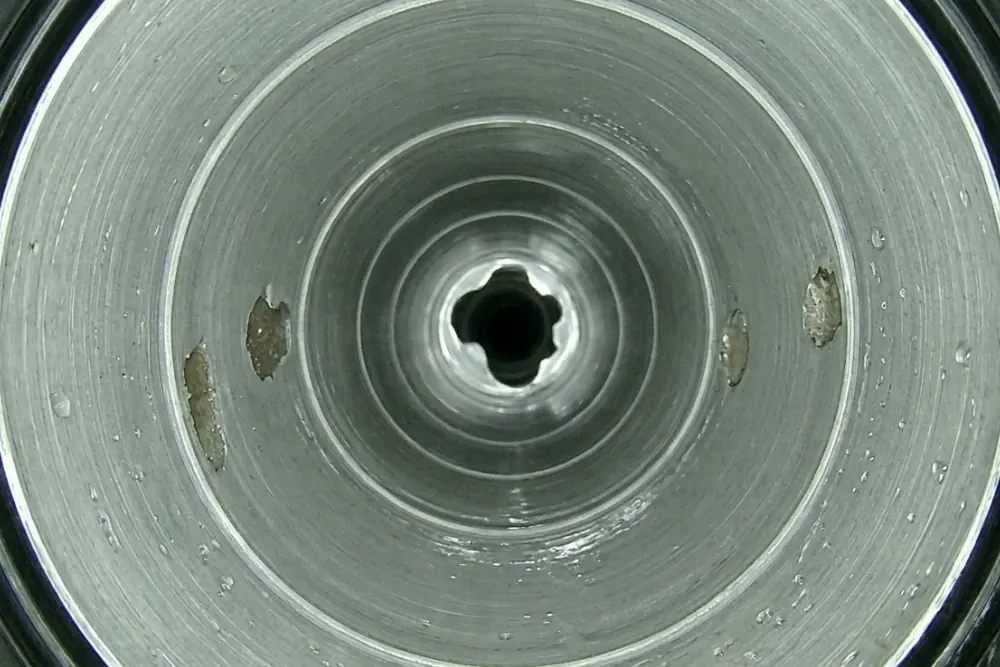
You will see intervals quoted, but a repeated number is not evidence. The interval comes from the line. A grease line from a kitchen blocks on the kitchen's schedule, and a villa's main on the garden's and the pipe's. The camera after a jetting shows how clean the wall is and where deposits start. We set a revisit from what the camera shows and from how fast the drain re-blocks, and we write the date on the note.
Jetting a kitchen line
A kitchen waste line is packed with fat that has hardened inside the pipe, and a jet that is only pushing through leaves a thin channel that fills again. A small nozzle that scours the wall, with plenty of flow, cuts the fat and carries it away. In a restaurant or hotel the line runs to a grease trap, and the debris and washwater need collecting at the trap and not sent on to the sewer. In a flat the kitchen branch joins a shared stack, so we tell building management before we jet it. Hot water softens grease, and a kitchen that is given a tidy habit of wiping pans before washing them needs the line jetted far less often.
Jetting a villa's external run
A villa's drain runs from the house to a chamber and from there to the connection or a tank. Silt, sand, grease, wipes and sometimes roots build up along it. We open the chamber nearest the blockage, run the camera to see the pipe, then jet toward the downstream chamber so the debris travels away from the house. Where the end of the line is a septic tank and not a sewer, the tank's level is checked first, because jetting into a full tank pushes the water back up the line. See septic and STP.
Car park, plant room and yard drains
A floor drain in a car park, a plant room or a yard collects sand, dust, oil and silt, and these settle into a sludge that blocks the outlet. The jet breaks it up, and the washwater carries oil, so it must be collected and not sent to a stormwater drain. We tell you how much the drain collects and whether a silt trap or gully trap upstream would reduce the work. See manhole and gully.
Roots in a garden line
Roots enter a joint looking for water and grow into a thick mat that catches everything that passes. A cutting head on the jet clears the mat. The roots will grow back until the joint is sealed, so the camera after the cut shows where the pipe is damaged and whether a patch or a replacement length is the answer. Palms and garden trees near the line are the usual cause.
Reading the camera footage
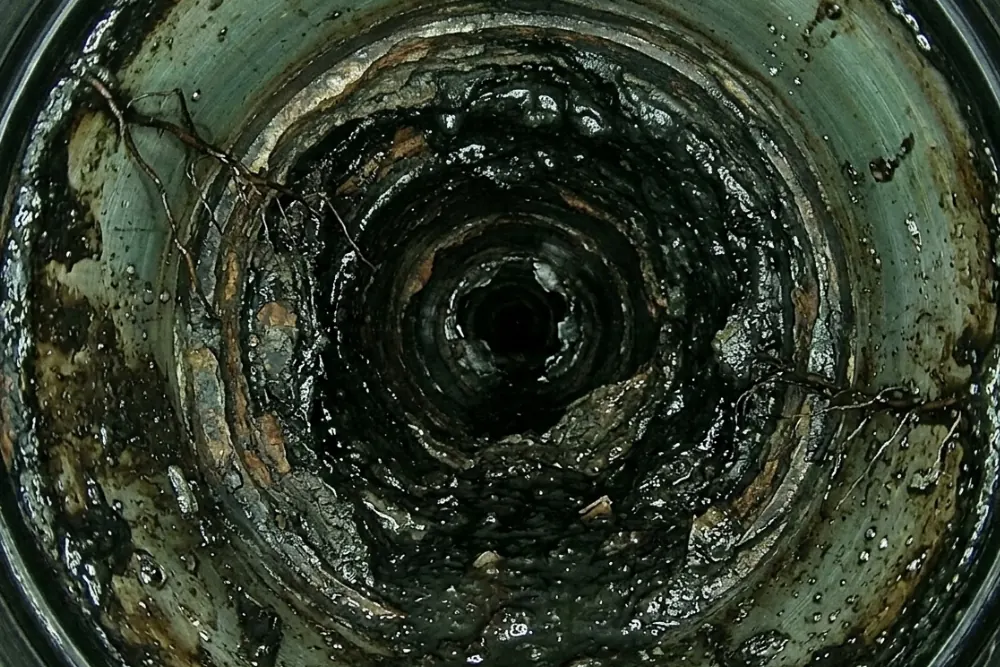
The footage shows the pipe from the inside, and it is easier to read than it sounds. A clean pipe shows a smooth, even wall. A cracked pipe shows a dark line along its length, and an offset joint shows a step where two lengths no longer match. A sag shows as a pool of standing water along a stretch of sound pipe. Scale and grease show as a rough, lumpy lining. A hole through the wall shows soil or roots behind it. We stop the camera at each defect, record how far along the pipe it is, and mark it on the note, so a repair can be planned for the exact length.
Protecting the site while we jet
Jetting is noisy, wet and uses hoses that cross floors and stairs. We lay the hose so it does not trip anyone, cover the floor near the access, and keep the washwater inside the drain or a container. In a flat, we tell you which neighbours might hear the machine. In a shop or restaurant, we plan the work for a quiet hour, with the area cordoned, and ask the kitchen not to run water into the drain during the work. After the work, run each tap and flush each toilet in turn and watch for slow drains or gurgles. Tell us at once if anything is not right, within the 30-day workmanship warranty.
Jetting before a repair, and a repair after jetting
Jetting often comes before a repair. A cracked pipe cannot be patched or lined until it is clean, so the line is jetted, surveyed and then the defect is dealt with. A short crack or a slipped joint can be repaired where it is. A pipe with a long sag or a collapsed section needs a length replaced, which means digging or opening the floor. We give you the footage, mark where the defect is, and quote the repair separately, because it is a different job from the clean. See sewer line repair.
A tower's shared stack: who does what
A blockage in a shared stack is a building matter. If water backs up in the lowest flat when a flat above flushes, or several flats on one stack are slow together, the stack or the line at its foot is blocked, and the building's contractor jets it. We can inspect the branch from your unit, show with the camera that your own pipe is clear, and give you a written note that helps management find the fault. We do not enter another flat without the occupant's agreement or management's, and we do not jet a shared stack without the building's say-so.
What to expect when we arrive
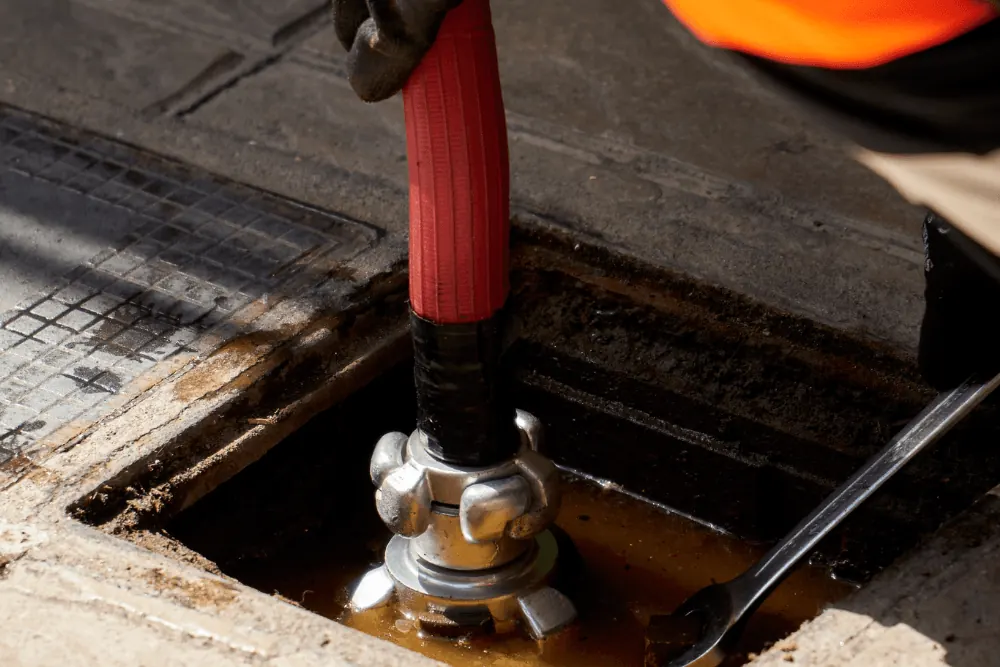
We ask again what has been happening, look at the fixtures and find the access: a clean-out, a gully, a chamber or a removed trap. If there is no access, we say so and tell you what must be fitted first, since jetting cannot start without it. We lay out the hose and protect the floor. If the pipe is not known, the camera goes in before any pressure. We tell you what we see before we jet, so the price and the method are agreed on facts. After jetting, the camera goes back in, and we run clear water until the line drains freely and check the fixtures upstream and downstream.
Permission in Dubai: who decides on jetting
Jetting an existing drain is maintenance. The questions arise when the drain is a shared line, when a chamber has to be opened, or when the washwater has to go somewhere.
This is general information and not legal advice. Tell us what your building asks for and we work to it. Where a jetting job falls:
| Job | Starting point |
|---|---|
| Jetting a blocked drain inside your own unit | Maintenance. Tell the landlord, and agree who pays. By default the landlord, unless your contract says otherwise |
| Jetting a shared line, riser or building drain | A common part. The building manager or owners' association decides access and timing |
| Reaching the line through a chamber | A chamber that is part of the public network is not ours to open. Ask the building before any chamber work |
| Collecting and removing the debris | A licensed tanker taking waste to an authorised point. Ask for the tanker operator's licence and the disposal record |
| Repairing a pipe damaged or revealed by jetting | A repair or alteration. Written consent. See sewer line repair |
We cannot say whether your building needs a certificate for a particular job. Building management can, and a request in writing is cheaper than a stopped job.
Warranty and the handover
What you should have when the job is finished:
- The before and after camera footage, with the date, for the stretch jetted.
- A written note: the line jetted and its length, the pipe material and diameter seen, the pressure, the nozzle and the flow used, and what came out.
- The disposal record: the tanker used, its licence and the authorised point it discharged to.
- Any damage found or caused, with its position and a photograph.
- A revisit date if one was set, and the reason for it.
- A clear warranty. Ask what the warranty covers and for how long, in writing.
- FAM's workmanship warranty, in writing. The warranty runs for 30 days and covers our labour only. Parts carry the manufacturer's warranty only.
How we work
- You tell us what is happening on WhatsApp: which drains, since when, whether it has been cleared before and by what method, and whether you own, rent or manage the building.
- We check on the visit what the drain serves, where the chambers are, what the pipe is made of if it is visible, and what a camera can reach.
- We run a camera first where the pipe is not known, and give you the footage.
- We give options and a price in writing: rodding, jetting or both, with the pressure approach and what each does not fix.
- Check permission. In a rented or managed property, ask the landlord or building management whether they need to approve this work before the visit.
- We jet, start at a lower pressure, raise it only if the pipe allows, keep the nozzle moving, and collect the debris at the downstream chamber where it matters.
- We camera the line again and hand over the written note, with the footage, the disposal record and the result.
Where we work in Dubai
We cover all of Dubai, including Dubai Marina, JBR, Downtown Dubai, Business Bay, Jumeirah Lakes Towers, Palm Jumeirah, Al Barsha, Jumeirah Village Circle, Dubai Hills, Mirdif, Deira and Al Quoz. See the full list of areas.
Which drains in a Dubai home or business suit jetting
Jetting is not a cure for every slow drain, and it helps to match the method to the pipe.
| Where | Typical blockage | Is jetting a good choice? |
|---|---|---|
| Kitchen waste line in a flat | Fat and food waste, packed into a narrow pipe | Yes, with a small nozzle. The hot, greasy buildup needs cutting rather than pushing |
| Main drain from a villa | Silt, sand, roots, grease, wipes | Yes. Jetting is the strongest tool for a long run and can scour the walls |
| Floor drain in a car park or plant room | Sand, dust, oil and silt | Yes, though the water and debris need collecting |
| Shower or basin trap | Hair and soap | Usually rodding or hand cleaning is quicker and less messy |
| A cracked or collapsed pipe | The pipe itself | No. Jetting can wash out the soil around a broken pipe. A camera comes first |
| Old cast iron or clay pipe | Scale, rust, partial collapse | With care. High pressure can damage thin or fragile walls |
| Roof and balcony drains | Leaves, dust and bird droppings | Often better cleaned by hand, then flushed |
Why drains block again
If a drain blocks again within weeks, jetting alone has not solved the cause. The usual reasons are:
- A dip in the pipe. Water collects in the sag and solids settle there. It needs regrading or replacing.
- A joint out of line. A step catches paper and fat.
- Roots. Common in garden lines. They come back unless the pipe is sealed or replaced.
- A kitchen with no grease control. Fat goes down the sink every day. Fat from a restaurant needs a grease trap, and a home kitchen needs the habit of wiping pans first.
- Too small a pipe or too little fall. An old line that cannot carry the flow of a larger family.
- Wipes and sanitary products. The most common cause in flats. They do not break down.
A camera survey after the clean is the way to find out which of these applies.
Jetting in a building: dealing with neighbours and management
In a flat, the main stack serves several homes. Jetting your kitchen branch can push debris into the shared stack, and a blockage lower down can send water into a neighbour's unit. Tell building management before the work, ask which access points you may use and whether the lower floors are at risk. If the stack itself is blocked, the work is a building matter and management arranges it. We can tell you what we see and what it means for the owner.
How much does drain jetting cost in Dubai?
The price depends on the line, not on a standard rate, because a short household branch and a long building drain are different jobs. The price follows these items:
- The camera survey, before and after.
- The visit and diagnosis. The visit fee is AED 50 + VAT, and it comes off the bill when you go ahead with the work.
- Labour and equipment. Machine, hose length, operators and the observer the safety controls call for.
- Length, diameter and access to the line, including chamber covers.
- Disposal. Collection, tanker, authorised discharge and the paperwork.
- Pipe condition. A fragile pipe means lower pressure and more time, or a repair first.
- Building rules. Permission, access hours and working at a shared riser.
We do not publish a starting price for this job. Send a photo on WhatsApp and we give you a fixed price before we start. Prices exclude 5% VAT.
Drain jetting FAQs
What is drain jetting?
Water at high pressure goes through a hose and nozzle to scour the inside of a drain. It clears grease, sludge and silt from the pipe wall, which a rod or a snake would pass through.
How is jetting different from rodding or snaking?
Rodding and snaking open a path of a few centimetres through the blockage, and do not clean the pipe walls. Jetting cleans the walls. See the comparison above.
What pressure is used for drain jetting?
It depends on the pipe. Soft debris clears at modest pressure, heavier build-up needs more, and a pipe of unknown condition stays low. We set the pressure from the pipe material and the camera, start low and raise it.
Can jetting damage my pipes?
Yes, if the pressure, the nozzle or the pipe's condition is wrong. Old, cracked, thin-walled or badly repaired pipe is at risk. That is why we run a camera first on a pipe nobody has surveyed.
Will jetting fix a collapsed or cracked drain?
No. See sewer line repair for patching, lining and replacement.
How often should drains be jetted?
There is no fixed interval. We set a revisit from the camera after the job and from how fast the drain re-blocks. A grease line may need it often and a clean villa main rarely.
Where does the dirty water go?
A licensed tanker takes the collected waste to an authorised discharge point, and nothing goes to a stormwater drain or open ground. Ask for the tanker's licence and a disposal record.
Is jetting dangerous?
Yes, to the operator, if the work is not controlled. The water jet can pierce skin, and a hose can whip. We use foot controls, a second person watching and full protective gear. Stay clear of the hose and nozzle, and keep children and pets away.
Do I need permission to have a drain jetted?
A flat's own drain is maintenance, so tell the landlord and agree who pays. A shared line or a chamber is for building management, and a public sewer chamber is not ours to open. This is not legal advice.
How much does jetting cost in Dubai?
It depends on the length, the access, the pipe and the disposal. We give a fixed price in writing, after the camera survey where the line is not known. Prices exclude 5% VAT.
Book drain jetting in Dubai
Tell us which drains are slow or blocked, whether they have been cleared before and how, whether it is a villa, a unit in a building or commercial premises, and whether you own or rent. Photos of the drains and chambers help. If sewage is coming up inside, stop using the fixtures on that line and call. We will check the pipe, run a camera where it is not known, jet it, and give you the footage and a written note.
WhatsApp: +971 55 407 7427 · Request a quote
Visit us: Office 871, Oasis Mall, Al Quoz 1, Dubai, UAE
Related services: Sewer line repair · Drain unblocking · Grease trap · Manhole and gully · Septic and STP · Drain general · Leak detection