
Grease trap services in Dubai: what we do
- Grease trap and interceptor cleaning: pumping out the whole contents, scraping the walls and baffles, and checking the lid, seal and fittings.
- Inspection and a written report: how full the trap is, the condition of the inlet and outlet fittings and baffles, and what needs repair.
- Repairs: baffles, inlet and outlet fittings, lids and seals, and the pipes between the kitchen and the trap.
- New installation or replacement: under-sink units, in-ground interceptors and automatic recovery units, subject to the building's and the authority's approval.
- Records and disposal paperwork: a service note with the date, the amount removed, the collector and the disposal point.
- Odour checks: tracing a smell in a kitchen to the trap, the lateral line or a dry floor drain.
Neighbouring topics have their own pages. High-pressure cleaning of the kitchen line, with its pipe-pressure limits and tanker enforcement, is on drain jetting. The owner's duties for the building's private sewer, its survey and repair, and the confined-space gas safety points are on sewer line repair and cleaning. Blocked sinks and floor drains are on drain unblocking and drain general, chambers and gullies on manhole and gully, tanks and treatment plants on septic and STP, and the sink fixtures themselves on kitchen sink. Leaks around a trap or its pipework are on leak detection.
What a grease trap is, and the four types
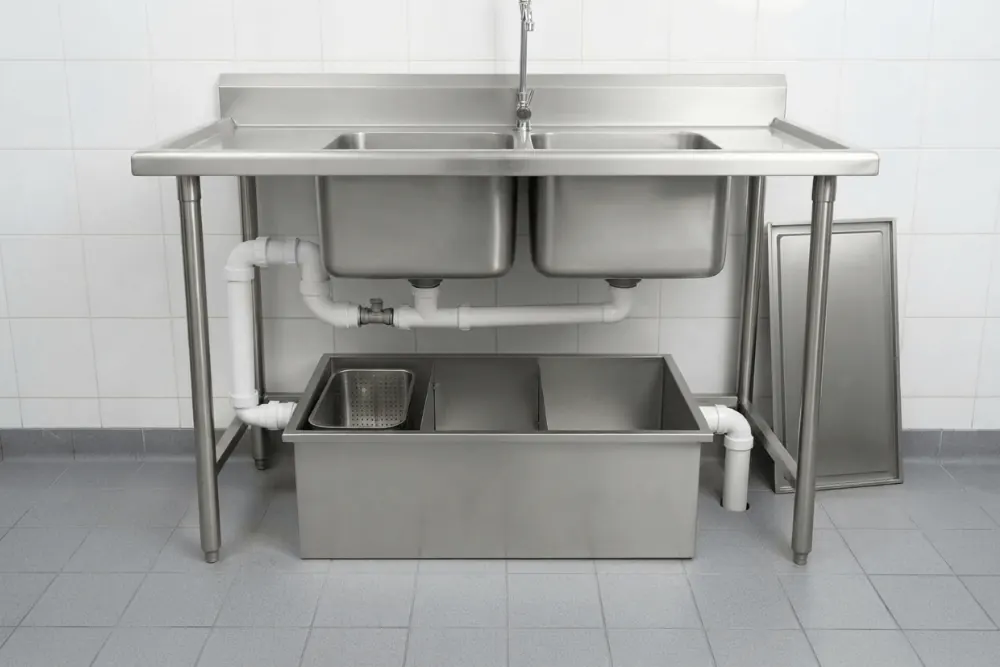
A grease trap, also called a grease interceptor, is a chamber that slows kitchen wastewater so that grease floats, solids sink and the water in between moves on. The names overlap, but the units fall into four types:
| Type | What it is | Where it fits |
|---|---|---|
| Under-sink hydromechanical (passive) unit | A small steel or plastic box that fits under or beside a sink, with baffles and an air-entrainment inlet. Cleaned by hand | A small kitchen with a compact space and staff who clean it on schedule |
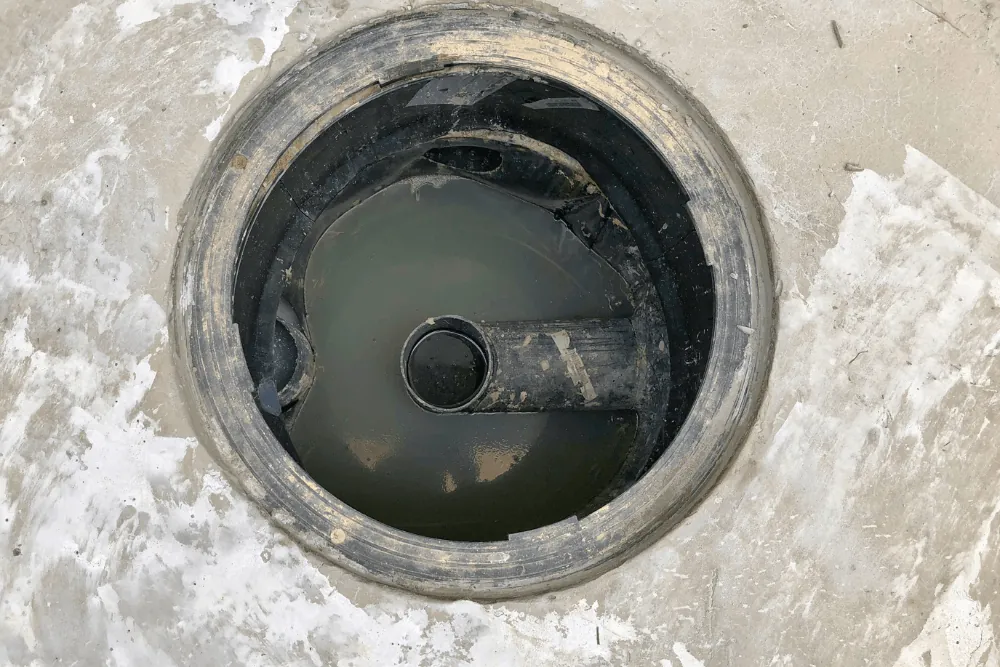
| Gravity interceptor | A larger concrete, steel or plastic tank, usually in the ground outside the kitchen, with a long retention time | A kitchen with a dishwasher, a pot-wash sink and a high flow |
| Automatic grease removal unit (AGRU) | A unit that skims the grease off automatically into a container, on a timer | A busy kitchen that wants less manual cleaning, at a higher purchase price |
| Large separator | A multi-chamber separator with a sludge trap, for food factories and large catering | A food factory or central kitchen, designed to the flow and the waste |
A small kitchen with a compact space and staff who clean it on schedule suits an under-sink unit; a kitchen with a dishwasher and a pot-wash sink has a flow that outgrows one and points to a gravity tank outside the kitchen; and an AGRU is a way of buying less manual cleaning with a higher purchase price. In every case the authority's approved specification decides.
Sizing a grease trap
A trap is sized from what drains into it, not from the number of covers or the size of the room. Three things set the size: the flow from the sinks, the dishwasher and the floor drains, how long the water must stay in the trap for the grease to separate, and how much grease and solid food the kitchen sends down. A kitchen with a dishwasher and a pot-wash sink has a much higher flow than a kitchen with one hand-wash sink, and the trap must be sized for the busiest hour, not the average.
Bigger is not better. A very large tank holds waste so long that it turns septic and smells, and an undersized unit fills quickly and lets grease pass. The designer sizes it from the actual fixtures and the dishwasher flow, and the building and the authority approve the size before anything is bought. We do not size by a rule of thumb from another kitchen. Send us the fixture list, the dishwasher model and a photo of the existing trap, and we tell you whether it is the right size for what drains into it.
Rules that apply to a commercial kitchen in Dubai
The building and the authority set what applies to your premises, and the requirements can change. In general terms:
- Grease traps are expected at restaurants, food factories, hotels and similar kitchens. Car washes and workshops need oil traps, which are a different trap for a different waste.
- Some discharges are barred. Anything toxic or hazardous cannot go down the drain.
- The owner is responsible for the building's private drains, including blockages, overflows and leaks.
- Breaches can bring fines and, in serious cases, closure. Ask the authority and building management what applies to your premises.
Grease collected from a trap has to go to an authorised recycling point, carried by a licensed operator who records where it was collected and where it was deposited. It is never poured into storm drains, open land or a manhole. How often a trap must be cleaned is set by the authority and the building and can change, so ask for the current requirement in writing and do not rely on a figure from an old article.
How often to clean a grease trap
There are two ways to set the interval: a calendar date and a fullness reading. The fullness reading is the better one, because kitchens differ so much.
A common working rule is to clean the trap when the grease layer and the settled solids together fill about a quarter of the depth of the liquid. To check it, push a pole to the bottom, note where the solids stop and the grease layer starts, and compare that to the total depth. At a quarter full the trap is working less well, and at half full grease is already passing through. A maker's stated maximum capacity comes before this rule where it is known.
Calendar intervals vary widely with the kitchen. A busy fry kitchen with an under-sink unit may need cleaning every week or two, a restaurant with an outdoor interceptor may need it every month or two, and a quiet cafe may go longer. A new trap is checked more often at the start, until you know how fast it fills. A kitchen that fills a trap in three weeks is not served by a quarterly contract. We follow these steps:
- Start from the authority's and the building's requirement. Ask what the permit or the lease requires, and write the answer into the service note.
- Measure, then set the interval. We record the grease and solids depth at each visit and set the next date from how fast it filled.
- Move the date when the kitchen changes. A new menu, longer opening hours or a second fryer all change the load.
What a proper clean-out involves
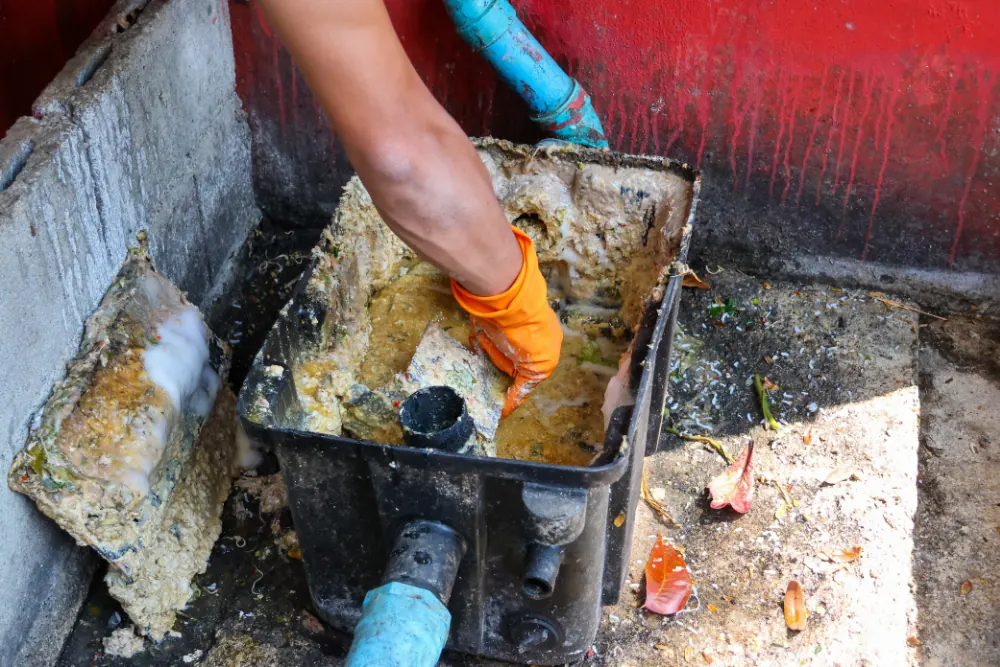
A proper clean-out is more than skimming the top:
- Open the lids and check the depth of grease and solids with a gauge, so the next date has a basis.
- Pump out the whole contents, water, grease and solids, not just the floating layer.
- Scrape and wash the walls, the baffles and the lid, and check the inlet and outlet fittings, the baffles and the seal.
- Refill with clean water to the outlet level, so the trap works from the first use.
- Record and dispose: the amount removed, the collector, the disposal point and the date.
Leaving some of the contents behind, or skimming only the top layer, is the most common shortcut. It saves the contractor a load and returns the problem within weeks.
Records and disposal paperwork
Keep the measurements and the dates, and the collection records. What you should hold after each clean-out:
- The date and the trap's location, with its size if known.
- The measured depth of grease and solids before cleaning, so the next date has a basis.
- The collector's name, licence and the disposal point, with the coupon or other record where one exists.
- What was found and repaired: damaged fittings, baffles, lids or seals, with a photograph.
- The next date, and the reason for it.
Faults: what goes wrong with a grease trap
| Fault | What to know | What we look for |
|---|---|---|
| Full trap, short interval | See the section on how often to clean | The interval was set too long, or the kitchen's grease load grew |
| Smell in the kitchen | The trap, the lateral line or a dry floor drain | A lid that does not seal, a trap that is overfull, or a floor drain with no water in its trap |
| Slow sinks upstream | Grease coating the pipe between the kitchen and the trap, or a blocked inlet | Jetting the kitchen line and checking the inlet fitting. See drain jetting |
| Grease downstream | The trap is full, or a baffle has failed, so grease passes through | Pumping, and replacing the baffle or outlet fitting |
| Water backing up from the trap | A blocked outlet, a full trap or a blocked line beyond it | Clearing the outlet and the line, and checking the cover and the vent |
| A cracked lid or seal | Wear, traffic or a bad fit | Replacing the lid or the seal. A broken lid is also a safety risk |
| Corroded or cracked tank | Age, acid from rotting food, or ground movement | A repair or replacement, with the authority's approval |
Additives, enzymes and bio-dosing
Products sold for grease traps fall into three groups: solvents, enzymes and bacteria, and detergents that emulsify grease. None of them replaces pumping and cleaning.
- Solvents and detergents loosen grease so it passes through the trap, and it re-forms further down the line. They move the problem and do not remove it.
- Enzymes and bacteria can break down some grease between cleanings, but they cannot remove solids, and they do not work in a trap that is hot, full or treated with strong cleaning chemicals.
- Some products are barred where they carry grease through the trap. If someone offers an additive programme as a substitute for pump-outs, ask for the authority's written position and the product's safety data.
The dependable fixes are frequent, complete pumping and cleaning, strainers on every sink, and keeping used oil out of the drain.
Hot water and dishwashers
Temperature matters. Grease separates best when the wastewater is cool, and very hot dishwasher discharge melts the grease and carries it through the trap. Dishwashers discharge very hot water, and where the design requires it, that discharge is cooled before it reaches the trap or taken to a separate line. Do not flush drains with excess hot water.
What goes into the trap and what must stay out
Only kitchen wastewater from sinks, dishwashers and floor drains goes into the trap. What must stay out:
- Food solids. Fit a strainer on every sink and floor waste, and scrape plates into a bin before washing.
- Fryer oil. Collect used oil in a container and send it for recycling. It never goes down a drain. Keep the fryer oil container within reach of the fryer, so staff do not take a shortcut.
- Toilet and washroom waste. It belongs to the sewer line and not the trap.
- Chemicals, solvents and cleaning concentrates, in quantity.
- Garbage disposer waste. A disposer adds solids and grease to a trap that is not sized for them, and many authorities prohibit it.
Installation: location, venting, levels, access and the dishwasher
Installing a grease trap is a design job, and the rules come from the authority and the building. The points that matter:
| Point | What to know |
|---|---|
| Location | Close to the fixtures it serves, and reachable by a tanker. An in-ground interceptor needs clear access above it |
| Air gap | A legal air gap for sinks or equipment draining into floor sinks before the trap inlet |
| Venting | The trap is vented so the water can flow and the seal is kept. The vent follows the drainage design |
| Levels | The inlet is above the outlet, and the invert levels match the line. A trap installed out of level does not hold the grease |
| Access | Lids that can be opened without moving equipment, and enough headroom to scrape and wash |
| Dishwasher | Cool the dishwasher discharge before it reaches the trap, or take it to a separate line where the design requires |
On the dishwasher and the sink fixtures, see the temperature point above. For the sink itself, strainers and the tap, see kitchen sink.
A villa or flat kitchen is a different case, and a home trap is the building's or the owner's choice.
Odour and gas: safety
A trap with decomposing contents can give off hydrogen sulfide, the rotten-egg gas that fades from your nose as you breathe it, which is why a smell is no measure of how much is there. The confined-space safety points are on sewer line repair and cleaning. The points that matter for a trap:
- Do not open the lid and lean in. A trap that smells is a trap with septic contents.
- An in-ground interceptor is a pit. Nobody climbs into it. The contractor pumps and washes it from outside, with lids open and ventilation, and a person entering is a case for the confined-space procedure, not a kitchen job.
A grease trap in a villa or a small cafe
Not every trap is in a large restaurant. A small cafe or a home kitchen run as a business often has an under-sink unit, and these are the ones most often forgotten. They are small, they fill in a few weeks and they sit in a cupboard that no one opens until the sink backs up. Put the trap on a written schedule, keep a pole and a scoop for the weekly check, and know where its lid is. A villa kitchen without a trap still gets grease on the pipe wall, and a monthly hot flush and a bin for fat keep the sink waste clear. See kitchen sink and drain unblocking.
Training staff to protect the trap
A trap fails faster than it should when staff treat the sink as a bin. Three habits make the biggest difference. Scrape plates and pots into a bin before washing, so food solids never reach the trap. Pour used fryer oil into a lidded container kept next to the fryer, and send it for recycling. Fit strainers in every sink and floor drain, and empty them at the end of every shift. A short note on the wall above the pot-wash sink, in the languages your staff speak, does more than a policy in a folder. We can walk the kitchen with the head chef or the manager on the cleaning visit and show where the grease is coming from.
What a well-kept trap log looks like
A one-page log, kept by the trap or in the kitchen office, gives an inspector or a landlord what they ask for. Each line has the date, the depth of grease and solids, who read it, whether it was pumped, the amount removed and the collector. A trap that is read weekly and pumped when it needs it shows a clear pattern, and the pattern justifies the interval. A trap with no log and a smell is the one that draws attention. We fill in the first lines on our visit and leave the form with you.
When the problem is not the trap
A kitchen drain that backs up is not always the trap's fault. If the trap is clean and the sink still drains slowly, the blockage is between the sink and the trap, or beyond the trap in the line to the sewer. If several fixtures back up at once, the main line may be blocked. If the trap is clean and the smell stays, a dry floor drain or a leaking waste pipe may be the cause. We trace the problem on the visit and say what we found, so you do not pay for another pump-out that does not fix it. See drain jetting and sewer line repair and cleaning.
Under-sink unit or in-ground interceptor: how to choose
The choice usually comes down to flow, space and who does the cleaning. An under-sink unit is cheap, sits next to the fixtures and is cleaned by hand, but it is small and fills fast, so it suits a kitchen with one or two sinks and a person who will actually lift the lid every week. An in-ground interceptor holds far more, needs a pumping tanker and a clear lid above it, and suits a kitchen with a dishwasher, a pot-wash sink and a steady flow. It is cleaned less often, but when it is neglected the smell and the cost are bigger. An automatic removal unit takes the grease off by itself, which suits a kitchen where nobody has time to scoop, at a higher purchase price and with its own service needs. Whichever you choose, ask who will clean it, how often, where the waste goes and what the access looks like, before you buy. A good unit with no one assigned to look after it fails the same as a bad one.
Permission in Dubai: who decides on a trap
Cleaning a trap is maintenance. Installing, moving or replacing one is a change to drainage that the building and the authority will want to see. A commercial kitchen fitted out in a Dubai building needs the building management's and the authority's approval before the unit is bought. Tell us what your building asks for and we work to it. This is general information and not legal advice. Where a trap job falls:
| Job | Starting point |
|---|---|
| Cleaning an existing trap in your own unit | Maintenance. Tell the landlord and building management, and agree who pays. A restaurant lease may assign the trap to the tenant, which is a contract question |
| Cleaning a shared or building-level interceptor | A common part. The building manager or owners' association decides access and timing |
| Collecting and removing the contents | A licensed collector taking waste to the authorised point. Ask for the collector's licence and the disposal record |
| Replacing a trap, moving it or adding a second one | A change, which needs the landlord's written consent and the building's and authority's approval |
| Opening a public sewer chamber | Not permitted for anyone. See manhole and gully |
Warranty and the handover
What you should have when the job is finished:
- The service note described under records above, signed and dated.
- A photograph of the trap before and after, with the lid off, showing the baffles and fittings.
- The disposal record: the collector, its licence and the point it discharged to.
- Any damage found or caused, with its position and a photograph.
- The next date, with the depth reading it is based on.
- A clear warranty. Ask what the warranty covers and for how long, in writing.
- FAM's workmanship warranty, in writing. The warranty runs for 30 days and covers our labour only. Parts carry the manufacturer's warranty only.
How we work
- You tell us what is happening on WhatsApp: the kitchen, the type and size of trap if you know it, when it was last cleaned and by whom, and whether you own, rent or manage the building.
- We check on the visit where the trap and its lids are, the depth of grease and solids, the condition of the fittings, and what the kitchen sends to it.
- We give options and a price in writing: clean only, clean and repair, or replace, with what each does not fix.
- Check permission. In a rented or managed property, ask the landlord or building management whether they need to approve this work before the visit.
- We pump out the contents, scrape, wash and inspect the fittings, and refill.
- We take the waste to an authorised point and keep the record.
- We hand over the service note and photographs, with the next date.
Where we work in Dubai
We cover all of Dubai, including Dubai Marina, JBR, Downtown Dubai, Business Bay, Jumeirah Lakes Towers, Palm Jumeirah, Al Barsha, Jumeirah Village Circle, Dubai Hills, Mirdif, Deira and Al Quoz. See the full list of areas.
Reading a trap from the lid
Lift the lid and look before you decide anything. A trap that is working shows a thin cap of grease on top, clear water in the middle and a layer of solids on the bottom. A thick, hard cap, water that is grey or milky all the way down, or a smell of rancid fat tells you the trap is past its interval. Push a pole to the bottom and note where the grease and solids stop: when they fill about a quarter of the liquid depth, the trap is working less well, and when they fill half, grease is already passing through. Write the depth down with the date. Two or three readings give you the interval that suits your kitchen, which is better than a calendar date copied from another kitchen.
How much does grease trap cleaning cost in Dubai?
The price depends on the trap, the load, the access and the disposal, and we do not publish a starting price for this job. A few reference points help you read a quote:
- A tipping fee is charged at the grease recycling plant and is part of what a collector passes on.
- Buying and installing a trap ranges from a low cost for a small under-sink unit to many thousands of dirhams for an underground interceptor, and more for the largest industrial units. Access, tanker and disposal arrangements change the figure from one kitchen to the next.
The price follows these items:
- How often. A weekly kitchen costs more over a year than a quarterly one.
- Access. How far the trap is from where the tanker can park, and a surcharge for difficult access.
- Disposal. Collection, tipping fee and the paperwork.
- Repairs. Fittings, baffles, lids and seals.
- Building rules. Permission, access hours, and working in a shared service area.
We do not publish a starting price for this job. Send a photo on WhatsApp and we give you a fixed price before we start. Prices exclude 5% VAT.
Grease trap FAQs
What is a grease trap?
A chamber that slows kitchen wastewater so grease floats, solids settle and the water between them moves on.
Does my kitchen in Dubai need one?
Yes, if it is a restaurant, food factory, hotel or similar commercial kitchen. A home kitchen is a different case, and is usually served by a plain sink trap.
How often should a grease trap be cleaned?
It depends on the kitchen. We measure the trap and set the date from the reading, using the quarter-full rule. A busy kitchen may need weekly or monthly cleaning, and a quiet one less often. Ask what your permit or lease requires.
What is the quarter-full rule?
Add the depth of floating grease to the depth of settled solids. When together they fill about a quarter of the depth of the contents, the trap is cleaned. Where the manufacturer states a maximum capacity, that comes first.
What does a proper clean-out involve?
Pumping out all the water and solids, scraping and washing the inside, inspecting the baffles and the inlet and outlet fittings, refilling with water, and recording the date, the amount and where it went.
Can enzymes or bacteria replace pumping?
No. Enzyme and bacteria products can break down some grease between cleanings, but they do not remove the solids and the grease cap that build up in the trap. The trap still has to be pumped out and cleaned on schedule, and the records kept.
Why does my grease trap smell?
A smell means the trap is full, the lid does not seal, or a floor drain has dried out. Do not open the lid and lean in, because the contents can give off hydrogen sulfide. Call us and we find the cause.
Where does the grease go?
To an authorised grease recycling point. Collection is recorded, so ask for the collector's licence and the disposal record.
Do I need my landlord's permission?
For cleaning, tell the landlord and building management. For replacing or moving a trap, written consent and the building's and authority's approval. This is not legal advice.
How much does it cost?
It depends on the trap size, how full it is, the access and the disposal. We give a fixed price in writing after a visit or from photos. Prices exclude 5% VAT.
Book grease trap cleaning in Dubai
Tell us the kitchen, the type and size of trap if you know them, when it was last cleaned, whether you smell it or see slow drains, and whether you own or rent. Photos of the trap and its lid help. If water is coming up in the kitchen, stop using the sinks on that line and call. We will check the trap, clean it, inspect the fittings, and give you a written note with the date and the disposal record.
WhatsApp: +971 55 407 7427 · Request a quote
Visit us: Office 871, Oasis Mall, Al Quoz 1, Dubai, UAE
Related services: Drain jetting · Sewer line repair · Drain unblocking · Manhole and gully · Septic and STP · Drain general · Kitchen sink · Leak detection