
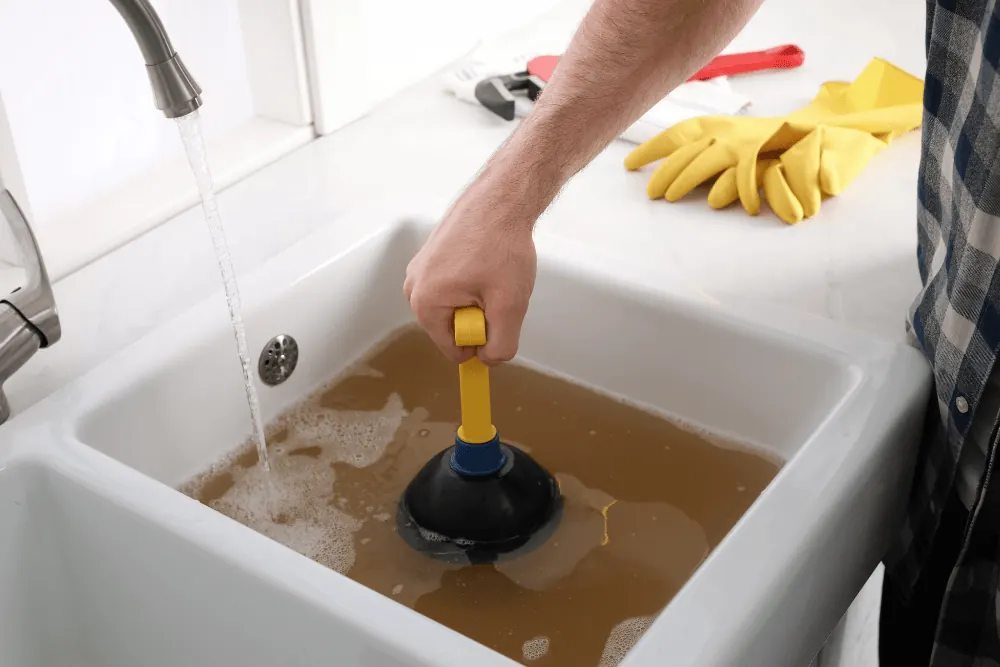
Which drain is blocked, and what could be wrong?
Where the problem shows up narrows the cause. Use this table to match what you see to a possible cause, then read the matching section below.
| What you notice | Possible cause | What clears it |
|---|---|---|
| One sink or basin drains slowly | Soap, toothpaste and hair built up in the trap or branch pipe | Trap cleaned, snake through the branch |
| Kitchen sink drains slowly and smells | Grease and food waste coating the pipe | Hot-water flush, snake, then jetting for heavy build-up |
| Shower water pools around your feet | Hair and soap caught on the drain grate or in the trap | Grate and trap cleaned, snake if needed |
| Bath drains slowly or gurgles | Hair and body oils in a long horizontal run | Snake from the overflow or waste |
| Toilet bowl rises then drains slowly | Paper, wipes or a partial blockage in the toilet trap or branch | Plunger or toilet auger, then snake |
| Several fixtures slow or gurgle at once | Blockage in the shared branch or the main line | Camera check, machine snake or jetting |
| Water backs up in one fixture when you use another | Main line is partly blocked | Camera check, then jetting |
| Smell from a floor drain but water drains fine | Dry trap or a venting problem, not a blockage | Refill the trap, check the vent |
| Washing machine drains slowly or overflows the standpipe | Lint, detergent sludge, a kinked or blocked hose | Hose and standpipe cleaned |
| Balcony or roof drain overflows | Sand, leaves and dust packed into the outlet | Outlet cleared, trap flushed |
| Sewage smell or wet patch outside the villa | Blocked manhole, gully or external line | Chamber cleaned, line jetted |
If your fault is in the main line or keeps returning, read our page on sewer line repair and cleaning as well.
Drain unblocking services in Dubai: what we clear
Every drain in a home has a different shape, a different type of debris, and a different weak point. These are the ones we are called to most, and how we approach each.
Kitchen sink drains
Kitchen drains block with grease. Fat, oil and food waste go down hot and liquid, then cool and stick to the pipe wall. Layer by layer, the pipe narrows until the water slows or stops. The smell you notice before a kitchen drain fully blocks is the same grease going rancid.
We start by clearing the trap and strainer, which holds the first plug of waste. Then we run a snake through the branch pipe. Where the grease coating is thick, we recommend jetting, because a snake punches a hole through the blockage but leaves the coating on the pipe wall, and the sink slows down again. If your kitchen sink and dishwasher share a waste pipe, we check both.
Bathroom basin drains
A basin blocks with soap scum, toothpaste, shaving residue and hair, bound into a sticky mass just below the plug. Basin drains also have a narrow trap and a pop-up waste mechanism that traps debris on its stem.
The fix is to remove the pop-up, clean the stem and trap, and snake the pipe behind it. We then run the tap to confirm the water flows freely.
Shower drains
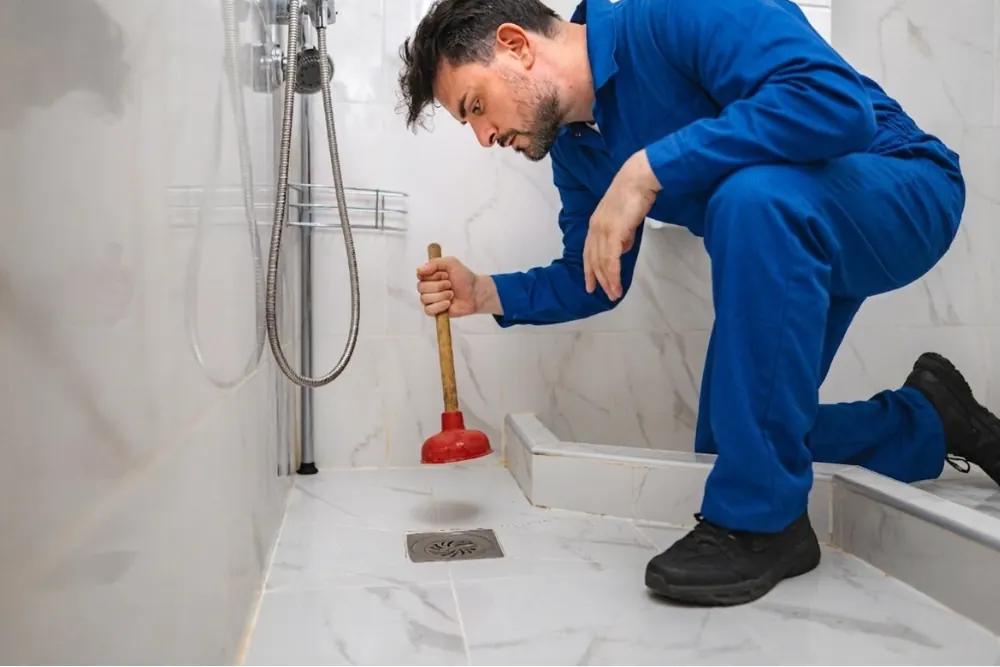
Hair is the main cause. It tangles with soap and shampoo residue on the crossbars of the drain and in the trap below. A shower that pools around your ankles while you wash is a partial blockage, not a leak.
We lift the grate, clear the trap by hand, and use a small drain snake to remove hair deeper in the pipe. If water has been standing at the drain, we also check the waterproofing around it for damage.
Bathtub drains
Baths drain through a long, shallow pipe that gives hair and body oils plenty of room to build up. Bath oils and products leave a film on the pipe wall. The overflow channel can also carry a blockage or a smell.
We clear the waste and overflow, snake the horizontal run, and flush with hot water. A bath that has slowed gradually needs the pipe cleaned along its length, not just at the plug.
Floor drains
Floor drains in bathrooms, kitchens, laundry rooms and balconies fail in two ways. They block with debris, or they dry out. A dry floor drain has no water in its trap, so sewer gas comes up into the room. A drain that is not used loses its water seal to evaporation.
If your floor drain smells but water drains normally, pour a jug of water into it and wait a day before assuming it is blocked. If the smell returns, we check the trap and the vent. If water drains slowly, we clear the grate and trap, then snake or jet the line.
Toilet blockages
A toilet blocks when too much paper, a wipe or a foreign object sticks in the trap, the curved passage built into the bowl. Wipes sold as "flushable" do not break down in a household pipe the way toilet paper does. Children's toys, cotton buds and sanitary products are other frequent culprits.
We use a toilet auger, which is shorter and gentler than a drain snake, so we do not scratch the porcelain. If the toilet blocks again within days, the blockage may be further down in the branch pipe, and we check that. For a stand-alone toilet fault, see toilet unblocking.
Washing machine and dishwasher drains
A washing machine pumps water out through a hose into a standpipe, a vertical pipe with a trap. Lint, fibres and detergent sludge collect in the hose and trap. When it blocks, water can rise up the standpipe and spill onto the floor.
We clean the hose, standpipe and trap, check that the hose is not kinked or pushed too far into the pipe, and confirm that the connection allows air in to prevent siphoning. See also washing machine plumbing.
Balcony and roof drains
These outlets sit outdoors and collect sand, dust, leaves and bird debris. They are also in the sun, so any water seal in the trap dries out between rains. A blocked balcony drain turns the first heavy rain into a flooded balcony, or water coming under the door.
We clear the outlet and the pipe beneath it, flush the trap, and check that the balcony slopes toward the drain. See rainwater and gutter drainage for downpipes and roof outlets.
Outside gullies, manholes and external lines
Villas have chambers and gullies outside, joined by underground pipes. They block with sand, soil, roots, wipes and grease. Signs are an overflowing gully, a smell near a manhole cover, or toilets that flush slowly with no sign of a blockage inside.
We lift the covers, see where the blockage is, and clear it with a machine or jetter. For recurring problems, we run a camera through the line. See manhole and gully cleaning.
Main drain and shared branch lines
When several fixtures slow down together, the blockage is not in a single fixture trap. It is in a pipe they share. We locate it by testing which fixtures are affected and which are not, then use a machine snake or a jetter and confirm with a camera. This is where a plunger or a bought chemical cannot reach.
How we find where the blockage is
We ask three questions before we pick up a tool.
- Is it one fixture or several? One slow fixture points to its own trap or branch. Several fixtures slowing together point to a shared line.
- Does water back up somewhere else? If flushing the toilet makes the shower drain gurgle or fill, the shared line is restricted.
- Is it getting worse, or did it happen suddenly? A slow decline points to build-up, and a sudden complete block points to an object or a collapsed section.
Then we look. We open the trap, lift covers and check the visible part of the pipe. If the cause is not obvious, or if the blockage returns, we use a drain camera to see the inside of the pipe: the debris, the joints, any offset or crack. A camera shows the pipe instead of guessing.
Which method will we use?
Different blockages need different tools. Using too much force on a fragile pipe causes damage, and using too little only moves the problem. These are the main methods and when each is the right choice.
| Method | How it works | Best for | Limits |
|---|---|---|---|
| Plunger | Pressure and suction move a soft blockage | Toilets, basins, sinks with a light blockage | Does nothing for a hard blockage or a deep one |
| Drain snake or auger | A rotating cable breaks up or hooks the blockage | A single blockage in a branch pipe, retrieving objects | Leaves a coating on the pipe wall, so grease returns |
| Machine snake | A powered cable with cutting heads for larger pipes | Longer runs, roots and hard build-up | Needs the right head for the pipe material |
| Hydro jetting | High-pressure water scours the pipe wall | Grease, scale, heavy build-up, recurring blockages | Needs sound pipework; not for a collapsed or cracked pipe |
| Drain camera | A small camera shows the inside of the pipe | Finding the cause, checking pipe condition before jetting | Shows the problem; does not clear it |
Our approach is to use the gentlest method that will work. A simple basin blockage does not need a jetter. A kitchen drain with years of grease does, because a snake alone will leave the coating behind. We explain our choice before we start. For the jetting method in detail, see high-pressure drain jetting.
Why jetting is not always the answer
Jetting is powerful, and that is why we check the pipe before using it. A pipe with a crack, a collapsed section or a poor joint can be damaged by high-pressure water. In those cases we use a snake to clear the blockage and then quote a repair for the damaged section. A camera before jetting tells us which approach is safe.
Why drains keep blocking
These are the causes we find behind repeat blockages.
- Grease and fat poured down the sink. Cooking oil does not stay liquid in the pipe. It cools into a coating that catches food waste.
- Hair in showers, baths and basins. Hair tangles around soap residue and grows into a mat.
- Wipes and non-flushable items in toilets. Wipes do not break down like paper. They collect in the trap and branch pipe.
- Detergent and lint from washing machines. The sludge builds in the hose and standpipe.
- Sand and dust on balconies and roofs. Outdoor outlets clog with grit.
- Pipe problems. A pipe with too little fall, a sagging section or a poor joint holds water and debris. These blockages return after clearing.
- Scale and hard deposits. In older pipes or where water is heated, scale narrows the pipe from inside. See descaling and limescale removal.
- Roots and soil in external lines. Roots find joints and enter. Soil enters through cracks.
If your drain blocks again within a few weeks of being cleared, the cause was not removed. Tell us, and we will look deeper, with a camera.
What the sounds and signs mean
Drains warn you before they block completely. Reading the signs early saves a call-out at midnight.
- Gurgling after you use a fixture. Water is struggling to pass a restriction, or the pipe is not getting enough air. If it happens on one fixture, its trap or branch is partly blocked. If it happens in several, check the shared line or the vent.
- Bubbles rising in a basin when the toilet flushes. Two fixtures share a pipe, and the shared part is restricted.
- Slow drainage that is getting worse. A growing coating of grease, hair or scale. Clear it before it closes.
- A drain that clears for a day and slows again. The blockage was moved or partly cleared. The coating or obstruction is still there.
- Water standing for hours in a shower tray or basin. A near-complete blockage. Stop using the fixture.
- A smell that follows a blocked fixture. Trapped waste is decaying. A smell with no slow drainage points to a dry trap or vent instead.
- Sewage rising in the lowest drain in the property. A main line blockage. Stop all water use and WhatsApp us.
Situations that cause blockages
Some blockages follow a particular event. Knowing the event helps us find the cause quickly.
- After renovation or fit-out. Cement, tile adhesive, grout and plaster dust washed into drains harden inside pipes. Tell us if work was done recently. These blockages need a machine, and sometimes a repair, not a plunger.
- After moving into a new home. Previous occupants may have left grease or debris in the lines, and traps in unused bathrooms may be dry. A first-week check is worthwhile. For new fit-outs, see bathroom renovation and fit-out plumbing.
- After returning from a holiday. Traps can dry out while you are away. Run every tap, flush every toilet and pour water into each floor drain on your return. See the smell section above.
- After heavy rain. Balcony outlets, roof drains and external gullies that were already part-blocked fail when they get a lot of water at once. Check them before rain, not after.
- After a change in use. A home that now has more people, or a kitchen used for catering, produces more grease and waste than the pipes were sized for.
Blocked drain or leaking pipe?
Water on the floor near a drain does not always mean a blockage. Two quick checks separate the two.
- Blockage: The water appears when you use the fixture, and it rises or pools at the drain. It goes down slowly once you stop.
- Leak: The floor stays wet when no water has been used for hours, or a damp patch grows on a wall or ceiling below. The drain itself may flow normally.
Run water for a minute in the suspect fixture. If the wet patch grows only while the water runs, the waste pipe or a joint is leaking. If the drain fills and the floor stays dry until it overflows, it is a blockage. A leaking waste pipe needs repair, not unblocking. See pipe leak repair and leak detection.
Try these first, safely
Try the basic steps first. Do them in order, and stop as soon as something feels wrong.
- Remove what you can see. Lift the grate or plug and pull out hair and debris by hand, wearing gloves.
- Use a plunger the right way. Cover the drain fully with the cup, with enough water to cover the rubber. Use a plunger meant for sinks on sinks and a flange plunger on toilets. Push and pull firmly 10 to 15 times. Block the overflow hole of a basin or bath with a wet cloth so pressure goes down the pipe.
- Flush with hot water and dish soap. For a greasy kitchen sink, pour a kettle of hot, not boiling, water mixed with washing-up liquid. Very hot water can soften plastic pipe joints, so avoid pouring boiling water into PVC.
- Clean the trap. Place a bucket under the U-shaped trap beneath a sink or basin, unscrew the connections by hand, and empty it. Refit the washers correctly before you tighten.
- Try a hand drain snake. A short plastic or wire drain tool works for hair in a shower. Push it in gently, twist, and pull out what it catches.
If the water has not cleared after two rounds of this, stop. Repeated plunging can force a blockage deeper or loosen a pipe joint.
What not to do
Some attempts at fixing a drain make it worse or put you at risk.
- Do not use strong chemical drain cleaners. They are caustic. They can burn skin and eyes, damage pipes and fittings, and splash back out of a drain. Never mix different cleaners. If a chemical cleaner has failed and water is sitting in the drain, tell the plumber, because the water is hazardous and we need to handle it with protection.
- Do not pour grease, oil or coffee grounds down the drain. Scrape pans into the bin and wipe them with paper first.
- Do not flush wipes, cotton buds, nappies or sanitary products. The label "flushable" does not mean it is safe for your pipe.
- Do not push a rigid object such as a wire hanger down a toilet. It scratches the porcelain and can wedge the blockage tighter.
- Do not keep running water into a blocked fixture. It rises, overflows and damages floors.
- Do not ignore a drain that gurgles or smells. It is warning you early.
A smell without a blockage
Not every drain smell means a blockage. If water drains normally but you smell sewage, check these causes first.
- The trap has dried out. A floor drain, a spare-room basin or an unused shower loses the water seal that blocks sewer gas. Pour a jug of water into it. If a drain is rarely used, pour water into it every few weeks, or ask us about a trap primer.
- A vent pipe is blocked or missing. Drains need air to flow. A blocked vent causes gurgling and can pull water out of traps. We check vent terminals on roofs and in risers.
- A loose or cracked waste pipe. A damaged joint behind a wall leaks gas or water.
- A dirty trap or grate. Organic build-up on the underside of a drain cover gives a smell even when the pipe is clear.
- A toilet that is not sealed. A loose pan or a failed wax seal lets odour out from the base. See toilet repair.
If the smell continues after refilling traps and cleaning the grate, WhatsApp us. A smell that comes and goes with the weather or with air-conditioning use points us to the trap and vent first.
What happens when you book
- You tell us what you see. Call or WhatsApp. Tell us which fixture is affected, whether others are slow, how long it has been happening, and what you have tried. A short video of the drain is more useful than a long description.
- We confirm the visit fee and when a plumber can come. The visit fee is AED 50 + VAT, and it is credited against the bill if you go ahead with the work.
- The plumber diagnoses first. We check the trap, the visible pipe and the pattern across fixtures. If needed, we use a camera to see the cause.
- You get the price before we start. We explain the cause and the method in plain words. You say yes or no.
- We clear the blockage and test. We run water to confirm the flow, check for leaks at any joint we disturbed, and clean the area.
- We tell you what caused it. You get advice on stopping it from returning, and a receipt.
If we find damage that clearing cannot fix, such as a cracked, sagging or collapsed pipe, we show you the camera footage and quote the repair separately. We do not start extra work without your approval.
How much does drain unblocking cost in Dubai?
We quote the exact price before work starts, because the cost depends on the cause and the method. These factors set the price.
- The type of blockage. A hair plug in a shower drain is a short job. A grease-lined kitchen line or a blocked main takes longer and needs more equipment.
- The method. A hand snake, a machine snake and a jetter use different equipment and time.
- Access. A trap under a sink is easy to reach. A line behind a wall, under a slab or in a shaft takes longer.
- Whether a camera is needed. An inspection adds time but can prevent a wrong repair.
- Repairs. Clearing a blockage is one job. Repairing a damaged pipe or replacing a trap is another.
We do not publish a starting price for this job. Send a photo on WhatsApp and we give you a fixed price before we start. Prices exclude 5% VAT.
Keep your drains clear: a routine for each drain
Habits that keep each type of drain clear. The intervals below are our own suggestions.
Kitchen
- Scrape plates and pans into the bin before washing.
- Pour used cooking oil into a container and bin it once it sets.
- Use a mesh strainer in the sink and empty it daily.
- Run hot water for 30 seconds after washing greasy dishes.
- Once a month, flush the drain with hot water and washing-up liquid.
Bathroom
- Fit a hair catcher in the shower and basin, and empty it after each use.
- Remove soap scum from the plug and pop-up each month.
- Do not flush wipes, cotton buds or floss. Bin them.
Washing machine
- Clean the lint filter and check the hose for kinks from time to time.
- Use the recommended amount of detergent. Too much builds sludge.
Floor and balcony drains
- Pour a jug of water into every floor drain once a month, especially in rooms you do not use.
- Clear sand and leaves from balcony and roof outlets, and check them before heavy rain.
Villas
- Lift manhole covers once or twice a year and look for slow flow or debris.
- Keep tree roots away from drain lines.
- Do not build over or around inspection chambers, so we can reach them.
Apartments and shared drains: who is responsible?
In a block, a blockage can sit inside your unit or in a shared stack. The shared pipework belongs to the building, so building management decides on shared lines.
- If only your unit is affected, the blockage is in your trap or branch. We can clear it.
- If neighbours below you are affected too, or several floors have the same problem, the blockage is in a shared stack. Contact your building management first.
- If your toilet or floor drain overflows when a neighbour uses their water, the stack may be restricted, and the building needs to deal with it.
Tell us what your building asks for and we work to it. Check your tenancy contract for repair responsibilities and tell your landlord or property manager before you book if the cause might be in the shared pipework. We give you a written diagnosis, with photos or camera footage, to pass on. Some buildings ask for notice or approved contractors, so check before work in shared risers or shafts.
Drain unblocking for villas, shops and restaurants
Villas have longer drain runs, external gullies, manholes and sometimes a septic tank. Roots, sand and the long horizontal pipes mean external lines block differently from flat drains. We clear external lines with machines and jetters, and recommend a camera survey if blockages repeat. See septic tank and STP service if your villa has one.
Restaurants, cafés and kitchens generate far more grease than a home. A blocked drain or smelly floor drain in a kitchen can come from a full or failing grease trap. See grease trap cleaning and our plumbing maintenance contracts for scheduled cleaning.
Emergency blocked drain
A drain that is overflowing into the home, sewage coming up through a floor drain, or a blocked toilet with no other toilet in the property cannot wait.
- Stop using water in the affected area. Do not flush or run taps.
- If water is rising, close the water supply to the fixture, or the main valve if you cannot find it.
- Move rugs and electrical items out of the way, and keep children and pets away from sewage.
- Take a photo or short video.
- Call or WhatsApp us with your area and what you see.
Sewage contains bacteria. Wear gloves and wash well after any contact. For other urgent faults, see our emergency plumber page.
Where we unblock drains in Dubai
We cover all of Dubai, including Dubai Marina, JBR, Downtown Dubai, Business Bay, Jumeirah Lakes Towers, Palm Jumeirah, Al Barsha, Jumeirah Village Circle, Dubai Hills, Mirdif, Deira and Al Quoz. See the full list of areas.
Drain unblocking FAQs
How long does it take to unblock a drain?
A trap clean or a plunge on a single basin takes under an hour. A snake through a branch pipe takes about an hour, and a jetting job or a main line with a camera check takes longer, because the camera, the jetting and the checks after are separate steps. A shared stack in a building can depend on building access. We tell you when a plumber can come when you message us.
Will you damage my pipes?
We choose the method to match the pipe. We use a camera before high-pressure jetting if the pipe condition is uncertain, and gentler tools on older or damaged lines.
Why does my drain block again after a week?
A snake clears a channel through the blockage but may leave a coating on the pipe wall. If that coating is grease or scale, the drain narrows again, and jetting removes it. If the drain still blocks, the cause may be a sagging pipe, a root or a damaged joint.
What if you cannot clear the blockage?
If a plunger and a drain snake have not worked, stop and call us. Repeated drain cleaner can damage old pipes and is a hazard when a plumber then has to work in the line. We clear it with a cable machine or a jetter and, where the cause is not clear, a camera to see what is blocking it.
Is it safe to use the toilet while a drain is partly blocked?
Avoid it. Every flush adds water to a line that is already restricted, and the next flush may overflow. Use another toilet if you have one and WhatsApp us.
Do I need to be at home?
Someone should be there to give access and approve the price. For a shared stack in an apartment block, we may also need access to a neighbour's unit or the building's riser. Your building management can arrange that.
Can tree roots block a villa drain?
Roots can enter through joints and cracks in external lines. A camera shows whether a root has entered and whether the joint needs repair, and a joint left unrepaired is a path for the roots to return.
Who clears a blocked drain in a block of flats?
The shared pipework belongs to the building, so a blockage in a shared stack is a matter for building management. A blockage in your own unit's trap or branch is cleared from your unit, and who pays inside a rented unit is a tenancy question. Tell building management at once if neighbours are affected too.
What should not go down a drain?
Grease and oil, coffee grounds, wipes (including the ones sold as flushable), cotton buds, floss and hygiene products.
Do you offer a guarantee?
Yes. We give a 30-day workmanship warranty on our labour. Parts carry the manufacturer's warranty only.
Book drain unblocking in Dubai
Tell us which drain is blocked and what you see. We will send a plumber.
WhatsApp: +971 55 407 7427 · Request a quote
Visit us: Office 871, Oasis Mall, Al Quoz 1, Dubai, UAE
Related services: Sewer line repair and cleaning · High-pressure drain jetting · Toilet unblocking · Grease trap cleaning · Emergency plumber