
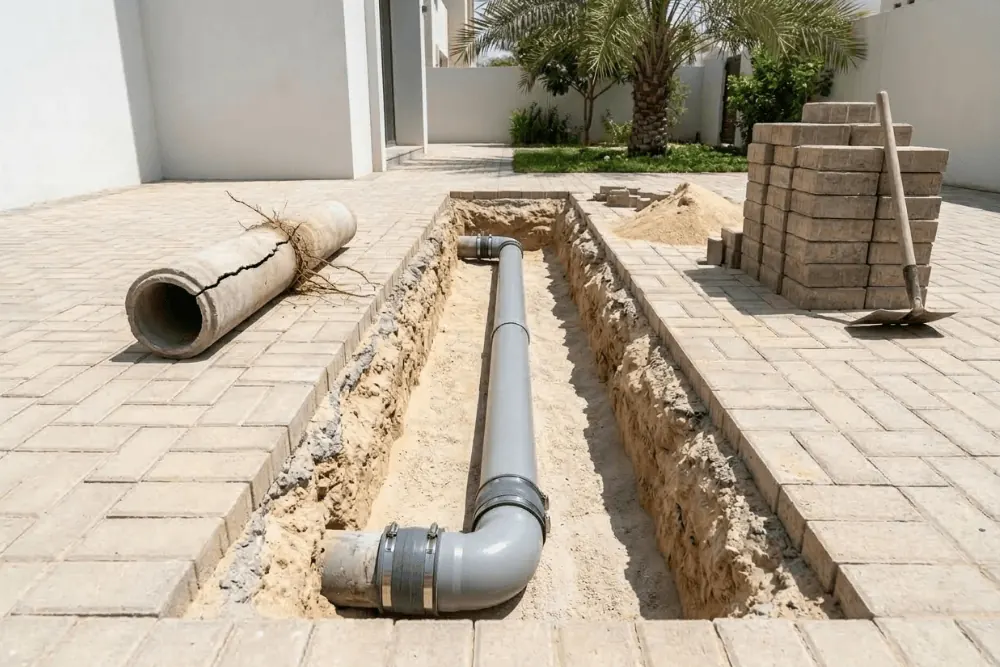
Sewer line repair and cleaning in Dubai: what we do
- CCTV drain surveys to find where a private sewer line is cracked, blocked, offset or collapsed.
- Cleaning the line by rodding or jetting where a survey shows a blockage and not a break.
- Patch (spot) repairs to a single defect.
- Relining and pipe replacement, by lining, bursting or open-cut, where the pipe needs more than a patch.
- Connection chambers and inspection access: finding, uncovering and repairing the covers and chambers on the line.
- Root and grease problems: clearing them and fixing what let them in.
- A written report with the survey footage, the defects found, the repair done and the test after it.
- Emergency visits. We answer calls and send a plumber 24 hours a day, 7 days a week, and we do not promise an arrival time.
Neighbouring topics have their own pages. Blocked sinks, toilets and floor drains are on drain unblocking, toilet unblocking and drain general, and high-pressure cleaning on drain jetting. Restaurant and kitchen interceptors are on grease trap, covers and gullies on manhole and gully, and tanks and treatment plants on septic and STP. Leaks in buried pipework are on leak detection and pipe leak repair, and replacing supply pipework on repiping.
What a private sewer line is, and who looks after it
A building's drainage has two parts. The private part is the pipework inside the plot or building, running to a connection chamber at the boundary. The public part starts beyond that chamber and is not ours or yours to alter. The line we survey, clean and repair is the private part.
| Question | What to know |
|---|---|
| Where does the private line end? | At the connection chamber where it meets the public sewer. Ask building management or the landlord where that chamber is, because it is often under paving or a lawn |
| Who maintains it in a villa? | The owner. A tenant's share depends on the lease |
| Who maintains it in a flat or an office? | Usually the developer, the owners' association or the landlord, because the line is a common part. Ask building management before any work |
| Can you open or move the connection chamber? | Not without the building's say-so. Chambers that belong to the public network are not for us or you to open, cover or move |
| Can you move a connection point or add a new connection? | That is a building and approvals question before it is a plumbing one. Ask the landlord or building management first |
This is general information, not legal advice. If who pays is unclear, ask in writing before the survey, because a survey finds the fault and the lease decides who pays for it.
Warning signs
| What you notice | What it points to |
|---|---|
| Several fixtures slow at once, or a toilet gurgles when a shower drains | A blockage or restriction on the shared line, not at one fixture |
| Sewage or wastewater surfaces at a floor drain, a gully or a chamber | A blockage or collapse downstream of that point |
| A drain smell in a room, in the garden or near a chamber | A dry trap, a cracked line, a missing cover or a tank issue |
| Wet or sunken ground, or unusually green grass, along the line | A leak or a break in the buried pipe |
| Cracks in a slab or paving that follow a pipe route | Settlement, or a leaking pipe washing the ground out |
| Repeated blockages that return a few weeks after clearing | A structural defect, such as an offset joint or a cracked pipe, that catches solids |
| Rodents or insects coming from a drain | A broken pipe or an open connection |
Two points from this table. If a different fixture reacts, the shared line is involved. The second is that the signs do not separate a clog from a break. A flat's repeated backup on the ground floor of a block is a building-line question for building management, and a villa's recurring backup is a survey question, because a villa's line runs under a garden and a driveway that the camera can follow.
Finding the fault: CCTV survey, dye test and smoke test
The fault must be located before a repair method is chosen.
| Test | What to know |
|---|---|
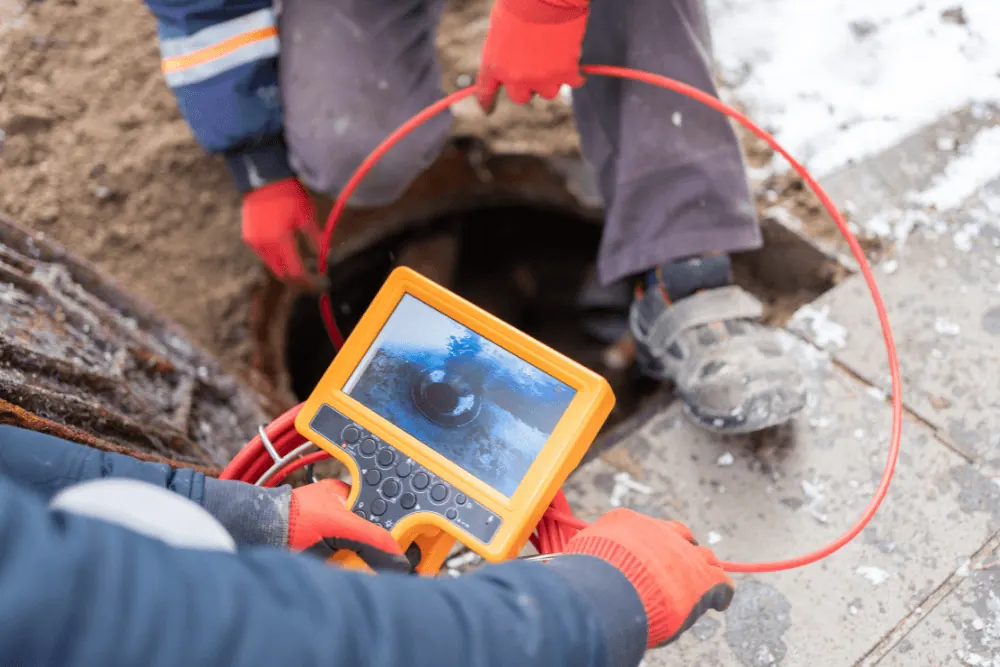
| CCTV survey | A camera on a push rod or a crawler travels the pipe and shows cracks, roots, offsets, sagging sections, scale, grease and collapse. It is the test for a private line, and it gives footage and a defect list |
| Dye test | Coloured dye goes into a fixture or drain, and you watch where it appears. It shows where a suspect pipe actually goes, and whether a wrong connection exists |
| Smoke test | Smoke is forced into the pipework and escapes at broken pipes, open joints and defective traps. The smoke is non-toxic, but it can enter a building through a dry trap or a defect, so occupants are warned first |
The camera is the test for a private line. A dye test answers a different question: where a suspect pipe actually goes. In Dubai buildings it is common to find air conditioning condensate, a balcony washdown or a washing machine outlet joined to the wrong pipe. A wrong connection can overload one line or send wastewater where it should not go, and a dye test is the cheap way to find it before anyone digs.
What a survey should produce: the footage, a written list of defects with their positions along the run, the pipe material and diameter where the camera shows them, and a judgement on whether the problem is a clog, a structural defect or both. A survey typically takes an hour or two for a villa line.
Causes: what damages or blocks a sewer line
| Cause | What to know |
|---|---|
| Wipes and solids | Wipes labelled flushable do not break down like paper and catch on rough joints, then build into a plug |
| Fat, oil and grease | Cools and sticks to the pipe wall, narrowing it until it blocks. Kitchens need a grease trap |
| Tree and shrub roots | Roots enter at joints and cracks, then grow into a mass inside the pipe. Roots follow moisture and find any small opening |
| Settlement and movement | Soil settles or washes away, leaving an offset joint, a sagging section or a pipe that has lost its fall |
| Poor installation | Joints not fully seated, wrong fall, or no bedding around the pipe |
| Heavy loads | A vehicle or construction traffic over a shallow pipe can crack it |
| Corrosion and age | Some older materials corrode from the inside. We do not give a lifespan for a sewer line, because the material, the ground and the use decide it |
| Construction debris | Cement, sand or building waste left in the line during building work |
| Damage during other work | An excavation or a drilling job that cracks a pipe |
Roots deserve a caution. A properly installed plastic pipe with sound joints keeps most roots out, but roots do enter through cracks and open joints, and a pipe that has lost its seal lets them in. Cutting the roots without repairing the opening means they come back.
The fall of a sewer line
A sewer line has to slope enough to carry solids and not so much that water outruns them. The building's drawings give the design fall if they exist. A survey that finds standing water along a stretch of otherwise sound pipe has found a slope fault or a settlement, and neither a patch nor a liner fixes it. A liner cannot fix a pipe that has lost its shape either. Where the fall is the fault, the pipe has to be relaid, and the new run is set out with levels so the fall is checked before the trench is closed.
Repair options: patch, lining, bursting and replacement
The four methods differ in what they can fix.
| Method | What it is | What it fixes | What it does not fix |
|---|---|---|---|
| Patch (spot repair) | A short sleeve or liner fixed over one defect | A single crack, a hole or an open joint in an otherwise sound pipe | Several defects, a collapse, an offset or a pipe that has lost its fall |
| Lining (cured-in-place) | A resin-soaked liner pulled through the pipe and cured to form a new pipe inside the old one | Multiple cracks, open joints and root entry along a pipe that still holds its shape | A collapsed or badly offset pipe, and a section with a fall fault. It reduces the bore slightly |
| Pipe bursting | A tool breaks the old pipe and pulls a new pipe in along the same line | A pipe too damaged to line, without digging the whole length | Ground where the old pipe is surrounded by hard rock or where other services are very close |
| Open-cut replacement | Digging up the old pipe and laying a new one | Anything, including a collapse or a wrong fall | Nothing, but it costs the most in access, disruption and reinstatement |
Four cautions. A liner needs a clean pipe, so cleaning and a survey come first. Where the pipe has collapsed, a liner cannot pass. Bursting depends on the ground and on what is nearby, and some soils and nearby services rule it out. And a method is a question to settle with the survey, not a default, so we do not recommend one until the camera shows the defect.
The choice, in the order we apply it:
- A blockage and a sound pipe: clean it (see below) and re-survey.
- One isolated defect and a sound pipe either side: a patch.
- Several defects along a pipe that still holds its shape and falls: a liner, with the liner's design basis and wall thickness stated in writing.
- A collapsed, offset, back-pitched or badly corroded section: replacement, by bursting where the ground and neighbouring services allow it and by open cut where they do not.
- Roots: cut them and repair or line the opening, not the first alone.
Cleaning the line: rodding and jetting
Cleaning clears a blockage and does not repair a defect. High-pressure jetting is covered on drain jetting and general blockages on drain unblocking, so we do not repeat the methods. What matters on a sewer line is the order: survey first, so the pressure is not applied to a cracked or collapsed pipe, and survey again after. We get a camera inspection before approving repairs, and that is the order we follow.
Sewer gas and confined spaces: why we do not send people into a line
Sewage produces hydrogen sulfide, and sewers and chambers can also be short of oxygen or hold other gases.
- Hydrogen sulfide is a colourless, flammable, very hazardous gas with a rotten-egg smell. It is heavier than air and may travel along the ground, and it collects in poorly ventilated, low-lying places such as sewer lines and chambers. Breathing it in a closed chamber can be fatal. Continued exposure can dull the sense of smell, sometimes quickly, so you cannot rely on smell to tell you the gas is still there.
- Confined-space deaths happen in sewers, and rescuers are often overcome too. People who walk into a sewer pipe or a deep chamber without breathing protection and gas monitoring have been overcome, and the colleagues who tried to help were overcome as well.
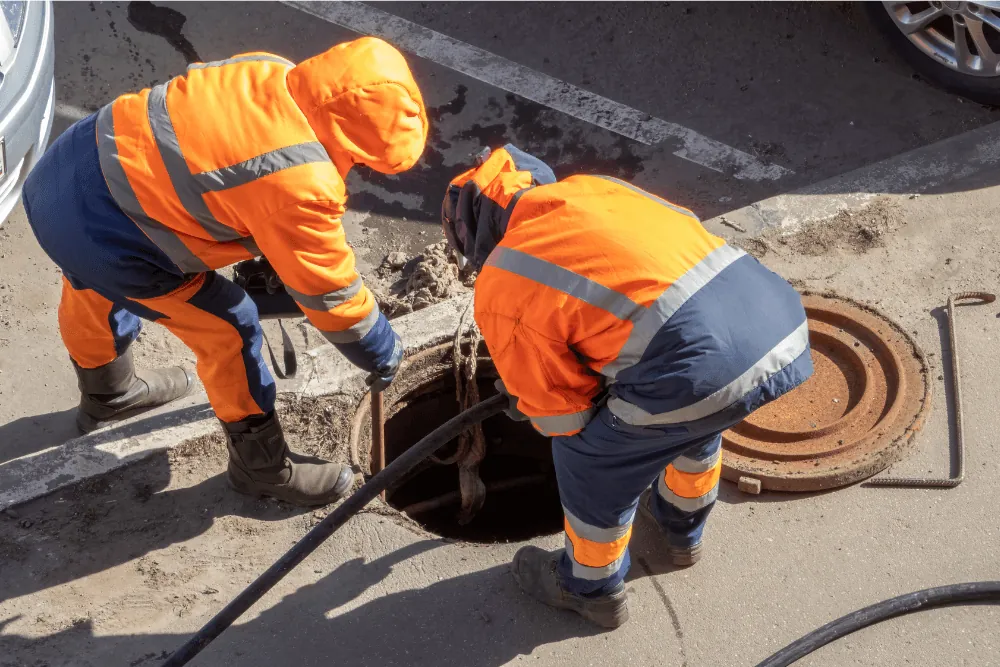
Do not lift a cover and look into a chamber, and do not climb into one to retrieve something. The smell is not a reliable warning. For FAM's own work, we survey from the outside with a camera where the line allows it, and entry into a chamber or pit is a job for trained people with a gas monitor and rescue arrangements.
Permission in Dubai: who decides on sewer work
A survey or a cleaning is maintenance. Changing, relaying or connecting a sewer line is an alteration to the building's drainage. This is general information, not legal advice. Where a sewer job falls:
| Job | Starting point |
|---|---|
| CCTV survey of an existing line | Inspection only. Tell the landlord or building management, and agree who pays. In a building, the line may be a common part, so the manager decides when access is given |
| Cleaning a blocked line | Maintenance. The owner, and the landlord by default unless the lease says otherwise |
| Patch or lining of a defect in an existing private line | A repair to the private line. Owner or landlord consent in writing, and building management where the line is shared |
| Replacing or rerouting a section | An alteration. Written owner or landlord consent, and building management or the master developer |
| A new connection or moved connection point | A building approval matter. The owner applies, not the plumber |
| Opening or moving a connection chamber cover | Ask the building before any work on a chamber, and do not touch one that belongs to the public network |
| A tenant paying for a repair | Only if the lease says so |
We cannot say whether your building needs a certificate or a permit for a particular job. Building management can, and a request in writing is cheaper than a stopped job. Tell us what your building asks for and we work to it.
Warranty and the handover
What you should have when the job is finished:
- The before footage and the written defect list, with positions along the run.
- A description of what was done and where: patch positions, lined length, replaced length, pipe material and diameter fitted.
- The after footage. A repair you cannot see on camera is not proved.
- The falls, if a section was relaid, with the fall used and how it was checked.
- The product documents for any liner or patch product, with its stated design basis. A product's warranty belongs to its maker or installer, so ask for the terms in writing.
- Photographs of any chamber or cover that was opened, and its condition when closed.
- FAM's workmanship warranty, in writing. The warranty runs for 30 days and covers our labour only. Parts carry the manufacturer's warranty only.
How we work
- You tell us what is happening on WhatsApp: which fixtures are affected, since when, whether there is a smell or a wet patch, and whether you own, rent or manage the building.
- We check on the visit where the fixtures drain together, where the chambers are, and which stretch needs a camera. We do not open a chamber without the right equipment and people. The visit fee is AED 50 + VAT, credited if the work goes ahead.
- We survey the line and give you the footage and a written list of defects.
- We give options and a price in writing: clean only, patch, line, or replace, each with what it does not fix.
- Check permission. In a rented or managed property, ask the landlord or building management whether they need to approve this work before the visit.
- We clean, repair or replace, and test.
- We survey again and hand over the written note, with the footage and the test result.
Where we work in Dubai
We cover all of Dubai, including Dubai Marina, JBR, Downtown Dubai, Business Bay, Jumeirah Lakes Towers, Palm Jumeirah, Al Barsha, Jumeirah Village Circle, Dubai Hills, Mirdif, Deira and Al Quoz. See the full list of areas.
How a private sewer line is laid, and why it matters
A sewer line is a gravity pipe. Water and waste flow downhill, and the pipe is laid to a fall so that solids move along with the water. Too steep a fall and the water runs ahead of the solids, which are left behind. Too shallow a fall and the flow is too slow to carry them. A line that settles after it is laid, or that was laid badly, develops a belly where water collects. Solids build up in the belly and block the pipe again and again.
The line also needs access. A manhole or an inspection chamber at each change of direction and at set distances lets a camera or a jet reach the whole run. A line with no access cannot be cleaned or surveyed without digging.
The camera survey, step by step
A CCTV survey is the best first step for any sewer problem. It shows the pipe from inside.
- Choose the access. A manhole, a clean-out or a lifted gully.
- Clean what is needed. A badly blocked line is cleared first, so the camera can pass.
- Run the camera along the pipe. A small camera on a flexible rod or a tractor goes along the line, with lights, and the footage is recorded.
- Note the distance and the defect. Cracks, offsets, roots, deposits, bellies and collapsed sections are logged with their position.
- Mark the line on the surface if a repair is needed, so the dig is in the right place.
- Review the footage with you. We explain what it shows and what it does not.
A survey avoids a dig in the wrong place, which is the most expensive mistake in sewer work.
What the survey commonly finds
| Finding | What it means | Likely action |
|---|---|---|
| Grease and scale along the walls | A pipe that has not been cleaned for a long time | Jet and review |
| Roots entering at a joint | A joint open or cracked, with a tree nearby | Cut roots, repair the joint, consider lining |
| A step at a joint | Two pipes out of line | Local repair or replacement |
| A belly with standing water | Ground settled, pipe sagged | Re-lay the section |
| A crack along the pipe | Ground movement or load | Patch, line or replace |
| A collapsed section | The pipe has broken | Dig and replace |
| A foreign object | Wipes, a toy, a rag, building debris | Remove, and find how it entered |
| Another pipe connected where it should not be | A rainwater or a kitchen connection | Disconnect and correct |
Choosing between lining and digging
Lining puts a new pipe inside the old one without a trench. It suits a pipe that is straight, round and structurally sound, and where the surface above is paved, finished or hard to dig. Digging replaces the pipe and gives a new line with the right fall. It suits a pipe that has collapsed, that has a belly or that has the wrong fall, and where the ground is open.
The choice depends on what the camera shows, the surface above, access, and cost. We explain the options and give a price for each, with the work fixed on WhatsApp before we start. Prices exclude 5% VAT.
What to have ready before the survey
A survey goes faster and costs less when the access is ready. Before we arrive:
- Find the chambers. Look for square or round covers in the garden, driveway or service yard. Photograph each one closed. If a cover is buried under paving or soil, tell us, because uncovering it is part of the job.
- Note which fixtures are affected, and which ones still work. The pattern tells us which branch joins the main line where.
- Write down when it started and whether it comes and goes, for example only after heavy use, after washing machine cycles or after rain.
- Keep the line quiet while we survey. Do not run washing machines or flush during the camera run, because moving water hides defects.
- Clear access to the chambers: move cars, pots and furniture, and make sure gates are open.
- Send any drawings you have, such as the plot's drainage layout. They save time finding the route.
- Warn building management if the line serves other units or if we need a lift, a parking bay or a service entrance.
Repairs that need a second visit
Not every job closes in one visit. Lining needs a clean, dry pipe, so a badly scaled line is cleaned and surveyed first, and the liner goes in on a second visit. A section that needs replacement may need materials ordered, a trench marked and a time agreed with the building for breaking out paving. We tell you the sequence before we start, what is done on each visit, and when water use has to stop, so a second visit is part of the plan and not a surprise. A temporary fix, such as clearing the line so the property is usable that night, is separate from the permanent repair, and we say clearly which one we have done.
Living with a line while it is being repaired
If you need the property during the work, plan ahead. Water use must stop while the line is open. In a villa, we plan the work so you can use water at some times of day. Where a line serves several flats, building management has to coordinate. A temporary pump or a holding tank may be needed. We tell you how long the work will take and what the arrangements are.
Keeping a line healthy
Do not flush wipes, nappies or sanitary products. Keep fat out of the kitchen sink. Do not plant trees with aggressive roots near the line. Keep manhole covers visible and accessible. Have the line cleaned if there is a history of slow drains. A short written record of every cleaning and survey helps spot a pattern.
How much does sewer line repair cost in Dubai?
The price follows these items:
- The survey. Access to the line, the length surveyed and the report.
- The visit and diagnosis. The visit fee is AED 50 + VAT, and it comes off the bill when you go ahead with the work.
- Labour. Cleaning, patching, lining or relaying, and testing.
- Access and reinstatement. Breaking and making good a driveway, a patio, landscaping or a floor.
- Chambers and covers. Opening, repairing or replacing a private connection chamber cover, rated for the traffic over it.
- Building approvals and fees, where an alteration or a connection needs them.
- Traffic, parking and working-hours limits in the building or area.
- Confined-space precautions for any entry, including gas monitoring and rescue arrangements.
We do not publish a starting price for this job. Send a photo on WhatsApp and we give you a fixed price before we start. Prices exclude 5% VAT.
Sewer line FAQs
What is a sewer line?
It is the pipe that carries a building's wastewater from its drains to the public sewer. The part inside the plot or building, up to the connection chamber, is the private line, and that is the part we survey, clean and repair.
Who is responsible for a blocked or damaged sewer line in Dubai?
In a villa, the owner looks after the private line. In a flat or an office, it is usually the developer, the owners' association or the landlord, because the line is a common part. A tenant's share depends on the lease. Ask in writing before the survey.
How do I know it is the sewer line and not one drain?
Flush the lowest toilet and watch the nearest shower or floor drain. If it reacts, the shared line is involved. Several fixtures slowing at once is the other sign. Call us and we will survey it.
How is a sewer line inspected?
By a CCTV survey: a camera in the drain shows cracks, roots, blockages and collapse, with a report and footage. A survey on a villa line typically takes an hour or two.
Can a liner fix a collapsed sewer line?
No. A collapsed, back-pitched or badly corroded section is a replacement job. A liner works where the pipe still holds its shape and its fall.
What is the difference between patching, lining and replacing?
A patch repairs one isolated defect in a sound pipe. A liner is a new inner layer along a stretch of pipe that has kept its shape. Replacement lays a new pipe, by bursting or by open cut. See the repair options table above.
Will tree roots come back after they are cut?
They can, because roots follow moisture back to any opening. We repair or line the opening, not only cut the roots.
Is it safe to look into a chamber myself?
No. Hydrogen sulfide collects in sewer lines and chambers, is heavier than air and can dull the sense of smell. People have died in sewer pipes and so have their rescuers. Do not lift a cover or climb in. WhatsApp us.
Do I need permission to repair a sewer line?
Get the owner's or landlord's consent in writing, and in a flat ask building management, because the line is often a common part. Moving a connection or changing a chamber is a bigger step and needs the building's approval first. Tell us what your building asks for and we work to it.
How much does a sewer repair cost in Dubai?
See the cost section above, then get a written price after the survey.
Book a sewer line survey or repair in Dubai
Tell us which fixtures are slow or backing up, whether there is a smell or a wet patch, whether the property is a villa or a unit in a building, and whether you own or rent. Photos of the chambers and the affected drains help. If sewage is coming up inside, stop using the fixtures on that line and call. We will survey the line, show you the footage and give you options with a written price.
WhatsApp: +971 55 407 7427 · Request a quote
Visit us: Office 871, Oasis Mall, Al Quoz 1, Dubai, UAE
Related services: Drain unblocking · Drain jetting · Manhole and gully · Grease trap · Septic and STP · Leak detection · Repiping