
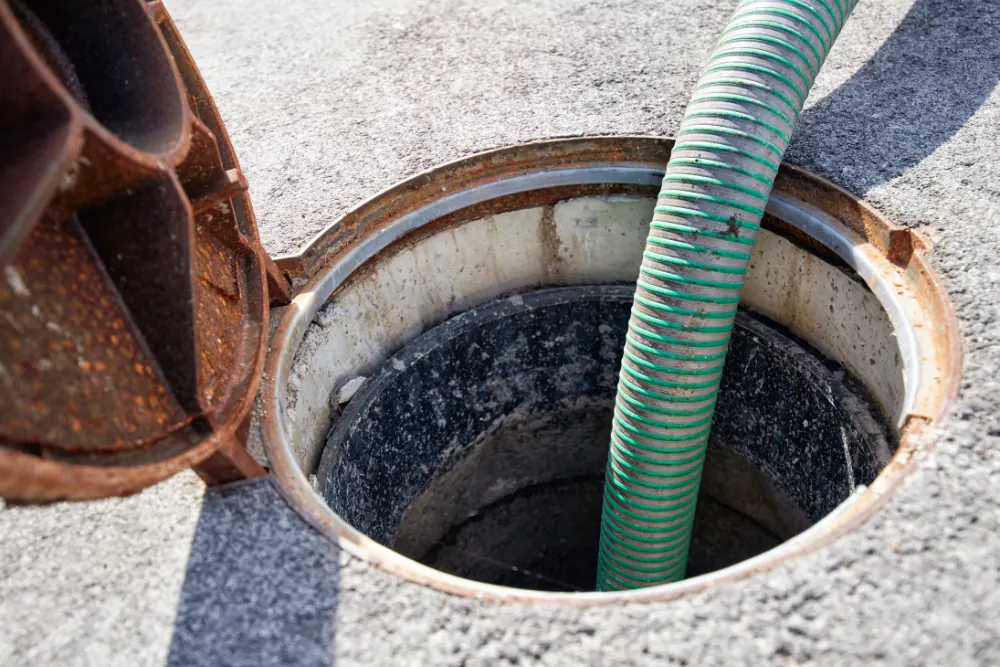
Manhole and gully services in Dubai: what we do
- Cleaning private manholes, inspection chambers and connection chambers: removing silt, sludge and debris, washing the walls and checking the flow channel in the base.
- Gully and gully trap cleaning: clearing the grating, the dish and the trap, and restoring the water seal.
- Cover and frame replacement: matching the opening, the load duty and the material to where the cover sits.
- Repairs to the chamber: cracked or displaced channels, loose frames, and pipe entries.
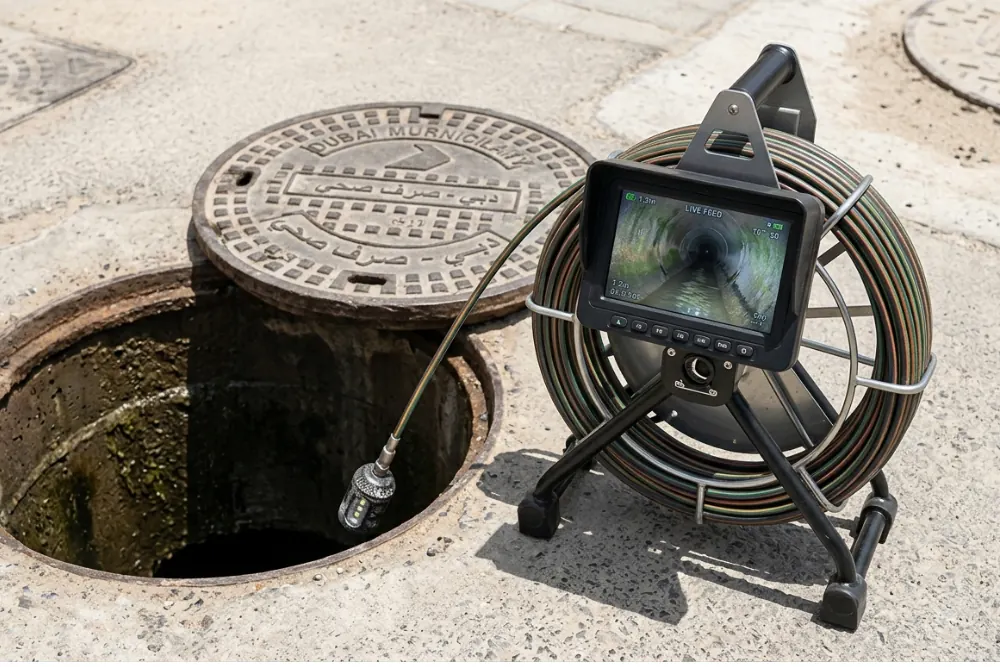
- A camera look into the line from the chamber, where the pipe is not known.
- A written note of what was removed, what was found and what was done.
Neighbouring topics have their own pages. High-pressure cleaning of the pipe run, with its pressure limits and the rules for where the washwater goes, is on drain jetting. Camera surveys, defects such as roots and cracks, repair methods and the confined-space gas rules are on sewer line repair and cleaning. Kitchen interceptors are on grease trap, tanks and treatment plants on septic and STP, and sinks, toilets and floor drains that clear with lighter methods on drain unblocking and drain general. A leak that a chamber does not explain is on leak detection.
Which structure is which, and who owns it
What decides who is responsible is the network the structure belongs to, not its name.
| Structure | What to know |
|---|---|
| Connection chamber | The final inspection chamber of a building's private drainage before it meets the public network. The private network runs up to that point |
| Public sewer manhole or inspection chamber | Part of the public network. Nobody may open, fill, cover or conceal one |
| Private inspection chamber or manhole | A chamber on the building's own drain, where the line can be seen, rodded and cleaned. The owner maintains it |
| Gully or gully trap | A grated drain in a floor, a yard or a balcony, with a trap that holds a water seal against sewer air |
| Catch basin or stormwater gully | A grated pit in a car park or road with a sump that traps sediment and debris before it reaches the stormwater drain |
Two networks matter. Foul drainage carries wastewater, and rainwater drainage carries storm water. Wastewater must never be sent to the rainwater network. Water from air conditioning and from balconies normally goes to the building's private foul drain. A gully that takes balcony or air-conditioning water is therefore a foul-network gully, and a grating in a road or car park is a rainwater one.
Why the network matters before a cover is opened
Water or waste sent to the wrong network can overload it. A foul line fed with rainwater surcharges, and a rainwater line fed with wastewater pollutes. Before cleaning or opening a chamber, we establish which network it serves, because guessing wrong has consequences for the building and for the network. A public chamber is never opened by us or anyone else.
Depth, size and construction
A chamber is a small box in the ground with a cover, a frame, walls, a base and the pipes that enter and leave it. The base carries a shaped channel, often called the benching, that guides the flow from the inlet to the outlet and keeps solids moving.
| Depth | What it is | What to know |
|---|---|---|
| Up to about 600 mm | A shallow inspection chamber | Reached from the surface, with a small opening, and cleaned by hand and suction |
| 600 mm to about 1.2 m | A shallow manhole | A standard opening is workable, but the cover is the main safety feature |
| Deeper than about 1.2 m, up to 3 m and beyond | A deep manhole | A standard opening on a deeper chamber is a fall risk, so it needs a reduced-access frame or a locked cover. Entry is for trained people |
A cracked channel, a base that has lifted away from a pipe entry, or a pipe that has pulled out of the wall is a defect to photograph and repair, and cleaning the chamber is what makes it visible.
Covers and frames: what load they carry
A chamber cover has to carry the heaviest thing that will cross it. Covers and gully gratings are made for different duties, from light foot traffic in a garden or a balcony to heavy vehicles on a driveway, a car park or a service road. The class is marked on the cover, and it follows the heaviest wheel that will cross, not the name of the place. A villa driveway used by a delivery van needs a stronger cover than a garden path, and a connection chamber outside a building should have a cover made for vehicle loads. It is sensible to choose the stronger duty and not the lighter one, and a cover has to match the opening and the frame it sits in. The same applies to gully grates.
Gully traps and water seals: why a dry trap smells
A gully trap holds a plug of water that blocks sewer air. The depth of that water is the seal, and a deeper seal takes longer to evaporate than a shallow one. We measure the seal on the visit and note it.
If a floor gully in an unused room has lost its seal, wetting it restores the seal. That is a stop-gap, and the reason it dried (nobody uses the gully) is what a trap primer or a regular visit addresses. If the seal is full and the smell persists, the cause is somewhere else: a cracked cover seat, an open pipe entry, or a defect in the line (see sewer line repair).
Fixtures that discharge a long way from their own trap can lose the seal by siphoning, so a long run needs a vent. Where a gully takes the waste of one fixture, the run from the fixture's own seal to the gully should be short unless it is vented, and we check this on a smell call.
Sand and silt in Dubai
Sand is the main difference between a Dubai chamber and one elsewhere. Wind carries it into yards, car parks and podium levels, and rain and washing carry it into gullies. A gully in a yard, a car park or beside a gate collects the sand blown and washed onto it, and a gully inside a kitchen collects grease and food waste, so the interval comes from what the last visit found.
How often to clean
There is no single interval that fits every structure. A gully that sees traffic and sand fills faster than one in a bathroom, and a rainwater gully should be clear before the rainy season. We set the next visit from the silt depth and what it contained, and we write the date on the note. A gully that fills before the next rain is cleaned before the rain.
What cleaning a manhole or gully involves
The pressure limits for pipe, the nozzle rules and the tanker enforcement are on drain jetting and not repeated. The order we follow, with the reason for each step:
- Identify the network and the owner. A foul chamber, a rainwater gully and a public manhole are different jobs, and nobody may open a public one.
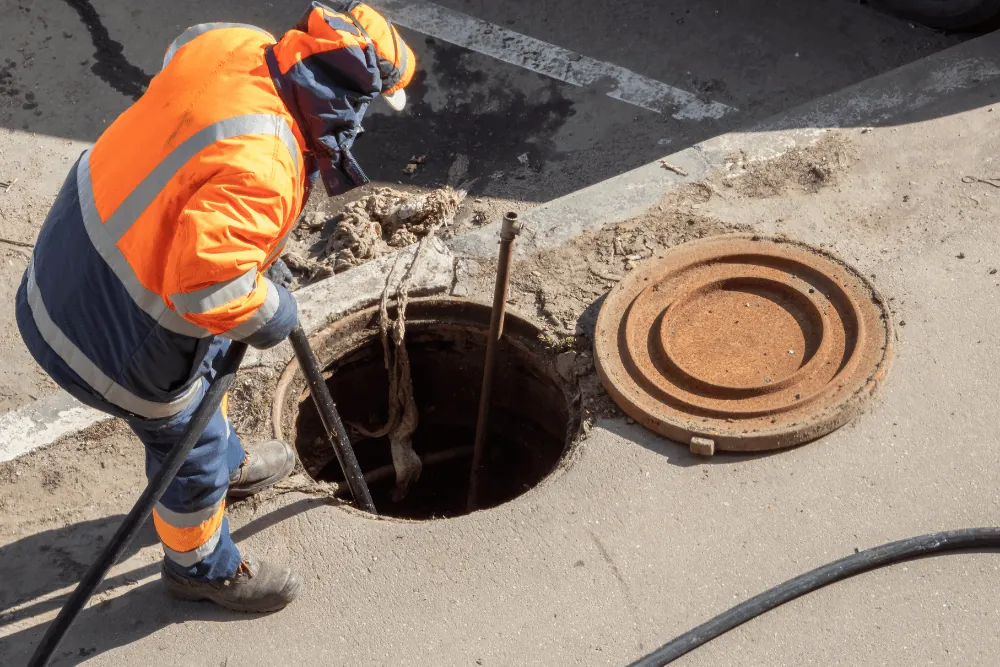
- Make the area safe before the cover comes off. The cover is lifted only where we can keep people away, and a chamber is not left open unattended.
- Record the starting state: the silt depth, what the silt contains, the water level and whether the flow is running, with a photograph.
- Remove the silt and debris. Large quantities go out by vacuum tanker. Small gullies are cleared by hand and suction. Nothing is washed into the stormwater system or an open area.
- Wash the walls and the channel and check each pipe entry for cracks, displacement and roots.
- Look into the line with a camera where the pipe beyond the chamber is not known.
- Test the flow and the seal, and refill a gully trap to its seal.
- Close up: the cover, frame and bedding are checked, and a worn one is replaced.
- Take the waste to an authorised point and keep the record.
Defects a chamber shows
A cleaned chamber shows what the line is doing. The repair methods are on sewer line repair, and we describe only what shows at the chamber.
| What shows | What to know | What we do |
|---|---|---|
| Cracked or missing channel, or pipe displaced at the wall | The base supplies the flow channels and the pipe connections | A repair to the chamber, with a photograph, and a check that the pipe beyond is intact |
| Roots | See the root study on sewer line repair | Roots in a chamber point to an opening in the pipe or the joint. Cutting them without closing the opening resets the clock |
| Backflow or surcharge | A gully grating has to cope with overloading from the discharge pipes or a blocked sewer line | If a gully overflows, the line downstream is full. Clear it, then find out why |
| Silt of one kind | Sand points to a yard or car park, grease to a kitchen, and building debris to recent works | What the silt contains tells us where it came from, and where to look |
Points to know about chambers, covers and the two networks
These are the practical points that apply to most buildings, and your building's management can tell you what else applies.
- The private sewer and the connection chamber. The private network is everything inside the building's plot up to the connection chamber, the last inspection chamber before the public network. Everything up to there is the owner's.
- Connecting to the public sewer needs approval, and the connection point is set by the authority.
- Air conditioning and balcony drains go to the private foul drain.
- Covers of connection chambers must suit the load they carry, and a chamber outside the building needs a cover that can take vehicles.
- Public chambers are not to be opened, filled, covered or hidden, and nothing that blocks access to them, such as a barrier or a tree, is allowed.
- Maintenance of the private network is the owner's.
- The two networks stay apart. Wastewater never goes to the rainwater network.
The last chamber before the public sewer belongs to the building's private network, so the owner maintains it. The chambers beyond the connection point are public, and nobody opens them. Works on the public network around your plot do not change who owns a building's gully, grating or connection chamber. For works at your boundary, ask your building management or the authority.
Safety at an open chamber
Two hazards sit at a chamber: the fall and the gas. The gas figures, the effect of the smell on judgement, and the confined-space rules are on the safety section of sewer line repair and cleaning and are not repeated here. A separate rule applies to anyone: nobody opens, fills or conceals a public chamber.
- The fall. A standard opening on a deep chamber is a fall risk, especially for a child, so deeper chambers get a narrower reduced-access frame or a locked cover.
- The gas. A smell that appears when a cover is lifted is not a measure of what is in the air. A chamber that smells is not looked into from above, and nobody climbs in to retrieve an object. Entry is for trained people with a gas monitor and rescue arrangements.
- The cover left off. A cover that is lifted goes back before the crew leaves, or the chamber is guarded and the owner is told in writing. We do not leave an open chamber unattended, and we do not leave a damaged cover in place without a barrier.
- The cover put back wrongly. A lifted round cover can dislodge and roll. A cover is lifted and replaced with a proper lifting tool, and the frame seat is cleaned of grit so the cover sits flat.
Sand removal before the rain
A Dubai yard, car park or podium collects sand and dust all year, and the first heavy rain of the season washes it into every gully and chamber at once. A gully that is half full of sand cannot take the rain, and the water backs up onto the paving or into the building. Before the rainy season, we clear gullies and catch basins in yards, car parks, ramps and balconies, check each grating for blockage and cracks, and note any gully that does not drain at the speed it should. A short list of gullies, with their positions and the date cleared, gives a building manager a record to point to when it rains. We also look at the fall of the paving towards the gully, because a gully that is clear but sits high will not drain a pool beside it.
Chambers in a villa
A typical villa has a few private chambers: one at the kitchen outlet, one near the bathroom stack and one at the boundary where the house drain leaves the plot. They are usually under a paved area or a planter, and they are forgotten until something backs up. Walk the plot once and mark where each cover is, so it is not buried by the next piece of paving or landscaping. Keep a note of which chamber serves which room. When a toilet and a shower back up together, the blockage is below the junction of their drains, and that points to the chamber we open first. A chamber that is easy to find and open is cleaned in minutes, and a chamber that is covered by tiles costs more to reach. See sewer line repair and cleaning.
What we leave you with after a gully clean
A gully clean that leaves you with no record is a clean you cannot compare with the last one. We leave the photographs, the silt depth and what it contained, the state of the seal and the cover, the date for the next visit and, where we found a problem we cannot fix on the day, a plain description of what it is and what it needs. For a building manager we can list every gully on the property, number them, and clean them in a round, so that the record shows which ones fill fastest.
Balcony, podium and car park gullies
Gullies on a balcony or a podium are small, so they block easily. A balcony gully takes washing water, plant water and sometimes air-conditioning condensate, and it fills with leaves, sand, cigarette ends and soil from planters. When it blocks, water backs up across the balcony, finds the door threshold or tracks along the slab to the unit below. Keep a hand-sized strainer over the outlet, lift it out and empty it every week or two, and keep planter soil from washing into it. A podium or car park gully is larger and takes the rain from a wide area, so it should be cleared before the rainy season and after any landscaping or building work. If a gully gurgles, smells or drains slowly even when clean, the pipe beyond it may be partly blocked or may have lost its fall, and that is a job for jetting and a camera look. See drain jetting.
Permission in Dubai: who decides on a chamber or gully
Cleaning a private gully is maintenance. Opening a shared chamber, changing a cover, or touching anything near the connection to the public network involves the building and the authority.
- The owner's duties. The owner maintains the private sewerage network, including blockages, overflows and leakages. Connection chamber covers must suit the load they carry. No one opens, covers or conceals public chambers.
This is general information and not legal advice. The fuller account of the landlord and tenant points is on our shower installation and water heater installation pages. Where a chamber or gully job falls:
| Job | Starting point |
|---|---|
| Cleaning a gully or chamber inside your own unit or plot | Maintenance. Tell the landlord and agree who pays. Maintenance is the landlord's by default unless the contract says otherwise |
| Cleaning a shared chamber, riser base or building connection chamber | A common part. The building manager or owners' association decides access and timing |
| Replacing a connection chamber cover | A change to a part that must carry the right load. Written consent and the building's approval first |
| Any chamber that might be public | Not for anyone to open. Ask the building and the authority before any work |
| Fitting a trap primer or changing a gully's position | A change, which needs the landlord's written consent and the building's approval |
| Collecting and removing the silt | A licensed tanker taking waste to an authorised point. Ask for the operator's licence and the disposal record |
We cannot say whether your building needs a certificate for a particular job. Building management can, and a request in writing is cheaper than a stopped job.
Warranty and the handover
What you should have when the job is finished:
- Before and after photographs of the chamber or gully with the cover off, showing the silt level, the channel and each pipe entry.
- A written note: the structure cleaned and its location, the network it serves, the silt depth found, what it contained, and what was removed.
- For a cover or frame: the duty marked on it, its size and material, and the reason it was chosen.
- The disposal record: the tanker used, its licence and the authorised point it discharged to.
- Any damage found or caused, with its position and a photograph.
- A revisit date and the reason for it.
- A clear warranty. Ask what the warranty covers and for how long, in writing.
- FAM's workmanship warranty, in writing. The warranty runs for 30 days and covers our labour only. Parts carry the manufacturer's warranty only.
How we work
- You tell us what is happening on WhatsApp: which gully or chamber, what you see or smell, when it was last cleaned, and whether you own, rent or manage the building.
- We check on the visit the network each structure serves, the cover and frame, the silt depth and the water seal.
- We give options and a price in writing: clean only, clean and re-bed or replace the cover, or clean and survey the line.
- Check permission. In a rented or managed property, ask the landlord or building management whether they need to approve this work before the visit.
- We make the area safe, lift the cover, and record the starting state.
- We remove the silt, wash the chamber, check the channel and the pipe entries, and camera the line where it is not known.
- We take the waste to an authorised point and keep the record.
- We hand over the photographs and the written note, with a revisit date.
Where we work in Dubai
We cover all of Dubai, including Dubai Marina, JBR, Downtown Dubai, Business Bay, Jumeirah Lakes Towers, Palm Jumeirah, Al Barsha, Jumeirah Village Circle, Dubai Hills, Mirdif, Deira and Al Quoz. See the full list of areas.
Keeping covers safe
A cracked or loose manhole cover is a danger to people and vehicles. Check covers for cracks, rocking and rust twice a year. Keep them clear of soil, paving and pots, so they can be opened when needed. Tell us if a cover is damaged, and keep people and vehicles away from it until it is repaired. Do not lift a cover to look inside. Gas and a fall are real risks.
Reading a chamber from the surface
A lot can be learned before a cover is lifted. A cover that sits proud of the paving or has sunk below it points to settlement of the ground or the frame. A cover that rocks or rattles is loose in its frame and is a trip or a vehicle hazard. A wet ring around the frame in dry weather means water is leaking up from a chamber that is full or surcharged. A gully grating clogged with sand and leaves is the commonest reason for standing water after rain, and it is cleared with a scoop and a hose and not with a chemical.
Once a cover is open, we note the depth to the invert, the direction of each pipe, whether the benching is intact and how much sand or silt has settled on the bottom. A chamber that is half full of sand has lost its fall, and the next blockage upstream is already forming. We photograph the chamber before and after, so that what we found is on record, and we do not open a chamber that belongs to the public network.
How much do manhole and gully cleaning and cover replacement cost in Dubai?
A villa's yard, a building's podium or a car park each differ in access, tanker and disposal, so a price for one is not a guide to another.
In Dubai, the price follows these items:
- The number and depth of structures. A shallow gully and a deep chamber are different jobs.
- The silt quantity and type. Sand, grease and building debris are removed differently.
- Access. Locked areas, car parks, podium levels and hours of access.
- Disposal. Collection, tanker and the paperwork.
- The cover and frame. Duty, size and material, and whether the frame is re-bedded or replaced.
- A camera look into the line, where wanted.
- Repairs to the chamber.
- Building rules. Permission, access hours and working in a shared area.
We do not publish a starting price for this job. Send a photo on WhatsApp and we give you a fixed price before we start. Prices exclude 5% VAT.
Manhole and gully FAQs
What is the difference between a manhole, an inspection chamber and a gully?
A gully is a surface drain that takes water through a grating into a trap. An inspection chamber is a shallow box on a drain where the line can be seen and cleaned, and a manhole is a deeper one that a person could enter. Which one a structure is matters less than which network it serves.
Who is responsible for a manhole or gully on my property in Dubai?
The owner maintains the private network, including its chambers and gullies. The final inspection chamber of that network is the connection chamber, and chambers of the public network belong to the authority. In a flat, the shared parts are for building management. This is not legal advice.
Can I open a manhole cover to look inside?
Not a public one. Nobody may open, fill or cover a public sewer chamber. On a private chamber, a smell on opening is not a measure of the air, so we do not look in from above and nobody climbs in.
Why does a floor gully smell?
The water seal may have dried. Trap water evaporates in infrequently used floor drains, and the seal is what blocks sewer odour. Pouring in water restores it for a while. If the seal is full and the smell continues, look at the cover seat and the line.
How often should a gully or manhole be cleaned?
It depends on what collects in it: sand in a yard or car park, grease in a kitchen. We set the next date from the silt depth and what we find, and a gully that fills before the next rain is cleaned before the rain.
What strength of cover do I need?
The duty follows the heaviest wheel that will cross it: light for pedestrians only, medium for footways and light car parks, and heavy for driveways, carriageways and heavy vehicles. A connection chamber outside a building needs a cover made for vehicle loads.
Can you replace a broken manhole cover?
Yes. A cracked or buckled cover is a replacement and not a repair, and a replacement should match the duty, the size and the material of the opening. A connection chamber may need the building's approval first.
Can I pour water or rainwater into the sewer chamber?
No. Wastewater must not go to the rainwater network, and rain or washwater sent to a foul chamber overloads the private network. Air conditioning and balcony water goes to the private sewer. Ask us which network a gully serves before you connect anything to it.
Do I need my landlord's permission?
For cleaning, tell the landlord and agree who pays. For replacing a connection chamber cover or changing a gully, written consent and the building's approval. This is not legal advice.
How much does it cost?
It depends on the number and depth of structures, the silt, the access and the disposal. See the cost section, then get a written price after the visit, excluding 5% VAT.
Book manhole and gully cleaning in Dubai
Tell us which gully or chamber, whether it smells or overflows, whether it is inside a building, in a yard or in a car park, when it was last cleaned, and whether you own or rent. Photos of the cover and the surrounding area help. If sewage is coming up inside, stop using the fixtures on that line and call. We will check the structure, clean it, inspect the cover and the pipe entries, and give you a written note with photographs and the disposal record.
WhatsApp: +971 55 407 7427 · Request a quote
Visit us: Office 871, Oasis Mall, Al Quoz 1, Dubai, UAE
Related services: Drain jetting · Sewer line repair · Drain unblocking · Grease trap · Septic and STP · Drain general · Leak detection