
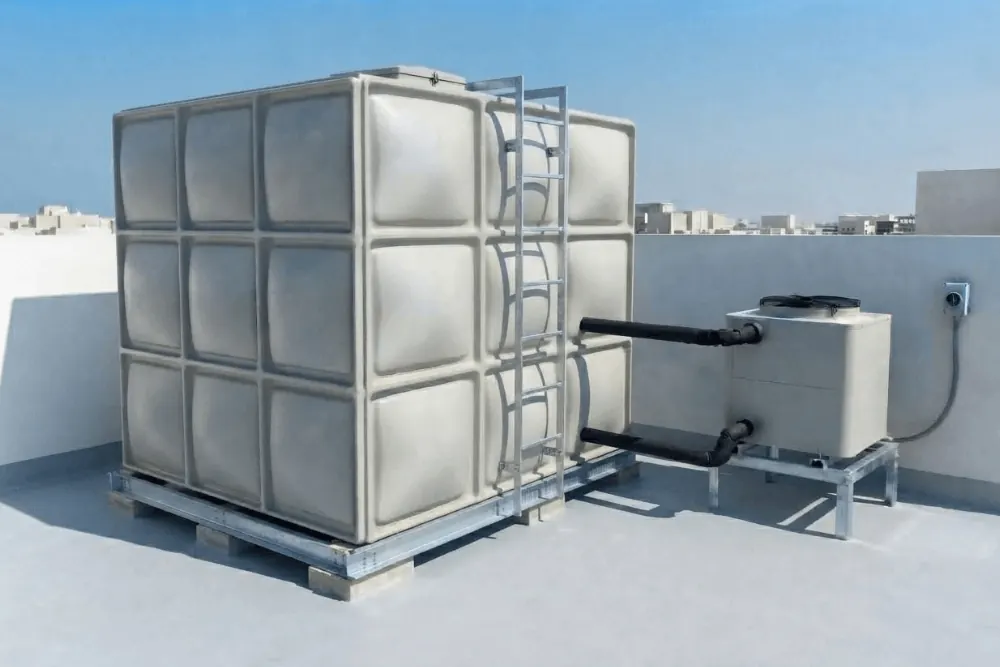
GRP water storage tank in Dubai: what we do
- Supplying and fitting sectional GRP tanks, and fitting a client's own, on a base checked first. See water tank installation.
- Checking a quote for a tank, line by line: the panels, the base, the cover, the ladder, the flanges and the paper.
- Float valves and float switches on a ground tank or a roof tank. See ball valves and transfer pump.
- GRP lining for a concrete tank, where the shell is sound and the surface has failed.
- Leak repair at a joint, a fitting or a cracked panel. See pipe leak repair.
- Cleaning and disinfection before first use and twice a year after. See water tank cleaning.
- Pump connections from a ground tank to a roof tank or a booster set. See booster pump.
- Emergency visits. We answer calls and send a plumber 24 hours a day, 7 days a week, including nights, weekends and public holidays.
- Areas. Across Dubai. The list is near the end of this page, and the full list of areas is on its own page.
What a GRP tank is: GRP, FRP, SMC and the names sellers use
GRP is glass-reinforced plastic: glass fibre set in a polyester resin. The same material is sold as FRP, fibreglass, fibre tank or simply "GRP panel tank". For a water tank they mean the same family of product, but the way the panels are made differs, and the quote should say which one you are buying.
- Press-moulded panels are pressed from sheet moulding compound in a heated mould, then bolted together on site. Both faces are smooth and the thickness is even.
- Hand-lay panels are glass mat laid by hand into resin, with a smooth coat on the inside face. Quality depends on the maker's control of the process.
- One-piece tanks are moulded as a single shell with no panel joints, limited by size and by how the tank can be carried to the site.
Ask for the resin and the glass reinforcement, and for a resin approved for contact with drinking water, which is what matters for stored water. The name does not tell you the construction, so ask.
Panels, heights and litres: sizing a sectional tank
A sectional tank is a box built from square panels. The litres come from the internal length, width and height multiplied out, and one cubic metre is 1,000 litres. A tank 3 m long, 2.5 m wide and 2 m high is 15 m³, which is 15,000 litres. A tank 4 m by 3 m by 2.5 m is 30,000 litres.
The external size is larger than the internal size, because the walls and flanges add to each side. Ask the maker for the external footprint, and add clearance for walking round the tank, before you choose a spot on the roof or in the plant room.
A tank is full to the float valve's shut-off and not to the brim, so the litres that matter are the ones between the low-level cut-out and the valve. Ask for both heights in writing. A float valve housing with an access hatch above the cover allows a higher valve position and more usable capacity. Sizing by daily use is on water tank installation.
Litres, in writing
Some sellers quote tanks in volume units other than litres, and the same name can mean different volumes in different places, a difference of thousands of litres on a large tank. Many sellers do not say which. Ask for the capacity in litres, worked out as the internal dimensions multiplied out, and check the multiplication yourself.
Base, weight and water pressure on the walls
A sectional tank does not rest on its panels alone. It needs a reinforced concrete base or a steel frame that is flat, level and strong enough for the full weight of the water. A quote that lists only the tank has left the base out, so ask for it as its own line.
- Base flatness. The maker states a flatness tolerance. A base that is out of level strains the panels and the joints.
- Clearance. Room above and round the tank for access to the cover, the bolts and the fittings.
- Catchment or drain. A tray, kerb or floor drain so a leak or an overflow does not run into the building.
- Flanges. A tank with internally flanged panels sits on a flat base. An externally flanged tank lets you reach every bolt from outside and drain the floor fully.
- Stays and bolts. Internal tie rods and stays should be stainless steel, and bolts galvanised or stainless, with stainless advised under water.
- Joints. Sealed with a sealant approved for contact with drinking water.
- Factory water test. Ask whether the panels and the finished tank were water tested.
One litre of water weighs 1 kg, so a 15,000 litre tank carries 15 tonnes of water. The pressure on the lowest panel grows with depth, which is why tall tanks need heavier panels and more stays. The tank maker can state the loads, and whoever owns the roof or the ground has to confirm the structure can carry them. A roof tank needs that structural check before the tank is ordered. See the weight and support section on water tank installation.
Insulation and heat in a Dubai summer
A GRP panel can be made with a foam core enclosed inside the laminate, or without one. Foam slows the heat getting through the wall and roof, and the thicker the foam, the less heat passes. Ask for the foam thickness for the exact tank. Insulated panels also cut condensation on the outside of the tank, and indoor tanks and tank rooms can be fitted with a condensation tray.
Conduction through the wall is a small part of the story. In a Dubai summer, sun on the roof and the walls and the temperature of the water coming in decide how warm the stored water gets, as much as the foam does. A shaded tank, a light panel colour, a roof cover and an insulated roof all help. An opaque panel also keeps light out, which slows algae growth in the stored water. The heat and light section of water tank installation covers the siting.
How long a GRP tank lasts
A GRP tank that is well made, correctly based and kept in good order can last many years. What shortens its life is poor panel quality, a bad base that strains the joints, failed gaskets and sealant, corroded bolts and stays, and sun on a roof tank with no cover.
We do not quote a number of years, because the figure depends on the maker and on the site. The figure a buyer can use is the written warranty on the tank and on the installation, and what it excludes. Our workmanship warranty runs for 30 days and covers labour only. Parts carry the manufacturer's warranty only.
A concrete tank cast on site and a stainless steel tank are the alternatives. They are covered on water tank installation.
Paper: what to ask for
Makers and sellers quote the same few documents.
- Product test report or certificate. Shows the tank was tested to a recognised standard for glass-fibre reinforced cold water storage tanks. Ask for the report or certificate for the exact tank.
- Drinking-water approval. Shows that a material, a sealant or a lining is suitable for contact with drinking water. Ask for the approval of the resin, the sealant and any insulation or lining.
- Quality management certificate. Shows the maker runs a quality management system. It does not prove the tank is suitable for drinking water.
Drinking water tanks must be built so that the water cannot be contaminated, with covers that keep out animals, birds and other foreign matter. For a tank in a block or a villa, the building management and the landlord may ask for particular paper. This is general information and not legal advice.
The safe request is to ask the seller for the certificate or test report for the exact tank, with its number and date, to read it, and to keep it with the handover papers. A page on a seller's website that says "certified" is not a certificate.
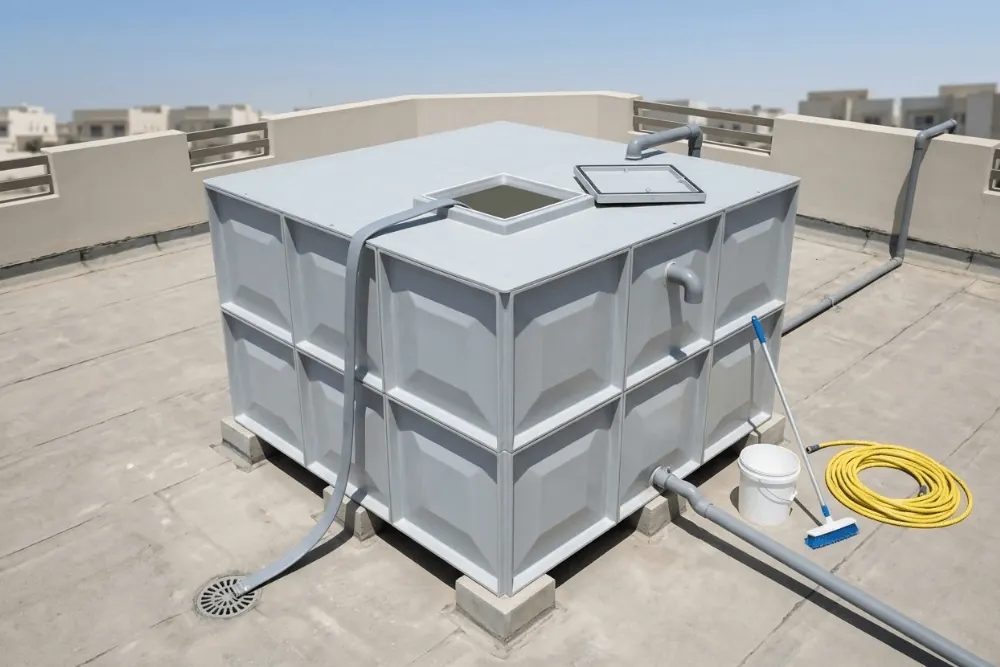
Covers, ladders, vents and the float valve housing
The panels are half the tank. The parts that sit on it decide whether it is safe to use and to clean.
| Part | What to know |
|---|---|
| Covers | Light-duty covers are not made to be stood on. Heavy-duty covers are rated for a person's weight. Ask for the rating in writing, and do not stand on a cover that has none |
| Manhole | A lockable, watertight GRP access cover, so only the people who should open the tank can |
| Access hatches | A small hatch (commonly 300 × 300 mm) over the float valve, and a larger manway (commonly 600 × 600 mm) on tanks over 1,000 litres so a person can get in to clean |
| Ladders | An internal ladder for cleaning and an external ladder to the cover on a tall tank, with a safety cage on the external ladder where the height needs one |
| Vent | Screened with a fine mesh so insects and dust stay out, and sized to let air in and out as the level moves |
| Overflow | Screened, large enough to carry the full inflow, and discharging somewhere safe and easy to see. See water tank installation |
| Dividers | Two compartments, or two tanks, let one side be emptied for a clean while the other keeps supplying |
| Condensation trays | For indoor tanks and tank rooms |
A 600 × 600 mm manway has 0.36 m² of opening and a 300 × 300 mm hatch has 0.09 m², so the manway is four times the area. That is the difference between a person who can climb in with equipment and one who cannot.
Float switches and float valves on a GRP tank
A float valve and a float switch do different jobs. The valve stops the fill. The switch tells a pump or an alarm.
| Job | Fitting | What to know |
|---|---|---|
| Stop the incoming water when the tank is full | A float valve (ball valve) | Mechanical. See ball valves and the float valve on water tank installation |
| Start or stop a pump from the tank level | A float switch | Electrical. See transfer pump |
| Warn that the tank is high or low | A float switch wired to an alarm | Electrical, on its own float |
The two-float arrangement between a ground tank and a roof tank is set out on transfer pump, and dry-run protection is on pump general. This section is about the switch on the tank.
Which switch. A vertical switch mounts from the top or the bottom of the tank, with a float that slides along a fixed stem. It suits tight or narrow tanks and sealed or pressurised ones, supports more than one switch point on one stem and gives more precise control. A horizontal switch goes through the side wall of the tank. It is simple and cheaper, but it needs a hole through a panel.
A hole through a panel is another joint to seal, and in a foam-cored panel the cut edge exposes the foam and the laminate. A vertical switch on a stem from the top, or a switch on the manway or float valve housing, adds no hole in the wall. Where a hole is needed, it is sealed with a sealant approved for drinking water.
Wiring. A pump or an alarm wired to a float is an electrician's job on a 230 V, 50 Hz supply. Our own electricians do it, and check that the switch contact is rated for the pump's load or that the float drives a contactor.
GRP lining for a concrete tank
A GRP lining is laminate built up on the inside of an existing tank, so the surface that touches the water is glass fibre and resin and not concrete. It suits an underground or roof concrete tank whose shell is sound and whose surface has failed: crumbling plaster, a tiled finish that has come away, rough or stained walls that cannot be cleaned properly.
It does not fix a tank with a structural crack or a failing slab. Those need a repair to the structure first, and some tanks are better replaced.
A lining goes on in a narrow range of conditions. Resin systems have a working temperature window and a cure time, and a closed underground tank in a Dubai summer can sit outside the window unless the work is planned for it. A contractor should be able to say what temperature range its resin system is applied in, what the cure time is at the temperature of the job, and what ventilation the tank gets while it cures.
Ask for the lining system by name (laminate, polypropylene liner or epoxy), the resin's approval for contact with drinking water and its certificate, the thickness and mat weight, the cure time, who tests the finished surface, and the warranty. A newly lined tank is a tank that has been opened and worked in, so treat it as the new-tank case on water tank cleaning: a clean and a disinfection before first use.
Repairing a GRP tank
A leaking GRP tank is inspected before anything is specified. Water can travel along seams, through insulation voids, behind coatings and round fixings, so a wet patch on the outside can be a long way from the hole.
- A failed gasket, a flange or a fitting is a local repair. We replace the gasket or reseal the flange with a sealant approved for drinking water.
- A minor crack in a panel can be mended on a sound laminate. The crack is cleaned back, a small hole is drilled at each end to stop it running, the crack is opened with a rotary tool, filled with a resin suited to the panel and finished smooth.
- Weeping at bolts usually means worn washers or a loose or corroded bolt. The bolt and washer are replaced with the right grade.
- A tank with widespread cracking, brittle panels or a damaged base is a replacement, because patches will keep failing.
The cause must be found and removed or the repair will fail again. The leak tests on water tank installation come before any patch. After a repair, the tank has been opened, so clean and disinfect it before it goes back into supply. See the new-tank case on water tank cleaning.
Repair against replacement is decided tank by tank, and we tell you which after a visit.
Getting the panels to the roof
A sectional tank is delivered flat in many pieces, which is its advantage on a roof where a one-piece tank cannot be lifted. The panels, the bolts, the stays and the sealant still have to reach the spot, so ask three questions before ordering. Can the panels go up in the lift, or must they be carried by stairs or hoisted outside? Is there a hoist point or a crane position? Can the roof carry the working load of the people and the pallets while the tank is built? A long building with the plant room on the top floor can add a day to the job for carrying alone. We walk the route on the visit, measure the door and lift, and say whether a hoist is needed so that the price does not change on the day.
Filling and the first week
A new tank is filled in stages. We fill a quarter, check the joints and the base, fill to half, check again, and then fill to the float valve. A weep at a joint is easier to cure with the tank part full than with the tank full. After a day standing full, we tighten the bolts again, because the panels settle slightly under load, and we check the stays. The overflow is tested by lifting the float valve so the water runs out of the overflow pipe where you can see it. Only then is the tank cleaned and disinfected and put into supply. In the first week, look at the base and the floor under the tank daily for a damp mark, and write down the float valve's shut-off level so you can compare it later.
Two compartments or two tanks
A single tank has to be emptied to be cleaned, which means the building has no stored water for the hours that takes. A tank divided into two compartments, or two tanks side by side joined at the bottom with an isolation valve, lets one side be cleaned while the other keeps supplying. It costs more at the start and is worth it for a block, a clinic, a restaurant or any building that cannot go dry. A villa can manage with one tank and a plan for the cleaning day, which is to fill the roof tank to the top the night before. The layout is easiest to change before the base is cast, so decide before the ground work starts. See water tank cleaning.
The overflow and the warning pipe
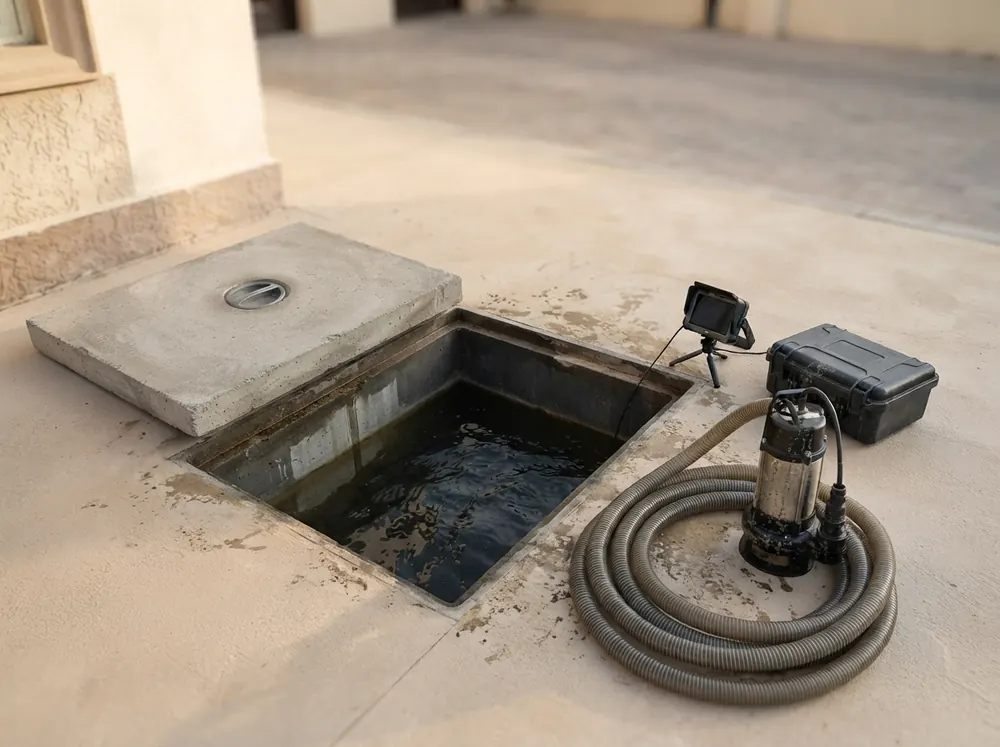
The overflow is the pipe that carries the water away when the float valve fails. It must be at least as large as the inlet, screened, fall continuously and end where a spill is seen and does no harm. An overflow that runs into a drain with no air gap can draw foul air or sewage back into the tank, and an overflow that discharges inside the building floods a ceiling. A warning pipe that drips on a wall or a car is the first sign the float valve has failed, and it is a better alarm than a clean tank wall, so do not plug it. If the overflow is running, tighten the float arm, replace the valve seat, or call us. See ball valve.
Eight checks before you buy or accept a quote
- The litres, in writing. The internal length, width and height multiplied out. If the quote uses another unit, ask for the litres.
- The construction. Press-moulded panels, hand-lay panels or a one-piece shell, the resin, the wall thickness and, if the panels are insulated, the foam thickness and its U value.
- The paper for the exact tank. The test report or certificate for the tank, the drinking-water approval of the materials and the sealant, and any approval your building asks for, each with a number and a date.
- The base. The plinth or frame as its own line, its flatness against the maker's tolerance, and who has checked the roof or the ground.
- The fittings, one by one. The manway and hatch sizes, the ladder and cage, the cover grade, the screened vent and overflow, the float valve housing, stainless stays under water and the bolt grade.
- The floats. The contact rating at 230 V, the cable length for the run, the approval if the switch is in the water, and any hole that has to be cut in a panel, with the sealant named.
- The lining or repair system, by name. Laminate, polypropylene liner or epoxy, the resin's approval for drinking water, the thickness, and the cure time at the temperature of the job.
- The quote. Who is selling, whether VAT is stated, whether installation and a clean before first use are in the price, how long delivery takes, and a price in writing.
Permission in Dubai: who decides on a GRP tank
A tank on a roof or in a plant room is part of the building. A tank in a villa garden is the owner's, and in a rented home it still touches the landlord. The fuller account of tanks in flats is on water tank installation.
- Building management. A roof or plant-room tank is on shared structure, so lifting, loading, shutting off the supply and discharging the overflow go through building management.
- Approvals for the fittings. Some buildings and communities want to approve the inlet and outlet connections, the overflow route and the access before work starts. Ask what yours needs.
Cleaning, a float valve or a switch replacement is maintenance, and needs a message to the landlord. A new tank, a change of tank, a lining that closes a tank for days, a new base or a new overflow route is an alteration, and needs written consent in a rented home and the building's approval. Tell us what your building asks for and we work to it.
When the job is finished
Ask for these. They cost nothing to produce.
- The certificate or test report for the tank, with its number and date, and the drinking-water approval of the sealant and any lining.
- The litres as built, with the internal dimensions measured and multiplied out.
- Photographs of the base and plinth before the tank went on it, and of the stays and bolts before the water went in.
- A list of the fittings, with the manway, hatch, ladder, vent and overflow sizes.
- The float settings written down: the shut-off height of the float valve, the pump start and stop heights, and a test that shows the pump stops when the upper float is lifted.
- A fill test, with every joint, bolt and fitting checked dry after the tank has stood full, and the overflow route seen.
- A clean and a disinfection record before first use. See water tank cleaning.
- The cure time and the resin datasheet for any lining or repair.
- FAM's workmanship warranty, in writing. The warranty runs for 30 days and covers our labour only. Parts carry the manufacturer's warranty only.
How we work
- You tell us what you have and want, with the litres, roof or ground, and photographs of the base, the access and any existing tank on WhatsApp.
- We visit and measure the space, the access route, the base and the supply and overflow. The visit fee is AED 50 + VAT, credited if the work goes ahead.
- We tell you what the tank needs, with the litres, the construction, the base and the fittings.
- We give a price and a method in writing, with the parts and the paper named.
- Check permission. In a rented or managed property, ask the landlord or building management whether they need to approve this work before the visit.
- We build or repair the tank, fit the floats and the fittings, and seal the joints.
- We test, clean and hand over, with the photographs, the settings and the paperwork.
Where we work in Dubai
We cover all of Dubai, including Dubai Marina, JBR, Downtown Dubai, Business Bay, Jumeirah Lakes Towers, Palm Jumeirah, Al Barsha, Jumeirah Village Circle, Dubai Hills, Mirdif, Deira and Al Quoz. See the full list of areas.
How much does a GRP water storage tank cost in Dubai?
- The tank. The price follows the litres, the construction, the foam thickness and the panel quality, and it varies a lot between makers and sellers.
- The work. Building the base, assembling the tank, fitting the floats and testing.
- What moves the price. The litres, the construction, the foam thickness, the base or the plinth, access for the panels, a crane or a hoist for a roof, the ladder and cover grades, the floats and any pump, and the paperwork.
We do not publish a starting price for this job. Send a photo on WhatsApp and we give you a fixed price before we start. Prices exclude 5% VAT.
GRP water tank FAQs
What does GRP mean on a water tank?
GRP is glass-reinforced plastic: glass fibre set in polyester resin. The same material is sold as FRP, fibreglass or "fibre tank". For stored drinking water, the resin and the sealant should be approved for contact with drinking water.
How do I work out the litres of a sectional tank?
Multiply the internal length, width and height in metres. A 3 m × 2.5 m × 2 m tank is 15 m³, which is 15,000 litres. Check the height to the float valve, because that is the level the tank fills to. See water tank installation for sizing by daily use.
What standard should a GRP water tank meet?
Ask for a recognised product test for glass-fibre reinforced water tanks, and a drinking-water approval of the materials that touch the water. Ask the seller for the certificate or test report for the exact tank, with its number and date, and keep it with your papers.
How long does a GRP water tank last?
We do not state a number of years, because it depends on the maker, the base and the site. Ask for the warranty in writing and what it excludes. Our workmanship warranty is 30 days on labour only, and parts carry the manufacturer's warranty only.
Will a GRP tank keep the water cool in Dubai?
Insulated panels slow the heat getting through the walls and roof, and thicker foam passes less heat. But sun on the roof and the temperature of the water coming in decide the summer temperature as much as the panel does. Shade, a light colour and a roof cover help, and an uncovered roof tank in full sun will still run warm.
Should I use a float switch or a float valve?
They do different jobs. A float valve is mechanical and shuts the water coming into the tank. A float switch is electrical and starts or stops a pump or sounds an alarm. A tank that is filled by gravity from the main needs the valve, and a tank that feeds or is fed by a pump needs the switch as well. See transfer pump.
Can a concrete tank be lined with GRP?
Yes, where the concrete shell is sound and the surface has failed. Ask for the system by name, the resin's drinking-water approval, the thickness and the cure time at the temperature of the job. The tank must be cleaned and disinfected before it goes back into use.
Can a cracked GRP tank be repaired?
A minor crack, a failed gasket or a leaking flange can be repaired when the laminate is otherwise sound and the cause is found and removed. Widespread cracking or brittle panels mean replacement. The tank is cleaned and disinfected before it goes back into supply.
How much does a GRP water storage tank cost in Dubai?
The price depends on the litres, the construction, the base and the access. Send photos and the size on WhatsApp and we give you a fixed price in writing before we start, excluding 5% VAT.
Book a GRP water tank visit in Dubai
Tell us the size in litres, whether the tank is on a roof or the ground, how the panels would reach the spot, whether there is a tank there now and what it is made of, and whether you rent or own. Photographs of the base or roof, the access route and the existing tank help. If a tank is leaking, shut the inlet and call.
WhatsApp: +971 55 407 7427 · Request a quote
Visit us: Office 871, Oasis Mall, Al Quoz 1, Dubai, UAE
Related services: Water tank installation · Water tank cleaning · Transfer pump · Booster pump · Pump general · Ball valve · Pipe leak repair · Water testing