
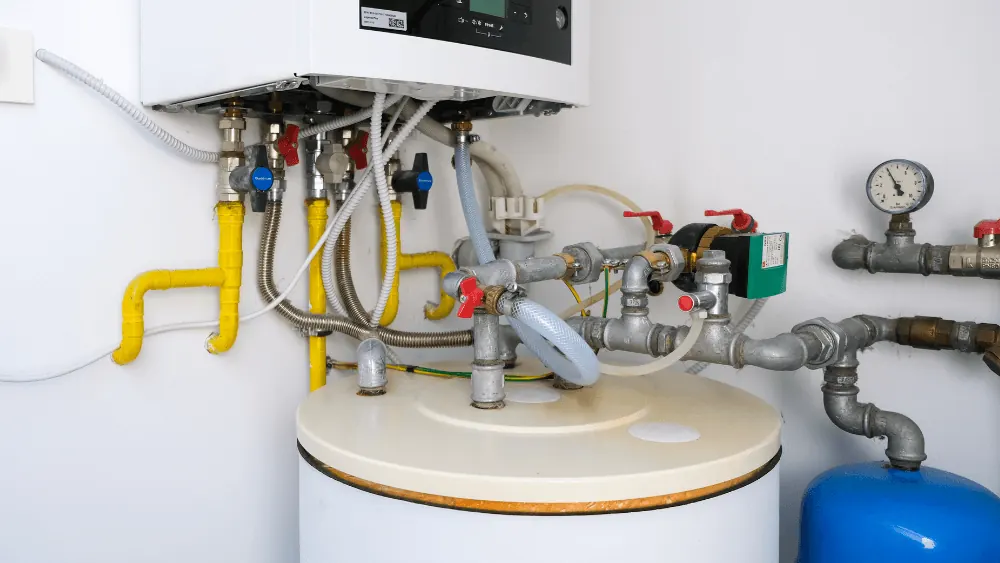
Ball valves in Dubai: what we do
- Replacing a seized or leaking ball valve at a fixture, a branch, a heater, a pump or the main. See valve repair and replacement.
- Fitting isolation ball valves so one bathroom, one appliance or one pump can be shut off without closing the whole property.
- Brass, PVC and press-fit ball valves for copper, plastic and PEX pipework.
- Motorised and actuated ball valves for tank filling and automatic shut-off.
- Ball valves for pools and gardens. See pool plumbing and irrigation.
How a ball valve works
A ball valve has a ball with a hole through it, held in the valve body between two seats. A handle on a stem turns the ball.
That gives the reading rule for a lever handle: parallel to the pipe is open, and across the pipe is closed. The handle shows the position from across the room, which a multi-turn valve cannot do.
A valve that spends years open and is asked to close in an emergency is the case that matters, and it is why the handle position and the condition of the stem matter more than the brand. Our valve repair and replacement page sets out how this compares with a gate valve, and our valves overview lists the gate valve alongside it.
The size line
The valves overview has the table that relates inches to DN to the pipe's outside diameter, and it shows a "1-inch" valve fits a pipe of 33.4 mm outside diameter.
Valves and pipes are sold by size in three ways: inches, DN and pipe outside diameter. A DN15 valve pairs with 20 mm pipe and a DN50 valve with 63 mm pipe, so the first number reads as a pipe outside diameter and the second as DN. Ask the seller which system a size is in before you order, and send us a photograph of the pipe with a tape measure across it.
Full port, standard port and reduced port
The port is the hole in the ball. It sets how much water passes when the valve is fully open.
A reduced bore valve has a ball bore one pipe size smaller than the valve's pipe size, so the water speeds up. A V-port valve has a V-shaped ball or seat and gives controlled flow. A full port valve has no restriction to the flow. A standard port valve creates some flow loss, and a reduced port valve is a kind of standard port valve.
The size of the loss is easy to work out.
| Valve size | Bore one size down | Area left, as a share of full | Water speed at the same flow |
|---|---|---|---|
| 1/2 inch | 3/8 inch | 56% | 1.8 times |
| 3/4 inch | 1/2 inch | 44% | 2.3 times |
| 1 inch | 3/4 inch | 56% | 1.8 times |
| 1-1/2 inch | 1-1/4 inch | 69% | 1.4 times |
| 2 inch | 1-1/2 inch | 56% | 1.8 times |
The real bore of a valve is set by the maker and is not the nominal figure, so read the maker's data for any valve that matters. The point of the table is the direction and the size of the effect: a reduced port valve is a narrower pipe fitted in the middle of the line.
A full-port valve adds little friction, and a standard port is acceptable on a short branch to a single tap or a toilet, where the valve is not the narrowest point in the line. On a main, a pump line or a tank outlet, we ask for full port, as our repair page also says. A shop will not always label the port, so ask for it.
One, two or three pieces
The body is made in one, two or three parts, and this decides how the valve is built, whether it can be opened for repair, and how large the ball can be.
| Body | What it is | What to know |
|---|---|---|
| One piece | A single body with the ball loaded in from one end | No seams to leak, always standard port, and it cannot be opened for repair |
| Two piece | Two body halves screwed together with the ball between them | Can be full port and costs less than a three piece. In practice it is replaced when it fails |
| Three piece | A centre body held between two end caps by bolts | Repairable and heavy duty, and the most expensive. The seats can be replaced with the body left in the line |
| Moulded in place (PVC) | The ball and stem are moulded into the body | A one-piece design used on small PVC valves |
A one-piece or two-piece brass valve at a fixture is replaced when it fails, because it costs less than the labour to rebuild it. A three-piece valve can be opened and its seats replaced with the pipe in place, which matters on a large pipe or a stainless steel line that would be hard to cut. Whether a seat repair is available depends on the maker supplying a kit. Ask for it before you buy.
Reading the pressure marking
A ball valve is marked with the pressure it will take. On valves sold in Dubai the figure is usually PN, in bar, so a PN16 valve is rated for 16 bar. If the marking uses another unit, ask the seller to convert it to bar before you buy.
Two points matter more than the number. First, a pressure rating belongs to a temperature. A valve on a roof tank line in summer can carry water well above room temperature, so ask the maker what the valve is rated for at the temperature your water reaches. Second, a pressure marking is not a gas approval. A water ball valve belongs on water. For a gas line, our gas safety page covers what the work needs and who may do it.
A house supply does not need an industrial valve. The rating to match is the pressure and the temperature in your pipe, with a margin the maker states.
Materials and ends
Brass, DZR and stainless steel
Brass suits threaded and compression joints on copper and most household lines. DZR (dezincification-resistant) brass is the choice where the water is aggressive, and stainless steel is for corrosive or high-purity lines. The valves overview has a separate section on brass, bronze, stainless steel and iron.
The ends: how the valve joins the pipe
The thread is a second specification. Threads are BSP or NPT, they look alike and do not seal together, so match the family on both sides and check which end is male and which is female. The valves overview shows why the two thread families do not mix.
PVC ball valves for pools and gardens
PVC-U ball valves are the type fitted on pool plant and irrigation.
A valve on a pool pump or filter is touched more often than one on a garden zone, so the true-union style earns its price there, and a single-union valve is enough where nobody will need to service the valve. Our pool plumbing and irrigation pages cover where the valves sit in each system.
Two-way and three-way
A two-way ball valve passes the flow straight through, from input to output, and is used for basic on and off control. A three-way valve has an L-port or a T-port bore. An L-bore switches flow between two paths, which suits diverting. A T-bore can connect or isolate three paths, which suits mixing or distributing.
A house isolation valve is two-way. A three-way valve belongs in a pool, a heating loop or a diverter, and our pool and heater pages cover those.
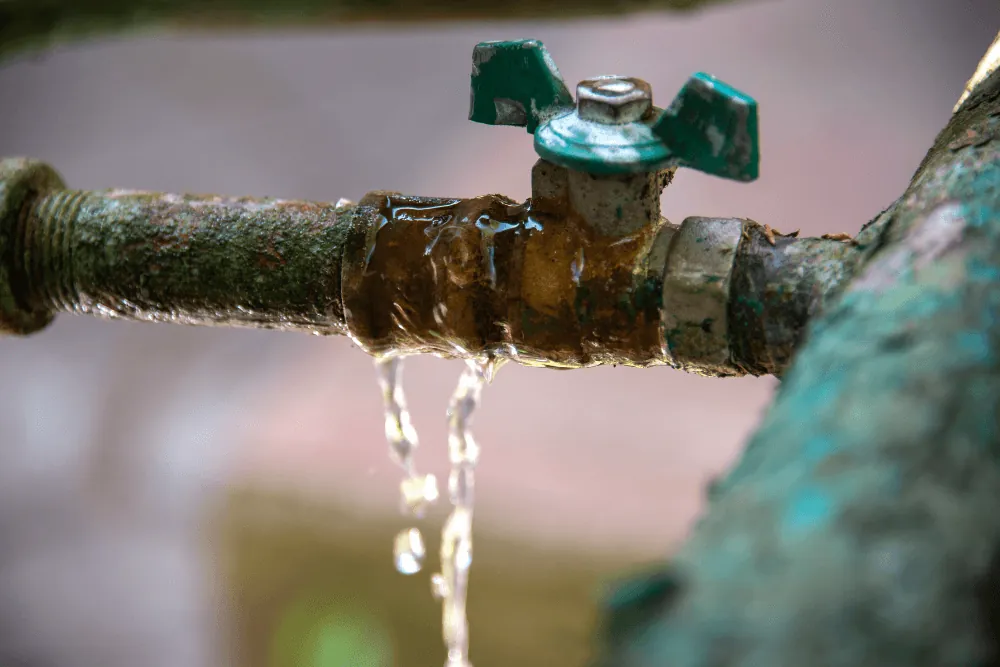
Motorised and actuated ball valves
A motorised ball valve is a ball valve with an electric actuator on the stem. It is the valve behind an automatic shut-off: a leak sensor or a controller sends a signal, and the actuator turns the ball.
| Control | What happens | What to know |
|---|---|---|
| 2-wire | A signal holds it open, and removing the signal closes it, or the other way round | On power loss the valve returns to its fail-safe position, which suits a leak shut-off |
| 3-wire | Separate signals open and close it. Limit switches stop the motor at each end | On power loss the valve does not move: open stays open and closed stays closed |
Ask what the valve should do when the power goes. A leak shut-off should close, and the 2-wire type is built to return to its fail-safe position. A valve on a line that must stay open through a power cut, such as a tank feed you would not want to close on its own, needs the 3-wire type or a manual override. A motorised valve is also one more thing that can stick, so it has a manual test routine like any other valve.
Our leaks overview covers what sensors tell the valve and what they miss.
Where a ball valve goes in a Dubai property
The table names what to ask the seller for. It is not a specification.
| Location | What the job needs | What to ask for |
|---|---|---|
| Property main, after the meter | A valve that closes in an emergency and has not moved for years | Full port, brass, lever handle. The utility's agreement is needed on the meter side. See valve repair and replacement |
| Branch to a bathroom or the kitchen | Shut off one area during a repair | Full port where the branch carries more than one fixture |
| Under a basin or beside a toilet | An isolation valve on a single fixture | A compact two-piece brass valve. A standard port is acceptable here |
| Roof or ground tank inlet | Isolate the float valve for repair | Brass or PVC, matched to the pipe. See water tank installation and repair |
| Pump suction and delivery | Isolate a pump to service it | Full port on the suction side. See booster pump installation |
| Water heater cold inlet | Isolate the heater to service it | Brass, and ask us what must not be closed off on that heater. See water heater repair |
| Washing machine or dishwasher tap | A small isolation valve on the supply | See washing machine plumbing |
| Garden zone | Isolate a zone or the garden supply | PVC-U, or brass at the tap. See irrigation |
| Pool pump and filter | Isolate for backwash and service | True-union PVC-U. See pool plumbing |
| Gas | A gas-approved valve only | Not a water valve. See gas safety |
A ball valve is for on and off
Do not use a ball valve to turn a flow down.
Two household cases come up. The first is reducing the flow to a tap or a washing machine: use the fixture's own tap or a regulator, not a half-closed isolation valve. The second is high pressure: a pressure reducing valve is the device for it, and our pressure valves page covers it.
Close a ball valve smoothly. A ball valve can be shut quickly by hand, which creates a risk of water hammer. The fix for a pipe that bangs is on the pressure valves page.
A ball valve is not a ball float valve
The phrase "ball valve and float" names a different part. A ball float valve, also called a ballcock, a float valve or a fill valve, fills a tank or cistern and shuts itself off when the water reaches a set level. A ball float valve uses a hollow ball on an arm to control the valve. The ball in that name is a float on an arm. The ball in a ball valve is a drilled sphere turned by a handle.
The two parts often sit next to each other: a ball valve upstream isolates a float valve so the float valve can be repaired. Our pages cover the two by what they serve:
- A roof or ground tank's float valve. See the float valve and overflow section on our water tank installation and repair page.
- A toilet cistern's fill valve. See toilet repair.
Faults: what each symptom means in a ball valve
Our valve repair and replacement page covers the whole repair, and our valves overview has a fault table. This table is for the causes that belong to a ball valve.
| Symptom | Likely cause |
|---|---|
| Water at the stem | Stem misalignment or damage, and worn packing. Tighten the packing nut slightly, and replace the packing if that does not stop it |
| Water from the body seam | Eroded or cracked seats, and on a three-piece valve uneven or loose body bolts |
| Water passes when the valve is closed | Seats that degrade and crack from corrosion, and debris or sediment |
| A leak at a threaded end | Too much or too little torque. Disassemble, apply PTFE tape and reassemble |
Do not force a stuck valve, because force can break the stem, crack the valve or cause a leak. Try rocking the handle gently with a cloth, loosening the packing nut about a quarter turn and retightening it, and calling a plumber if the valve is still stuck. If the valve is the one that would stop a burst, do not spend the afternoon on it. Close the main and call.
Replacing an isolation valve: the job in order
- Find the next valve upstream. We need a way to stop the water. If there is none for the area, the job starts at the main, and the building's isolation window is arranged first.
- Drain the line by opening the lowest tap, so no water sits above the valve when it is cut.
- Cut or unscrew the old valve. A seized threaded valve is cut out rather than forced, because force on the pipe can crack a joint further back.
- Prepare the pipe. Clean the thread or the cut end, and check the pipe for scale and damage. A new valve on a rough or corroded end leaks again.
- Fit the new valve with the handle clear of walls and cupboard doors, so it can be turned through its full quarter turn.
- Open the supply slowly, check every joint with a dry tissue and run the valve closed and open twice.
- Label it on your valve map, with a photo of the handle in the open position.
Dubai water and ball valves that have not moved in years
A valve that has stayed open for years is the one that sticks when you need it. Dubai's water leaves mineral scale on the stem and the ball, and the packing dries out in the heat of a plant room or a roof. The lever then turns stiffly, or not at all, and a valve that cannot be closed is no isolation at all.
The remedy is to exercise isolation valves. Close and reopen each main valve a couple of times a year, a quarter turn each way, and feel for stiffness. A valve that turns freely is fine. A valve that grinds or needs force is telling you to replace it while you can still close the main to do so, and not after a leak has started. Where a valve has to stay open for a long time, such as one on a pump line, tell us, and we note it for the next visit.
Threaded, compression and press-fit ends: which for which pipe
The end of the valve has to match the pipe. A threaded valve joins steel and brass pipe, and plastic pipe with a threaded adaptor. A compression valve joins copper without heat, with an olive and a nut, which suits a retrofit. A union or socket valve, in PVC-U, joins plastic pipe with solvent cement. A press-fit valve joins PEX and similar pipe with a crimp tool, and is a different system with its own fittings.
Mixing them is where leaks begin. A threaded valve screwed on a thread of the wrong family looks tight and weeps. A compression olive reused on a new valve seals badly. A crimp valve does not fit a threaded line without an adaptor. When you send a photograph, include the pipe and the joint, and we match the valve to what is there.
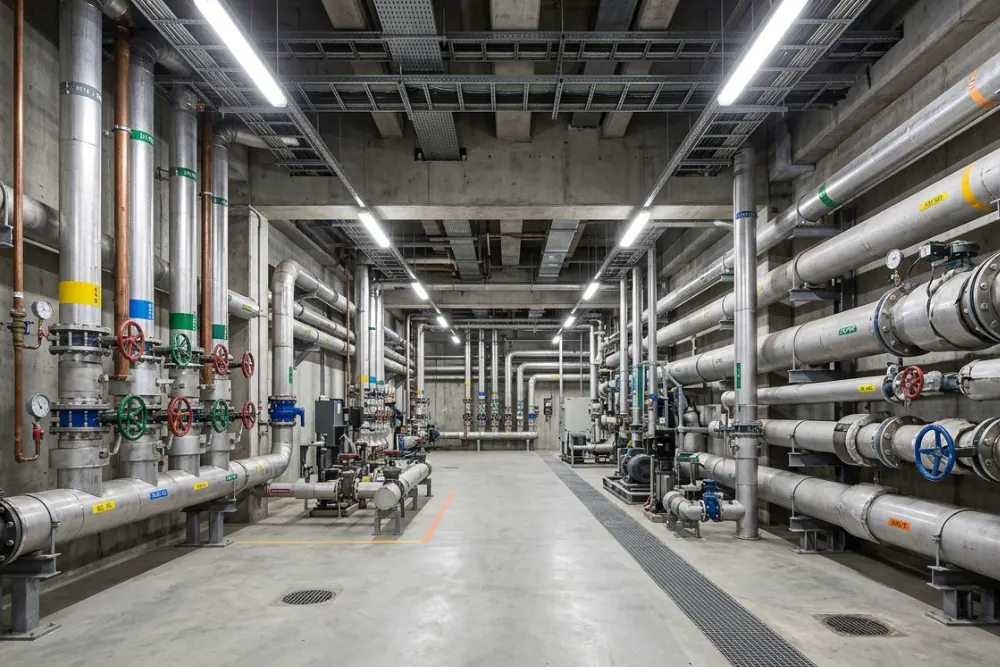
Handles, tight spaces and the quarter turn
The handle is part of the valve's job. A long lever gives more leverage on a stiff valve, and it shows the position at a glance, but it needs room to swing. Under a basin, behind a toilet or in a narrow riser cupboard, a long lever hits the wall or a pipe, and the valve cannot be fully closed. In those places we choose a short lever, a butterfly handle or a valve with a slotted stem and a screwdriver, and we say which on the quote. A handle that cannot make its quarter turn gives a false sense of isolation, because the valve looks closed and is not.
Check the handle after the work. Close the valve, open a tap downstream and see that the flow stops. Open the valve and see that the handle sits parallel to the pipe. Take a photo of each position, and keep them with your valve map. If a handle is loose on its stem, or the stem turns inside it, the nut or the handle is replaced before the valve is trusted.
Six checks before you buy a ball valve
- Port. Ask for full port on a main, a pump line or a tank outlet. A standard port is acceptable beside a single tap.
- Body pieces. One-piece valves are standard port, a two-piece can be full port, and only a three-piece is made to be repaired in the line.
- Pressure and temperature. Check the PN figure and the temperature it applies at.
- Ends. Match the thread family, and check male and female positions. A crimp valve joins PEX and PERT, and a threaded valve does not.
- Material and the pipe. Brass for a threaded or compression joint, PVC-U for solvent or union joints on plastic, and a listed DZR or lead-free brass where the supplier states it.
- Handle. A lever shows the open and closed positions. Check that it is fitted so that parallel to the pipe means open.
A valve map for your property
Most people learn where their isolation valves are when a pipe is already leaking. A valve map takes an hour and saves that panic. Walk the property with your phone and record:
- The main valve where the supply enters the property, or the unit's own valve in a flat.
- The tank and pump valves, inlet and outlet, and the bypass if there is one.
- The heater valves, cold feed and hot outlet.
- Each bathroom and the kitchen, with the valve under the basin, behind the toilet and under the sink.
- The garden and irrigation valves.
For each one, note where it is, what it controls, its size and whether it turns freely. Take a photo of it open and a photo of it closed, and keep them together. Tag any valve that is stuck, leaking at the stem or hidden behind a fixed panel, and tell us, because those are the ones to fix before they are needed. A valve you cannot find or cannot turn is not an isolation valve yet.
Permission in Dubai: who decides on a ball valve
A ball valve change touches the water utility, the building and the landlord.
- The utility owns the valves on its side of the meter and expects them to stay open. We do not alter valves on the meter side without the utility's agreement.
- Building management. In a flat, the building's risers and shared valves belong to the building, and we do not work on riser valves without management.
In practice: replacing a seized valve with a like-for-like ball valve inside your own flat or villa is normally the landlord's responsibility, so tell the landlord in writing first. Adding new isolation valves is an alteration and needs written consent in a rented home. Tell us what your building asks for and we work to it.
When the job is finished
Ask for these. They cost nothing to produce.
- A valve map or note saying which valve closes which area, with the make and model of each new valve.
- A photograph of each valve with the handle in the open position, and one with it closed.
- The marking on each new valve photographed, with the invoice, for the warranty.
- A test result: the valve closed, the downstream side checked for water passing, and the valve opened and the connections checked for weeping.
- FAM's workmanship warranty, in writing. The warranty runs for 30 days and covers our labour only. Parts carry the manufacturer's warranty only.
How we work
- You tell us what the valve is for on WhatsApp, with a photograph of the valve and the pipe. A photo of the marking on the body saves a visit.
- We say what is needed: a like-for-like replacement, a full-port valve in place of a reduced one, or a different material.
- We give a price in writing for the valve and the work.
- Check permission. In a rented or managed property, ask the landlord or building management whether they need to approve this work before the visit.
- We isolate the supply, fit the valve and test it, closed and open.
- We hand over the valve map and photographs.
Where we work in Dubai
We cover all of Dubai, including Dubai Marina, JBR, Downtown Dubai, Business Bay, Jumeirah Lakes Towers, Palm Jumeirah, Al Barsha, Jumeirah Village Circle, Dubai Hills, Mirdif, Deira and Al Quoz. See the full list of areas.
How much does ball valve work cost in Dubai?
The valve is a small cost, and the work is the other. A small brass isolation valve is cheap. A large full-port, stainless steel or motorised valve costs much more, and a press-fit valve for PEX is a different system from a threaded one and is priced separately.
- The work. Isolating the supply, removing the old valve, fitting and jointing the new one and testing.
- What moves the price. The size and material, how hard the old valve is to remove, whether the pipe has to be cut and rejoined, and access.
We do not publish a starting price for this job. Send a photo on WhatsApp and we give you a fixed price before we start. Prices exclude 5% VAT.
Ball valve FAQs
Which way is a ball valve open?
With a lever handle, parallel to the pipe is open and across the pipe is closed. The handle lies flat in alignment with the flow when open and is perpendicular to it when closed. The ball turns 90 degrees between the two positions.
What is a full-port ball valve and do I need one?
A full-port valve has a ball bore the same size as the pipe, so it adds little friction. Ask for full port on a main, a pump line or a tank outlet.
What does PN16 on a valve mean?
It is the pressure rating in bar, so 16 bar. If the marking uses another unit, ask the seller to convert it to bar. The rating applies at a stated temperature, so check what the maker says for your water. A pressure marking is not a gas approval.
Is a ball valve the same as a ballcock or float valve?
No. A ball valve is a drilled sphere turned by a handle, and a ballcock or float valve fills a tank and shuts itself off at a set level. They often sit side by side: a ball valve upstream of a float valve lets you isolate it for repair.
Can I use a ball valve to reduce the flow?
No. A ball valve is made for on and off, and half-closed it wears the seat and can make the pipe bang. To turn the flow down, use the fixture's own tap or a regulator, and for high pressure use a pressure reducing valve.
Can I use a water ball valve on a gas line?
No. Gas needs a valve approved for gas, and gas work is not something FAM does. Our gas safety page covers who may do it.
What is the difference between a one-piece, two-piece and three-piece ball valve?
A one-piece valve has no seams and is always standard port, a two-piece valve is easier to build and can be full port, and a three-piece valve is repairable and heavy duty and very expensive. Only the three-piece type is made to have its seats replaced with the body in the line.
What is a motorised ball valve and which type do I need?
It is a ball valve with an electric actuator. A 2-wire actuator returns to a fail-safe position when power is removed, and a 3-wire actuator stays where it is. For a leak shut-off, choose the type that closes on a power cut. For a line that must stay open, choose the one that holds its position. Check the data sheet of the actuator you are buying.
Why will my ball valve not turn, or leak when closed?
A stuck valve is usually mineral build-up, rust on the stem or worn packing. Do not force it. If it is the valve that would stop a burst, close the main and WhatsApp us.
Book a ball valve visit in Dubai
Tell us what the valve serves, what it is made of and whether you own or rent. A photograph of the valve, the marking on its body and the pipe beside it helps. If water is escaping and the valve will not close, close the main and call. We will say what is needed, give you a price in writing, do the work and hand over a valve map.
WhatsApp: +971 55 407 7427 · Request a quote
Visit us: Office 871, Oasis Mall, Al Quoz 1, Dubai, UAE
Related services: Valves overview · Valve repair and replacement · Pressure valves · Backflow prevention · Water tank installation · Booster pump · Pool plumbing · Irrigation · Leak detection · Emergency plumber