
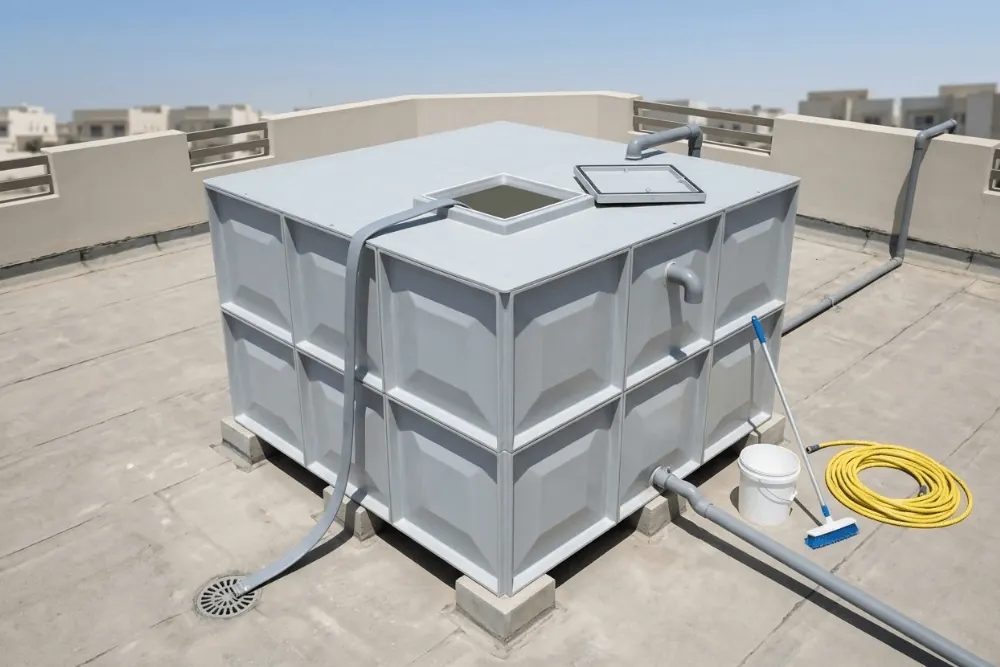
Water tank cleaning in Dubai: what we do
- Inspection. Cover, hatch, vents, overflow, float valve, inlet and outlet, and the state of the water.
- Cleaning and disinfection. Draining, sediment removal, scrubbing, disinfecting and flushing, done by our own team.
- Plumbing before and after. Isolation valves, drain points, overflow and float valve checks, protecting the pump, the refill and restoring supply.
- Repairs found at inspection. Covers, float valves, vents, overflow screens, outlets and pipework.
- Testing and paperwork. Water samples after the clean, a report and photographs.
- Emergency visits. We answer calls and send a plumber 24 hours a day, 7 days a week, and we do not promise an arrival time.
How often a tank should be cleaned
A tank that feeds drinking and washing water should be cleaned and disinfected on a schedule. Every six months is the practice we recommend, with extra cleans when the tank needs one. If you search for the interval, you will find different answers, from once a year to every three months. The right answer depends on the tank, the water use and what the last clean found.
Tanks should be kept covered and built so that animals, birds, dust and other foreign matter cannot get in. Where a tank is shared, each user can ask to see the cleaning record. Your building or your contract may set its own schedule, so ask building management what applies to you.
When to clean sooner
- A new tank before first use.
- A polluted tank or source.
- A tank with missing or badly fitted covers.
- A property that has stood empty for weeks.
- A tank that has been opened for repair.
- Water that looks, tastes or smells wrong.
Questions to ask any tank cleaning company
Put these to every cleaning company you are considering. The answers tell you more than the price.
- Who has done this before, and can I see a past report? The answer should be a real report with photographs.
- What does the price include? Draining, sediment removal, scrubbing, disinfection, flushing, refilling, the report and the photographs are the usual items. Testing and repairs may be extra.
- What chemical do you use, at what concentration, and for how long? A clear answer names the product, the parts per million and the contact time. A vague one is a warning.
- Do you drain and scrub, or just add chemicals? Disinfecting a tank full of sediment does not clean it.
- Who will enter the tank, and what safety procedures do you follow? The answer should mention trained staff, a second person outside and ventilation.
- What will I receive afterwards? Expect a report, photographs and test results, as set out below.
- How long will the water be off? The company should give a realistic window, not "an hour or two" for every tank.
- What happens if you find damage? A good company stops, shows you and quotes the repair before refilling.
A company that cannot answer questions three and four has not told you how it will clean the tank. Be wary of a quote that arrives with no questions about the size, type and location of the tank, because a company that does not ask cannot price it.
Know your tank
Cleaning differs by where the tank sits and what it is made of. A tank that is easy to open is quicker than one reached by a manhole in a floor slab.
| Tank | Where it is | What to know |
|---|---|---|
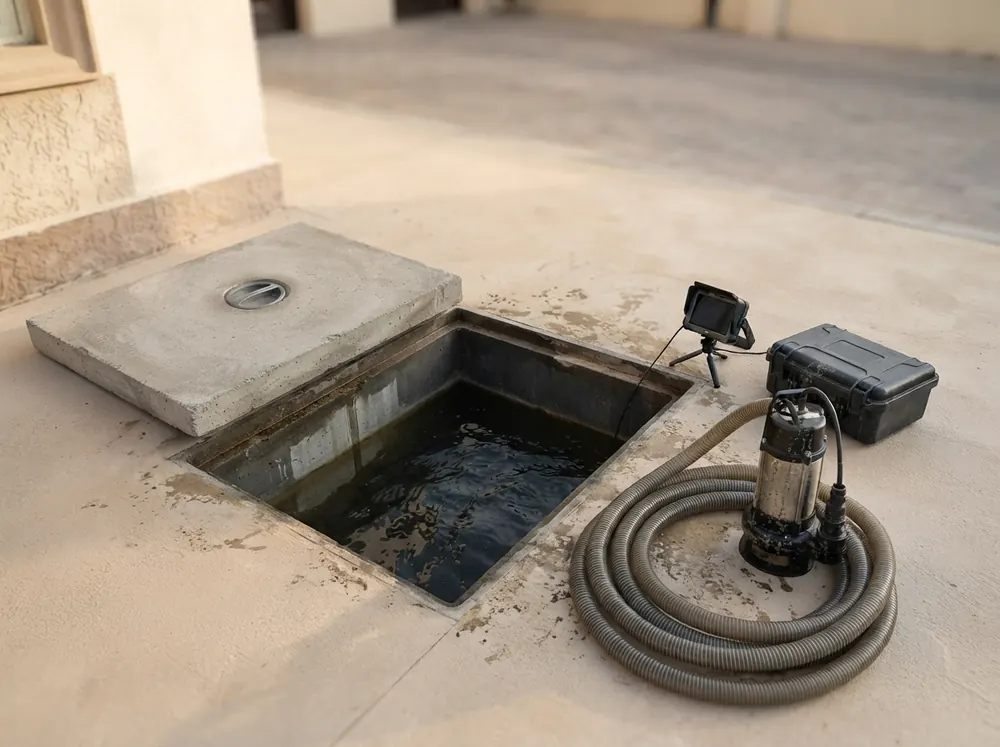
| Underground (ground-level) tank | Below a villa's garden or driveway, or a building's basement | Reached by a hatch or manhole. Water is lifted to the house by a pump. The cover and seal matter, because dust and soil sit close by |
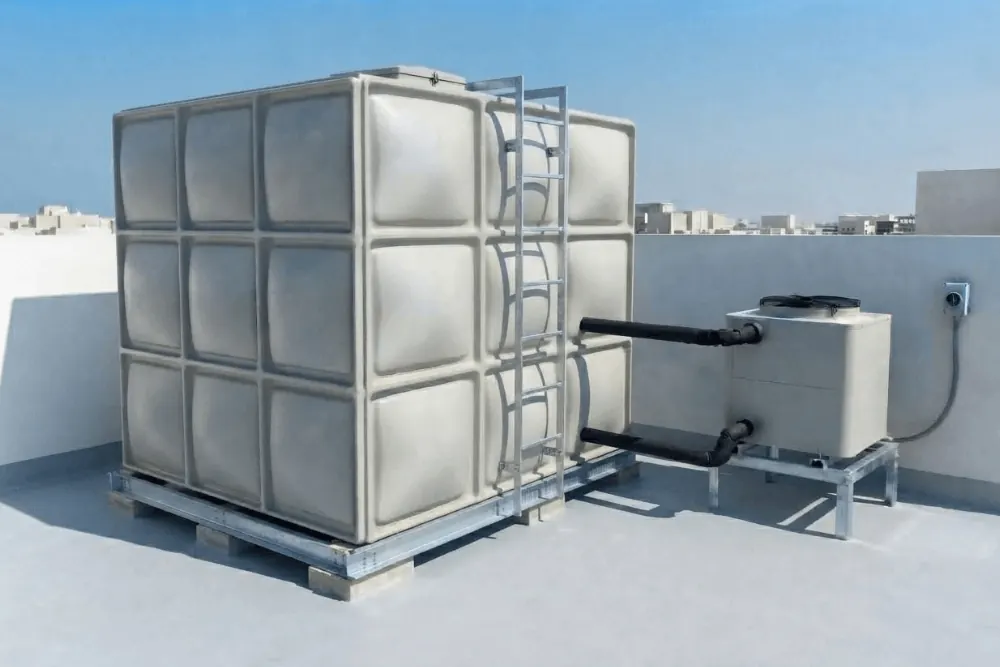
| Rooftop tank | On a building's roof or a villa's flat roof | Reached by a ladder or hatch. Feeds taps by gravity, or via a pump |
| Break tank | In a pump room, between the supply and a booster set | Feeds booster pumps. Pumps fail if it runs low |
| Small plastic tank | Roof of a flat or a small villa | Easier to open and clean than a large tank |
Tanks are built from concrete, fibreglass-reinforced plastic, polyethylene or stainless steel. The material affects how the surface is cleaned, and the method is chosen after seeing the tank.
Is your tank above or below ground?
Look for these:
- A hatch or manhole cover in the garden, driveway or basement points to an underground tank.
- A tank on the roof is a rooftop tank, which may be plastic.
- A pump close to a hatch points to a ground tank feeding a roof tank or taps.
- No tank at all means a mains-fed property, and this page is not about you. See our page on low water pressure for how water reaches the tap.
A villa may have both a ground tank and a roof tank. In that case both need cleaning, and so do the pipes between them if the water has been standing in them.
Signs your tank needs cleaning
You cannot see inside a closed tank, but the water gives it away.
| What you notice | What it may point to | What to do |
|---|---|---|
| Cloudy water that does not clear in a glass | Sediment or suspended matter in the tank | Check the tank. Book a clean |
| Brown, yellow or rust-coloured water from every tap | Sediment, or rust in an old tank or pipes | Check the tank and pipes |
| Brown or discoloured water from the hot tap only | The water heater or the hot pipes | See water heater repair |
| A rotten-egg or sulphur smell | Stagnant water or bacterial growth in the tank | Book a clean and test |
| Musty or earthy smell and taste | Algae or biofilm | Book a clean |
| Visible particles or flakes | Scale, sediment or tank lining flaking | Check the tank. Book a clean |
| Insects, dirt or debris in a tap or the tank | A damaged cover or vent | Cover first, then clean |
| Water that stood unused for weeks | Stagnation | Clean and disinfect before use |
If the water at the tap looks wrong but the tank is clean, the cause may be the pipes, a filter or the supply. See our pages on smelly or discoloured water and water quality testing.
Do not wait for the water to change
Clean-looking water can still be contaminated. A tank can hold bacteria without any change in colour, taste or smell. Treat the schedule as the baseline and the signs as the reason to clean early.
Common reasons a tank gets dirty
- Sediment settling. Silt and fine particles from the supply settle on the bottom over months.
- A cover that does not seal. Dust, insects and small animals get in.
- Light. A tank exposed to light can grow algae. Opaque tanks and sealed covers reduce it.
- Stagnation. Water that stands without turning over loses its disinfectant residual. A tank oversized for the property, or a property used rarely, holds water for a long time.
- A failing float valve or overflow. Water that overflows or backs up can bring in contamination. See water tank installation and repair.
- Pipes and fittings. Old corroded pipes shed rust into the water.
- Maintenance work. Opening a tank or working on a pump can introduce dirt.
What a proper water tank cleaning involves
A proper clean is a sequence, and skipping a step leaves a dirty tank behind. This is how the job runs.
1. Survey and notice
We look at the tank before quoting: its size, type, material, access and the water use in the property. Then we agree a time, because the water has to be shut off or reduced while the tank is out of use. In a building, management needs to know. The visit fee is AED 50 + VAT, credited if the work goes ahead.
2. Isolate the tank
The supply to the tank is closed, and any float valve is controlled so the tank does not refill mid-clean. The pump is switched off, so it does not run dry. Valves leading to the distribution pipes are shut.
3. Drain
The tank is drained, and the water is directed to a suitable drain, away from planting and not into a septic system. Draining happens in two stages: most of the water goes first, and the rest goes after scrubbing and rinsing, together with the sediment.
4. Remove sediment
Sludge on the bottom is removed by vacuum or by hand-held equipment. Sediment is where bacteria and slime sit, so it has to leave the tank, not be washed round it.
5. Scrub and rinse
Walls, floor, ceiling and fittings are scrubbed. Corners, inlets, outlets and the underside of the cover are checked.
6. Inspect
With the tank empty, we look for cracks, a damaged lining, corrosion, a loose cover, blocked vents and a faulty float. These are recorded, because they are the faults that make a tank dirty again.
7. Disinfect
The tank is disinfected with chlorine at a measured dose for a set contact time. If the chlorine residual falls to nothing during that time, the disinfection is repeated. Nobody may come into contact with the chlorinated water while it is in the tank.
8. Drain, flush and refill
The chlorinated water is drained away safely, the tank is flushed with drinking-quality water, and the float is restored before refilling.
9. Test
Water is sampled after refilling.
10. Paperwork and photographs
We record the date, tank details, method, chemicals and readings, and take before-and-after photographs. See the section below on what you should receive.
Never enter a tank without training
A tank is a confined space, and the chemicals used in cleaning add to the risk. Entry is for trained people with the right equipment and a second person outside. This is the main reason we advise against cleaning a tank yourself.
Disinfection: what matters
Disinfecting a tank is more than adding bleach. Three things decide whether it works:
- Strength matters. Chlorine products differ in concentration, so the label has to be checked before any dose is worked out, and the dose has to suit the volume of the tank.
- Mixing matters. The chlorine has to spread through the whole tank. Adding it to one corner leaves other parts untreated.
- Contact time matters. The residual has to be present for the full contact time. If it drops to nothing, the disinfection starts again.
None of this is a recipe for doing it yourself. Use a trained team, and ask what dose and contact time it uses. We tell you ours before we start.
Plumbing we check at the inspection
The tank is only part of the system. At the inspection we look at the fittings that decide whether it stays clean.
- The float valve. It should close firmly at the right level. A float that sticks lets the tank overflow, and one that closes early leaves the pump short of water.
- The overflow pipe. It should end where an overflow is seen and carry a mesh or flap so insects cannot climb in.
- The vent. It should be clear and screened.
- The outlet. It should sit high enough above the floor that sediment is not drawn into the supply, and should have an isolation valve that works.
- The inlet. It should enter above the water level, so water cannot be drawn back into the supply.
- The pump connection. The suction side should be tight and the pump protected against running dry.
Where any of these fails, we say so before the tank is refilled. See water tank installation and repair and booster pump.
Tanks in Dubai summers
A rooftop tank in full sun warms its water, and warm water carries less of its disinfectant for long and grows slime faster. A tank in light grows algae. A shaded, opaque, well-covered tank stays cleaner. When a rooftop tank is in direct sun, we look at shading, an insulated or reflective cover and the pipe run, as well as the water. The six-monthly clean matters more in the hottest months, and a property left empty over summer should be flushed and checked before use.
What the photographs should show
Before-and-after photographs are only useful if they show the right things. Ask for:
- The whole inside floor, before the clean and after, from the same angle.
- The walls and the underside of the cover, where slime and insects sit.
- The inlet, the outlet and the float valve, with the condition visible.
- Any damage found, such as a crack, a peeling lining or corrosion, with a close-up.
- The cover and its seal after refitting.
What you should receive after the clean
A clean tank you cannot see is a tank you have to take on trust. The paperwork is how you check. In a rented flat you can ask building management for water test results, tank cleaning records and before-and-after photographs. After a job, you should expect:
- A cleaning report with the date, tank details, method and who did the work.
- Before-and-after photographs of the inside of the tank.
- The chemicals used and the concentration and contact time.
- Water test results from the laboratory, once they are back.
- The company's contact details and the names of the people who did the work, to file with the report.
- A note of any faults found, such as a damaged cover, a cracked wall or a faulty float.
Keep these together. They matter when management or a landlord asks, and when you sell or hand back a property.
Before the cleaners arrive
A tank clean interrupts the water, so a little preparation avoids a bad day.
- Agree the time and the expected duration with us. A disinfection with a long contact time takes longer than a quick wash.
- Store drinking and cooking water in clean containers. Do not rely on the taps.
- Fill what you need beforehand: the washing machine, the dishwasher and the water heater, if it is not going to be used.
- Switch off the pump or leave it to us. A pump that runs on an empty tank can be damaged, as our booster pump page explains.
- Tell the household, and in a building, tell neighbours and management.
- Clear access to the hatch, the roof and the pump room, and move vehicles from over a ground tank.
- Know where the isolation valves are. We will ask.
- Ask us about your water heater. We will tell you whether to switch it off while the supply is cut.
After the clean: refilling and first use
A tank refills slowly, so water returns gradually.
- Refill time depends on tank size and supply. A large ground tank takes longer than a small roof tank.
- Run the cold taps for a few minutes to flush the pipes. The first water may look cloudy as trapped air escapes.
- Smell the water. A faint chlorine smell can remain briefly after disinfection. If it persists, tell us.
- Check the float valve and overflow while the tank fills, to confirm it stops at the right level.
- Restart the pump only after the tank has enough water over the pump inlet.
- Run the hot taps too, and flush the water heater's cold feed.
- Wait for the laboratory result before you drink the water, if your building or contract requires testing.
If water does not return at some taps after the clean, the cause may be air in the pipes or a valve left closed. Open the tap fully and let it run. If it does not clear, WhatsApp us.
Problems cleaning will not fix
A tank can be spotless and still put dirt back in the water. These faults need repair, and a clean without a repair is a clean that will not last.
| Fault | Why it matters | The fix |
|---|---|---|
| Cover missing, warped or not sealing | Dust, insects and animals get in | Replace or reseat the cover and seal it |
| Cracked tank wall or floor | Water leaks out and dirty ground water can get in | Repair or replace the tank |
| Peeling lining or flaking surface | Flakes enter the water and give bacteria a surface to grow on | Re-line or replace |
| Corrosion in a metal tank | Rust enters the water | Treat or replace |
| Blocked or open vents | Insects and dust enter, or the tank cannot breathe | Fit insect screens, clear vents |
| Faulty float valve | The tank overflows or runs low | Repair or replace. See float valve and overflow repair |
| Overflow pipe open to the outside | Pests can enter | Fit a mesh or flap |
| Dirty or leaking pipes | Contaminate the water after the tank | Flush, repair or replace. See repiping |
| Old filter with spent cartridge | Stops filtering and can add its own growth | Service the filter. See whole-house filters |
We record these at the inspection stage, so you hear about them before the tank is refilled. Fixing the cover before refilling costs less than cleaning twice.
Villas, flats and commercial properties
Who must clean the tank, and who pays, changes with the property.
Villas
A villa owner is responsible for the villa's tanks. A rented villa shifts that question to the tenancy contract, which can say who arranges and pays for routine cleaning. Check it before you book. If you are the tenant, ask your landlord when the tank was last cleaned, and for the report.
Check these in a villa:
- Both tanks, ground and roof, if you have both.
- The cover and seal on the ground tank, which sits in a garden or driveway where dust, soil and rain can reach it.
- Garden or irrigation connections to the same water, because a connection that can siphon back is a contamination route. See backflow prevention.
- The pump, which depends on the tank. See booster pump installation and repair.
Flats and buildings
In a building, the tanks are shared, and building management arranges their cleaning. As a tenant or owner, you can:
- Ask management when the tanks were last cleaned.
- Ask for the cleaning report, the photographs and the water test results.
- Report symptoms in writing, such as discoloured water or a smell, with the date and the units affected.
- Compare notes with neighbours. If several units have the same problem, the cause may be at the tank.
- Keep a copy of what you are told.
A shared tank is a building system, so its cleaning is not a tenant's repair. Your contract decides the detail.
If you are an owner or manager, be able to show documented evidence that the tank has been cleaned, and keep it where you can find it.
Offices, shops and restaurants
A food business has more at stake in the quality of its water, so it should keep proper records. For offices and shops with a tank, the same practice is sensible.
- Keep the cleaning reports where you can find them quickly.
- Check shared tanks in malls and multi-tenant buildings. Where several tenants share a tank, each should be able to show evidence of cleaning.
- Test the water at the tap if you serve food or drink, and keep the results.
- Plan around opening hours. A tank clean means no water for some time, so schedule it when the business is closed.
- Consider a regular schedule that books cleaning twice a year. See plumbing maintenance contracts.
Between cleans: simple checks
You can catch problems early without opening the tank.
| How often | Check |
|---|---|
| Weekly | Look at the water in a clear glass. Note colour, cloudiness and smell |
| Monthly | Look at the tank cover, hatch and vents from outside. Check for gaps, damage and insect entry |
| Now and then | Listen for the float valve. Check that the tank fills, stops and does not overflow |
| Twice a year | Book the clean, and file the report |
| After any repair or opening of the tank | Book a clean and disinfection |
| After the property has been empty for weeks | Flush all taps and consider a clean before use |
These intervals are our own suggestions. Keep a log, which answers the question "when was it last done?" before anyone asks.
What not to do
- Do not pour bleach into the tank to "freshen" it. Without draining, scrubbing and a measured dose, you add chemicals without removing the dirt, and you risk the wrong concentration.
- Do not mix chemicals. Bleach and acids or ammonia products release dangerous gases.
- Do not hire on price alone. Ask for proof of approval and a list of what you will receive.
- Do not skip the repair. A clean tank with a broken cover is dirty again soon.
- Do not drink the water straight after cleaning if testing is required. Wait for the result.
- Do not leave a tank open after a clean or an inspection.
- Do not enter a tank.
How much does water tank cleaning cost in Dubai?
We quote the price after a survey, or from photos and the tank size. The cost follows the work.
- Tank size and number of tanks. A large ground tank takes longer than a small roof tank, and a villa may have both.
- Access. A hatch in a garden is easier than a manhole under a slab or a tank on a high roof.
- Condition. A tank with heavy sediment takes longer. One with damage needs repair as well.
- Contact time. A longer disinfection means a longer interruption.
- Testing. Laboratory tests are an extra cost.
- Paperwork. The report and photographs.
- Repairs found at inspection, such as a cover, a float valve or a vent.
We do not publish a starting price for this job. Send a photo on WhatsApp and we give you a fixed price before we start. Prices exclude 5% VAT.
Where we help with water tanks in Dubai
We cover all of Dubai, including Dubai Marina, JBR, Downtown Dubai, Business Bay, Jumeirah Lakes Towers, Palm Jumeirah, Al Barsha, Jumeirah Village Circle, Dubai Hills, Mirdif, Deira and Al Quoz. See the full list of areas.
Water tank cleaning FAQs
How often should a water tank be cleaned in Dubai?
Every six months is the practice we recommend, and more often if the tank needs it. Clean sooner for a new tank, a polluted tank, a tank with a missing or poor cover, or water that looks, tastes or smells wrong.
Is water tank cleaning mandatory in Dubai?
We do not quote a rule on it. A tank that feeds drinking water should be cleaned on a schedule, and your building or contract may set one. Ask building management what applies to you.
Who can clean a water tank in Dubai?
We do it ourselves, from isolating the tank to the refill check, and we repair what we find. Whoever you ask, request their method, the dose and contact time, and what you receive afterwards.
Who pays, the landlord or the tenant?
A tenancy contract can set out who arranges and pays for routine cleaning, so read yours. If the contract is silent, ask your landlord in writing.
How long does a water tank cleaning take?
The time follows the size and number of tanks and the disinfection method. A long contact time means the tank is out of use for longer than a short, stronger treatment. We agree the window with you before we start.
Can I clean my water tank myself?
We advise against it. A tank is a confined space, the chemicals add risk, and a clean without a measured dose and a record does not tell you the water is safe.
Is it safe to use the water straight after cleaning?
Wait until the tank has been flushed and refilled, and until any required test result is back. A faint chlorine smell can remain briefly.
What should I get after the cleaning?
A report, before-and-after photographs, the chemicals and concentration used, test results when available, and the company's contact details. Ask for them before you pay.
Why does my water still smell after the tank was cleaned?
The cause may be in the pipes, the water heater, a filter or a fault in the tank such as a broken cover. See smelly or discoloured water and water quality testing.
Do you offer a guarantee?
Yes. We give a 30-day workmanship warranty on our labour. Parts carry the manufacturer's warranty only.
How much does tank cleaning cost?
We do not publish a starting price for this job. Send a photo on WhatsApp and we give you a fixed price before we start. Prices exclude 5% VAT.
Book a water tank cleaning in Dubai
Tell us what type of tank you have, where it sits and when it was last cleaned. A photo of the hatch or roof tank helps. We will inspect it, give you a fixed price on WhatsApp before we start, and do the clean and any repairs ourselves.
WhatsApp: +971 55 407 7427 · Request a quote
Visit us: Office 871, Oasis Mall, Al Quoz 1, Dubai, UAE
Related services: Water tank installation and repair · Water quality testing · Smelly or discoloured water · Booster pump installation and repair · Whole-house water filters · Emergency plumber