
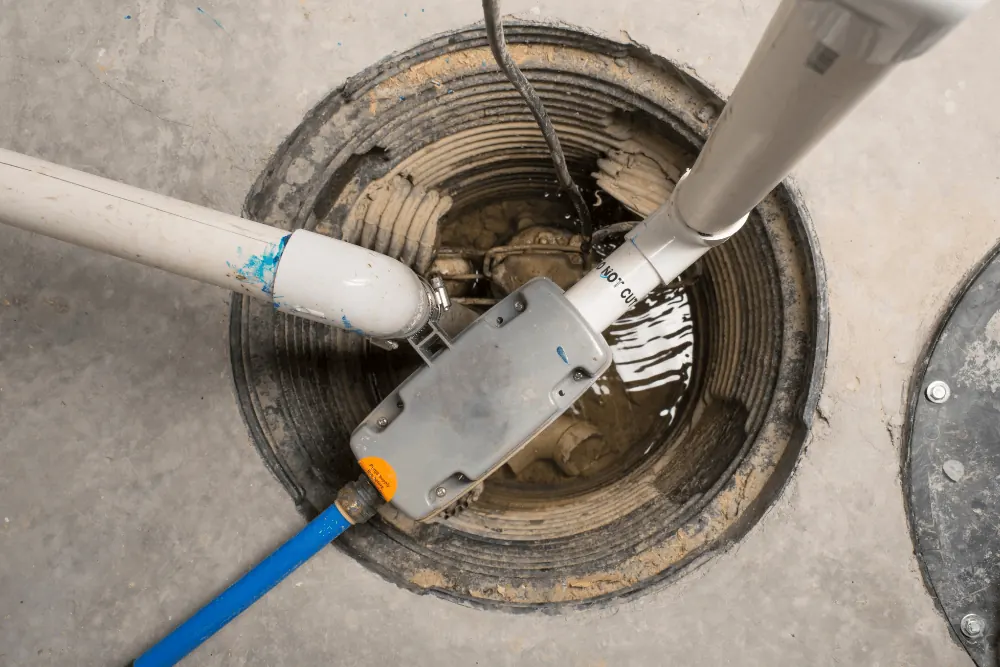
Transfer pump in Dubai: what we do
- Water transfer between tanks. Ground tank to roof tank, a tank to a tank on a plot, a drum or a small tank filled from a larger one. See water tank installation for the tanks themselves.
- Choosing the pump. From the liquid, the flow you need, the vertical rise and the supply at the pump. The sections below set out each of the four.
- Float and controller wiring. A float or a two-float controller that starts the pump when the roof tank falls and stops it when the tank is full. Our own electricians make the electrical connection.
- Priming and suction faults. A pump that runs and moves nothing, or that moves less than it did.
- Pressure and taps. A pump that raises pressure at the taps is a different job. See booster pump, pump pressure and low water pressure.
- Emergency visits. We answer calls and send a plumber 24 hours a day, 7 days a week, and we do not promise an arrival time.
- Areas. Across Dubai. The list is near the end of this page, and the full list of areas is on its own page.
Which transfer pump you mean
The name is loose, which is why this page opens with a decoder. A person who types transfer pump may want a tank-filling set, a drum pump for a generator, a spare for a truck engine or a pump for acid. The answer to each is a different pump.
| What the seller means | What it is | Covered here |
|---|---|---|
| Water transfer pump | A centrifugal or self-priming pump that fills a tank from another tank or a source | Yes, in full |
| Drum or barrel pump | A hand, electric or drill-driven pump for a drum of liquid | In general terms |
| Fuel transfer pump | A pump built for diesel or petrol, with a sealed motor | Briefly, with limits |
| Chemical transfer pump | A pump whose materials suit one chemical | Briefly, with limits |
| Air or inflation pump | A pump that moves air, not liquid | No |
| Cordless or 12 V pump | A small pump on a battery, for a vehicle, boat or site | In the power section |
The one question that decides everything
Every other choice follows from the liquid. A pump has to be compatible with the specific liquid, at its specific concentration, and at its operating temperature. Three different liquids are three different reasons that a pump built for one will fail on another.
Write the liquid on the enquiry before the pump. Clean water to a roof tank is a plumbing job and is covered in full below. Anything else needs the name of the liquid, its concentration and its temperature before a pump is named.
Moving water between tanks
A ground tank, a roof tank and a pump between them is the water transfer job. Other pages on this site cover the parts that belong to them, and we do not copy those here:
- The pumps overview has the flow, head and voltage explanation and the hand pump suction limit. See pumps overview.
- The booster page covers float protection and dry-run protection for a pump that raises pressure at taps. See booster pump.
- The tank page covers the ground and roof tank, the float valve and the overflow. See water tank installation.
Lift, head and what they do to the flow
Two heights matter, and sellers mix them. Suction lift is the vertical distance from the water up to the pump inlet. Head is the vertical rise the pump delivers against, plus the friction in the pipe. A transfer pump label shows the maximum of each, and the maximum flow is measured with neither of them in the way.
| Figure | What to know |
|---|---|
| Suction lift | A pump cannot pull water up more than a few metres, and a real pump works well inside the lower part of its stated range. A label may show a higher number, and the nameplate and the maker's curve govern |
| Head (delivery) | The vertical rise to the roof tank, plus friction in the pipe. The higher the head, the lower the flow |
| Maximum flow | Measured with no head, so the flow at your rise is lower |
A pump whose inlet is below the water level has no suction lift to lose. A pump beside a ground tank with the water 2 or 3 m below the inlet is working within every figure in the table.
Head takes a large share of the flow. A flow figure on a label is the best case, and the number that governs the job is the flow at your rise, which the maker's curve gives. Ask for the curve, not the label.
The fill-time table
The times below are the time to move a given volume at a steady flow. They assume the flow holds for the whole fill, which it does not when the head rises or the tank fills and the water level in the source drops.
| Flow | 1,000 L | 5,000 L | 10,000 L |
|---|---|---|---|
| 20 L/min | 50 min | 4 h 10 min | 8 h 20 min |
| 50 L/min | 20 min | 1 h 40 min | 3 h 20 min |
| 100 L/min | 10 min | 50 min | 1 h 40 min |
| 200 L/min | 5 min | 25 min | 50 min |
Two readings. First, the spread from the smallest flow to the largest is a factor of ten in time, so a pump chosen on price alone changes a one-hour task into an overnight one. Second, a 10,000 litre tank takes 50 minutes at 200 L/min only if the pump delivers 200 L/min at your rise. We measure the flow at the site and record the fill time on the handover note.
Controlling a transfer pump
A transfer pump left on a switch fills the roof tank until someone turns it off.
Floats and a controller
The two-float arrangement answers the overflow question directly. The upper float in the roof tank says full and stops the pump. The lower float in the ground tank says empty and stops the pump from running dry. Those are the two failures a transfer pump on a plain switch has, and a controller with one float at each end removes both.
A controller can also trip on dry run and on overload, and it can hold the pump off for a few seconds after a trip. Check the nameplate of the controller and the pump against your supply.
What a float protects, and what it does not
A float tells the pump when the tank is full or empty. It does not tell the pump that the valve downstream is shut, that the suction strainer is blocked or that the pump has lost its prime. A controller with dry-run and overload trips covers those, and a pump without a controller covers them only if someone is there. The float valve and the overflow pipe on the tank are the second line, and the tank page sets out how they work. A tank that overflows with a float on the pump has two things to check: the float, and the valve on the inlet.
A pump that runs dry gets hot and can seize within minutes, so we fit protection on any pump that can lose its water.
Power: what each type draws
The power source changes the pump, the cable and who may install it.
| Type | What to know |
|---|---|
| 12 V DC, battery | For a vehicle, a boat or a site with no mains. Low power, and thick cable is needed for any run |
| Drill pump | A pump driven by a hand drill. Light use only, and a drill overheats on a long fill |
| 230 V single phase | The normal supply in a Dubai home. Suits tank-filling pumps up to a few kilowatts |
| 400 V three phase | For larger pumps and commercial sites |
| Air-operated | Driven by compressed air, common for chemicals and thick liquids. Needs a compressor |
What the numbers show
A 12 V pump shows the reason low voltage means thick cable. The same power at 12 V draws about twenty times the current it would at 230 V, so a 12 V pump needs short, thick cable and good connections to work properly.
Whatever the label, the nameplate on the pump you receive is what governs. A pump sold abroad may be made for a different voltage or frequency, and it will not run properly on the supply here. Our own electricians make the electrical connection.
Fuel and gas
Fuel is the part of the transfer pump cluster where the wrong pump is dangerous and not merely slow.
- A water pump is not a fuel pump. A motor that can spark next to petrol vapour is a fire risk. Only a pump marked by its maker for the fuel, with a motor made for flammable vapour, should move it.
- Ask for the marking in writing. A seller's description is not a marking.
- Diesel and petrol are different. A pump made for diesel is not made for petrol.
- Storing and moving fuel carries its own rules. Ask your building, your landlord or your fuel supplier what applies to your site before you move fuel yourself.
We do not move or pump fuel for customers, and we do not install fuel pumps. A fuel job belongs with a fuel supplier or a specialist.
LPG
LPG is a separate subject. Pipe work from a cylinder or a tank to an appliance is gas fitting, and we do not do gas work.
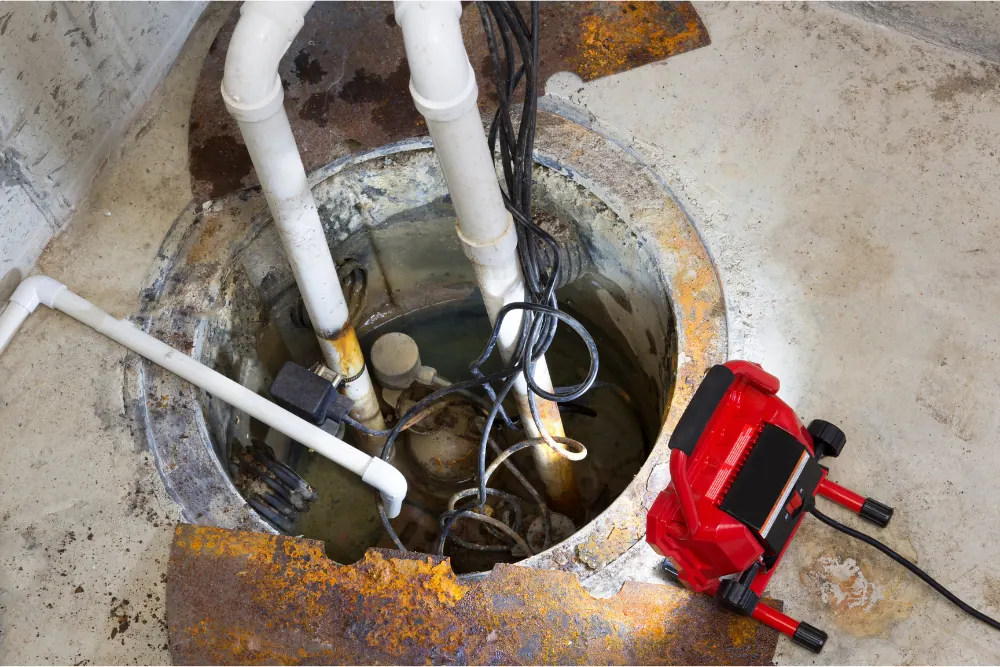
Chemicals and thick liquids
A chemical or a thick liquid moves the question from the pump's size to the pump's type and materials.
| Question | What to know |
|---|---|
| Is the pump compatible? | The pump has to suit the specific chemical, at its strength and at its operating temperature. Check the maker's compatibility chart before choosing |
| Toxic, hazardous or flammable? | The liquid must be safely contained by the pump and its equipment, and the choice is a job for a specialist |
| Thin or thick? | Ordinary water pumps suit thin liquids and lose performance as the liquid gets thicker. Thick or paste-like liquids need a different pump type |
| Abrasive or full of solids? | Abrasive liquids wear pump parts quickly, so the pump type and materials matter |
| Food or drink? | Hygienic pumps made from suitable materials and easy to clean are used for food and drink |
A corrosion-resistant label is not a list of chemicals. Ask for the maker's compatibility chart for your chemical and its strength. We do not select or install chemical transfer pumps. For water treatment dosing, see water testing, and for the tank side, water tank cleaning.
Why a transfer pump will not prime
A pump that runs and moves nothing has lost its prime, meaning the suction side is not full of water. The common causes:
| Cause | Fix |
|---|---|
| Suction strainer or inlet blocked by debris | Shut the system down and remove the debris |
| Suction hose or joint not airtight | Check the hose for damage, kinks or flattening, and every joint on the suction side. Air leaks stop a pump priming |
| Suction lift too high | If the vertical distance from the lowest water level to the inlet is above what the pump can lift, no repair can change it. Lower the pump or raise the water |
| A foot valve that leaks or is stuck open | The water drains from the suction line and the pump loses its prime. Clean or replace the foot valve |
| A pump casing that was not filled | Fill the casing with water before starting, if the pump is not self-priming |
Check them in that order. First the lift, because a repair cannot change it. Second the strainer and the hose, because they sit outside the pump casing. Third the connections on the suction side, because a joint that lets air in will stop a pump that is otherwise sound. Fourth the motor: a pump that draws current and does not turn is a different fault, a stall. If the pump is stalled, switch it off, because a stalled motor overheats quickly.
Permission in Dubai: who decides on tank and pump work
A transfer pump touches the tank, the pipe and the supply, and in a rented home or a building it touches the landlord and the building. This is general information, not legal advice.
- Building management. A ground-floor tank room and a roof tank that serve more than one flat belong to the building, and its management decides who touches the pump.
- The landlord. In a rented villa the landlord decides on new pumps, moved tanks and new pipework.
Replacing a pump with an equivalent one is a repair that needs a message to the landlord. Adding a pump, moving a tank, fitting a controller or changing the pipework is an alteration and needs written consent in a rented home. Tell us what your building asks for and we work to it.
When the job is finished
Ask for these. They cost nothing to produce.
- The pump's nameplate, photographed: voltage, power, maximum flow, maximum head and maximum suction.
- The float heights or controller settings, written down, and a test showing the pump stops when the upper float is lifted and when the lower float drops.
- The measured fill time for the tank, with the date, so the next slow fill has something to compare with.
- The dry-run and overload settings, if a controller is fitted.
- The inlet and outlet pipe sizes and the position of any isolation valve.
- A note of any leak, air in the suction line, or blocked strainer found.
- FAM's workmanship warranty, in writing. The warranty runs for 30 days and covers our labour only. Parts carry the manufacturer's warranty only.
How we work
- You message us with the two tanks and the distance between them, the pump make if there is one, a photograph of its nameplate, and what it is doing.
- We say what we think is happening, whether the lift, the strainer, a suction leak, the control or the pump itself, and whether to switch it off until we arrive. The visit fee is AED 50 + VAT, credited if the work goes ahead.
- We give a price in writing, with the pump and the work shown separately.
- Check permission. In a rented or managed property, ask the landlord or building management whether they need to approve this work before the visit.
- We measure first: the vertical lift, the pipe run, the fill time and the supply at the pump.
- We fit or repair, prime the pump, set the floats or controller and run a full fill.
- We hand over the nameplate, the settings, the measured fill time and the warranty.
Where we work in Dubai
We cover all of Dubai, including Dubai Marina, JBR, Downtown Dubai, Business Bay, Jumeirah Lakes Towers, Palm Jumeirah, Al Barsha, Jumeirah Village Circle, Dubai Hills, Mirdif, Deira and Al Quoz. See the full list of areas.
Setting up a transfer pump between two tanks
A typical Dubai villa or building has a ground tank and a roof tank, and a transfer pump moves water between them. The system works if three things are right: the pump, the pipe and the controls.
- The pump must be sized for the flow the roof tank needs and the height it has to lift. A pump too small never keeps up, and one too large short-cycles.
- The pipe should be the size the pump needs, with as few bends as possible, and supported along its length. A long pipe with many bends adds friction and cuts the flow.
- The controls switch the pump on at a low level in the roof tank and off at a high level, and protect it from running dry if the ground tank is empty.
A system with all three working needs little attention. A system with any one wrong will cause trouble.
Common faults and where to look
| Fault | Likely cause | Check |
|---|---|---|
| The pump runs and no water arrives | Lost prime, a closed valve, an air leak or a blocked suction | Check the level, the foot valve, the valves and the suction line |
| The pump does not start | Tripped breaker, failed float switch or a faulty controller | Check the power, the float and the control box |
| The pump runs all the time | A float stuck, a leak or an undersized pump | Check the float and the roof tank level |
| The pump starts and stops often | A float set too close, or a pressure fault | Adjust the floats or check the controller |
| The tank overflows | A float stuck, a controller fault or a valve that will not close | Check the float and the inlet valve |
| A loud noise from the pump | Air in the pump, a worn bearing or cavitation | Check the suction and the prime |
| Water hammers in the pipe | A fast closing valve, or a pump that stops suddenly | Check the non-return valve and the pipe supports |
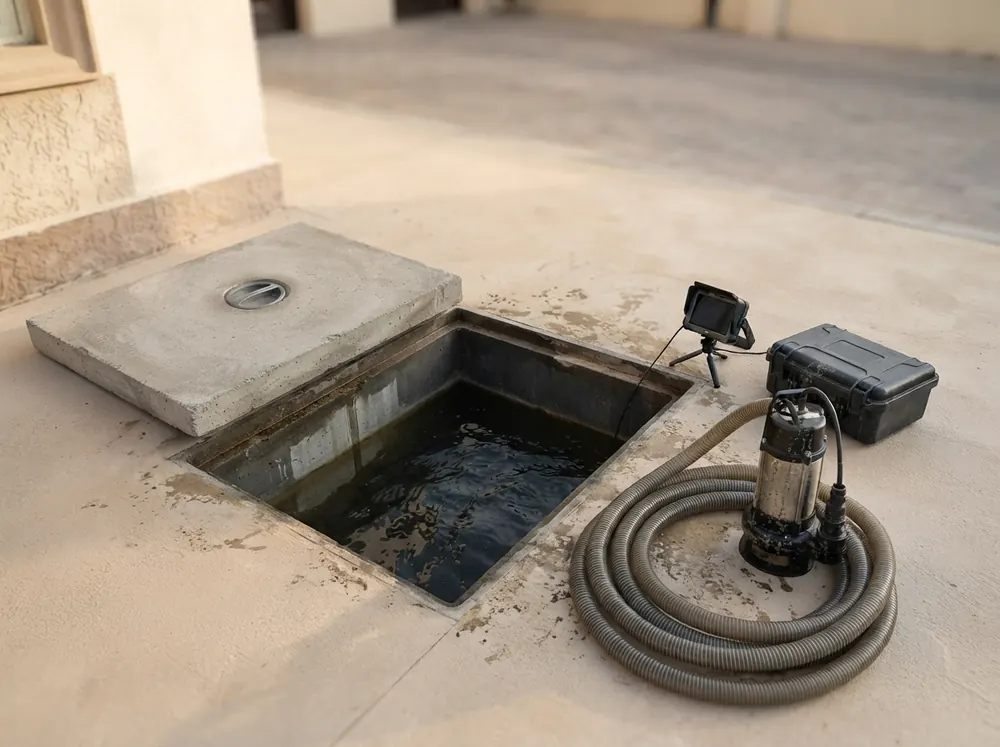
Pipe, valves and fittings on the transfer line
The pump gets the credit or the blame, but the pipework decides what it can do.
- Suction side first. The suction pipe should be at least as large as the pump inlet, as short and straight as possible, and fall towards the pump or run level, with no high points where air can collect. A foot valve with a strainer at the end keeps the line full and stops debris.
- Discharge side. A non-return valve after the pump stops water falling back into the ground tank when it stops, and an isolation valve each side of the pump lets it be removed without draining the line.
- Pipe size and friction. A long run to a roof tank loses flow in every bend and fitting. Pipe one size up often does more than a bigger pump.
- Support. A pipe full of water is heavy. Clips every short length stop it sagging, and a rigid pipe needs a flexible joint at the pump so vibration does not crack the connections.
- Materials. The pipe has to suit the sun on a roof. UV and heat harden some plastic pipe, so exposed runs are lagged or painted or run in a better-suited material. See pipe fittings and pipe insulation.
- Tank connections. Inlets enter above the water level, with the float valve and overflow set as on the tank page, so the tank cannot overflow and water cannot be drawn back.
Safety on a roof and at a tank
Roof tanks are high, hot and often in poor light. A fall from a roof is serious. Do not go up in the dark or in the rain. Use a proper ladder or a fixed access, wear shoes with grip and tell someone you are there. Tank covers should be closed after work. A tank in strong sun may have very hot water in summer. Electrical equipment near water needs correct protection and earthing. If a pump panel is wet or scorched, switch off at the breaker and call us.
Float switches and level controls
A float switch is a simple, reliable control, and also a common point of failure. It has a cable, a float and a weight. The float can stick, tangle with another cable or fill with water and sink. Check each float by lifting it by hand and hearing the click. A second float as a backup gives a safe stop if the first fails. Electronic probes avoid moving parts but need clean contacts, and scale on the probe can give false readings.
Dry run protection
A pump that runs dry overheats within minutes. A low-level cut-out in the ground tank stops the pump when water falls below the suction. A flow switch on the outlet also detects when no water is moving. A pump that has burned out once without protection will burn out again.
What a visit covers
We look at the tanks, the pump, the pipes, the valves and the controls. We test the floats, the controller and the pump under load. We check the isolation valves and the non-return valve. We tell you what is wrong and what it will cost to fix, with the price fixed on WhatsApp before we start. Prices exclude 5% VAT.
Noise, vibration and mounting
A transfer pump on a roof or a plant-room floor can be heard through the building, and the noise is usually the mounting and not the pump. We look at four things. The pump should sit on a firm base fixed to the slab, with rubber or spring feet where the building needs them. The pipes on both sides should connect through short flexible joints so that vibration does not travel down the line. Pipe clips should hold the pipe without pinching it, and the pipe should not rest against a wall or a duct. A pump that cavitates, because its suction is restricted or the tank is low, also rattles, and that is a fault to fix and not a noise to damp. If a neighbour below complains about a hum at the same time each night, the pump's start time and its mounting are the first things to check.
How much does transfer pump work cost in Dubai?
- The work. Isolating, fitting, priming, wiring the controller and testing a full fill.
- What moves the price. The pump's size and supply, single-phase or three-phase, the float or controller, the pipe run and the lift, and access to a tank room or a roof.
- The visit. The visit fee is AED 50 + VAT, credited if the work goes ahead.
We do not publish a starting price for this job. Send a photo on WhatsApp and we give you a fixed price before we start. Prices exclude 5% VAT.
Transfer pump FAQs
What is a transfer pump?
A pump that moves liquid from one container or tank to another. In the water trade it usually means the pump between a ground tank and a roof tank. In other trades it can mean a fuel pump, a chemical pump or a drum pump. Name the liquid first.
What is the difference between a transfer pump and a booster pump?
A transfer pump fills a tank, using floats in the ground tank and the roof tank to start and stop it. A booster raises the pressure at the taps, and starts from a pressure switch or a controller. See booster pump.
Can I fill my roof tank with a transfer pump?
Yes, if the tank, the pipework and the building allow it. Check permission with the building first, and see water tank installation for the float valve and the overflow. We fit the floats so the tank cannot overflow and the pump cannot run dry.
How high can a transfer pump lift water?
Two limits apply. The suction lift, from the water up to the pump, is limited to a few metres. The delivery head, from the pump up to the tank, is set by the pump's curve, and a higher rise gives a lower flow. Send us the heights and we say whether a pump suits.
Can a water pump move diesel or petrol?
No, not safely. A fuel needs a pump marked for it by the maker. We do not move or pump fuel.
Why does my transfer pump run but not pump water?
The usual causes are a blocked strainer, an air leak on the suction side, a suction lift that is too high, or a foot valve that has failed. Check them in that order. If the pump draws current and does not turn, switch it off.
Can a transfer pump run dry?
No. A pump that runs dry overheats, and a seal or the motor can fail within minutes. Fit a float or dry-run protection.
Should I choose a 12 V or a 230 V transfer pump?
A 12 V pump suits a vehicle or a site with no mains, and it carries a high current, so it needs thick cable. A 230 V pump suits a villa or a building and gives a lot more flow for the same cable.
Can I move fuel with a transfer pump?
Only with a pump marked by its maker for that fuel. We do not move or pump fuel, and we do not install fuel pumps. Ask your fuel supplier or a specialist.
How much does a transfer pump cost in Dubai?
The price depends on the pump's power, flow and head, and on the pipework and the float or pressure controls it needs. We give a fixed price on WhatsApp after a visit or a photo of the tank and the pump. Prices exclude 5% VAT.
Book a transfer pump visit in Dubai
Tell us what the pump is doing, the two tanks and the distance between them, the pump make if you know it, and whether you own or rent. A photograph of the nameplate helps. If a pump is stalled, or water is overflowing, switch it off and call. We will measure, give you the options and a price in writing, do the work and hand over the settings.
WhatsApp: +971 55 407 7427 · Request a quote
Visit us: Office 871, Oasis Mall, Al Quoz 1, Dubai, UAE
Related services: Pumps overview · Booster pump · Pump pressure · Pressure tank · Submersible and borehole pump · Low water pressure · Water tank installation · Water tank cleaning · Emergency plumber