
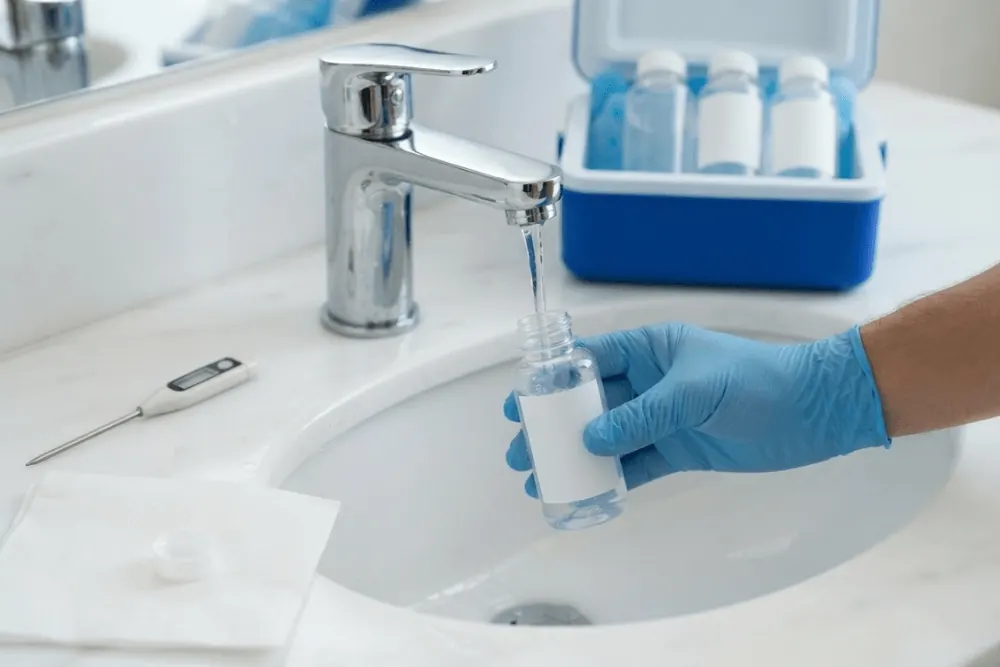
Water quality testing in Dubai: what we do
- On-site checks. Hardness, free chlorine, pH, total dissolved solids (TDS) or conductivity, and a look at colour, clarity and smell.
- Laboratory sampling. Bacteria and metals need a laboratory. FAM does basic on-site tests only, and we explain when a lab test is the right next step and arrange the sampling.
- Source tracing. Samples at more than one point, so a problem is placed in the supply, the tank, the pipes or the tap.
- Plain-English report. Each result, the reference value beside it, what it means and what to do.
- Before-and-after testing. A baseline before a filter, softener, RO unit or tank cleaning, and a retest after it.
- Inspection. The tank, pump, filters and pipework, since a result without a look at the system is half an answer.
- Emergency visits. We answer calls and send a plumber 24 hours a day, 7 days a week, and we do not promise an arrival time.
Fixes have their own pages. Hardness is on our water softener page. Particles and chlorine are on our whole-house water filter page. Dissolved solids in drinking water are on our RO purifier page. Tank cleaning is on our water tank cleaning page.
When a water test is worth doing
A test earns its cost when it answers a specific question. Pick the trigger that matches yours.
| Trigger | What to test first | Why |
|---|---|---|
| White scale on taps, kettle and heater | Hardness | Confirms hard water before you buy a softener |
| Chlorine taste or smell | Free chlorine, and a taste check at several taps | Separates the supply from a tank or filter problem |
| Cloudy, brown or orange water | Turbidity, iron, colour | Tells particles from air and rust |
| Musty or rotten-egg smell | Smell at cold and hot taps, then bacteria | Cold-only and hot-only smells have different causes |
| After a tank cleaning | Bacteria, chlorine, turbidity | Confirms the tank is fit to use. A laboratory test after cleaning is normal practice |
| Before a filter, softener or RO unit | Hardness, TDS, chlorine, turbidity | Specifies the right unit |
| After a filter, softener or RO unit | The same set | Shows it works |
| After pipe repairs or a long shutdown | Turbidity, bacteria | Debris and stagnant water |
| Baby, elderly person or weakened immunity at home | Bacteria and metals | A stricter safety margin |
| A complaint to building management | Written results from a lab | Gives you evidence to put to management |
| A restaurant, cafe or clinic | A documented set of lab results | Records show what was tested and when |
If none of these fits, you may not need a test.
Where water quality problems start in Dubai
The public supply ends at the meter. After it, the internal pipes and storage tanks belong to the building and its owner.
That split is why a test should say where a problem begins. Water passes through five stages, and each can change it.
- The supply up to the meter.
- The storage tank, where water sits and can pick up sediment or bacteria.
- The pump and the pipework, where age, scale, rust and repairs add particles and metals.
- The tap or fixture, including aerators, hoses and filters that hold stagnant water.
- The water heater, which affects only the hot side.
Sampling to find the source
Sampling at several points narrows the cause. We choose points that split the system in half.
| Compare | A difference means |
|---|---|
| Cold kitchen tap vs cold bathroom tap | A local pipe, fixture or filter problem |
| Cold tap vs hot tap | The heater or the hot pipes |
| Tank outlet vs tap | Something added between the tank and the tap |
| Tap run for a minute vs first draw after standing | Something in the pipes or fixture, not the supply |
| Before vs after a filter or RO unit | Whether the unit is doing its job |
If a sample from the tank outlet is already bad, the fix is at the tank. If the tank outlet is fine and the tap is not, the fix is in the pipes or fixtures. One comparison like this separates a tank problem from a tap problem before any money is spent.
On-site tests and laboratory tests
Some results come back in minutes at your tap. Others need a laboratory. The table sets out which is which.
| Test | Where it is done | What it tells you | What it does not tell you |
|---|---|---|---|
| Hardness | On site | How much calcium and magnesium is dissolved | Anything about safety |
| Free chlorine | On site | Whether disinfectant is present and how much | Whether the water is free of bacteria |
| pH | On site | Acidity or alkalinity | What is dissolved in the water |
| TDS or conductivity | On site | Total dissolved material | What the material is, or whether it is harmful |
| Turbidity and colour | On site (visual) or lab | Cloudiness and particles | The cause of the particles |
| Iron | On site (kit) or lab | Rust staining and taste risk | Whether the pipes are failing |
| Total coliforms and E. coli | Lab | Whether faecal contamination is present | Anything about chemicals |
| Legionella | Lab | A bacterium that grows in warm water systems | Anything about the rest of the water |
| Lead, copper and other metals | Lab | Metal released from pipes and fittings | Where along the pipe it came from |
| Full chemical panel | Lab | A broad set of chemicals and minerals | Most are not relevant to a home |
Bacteria are the test most worth sending to a lab. A strip or meter cannot detect them, and a low TDS reading says nothing about them.
How to read a result
A reading means something only against a reference value. A lab report should state, beside each result, the limit it was compared with and whether the result passed. We do not publish a table of limits here, because the right reference depends on what the water is for and who uses it, and because the lab's report decides. What we do is read each result with you and say what it points to. Three habits make any result easier to read:
- Compare like with like. The same tap, the same flow and the same time of day.
- Look at the direction as well as the number. A reading that climbs over several tests matters more than one high reading.
- Never read one number alone. Chlorine at zero with a clear sample is a different story from chlorine at zero with cloudy water.
What each result means
Hardness
Hardness is dissolved calcium and magnesium. A harder reading means more scale and more soap. Hardness is a nuisance rather than a health issue. If the reading is high and scale is your complaint, see water softeners.
Free chlorine
Free chlorine is the disinfectant left in the water. Too little at the tap means the water has no protection against growth on its way to you. Too much shows as a pool-like smell and taste. A reading of zero at a tank outlet is a reason to look at how long water sits in the tank. The level that protects the water, the level you can smell and the level that harms health are far apart, which is why a single number misleads. Carbon removes chlorine, and the trade-off is on our whole-house water filter page.
pH
pH measures acidity on a scale where 7 is neutral. Water well away from neutral is not a health emergency in itself, but a low reading is corrosive to metal pipes and fittings. A low pH result tells you to look at the pipes and fittings, not to buy a treatment unit.
TDS and conductivity
TDS is the total weight of dissolved material per litre. Handheld meters read electrical conductivity and convert it, so two meters can show slightly different numbers for the same water. TDS is a taste guide and a way to check an RO unit. It does not tell you the water is safe, and no health effect is attributed to TDS itself.
Turbidity and colour
Turbidity is cloudiness from suspended particles. Particles can shield bacteria from chlorine, which is why clear water is easier to disinfect. Cloudy water that clears from the bottom upward points to trapped air. Water that stays cloudy, or settles into sediment, is carrying particles. See smelly or discoloured water.
Iron
Iron gives a metallic taste and orange-brown staining. Iron also reduces a softener's effectiveness. Rust-coloured water that clears after flushing was stagnant or disturbed, for example after a repair. If it keeps coming back, the pipe itself is the next place to look. See repiping.
Bacteria
Total coliforms and E. coli are indicators. E. coli should not be present in drinking water. A positive result is not a diagnosis of illness, and it is a reason to act the same day. Until it is cleared, use boiled or bottled water for drinking and cooking, and find the cause. The causes to check are the tank, a stagnant dead-leg in the pipework and a contaminated fixture. See water tank cleaning.
Legionella
Legionella is a bacterium that grows in warm, stagnant water. Hot-water systems that run cool, shower hoses and dead-end pipes are the places to look. Test results need interpreting by a professional, and a positive result calls for system disinfection and a review of temperatures and flow.
Lead, copper and other metals
Metals reach water from pipes, fittings and solder, especially when water has sat. A metals result guides you to the fitting or pipe that needs replacing, and to RO for the drinking tap in the meantime.
How a sample is taken properly
A good test depends on a good sample. A badly taken sample can make clean water look contaminated, or the reverse.
For bacteria
- Use a sterile bottle from the lab. The bottle holds a neutraliser. Without it, the chlorine keeps killing bacteria in the bottle on the way to the lab and the result reads cleaner than the water was.
- Choose the tap. Pick an indoor cold tap, and remove any aerator or hose.
- Run the water. Flush for two to three minutes.
- Do not rinse the bottle. Rinsing removes the neutraliser.
- Fill with the flow reduced to avoid splashing, to just above the shoulder. Do not touch the inside of the bottle, the cap or the tap.
- Keep it cool and deliver it fast, within the lab's own time limit. A sample that waits too long gives a weaker result.
- Record the date, time and location.
For chemistry
Chemical tests use different bottles, and the lab tells you which.
What on-site tests need
- Fresh reagents. Test strips and drop kits expire and spoil in heat.
- A clean cup and a fresh sample. Taken from the tap, read straight away.
- A calibrated meter. A TDS or pH meter drifts between uses.
Home kits and professional testing
A strip or meter is useful for hardness, chlorine, pH and TDS. It gives a class or a number and misses fine detail. It cannot test for bacteria or metals. For those two, and for any result you want to rely on in a dispute, a laboratory report is the record. Home kits are a good first look and a poor final answer.
Hot water on its own
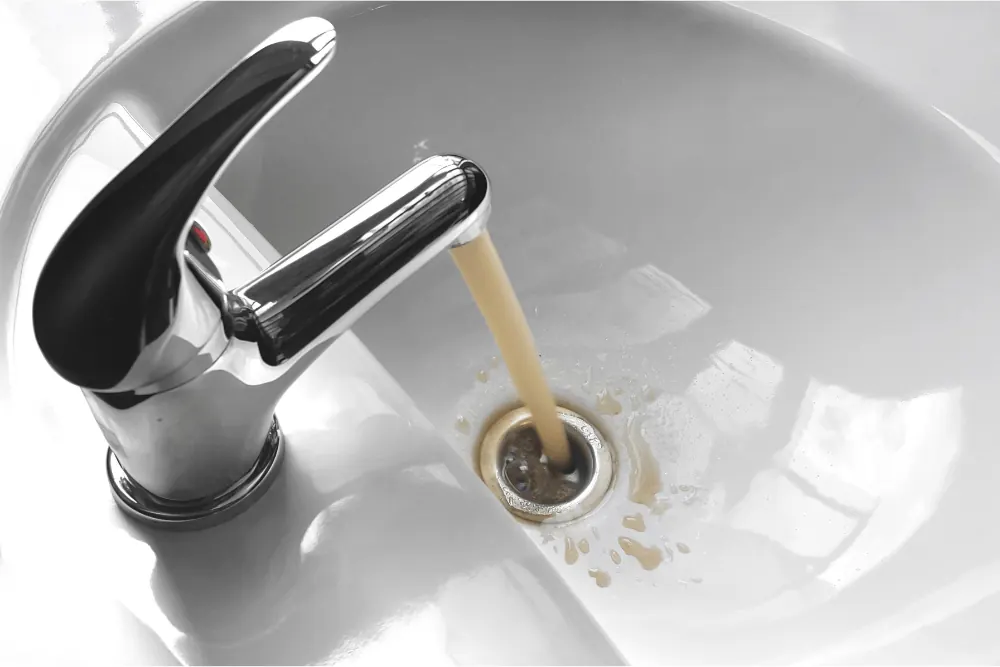
If the problem appears only at the hot tap, the cold supply is not the cause. Test the cold and hot taps side by side. A rotten-egg or musty smell on the hot side only points to the heater or the hot pipes, and a used-up anode or bacteria in the tank are the usual causes. Hot water that never gets warm enough, or sits in dead-end pipes, is the place to look for Legionella. Heater faults are on our water heater repair page.
Reading a laboratory report
A lab report is easy to misread. Check these before you look at a result.
- Sample details. The sample point, the date and time it was taken and the date it reached the lab. A long gap weakens a bacteria result.
- Units. Metals can be reported in micrograms per litre (µg/L) or milligrams per litre (mg/L), and 1,000 µg/L equals 1 mg/L. A reader who compares 500 with 0.5 without converting thinks a result is a thousand times too high.
- Bacteria units. Results appear as colony-forming units (CFU) or most probable number (MPN) per 100 mL. "Not detected" and "0 per 100 mL" mean the same thing.
- The "less than" sign. A "<" before a number, such as "<0.001", means the lab could not detect the substance above that limit. It does not mean there is a trace.
- The standard. The report should say which standard or guideline each result is compared against, and mark pass or fail. If it does not, ask.
Three testing plans
These are examples of how we plan tests, not results from any property.
A rented flat with scale and a chlorine taste. On-site hardness, free chlorine and TDS at the kitchen cold tap and the bathroom cold tap. If the readings match, the cause is the supply or the shared tank, and the evidence goes to building management. If they differ, we look at the fixtures and pipework between the two taps.
A villa after a tank cleaning. Free chlorine, turbidity and a laboratory bacteria sample from the tank outlet and the kitchen cold tap. The outlet sample shows the tank. The tap sample shows what the pipes add. Both results go in the file with the cleaning certificate.
A cafe with a coffee machine and an ice maker. TDS, hardness and free chlorine at the point where water enters each machine, a bacteria sample from the ice machine feed, and the tank record. The results set the filter and the softening the machines need, and the file proves what was tested and when.
What we do at the tap
An on-site test follows the same order every time, so the numbers can be compared later.
- Choose the point. The kitchen cold tap for drinking water, a bathroom tap for the shower complaint, the tank outlet where we can reach it.
- Note the conditions. The time, how long the tap was idle and the water temperature.
- Look and smell first, in a clean glass against a white background.
- Run the tap to a steady flow, then take the sample into a clean cup.
- Test straight away for chlorine, hardness, pH and TDS, because chlorine in particular changes within minutes.
- Repeat at a second point so the two can be compared.
- Write the readings down with the point and the time.
Testing before and after a unit
A filter, a softener or an RO unit should be judged by a before-and-after test, taken the same way.
- Test ahead of the unit and after it, at the same flow and the same time of day.
- For a softener, the soft tap should read close to zero hardness while the unsoftened tap reads what you started with.
- For an RO unit, the TDS after the membrane should be far below the TDS before it, and a reading that drifts up over weeks means the membrane or the cartridges need attention.
- For a carbon filter, the chlorine after the filter should be low while the chlorine before it is not, and a cartridge that stops removing it is spent.
- Keep the first readings. They are the baseline every later test is compared with.
Waiting for a laboratory result
A bacteria result takes time. While you wait:
- Use bottled or boiled water for drinking, cooking and brushing teeth if the sample was taken because the water smelled or looked wrong or someone was unwell.
- Do not add chemicals to the tank or the pipes to get ahead of the result. A guessed dose can confuse the retest and does not fix an unknown cause.
- Keep a note of what you notice and when, which helps read the result.
- Tell building management if the sample came from a shared system.
Questions for anyone offering a free water test
A free test at your door is often a sales call. Ask:
- Will you give me the numbers in writing, with the point, the date and the unit?
- What is each number compared with? A result with no reference is not a result.
- Can the same test be repeated by someone else? A test that only they can run is a demonstration.
- What does the result say I need, and what does it say I do not?
- Will you take the sample for a laboratory if bacteria or metals are the concern?
A good test sometimes ends with "you do not need to buy anything", and a company that never says that is selling and not testing.
After the result: what to do
| Result | What it points to | Next step |
|---|---|---|
| Hard or very hard | Dissolved calcium and magnesium | Softener if scale is the problem |
| Strong chlorine taste, healthy residual | Normal disinfectant | Carbon filter, or RO at the drinking tap. See filters and RO |
| Zero chlorine at the tank outlet | Disinfectant has been used up | Check how long water sits, the tank condition and the cleaning date |
| High TDS and a taste complaint | Dissolved solids | RO at the drinking tap |
| High turbidity or sediment | Particles from the tank or pipes | Clean the tank, flush the pipes, then a sediment filter |
| Iron above reference | Rust or iron in the supply | Find the pipe source. Pretreat before a softener |
| Low pH | Corrosive water | Check pipes and fittings for corrosion |
| E. coli or coliforms detected | Contamination | Boil or use bottled water, find the source, clean and disinfect, retest |
| Legionella detected | Warm, stagnant water | Disinfect the system, review temperatures and dead legs, retest |
| Lead or copper above reference | Pipes and fittings | Replace the source, use RO for drinking meanwhile |
| Everything within range | The parameters tested are not the cause | Look at the tap, the heater, the drain, or test further |
A test that returns clean results is a good outcome. It means you do not need to buy a unit.
Who is responsible for the water in your building
The public supply ends at the meter. Inside it, the property owner or the building is responsible for the tanks and pipes. In practice that means the following.
- Villa owners arrange tank cleaning and testing themselves. Tenants should read the contract.
- Flat tenants with a shared tank should ask building management for the latest cleaning record and test result, and for before-and-after photographs of the tank.
- Landlords should hear about complaints in writing, with a test result attached.
Businesses
A restaurant, cafe or clinic should keep the cleaning certificate and the lab result together. We test after each cleaning and file the result. See water tank cleaning.
Moving in or buying: a water checklist
A new home is the cheapest moment to find a water problem, because the previous owner or the landlord is still the person to ask.
- Ask for the tank record. The date of the last cleaning, the company, and the lab result.
- Look at the tank. Is it covered, sealed and accessible? A tank no one can open cannot be cleaned or inspected. See water tank installation.
- Run every tap. Look for brown water, sputtering and a smell, cold and hot. Check the pressure on the way. See low water pressure.
- Check the age of the pipes. Old steel pipe rusts and old fittings leach metals. A pipe survey and a metals test are worth it in an older building.
- Look under the sinks and at the water heater. Scale, drips and stains are signs of hardness and slow leaks.
- Take a baseline. Hardness, free chlorine, TDS and turbidity at the kitchen cold tap. A later problem is easier to place when you know where you started.
- Put findings in writing to the landlord or seller before you pay for work.
What a test cannot tell you
- A single sample is a snapshot. Water changes with time, season, tank level and what has just been used.
- A panel cannot cover everything. Hundreds of substances can occur in water. We test for the ones your symptoms and system suggest.
- A result is only as good as the sample. A dirty tap or a late delivery changes it.
- A pass today does not prove the tank stays clean. Retest after cleaning, after repairs and when something changes.
What not to do
- Do not buy a treatment unit before testing.
- Do not test only the cold kitchen tap when the complaint is in the shower or on the hot side.
- Do not rinse a sterile bottle, and do not use a household jar for a bacteria sample.
- Do not store a bacteria sample for days.
- Do not judge safety by TDS or by clarity. Clear water can carry bacteria.
- Do not ignore a positive bacteria result, or assume one clean result clears an old problem.
- Do not treat a sales demonstration as a test. Only a measured result against a reference value counts.
Keeping the results
Keep the lab report with the property file, with the date, the place the sample was taken and the conditions. Compare each new test with the old one. A change over time, such as a rise in hardness or a new colour, tells you something about the tank, the pipes or the supply. We help you read a report and decide what to do next.
How much does water testing cost in Dubai?
We quote by what you ask us to test. The price follows the plan.
- Which parameters. On-site checks cost less than laboratory panels.
- How many sampling points. A tank outlet, a kitchen tap and a hot tap give a clearer answer than one tap.
- Laboratory fees. Bacteria, metals and Legionella are charged by the lab.
- Sampling and travel. A trained person takes the sample and delivers it. The visit fee is AED 50 + VAT, credited if the work goes ahead.
- A report. A plain-English summary with next steps.
- Retests. After a cleaning, a repair or a new unit.
We do not publish a starting price for this job. Send a photo on WhatsApp and we give you a fixed price before we start. Prices exclude 5% VAT.
Where we test water in Dubai
We cover all of Dubai, including Dubai Marina, JBR, Downtown Dubai, Business Bay, Jumeirah Lakes Towers, Palm Jumeirah, Al Barsha, Jumeirah Village Circle, Dubai Hills, Mirdif, Deira and Al Quoz. See the full list of areas.
Water quality testing FAQs
Is Dubai tap water safe to drink?
The public supply is treated and disinfected before it reaches the meter. Storage tanks and internal pipes after the meter are the property's responsibility, and they are where quality most often slips. Many residents choose to filter or boil tap water. A test of your own tap tells you more than a general answer.
What should I test my water for?
Match the test to the complaint. Cloudy or brown water calls for turbidity and iron. Smell, a tank problem or a vulnerable household calls for bacteria. Metals are worth testing in older buildings.
Can I test my water myself?
Yes, for hardness, chlorine, pH and TDS, with strips or a meter. Bacteria and metals need a laboratory and a proper sample. A home kit is a first look and not proof.
How do I take a water sample for bacteria?
Use a sterile bottle from the lab, with a chlorine neutraliser. Use a cold indoor tap, run the water for a few minutes, do not rinse the bottle, fill it without touching the inside, keep it cold and deliver it within the lab's time limit.
What is a good TDS reading for drinking water?
A lower reading generally tastes better, and TDS has no health meaning on its own. It says nothing about bacteria or individual chemicals. Our RO purifier page explains how to use it to check a unit.
What does a positive E. coli result mean?
E. coli should not be present in drinking water. A positive result means contamination reached the water. Use boiled or bottled water, find and fix the source, disinfect the system and retest.
How often should I test my water?
Test after a tank cleaning, after plumbing repairs that open the system, after installing or servicing treatment equipment, and when taste, smell or colour changes. Food businesses should keep the lab result for each cleaning.
Do I need a test before buying a filter or softener?
Yes. A hardness, chlorine, TDS and turbidity reading specifies the unit and gives you a baseline to retest against.
How much does water testing cost?
We do not publish a starting price for this job. Send a photo on WhatsApp and we give you a fixed price before we start. Prices exclude 5% VAT.
Book water quality testing in Dubai
Tell us what you notice, where it happens and whether you have recent tank or test records. A photo of the tank and the tap helps. We will send a plumber to sample the water, explain the results and recommend the next step.
WhatsApp: +971 55 407 7427 · Request a quote
Visit us: Office 871, Oasis Mall, Al Quoz 1, Dubai, UAE
Related services: Water tank cleaning · Whole-house water filter · RO purifier · Water softener · Smelly or discoloured water · Leak detection