

Kitchen sink installation and repair in Dubai: what we do
- Sink installation and replacement: drop-in, undermount and apron-front sinks, matched to the worktop and the cabinet.
- Waste and trap work: strainers, tailpieces, traps and double-bowl waste kits, fitted and tested.
- Appliance connections: dishwasher drain and supply, and the washing machine point where the kitchen holds it.
- Leak tracing under the sink: supply lines, valves, the trap, the strainer seal and the sealant around the rim.
- Slow-draining and blocked kitchen sinks, where the cause is the sink's own pipework and the line beyond it.
- Food waste disposer fitting, where the building allows it.
- Taps and filter outlets on the sink, coordinated with the tap work.
- A written note of the sink, the parts, the connections and the test.
Neighbouring topics have their own pages. The tap itself is on tap installation, and drips and handle leaks on tap repair. Blocked lines are on drain unblocking, and kitchen grease on grease trap. Burst or weeping pipes are on pipe leak repair, washing machines on washing machine plumbing, and drinking water filters on RO purifier.
Choosing the sink: how it is mounted
The mounting decides who can fit it, what the worktop must be, and what happens at the edge.
| Type | How it sits | What to know |
|---|---|---|
| Drop-in (top-mount) | The bowl hangs through the worktop and the rim rests on top | The easiest to fit and works with nearly any worktop. The rim collects dirt and needs a sealed edge |
| Undermount | Fixed under the worktop, with the edge of the cutout exposed | A clean wipe-over edge. Needs a solid worktop (stone or solid surface) cut and polished by a fabricator, and brackets or adhesive from below |
| Flush mount | Sits level with the worktop | Neat, but costs more and is harder to fit than a drop-in, and the cutout has to be exact |
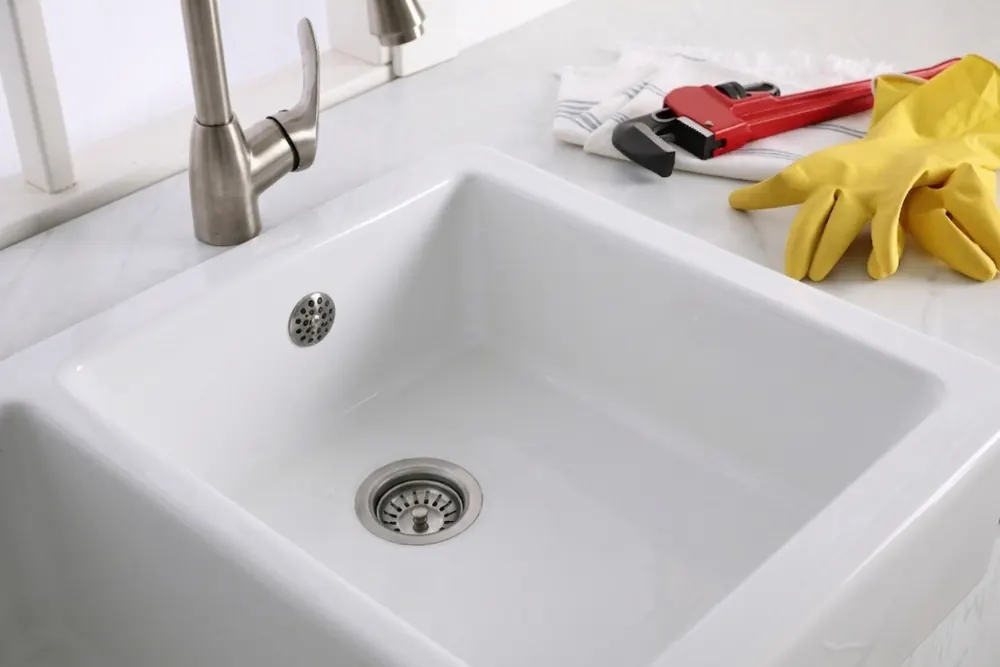
| Apron-front or Belfast | A deep sink whose finished front shows in place of a cabinet panel | The cabinet has to be altered to take it. A Belfast is ceramic and often has an overflow to stop spills reaching the worktop. Very heavy |
The cutout in the worktop is where the choice becomes a fixed fact, so the next section covers it.
Sink materials
The material sets the noise, the weight, the care and the price.
| Material | What to know |
|---|---|
| Stainless steel | Light and easy to fit. Can be noisy unless it has sound-deadening pads, and shows water marks. Gauge numbers run backwards, so a lower number is a thicker sheet |
| Granite composite or quartz composite | Heavy, quiet and hard-wearing. Needs a sound cabinet |
| Ceramic or fireclay | Very heavy, easy to keep clean, and can chip or crack under a dropped pan |
| Cast iron with enamel | The heaviest. Enamel can chip, and the cabinet must be built for the load |
We follow the maker's instructions and check the cabinet. Prices vary widely between materials and makers, and a thicker steel or a heavier composite costs more.
A heavy sink can weigh 18 to 23 kg empty, and full of water and dishes it is far more. A cabinet in a rented flat may not have been built for that, so we check the cabinet carcass and the base panel before a heavy sink is chosen. Water spots on stainless steel are down to the water's hardness and how the sink is dried. See water quality testing.
The cutout and the worktop
The cutout is where an installation succeeds or fails, because a hole in stone cannot be un-cut.
| Point | What to know |
|---|---|
| The template | The sink maker supplies a template or a specification sheet with the cutout width, depth and corner radius. The cutout follows it exactly |
| Edge clearance | Leave enough solid worktop between the cutout and the front and back edges. The sink maker's sheet gives the minimum |
| The cabinet | The cabinet must be wide enough for the bowl and deep enough for the trap, and its base panel sound |
| Support | A heavy sink needs support under the rim or the bowl, from battens or brackets, and not only the worktop edge |
| Taps and holes | The tap holes in the deck or the worktop are set before the sink goes in. See tap installation |
A stone worktop is cut by its fabricator to the sink's template, before the sink is fitted, so we ask for the sink's make and model early, get the template or the specification sheet, and have the fabricator confirm the cutout.
Sealant and clips
A drop-in sink is held by clips from below and sealed round the rim with silicone. An undermount is held by brackets or adhesive fixed from below. The strainer flange is sealed with putty or silicone according to its maker. We use whichever the maker of the part specifies, and we leave the sealant to cure before the sink is used heavily.
The waste, the trap and the strainer
Everything the sink drains passes through three parts in the cabinet: the strainer in the bowl, a tailpiece below it, and a trap that holds a plug of water.
| Part | Typical size | What to know |
|---|---|---|
| Strainer | About 90 mm hole in the bowl | Sealed to the bowl with putty or silicone, and held by a nut from below. A leaking strainer seal is a common cause of a wet cabinet |
| Tailpiece | About 38 mm | Joins the strainer to the trap or to a double-bowl kit |
| Trap | A P-trap or a bottle trap | Holds a plug of water, the seal, that stops drain smells coming up |
| Branch to the wall | Falls about 2 per cent | A fall of about 20 mm per metre, so the water runs away and the pipe does not hold dirty water |
A double-bowl sink uses a waste kit that joins both bowls to one trap. A sink whose wall outlet sits too high or too low for a standard kit is a pipework job before it is a fitting job, and the long run and the fall can only be corrected by moving the pipe.
A kitchen sink left unused for a long time can smell, because the water in the trap can evaporate and break the seal. Running water through the trap restores it, and a persistent smell with a full trap points to the drain, which is on drain unblocking.
Dishwasher and washing machine connections
A dishwasher drains into the sink's waste, and the connection has to stop dirty water from running back into the machine.
- An air gap. A small device mounted on the sink or worktop, above the rim, that breaks the connection with open air. It does not rely on a hose staying where it was clipped.
- A high loop. The drain hose is looped up to the underside of the worktop and then down to the waste. It works as long as the loop is kept, but a loop cannot assure that water never siphons back.
- The machine maker's instructions state the height and the connection the machine was designed for, and they come first.
We follow the maker's instructions, and where they are silent we prefer an air gap above the sink rim. A drain connected below the worktop also needs a connection made on the waste side of the trap, with an anti-siphon arrangement.
Washing machine inlets and outlets are on washing machine plumbing.
Food waste disposers
A disposer grinds food scraps into the drain, and it adds a flange, a motor and an electrical connection under the sink.
A disposer sends food solids into the waste, and it adds load to a grease-laden line, which the next section covers. Many buildings and owners restrict them, because the solids and the fat add to the risk of blockages in a shared drain. Ask the building before you buy one. Where it is allowed, we fit it with a proper flange seal and a trap that can take the flow, and our own electricians make the electrical connection.
Cooking oil, grease and the slow kitchen sink
Grease is the kitchen sink's own failure mode. Hot oil poured down the drain cools and solidifies in the pipe, gathers food scraps and builds up until the line is narrow or blocked. In a building it is not only your sink that suffers, because the same cooled fat collects in shared stacks and drains.
What to do at a home kitchen sink:
- Pour used cooking oil into a container, let it cool, and bin it. Do not pour it down the drain, hot or cold.
- Use a strainer in the bowl, which the waste parts above already include.
- Wipe greasy pans and plates with paper before washing them.
- Treat a slow sink as a pipe question after the trap is ruled out. If the water drains slowly from the sink alone and not from the other fixtures, the cause is in the sink's trap and branch. If other fixtures slow down too, it is in the line beyond, and our drain unblocking page covers it.
Commercial kitchens need a grease trap, which is on grease trap.
Tracing a leak under the sink
A wet cabinet has many causes, so we find it with a test and not by guessing.
For the basin test, lay towels first, fill both bowls, drain them at the same time, run the disposer while draining if there is one, and then run the dishwasher. Test every tap mode to rule out the tap. Look at each joint with a dry paper towel after each step.
First, a leak that appears only when the tap runs sits upstream of the trap, and a leak that appears only when the sink drains sits downstream, so the order of the basin test tells you which half to open. Second, a cabinet that has been wet for some time has a base panel that may swell or rot, and we look at it as well as the pipe. Third, water that keeps coming with every fixture closed points to a supply line or valve, and a pipe in the wall or ceiling is on pipe leak repair, with hoses on hoses, valves on valve repair and replacement and the tap side on tap repair. Water coming through a ceiling below is on ceiling and wall leaks.
Taps, sprayers and filter outlets on the sink
A sink deck often carries more than a tap. The holes decide whether a soap dispenser, a sprayer or a filter tap can be fitted as well as the main tap. The hole counts and what fits each are on our tap installation page. A filter or RO outlet on the sink adds a drinking water tap and a hose run to the filter under the cabinet. The filter side is on RO purifier. A sprayer or pull-out hose has its own backflow note on the tap installation page. These are separate jobs from the sink itself, but they share the cabinet, so we plan the hole layout and the under-sink space together before the sink goes in.
Bowl size, depth and drainer: choosing for how you cook
A sink is chosen once and used every day, so it is worth thinking about how the kitchen is used before looking at catalogues. A single large bowl takes a roasting tray and a big pot, which a pair of smaller bowls will not. A double bowl lets you wash in one side and rinse in the other, which suits a household that washes by hand. A deep bowl hides a pile of dishes and contains splash, but it makes you bend further and holds more water. A drainer beside the bowl saves worktop space for drying, and a sink without one needs a rack. Households with a helper who washes up for a large family usually do better with a deep double bowl and a pull-out sprayer. A flat that mostly runs on a dishwasher and a few pans can manage with one good bowl. Ask yourself what you wash by hand and choose for that.
Noise from a stainless steel sink
A thin stainless sink drums when water hits it, and the noise carries through the cabinet and into an open-plan room. Better sinks have sound-deadening pads or a coating on the underside, and a thicker sheet rings less. A sink that is fixed firmly to the worktop and not left resting on the rim also sounds duller. If a sink is noisy, the cure is often a pad, a firmer fixing or a slower tap flow, and not a new sink. We listen to it on the visit and tell you what is likely to help before anything is replaced.
Planning the space under the sink
The cabinet under the sink is shared by many things: the trap and waste, two supply hoses and valves, perhaps a dishwasher hose, a filter, a boiling water tank, a disposer and the bin. If they are fitted one after another without a plan, the cabinet becomes a knot of pipes that no one can reach. Plan the layout before the first fitting. Keep the isolating valves at the front, where a hand can reach them. Keep the trap clear so it can be unscrewed. Put the filter on a side wall, not hanging from a hose. Leave room to lift a bin without disturbing a pipe. A cabinet planned this way is easier to service and gives a leak less of a place to hide. See RO purifier for the filter side.
How we install or replace a kitchen sink
| Step | What to know |
|---|---|
| 1. Isolate | Close the isolating valves under the sink, or the flat's main if they will not close, and open the tap to relieve the pressure |
| 2. Disconnect and remove | Disconnect the supply lines and the trap, then cut the sealant seam and lift the sink out |
| 3. Prepare the opening | Clean off old sealant, check the cutout against the new sink's template, and check the cabinet is level and sound |
| 4. Fit the strainer and tap | Fit the strainer, the waste kit and the tap to the sink on the bench, where access is easy |
| 5. Set the sink | Drop it in or fix it from below, with the sealant or brackets the maker specifies, and support a heavy sink |
| 6. Connect the supply and waste | New hoses and isolating valves if the old ones fail the check, and the trap and the appliance connections |
| 7. Test | Run the basin test, look at every joint, and look again under the sink after an hour |
We check the cabinet is level and sound before the sink goes in, and we fit a valve on each feed if the old ones are missing, as on our tap installation page.
Permission in Dubai: who decides on a kitchen sink
Repairing a leak or swapping a failed part is maintenance. Replacing the sink, moving it, cutting the worktop or adding a disposer is an alteration.
This is general information and not legal advice. The fuller account is on our shower installation and water heater installation pages. Where a sink job falls:
| Job | Starting point |
|---|---|
| Fixing a leaking trap, strainer seal, hose or valve | A repair, and the landlord's by default, unless your contract says otherwise. Tell the landlord first and get the decision in writing |
| Replacing a failed sink with the same size in the same cutout | Ask the landlord, since the cost is larger than a repair and the upgrade may not be the landlord's to pay |
| A different size, a new cutout or a new material | An alteration. The worktop is cut, so written landlord consent and building management first |
| A disposer or filter outlet that needs a new power point or a drain change | An alteration, since electrics or drainage change. Written consent, and our own electricians for any new point |
| A shared stack or drain problem | Building management, not an individual tenant |
We cannot say whether your building needs a certificate for a particular job. Building management can, and a request in writing is cheaper than a stopped job.
Before we arrive: a ten-minute checklist for a kitchen sink job
A few minutes of preparation saves a second visit. Most delays on a kitchen sink job come from something nobody looked at until the plumber was already in the cupboard.
- Empty the cabinet under the sink. We need to see the trap, the supply hoses and the isolating valves, and to lay a towel under any leak. Chemicals, bin liners and a dishwasher hose all get in the way.
- Find the isolating valves. There is usually one small valve on each supply hose under the sink. Turn each a quarter turn and check that it moves. If one is stuck or missing, tell us, because the job then needs the water shut off at the flat's main valve.
- Take three photographs. The whole cabinet interior, the trap and waste pipe, and the tap and sink from above. Send them on WhatsApp and we can usually tell you the likely cause and the parts before the visit.
- Note what is connected to the sink. A dishwasher, a water filter, a boiling water tap or a food waste disposer each add a connection, and each one changes the order of work.
- Check the sink brand and the cutout. If you are replacing a sink, the new one has to fit the old cutout or the worktop has to be altered. Measure the width and depth of the opening, and tell us whether the worktop is stone, laminate or solid surface, because the cutting method differs.
- Tell us about the building. If the sink sits on a shared riser or the building needs notice before the water is shut off, say so when you book.
Repair or replace: how we decide
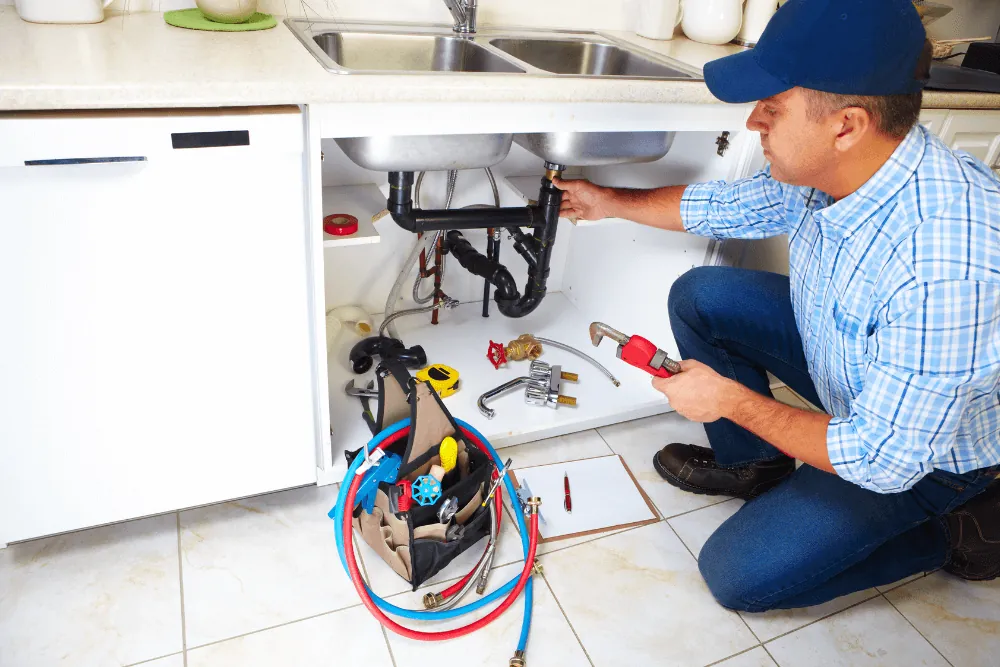
A leaking kitchen sink is not always a reason to buy a new sink. The visible symptom often points to a cheap part.
Repair when:
- the leak is at the trap, the waste joint or a supply hose connection, which means a washer, a seal or a hose
- the tap drips or sprays from the wrong place, which points to the tap and not the sink
- the sealant around the rim has failed but the sink body is sound
Replace when:
- a stainless steel sink has a split seam or a crack at the drain outlet
- a composite or ceramic sink has a crack that goes through to the underside
- the sink has rust, pitting or deep staining that cleaning does not shift
- the cabinet base under the sink has swollen from long-term moisture and no longer supports the sink
We tell you which it is before we start, with a price for each, and we do not replace anything you do not need replaced.
What is different about kitchens in Dubai flats and villas
Kitchens in Dubai buildings often have a few features that change a plumbing job. Many flats have the kitchen against a shared wall or a riser, so a leak can reach a neighbour quickly and the building may want to know. Hot weather and humidity are hard on the cabinet base under a sink, and chipboard that has been wet once swells and does not recover. In areas with hard water, scale builds up in the tap aerator, the cartridge and the strainer, which is why a tap that was fine last year can lose flow. A villa with a separate maid's kitchen or an outside kitchen often has an older waste run and a longer distance to the drain, so a slow sink there can be the pipe and not the sink.
What a clear quote for a kitchen sink job contains
Ask any plumber for a quote that lists the parts as separate lines. For a kitchen sink we give you:
- the sink itself, if we supply it, with the make and model
- the trap, waste kit and any flexible hoses
- the tap, if it is being replaced
- the labour, as one fixed figure
- any work on the worktop cutout, the sealant and the clean-up
- the removal of the old sink
Prices exclude 5% VAT and are fixed before we start. The figure changes only if you add work, for example a disposer or a new filter outlet.
After the job: what to check in the first week
A good installation shows its faults in the first few days, so check these.
- Run the sink full and let it drain, then look under the trap with a dry paper towel. Any damp mark means a joint needs tightening.
- Run a dishwasher or washing machine cycle if either is connected, and check the connections again at the end.
- Look at the base of the cabinet the next morning. It should be dry.
- Leave the sealant alone for 24 hours. Silicone needs time to cure before the sink is used heavily or cleaned hard.
- Call us on WhatsApp if anything weeps. The 30-day workmanship warranty covers our labour.
Warranty and the handover
What you should have when the job is finished:
- A written note of the sink make and model, the tap, the waste and trap fitted, and where the isolating valves are.
- The test result: the basin test and the leak check, with the date.
- The box, template and instructions, kept. The sealant and clip guidance is in them.
- The warranty terms. A sink's warranty is the manufacturer's or supplier's, not ours. A worktop cutout has its own provider, so ask who warrants it.
- The old sink and parts, if you want them back.
- FAM's workmanship warranty, in writing. The warranty runs for 30 days and covers our labour only. Parts carry the manufacturer's warranty only.
How we work
- You send us the sink, the cabinet and the problem on WhatsApp: a photo of the cabinet interior, the sink's make and model if it is already bought, and what the sink is doing.
- We check the fit before the day: the worktop type, the cutout, the cabinet and the waste outlet height.
- We give options and a price in writing, including hoses, valves, waste kit and any extra parts.
- Check permission. In a rented or managed property, ask the landlord or building management whether they need to approve this work before the visit.
- We isolate the supply, remove the old sink or part and fit the new one, with new hoses and valves where the old ones fail the check.
- We test: the basin test, every joint, the tap and any appliance connection.
- We hand over the written note, with the test result.
Where we work in Dubai
We cover all of Dubai, including Dubai Marina, JBR, Downtown Dubai, Business Bay, Jumeirah Lakes Towers, Palm Jumeirah, Al Barsha, Jumeirah Village Circle, Dubai Hills, Mirdif, Deira and Al Quoz. See the full list of areas.
How much does kitchen sink installation cost in Dubai?
In Dubai, the price follows these items:
- The sink. Type, material and size, supplied by you or by us.
- Diagnosis and visit. The visit fee is AED 50 + VAT, and it comes off the bill when you go ahead with the work.
- Labour. Removal, fitting, connection and testing.
- Waste kit, trap, hoses and valves, new where the old ones fail the check.
- The worktop. A new cutout, or the fabricator's work, which is separate from the plumbing.
- Appliance connections. Dishwasher and washing machine.
- A disposer or filter outlet, with the electrical or drain work it needs.
- Access and making good. A cramped or damaged cabinet.
Prices exclude 5% VAT and are fixed before we start.
- Tap or mixer replacement, labour only, from AED 145 + VAT. The tap itself is extra.
For other jobs we give a fixed price on WhatsApp before we start. Ask for the price in writing on WhatsApp before we begin.
Kitchen sink FAQs
Can I replace a kitchen sink myself?
A drop-in swap of the same size is possible for a confident DIYer with the right waste kit and a sound cabinet. An undermount, a stone worktop, a new cutout or a disposer is a job for a plumber and, for stone, a fabricator. In a rented flat the landlord also decides.
Which is better, a drop-in or an undermount sink?
A drop-in is easier to fit and works with nearly any worktop, but its rim collects debris. An undermount gives a cleaner edge but needs a solid worktop cut precisely. The better choice depends on your worktop, so tell us what it is made of.
Is a stainless steel or a composite sink better?
Stainless is lighter and easier to install, but it can be noisy and shows water marks. A composite is heavier, quieter and harder wearing, and needs a sound cabinet. Choose by the cabinet, the look and the budget.
Do I need an air gap for my dishwasher?
Follow the dishwasher maker's instructions first. An air gap above the sink rim is the most reliable way to stop dirty water running back into the machine, and where the instructions are silent we prefer it to a high loop. Ask us when you book.
Why does my kitchen sink drain slowly?
We rule out the trap and strainer first, then check whether other fixtures are slow too. If only the sink is slow, the cause is in the trap or its branch. If others are slow, the line beyond is blocked. The line beyond the trap is on drain unblocking.
Can I put cooking oil down the sink in Dubai?
No. Pour used oil into a container, let it cool and bin it. Oil solidifies in the pipe and blocks it, and in a building it blocks the shared drain too.
Can I fit a garbage disposer in Dubai?
Where your building allows it. We ask what your building drains to, and we need permission from the landlord and building management in a rented unit. A disposer adds solids and load to the waste line, and some buildings ban them.
Why is the cabinet under my sink wet?
We find it with the basin test, not by guessing. The cause is usually the strainer seal, the trap joints, a supply hose or the tap. If the leak runs on with everything off, close the isolation valve and call.
Who cuts the worktop for an undermount sink?
For stone, a professional. The fabricator cuts to the sink's template, which is why we ask for the make and model before the worktop is cut.
Who pays and who must agree in a rented flat?
A leak repair or a failed part is usually the landlord's, unless your contract says otherwise. A new sink, a new cutout or a disposer is an alteration that needs written consent. This is not legal advice.
Book a kitchen sink installation or repair in Dubai
Tell us what the sink is doing or which sink you have bought, what the worktop is made of, and whether you rent or own. Photos of the cabinet interior, the sink and its box help. If water is leaking, close the isolation valve under the sink and call. We will find the cause, fit or repair the sink and its waste, test every joint, and give you a written note.
WhatsApp: +971 55 407 7427 · Request a quote
Visit us: Office 871, Oasis Mall, Al Quoz 1, Dubai, UAE
Related services: Tap installation · Tap repair · Drain unblocking · Grease trap · Pipe leak repair · Washing machine plumbing · RO purifier