
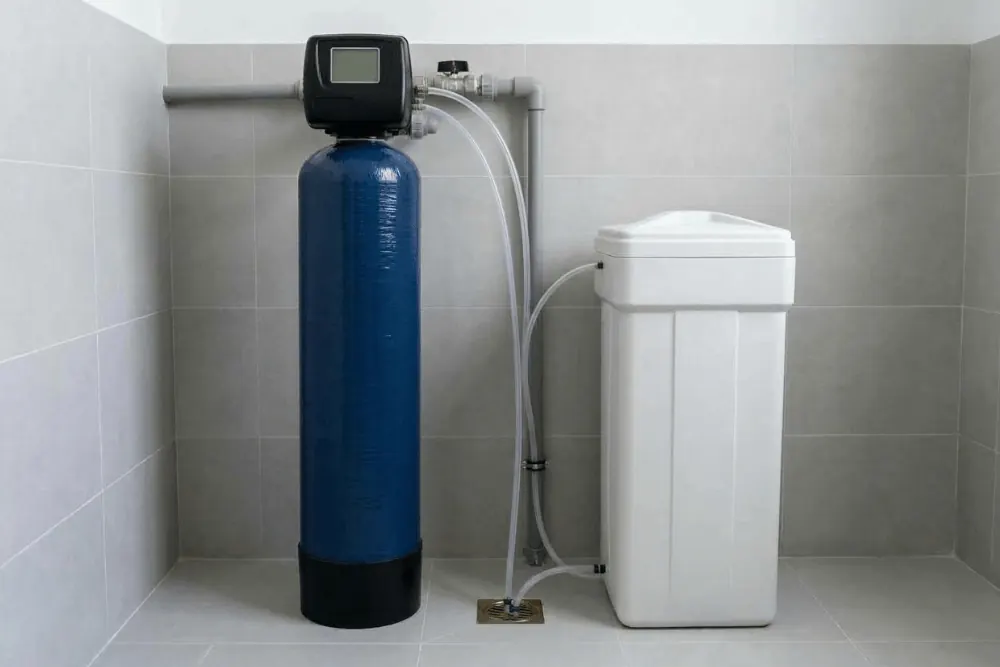
Whole house water filter installation in Dubai: what we do
- Water and system check. We look at the symptoms, the tank, the pump and the pipework, and take a sample where needed.
- Filter selection. Sediment, carbon or both, with the cartridge or media that matches the problem.
- Sizing. The housing and the pipework are chosen for your peak flow, so the filter does not choke the taps.
- Installation. On the main line, with isolation valves, a bypass and pressure gauges.
- Servicing. Cartridge changes on a schedule, and fault finding when pressure drops or the water changes.
- Replacement and upgrades. Taking out an old unit that no longer suits the property, or adding a second stage.
- Emergency visits. We answer calls and send a plumber 24 hours a day, 7 days a week, and we do not promise an arrival time.
Neighbouring problems have their own pages. Scale and hard water are covered on our water softener page. Drinking water at the kitchen tap is covered on our RO purifier page. Brown, cloudy or smelly water is covered on our smelly or discoloured water page.
What a whole house water filter does, and what it does not
A whole-house filter removes particles and, with carbon, chlorine and the taste and smell that go with it. It does not soften water, it does not remove dissolved salts, and it does not make unsafe water safe. Match your problem to the table before you spend anything.
| Your problem | Does a whole-house filter fix it? | What does |
|---|---|---|
| Sand, silt, rust flakes or tank debris in the water | Yes. A sediment stage catches them | Sediment filter, plus cleaning the tank if the debris comes from it |
| Chlorine taste or smell | Yes, with a carbon stage | Carbon block or granular activated carbon |
| Scale on taps, showerheads and heater elements | No | Water softener |
| Salty or dissolved-mineral taste in drinking water | No | RO purifier at the kitchen tap |
| Bacteria | No. Whole-house sediment and carbon stages are not designed for it | Tank cleaning, disinfection, and UV or RO where needed |
| Rotten-egg or musty smell from the hot tap only | No | Check the water heater |
| Brown water after a pipe repair or a long shutdown | A sediment stage helps catch it, but flushing clears it | See smelly or discoloured water |
| Weak pressure | No. A filter can make it worse | Low water pressure fix |
Sediment filters are not designed to remove lead, bacteria or dissolved chemicals. The same applies to a sediment stage on any whole-house system. A filter that needs to deal with bacteria or dissolved contaminants needs a different technology, and we say so before you buy.
Where the dirt comes from in Dubai
The public supply ends at the meter. After it, the internal pipes and storage tanks belong to the building and its owner. In other words, the supply is the utility's job, and what happens after the meter is the property's.
That is why a filter on the main line makes sense in a building with a storage tank. Water enters the property, sits in a tank, passes through a pump and runs through pipes of different ages. Each step can add something: sediment settling in the tank, scale or rust flaking off old pipe, fine debris from a repair. A filter after the tank and pump catches what the tank and the pipes add on the way.
It is not a substitute for cleaning the tank. A tank that feeds drinking water should be cleaned and disinfected on a schedule, every six months being our recommendation, and a filter does not change the need to clean any tank. A filter that catches tank sediment is also working harder than it should if the tank is overdue. See our water tank cleaning page for how that is done.
Do you need one? Signs and checks
Install a filter because something specific is wrong, or because you want a specific result. These are the symptoms that point to a filter and the checks we make first.
| What you notice | What it points to | First check |
|---|---|---|
| Grit or sand in the aerators, or a gritty feel | Sediment from the tank or pipes | Inspect the tank. Look at what the aerators have caught |
| Cloudy water that clears from the bottom of a glass | Air, which is harmless, or fine particles | Let a glass stand. Clearing from the bottom up points to air |
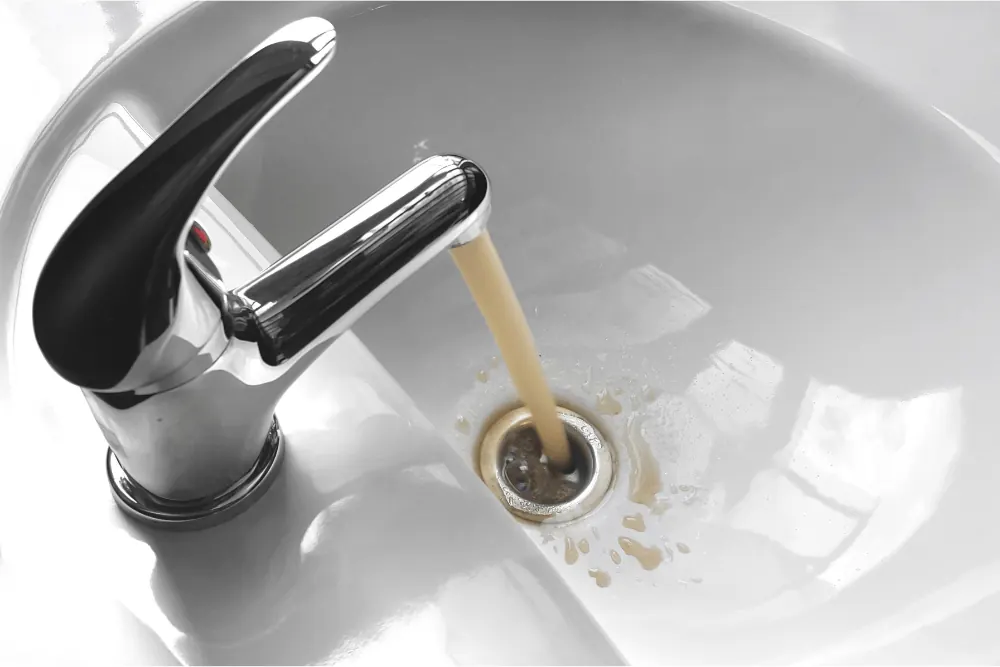
| Brown or orange water | Rust, from old steel pipe, a repair or a long shutdown | Run the cold tap. If it clears quickly, it was stagnant. If not, check the pipework |
| Strong chlorine smell or taste | Disinfectant in the supply or in the tank | Smell cold and hot water separately |
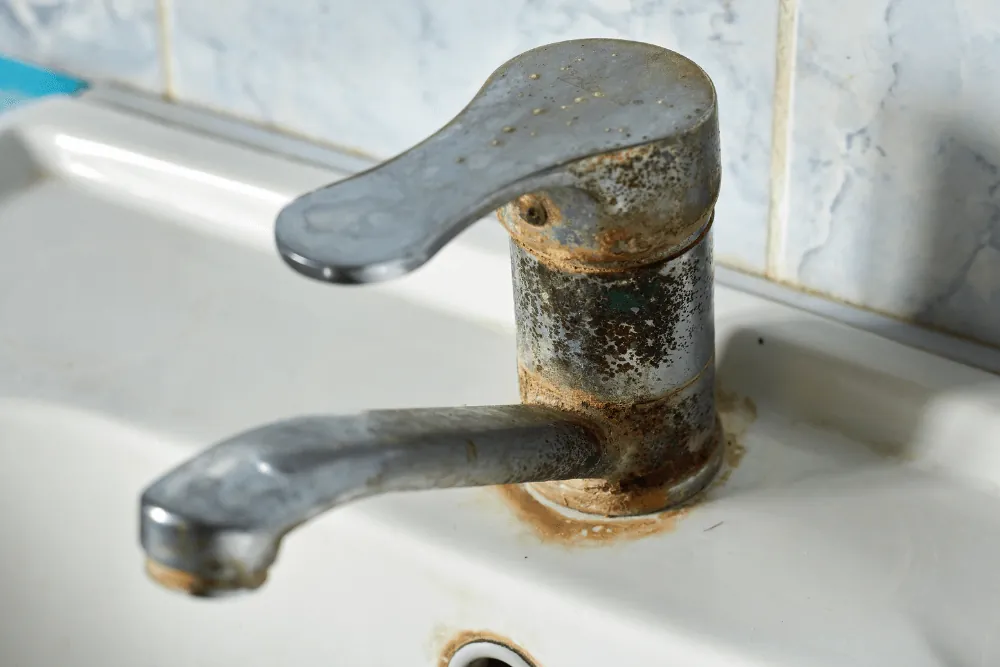
| Taps, showerheads and heaters scale up quickly | Hardness | A hardness test. A filter does not fix this |
| Washing machine and dishwasher inlet screens keep blocking | Particles in the supply | Check the inlet screens, then the tank |
| Bad-tasting drinking water only | Chlorine, or something in the kitchen line | Taste at another tap in the property |
Test before you buy
Ask for a test, not a sales pitch. A hardness test, a chlorine check and a look at what is in the tank take little time and tell you which products are worth considering. See our water quality testing page.
Sampling matters as much as the test. A glass taken after the water has sat in the pipes overnight tells you about the pipes. A sample after running the tap for a minute tells you about the supply. We take both when we are chasing a problem.
General claims about tap water quality, in either direction, do not tell you what is in your own water. The cause could be the supply, the building or the tap, and only a test at your property separates them. That is the reason to test instead of guessing from a headline.
Filter types and what each one removes
A "whole-house filter" is a housing with one or more stages inside. The stage decides what it removes.
| Stage | What it does | Where it falls short |
|---|---|---|
| Spun (depth) sediment | Traps particles throughout its thickness, coarse first | Does not remove dissolved chemicals, bacteria or lead |
| Pleated (surface) sediment | Catches particles on its surface. Used as a pre-filter where there is a lot of coarse debris | Not built to remove dissolved chemicals or bacteria |
| Granular activated carbon (GAC) | Loose carbon granules that adsorb chlorine and chemicals. Holds more contaminant at once and holds flow rate better than a block | Less fine filtration than a block |
| Carbon block | Compressed carbon that gives finer filtration and better contact with the water | Restricts flow more than loose granules |
| Ultrafiltration (UF) | A membrane that removes very fine particles, and can remove bacteria | Not a replacement for tank cleaning |
| UV unit | Disinfects with light after filtering | Does nothing for chlorine, taste or particles. Sits after a sediment stage |
Product descriptions from sellers are marketing, so we rely on the water test and the manufacturer's data sheet for the exact unit.
Micron ratings
The micron rating on a sediment cartridge is the size of particle it is built to catch. A lower number catches finer particles and is harder for water to push through. A common guide is:
| Rating | Typical use |
|---|---|
| 50 micron | Visible debris, sand and grit |
| 20 micron | A common whole-house sediment choice |
| 5 micron | Protection ahead of carbon filters or RO membranes |
| 1 micron or finer | Fine clay, silt and rust, but it may clog sooner |
A 5-micron cartridge catches a wider range than a 10-micron one but clogs faster, and a 20-micron filter is not enough where bacteria are the concern. That is why we do not fit the finest cartridge available.
Cartridge systems and media tanks
- Cartridge housings. Suit most villas and flats. A filter cartridge sits in a plastic housing that you unscrew to change it. Cartridges come in standard and large sizes, and we use the larger sizes for whole-house work.
- Media tanks. A tall tank filled with carbon or other media, and some have a control head. Tank systems generally hold up better under sustained whole-home demand than cartridges sized close to peak flow. They suit larger villas and commercial properties.
How we choose the stages
Order matters. Sediment goes first, so carbon is not clogged by grit. A typical build is one of the following.
| Setup | Stages | Suits |
|---|---|---|
| Sediment only | One sediment cartridge | Flats and villas with grit or rust but no taste complaint |
| Sediment and carbon | Sediment first, then carbon block or GAC | Properties with debris and a chlorine taste or smell complaint |
| Sediment, carbon and softener | Filter first, softener after | Properties with scale problems as well |
| Sediment, carbon and UV | UV last | Where bacteria are a concern, after the tank has been cleaned |
| Whole-house filter plus RO at the kitchen | Filter on the main, RO under the sink | Where you want drinking water treated further |
The softener goes after the filter because sediment can foul the softener resin. That is our installation practice, and the manufacturer's instructions for any specific softener take priority. See water softeners.
What a filter does to the chlorine in your water
Carbon removes chlorine. That is the point of the carbon stage, and it improves taste and smell. It also means the water leaving the carbon stage no longer carries the disinfectant that was protecting it. The pipes after the filter, the water heater and the taps now carry water without that chlorine residual. A carbon filter that is left too long also stops removing chlorine and can release what it has trapped. Exhausted filters can release trapped contaminants back into the water stream.
For this reason we ask two things. Is the carbon stage needed at all, or is the complaint only about sediment? And if carbon is fitted, will the cartridge be changed on time? A whole-house carbon filter is not a set-and-forget item. If you want drinking water treated to a higher standard, an RO unit at the kitchen tap does that job at the point of use. See our RO purifier page.
Sizing: get the flow right
A filter that is too small for the property cuts flow at every tap when several run at once. The cure is to size for peak flow, not average use.
Peak flow, in litres per minute
Count the fixtures that run together: showers, the kitchen tap, the dishwasher, the washing machine, the garden tap. As a starting chart:
| Home type | Typical busy-time overlap | Starting flow |
|---|---|---|
| 1 to 2 bathrooms | One shower plus a tap or appliance | About 23 to 30 litres per minute |
| 2 to 3 bathrooms | Two showers, or shower plus laundry and tap | About 30 to 45 litres per minute |
| 3 to 4 bathrooms | Two showers plus a tap and an appliance | About 38 to 57 litres per minute |
| 4 or more bathrooms | Frequent overlap across bathrooms | About 45 to 76 litres per minute or more |
How we measure your flow
Fill a 20-litre bucket from an outdoor tap with everything indoors switched off and time it. Filling in 60 seconds is 20 litres per minute. We do this at the main, after the pump, on the line where the filter will sit. A flow figure from before the pump or at a distant tap tells you the wrong thing.
Pipe size and fittings
Most homes use three-quarter inch or one-inch plumbing, and the inlet and outlet size, elbows, reducers and other restrictions can limit flow more than the pipe size. We fit the housing ports to the pipe, avoid reducing the line more than we must, and flag any restriction we find on the way.
Pressure drop
Every filter costs some pressure. A fresh cartridge costs little. A clogging one costs more. A fine cartridge costs more than a coarse one at the same flow. A small flow change after installation is normal, but a significant drop points to a clogged filter.
If you already have weak pressure, a filter makes it worse before it makes anything better. Fix the pressure first, then fit the filter. See our low water pressure page and our booster pump page.
Where the filter goes
The filter belongs near the point where water enters the home, after the storage tank and pump and before the branches that feed the rest of the property. A few points decide the exact spot.
- After the pump, not before it. A filter on the suction side of a booster pump starves the pump as the cartridge loads, and a starved pump can run dry. On the delivery side the filter sees steady pressure. See booster pump installation and repair.
- Out of direct sun. Heat and sunlight are hard on plastic housings, and light grows algae inside a clear one. We use opaque housings where light is a risk and shade any outdoor install.
- On a floor with a drain, or on a tray. Housings leak when a cartridge is changed. A floor drain or a drip tray turns that into a mop-up.
- On a solid wall. A housing full of water is heavy. It needs brackets fixed to masonry, or a backing board, not a hollow partition.
- With room to work. Unscrewing a housing needs clearance below it for the cartridge to come out. We leave that room.
- Before the water heater. So the heater is protected from sediment too.
Villas
A villa has space for a proper installation: a utility area, a plant room, the pump room or a shaded wall near the tank outlet. The filter can go on the main line leaving the pump set, with a bypass, isolation valves and gauges. A larger villa with several bathrooms may need a bigger housing or a media tank.
Flats
A flat may have no pump room of its own. The filter goes where the main enters the unit, which could be the service area, a utility cupboard or the shaft. Before we start, confirm two things: that you may alter the supply line in the unit, and where the unit's own isolation valve is. Building management may need to approve the work. Tell us what your building asks for and we work to it.
A flat's tank is shared and belongs to the building. If the sediment you see is coming from it, a filter in your unit treats the symptom. The cause is a tank cleaning request to management, and you should send it in writing.
Offices, shops and restaurants
Commercial premises have two reasons to filter: protect equipment and protect the product. A restaurant also keeps records of its water tank cleaning, and a filter does not replace those. We size commercial installs for the equipment's flow demand and plan the work around opening hours.
How a whole-house filter is installed
- Check and measure. We confirm the problem, take the flow reading and look at the pipe size and material. The visit fee is AED 50 + VAT, credited if the work goes ahead.
- Choose the position. Near the main, on a solid wall, after the pump, with working room.
- Isolate the supply. Close the main valve, open a tap lower down to drain the section and relieve the pressure.
- Cut in. Cut the pipe cleanly and fit adapters to the housing ports. Plastic housings stay clear of heat from soldering. We use fittings suited to the pipe material.
- Mount the housings. Fixed to the wall on brackets, with the sediment housing first in the flow direction.
- Fit isolation valves before and after. So the filter can be closed off without shutting the whole property.
- Fit a bypass. We fit one on every install.
- Fit pressure gauges before and after. The difference between the two readings is the filter's pressure loss.
- Fit the cartridges in the correct order and direction, following the manufacturer's instructions.
- Open the supply slowly. Vent air from the housings, and check every joint for leaks.
- Flush. Run taps throughout the property to release air and flush the new cartridges.
- Test. Read both gauges, check flow at the furthest tap and at the highest fixture, and compare with the flow we measured at the start.
- Hand over. We show you the isolation valves, the bypass, the gauges, how to open and close a housing, and when the first change is due.
Why the bypass and the gauges matter
A bypass lets the property keep water while a cartridge is being changed, and lets you take the filter out of the circuit if it becomes a problem. A growing gap between the two gauge readings is the signal to change the cartridge.
Maintenance: when to change cartridges
A filter that is never changed stops doing its job. It restricts flow, stops catching particles and can release what it has caught. The intervals below are starting points, because the load differs from property to property.
| Cartridge | Typical interval | Signs it is due |
|---|---|---|
| Sediment (spun or pleated) | Every 1 to 3 months, sooner with a dirty tank | Pressure gauge gap widens, flow drops, grit in the aerators |
| Carbon block or GAC cartridge | Every 3 to 6 months | Chlorine taste or smell returns, or flow drops |
| UF membrane | Per the manufacturer, often yearly | Flow drops, or the cleaning cycle no longer restores it |
| UV lamp | Yearly, since the lamp output fades before it goes dark | The unit's indicator, or the replacement date |
| Media tank | Set by the media and the manufacturer | Same signs, plus the control head's schedule |
We set a first interval, read the gauges at the first visit and adjust.
What changes the interval in Dubai
- A dirty tank. Sediment from an overdue tank clogs the first stage quickly. Cleaning the tank slows the loading.
- Recent pipework. Debris from a repair or a repipe loads the first cartridge in the first weeks.
- High use. Larger households and commercial premises pass more water through the cartridge.
- Finer micron rating. It loads sooner than a coarse one.
How we service a filter
- Read the gauges and note the pressure loss.
- Close the isolation valves and open the bypass.
- Relieve the pressure and open the housing.
- Check the old cartridge, note how dirty it is and where.
- Clean the housing and check the O-ring. Replace it if it is dry, flat or cracked.
- Fit the new cartridge, reseat the O-ring and close the housing.
- Reopen slowly, vent the air and check for leaks.
- Flush the new cartridge and record the date and the gauge readings.
Reading the gauges after installation
The two gauges on a new installation are the quickest way to judge the filter without opening it.
- First reading. Note the readings before and after the filter when the cartridges are new and the property is running at its usual flow. The gap between them is the clean pressure loss.
- A growing gap means the cartridge is loading. Our rule is to change it when the gap has grown clearly beyond the first reading, and not to wait for the taps to weaken.
- Both gauges falling together points to the supply, the pump or the tank, not the filter.
- The after gauge falling with the before gauge steady points to a clogged cartridge or a partly closed valve.
- Fluctuating readings at the before gauge point to a pump that is cycling or a tank running low.
We write the first readings on the handover note and on the housing, so every later service starts from them.
Common faults after a filter is fitted
| What you notice | Likely cause | The fix |
|---|---|---|
| Weak flow at every tap | A loaded cartridge, or a housing sized below peak flow | Change the cartridge, or fit a larger housing |
| Air spitting from taps after a change | Air left in the housing | Vent the housing and run the taps |
| Water dripping from the housing | A dry or flat O-ring, or a cross-threaded housing | Replace the O-ring, refit the housing |
| Black specks at the taps | Carbon fines after a new carbon cartridge | Flush the cartridge until the water runs clear |
| Chlorine smell returns | Spent carbon, or a bypass left open | Change the carbon, close the bypass |
| Pump starts and stops often | A restriction after the pump, or a pressure tank problem | Check the cartridge, then the pressure tank |
| Cloudy water for a day after a service | Air, which clears from the bottom of a glass | Run the taps and wait |
Questions to ask before a cartridge is changed
- Did you read the gauges first, and what were they?
- Did you check and replace the O-ring where it was worn?
- Was the new cartridge flushed before the taps were used?
- Where is the date and the reading written down for the next change?
What to ask any company before you buy a filter
Ask these questions of FAM or anyone else. The answers sort quick sales from real jobs.
- What is wrong with my water, and how do you know? A test or an inspection, not a guess.
- What will this filter remove, and what will it not? The honest answer includes a list of exclusions.
- Is it independently certified? Certification can cover taste and odour effects, health effects and material safety. Ask for the certificate for the specific product, not the brand, and ask what it covers.
- What flow is it rated for, and what pressure will I lose? Get the figures in litres per minute and in bar.
- Is there a bypass, isolation valves and gauges?
- How often are the cartridges changed, and what do they cost? The running cost matters as much as the install price.
- Who changes them? And can I see the records?
- What happens to the chlorine, and what do I do about the water after the filter?
- What if the water changes later?
- What is the guarantee?
What not to do
- Do not buy a filter for scale. A filter does not soften water. A softener does.
- Do not fit a fine cartridge on a pump that is already struggling. Fix the pressure first.
- Do not leave cartridges in for years. A spent cartridge does not filter.
- Do not fit a filter on the pump's suction side.
- Do not put the housing in the sun.
- Do not remove the bypass because it looks untidy.
- Do not mix cartridges in the wrong order. Carbon before sediment clogs the carbon.
- Do not assume the filter makes the water safe to drink. A sediment and carbon system is not designed to remove bacteria. See RO purifiers for drinking water.
- Do not skip cleaning the tank because a filter is fitted.
Home water filtration systems: one name, six systems
The words home water filtration system cover products that differ in where they go, what they treat and what they cost.
| System | Where it goes | What to know | Where to read more |
|---|---|---|---|
| Tap-mounted or countertop filter | One tap | Chlorine taste and the contaminants on its certificate | Faucet filters |
| Under-sink filter | The cold line under the kitchen sink | The same, with a larger cartridge | Water filters |
| Whole-house sediment and carbon filter | The main line, after the tank and pump | Grit, rust, tank debris, chlorine taste and smell | Covered above |
| Whole-house softener | The main line, after the filter | Hardness, which causes scale | Water softeners |
| Reverse osmosis (RO) unit | The kitchen drinking line | Dissolved salts (TDS), which a cartridge filter cannot remove | RO purifiers |
| Ultraviolet unit | The main line or the drinking line, last in the chain | Microbes, once the water is clear | Water filters for the UV section |
A complete system is a choice of rows from this table, not a single row. A household that wants softer water and cleaner drinking water is buying two rows, and the question this page answers is how the rows fit together.
Main line or sink: point of entry and point of use
Water treatment divides into two kinds. A point-of-entry device, or POE, treats all the water entering the home. A point-of-use device, or POU, treats the water at one tap and so handles a smaller volume.
- Usually point of entry: media filters, softeners, oxidising filters and acid neutralisers, and continuous disinfection by chlorine or UV on the main line. Sediment filters can go either way.
- Usually point of use: reverse osmosis units, activated carbon filters and distillers, because they treat a small volume of water for drinking and cooking.
- Nuisance problems such as iron, hardness or odour in all the water point to whole-house treatment. A concern about what you swallow can be met at the kitchen tap.
A person drinks only a couple of litres of water a day, while a household uses far more on showers, toilets, laundry and washing up. So the water you drink is a small fraction of the water you use. A whole-house system treats the rest for taste, scale or grit, and a point-of-use unit treats the water you swallow. That is why the two jobs are sized so differently.
In practice:
- A concern about what you drink points to the kitchen. A reverse osmosis unit or an under-sink filter treats a small volume at lower cost than treating the whole supply to drinking standard.
- A household with both complaints needs both. A filter or softener on the main protects the pipes, heater and appliances, and a unit at the sink treats the drinking water.
- In Dubai the main line sits after the tank and pump. The path from the utility's meter to your tap runs through a tank and the building's pipes, as set out earlier on this page. What the system sees is what has left your tank.
The order of the stages
Each stage protects the next one, so the order is not a free choice. Sediment comes first, because grit clogs everything after it. A softener comes after the sediment filter, because the resin is fouled by grit and the maker's instructions for a specific softener come first. Carbon follows the sediment stage to take out chlorine and taste. RO needs a sediment and carbon prefilter and low hardness, or the membrane scales. UV comes last, because it works only on clear water.
Five homes
| Situation | Stages, first to last | Why this order |
|---|---|---|
| Grit or rust in a tank-fed home, no other complaint | Sediment | Nothing else to protect |
| Scale on taps, kettle and heater | Sediment, then softener | The resin is fouled by sediment. Add carbon if taste is also a complaint |
| Chlorine taste and smell at every tap | Sediment, then whole-house carbon | Carbon needs grit kept out, or it clogs and channels |
| Salty or high-TDS drinking water | Sediment, softener if the water is hard, carbon, then RO at the kitchen | RO membranes are damaged by chlorine and scaled by hardness |
| A microbe concern on a tank or well supply | Sediment, carbon, then UV last | UV needs clear water, and a lamp does not remove dissolved salts or chemicals |
Three consequences:
- Adding a stage adds a condition. UV needs low turbidity, RO needs a prefilter and low hardness, and a carbon stage needs grit kept out. A stage bought on its own, without its protection, fails earlier.
- The first stage protects the rest. If the sediment stage is not changed, every stage after it works on dirtier water than the design assumed.
- Test between stages. A reading at the kitchen tap before and after the system tells you whether it is doing anything. See water testing.
Pressure and temperature on the label
A label states the working pressure and the water temperature the housing is built for. Check both against your property before the system is chosen:
- Pressure. Compare the label with the pressure at your main. A tank and booster pump set usually sits well below a housing's rating, and a direct supply with no pressure control can come closer. Measure it rather than assume it.
- Temperature. A housing on the outlet of a rooftop tank, or in the sun on a villa wall, can see much warmer water than the label assumes in a Dubai summer. Measure with a thermometer before you choose, and keep the housing in shade.
- Minimum pressure. A low-pressure supply is where some cartridges and RO units will not work as rated.
The faucet filter page works through the same temperature check for a tap filter.
Well water and a home system
A home on a well or borehole needs a different design from a home on the mains, because the water is not treated before it reaches you and can be salty, hard and microbiologically unsafe. Start with a laboratory test and not a filter.
- Salt. Salty water cannot be fixed by a sediment and carbon system, which takes out none of the salt.
- Hardness. Well water is often very hard, so a softener is likely.
- Other minerals. The laboratory report gives them, and they decide whether RO is needed.
Reverse osmosis rejects dissolved impurities, but it is not a disinfection method and is not the answer to bacteria. For bacteria the options are chlorination, UV, boiling and distillation, and UV needs clear water. A private supply should be retested regularly for bacteria.
Ask building management or the plot's owner whether a well or borehole may be used and what they need to see. Salty water needs RO at the point of use, a bacteria result decides on UV, and grit decides on the sediment stage. See RO purifiers and water testing.
How much does a whole-house filter cost in Dubai?
We quote after the water check, from photos or from a site visit. The price follows the job.
- The number of stages. Sediment alone costs less than sediment and carbon, and either costs less than adding UV or a softener.
- Housing size and type. A standard cartridge housing or a large media tank.
- Flow and pipe size. Larger pipes need larger housings and fittings.
- Position and access. A clear wall next to the main, or a long pipe run through a shaft.
- Gauges, bypass and valves.
- Cartridges. The first set and the running cost of replacements. The running cost of a stage is the price of its cartridge divided by the months it lasts, and the months depend on the volume of water used and the calendar limit, whichever is reached first. Ask for the price and the life of each stage in the chain, and add them.
- Approvals. Any fees charged by the building are separate from our price.
We do not publish a starting price for this job. Send a photo on WhatsApp and we give you a fixed price before we start. Prices exclude 5% VAT.
Where we install whole-house filters in Dubai
We cover all of Dubai, including Dubai Marina, JBR, Downtown Dubai, Business Bay, Jumeirah Lakes Towers, Palm Jumeirah, Al Barsha, Jumeirah Village Circle, Dubai Hills, Mirdif, Deira and Al Quoz. See the full list of areas.
Whole house water filter FAQs
What does a whole-house water filter remove?
A sediment stage removes sand, silt, rust and other particles. A carbon stage removes chlorine and the taste and smell that go with it. It does not soften water, remove dissolved salts or make unsafe water safe.
Will a whole-house filter stop limescale?
No. Scale comes from hardness, which dissolves in the water and passes through a sediment or carbon filter. A softener reduces it. See our water softener page.
Will it make my tap water safe to drink?
It will improve taste and remove particles, but a sediment and carbon system is not designed to remove bacteria or dissolved contaminants. For drinking water, an RO unit at the kitchen tap is the usual extra step, and the tank should be kept clean.
Where is a whole-house filter installed?
On the main line near where water enters the property, after the tank and pump and before the branches to the bathrooms, kitchen and heater. It needs a solid wall, working room, a drain or tray and shade.
Will a whole-house filter weaken the shower or the upstairs taps?
Only if it is sized for less flow than the house uses at its busiest. A main-line filter sees every tap at once, so we size the housing and the cartridge for peak demand, not average use. We fit a gauge before and after it, so the pressure drop is a reading rather than a guess. A drop that grows over weeks is a cartridge that needs changing.
How often do the cartridges need changing?
A sediment cartridge is often every one to three months and a carbon cartridge every three to six, but heavy loads shorten these. The gauges tell us when.
Do I need a filter if I already clean my tank?
Not necessarily. Cleaning removes what has built up in the tank. A filter catches what still comes through from the pipes and the pump. We check what is in your water and tell you whether a filter would change anything.
Can I install it in a rented flat?
Check with your landlord and the building first. The supply line is part of the building's plumbing, and building management may need to approve changes. We work to what your building asks for.
Do I need both a filter and a softener?
Only if both problems are present. We fit the filter first and the softener after it. A hardness test tells us whether you need a softener at all.
Do you offer a guarantee?
Yes. We give a 30-day workmanship warranty on our labour. Parts carry the manufacturer's warranty only.
How much does a whole-house filter cost?
We do not publish a starting price for this job. Send a photo on WhatsApp and we give you a fixed price before we start. Prices exclude 5% VAT.
Which home water filtration system is best for Dubai?
Start from a test of your own tap, because the stages follow the result: grit needs sediment, chlorine taste needs carbon, scale needs a softener, a high TDS needs RO and a microbe worry needs UV. See the order of the stages above.
Should I fit a whole-house system or a filter at the sink?
Nuisance problems such as iron, hardness or odour in all the water point to whole-house treatment, and a concern limited to what you swallow can be met at the tap. Drinking water is a small fraction of household use, so a home with both complaints needs both.
In what order do the stages go?
Sediment first, then the softener if the water is hard, then carbon, then RO at the kitchen if you need it, and UV last. Sediment goes ahead of everything because grit clogs the rest, and hard water scales an RO membrane, so the softener comes before it.
Can I use a home filtration system on well water?
Only after a laboratory test. Well water can be salty, very hard and unsafe to drink, and a sediment and carbon system takes out none of the salt. The report decides whether you need a softener, RO, UV or all three, and whether the water is worth treating at all.
Book a whole-house water filter installation in Dubai
Tell us what you notice in the water, where it comes from and what kind of property you have. A photo of the tank, the pump set and the pipe where it enters the property helps. We will send a plumber to check the water and quote.
WhatsApp: +971 55 407 7427 · Request a quote
Visit us: Office 871, Oasis Mall, Al Quoz 1, Dubai, UAE
Related services: RO purifier · Water softener · Water quality testing · Smelly or discoloured water · Water tank cleaning · Booster pump