
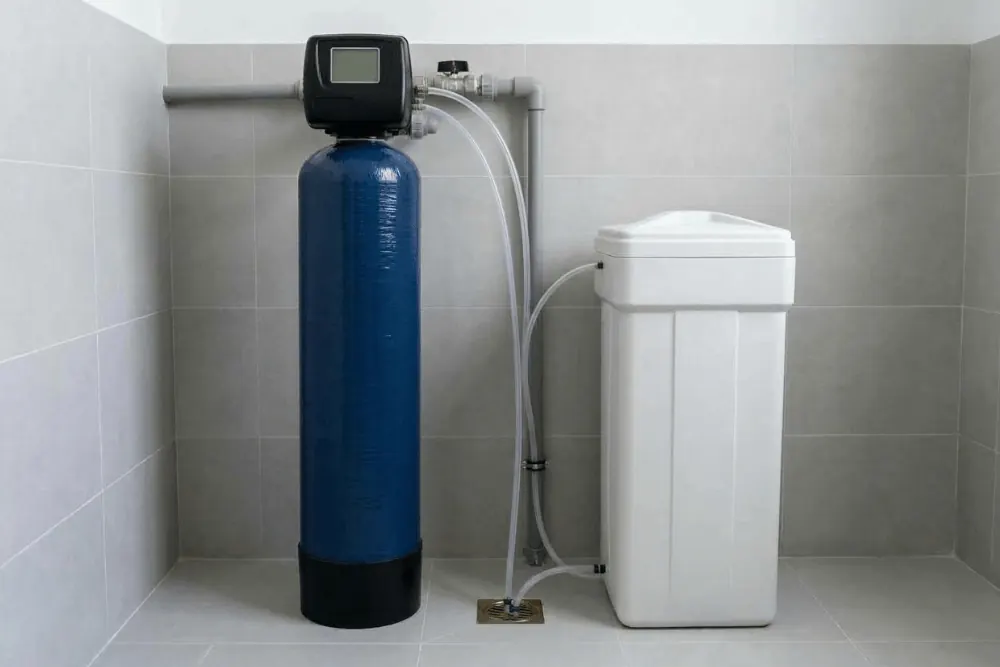
Water softener installation and descaling in Dubai: what we do
- Hardness testing. A reading at your own tap, in the unit you will use for sizing.
- Softener installation. A salt-based unit on the main line, with a bypass, a drain and an unsoftened drinking tap.
- Replacement. Taking out an old softener and fitting a new one.
- Servicing and repair. Salt, brine tank, resin, valves, regeneration settings and faults.
- Descaling. Water heaters, taps, mixers and showerheads.
- Advice on alternatives. Salt-free conditioners and electronic descalers, and how much to trust them.
- Emergency visits. We answer calls and send a plumber 24 hours a day, 7 days a week, and we do not promise an arrival time.
Related water-treatment problems have their own pages. Particles and chlorine are covered on our whole-house water filter page. Drinking-water treatment is covered on our RO purifier page. Heater faults are covered on our water heater repair page.
What hard water is, and what it does
Hardness is dissolved calcium and magnesium.
How hard is hard?
Hardness is reported in milligrams per litre as calcium carbonate (mg/L). The higher the number, the harder the water, and the more scale it leaves on heaters, taps and glass. A reading in mg/L tells you very little by itself, because the same number means more scale in a heater than in a cold tap. What matters is what comes out of your own tap and what that does to your heater and fixtures, which is why we measure it.
What scale does in a home
- Heaters. Heat makes calcium and magnesium carbonate come out of the water as scale. It coats the element, so the element works harder, heats slower and burns out sooner, and it settles on the tank floor as sediment.
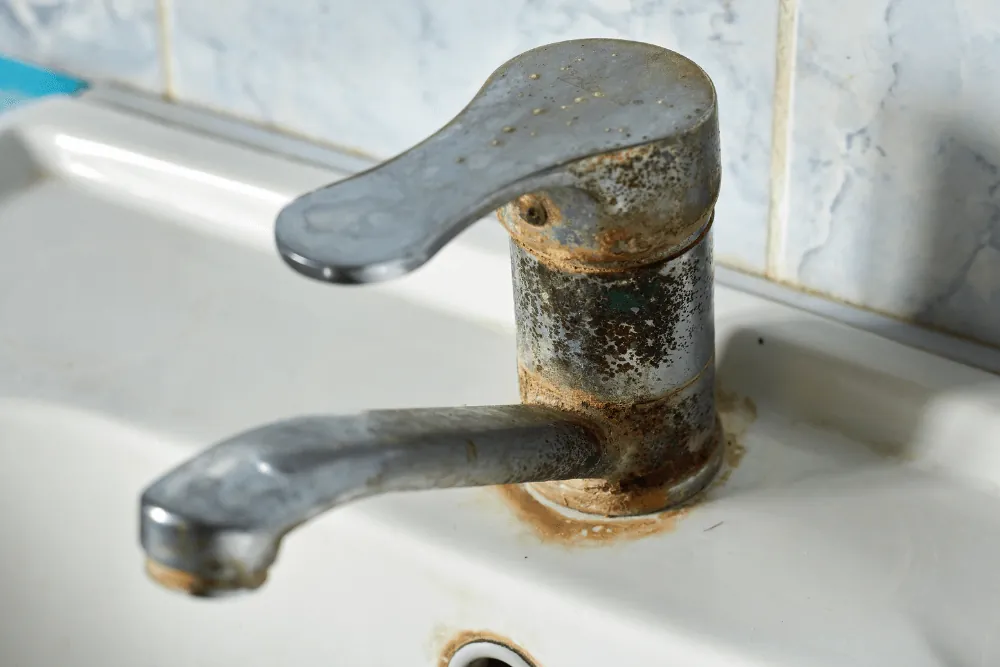
- Taps, mixers and showerheads. White crust builds where water dries. In showerheads it blocks nozzles and changes the spray.
- Kettles, coffee machines and appliances. Scale forms on whatever heats the water.
- Soap and laundry. Hard water needs more soap and detergent to get the same result.
How hard is Dubai's water? Measure it
Where the water comes from does not tell you the hardness at your tap. Hardness depends on how the water is treated and supplied, and your own tank, pipes and heater all sit between the supply and the tap. A single figure for a whole city says little about one property, so we measure each one.
Signs of hard water
| What you notice | Points to hardness? | Other things to check |
|---|---|---|
| White crust on taps, showerheads and around drains | Yes | |
| Spots on glasses and shower screens after drying | Yes | |
| Soap and shampoo lather poorly | Yes | |
| Kettle or coffee machine fills with chalky flakes | Yes | |
| Water heater takes longer to heat or makes rumbling noises | Scale on the element or sediment in the tank | See water heater repair |
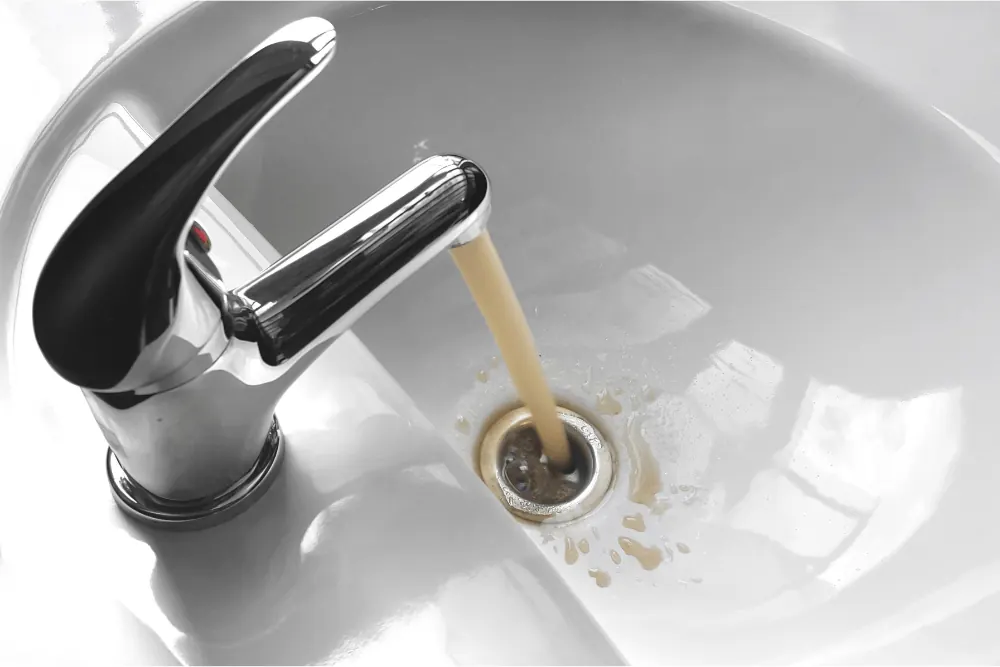
| Cloudy water, grit or rust | No. Those are particles | Whole-house filter |
| Chlorine taste or smell | No | Whole-house filter or RO |
| Musty or rotten smell | No | Smelly or discoloured water |
A softener fixes the first four rows and the scale in the heater. It does not fix the last three.
Test before you choose
A hardness test costs little and settles the question.
- Test strips. Fast and cheap. They give a rough class, such as soft, moderate or hard.
- Drop-count titration kits. Count drops to a colour change. More precise than strips.
- Laboratory test. Gives hardness, iron and other readings together. See our water quality testing page.
Three practical rules apply.
- Know the unit. A result can be written in more than one unit and the numbers look nothing alike. Ask for mg/L as calcium carbonate.
- Test where you will use it. Take the sample from a cold kitchen or bathroom tap after running the water for a minute. A building tank and a villa tank can give different results.
- Test for iron as well. Iron reduces a softener's effectiveness. The limit depends on the unit, so check the manufacturer's rating.
Your options
Only some of these remove hardness. The table says which.
| Option | Removes hardness? | How it works | Our view |
|---|---|---|---|
| Salt-based softener (ion exchange) | Yes | Swaps calcium and magnesium for sodium on resin, then regenerates with brine | The method that removes hardness from the whole property |
| Salt-free conditioner | No. It changes how scale forms | Turns hardness minerals into tiny crystals that are less likely to stick | Worth considering where salt is not wanted. Ask for test data at your own hardness |
| Electronic or magnetic descaler | No | A coil or magnet around the pipe | Evidence is weak. We do not recommend it as a substitute for a softener |
| RO unit at the kitchen tap | Yes, at one tap | Membrane removes dissolved solids | For drinking water. Not for the whole property. See RO purifiers |
| Point-of-use cartridge or showerhead filter | At one point only | Small ion-exchange or scale-inhibiting cartridge | Protects only what it is plumbed to |
| Whole-house sediment and carbon filter | No | Catches particles and chlorine | Does not touch hardness |
Salt-free and electronic devices
Results for devices that do not remove hardness are mixed. Some reduce how much scale sticks in moderately hard water, and others make no measurable difference. The practical rule: ask for independent test data at your own hardness, flow and temperature before you pay for a device that does not remove hardness.
Choosing between salt-based and salt-free
| Your situation | Better fit | Why |
|---|---|---|
| A villa where the main can be cut into and a drain is near | Salt-based softener | Removes hardness from the whole property |
| A flat where the supply line cannot be altered | A point-of-use device or regular descaling | A whole-property unit needs a drain and a place on the main |
| Hard water but salt or sodium is a concern | Salt-free conditioner, or an RO unit for drinking | No sodium added, though scale is reduced and not removed |
| Only the heater is a worry | A heater flush and anode check on a schedule | Cheaper than treating the whole property |
How a salt-based softener works
Inside the tank is a bed of resin beads loaded with sodium. As hard water passes through, calcium and magnesium ions trade places with sodium ions. When the resin is full of calcium and magnesium, the unit regenerates: it flushes the bed with brine, which is a strong sodium chloride solution made in a separate tank, and restores the sodium.
| Part | Job |
|---|---|
| Resin tank | Holds the resin beads where the exchange happens |
| Brine tank | Holds the salt and makes the brine for regeneration |
| Control valve | Directs water and starts regeneration, on a timer or by water use |
| Bypass valve | Lets water go around the unit for servicing |
| Drain line | Carries the regeneration water away |
Regeneration
- How much water it uses. A regeneration uses a noticeable amount of water, often a couple of hundred litres for a household unit. The unit's data sheet gives the figure for your model.
- Timer or demand. A timer regenerates on a fixed schedule, even if little water was used. A demand valve counts the water used and regenerates only when the resin is nearly full, which saves salt and water.
- Timing. Regeneration normally runs at night, so softened water is ready in the morning. Ask for the setting.
Sodium and drinking water
A softener adds sodium, and the harder the water, the more sodium it adds. We leave one cold kitchen tap unsoftened for drinking and cooking, and anyone on a sodium-restricted diet should ask their doctor. Potassium chloride can replace sodium chloride in the brine tank.
We fit an unsoftened kitchen drinking tap as standard, or take the drinking tap from an RO unit.
Water that should not be softened
We take the garden tap off the softened line. Softened water is not good for plants, and there is no reason to spend salt on irrigation or car washing.
Sizing a softener
A softener is rated by the amount of hardness it can remove before it must regenerate. Too small and it regenerates constantly. Too large and it wastes salt and money. The sum is simple.
Daily hardness load = daily water use × hardness. The unit's data sheet gives its capacity in the same terms, and dividing the capacity by the daily load shows how many days it runs between regenerations.
A worked example
This is an illustration and not a measurement of any Dubai property. A villa uses 800 litres a day, and a test reads 120 mg/L. That is 800 × 120 = 96,000 mg, or 96 g of hardness a day. A unit whose data sheet gives a capacity of about 2 kg of hardness between regenerations would run about three weeks.
The same villa at 240 mg/L carries twice the load, so the same unit regenerates in about half the time. Hardness doubles the load and halves the interval, which is why the test comes first. A real design also allows for iron, for peak flow and for a margin, and the manufacturer's rating tells us how much capacity the unit delivers at a sensible salt dose.
Flow rate
The softener must pass your peak flow without a large pressure drop. We measure it with a bucket test at the main, after the pump, with indoor fixtures off. See the flow section on our whole-house water filter page. If pressure is already weak, fix that first. See low water pressure.
Where the softener goes and how it is installed
The softener belongs on the main line, after the tank and pump and after any sediment filter, before the water heater and the branches to bathrooms and kitchen. Sediment can foul resin, which is the reason the filter goes first.
It needs:
- A drain for regeneration water, with an air gap so waste can never flow back.
- A power socket for the control valve, protected from water. FAM has its own electricians if a socket has to be added.
- Floor space and access for the resin tank and a salt tank that can be topped up.
- A bypass so the property keeps water during service.
- An unsoftened line to the kitchen drinking tap, and to outdoor taps.
Villas and flats
A villa may have a utility room, pump room or covered wall near the tank outlet where a softener fits. A flat may not have the space or a suitable drain, and the supply line is part of the building's plumbing. Check with your landlord and the building first. Tell us what your building asks for and we work to it. Small units that treat one bathroom or one appliance exist, and they protect only what they are plumbed to.
Installation steps
- Test the water for hardness and iron, and measure the flow.
- Choose the position near the main, after the pump and filter, on level ground with a drain nearby.
- Isolate the supply and drain the section.
- Cut in and connect the inlet and outlet with isolation valves and a bypass.
- Connect the drain line with an air gap, and the brine overflow to a safe discharge.
- Fit the unsoftened lines to the kitchen drinking tap and the garden tap.
- Load the salt and set the hardness, the capacity and the regeneration time on the control valve.
- Open the supply slowly, vent air and check every joint.
- Run a regeneration to flush the resin and confirm the brine draw and the drain.
- Test the water at the soft tap and the unsoftened tap. The soft tap should read near zero.
- Hand over. We show you the bypass, the settings, the salt level and the service dates.
Salt, servicing and what to look after
A softener needs very little attention, and the attention it needs is regular.
| Task | How often | Notes |
|---|---|---|
| Check the salt level | Monthly | Never let it run out |
| Add salt | As needed | Use the type the manufacturer specifies |
| Test the water | Now and then | A soft-tap reading above zero means the unit needs attention |
| Review the settings | After any change in water use | A bigger household or a new hardness reading changes the interval |
| Professional service | Yearly | Resin, valves, drain and settings checked |
Which salt
Pellets, crystals and block salt are made for different units. Block salt should be used only in units designed for it, and rock salt only if the manufacturer allows it, because it carries more impurities that clog the brine tank. Follow the manual. Potassium chloride is the alternative when sodium must be limited.
We tell you which grade your unit takes.
Questions to ask any company before you buy a softener
Put these to FAM or anyone else.
- What is my hardness and my iron, and how was it measured? The answer should be a number from a test, not "it is hard in this area".
- What capacity do you recommend, and how did you work it out? Units are rated by the total hardness they can remove before recharging. Ask to see the sum.
- How often will it regenerate at my hardness and water use? The interval follows from capacity and load.
- Timer or demand regeneration? Demand saves salt and water.
- How much salt and water does one regeneration use? These are the running costs.
- Is it independently certified for hardness reduction? Ask for the certificate for the exact model.
- Is there a bypass, and an unsoftened drinking tap?
- Where does the regeneration water go? A drain with an air gap, not a hose into a gully.
- What does a yearly service cost, and what does it cover?
- What happens if my iron or hardness changes later?
Be wary of any company that quotes before testing, or that offers an electronic device as a softener without test data.
Reading a softener's label
- Capacity. The total hardness the resin can remove before regenerating.
- Salt dose. How much salt a regeneration uses. A smaller dose uses less salt per cycle and delivers less capacity, so a capacity figure is only meaningful with its salt dose beside it.
- Service flow rate. The flow the unit passes without a large pressure drop.
How to read your test result
- Ask for the unit. The result should say mg/L as calcium carbonate.
- Ask where the sample was taken. A cold kitchen tap after a minute's run is the usual point, and a sample from the tank outlet may read differently.
- Ask for iron. A result with iron on it tells us whether pretreatment is needed.
- Take a second reading after installation. The soft tap should read close to zero, and the unsoftened tap should read what you started with.
- Keep the numbers. A rise at the soft tap later is the first sign the resin is tired or the settings are wrong.
Softened water around the home
Softened water changes a few things you will notice.
- Soap and shampoo lather more, so you use less, and a slippery feel on skin at first is normal.
- Glass and shower screens spot less, and tiles stay clearer.
- Washing machines and dishwashers run with less scale on their heating parts, and often need less detergent.
- The water heater scales more slowly, and the element lasts longer.
- Plants and cars do better on unsoftened water, which is why the garden tap stays on the hard line.
Salt storage
Salt bags go in a dry, cool place off the floor. In a humid utility room, an open bag cakes and bridges in the brine tank, and a bag left on damp concrete takes up moisture. Keep the lid on the brine tank, lift bags with your legs and not your back, and top up with the type the maker names. Pellets, crystals and block salt are not interchangeable.
Space and drain check for a flat
Before we recommend a softener for a flat, we check four things: a place on the main where the unit can sit, a drain close enough for the regeneration water, a socket for the control valve, and whether the building allows changes to the supply line. If any one is missing, the better answer may be a point-of-use device, a descale schedule or an RO unit for drinking water. We say so at the visit.
When your softener stops softening: checks you can make
- Look at the salt. An empty brine tank stops regeneration, and the fix is a bag of the right salt. If the salt looks hard and crusted on top, tell us.
- Check the bypass. A bypass left open sends hard water straight through.
- Check the display and the power. A blank display or a wrong clock moves the regeneration to the wrong time.
- Run a manual regeneration if the manual shows how, then test the soft tap after it finishes.
- Test the soft tap and the unsoftened tap and note the readings.
- Look for orange or brown stains around the unit and at taps, which point to iron.
- Tell us what changed: more people, a new heater, a tank cleaning, a plumbing repair.
Softener repair and problems
| What you notice | Possible cause | The fix |
|---|---|---|
| Water is hard again | Salt has run out, the bypass is open, the unit did not regenerate or is undersized for new demand | Check salt and bypass, start a manual regeneration, review the settings |
| Salt level never drops | The unit is not drawing brine: a blocked injector, a bridged salt crust, or a control fault | Clear the injector, break the crust, check the valve |
| Salt use is very high | Regeneration too frequent, wrong capacity setting or leaking brine valve | Reset hardness and capacity, check the valve |
| Water runs to drain all the time | A worn seal or a stuck valve in the control head | Service or replace the seals |
| Pressure dropped after the softener | Resin fouled by sediment or iron, a blocked valve or an undersized unit | Clean or replace the resin, check the filter ahead, check sizing |
| Orange or brown staining returns | Iron is fouling the resin | Test iron and add iron treatment ahead of the softener |
| Water tastes salty | Too much brine in the line after a fault, or a brine valve problem | Check the brine draw and rinse cycle |
| No display, or an error code | A power or control board fault | Check the supply and the board |
| Resin beads in taps or aerators | A cracked distributor inside the tank | Replace the part |
| Brine tank overflows | A faulty float or a blocked drain | Replace the float and clear the line |
Iron deserves a second mention. A softener that keeps failing in the same way may point to something in the water that the test did not look for.
Softened water and your heater
Softened water scales less, which helps the heater, but it changes one thing worth knowing. Water chemistry, heavy hot-water use and water softeners all affect how fast a tank's anode rod wears. The anode rod protects the tank from corrosion, and once it is used up the steel starts to rust. In a home with a softener, we check the anode at each heater service. See water heater repair.
Descaling and limescale removal
A softener stops new scale. It does nothing about the scale already in place. Descaling removes what is there. We do both: the softener for the future, and the descaling for the existing build-up.
What you can safely do yourself
| Item | Method | Cautions |
|---|---|---|
| Taps | Wrap a vinegar-soaked cloth around the scale for about 30 minutes, then wipe | Do not use vinegar on marble, granite, plated taps (especially gold) or cast iron |
| Kettle | Descale with a product made for kettles or a mild acid, then rinse thoroughly | Monthly in hard-water areas, or every two to three weeks if scale builds fast |
| Glass shower screens | Wipe dry after each use |
Test any cleaner on a hidden spot first. Ventilate the room. Do not combine cleaning products unless the label allows it.
What we do
- Tank water heaters. Flush the tank and check the anode rod and the safety valve. Most tank heaters need flushing at least once a year, more often in hard-water areas, and the anode rod should be inspected yearly. We also inspect the element on an electric heater.
- Tankless heaters. Scale builds up in the heat exchanger, and we descale per the manufacturer's method. See tankless water heaters.
- Showers, taps and mixers. Descale or replace the part. Where a cartridge is scaled beyond cleaning, we replace it. See shower repair and tap repair.
- Pipes. Descaling inside pipework is not a routine job. If a section is badly scaled, replacing it is the fix. See repiping.
Do not work inside a heater yourself. Isolate the power first, and call us for anything behind a panel.
A descaling schedule
| Item | Interval | Basis |
|---|---|---|
| Kettle | Monthly in hard water, sooner if scale forms quickly | Scale builds faster at higher hardness |
| Tank heater flush | At least yearly | Sediment settles on the element and tank floor |
| Anode rod check | Yearly | A used-up anode lets the tank corrode |
| Showerheads and taps | When spray or flow changes, or crust appears | Our practice |
What not to do
- Do not buy a softener for a smell or a cloudy-water complaint. It will not fix either.
- Do not skip the hardness test. A softener sized without one is a guess.
- Do not feed the garden tap or the drinking tap with softened water.
- Do not let the salt run out. Hard water goes straight through.
- Do not use the wrong salt or block salt in a unit made for pellets.
- Do not soak plated, gold or stone surfaces in vinegar.
- Do not mix cleaning products.
- Do not drain a hot heater until it has cooled, and do not restart an electric heater with the tank empty.
- Do not rely on a device that does not remove hardness without test data at your own hardness.
How much does a softener or descaling cost in Dubai?
We quote after the test and a look at the space. The price follows the job.
- Unit size and type. Capacity, control valve, single or twin tank.
- Pretreatment. A sediment filter ahead, and iron treatment where the test shows iron.
- Installation. Position, drain, bypass, unsoftened lines and access.
- Salt and servicing. The running cost, and a yearly service.
- Descaling work. A heater flush costs less than a tankless descale or a replaced element.
We do not publish a starting price for this job. Send a photo on WhatsApp and we give you a fixed price before we start. Prices exclude 5% VAT.
Where we install softeners and descale in Dubai
We cover all of Dubai, including Dubai Marina, JBR, Downtown Dubai, Business Bay, Jumeirah Lakes Towers, Palm Jumeirah, Al Barsha, Jumeirah Village Circle, Dubai Hills, Mirdif, Deira and Al Quoz. See the full list of areas.
Water softener and descaling FAQs
How do I know if I have hard water?
Look for white crust on taps and showerheads, spots on glass, poor lather and chalk in the kettle. A test confirms it. Most people start to notice problems once the reading is clearly above the soft range, and we read your result against what your heater and fixtures are doing.
Is hard water harmful to drink?
Hardness is a nuisance rather than a health problem. It still damages heaters, fixtures and appliances over time.
What does a water softener do?
A salt-based softener swaps calcium and magnesium for sodium, so the water leaves scale-free. It does not remove chlorine, bacteria or sediment.
Does a softener make water salty or unsafe to drink?
It adds sodium, in proportion to the hardness it removes. That is why we leave one kitchen tap unsoftened, or take drinking water from an RO unit. Check with your doctor if you are on a sodium-restricted diet.
Do salt-free conditioners and electronic descalers work?
They do not remove hardness. Salt-free conditioners may reduce scale in moderately hard water, and the evidence for electronic and magnetic devices is weak. Ask for independent data at your own water hardness.
How often does a softener regenerate?
The unit's capacity divided by your daily hardness load sets the interval. In our worked example, a villa at 120 mg/L and 800 litres a day regenerates about every three weeks. A demand valve works this out for itself.
How much salt does a softener use?
The salt dose setting for the unit and its capacity sets it. We check the setting at installation and at each service.
Will a softener damage my plumbing or heater?
No. Softened water scales less, which protects the heater's element and tank. It can speed up anode wear, so we check the anode at each heater service.
Can you descale my water heater?
Yes. We flush tank heaters and descale tankless units per the manufacturer's method. A tank heater needs a flush at least once a year, more often in hard water.
Do you offer a guarantee and a service plan?
Yes. We give a 30-day workmanship warranty on our labour. Parts carry the manufacturer's warranty only. For a service plan, ask for a quote on WhatsApp.
How much does a softener cost?
We do not publish a starting price for this job. Send a photo on WhatsApp and we give you a fixed price before we start. Prices exclude 5% VAT.
Book a water softener installation or descaling in Dubai
Tell us what scale you see, where, and what kind of property you have. A photo of the scaled tap or heater and the pipe where the main enters the property helps. We will send a plumber to test the water and quote.
WhatsApp: +971 55 407 7427 · Request a quote
Visit us: Office 871, Oasis Mall, Al Quoz 1, Dubai, UAE
Related services: Whole-house water filter · RO purifier · Water quality testing · Water heater repair · Tankless water heaters · Shower repair