
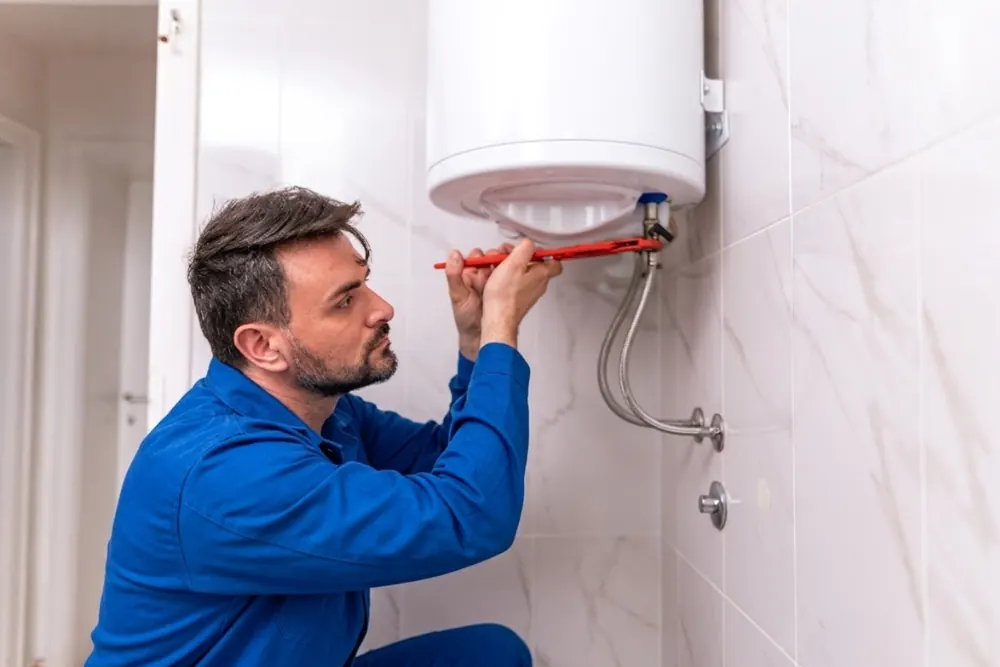
What is wrong with your water heater?
Start with the symptom. The table matches each symptom to a likely cause, the usual fix and how big the job tends to be. It is a guide from general plumbing practice, and the diagnosis on site decides.
| What you notice | Possible cause | Fix | Job size |
|---|---|---|---|
| No hot water at all | Tripped cut-out, failed thermostat, burnt element, no power | Reset, or replace the faulty part | Small to medium |
| Hot water runs out fast | Failed lower element, heavy scale, undersized tank | Replace element, descale, or upsize | Medium |
| Water is only lukewarm | Thermostat set low, worn element, a faulty mixer downstream | Adjust or replace parts | Small to medium |
| Water is scalding hot | Stuck thermostat, thermostat out of calibration | Replace thermostat | Small |
| Water dripping from the tank body | Corroded tank | Replace the heater | Large |
| Water dripping from a pipe or valve | Loose joint, worn washer, failing relief valve | Reseal or replace the part | Small to medium |
| Breaker trips when the heater turns on | Earth fault in the element or thermostat | Test, replace the faulty part | Medium |
| Rumbling, popping or hissing | Scale on the element or tank floor | Flush and descale | Small to medium |
| Rusty or smelly hot water | Used-up anode rod, corrosion inside the tank | Replace the anode, flush, or replace the heater | Medium to large |
| Weak hot water flow | Blocked inlet strainer, partly shut valve, scaled pipes | Clean, open or replace | Small to medium |
If your problem is not on the list, send us a short description or a photo on WhatsApp. A photo helps us name the cause before we arrive.
Water heater repair in Dubai: what we fix
"Water heater" covers several different machines, and each fails in its own way. The first thing we do on a visit is identify what you have.
Electric storage heaters (geysers)
A storage heater is an insulated tank with one or two electric elements and a thermostat. The tank may sit in the ceiling void above the bathroom or in a utility cupboard, where it is out of sight until it fails.
The parts that wear out are predictable. Elements burn out or crack under scale. Thermostats drift or stick. The anode rod, a sacrificial metal rod that protects the tank wall from rust, is used up over time. The tank itself is the one part we cannot repair when it corrodes through. We repair all common makes and sizes.
Instant (point-of-use) heaters
These small units sit under a sink or near a shower and heat water as it flows. They have no tank, so the faults are different: a failed flow sensor, a burnt heating coil, a blocked inlet filter, or scale choking the small waterways inside. Once the coil fails, we give you the repair price and the price of a new unit side by side.
Tankless and whole-house instant heaters
Larger tankless units heat water on demand for a whole bathroom or apartment. They need a strong electrical supply and a steady water flow to work. Typical problems are error codes, scale in the heat exchanger, and a flow rate too low to switch the unit on. We repair electric units and we do not do gas work. If your unit is old and you are thinking of switching type, read about tankless water heaters.
Solar water heaters
Some villas have rooftop solar collectors with an insulated tank. The sun does the heating, and an electric backup element handles cloudy days and winter evenings. Faults split into two groups: the solar loop (collectors, circulation pump, controller, sensors) and the backup element and thermostat, which behave like any electric heater. A solar system that never gets hot has a fault in the solar loop or in the backup, and the loop is tested separately. More on our solar water heater page.
Central systems and boilers
Larger villas and some compounds use a central hot water cylinder or boiler feeding every bathroom. Faults include failed circulation pumps, scaled heat exchangers, faulty controls and leaking cylinders. See boiler repair and service for details.
Heat pump water heaters
Heat pump units move heat rather than creating it, so they use far less electricity but have more parts that can fail: compressor, fan, evaporator and controls. We diagnose these and repair the plumbing and electrical side. Sealed refrigerant work goes back to the manufacturer where the warranty requires it. See heat pump water heaters.
Common water heater problems and how we fix them
No hot water
Work through the causes in the order a plumber would.
- No power to the heater. A tripped breaker, a switched-off isolator, or a failed timer is the simplest cause. We check the supply at the heater before touching anything else.
- Tripped thermal cut-out. Electric heaters have a safety switch that cuts power if the tank overheats. The reset button sits behind a cover on the thermostat, and your heater's manual shows where. If it trips again straight after a reset, a faulty thermostat or element is the cause. Pressing it repeatedly does not fix the problem.
- Failed thermostat. The thermostat tells the element when to heat. When it fails, the element never switches on, or never switches off. We test it with a meter and replace it if it is out of range.
- Burnt-out element. Elements fail when scale insulates them from the water and they overheat, or when they reach the end of their life. We test the element for continuity and for earth leakage. If it fails either test, we replace it.
- Tank full of air or no water supply. If the cold feed is shut or the tank is airlocked, the heater cannot fill and the safety circuit holds the element off. We check the inlet valve and bleed the tank.
Most no-hot-water calls end in one of two parts: a thermostat or an element. Both are quick replacements once the fault is confirmed. See element and thermostat replacement.
Hot water runs out quickly
You get a few minutes of hot water, then it turns cold. The tank is heating only partly.
In a two-element tank, the lower element does most of the work. If it fails, only the top section of the tank gets hot, and you get a fraction of the normal volume. Scale on the lower element, or sediment settled around it, causes the same effect.
Other causes are a thermostat set too low, a dip tube that has cracked so cold water mixes straight into the outlet, or a tank that is too small for your household. We will tell you which one it is. If the tank is undersized, we say so and quote an upgrade rather than repeated repairs.
Water is only lukewarm
Lukewarm water points to one of four things: a thermostat set too low, a weak or partly failed element, a mixing valve or shower mixer faulty downstream of the heater, or cross-flow between hot and cold pipes. The last one is easy to miss. If a faulty mixer or non-return valve lets cold water creep into the hot line, the heater can be perfect and the tap still runs warm.
We test the temperature at the heater outlet first. If it is hot there, the fault is in the pipework or mixer, not the heater.
Water is too hot
Water hot enough to scald is a safety fault. The thermostat is stuck closed or out of calibration, so the element keeps heating past the set point. The safety cut-out and the relief valve are the last line of defence, and if they are the only thing stopping the tank, the heater needs attention now.
Switch the heater off at the isolator and WhatsApp us. We replace the thermostat and test both safety devices before we leave.
Leaking water heater
Where the water comes from decides everything.
- A drip from a pipe connection or valve. Repairable. Causes include a worn washer, a loose compression fitting or a failing relief valve. We reseal or replace the part.
- A weep from the element flange or thermostat pocket. Repairable. The gasket has failed or the element is cracked. We replace the gasket or element.
- Water pooling from the tank body or base. Not repairable. The steel shell has corroded through and no patch lasts. Replacement is the only safe option.
Turn off the cold water supply to the heater and switch off its power at the isolator before you do anything else. Then WhatsApp us. A heater that is leaking and still powered is both a water risk and an electrical one. If water has reached the ceiling below, our leak detection team can trace any other leaks at the same visit.
Heater trips the breaker
If the breaker trips the moment the heater heats, one cause is an earth fault: a cracked element, a damaged thermostat, or water getting into the connection box. Resetting the breaker repeatedly is risky and can damage the board.
We isolate the heater, test the element and thermostat with an insulation tester, and replace whatever is leaking current. FAM has its own electricians, so a fault in the circuit or the isolator is checked on the same visit.
Noisy water heater
Rumbling, popping, crackling or a kettle-like hiss are the sounds of water boiling in pockets under a layer of scale. The scale traps water against the element or tank floor, which flashes to steam and makes noise. Flushing and descaling fix most cases, and the routine is set out in the section on keeping your heater working longer.
Rusty, brown or smelly hot water
If the cold tap runs clear and only the hot water is brown, the tank is the source. A spent anode rod lets the steel wall start to rust, and rust flakes then colour the water. Smell causes are on our water smell and discoloration page.
We inspect the anode, flush the tank, and raise the stored temperature briefly to kill bacteria where it is safe to do so. If the tank wall is badly corroded, we say that replacement is next. Where the cold water also looks brown or smells, the problem is upstream and we check your water tank instead.
Low hot water pressure
When cold water flows well and hot water does not, the restriction is on the hot side. Common causes are a blocked inlet strainer or filter, a partly closed isolation valve, scale in the heater outlet or pipework, or a failing mixer cartridge. We trace it from the heater outward. For house-wide pressure problems, see low water pressure fix.
Parts we replace and what each one does
Knowing the parts helps you read a quote. These are the components behind most repairs.
| Part | What it does | Sign it is failing | What to know |
|---|---|---|---|
| Thermal cut-out (reset button) | Cuts power if the tank overheats | Keeps tripping, or heater is dead | It trips because of another fault, so the cause is found first |
| Thermostat | Switches the element on and off to hold the set temperature | Water too hot, too cold, or no heat | A common repair. We test it before replacing it |
| Heating element | Heats the water | No heat, breaker trips, hot water runs out fast | Scale shortens its life. We test for continuity and earth leakage |
| Anode rod | Corrodes in place of the tank wall | Rusty or smelly hot water | Check it yearly. A used-up anode lets the tank rust |
| Temperature and pressure relief valve | Opens if the tank gets too hot or too high in pressure | Drips constantly, or does not release when lifted | Never block or cap it. Replace it, do not stop it |
| Isolation valve | Shuts the cold feed to the heater | Stiff, leaking at the spindle, or will not close | See valve repair and replacement |
| Non-return valve | Stops hot water flowing back into the cold supply | Hot water in the cold line, or lukewarm taps | Fitted close to the heater inlet |
| Flange gasket | Seals the element or thermostat pocket | A weep at the element flange | Replaced with the element |
| Dip tube | Sends cold feed to the bottom of the tank | Hot water runs out fast | A cracked tube mixes cold water into the outlet |
| Flow sensor (instant units) | Switches the unit on when water flows | Unit does not start, or cuts out | Common on under-sink units |
| Inlet strainer | Catches grit before it reaches the heater | Weak hot flow | Cleaned or replaced |
Where possible we show you the failed part. If we replace something, ask to keep it.
Reading your heater's label
The label on the side of the tank or unit saves us time and avoids wrong parts. Photograph it and send it on WhatsApp before we arrive. Look for:
- Brand and model. Needed to match elements and thermostats.
- Capacity in litres. Tells us how large a replacement must be.
- Power in watts or kW. Tells us what element and cable the heater needs.
- Voltage and phase. A tankless unit may be single or three phase.
- Manufacture date or serial number. Check the label or manual for a date code, which gives the heater's age and warranty status.
- Maximum pressure. Matters if your building has high water pressure.
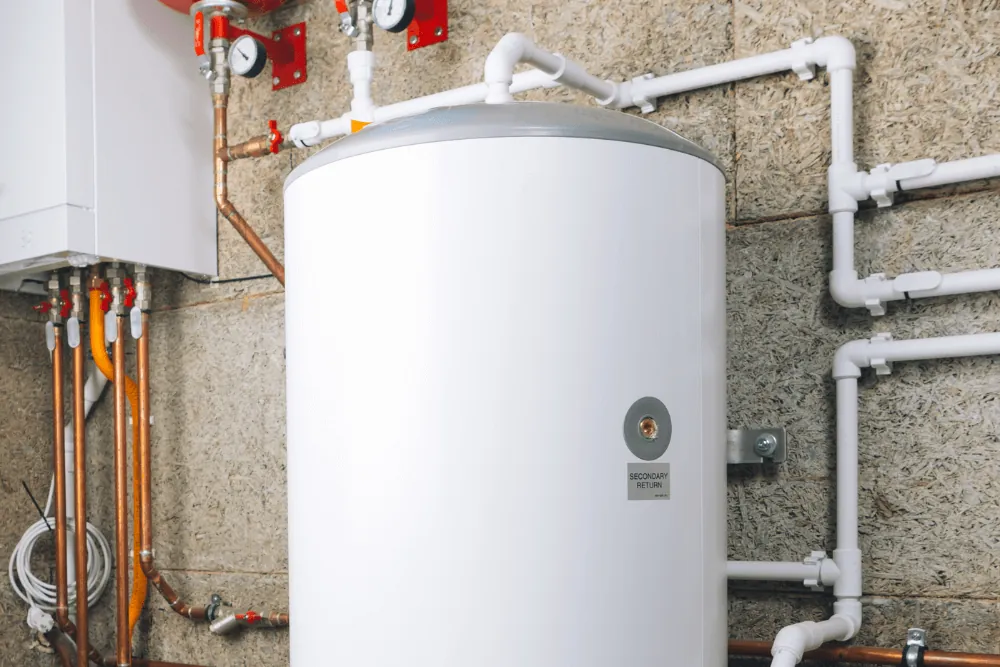
Solar water heater: why it will not get hot
A rooftop solar system has more places to fail than an electric tank, but the common faults are easy to rank.
- Backup element or thermostat. When the sun is weak, the backup does the work. If it has failed, you notice on the first cloudy or cool evening.
- Sensor or controller. The controller reads temperature sensors to run the circulation pump. A drifting sensor can stop the pump while the collectors are hot.
- Circulation pump. In pumped systems, a worn pump or an airlock stops heat moving to the tank.
- Scaled or leaking collectors. Scale in the tubes cuts heat transfer, and a corroded joint on a roof leaks into the ceiling below.
- Tank and pipe insulation. Damaged lagging on rooftop pipes loses heat overnight, so the tank is cold in the morning even though it was hot at dusk.
A system that overheats in summer has the opposite problem. Check that the pressure relief valve has not been blocked and that the controller is not turning the pump off while the collectors are at peak temperature. We work on the roof only when it is safe and with proper access. See also our solar water heater page.
Heaters in ceiling voids
A heater may sit in the false ceiling above the bathroom. It is out of sight, so a slow leak can run before a stain appears.
What this means for a repair:
- Access is the job. We need a ladder that clears the bathroom fittings, floor protection, and an access panel. If there is none, we explain what has to be opened before we begin.
- A leak above a ceiling needs two fixes. We stop the leak, then we check the ceiling board and insulation for water damage. Wet boards left in place can sag or grow mould.
- Replacement is harder than repair. The old tank is heavy and full of water. We drain it first and lower it safely.
- Ask your building. Some buildings need a notice or permission for ceiling work. Tell us what your building asks for and we work to it.
If you are installing a new heater, a drip tray with a drain line under it limits the damage if the tank ever fails. We can fit one during the work.
When faults show up in Dubai
A heater can fail in any month, but you tend to notice it when it matters. In summer, tap water from rooftop tanks is already warm, so a dead heater goes unnoticed. When the weather cools in winter, the same fault becomes a cold shower. Use the first cool week of the year as your yearly check: run a hot tap for a minute, see how long the water stays hot, and listen to the tank. A small problem found in October is a short visit. The same problem found in December is a cold morning and an emergency call.
Safe checks to make before you call
These checks give us a head start even if they do not fix it. Stay with what is listed here. Opening the heater's cover or touching its wiring is for a plumber or electrician.
- Check other power in the home. If the lights or sockets are off too, the problem is the building supply, not the heater.
- Look at the breaker for the heater. Look on the board for a switch labelled "water heater" or "geyser". If it is down, switch it back up once. If it drops again, leave it off and WhatsApp us.
- Find the isolator switch near the heater and make sure it is on.
- Check the thermostat dial, if you can reach it. Some units have an external dial.
- Run another hot tap. If one tap is cold and another is hot, the heater is fine and the fault is a mixer or a pipe. Tell us which tap.
Do not:
- Open the heater's electrical cover with the power on.
- Press the reset button repeatedly. If it trips again, something is wrong and each reset adds heat and stress.
- Drain a heater with the power on. The element can burn out when it is not covered with water.
- Block or cap the relief valve if it drips. That valve is the safety device. A dripping valve means we need to look at it, not stop it.
- Climb into a ceiling void to reach a heater. Use a stable ladder and, if the heater is above a false ceiling, let us do it.
Repair or replace? How we decide
Repair when:
- The fault is a part, such as an element, thermostat, relief valve, anode rod or pipe fitting, and the tank is sound.
- The tank is dry on the outside, with no stains or rust at the base.
- The repair costs clearly less than a new unit of the same size.
Replace when:
- The tank body or base is leaking.
- The heater is old and needs a major part.
- It keeps failing, with a new fault each time.
- The anode has failed and the inside of the tank shows heavy corrosion.
- The tank is too small for how your household now uses hot water.
We check the tank, the anode and the element, then tell you what we see.
| Situation | Our choice | Why |
|---|---|---|
| Burnt element, tank dry and sound | Repair | A part on a sound tank |
| Thermostat and element both failed | Compare both | Two parts plus labour against the price of a new unit |
| Leak at the base of the tank | Replace | A corroded shell cannot be repaired |
| Tripping the breaker with an earth fault | Test, then decide | An earth fault is a safety matter, so we test before any decision |
| Rooftop solar tank, no hot water | Repair first | The fault sits in a sensor, pump or backup element, which are parts |
| Under-sink instant heater, coil failed | Compare prices | The coil against the price of the unit |
If you do need a new unit, we install it. See water heater installation and replacement.
What happens when you book
- You tell us what is happening. Call, WhatsApp or use the form. Tell us the heater type if you know it, what the water does, and your area. A photo of the heater label helps: it shows the brand, model and size.
- We agree the visit. The visit fee is AED 50 + VAT and covers the visit and diagnosis. It is credited against the bill if you go ahead with the repair.
- The plumber diagnoses the fault. We test the supply, thermostat, element and safety devices before we name a cause. We do not guess.
- You get the repair price before we start. We explain the fault in plain words, show you the failed part where we can, and quote the repair. You say yes or no.
- We repair and test. After the repair we check the water temperature at the heater and at the tap, check for leaks under pressure, and test the safety cut-out and relief valve.
- We clean up and give you advice. We leave the area tidy and tell you what caused the fault and what to do to prevent it. You get a receipt.
Ceiling-mounted heaters take longer because access is slower. If a part is not on the van, we tell you straight away and book the earliest return visit.
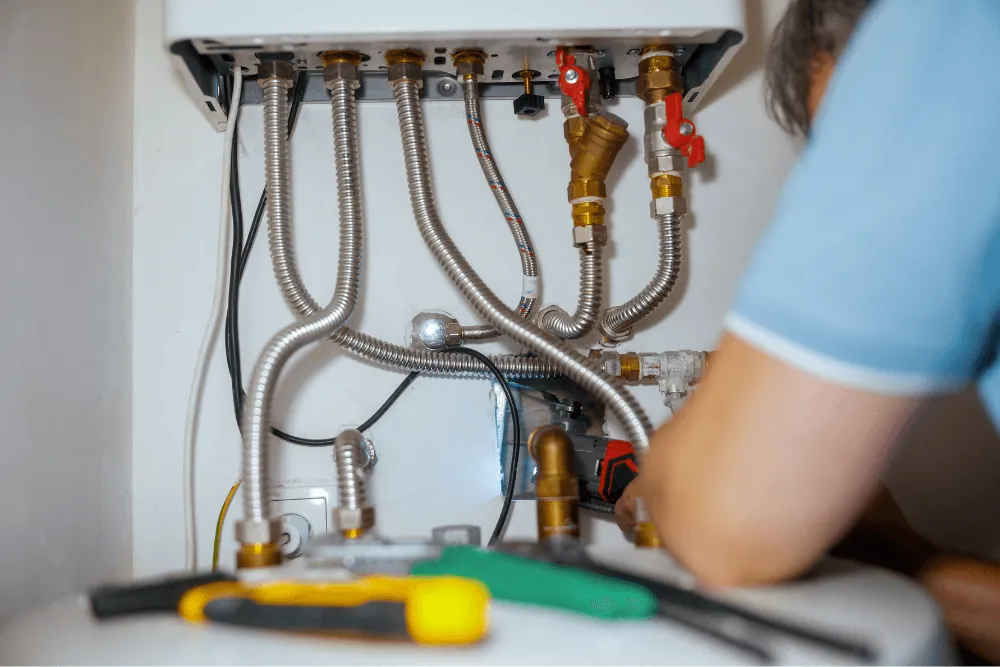
How much does water heater repair cost in Dubai?
We give a fixed price before any work starts. We do not publish a single figure for repair because the range is wide, from a ten-minute washer swap to replacing an element in a hard-to-reach ceiling void.
These are the factors that move the price:
- The part. A relief valve or washer costs little. An element or thermostat costs more. A part for an older model can be hard to find.
- Access. A heater on a bathroom wall is easy to reach. A heater in a false ceiling needs ladders, protection for your bathroom, and sometimes an access panel cut or reopened.
- Heater size and type. A 30-litre unit and a 100-litre unit use different parts. Tankless and solar systems take longer to diagnose.
- How many faults. One failed element is a simple job. A heater with a bad element, a bad thermostat and a leaking relief valve is three repairs.
- Electrical work. A fault in the circuit or the isolator adds to the job. Our own electricians handle it.
We do not publish a starting price for this job. Send a photo on WhatsApp and we give you a fixed price before we start. Prices exclude 5% VAT. If we find more faults once the heater is open, we stop and ask you first.
Keep your heater working longer
Flush the tank at least once a year
Sediment settles at the bottom of the tank, covers the lower element and traps heat. That makes the element work harder and shortens its life. Most tank heaters need flushing at least once a year, more often where the water scales heavily. Flush with the power off and the cold feed shut, or ask a plumber.
Check the anode rod yearly
The anode rod is consumed instead of the tank wall. Once it is used up, the steel starts to rust. Checking it takes a few minutes and a replacement costs far less than a new tank. Leave room around the heater so the anode can be reached.
Test the relief valve
The temperature and pressure relief valve protects the tank. Lifting the lever should release a short burst of water. If nothing comes out, or if it will not seat afterwards, it needs replacing. Do this only if the valve is easy to reach and the discharge pipe runs somewhere safe.
Choose the thermostat setting
Set a storage heater to about 60°C, which limits bacterial growth in the tank, and fit a mixing valve or take care at the taps, because water at 60°C scalds. If children or elderly people use the taps, a lower setting with a mixing valve is safer. We check the setting with a thermometer at the tap and not by the dial.
Add a softener or filter where scale is heavy
Scale builds wherever water is heated, and the amount depends on your supply. If elements keep burning out, or you see white crust on taps and showerheads, a water softener or a scale filter on the heater feed is worth considering.
Renting in Dubai? Who pays for the repair?
Who pays is settled between you and your landlord, and your tenancy contract is the first place to look. Check it and ask your landlord or property manager before you book.
A few practical points:
- Tell your landlord first when the heater is old, leaking from the tank or needs replacement. A breakdown repair is usually raised with the landlord first.
- Ask for approval in writing if you need it. A WhatsApp message with a photo and our quote works for most landlords.
- Keep the invoice from us. It shows what failed and what was done.
- Building management may need notice for work in shared ceiling voids or risers. Tell us what your building asks for and we work to it.
We will send the written diagnosis your landlord or property manager asks for.
Where we repair water heaters in Dubai
We cover all of Dubai, including Dubai Marina, JBR, Downtown Dubai, Business Bay, Jumeirah Lakes Towers, Palm Jumeirah, Al Barsha, Jumeirah Village Circle, Dubai Hills, Mirdif and Deira. See the full list of areas.
Emergency water heater repair
A heater that is leaking onto a ceiling, a breaker that keeps tripping, or water that is dangerously hot cannot wait for the next day. We answer calls and send a plumber 24 hours a day, 7 days a week, and we do not promise an arrival time.
In an emergency:
- Switch the heater off at the isolator or breaker.
- Close the cold water valve feeding the heater. If you cannot find it, close the main water valve.
- Call or WhatsApp us with a photo.
Our emergency plumber page covers other urgent problems.
Water heater repair FAQs
Can I reset the heater myself?
Check the breaker and the isolator first, and press the thermostat's reset button once if your manual shows one. If it trips again, leave it off and call, because each reset adds heat and stress to a heater that has a fault. Do not open the electrical cover with the power on.
Could a wrong setting be the fault?
Yes. A dial turned down or a thermostat that has drifted looks like a weak heater. Check the setting first, using the guide on our water heater thermostat page, and if the water is still not hot, message us.
Who pays for a heater repair in a rented flat?
That is settled between you and your landlord, and your contract is the place to look. Tell the landlord in writing before you book.
Is my heater still under warranty?
Check before anyone opens it. Warranty terms differ by maker and model, and an unapproved repair can affect cover. Look for the date code on the label, ask your landlord or the shop that sold it, and tell us if a warranty may apply. We tell you what we find on the heater and the label.
Can I use the hot water in the meantime?
Not if the heater is leaking, tripping the breaker or running dangerously hot. Isolate it and heat water another way. Lukewarm water or water that runs out quickly does not by itself involve a leak or a tripping breaker, but have it looked at.
Do I need to be home during the repair?
Someone should be there to give access and approve the quote. If you are renting, a property manager or a trusted person can stand in. Tell us if the heater is in a ceiling void so we bring the right ladder and cover.
My heater is in the ceiling. Is that a problem?
It makes the job slower, not impossible. We need a safe opening, a floor cover in the bathroom, and room to lift the unit if it must be replaced. If there is no access panel, we tell you before we cut one. Ask your building management whether ceiling work needs notice.
Can you move or relocate a water heater?
Yes. A move involves new pipe runs and an electrical connection, which is installation work. See water heater installation.
Which brands do you repair?
We repair the common makes of electric storage and instant heaters. Send the make and model on WhatsApp and we confirm before the visit.
Do you repair gas water heaters?
No. We do not do gas work. We repair electric, solar and heat pump heaters, and the water-side plumbing of boilers.
Do you guarantee repairs?
Yes. We give a 30-day workmanship warranty on our labour. Parts carry the manufacturer's warranty only.
How much does a water heater repair cost?
The price follows the part, the access and the number of faults. We do not publish a starting price for this job. Send a photo of the heater and its label on WhatsApp and we give you a fixed price before we start. Prices exclude 5% VAT.
Book your water heater repair
Tell us what the heater is doing and we will send a plumber.
WhatsApp: +971 55 407 7427 · Request a quote
Visit us: Office 871, Oasis Mall, Al Quoz 1, Dubai, UAE
Related services: Water heater installation · Element and thermostat replacement · Leak detection · Emergency plumber