
Water filters in Dubai: what we do
- Whole-house and main-line filters. Wide housings on the supply. See whole-house water filters.
- Under-sink and sink filters. Carbon and sediment units on the kitchen cold line, with their own tap or a connection to the existing one. The steps are below, and the sink work is on our kitchen sink page.
- Drinking water purifiers. RO units, with or without UV. See RO and drinking water purifiers.
- Hard water. A filter does not soften. See water softeners and hard water.
- Testing before choosing. See water quality testing.
- Cartridge, lamp and housing service. Replacing what has reached its limit.
- Supplying the filter. We supply and fit, and we also fit items you have bought.
Which filter does which job
A filter removes what its medium catches. The table matches each job to the filter that does it.
| You want to remove | The filter that does it | What it does not do | Where to read |
|---|---|---|---|
| Sand, silt, rust flakes, tank debris | A sediment cartridge, spun or pleated | Take out chlorine or taste, which is carbon's job | Whole-house filters |
| Chlorine, taste and smell | A carbon cartridge, block or granular | Touch hardness | The sections below |
| Hardness (limescale) | A softener, or a scale device. A filter is not one | Softeners | |
| Dissolved salts and a high TDS | Reverse osmosis | RO purifiers | |
| Microbes | UV, with a unit that has a sensor and alarm | Clear a cloudy supply, and leave no residual in the pipes | The UV section below |
Between the main and your tap the water passes a tank, a pump and the building's pipes, so a test taken at your own tap, and not a figure for the supply, shows what a filter has to deal with. A test comes before the purchase.
Reading a filter's claim: certification
A claim on a box is not a certificate. Filters can be independently certified for a particular job, such as taste and odour, a named health contaminant, UV disinfection or reverse osmosis, and the job decides what the certificate means. A filter certified for chlorine taste and smell is not certified for a health contaminant, and a shower filter is normally certified for chlorine reduction only. Certification does not mean that a filter, purifier or treatment system will reduce all possible contaminants.
- Ask for the certificate number, and check the exact model with the certifying body, because a certificate belongs to one model.
- Read the partial claim. A filter certified for chlorine is not certified for chloramines unless it says so.
Wordings such as "tested to", "meets" or "based on" a standard are weaker than a certificate. Ask the seller for the standard number first, and check it.
Cartridge and housing sizes decoded
Cartridges are sold by diameter and length, and the names hide how different they are. The common lengths are 10 and 20 inches, and the common diameters are a slim 2.5 inch and a wide 4.5 inch. A 20 inch cartridge holds about twice as much media as a 10 inch one in the same diameter, and a wide one holds about three times as much as a slim one of the same length. A real cartridge has a hollow core, so these are comparisons and not capacity. What they show is that the price of a cartridge should be read against its size before it is read against its micron rating, and that a wide 20 inch cartridge lasts far longer than a slim 10 inch one on the same water.
What a housing is rated for
A housing has its own pressure and temperature limits, separate from the cartridge in it. Most are for cold water only, and the ratings differ between a slim under-sink housing and a wide whole-house one. A rating belongs to one housing and one wall thickness, so the number that counts is the one on the data sheet for the housing in your hand, and a seller who cannot produce it has not answered the question.
Good practice for any housing is to stay well below its pressure limit, to use a pressure-limiting valve where the supply is strong, to use cold water only and not on hot lines, and to have microbiologically safe water or disinfect it first.
Two checks follow:
- Pressure. A pump or a tank can lift the pressure at the filter, so put a gauge at the filter. Our pressure valves page covers a pressure-limiting valve, and our low water pressure page explains the gauge.
- Temperature. Put a thermometer in a glass at the filter's position on a summer afternoon before choosing, and put the filter on the cold main side and not near a heater's hot outlet. Our water heater page covers the hot side.
Which limit governs: months or litres
A cartridge carries two limits, a calendar one and a volume one, and the first to arrive ends its life.
- Calendar. Under-sink carbon cartridges are usually changed every six months, or sooner if the flow drops. Whole-house sediment cartridges are changed every three to six months, depending on how much grit the water carries.
- Volume. The rated litres divided by your daily use gives the days. A cartridge rated for 4,000 litres lasts 400 days at 10 litres a day.
Below a certain daily figure, the calendar ends the cartridge first. Above it, the litres do. An under-sink kit used only for drinking and cooking draws a few litres a day, so the calendar governs. A whole-house filter on a busy household can draw 2,000 litres a day or more, and the cartridge clogs with dirt well before its calendar limit, so the pressure drop and the flow govern. The daily figure is something a household can check by counting what it drinks and cooks with.
UV water filters: what ultraviolet does and does not do
UV is not a filter. It is a lamp behind a quartz sleeve that treats the water passing it, and it removes nothing. Some UV units are meant for clear well or surface water and carry a sensor and alarm, and others are supplemental, meant to polish treated mains water and not to disinfect water that is unsafe. What the label does not tell you:
- No residual. UV leaves no disinfectant in the water, so storage and distribution hygiene needs attention after the lamp. A tank and its pipes can recontaminate treated water, which is why our water tank cleaning page matters upstream.
- Clear water. UV needs clear water, and a fine pre-filter ahead of it. UV does not make cloudy water safe.
- The right unit. Pond and fish-tank UV units are not safe for drinking water.
- Scale. Scale on the quartz sleeve cuts the light that gets through. Water that leaves limescale on a kettle can leave it on the sleeve, so a sleeve needs inspecting, and a softener or scale control upstream protects it.
- The lamp. Output falls over the first year while the lamp still lights, so a lit lamp proves nothing. We recommend a UV intensity monitor with an alarm.
For a Dubai home on the municipal supply, a UV unit is an optional extra after the tank and the filters. For a borehole or well, our borehole pump page covers the water source, a test comes first, and a unit with a sensor and alarm is the one to choose.
Installing a sink filter: the steps and what to check
The sequence for an under-sink filter follows.
- Shut the supply and release the pressure. Close the valve under the sink, then open the cold tap to drain what is left.
- Connect to the cold supply. The kit's adapter goes onto the shutoff valve with plumber's tape. Push-fit tubing joins the filter. Use PTFE tape on plastic fittings only, and put the unit on the cold water only.
- Mount the housing level and where the cartridge can be reached. Leave at least 5 cm of clear space below it for the cartridge change.
- Fit the tap. A filter with its own tap needs a separate faucet hole. On a four-hole sink you may give up the spray hose or the soap dispenser.
- Flush before drinking. Run water through the new cartridge as the maker instructs, often several litres over a few minutes, to clear carbon dust.
- Check for leaks at every joint, now and again after an hour and after a day.
Before buying, check the kit against the sink. If that valve does not close fully, the job becomes a plumbing repair first, and the filter second. The sink side is on our kitchen sink page, and the valves are on our valves page.
Other filters in a Dubai home: jugs, appliances, showers, pools and gardens
Not every filter needs a plumber, and not every filter belongs on this page. This section says what each other kind does and where to read more.
- Jugs. A jug needs no installation. Compare the cartridge's calendar limit with how fast the household drinks, and read the TDS of your tap: a jug does not lower dissolved salts.
- Washing machine and dishwasher inlet filters. A small screen sits in the inlet hose or valve. The cleaning steps are on our washing machine plumbing page.
- Shower filters. Certification for them covers free chlorine reduction only. A shower filter that lists limescale or heavy metals is making a claim outside that certification. See shower installation.
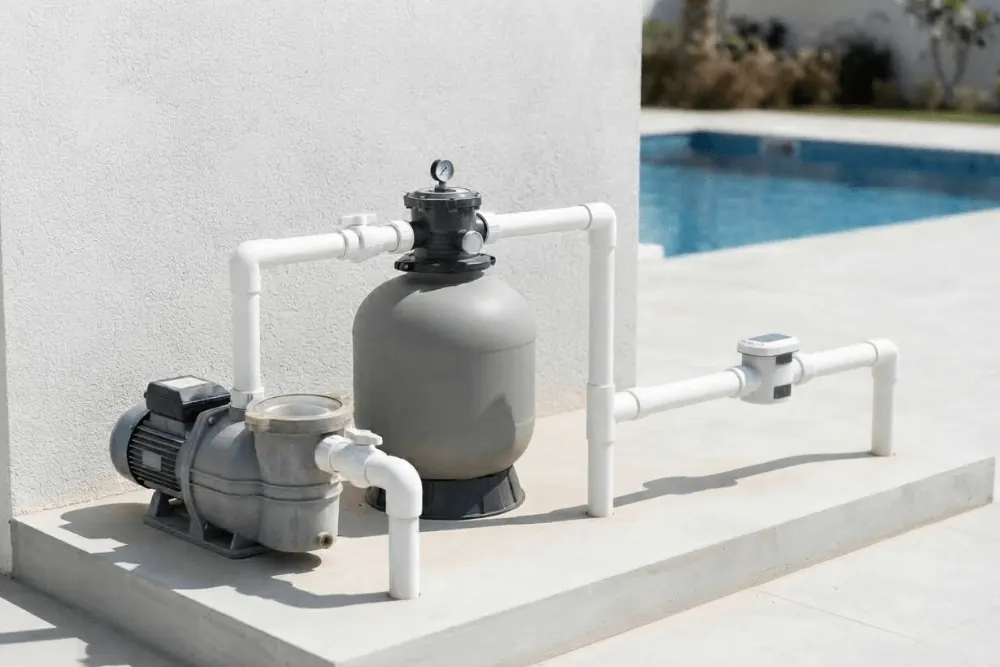
- Pool filters. A pool's sand or cartridge filter is part of its circulation system and is covered on our pool plumbing page.
- Irrigation filters. A screen or disc filter protects emitters from grit, and it is covered on our irrigation page.
- Hot and cold dispensers. The filter inside a dispenser follows the dispenser's own manual. Our no hot water page covers the dispenser faults.
- Well and borehole water. Test first. UV needs clear water and a fine pre-filter, and the UV section above sets the class that matters.
Tank water and mains water: what each needs
Many Dubai buildings store water in a tank and pump it up to the units, so the water at your tap may have sat in a tank and passed through a pump and a riser. Tank water can carry sediment, a taste from the tank itself and, in a tank that has not been cleaned, biological growth. A sediment stage before a carbon stage protects the carbon from clogging. Water straight from the mains is cleaner on arrival, but a villa's own tank and pump put it back into the same position. Whatever the source, a test at your own tap shows more than a figure for the supply. A filter does not replace a clean tank, and when the problem is the tank, cleaning it is the cure. See water tank cleaning.
What to ask before you buy an under-sink filter
Before you buy, check the kit against the sink. Is there room under the sink for the housing and for the clearance needed to change the cartridge? Does the isolation valve under the sink close fully? Does the kit come with its own tap, and is there a hole for it? What is the cartridge, how long does it last, and what does it cost to replace? Does it carry a certificate for what you want it to do, and can the seller give you the number? A filter bought without these answers is often returned or left unfitted, and we are glad to check a box or a photo before you order.
Flushing and sanitising a new filter
A new cartridge carries carbon dust and, in some models, a little preservative from the factory. Flush it for the time the maker states before the first drink, and discard that water. A housing that has stood unused for weeks or a cartridge that has been wet for months should be treated as old, because bacteria can grow in the damp media. When a filter is serviced, we wash the housing with clean water, check the seal and the o-ring, and flush the new cartridge. We do not use strong chemicals in a housing that is meant for drinking water.
A leaking filter housing
Most housing leaks come from the seal after a cartridge change. The o-ring may be flat, dry, pinched or missing, the housing may have been overtightened or cross-threaded, or the cartridge may sit crooked so the housing cannot seat. A weep at the inlet or outlet fitting is a thread or tape fault. We close the isolation valves, release the pressure, take the housing off and check the seal, the groove and the thread, and refit with a lubricated seal and a hand-tight turn. A housing that is cracked is replaced, because a cracked housing under pressure can fail without warning. A filter that leaks repeatedly near the same seal has the wrong seal, or a pressure that is too high for it.
What a filter costs to run over a year
A filter's price is a small part of what it costs over several years. Add the cartridges you will use in a year, the time or the call-out to change them, and the effect on pressure if the filter is fine. A cheap filter with dear, short-life cartridges costs more over three years than a larger one with long-life cartridges. We write the yearly cartridge cost beside the purchase price on the quote, so you can compare options on the cost of owning them.
Why the order of stages matters
Stages are fitted coarse first, then fine. A sediment cartridge goes first because it catches grit, rust flakes and tank debris, which would otherwise clog a carbon cartridge within weeks. The carbon stage follows and takes out chlorine, taste and smell. A reverse osmosis unit or a UV lamp, where one is fitted, comes after both. Fitting them in the wrong order shortens the life of the finer stages and costs more in cartridges. When a filter set is added to over time, we check the order and move a stage if it is in the wrong place.
Where a filter goes in a flat
A flat often has no accessible main line, so the practical places are the kitchen sink cabinet and the shower. We look for room to open the housing, a drain or tray below in case of a drip, and a valve either side. If the filter goes inside a closed cabinet with no isolation valves, the cartridge will not be changed and the filter will fail slowly. A small leak sensor under the filter, which sounds an alarm if water reaches the cabinet floor, is a sensible addition in a rented flat where a leak would reach the neighbour below.
Permission in Dubai: who decides on a filter
A filter on the main line changes the building's pipework and adds a pressure drop, so in a flat the building and the landlord have a say. An under-sink filter sits inside your own unit, but it still cuts into the cold line. We ask before we book.
In practice: in a rented flat, get the landlord's written approval before a filter is fitted to the main line, and tell building management. For a sink filter, ask the landlord before it is fitted, because the cold line is cut or tapped. Tell us what your building asks for and we work to it.
Warranty and the handover
What you should have when a filter job is finished:
- A written note of every part fitted: make, model, housing size, cartridge sizes and part numbers, and the housing's stated pressure and temperature limits.
- The change dates, twice. The calendar date from the cartridge's manual and the date on which the volume limit arrives at your daily use, with the first one to come marked.
- The pressure reading at the filter, before and after, and the water temperature at the filter on the day.
- Photographs of the connections and the isolation valves before the cabinet is closed or the housing is boxed in.
- A flush record, including the volume and time run through the filter before first use.
- FAM's workmanship warranty, in writing. The warranty runs for 30 days and covers our labour only. Parts carry the manufacturer's warranty only.
How we work
- You tell us what you want from the water on WhatsApp: the taste, the sediment, the scale or the worry, whether you own or rent, and a photograph of the filter, the box or the sink cabinet.
- We visit, measure the pressure and temperature at the filter's position, look at the water, and say which filter the problem calls for before proposing anything.
- We give options and a price in writing, with the cartridge sizes, the change dates and the yearly cartridge cost beside the purchase price.
- Check permission. In a rented or managed property, ask the landlord or building management whether they need to approve this work before the visit.
- We do the work, isolate the supply, fit and mount the unit, flush it and check every joint for leaks.
- We hand over the written note and photographs and show you where to isolate the filter and how to change the cartridge.
Where we work in Dubai
We cover all of Dubai, including Dubai Marina, JBR, Downtown Dubai, Business Bay, Jumeirah Lakes Towers, Palm Jumeirah, Al Barsha, Jumeirah Village Circle, Dubai Hills, Mirdif, Deira and Al Quoz. See the full list of areas.
Choosing a filter in four questions
Filters are sold with a lot of claims. These four questions get you to the right one.
- What do you want to remove? Sediment and sand, chlorine and taste, hardness, bacteria, or dissolved salts need different filters.
- What is your water like? Tank water, mains water and borehole water carry different problems. A test shows more than a guess. See water testing.
- Where will it go? One tap, the whole house, an appliance or a shower. Each needs a different size and fitting.
- How much will it cost to run? Cartridges, power, waste water and the time to change them. A cheap filter with dear cartridges is not cheap.
A fitting plan for a villa and for a flat
A villa can fit a filter on the incoming line from the tank or the mains, which protects every tap, appliance and heater. It suits a sediment filter first, then carbon, then any further stage. A flat often has no space or access to the main line, so a filter at the kitchen sink, plus a small one at the shower, is the practical choice.
Think about where the filter will sit. It needs room to be opened, a drain below in case of drips, and a shut-off valve on each side so the cartridge can be changed without closing the whole house. A filter hidden behind a cupboard wall with no valves is a filter that will not be changed.
Changing a cartridge
Cartridges lose their effect and then start to release what they have caught. They also grow bacteria if left in place too long.
- Close the valve before and after the housing.
- Release the pressure with the relief button, or open a tap downstream.
- Place a bucket and a cloth under the housing.
- Unscrew the housing with the wrench supplied, taking care with the seal.
- Remove the old cartridge, wash the housing and check the seal. A seal that is flat or cracked needs replacing.
- Fit the new cartridge, with the right way up, and check the seal sits properly.
- Screw the housing hand tight, and a little more with the wrench. Do not overtighten.
- Open the valve slowly, vent the air and check for leaks. Flush the new cartridge as the maker says.
Mark the date on the housing. Many leaks begin at the housing seal after a change.
What the signs of a tired filter are
- The flow drops, because the cartridge is clogged.
- The water tastes or smells of chlorine or of something stale.
- The cartridge is brown, black or slimy when removed.
- The housing sweats or leaks at the seal.
- The pressure gauge before and after the filter shows a larger gap than when new.
A cartridge that is past its date is not safe to leave in place, even if the water looks fine.
Keeping a simple filter log
A filter that nobody remembers is a filter that goes stale. Keep a short log on the inside of the cupboard door or on your phone: the date fitted, the cartridge type, the date it is due, and the date it was changed. Put the supplier and the part number beside it, so the next change takes a minute. If you rent, leave the log in the cupboard when you move out. If you manage several properties, keep one sheet for all of them. A log also shows when a cartridge is clogging sooner than it should, which points to a change in the water, a problem in the tank or a pump fault upstream. Tell us when the interval changes, and we look at the cause.
How much does a water filter cost in Dubai?
Two prices make up the bill: the filter and the work.
- The filter. Prices vary widely by brand, housing size and number of stages, and they change. Ask any seller for the price excluding VAT and for the cartridge price at the same time.
- The work. Isolating the supply, mounting, connecting, flushing and testing.
- The cartridges. They are the running cost. A wide 20 inch cartridge holds far more than a slim 10 inch one, and the change dates fix how often you pay. Ask for the cartridge price before you buy the filter.
- What moves the price. The filter size and number of stages, the access, whether the job is a new fitting or a replacement, and whether a pump or a pressure valve is needed.
We do not publish a starting price for this job. Send a photo on WhatsApp and we give you a fixed price before we start. Prices exclude 5% VAT.
Water filter FAQs
Which water filter should I get for my home in Dubai?
The one that matches your problem, found by a test and not by a brand. Sediment at every tap points to a whole-house sediment stage. A chlorine taste points to carbon at the kitchen tap. The job table near the top of this page matches each problem to its filter, and the water testing page says how to get the reading.
Does a water filter remove limescale?
A carbon or sediment filter does not touch hardness. Limescale needs a softener or a scale device. See water softeners and hard water.
What does "certified" mean on a filter?
It means the product was independently tested for one particular job, such as taste and chlorine, a named health contaminant, UV or RO. Certification does not mean the filter reduces all possible contaminants. Ask the seller for the certificate number and check the exact model with the certifying body. "Tested to" and "meets" are weaker wordings.
Which cartridge size do I need?
Cartridges come in 10 and 20 inch lengths and in slim and wide diameters. A 20 inch cartridge holds about twice the media of a 10 inch one in the same diameter. Which you need follows from the flow, the space and the change schedule, and we size it on the visit.
How often should I change a filter cartridge?
Whichever limit arrives first, the calendar or the litres. Under-sink carbon cartridges are usually changed every six months, and whole-house sediment cartridges every three to six months. A drop in flow or a return of the taste is a reason to change early.
Does a UV filter make water safe to drink?
Not by itself. UV is a lamp and not a filter. It needs clear water, leaves no residual in the pipes, and lamp output falls over the first year while the lamp still lights. A unit with a sensor and alarm is the one to choose for well or borehole water, and the water needs testing first.
Is a filter jug enough for Dubai tap water?
Whether it is enough turns on what you want removed. A carbon jug reduces chlorine taste and smell, and it does not lower dissolved salts or soften water. A jug needs no plumber, and its cartridge has a calendar limit that you set against how fast the household drinks.
Can a water filter go on a hot water line?
Not usually. Most housings are rated for cold water only. Water from a roof tank can run hot in summer, so measure at the filter and check the data sheet. Our water heater page covers the hot side.
Can you install a filter I bought online?
Send us a photograph of the box, the contents laid out and the sink cabinet. We tell you what is missing before we start.
Will a filter reduce my water pressure?
Any cartridge adds resistance, and a clogged one adds more. Measure the pressure with a gauge before and after the filter. If the drop is large, see our low water pressure page.
Book a water filter installation or service in Dubai
Tell us what you want from the water, whether you own or rent, and send a photograph of the filter, the box or the sink cabinet. If you have a TDS reading or a test result, send that too. We will find the right filter for the problem, give you the options and a price in writing, do the work and hand over a note.
WhatsApp: +971 55 407 7427 · Request a quote
Visit us: Office 871, Oasis Mall, Al Quoz 1, Dubai, UAE
Related services: Whole-house water filters · RO and drinking water purifiers · Water softeners · Water testing · Water smell and discolouration · Kitchen sinks · Low water pressure · Water tank cleaning · Emergency plumber