
RO water purifier installation and service in Dubai: what we do
- New installation. An under-sink unit with its storage tank, drinking-water faucet, feed connection and drain.
- Replacement. Taking out an old unit and fitting a new one in the same position.
- Filter and membrane changes. Pre-filters, post-filter, membrane and UV lamp, with the unit sanitised and tested afterwards.
- Repair. Leaks, constant draining, slow flow, low tank volume, bad taste, noise and faulty pumps.
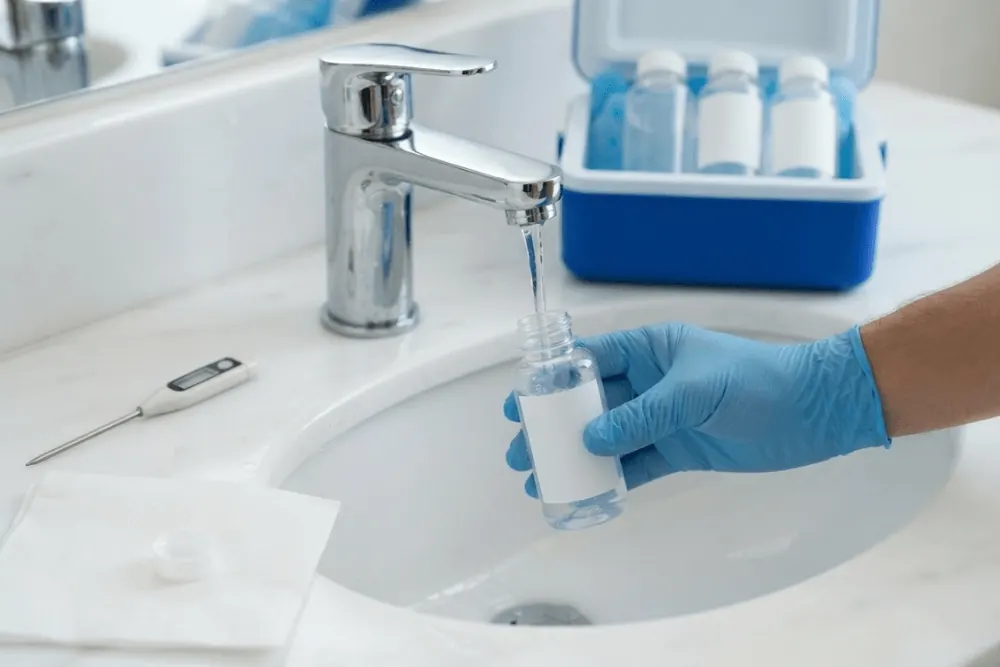
- Water testing. Dissolved-solids readings at the tap and at the purifier, before and after.
- Moving a unit. Disconnecting and refitting a purifier when you change kitchen or move home.
- Extra connections. A line to the fridge or ice maker, where the unit can supply it.
Related problems are on other pages. A whole-property filter for sediment and chlorine is on our whole-house water filter page. Scale and hard water are on our water softener page. Tank cleaning is on our water tank cleaning page.
What an RO purifier does, and what it does not
Reverse osmosis pushes water through a semipermeable membrane at pressure. Most dissolved solids stay behind and go to the drain, and the treated water goes to a storage tank. It is the right tool for reducing dissolved solids in drinking and cooking water. It is not a tool for the whole property, and it is not a disinfectant.
| Question | What an RO purifier does |
|---|---|
| Reduces dissolved salts and minerals? | Yes. This is its main job |
| Reduces chlorine taste and smell? | Yes, through its carbon stages |
| Removes sediment? | A sediment pre-filter handles that before the membrane |
| Treats the whole property? | No. It serves one drinking tap, and sometimes the fridge |
| Softens water for showers and heaters? | No. See water softeners |
| Wastes water? | Yes. Some water goes to the drain. See the section on drain water below |
An RO unit improves what comes out of one tap. It does not repair a dirty tank or a failing pipe. If the supply into your home has a problem, the first fix is at the tank or the main line, and RO is the finishing stage.
Do you need one in Dubai?
Water arrives treated, but after the meter the pipes and tanks inside the property belong to the owner, so the last stretch of water quality is in your hands.
That leaves three reasons to fit an RO unit.
- Taste. You find the tap water flat, salty or chlorinated, and you want a cleaner taste for drinking, tea and coffee.
- Appliances. A coffee machine, ice maker or kettle that suffers from dissolved solids gets cleaner water from a purifier.
- Control. You want a measured reduction in dissolved solids at the tap, with a filter schedule you can see, instead of relying on bottled water or a dispenser.
Two reasons do not hold up. An RO unit does not fix a tank that has gone unclean, and it does not stop scale in the shower or the heater. Where those are the real complaints, start with tank cleaning or a softener.
Check before you buy
- Dissolved-solids reading. A handheld meter gives a total dissolved solids (TDS) figure in parts per million. It tells you how much is dissolved. It tells you nothing about bacteria, so a low reading does not mean safe.
- Water quality test. If you want bacteria, hardness and chlorine checked, see our water quality testing page.
- Tank history. When was the tank last cleaned? If you do not know, ask building management or arrange a cleaning before spending on a purifier.
How an RO system works, stage by stage
A typical under-sink unit has four roles. The number of cartridges varies by brand, but the jobs are the same.
| Stage | Job | What happens if it is neglected |
|---|---|---|
| Sediment pre-filter | Catches particles before they reach the membrane | The membrane clogs sooner and flow falls |
| RO membrane | Rejects most dissolved solids | TDS rises and output falls |
| Storage tank | Holds treated water, since the membrane produces slowly | Not a filter stage. Water sits in it, so it needs sanitising |
| Carbon post-filter | Polishes taste and odour picked up in the tank | Taste goes stale |
Optional extras are a remineralisation cartridge that adds minerals back, a UV lamp for extra protection and a booster pump for low feed pressure.
Why there is a tank
A membrane makes treated water slowly. The tank fills while nobody is using the tap, so water arrives at a normal rate when you open it.
Types of RO unit
| Type | How it works | Suits |
|---|---|---|
| Under-sink with tank | Plumbed to the cold supply and drain, with a dedicated faucet | Kitchens with cabinet space under the sink |
| Under-sink with pump | A pump raises the pressure on the membrane. Suits low feed pressure | Properties with weak pressure at the kitchen |
| Commercial | Larger flow and more stages in some models | Cafes, restaurants, clinics, offices |
If feed pressure at your kitchen is weak, solve that first. A unit with a built-in pump or a booster pump is worth considering when the pressure at the kitchen tap is weak. See our low water pressure and booster pump pages.
Drain water, efficiency and running costs
Every RO unit sends part of the incoming water to the drain. How much depends on the design.
- Waste. Many RO systems send about three to four litres to drain for every litre of treated water, because only part of the feed passes through the membrane.
- The efficiency figure. Efficiency is the share of the incoming water that becomes drinking water. A unit that turns 30 percent of the feed into drinking water wastes about 2.3 litres per litre produced, and one at 25 percent wastes 3 litres. Units with a permeate pump or a more efficient design waste less.
Ask any seller for the waste ratio of the exact model. It is part of the running cost, and a unit that wastes less costs less to run. Some of the drain water can be used for plants or cleaning, if you want to collect it.
The drain connection matters as much as the number. The drain line must connect to the sink waste with a proper fitting and an air gap or an equivalent arrangement, so that dirty drain water can never flow back into the treated water. See our drain unblocking page if the kitchen waste is slow.
Taste, minerals and remineralisation
RO removes most dissolved solids, which includes the calcium and magnesium that give water some of its taste. People describe RO water as flat. Most of the minerals we need come from food, so remineralisation is mostly a matter of taste. A remineralisation stage adds minerals back and reduces the flat taste.
Our position is practical. A remineralisation cartridge is an option for people who dislike the taste, and it is not a medical necessity. We fit one if you ask for it. If you drink RO water as your only water, keep a varied diet and ask your doctor if you have a specific health condition.
Reading a TDS meter properly
A handheld TDS meter is the quickest way to see what the unit is doing, and the easiest to misread. It shows total dissolved solids in parts per million, which is the same as milligrams per litre.
- What it measures. Most handheld meters read electrical conductivity and convert it to a TDS number. They cannot tell harmless calcium from a harmful metal, and they say nothing about bacteria. A low reading means little is dissolved, not that the water is safe.
- What the number is for. Comparing tap water with RO water at the same visit shows how well the membrane is rejecting.
- How to take a fair reading. Run the tap for about 30 seconds first, so the sample is fresh from the line. Rinse the probe in the water you are about to test. Take the tap reading and the RO reading in the same session.
- What to record. The date, the tap reading, the RO reading and the rejection rate. A single reading means little, and a trend over a year tells you when the membrane is wearing.
A rising RO reading with the same tap reading means the membrane is losing performance. A rising RO reading with a rising tap reading means the supply changed. Because tank water can change after a cleaning or a refill, we always take both.
RO compared with other ways to get drinking water
| Option | Reduces dissolved solids? | Plumbing? | What you maintain |
|---|---|---|---|
| Under-sink RO | Yes | Yes. Feed, drain and a faucet | Filters, membrane, tank, yearly sanitise |
| Carbon jug or tap-mounted filter | No. Carbon improves taste and smell but does not remove dissolved salts | None or a tap fitting | Cartridge changes |
| Whole-house sediment and carbon filter | No | On the main line | Cartridges. See whole-house filters |
| Bottled water and dispensers | Depends on the product. Read the label | None | Deliveries, storage and dispenser cleaning |
An RO unit also pairs with the other options. A whole-house filter protects pipes and appliances, and RO at the kitchen tap treats the water you drink. A softener deals with scale, not taste. We tell you which of the three the problem needs.
Sizing and where the unit goes
Under-sink RO is sized by tank volume and refill time, not by a headline daily output figure. Ask three things: how much treated water do you draw at the busiest time, how long does the tank take to refill, and how does the unit perform at your feed pressure?
- Tank volume. Several glasses, a kettle and a pot of rice at once should not empty it. A bigger household needs a bigger tank, or two.
- Refill time. Low feed pressure slows production and lengthens the refill.
- Cabinet space. The housings, the tank and the pipework need room, and the cartridges need clearance underneath to be changed.
Where the parts go
| Part | Position |
|---|---|
| Feed connection | Tee into the cold supply under the sink, with its own isolation valve |
| Drain connection | A drain saddle or fitting on the sink waste, with an air gap or equivalent |
| Dedicated faucet | A separate drinking faucet on the sink or countertop. This needs a hole, so renters should check first |
| Storage tank | Under the sink or in an adjacent cabinet, upright, with its valve accessible |
| Pump and power | Near a socket protected from water, if a pump or UV lamp is fitted |
| Fridge line | A tee on the treated-water line to the fridge or ice maker, with a shut-off valve |
Installation steps
- Check the space, the feed pressure and the drain.
- Mount the housings on the cabinet wall with room below for cartridge changes.
- Close the cold supply to the sink and fit the feed tee with an isolation valve.
- Fit the drain saddle on the sink waste and connect the drain line with an air gap.
- Install the faucet, drilling the sink or countertop where needed.
- Connect the tubing from the feed to the pre-filters, the membrane, the tank and the faucet. Cut tubing square and push it fully home.
- Check the tank air charge. An empty RO tank holds a small air charge, much lower than a house tank. The manufacturer's figure takes priority.
- Open the feed slowly and check every joint for drips.
- Flush. Run the unit to drain before drinking. We discard the first tankful and tell you to do the same.
- Test. Take a TDS reading at the kitchen tap and at the RO faucet. Check the tank refills, and the unit stops draining when the tank is full.
- Sanitise per the manufacturer's instructions.
- Hand over. We show you the isolation valve, the tank valve, the filter order and the first change date.
Servicing: filters, membrane and sanitising
An RO unit needs three kinds of attention: cartridge changes, a sanitise and a performance check. The intervals below are typical starting points. Heavy use, weak feed pressure or poor feed water shorten them, and your unit's manual takes priority.
| Part | Typical interval | Notes |
|---|---|---|
| Sediment pre-filter | About every 6 months | Sooner if the water carries visible grit |
| Carbon pre-filter | About every 6 months | Protects the membrane from chlorine |
| RO membrane | About every 2 to 3 years, or when the rejection rate falls | Judge by readings, not the calendar |
| Carbon post-filter | About every 12 months | Keeps the taste fresh |
| Tank air charge | Check at each filter change, with the tank empty | Set to the maker's figure |
| Sanitising | Once a year | Best done at a filter change |
| UV lamp, if fitted | Per the manufacturer, often yearly | Check the unit's manual |
The calendar is only the starting point. The readings decide.
The membrane check: rejection rate
The rejection rate shows how well the membrane is working. For example, a tap reading of 300 ppm and an RO reading of 15 ppm gives (300 minus 15) divided by 300, which is 95 percent. The numbers are an example, not a measurement of Dubai water.
A new membrane typically rejects about 90 percent or more. When the rate falls below about 80 percent, it is time to replace the membrane. We take both readings at each visit and record them.
Why the pre-filters come first
The pre-filters protect the membrane. Exhausted carbon filters can let chlorine reach the membrane and damage it. A late pre-filter change therefore costs you a membrane, and a membrane is the most expensive part to replace. We change the pre-filters on schedule even when the water tastes fine.
How we service a unit
- Take the before readings: TDS at the tap, TDS at the RO faucet, tank pre-charge, flow.
- Close the feed and the tank valve and open the faucet to relieve pressure.
- Remove the old cartridges and note their condition.
- Clean the housings and check the O-rings. Replace any that are dry, flat or cracked.
- Sanitise the system per the manufacturer's instructions, then flush it thoroughly.
- Fit the new cartridges, in the correct order and direction.
- Reset the tank pre-charge with the tank empty if it is out of range.
- Open the feed slowly, check for leaks and flush to drain.
- Take the after readings and record the date and the figures.
Hygiene: the storage tank
The membrane blocks most bacteria. It is not certified as a disinfection method. Bacteria can grow in the storage tank. Yearly sanitising and on-time filter changes keep that in check. A unit that has sat unused for weeks should be flushed before you drink from it. If you are not sure the water going in is clean, add a UV stage and have the building tank cleaned. See our water tank cleaning page.
Before a holiday or a long absence
An RO tank holds water that sits while you are away. Bacteria can grow in the tank. Before you leave, you can close the feed isolation valve and the tank valve. When you return, open them and run the RO faucet to drain for a few minutes, then pour away the first tankful before you drink. If the unit has been unused for months, ask us to sanitise it first.
What to expect in the first week with a new unit
A new unit needs a little patience. The tank fills slowly the first time, often overnight, and the first tankful is poured away. The new faucet may sputter as air works out of the line. The water may taste different from what you are used to, and some people find it flat for a few days. Check the cabinet each day for the first week for any damp, and look at the drain line for drips. If the unit sounds like it is draining constantly, tell us on the first day and not the sixth, because a stuck valve wastes water and is easy to fix. We send you a reminder of the first filter date, and we leave a note on the cabinet door so the next person knows.
Fitting a purifier in a small Dubai kitchen
Many flats have a compact kitchen with a small sink cabinet, and the space under the sink is shared with the waste, the water heater connection and the cleaning products. A purifier needs room for three or four housings, a tank and tubing. In a small cabinet we can mount the housings on the side wall, put the tank in an adjacent cupboard or a utility space, and run the tubing neatly so nothing is crushed by the door. We look at the space first and tell you what fits. If it does not, a compact unit or a countertop model may be a better choice than forcing a larger one in. Leave room below the housings so the cartridges can be changed without taking the whole unit apart.
Keeping a record of your purifier
A short record is worth keeping: the date of installation, the make and model, the dates of each filter and membrane change, the readings you took and the name of whoever did the work. Stick a label inside the cabinet door with the next change dates. The record tells you whether the membrane is wearing sooner than it should and helps if you move house or sell the property. We write the details on a card when we finish a job, and you can send us a photo of it when you are due for a service.
RO purifier repair: symptoms and causes
| What you notice | Possible cause | The fix |
|---|---|---|
| Very slow flow at the RO faucet | Clogged pre-filters, a worn membrane, low feed pressure or a tank with the wrong pre-charge | Change filters, check the membrane, check the pressure and set the tank pre-charge |
| The tank has little water | The same causes, or a closed tank valve | Check the tank valve, the pre-charge and the refill time |
| The unit drains all the time | A faulty shut-off or check valve, or a membrane that is not building pressure | Replace the valve or the membrane |
| Water tastes of chlorine | An exhausted carbon pre-filter or post-filter | Replace the carbon stages and check the membrane for damage |
| Water tastes stale, flat or musty | Water sitting in the tank, a spent post-filter or an unsanitised system | Change the post-filter, sanitise and flush the tank |
| TDS reading is high | A worn membrane, a membrane seal leak or a bypass fault | Test rejection rate, replace the membrane or the seal |
| Leak under the sink | A loose fitting, a cracked housing, a worn O-ring or tubing not seated | Reseat or replace the part. See tap and sink leaks |
| Dripping from the air gap | A blocked drain line or a slow sink waste | Clear the line. See drain unblocking |
| Noisy gurgling during drain | The drain saddle position or the air gap | Reposition or replace the drain fitting |
| Pump runs but no water | A low-pressure switch fault, a clogged membrane or a failed pump | Test the switch and the pump |
| UV lamp light off or error | Lamp end of life or a power fault | Replace the lamp, check the power |
Clogged pre-filters cause or worsen several of these faults, which is why we check them first.
Before you call: checks you can make
- Look under the sink for water. A wet cabinet means a leak. Close the feed isolation valve and the tank valve, dry it and WhatsApp us.
- Check the valves. The feed valve and the tank valve should both be open. A closed tank valve makes a full tank feel empty.
- Check the tubing. Tubing should be pushed fully into each fitting, with no kinks.
- Check the power. If the unit has a pump or UV lamp, check the socket and the plug.
- Take a TDS reading at the RO faucet and at the kitchen tap, and tell us the numbers.
- Note the age of the filters. If you do not know when they were changed, say so. It narrows the cause.
If water is leaking
Close the feed isolation valve first, then the tank valve, then dry the cabinet. Do not use the unit until it has been checked. Water under a sink can reach the floor below in a flat, so act quickly.
What to ask any company before you buy an RO purifier
- What will it remove, and what will it not? The answer should include bacteria and viruses.
- What has it been tested for? Ask for the test report for the exact model, not the brand, and ask what the test measured.
- What is the waste ratio? And what is its efficiency rating?
- What feed pressure does it need? And what happens at the pressure in my kitchen?
- What are the filters and membrane, and what do they cost? The running cost matters as much as the install.
- Who changes them, and at what interval? Ask to see the record.
- Is there a UV stage and a remineralisation stage, and do I need them?
- What are the claims based on? Be wary of figures like "99.9 percent pure" with no test report, and of terms like "energised" or "structured" water that have no standard behind them.
- What does the guarantee cover?
A test report for the specific model tells you more than a logo.
Flats, villas and offices
- Rented flats. The faucet needs a hole in the sink or counter, and the drain saddle goes on the sink waste. Get your landlord's written agreement before drilling. A countertop unit avoids the issue.
- Villas. A villa may have the space for a larger unit, a pump or a second tap.
- Offices and shops. Higher use needs a bigger tank or a commercial unit, and a service schedule that fits opening hours.
- Cafes and restaurants. A food business depends on clean water at every tap, so the tank matters as much as the unit. See our water tank cleaning page.
What not to do
- Do not drink from a new unit before flushing it.
- Do not skip the pre-filter changes to save money. The membrane pays for it.
- Do not judge safety by TDS alone. A low reading says nothing about bacteria.
- Do not leave a unit unused for weeks and then drink from it without flushing.
- Do not run the drain line without an air gap.
- Do not drill a rented sink without written permission.
- Do not buy on claims such as "99.9 percent pure" with no test report.
- Do not fit RO before fixing a dirty tank.
- Do not ignore a slow drip under the sink. It is worth fixing before it damages the cabinet.
How much does an RO purifier cost in Dubai?
We quote after a short check, from photos or on site. The price follows the job.
- The unit. Type, number of stages, tank size, pump, UV and remineralisation.
- Installation. Faucet and drain, access under the sink and any extra lines.
- Feed pressure. A booster pump adds cost where pressure is low.
- Filters and membrane. The first set and the running cost of replacements.
- A service plan. Visits, parts and sanitising over a year.
- Out-of-hours work. We answer calls and send a plumber 24 hours a day, 7 days a week.
We do not publish a starting price for this job. Send a photo on WhatsApp and we give you a fixed price before we start. Prices exclude 5% VAT.
Where we install and service RO purifiers in Dubai
We cover all of Dubai, including Dubai Marina, JBR, Downtown Dubai, Business Bay, Jumeirah Lakes Towers, Palm Jumeirah, Al Barsha, Jumeirah Village Circle, Dubai Hills, Mirdif, Deira and Al Quoz. See the full list of areas.
RO water purifier FAQs
What does an RO purifier remove?
It reduces dissolved solids and, through its carbon stages, chlorine and its taste and smell. A sediment stage catches particles. It is not certified as a disinfection method, so it is not a guarantee against bacteria.
Is RO water safe to drink?
It is only as safe as the water going in and the condition of the unit. A unit with fresh filters, a yearly sanitise and a clean tank upstream is a sound source of drinking water. A neglected unit or a dirty tank is not.
Does RO remove the minerals I need?
It removes most minerals from the water. A remineralisation cartridge adds minerals back for taste.
How much water does an RO unit waste?
Many systems send about three to four litres to drain for every litre produced. Efficient models and units with a permeate pump waste less, and the waste ratio of the exact model is worth asking for before you buy.
How often do I change the filters and membrane?
Pre-filters and the post-filter are usually changed every 6 to 12 months, and the membrane every 2 to 3 years, with the table above as the starting point. The rejection rate tells us when the membrane is due. Heavy use or poor feed water shortens the intervals.
Why is my RO unit draining all the time?
We check the shut-off valve and the check valve first, then the membrane, which may not be building pressure. We test and replace the part.
Why does my RO water taste bad?
Chlorine taste points to a spent carbon filter. A stale or musty taste points to water sitting in the tank or a spent post-filter. Sanitising and a filter change normally fix both.
Can you install RO in a rented flat?
Yes, with your landlord's written approval, since the faucet needs a hole and the drain needs a fitting. A countertop unit avoids that.
Do I need RO if I already have a whole-house filter?
A whole-house filter removes particles and chlorine. It does not reduce dissolved solids. RO does, at one tap. They do different jobs, and a home can use both. See our whole-house water filter page.
Do you offer a guarantee and a service plan?
We give a 30-day workmanship warranty on our labour. Parts carry the manufacturer's warranty only. If you want filter changes on a schedule, ask us on WhatsApp and we will set up a service plan.
Book an RO purifier installation or service in Dubai
Tell us what you have, what it is doing, and what you want from it. A photo of the unit, the cabinet under the sink and the tank helps. We will send a plumber to check the water and quote. The visit fee is AED 50 + VAT, credited if the work goes ahead.
WhatsApp: +971 55 407 7427 · Request a quote
Visit us: Office 871, Oasis Mall, Al Quoz 1, Dubai, UAE
Related services: Whole-house water filter · Water softener · Water quality testing · Water tank cleaning · Booster pump · Plumbing maintenance contracts