
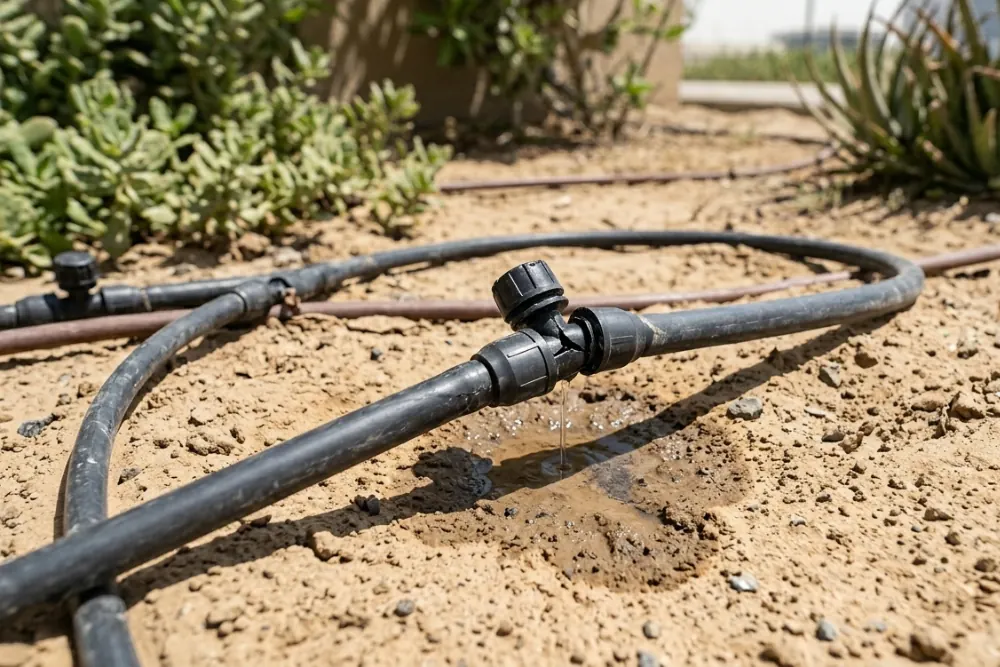
Garden taps in Dubai: what we do
- Fitting a new garden tap on a villa wall, a boundary wall or a utility area, including the supply branch, the isolation valve and the backplate.
- Replacing a failed or mismatched tap with one whose inlet and hose outlet match what is already there.
- Hose connectors, two-way splitters and flow control valves. We tell you which thread each one needs before you buy it.
- Locks, timers and meters on an outside tap.
- Low flow at the hose. A tap that gives a trickle is traced to the tap, the connector or the supply. See low water pressure.
- Repairs to an existing tap. The washer, the packing, the hose-end leak and the vacuum breaker are on the outdoor tap repair page.
- Emergency visits. We answer calls and send a plumber 24 hours a day, 7 days a week, including nights, weekends and public holidays.
- Areas. Across Dubai. The list is near the end of this page, and the full list of areas is on its own page.
The types: bib, nozzle, two-way, lockable
| Type | What to know | When it fits |
|---|---|---|
| Bib tap | A tap with a horizontal inlet that fixes to the wall and a hose-ready spout pointing down. The common outdoor tap | A wall with a pipe behind it |
| Long body | An extended barrel between the wall connection and the spout, for thick walls and deep pipework | Choose by the wall thickness. Measure it first |
| Short body | A compact version that sits closer to the wall, for residential and light commercial installations | A thin wall or a surface-mounted pipe |
| Angular | An angled body, at about 90 degrees, that changes the direction of flow where the supply does not line up | A supply pipe that arrives at the wrong angle |
| Lockable lever tap | A solid brass tap with a lock or removable handle, so strangers cannot use the water | A tap on a boundary or a street-facing wall |
| Two-way | Brings two supplies, hot and cold, to one outlet where there is no mixer. Two-way is also used for a tap with two outlets | See the explanation below |
Two-way means two different things
A two-way tap can mean a tap that brings a hot and a cold supply to one outlet. Another use of the same words is a splitter with two outlets, one for a hose and one for a bucket. Descriptions on shop pages sometimes mix the two, so ask which one a listing means.
If you want a hose on one side and a bucket tap on the other, you want two outlets. If you want warm water for washing a pet or a car, you want a hot and cold supply to one outlet, and the second supply has to exist on the wall.
Half inch, 15 mm, three-quarter inch: which number is which
The same number can name any of three things: the tap's outlet thread, the pipe that feeds it and the hole through the wall.
| Number | What it can mean |
|---|---|
| ¾ inch | The tap's outlet thread, and a hose size too. It is the garden hose thread on many imported connectors |
| ½ inch | A smaller outlet thread, found on many taps sold in Dubai |
| 15 mm | The pipe that feeds the tap, usually through a hole of about 22 mm in the wall |
| 22 mm | The hole through the wall, or a larger supply pipe |
The inch size on a pipe thread names the bore of the pipe the thread fits, not the outside diameter of the thread, which is why the numbers do not match what a ruler shows. The only way to be sure is to put calipers on the male thread of the tap, or on the hose connector you want to fit.
Threads: BSP, GHT and NPT
Three thread families turn up on garden taps and hose fittings.
| Thread | Form | Where you meet it |
|---|---|---|
| BSP | Parallel. Common on taps and connectors sold in Dubai | ½ and ¾ inch taps and connectors |
| GHT | Parallel, a garden hose thread, with the seal as a washer in the hose coupling | Some imported garden hose connectors |
| NPT | Tapered, for pipe inlets | Some imported hose bibs |
A ¾ inch BSP thread and a ¾ inch garden hose thread are within a millimetre of each other, so a buyer can mistake one for the other. They have different thread pitches, so forcing one onto the other strips it. A tapered pipe thread is not compatible with a hose thread without an adapter.
The hose end has its own size. Quick-connect brands are normally interchangeable among themselves and click together, though mixing brands can leak, so sticking to one brand is the safer course if leaks occur.
Where a garden tap sits in the system
A garden tap is a branch from the household supply, and its position decides how it behaves. In many villas there are several outside taps, fed from one pipe that runs along the boundary wall. The tap at the far end will have lower flow than the tap nearest the house, and a second tap opened at the same time reduces both. A tap fed from a roof or ground tank through a pump has a different pressure from one fed straight from the mains. Knowing which supply feeds the tap explains most of its behaviour.
Check these before blaming the tap:
- Is it on the mains or the tank? A tank supply with a weak pump gives a poor flow.
- Is there a valve upstream? Many outside taps have their own isolation valve inside the house or in a box. If it is partly shut, flow is low.
- Is the pipe full bore? Half inch pipe feeding two hoses will always disappoint.
- Is there a filter or strainer? A blocked one is a common cause of a slow tap.
Choosing a tap for the job: a buyer's table
Fault finding on an outside tap, with the washer, gland and wall seal, is on our outdoor tap repair page. This page is about choosing the tap, and these are the choices that change what you buy.
| If you want | Look for | Watch out for |
|---|---|---|
| A tap for a garden hose that stays on all day | A brass bib with a hose thread and a replaceable washer or cartridge | A plastic body that goes brittle in the sun |
| A tap that children or passers-by cannot open | A lockable tap, or one with a removable key | A key that is lost, so keep a spare |
| Two hoses from one point | A two-way tap, with a separate valve for each outlet | A shared inlet that halves the flow when both run |
| A tap on a wall that gets full sun | Brass or chrome-plated brass, with a handle that does not heat up | A plated handle that is too hot to touch |
| A tap beside a pool, a pet area or a car wash | A tap with a hose connection that accepts a vacuum breaker | A bare bib with no protection against water flowing back |
| A quick connector for a reel or a spray gun | A tap with a standard connector thread | A connector that does not match the thread, and leaks |
Whichever tap you choose, the connector at the hose end is what leaks first, and it is the cheapest part to change. Buy the tap and the connector as a pair, and keep the box or the label so the size is known when a part has to be replaced.
Hoses, connectors and the hose itself
A tap is often blamed for what the hose is doing. A hose left in the sun for months becomes brittle and splits at the ends. A cheap connector stays tight for a week and then spits. A hose with a kink holds pressure behind it and bursts at the weakest point.
- Store the hose in shade, coiled loosely, with the tap closed.
- Fit a quick connector on the tap and on the hose, so you can fit and remove them without tightening each time.
- Replace washers each season. They cost little and prevent most connector leaks.
- Switch off at the tap, not at the spray gun, when you finish. A hose under pressure all day is a hose that fails.
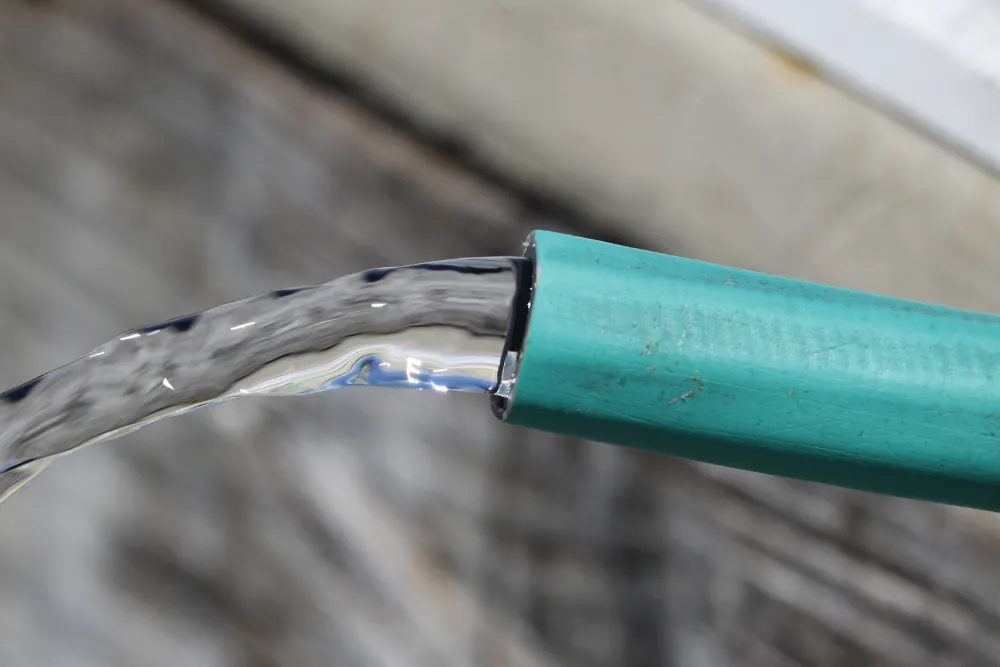
A tap for a car wash, a pet area or a pool
Different uses ask different things of a tap.
- Car washing needs a tap at a convenient height with a drain or gravel below, so the water does not pool on a driveway. A two-way tap lets you run a hose and fill a bucket together.
- Pet areas call for a tap that can be closed without the hose staying under pressure, and a surface that drains.
- Pool filling and top up. A tap used to fill a pool should have backflow protection, and a meter helps track what goes in. See pool plumbing for the rest.
- Irrigation. A tap that feeds a timer or a manifold should be full bore, with a filter after it. See irrigation.
Pairing a tap with a hose reel
A hose reel fixed to the wall beside a tap keeps the hose off the ground, out of the sun and free of kinks. Fix the reel to solid wall, not a thin render, and choose a tap height that lets the reel turn freely. A good reel has a swivel at the tap end, so the hose does not twist, and a quick connector, so you can unclip it in a second. Close the tap after use, not just the spray gun. A hose reel with a fixed pipe behind it makes the tap an outdoor outlet that you can lock, which is useful on a shared roof or balcony. Tell us what you plan to fit, and we position the tap for it.
How much water a garden tap gives
A garden tap's flow depends on the supply pressure, the pipe, the tap and the hose. A sprinkler needs roughly 10 to 15 litres per minute to work well, and a full-bore outdoor tap on a good supply gives well above that. A wider hose passes much more than a narrow one, and a longer hose loses more, so a long run needs a wider hose. The lower figure governs: the tap, the hose or the supply, whichever delivers the least. Pressure at the tap is the other half, and a weak supply gives less.
Measure it: bucket tests
A bucket test is the simplest way to know what your tap gives. Fill a bucket of known volume and time it. A 20 litre bucket that fills in 2 minutes is 10 litres per minute, and one that fills in 80 seconds is 15.
If the test gives less than your supply should, the fault is upstream of the tap or inside it. See low water pressure.
Timers, splitters, locks and meters
Four add-ons attach to a garden tap:
- Timers. A timer switches the water on and off at set times, usually from batteries. Most need a minimum pressure to open their valve, and the manual states it.
- Splitters. A two-way or four-way splitter feeds more than one hose from one tap.
- Locks. A lock stops others using the tap.
- Meters. A small meter on the tap measures the water a hose uses.
One bar is 10.2 m of water, and one metre of height is 0.098 bar. A garden tap fed by gravity from a roof tank 3 m above it sees about 0.3 bar, which is under the minimum pressure of many timers. That is a point to check for the model you buy. A tap fed through a booster pump is in a different position. See booster pump installation and repair.
Two valves on one tap split the tap's water between two hoses. They do not add water. Fittings add restriction, so a splitter on a tap that already gives 10 litres per minute leaves less than 10 for each hose.
A valve in the hose lets you stop the flow at the end of the hose without walking back to the wall. Whether your plot needs a lock is for you to judge, and a lockable tap on a boundary wall is a sensible choice.
Summer heat in an outside tap
Water that stands in an exposed pipe or hose warms in the sun. Midday temperatures in Dubai sit above 40°C for weeks, and a west-facing wall can be well above that. Brass takes this well, but a plastic tap or hose connector may soften or crack. A tap that faces south or west should be shaded where possible, and buried or lagged pipe stays cooler than a bare pipe on a wall. Run the first litres off before filling a pet's bowl or a paddling pool, because the first water from an exposed pipe can be hot enough to scald. Watering before 8 a.m. or after 7 p.m. is better for plants too, because midday watering loses much of the water to evaporation. Shading or insulating a roof tank and the pipe run are sensible precautions, and keeping the hose out of the sun helps. See pipe insulation.
Fitting a new outside tap
A new outside tap is a change to the property. The legal side is in the permission section further down. On a Dubai villa the points are:
- The feed. The mains, a tank with a pump, or the garden line may be the supply. A tap on a garden line fed by treated water is not a drinking tap, and it should not be connected to one without separation. See backflow prevention.
- Backflow. Fit a device that the maker names for the job, and keep the hose out of buckets and pools. A double check valve or a hose-connection vacuum breaker is the usual answer.
- The pipe. The PPR pipe page covers sunlight on exposed runs, so an outside run is boxed, sleeved or made in metal.
- The wall. A hole through an external wall of a villa in a community, or any wall of a flat, is a question for the owner or building management. See permission, below.
- The drain. A drain point lets the pipework be emptied. Whether to fit one in Dubai is a design choice, since freezing is not a risk.
Choosing a spot for a new tap
A new tap goes where the hose will actually reach, at a height that suits the job and over a surface that drains. A tap about knee to hip height is comfortable for a hose and a bucket, and a lower one catches splash on the wall. Choose a spot out of the full afternoon sun where you can, and keep it clear of door thresholds and parking, where a hose is stepped on. The pipe behind the tap should be as short as it can be, since a long dead leg holds warm water. The ground below needs a fall or gravel so water does not pool against the wall. We look at the wall, the supply and the usual hose route on the visit before we mark the position.
Replacing a garden tap: what we check on the wall
A replacement tap has to match what is on the wall: the thread on the pipe or the wall plate, the distance from the wall, and the outlet. We close the supply, remove the old tap, and look at the pipe and the wall plate for corrosion and cracks, because a new tap on a corroded thread leaks again. A wall plate or a backplate that has come loose from the render is refixed to solid wall. We wrap the thread with tape, fit the tap hand-tight and a little further, and test it under pressure with the hose attached. If the pipe has to be cut back to sound metal, we say so before we start.
Taps for irrigation and timers
A tap that feeds a timer or a manifold should be full bore, with an isolation valve ahead of it and a filter after it, because a half-open tap restricts the whole system. The timer sits on the tap thread and the hose or drip line leaves it. A tap on a pump-fed garden line has a different pressure from a tap on the mains, and drip lines need a pressure reducer on a strong supply. See irrigation for the system and booster pump for a weak supply.
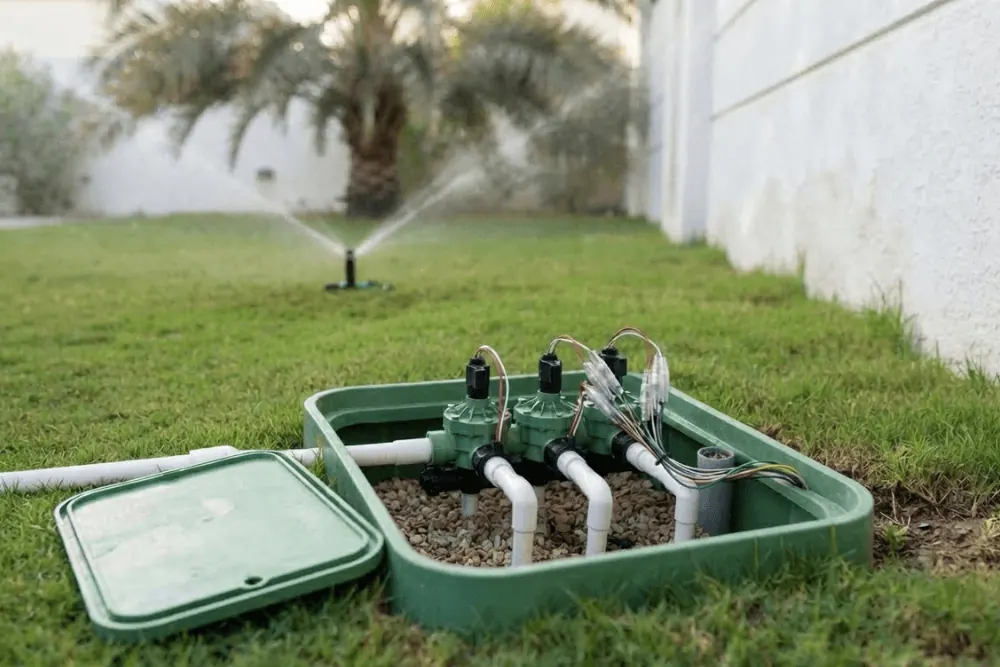
Lockable taps on a boundary wall
A tap on a street-facing wall is a free water supply for anyone who passes, and a leaking tap there loses water all day. A lockable lever tap, or a tap with a removable key, stops others using it. Keep a spare key, and fit the tap on its own isolation valve so it can be shut off from inside the property. A tap that is shared with a neighbour or a gardener needs a clear arrangement about who pays for the water, and a meter on the line makes that simple.
Salt, sun and what fails first on an outside tap
On a coastal villa, salt air attacks plated finishes and the exposed thread. On any villa, sun and heat harden the washer and make plastic parts brittle. The things that fail first are the washer, the hose connector, the plastic handle and the plating. A solid brass tap on a short plastic-free pipe lasts longest. A tap with a plated handle that is too hot to touch in July is a nuisance, and a handle that cracks is a leak. Check the washer and connector each season, and replace what shows wear before the tap fails.
Materials
Garden taps are made of a few materials:
- Brass with a chrome or nickel finish. Holds up in wet and outdoor environments. This is the usual choice for a tap on a wall.
- Solid nickel-plated brass. Used for lockable lever taps.
- Zinc and brass alloys. Often described as brass with zinc added for strength. Cheaper, and less durable in strong sun and salt air.
- Plastic. Light and cheap, and degrades in strong sun and high temperatures.
- Copper fittings for outside runs, because plastic degrades in extreme temperatures.
A listing that names one material in the headline may use another for part of the body, such as a zinc handle on a brass tap. Ask which part is which.
Permission in Dubai: who decides on a garden tap
A new tap goes through a wall, ties into the supply and may sit on a boundary or on a face the building controls. A wall, a facade or a shared garden that belongs to the building or the community goes through building management, and so does any work that needs the water shut off for other units. Swapping a failed tap for the same type in the same place is maintenance and needs a message to the landlord. A new tap, a second outlet or a hole through an external wall is an alteration, and needs written consent in a rented home and the owner's or building's approval. Tell us what your building asks for and we work to it. The fuller account is on the outdoor tap repair page.
When the job is finished
Ask for these. They cost nothing to produce.
- The tap's make, type and size, photographed before the wall is closed: the inlet, the hose outlet and any marking on the body.
- The thread of the hose outlet, written down, so the next connector you buy fits.
- A flow reading at the tap before and after the job, using a bucket test, written down.
- The isolation valve, shown to you, with where it is.
- The backflow device, named, with its marking, or a note that none was fitted and why.
- The pipe route through the wall, photographed.
- FAM's workmanship warranty, in writing. The warranty runs for 30 days and covers our labour only. Parts carry the manufacturer's warranty only.
How we work
- You message us with a photograph of the wall, the existing tap or pipe, the hose you use, and what you want the tap to do.
- We say what we think is needed, whether a replacement, a new tap or a different connector, and whether it is work we do.
- We give a price in writing, with the tap, the fittings and the work shown separately.
- Check permission. In a rented or managed property, ask the landlord or building management whether they need to approve this work before the visit.
- We check the supply first: the source, the pressure, the pipe material and the route.
- We fit the tap with an isolation valve and the backflow device its maker names, and test it.
- We hand over the markings, the flow reading and the warranty.
Where we work in Dubai
We cover all of Dubai, including Dubai Marina, JBR, Downtown Dubai, Business Bay, Jumeirah Lakes Towers, Palm Jumeirah, Al Barsha, Jumeirah Village Circle, Dubai Hills, Mirdif, Deira and Al Quoz. See the full list of areas.
How much does a garden tap cost in Dubai?
- The tap and the fittings. Hose connectors and splitters are cheap, and a solid brass tap costs more. Prices vary by brand and finish, and we show them separately on the quote.
- The work. Cutting a hole, running the supply, fitting the isolation valve and the backflow device, fixing the tap and testing it.
- What moves the price. The wall, the distance from the supply, the pipe material, the backflow device, and building approval.
We do not publish a starting price for this job. Send a photo on WhatsApp and we give you a fixed price before we start. Prices exclude 5% VAT.
Garden tap FAQs
What size is a garden tap?
A 15 mm tube usually feeds the tap, through a hole of about 22 mm in the wall, and the tap's outlet thread is usually ½ or ¾ inch. Measure the male thread with calipers.
Will a hose connector fit my tap?
Only if the thread matches. See the thread table above.
Is a two-way garden tap double the flow?
No. A tap with two outlets shares its flow between them. The same words are also used for a tap that brings a hot and a cold supply to one outlet.
How much water should a garden tap give?
A good supply gives well over 10 litres per minute at the hose, and sprinklers need about that. Test your own: fill a 20 litre bucket and time it. 2 minutes is 10 litres per minute, and 80 seconds is 15.
Which garden tap suits a hose that sits in a pool or a bucket?
One that takes a hose-connection vacuum breaker or a check valve at the outlet, because a hose left in water can siphon it back into the supply. How the device works, how to test it and what to do when it leaks are on our outdoor tap repair page, and the rules are on backflow prevention.
Why is the water from my garden tap hot in summer?
Sun on an exposed pipe, a hose or a roof tank warms the water standing in it. Run the first litres off, and see pipe insulation.
Can I put a timer on a garden tap?
Yes, if the tap gives enough pressure. A roof tank 3 m above the tap gives about 0.3 bar by gravity, which is under the minimum of many timers. Check the manual for the model you buy.
Is brass the best material for a garden tap?
Brass with a chrome or nickel finish holds up well in wet and outdoor use, and is the usual choice. Zinc alloys and plastic are cheaper and wear faster in Dubai's sun.
How much does a garden tap cost in Dubai?
It depends on the tap, the wall, the supply and the backflow device. We give a fixed price in writing on WhatsApp. Prices exclude 5% VAT.
Can I fit a new garden tap myself?
A tap that screws onto an existing outlet is a job you can do. A new tap through a wall means a pipe connection, a hole in an external wall and often a backflow device, and in a rented home you also need the landlord's written approval. We do the work and apply for the approvals. See permission, above.
Book a garden tap visit in Dubai
Tell us what the tap will serve, the wall and pipe it comes from, the hose you use, the thread on any tap you already have, and whether you own or rent. A photograph of the wall and the tap helps. We will identify what you have, say whether it is work we do, give you the options and a price in writing, and hand over the markings and the flow reading.
WhatsApp: +971 55 407 7427 · Request a quote
Visit us: Office 871, Oasis Mall, Al Quoz 1, Dubai, UAE
Related services: Outdoor tap repair · Tap installation · Tap repair · Irrigation system repair · Low water pressure · Backflow prevention · Pipe insulation · PPR pipe · Emergency plumber · how plumbing works in a Dubai home