
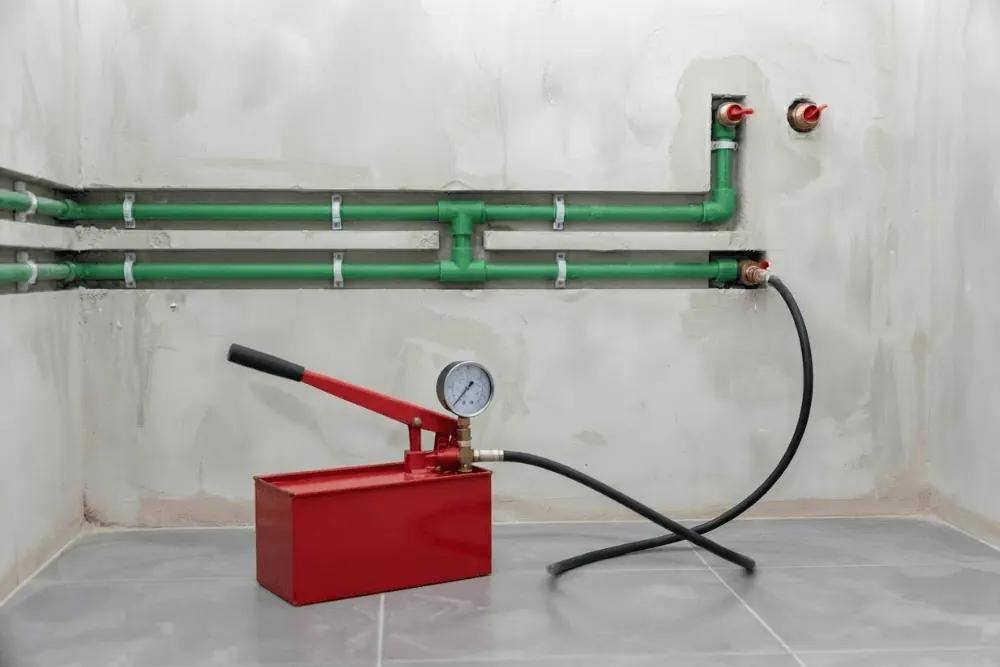
PPR pipe in Dubai: what we do
- Reading the pipe you have. The marking printed along it, its outside diameter, wall and rating.
- Installing PPR supply lines. Cutting, fusing, clipping and testing hot and cold water pipework.
- Repairing and replacing fused joints. See pipe leak repair and pipe fittings.
- Repiping a home or unit in PPR. See repiping.
- Insulating PPR lines. See pipe insulation.
- Emergency visits. We answer calls and send a plumber 24 hours a day, 7 days a week, including nights, weekends and public holidays.
- Areas. Across Dubai. The list is near the end of this page, and the full list of areas is on its own page.
Reading the marking on the pipe
PPR is polypropylene random copolymer. A pipe is normally printed along its length with the maker, the outside diameter, the wall thickness or series, a pressure rating and the use it is made for. Check that the marking says it is for hot and cold water, and photograph it before the wall is closed. A pipe made for cold water only is not the right pipe for a hot line, and a pipe made for a moderately hot line is not right for water that is kept much hotter. The maker's datasheet says what each pipe is for. Permanent disinfection of hot water with chlorine dioxide shortens the life of a system, so tell us if your building does it.
Why pressure ratings differ between makers
The rating on a PPR pipe, such as PN16 or PN20, is a label in bar that depends on the maker's design basis. The same wall can be printed with one rating by one maker and another by a different one, because they rate the material on a different basis, or because one uses a modified material that holds more pressure at the same wall. The wall is the fact and the rating is the claim. What to ask for is the wall thickness in millimetres, the use it is made for, and the maker's datasheet for your water temperature. A buyer who compares two quotes by rating alone can be comparing two different walls.
Wall and bore: why a thicker pipe flows less
A thicker wall holds more pressure and takes bore from the inside. Two pipes with the same outside diameter can have noticeably different inside diameters, so the thicker one passes less water at the same speed. That matters on a long hot line or a branch that feeds several fixtures. When a quote says 25 mm, ask which wall, because the 25 mm that is right for a cold line may be too thin for a hot one, and the thick one may choke a branch that needed flow. We choose the wall for the temperature and the flow, and we tell you what we chose. The flow side is on the pipework page.
Fusion welding step by step
PPR is joined by socket fusion: a heated tool melts the outside of the pipe and the inside of the fitting, and the two are pushed together. The procedure is the same across makers.
- Cut the pipe square with a pipe cutter made for plastic, and clean the pipe end and the fitting socket.
- Mark the insertion depth on the pipe, so the pipe goes in to the same depth every time.
- Heat the welding tool to the maker's temperature and check it with a thermometer.
- Push the pipe into the heating sleeve and the fitting onto the heating spigot at the same time, straight, without twisting, and start timing when both are fully on.
- Take both off together when the heating time is up and push them together straight, without twisting, to the marked depth.
- Hold the joint for the joining time, then let it cool for the full cooling time before the line is stressed or pressurised.
The heating, joining and cooling times rise with the pipe size, and the maker's table for the pipe in hand governs. A few seconds too long on a small pipe is a large share of its heating time, and a few seconds too short leaves a joint that has not fused. Too little heat gives a joint that has not fused, and too much narrows the bore. Neither shows clearly from outside, which is why the timings are not judged by eye.
Other causes of a bad fusion joint are covered further down, and the repair side is on the pipe leak repair page.
Clip spacing, expansion and bends
Plastic pipe sags between clips and grows when it warms, so the spacing and the allowance for growth are set by the maker's tables. The spacing is tighter for hot water than for cold, and it grows with the pipe diameter. A vertical run can take wider spacing than a horizontal one. Put a clip either side of a fitting, so the fitting is not carrying the weight of the pipe.
How much it grows
PPR grows more than metal when it heats. A hot run of several metres can grow by several centimetres between cold and hot. Fibre-reinforced and multilayer pipe grows much less than plain PPR. A fixed pipe has nowhere to go when it grows, so it bows or loads its joints, and the allowance is a flexible arm, a loop or an offset, with a mix of fixed and sliding clips. The size of the loop depends on the pipe and the length of the run, which is a design job, and we work it out from the maker's datasheet. A pipe that ticks and knocks as the water heats is telling you it has no room.
PP-R, PP-RCT and multilayer pipe
Three kinds of PPR pipe are sold, and they are welded the same way but differ in what is in the wall.
| Type | What it is | What to know |
|---|---|---|
| PP-R | Ordinary random copolymer pipe | The common domestic pipe. Expands the most |
| PP-RCT | A modified material that holds more pressure at the same wall | The same wall carries a higher rating, so a thinner wall can do the same job |
| Fibre-reinforced or multilayer | A layer of glass fibre or another material in the wall to cut expansion | Lower growth, and often an outer layer that must be stripped before welding |
A layered pipe cannot be welded as plain pipe, because the outer layers are removed first, with a stripping tool made for it, and a fitting made for plain pipe is not a fitting for layered pipe unless the maker says so.
Insulating PPR
Insulation does a job on PPR that plastic does not do for itself.
- Hot lines lose heat. PPR insulates better than metal, but a long hot run still loses heat.
- Cold lines sweat. In a humid shaft a cold PPR pipe collects condensation on its outer surface. See pipe insulation.
- Sunlight damages the pipe. Outdoors, PPR needs UV protection, shade or a cover.
- Protect against weather and contamination where it runs outdoors or through plant rooms.
Insulation hides joints, so the pipe is tested before it is lagged.
Fittings for PPR
A PPR system has its own fittings, fused to the pipe, plus adapters where the plastic meets a metal thread. The pipe fittings page has the joint types and the thread rules.
| Group | What it covers |
|---|---|
| All-plastic | Sockets, elbows, reduced and full-size tees, reducers, end caps and cross-pieces |
| With a brass thread | Fittings with a brass insert for the thread: reducing sleeves, tees, wall-mount elbows, wall-mounting groups with tap connectors |
| Flanged | Combined flanged fittings |
| Valves | Plastic valves, classic and under-plaster, and ball valves with a metal handle |
| Special elements | Crossovers and compensation pipes |
| Other jointing | Electrofusion sockets, butt welding, and mechanical threaded couplings sealed with PTFE tape or sealant |
One rule matters for repairs: a plastic thread is the part to avoid. Where a PPR line meets a tap, a valve or a heater, the thread is a metal insert set into the fitting by the maker. A fused joint that leaks is cut out and replaced, per the pipe fittings page, which also covers the PPR to CPVC transition.
Spotting a poor PPR job
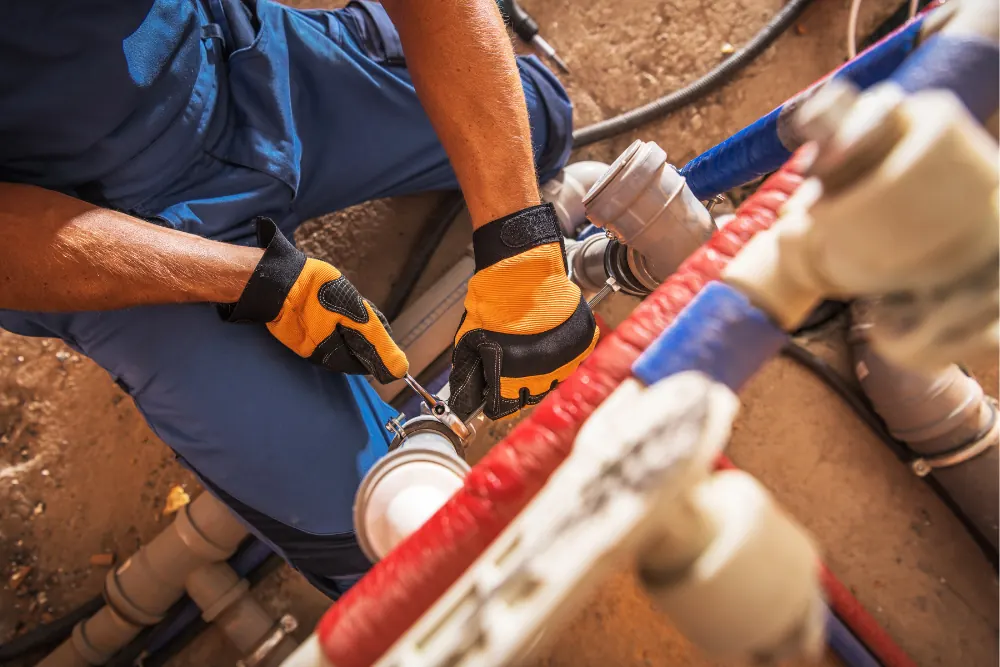
Most PPR faults trace to the welding, and some show before they leak. A bead of melted plastic that is lopsided or very large is a sign of a twisted or over-heated joint. A joint where the pipe has not gone fully into the fitting leaves a gap you can see. A pipe that bows between clips, a clip that has pulled out of the wall, or a joint that ticks when the water heats all point to poor support or no allowance for growth. A damp patch under a joint after the first week is a weak fusion. If you are buying a property with PPR, or taking over a fit-out, ask for the test record and the photographs of the pipes before the walls were closed. Without them, the pipe is a guess.
Choosing PPR for a flat or a villa
For a flat, PPR runs behind finished walls, so the joint quality and the test matter more than the price of the pipe. For a villa, it also runs through a roof, a plant room or the garden, so sun, heat and long runs matter as much. In both we choose the wall for the temperature, plan the clips and the room for growth, keep hot and cold lines apart, and lag the hot ones. Where the line crosses the roof or runs outside, we either choose a pipe made for it, or cover it against sunlight. We also decide where the isolation valves go, because a line without them turns a small repair into a shutdown for the whole home.
Hot water loops and long runs
A long hot line to a distant bathroom wastes water while you wait for it to run hot, and loses heat on the way. Where the layout allows, we keep the heater close to the busiest outlets, or run a short branch from a main hot line. On a villa with several bathrooms, a return loop keeps hot water close to every tap, but it adds pipe, a pump and heat loss, so it is a design decision and not a default. Whatever the layout, lagging the hot lines pays back, because PPR is slow to give up heat but a long exposed run still loses it. See no hot water for the heater side.
Protecting PPR on a roof or outside
Sunlight ages plastic over the years. A PPR pipe on a roof or an outside wall should be covered, shaded or boxed, or made in a pipe made for outdoor use. A cover also protects from knocks, from roof work and from people stepping on it. Where a pipe passes through a wall or slab, it needs a sleeve, so it can move and so concrete does not grip it. Roof lines that carry hot water need lagging with a weatherproof finish. We tell you what we see on your roof, and what we would change.
How to tell whether your property has PPR
PPR pipe is usually green, white or grey, with a matte finish and a printed line of text along it. You can often see it in a flat's kitchen cupboard, in a utility area, on the roof or at the water heater. It feels like firm, slightly waxy plastic and is lighter than metal. The joints are fused, so you see a small raised bead at each fitting and no threads or nuts. If you can read the print, send us a photo. If the pipe is hidden, tell us the age of the building and whether it was a fit-out or the original, and we say what is likely.
What PPR does not like
PPR handles heat and water well, but it has limits. It does not like strong sunlight for years on end, so cover it outdoors. It does not like being heated hotter than it is made for, so a heater set too high or a pipe next to a hot flue is a risk. It does not like being clamped hard, bent sharply or knocked, because it can crack or kink. It does not like solvent cement, because it cannot be glued, only fused or mechanically jointed. And it does not like a poor weld, because the joint is the weak point of the whole line. Knowing the limits is how you decide where PPR is the right pipe and where another material is better.
Mistakes we see on PPR jobs
- Welding with an unmeasured tool. A tool that is too hot or too cold gives weak or narrowed joints.
- Welding without a clean cut. A pipe cut crooked or dirty does not seat evenly in the socket.
- Leaving no room for growth. A hot pipe clipped solid at both ends bows or loads its joints.
- Burying joints behind tile without a test. A weep found after tiling means demolition.
- Using a plastic thread into a metal thread. It cracks when tightened. The correct fitting has a metal insert.
- Mixing makers for pipe and fittings, so the socket and the pipe do not match.
- No isolation valves. A small repair becomes a shutdown for the whole home.
- No photographs or record. The next plumber has to find the pipes by guesswork.
Questions to ask a plumber who proposes PPR
Ask which wall they will use and why, and whether the pipe and fittings come from the same maker. Ask how the joints will be tested before they are covered, and whether you will get the result in writing. Ask how they will allow for growth on the hot lines and where the isolation valves will go. Ask whether the hot lines will be lagged, and what happens on the roof. Ask who is responsible if a joint fails, and what the warranty covers. A plumber who answers each in a sentence has done this before. Ours is 30 days on workmanship, labour only, and parts carry the manufacturer's warranty only.
Permission in Dubai: who decides on PPR pipework
PPR runs inside walls, ceilings and shafts that belong to the building. In a rented home they also touch the landlord. The fuller account is on the repiping page.
- Building management. A riser or shaft shared with other units is the building's, so work that reaches it, or that needs the water shut off for other units, goes through building management.
Fusing a repair into an existing PPR branch in your own unit, like for like, is maintenance and needs a message to the landlord. Re-routing a line, replacing a branch in a new material or opening a wall or ceiling is an alteration, and needs written consent in a rented home and the building's approval. Tell us what your building asks for and we work to it.
When the job is finished
Ask for these. They cost nothing to produce.
- The pipe's marking, photographed before the wall is closed: maker, diameter, wall or series, and PN.
- The fittings' maker, and a note if they differ from the pipe's.
- The tool and the method: the welding temperature and the table used, written down.
- The clip layout and expansion allowance on hot runs, shown to you, with where the loops are.
- The pressure test record: pressure, hold time and the drop. The test pressures that makers use are on the pressure testing pump page.
- Insulation on hot lines, and on cold lines where the building needs it.
- FAM's workmanship warranty, in writing. The warranty runs for 30 days and covers our labour only. Parts carry the manufacturer's warranty only.
How we work
- You message us with a photograph of the pipe, any printing on it, the fittings, the leak or the plan, and whether the line is hot or cold.
- We say what we think is needed, whether a repair, a replacement or a new line, and whether it is work we do.
- We give a price in writing, with pipe, fittings and work shown separately.
- Check permission. In a rented or managed property, ask the landlord or building management whether they need to approve this work before the visit.
- We check the system first: the pipe's series, the existing material, the pressure and the route. The visit fee is AED 50 + VAT, credited if the work goes ahead.
- We fuse, clip and test to the maker's table for the pipe, with the pressure test before anything is closed.
- We hand over the markings, the test record, the insulation note and the warranty.
Where we work in Dubai
We cover all of Dubai, including Dubai Marina, JBR, Downtown Dubai, Business Bay, Jumeirah Lakes Towers, Palm Jumeirah, Al Barsha, Jumeirah Village Circle, Dubai Hills, Mirdif, Deira and Al Quoz. See the full list of areas.
Where PPR is used in a Dubai property
PPR (polypropylene random copolymer) pipe is a common choice for hot and cold water inside buildings. It is welded, so the joints become part of the pipe, and it does not corrode.
| Place | Why PPR suits it | What to watch |
|---|---|---|
| Hot and cold water risers in a building | Long straight runs, no corrosion, joints that do not loosen | Expansion in hot lines, which needs room and clips |
| Bathroom and kitchen branches | Fewer joints in the wall than with threaded pipe | Correct fusion, and tested before closing up |
| Plant rooms and boiler connections | Handles heat well when selected for the temperature | Insulation and supports |
| Pool and garden supply | Resists chemicals and ground conditions | UV, which damages exposed pipe |
| Villa mains distribution | A lasting supply for the whole house | Sunlight and heat on exposed sections |
PPR is not meant for places that see strong sunlight with no cover, and it must be protected where it passes through walls and slabs.
Why a welded joint fails, and how to prevent it
Most PPR failures are joint failures, and nearly all of them come from the welding, not the pipe.
- Too short a heating time. The surfaces do not melt deep enough and the joint is weak.
- Too long a heating time. The wall melts too far, the bead inside grows and flow is restricted, or the pipe collapses.
- Not pushing straight. A twisted joint has a weak side.
- Dirty or wet surfaces. Dust, oil and moisture stop the melt bonding.
- Moving the joint during cooling. The material needs a short time to set.
- A cold weld machine or a worn tool. The temperature must be right, and the tool clean.
A good welder follows a timing chart for each size, marks the depth, checks alignment and leaves the joint still. Joints are tested under pressure before they are covered.
Pressure testing PPR before it is hidden
A new PPR system should be filled, bled of air and tested at a pressure above working pressure for a set time before it is covered. During the test, watch the gauge and every joint. A drop that settles quickly may be air, but a steady fall is a leak. We record the test, the figure and the time. Once the pipe is tested and the wall closed, any later fault is much more expensive to reach, so the test is the cheapest insurance on the job.
Repairing and extending PPR
PPR can be repaired and extended by welding in a new section with couplings, but the work needs the pipe to be dry and the tool to fit. In a wall, space is tight. A leak in a PPR line is often at a joint or at a spot damaged by a nail or a drill. For a repair, we locate the fault, cut out the damaged section, fit new pipe with couplings or repair sockets, and test. For a new branch, we use a tee, welded to the line, supported and lagged as needed.
Mixing PPR with other pipe
PPR connects to copper, brass and steel through threaded or compression adapters. The adapter should be a proper PPR-to-metal fitting with a brass insert, not a plastic thread into a metal thread. Overtightening a threaded adapter cracks the plastic. Thread seal should be sparing. Where PPR meets a different plastic, such as CPVC or PVC, use the correct adapter, and never solvent-cement PPR.
Marking the pipe route before the wall is closed
Before a wall is closed, photograph the PPR routes with a tape measure in the shot, and mark the position on a sketch. Later, when someone wants to hang a shelf, fit a cabinet or drill for a fixing, the photo shows where not to drill. A nail through a pressurised PPR pipe is one of the most common causes of a hidden leak, and a photo costs nothing.
PPR in a bathroom renovation
A renovation is the usual time PPR is chosen, because the old pipe is exposed and new pipe goes in before the tiles. A good sequence keeps the work tidy.
- Plan the routes on paper. Mark each fixture, the hot and cold lines and the branches. Keep hot and cold lines apart and avoid crossings.
- Cut chases to the right depth, deep enough for the pipe and any lagging, and clear of structure.
- Weld the lines in the chase with the fusion tool, using the timing for each pipe size.
- Fix the pipe with clips, and lag the hot line.
- Pressure test the whole system for the time set, and watch every joint.
- Photograph the routes before they are covered.
- Close the chase only after the test and the photos.
The test is the step that most often gets rushed. A joint that weeps under test is a ten-minute repair, and a joint that weeps behind new tile is a day of demolition. We give a note of the test pressure and time, and the price is fixed on WhatsApp before we start. Prices exclude 5% VAT.
How much does PPR pipe work cost in Dubai?
- The pipe and fittings. The price follows the size, the series, the length and the number of fittings, and whether the pipe is plain PP-R, PP-RCT or a layered type.
- The work. Cutting, fusing, clipping, testing and making good.
- What moves the price. The size and series, the length, the number of fittings, access, concealed or exposed routing, insulation, pressure testing, and the building's approval.
We do not publish a starting price for this job. Send a photo on WhatsApp and we give you a fixed price before we start. Prices exclude 5% VAT.
PPR pipe FAQs
What does PN mean on a PPR pipe?
PN is a nominal pressure rating in bar, and the number comes from the maker's own basis. Ask for the wall in millimetres and for the datasheet at your water temperature.
What is the difference between PN16 and PN20 PPR pipe?
The higher number is a higher pressure rating, and it usually means a thicker wall, so it suits hotter water and higher pressure, and it has a slightly smaller bore. Makers rate on different bases, so compare the wall in millimetres and the datasheet, and not only the label.
How long does PPR pipe last?
Many decades when the right pipe is chosen and installed correctly. Water hotter than the pipe is made for, sunlight and strong disinfection of the hot water shorten that. UV damages the pipe, so storage and routing matter.
How long do you heat PPR pipe to weld it?
The heating time depends on the pipe diameter, so we follow the pipe maker's welding table and the tool's set temperature. A small pipe is heated for a few seconds, then joined at once and held until it sets. Too little heat gives a weak joint and too much narrows the bore.
Does PPR pipe need insulation?
Hot lines are insulated to cut heat loss and cold lines where they sweat, such as in humid shafts. PPR also needs protection from sunlight outdoors. See pipe insulation.
How far apart should PPR pipe clips be?
Closer for hot lines than for cold, and closer for smaller pipe, with a clip either side of a fitting. The maker's table for your pipe governs, and we set the layout when we fit the line.
How much does PPR pipe grow when hot?
A long hot run can grow by several centimetres, which is why we plan loops or offsets and use sliding clips. Fibre-reinforced pipe grows much less.
Can PPR pipe go outside or on a roof?
It can, if it is protected. A roof or outside run is boxed, shaded or covered against UV, or made in another material. That is a design decision for the building.
Can PPR be joined to copper, CPVC or a tap?
Yes, through an adapter, and not by fusing. The pipe fittings page covers PPR to CPVC and to metal threads. Where PPR meets a metal thread, the thread is a metal insert and not a plastic one.
How much does PPR pipe cost in Dubai?
It depends on the size, the series, the length and the fittings, and on the work. We give a fixed price on WhatsApp before we start. Prices exclude 5% VAT.
Book a PPR pipe visit in Dubai
Tell us what the line serves, whether it is hot or cold, the printing on the pipe, the fittings you can see, what is leaking or what you plan to build, and whether you own or rent. A photograph of the pipe helps. We will identify the pipe, say whether it is work we do, give you the options and a price in writing, and hand over the markings and the test record.
WhatsApp: +971 55 407 7427 · Request a quote
Visit us: Office 871, Oasis Mall, Al Quoz 1, Dubai, UAE
Related services: Repiping · Pipework overview · Pipe fittings · Pipe insulation · Pipe leak repair · Pressure testing pump · Leak detection · Water hammer arrestor · Emergency plumber · how plumbing works in a Dubai home