
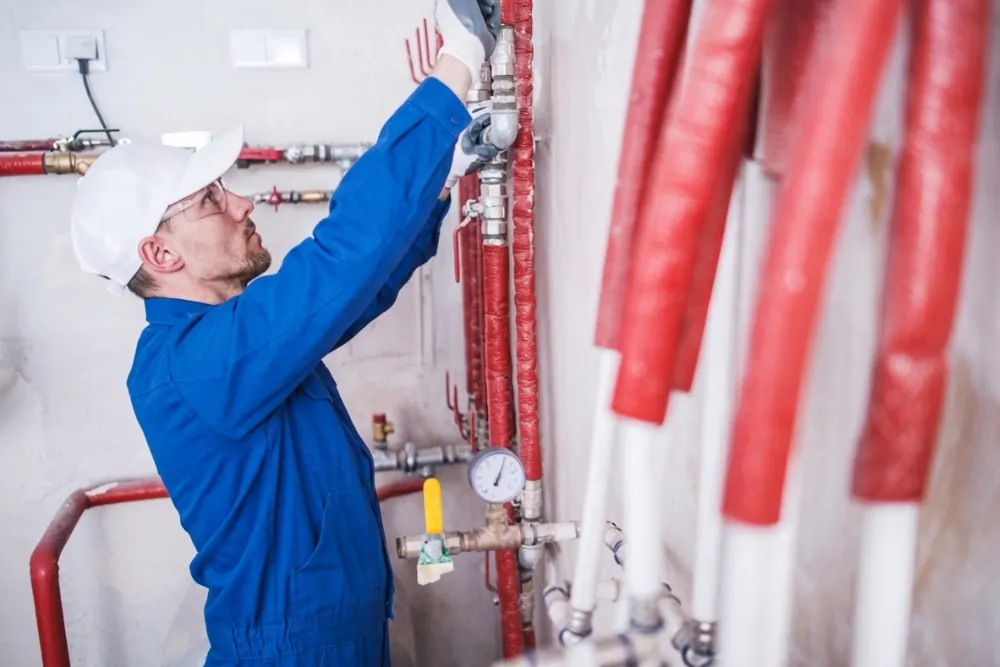
Pipe insulation in Dubai: what we do
- Survey. We find which lines are hot, which are cold, which sweat, which sit in the sun and which are already lagged badly.
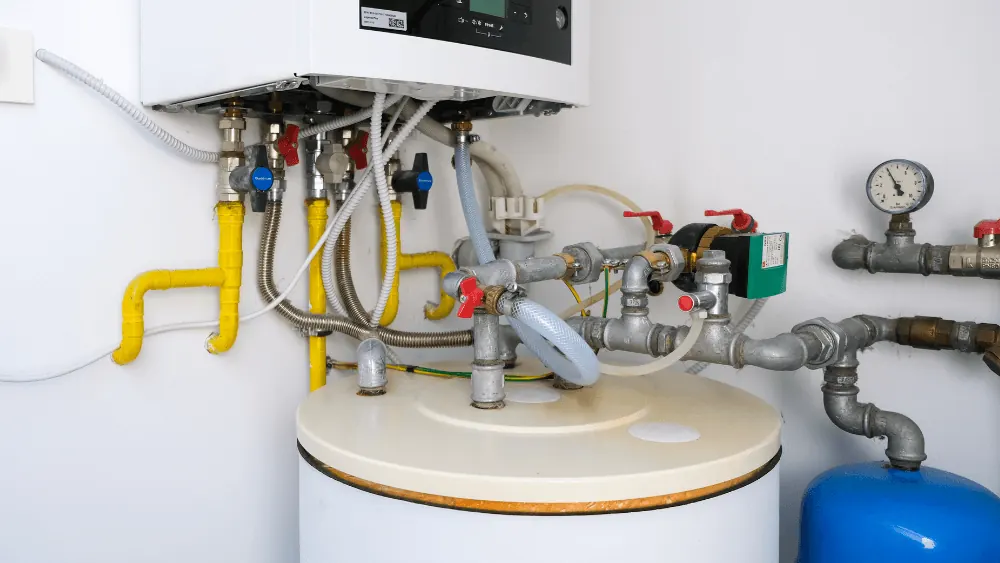
- Hot water lagging. Heater outlets, distribution lines, recirculation loops, and valves and fittings.
- Cold line lagging. Closed-cell insulation with sealed joints on cold lines that sweat and drip.
- Outdoor and roof pipework. UV-resistant insulation with a weatherproof finish.
- Replacing failed lagging. Wet, crushed, cracked, open-jointed or missing insulation.
- Fittings. Valves, elbows, tees and supports, which are where most lagging fails.
- Sweat or leak diagnosis. Telling a sweating pipe from a leaking one before a ceiling is opened.
- Emergency visits. We answer calls and send a plumber 24 hours a day, 7 days a week.
Neighbouring topics have their own pages. Replacing old pipe is on our repiping page, and joints and connectors are on our pipe fittings page. Flexible connectors are on our hoses page. Hot water faults are on our water heater repair page. Finding a hidden leak is on our leak detection page, and repairing water damage to a ceiling or wall is on our ceiling and wall leak page.
Hot, cold or outdoors: three jobs, three specifications
| Line | What goes wrong without insulation | What the insulation must do | What decides the spec |
|---|---|---|---|
| Hot water | Heat escapes from the pipe, hot water takes longer to arrive and the heater works harder | Slow heat loss | Pipe size, water temperature, the quality of the insulation |
| Cold water and chilled water | The pipe surface falls below the air's dew point, so water forms on it and drips | Keep the outer surface above the dew point and keep moist air from reaching the pipe | Thickness, closed-cell material, sealed joints |
| Outdoor and roof | Sun, rain and dust break down ordinary lagging | Survive the weather as well as insulate | UV resistance and a protective finish |
The jobs conflict in one respect. Hot-line lagging is judged by how well it resists heat flow. Cold-line lagging is judged by how well it keeps moisture out as well. Treat the two as separate specifications.
Is it sweating or leaking?
A damp pipe or a drip from a ceiling has two common explanations, and the repair for each is different. Replacing a pipe because it sweats wastes money, and insulating a pipe that leaks hides the problem.
How condensation works
Air holds water vapour. When air meets a surface colder than its dew point, the vapour condenses on the surface. The warmer and more humid the air, the higher the dew point.
That matters a great deal in Dubai. On a humid summer day the dew point outdoors can be in the high twenties, and in a humid shaft or plant room it can be well above the temperature of a cold water line. Any pipe whose surface is colder than the dew point of the air around it will sweat. A chilled water line sweats almost anywhere in a humid building. A cold domestic line sweats only if the water in it is cooler than the dew point. A pipe carrying water at room temperature does not sweat in an air-conditioned room, but the same pipe running through a humid, unconditioned shaft or plant room might. The surface temperature of the pipe is the number to measure.
How to tell sweat from a leak
| Test | Condensation | Leak |
|---|---|---|
| When it appears | Worse in humid weather, and in cooler hours when the pipe is cold | Constant, whatever the weather |
| Where it appears | Along the whole length of a cold pipe, at valves and fittings, and under hangers | At one point, a joint or a fitting, with a trail below it |
| Dry-and-watch test | Wipe the pipe dry and it re-wets evenly, over the whole surface, in minutes | Wipe dry and one spot re-wets first |
| Shut-off test | Stays wet or drips even with the supply closed, if the pipe is still cold | Stops when the supply is closed |
| The water meter | Does not move with all taps off | Moves with all taps off, if the leak is on the supply side |
Our leak detection page has the meter test. A pipe with lagging can be sweating hard underneath while looking nearly dry on top.
The water damage is the part that reaches the ceiling below. See our ceiling and wall leak page.
Other sources of a wet ceiling
A stain below a pipe run is not always the pipe. Ceiling voids carry several systems, and they leave similar marks.
| What you see | Likely source | Where to read more |
|---|---|---|
| Even dampness along the pipe, worse in humid weather, dry when the air is dry | Condensation on a cold line | This page |
| Drips that follow the air-conditioning cycle and stop when the unit is off | The air-conditioning condensate, a separate system from the water supply | The AC contractor |
| Constant, from one point, and the water meter moves with everything off | A leak on the supply pipe | Leak detection |
| Appears after a toilet, shower or basin is used, and may smell | A drain or waste pipe | Drain unblocking |
| Follows rainfall | The roof or a wall penetration | Ceiling and wall leaks |
Running through these in order finds the source before anyone opens the ceiling, and the repair for each is different.
Where cold pipes meet humid air in a Dubai building
These are the places where a cold surface and humid air are most likely to meet.
- Riser cupboards and service shafts, where cold or chilled lines run through air that is not conditioned.
- Ceiling voids over bathrooms and kitchens, where humid air collects around cold lines.
- Balcony and utility areas, where a cold line meets outdoor air in the humid months.
- Valves and fittings on any of these lines, which are the first points to drip when lagging is missing.
Insulation materials compared
The maker's datasheet for the product governs. The principle is simple: for any line that can sweat, choose a material that does not let moisture in and seal every joint. For a hot line in a dry space, thickness matters more than vapour resistance.
| Material | Moisture | Best for | Watch for |
|---|---|---|---|
| Closed-cell elastomeric foam | Resists vapour on its own when joints are sealed | Cold, chilled and hot lines indoors | Needs UV protection outdoors. Saturated foam cannot be dried and reused |
| Polyethylene foam tube | Closed cell, resists water | Short hot and cold runs in dry areas | Lower temperature limit than elastomeric. Soft, and crushes under supports |
| Mineral or stone wool | Absorbs water unless faced with a vapour barrier | Hot lines, plant rooms, where fire resistance matters | On a cold line it must have a sealed vapour barrier, or it soaks |
| Glass wool | Absorbs water unless faced | Hot lines in dry places | Itchy to handle, and unsuited to damp or exposed places |
| Phenolic or PIR foam, faced | Closed cell, with a foil or similar facing | Chilled lines where space is tight | Cost, and the facing and joints must be sealed |
A thinner layer of a better insulator can match a thicker layer of a poorer one, but on a cold line the vapour seal matters as much as the number.
Thickness: why the numbers disagree
There is no single correct thickness. It is set by the pipe diameter, the temperature of the contents, the air around the pipe and the quality of the insulation. Different makers give different answers for the same pipe, because they are answering different questions: saving energy, preventing condensation or protecting people from burns.
| Line | Typical thickness | When to go up |
|---|---|---|
| Domestic hot water | 13 to 25 mm, rising with pipe size | Long runs, outdoor lines, and where heat in the space matters |
| Domestic cold water | 13 mm minimum | One size up where humidity is consistently high |
| Chilled water | 19 to 25 mm | One size thicker in high humidity or at lower water temperatures |
| Outdoor and roof | As for the line, plus a weatherproof finish | Where the pipe sees full sun |
The thickness is a starting point for a plain domestic line. For commercial and building-services work, the consultant's specification sets the thickness. For a villa or flat, we choose from the maker's chart for the actual temperature and humidity and give you the thickness in the quote.
Hot water lines: where lagging earns its place
Expect a modest saving, not a large one. A bare hot pipe loses heat in proportion to its length and its surface, and lagging slows that loss.
Two reasons point the same way in a Dubai home.
- Hot water arrives sooner. Insulated pipes deliver hot water faster at taps and showers, which also saves water, and the water arrives a little hotter at the tap.
- Less heat in the space. In an air-conditioned Dubai home the same heat is something the air-conditioning must remove.
Which hot lines first
- The first metre or two out of the heater. The hottest pipe, and the one losing the most.
- Valves, elbows and tees near the heater. Uninsulated fittings act as thermal bridges, and clips, valves and tees are local heat-loss points.
- Accessible distribution lines. The runs through ceiling voids, shafts and cupboards.
- Long runs to a distant bathroom or kitchen, where the water cools between draws.
- Roof and outdoor hot lines, with a weatherproof finish.
- Pipes within reach of people. A bare hot pipe in a kitchen, plant room or shared space can burn a hand that touches it, and lagging covers the surface.
Dead legs, stagnant branches and a heater set too low are design and operating issues. See our water heater repair page for heater faults.
Cold lines: stopping the sweat for good
A cold line sweats when its surface is colder than the dew point of the air around it, so the cure is a surface kept warm by insulation and a skin that moist air cannot get through.
| Cause | What happens | Fix |
|---|---|---|
| Thin lagging | The outer surface still falls below the dew point | Thicker lagging, one size up in humid places |
| Open-cell material | Moisture soaks in and the lagging stops working | Closed-cell material, or a sealed vapour barrier |
| Unsealed joints | Warm air gets in at the seam and condenses on the pipe | Seal every seam and butt joint with the maker's adhesive or tape |
| Bare fittings | Valves, elbows and tees left uncovered drip first | Pre-formed covers, mitred elbows, filled gaps |
| Damaged lagging | Tears, cracks and UV wear let vapour in | Replace the section |
| Pipe too cold for the room | A very cold line in a humid space can sweat even through standard lagging | Thicker lagging, or a vapour barrier jacket |
The workmanship is as important as the material: insulate in dry conditions, cut mitres with a sharp knife at elbows and tees, seal every seam and butt joint with the maker's adhesive or tape, and check for condensation after 24 hours and again each year.
Wet insulation
Wet lagging is not a drying job. Saturated elastomeric foam has permanently degraded vapour barrier properties and should not be dried out and reused. Wet insulation has three common sources:
- A vapour barrier breach, such as an unglued joint, an uninsulated fitting, a puncture or UV damage. The lagging saturates from the inside out.
- Water from outside, such as rain through a roof penetration, a leak above or a condensate overflow.
- A leak in the pipe itself, which soaks the lagging from the pipe outwards.
A corroded or wet pipe under wet lagging points to condensation or a leak in the pipe. A dry pipe points to water coming from outside. The fix follows the cause, and replacing the lagging without fixing the breach does not stop it coming back.
Pipes on roofs and outside walls
Roof pipework meets sun, rain and dust at once. Outdoor insulation needs resistance to sun, water and corrosion.
Our approach to outdoor and roof pipes:
- UV-resistant insulation, or standard insulation with a weatherproof finish over it. A metal or plastic jacket rated for outdoor use does the second job.
- Sealed ends and joints, so rain does not run along the insulation to the pipe.
- Protected penetrations where pipes pass through the roof or a wall.
- Pipe material checked as well. The plastics in common use for water pipe are damaged by sunlight, as our repiping page explains. Insulation and cladding protect the pipe underneath as well as the lagging.
- Supports that carry the weight of the jacket and let the pipe move.
Concealed and exposed pipework
Exposed lines are the easy case: the pipe is visible, so lagging can be inspected and replaced.
Concealed lines inside walls, slabs and ceilings are different.
- Test before you lag. A concealed pipe is pressure tested and passed before insulation covers the joints. Insulation hides a weeping joint. Our test practice is on the repiping page.
- Allow room. A chase or sleeve needs space for the pipe and its insulation. A pipe with no room for lagging is a pipe with no lagging.
- Keep the skin continuous. Where a cold line passes through a sleeve in a wall or slab, the vapour seal should continue through, so moist air does not get behind the insulation. That is our practice and not a quoted rule.
- Record the route. Photograph the pipe and its insulation before it is closed.
A sweating pipe behind a finished wall shows up as a stain, a damp patch or peeling paint, not as drops. If you see that pattern, check for a leak first. See leak detection.
Fire and smoke ratings
Insulation materials differ in how they behave in a fire, and in towers and fire-rated shafts that matters. Stone wool is non-combustible and has strong fire resistance. Foam insulations are made in grades with different fire performance, and the datasheet states the grade.
We do not carry out fire-system work, and we do not quote a fire class for pipe insulation. The practical rule is to follow the building's own fire strategy and the consultant's specification, and to ask for the datasheet showing the product's fire classification before it is installed in a shaft, a plant room or a fire-rated penetration.
Replacing old lagging
| What you see | What it means | What to do |
|---|---|---|
| Soggy or heavy lagging | Saturated. Its vapour properties are gone | Replace. Do not dry and reuse |
| Stains or drips below the pipe | Sweating or a leak | Find out which before covering anything |
| Cracked, brittle or powdery foam | UV or age | Replace with UV-resistant lagging or add cladding |
| Open joints or gaps | A vapour or heat leak at the seam | Re-seal, or replace the section |
| Crushed lagging at supports | Thin spot, a cold or hot bridge | New lagging with proper supports |
| Bare valves and fittings | The point where the pipe sweats first | Pre-formed covers |
| Mould or black spotting | Long-term dampness | Replace the lagging, clean the surface and fix the cause |
| Lagging missing altogether | Gone, or never fitted | Fit new lagging after checking the pipe |
When we take off old lagging, we look at the pipe underneath. A corroded pipe under wet lagging may need more than new insulation. See pipe leak repair.
How we insulate a pipe
- Survey the line. Hot or cold, pipe size, route, humidity, exposure to sun.
- Check the pipe first. It is tested and dry, and any leak is repaired before it is covered.
- Clean and dry the surface. Adhesive does not bond to a damp pipe.
- Pick the material and thickness from the maker's chart for the actual temperature and humidity.
- Fit the lagging. Match the bore to the pipe's outside diameter, slide on tube where the pipe is open, or use slit tube with self-seal or adhesive where it is not.
- Mitre the corners. Cut elbows and tees with a sharp knife so the faces meet without gaps.
- Cover valves and fittings with pre-formed covers or filled offcuts.
- Seal every joint, and overlap butt joints on cold lines.
- Support without crushing. Saddles or load-spreading supports under the insulation.
- Finish outdoor runs with UV-resistant lagging or a weatherproof jacket.
Insulating a roof tank line
A roof tank bakes in the sun, and the pipes on the roof carry that heat into the building. The cold feed that leaves a tank can run hot for the first litres every afternoon, and an exposed pipe heats water that is standing in it. Insulating the outlet pipe, the pump line and the float feed with UV-resistant lagging and a weatherproof finish keeps the water cooler and the lagging in one piece. A cover or a shade over the tank itself does more than the lagging, so we look at both. A cold tap that runs hot in summer is mostly a tank and roof pipe matter, not a heater fault. See water tank installation and no hot water.
Lagging the pipes under a sink or in a cupboard
Pipes under basins and kitchen sinks are short, but they are easy to lag and easy to forget. A cold supply under a sink sweats in a humid kitchen and drips onto the cabinet base, which swells. The hot supply to a kitchen tap loses heat into a cupboard, and a bare hot pipe there is a burn risk for a child. Use pre-slit foam tube of the right bore, tape every joint and cut round the valves rather than leaving them bare. Leave room to turn the angle valves, and do not wrap a valve in a way that stops you reaching the spindle. If a cabinet base is already stained or swollen, the cause may be a leak and not sweat, so check with a dry tissue before you lag. See kitchen sink.
Insulation and the cost of electricity
In an air-conditioned Dubai home, heat lost from a hot pipe is a load on the air conditioning, and heat gained by a cold pipe is lost cooling. The saving on a single pipe is small, but across a villa with long hot runs and a roof tank it adds up, and the comfort gain, hot water sooner and a cold tap that is cold, is felt every day. The first metre or two from the heater and the exposed roof pipes pay back fastest. We do not promise a figure for your bill, because it depends on the pipe lengths, the hot water use and the air conditioning, and we say so on the quote.
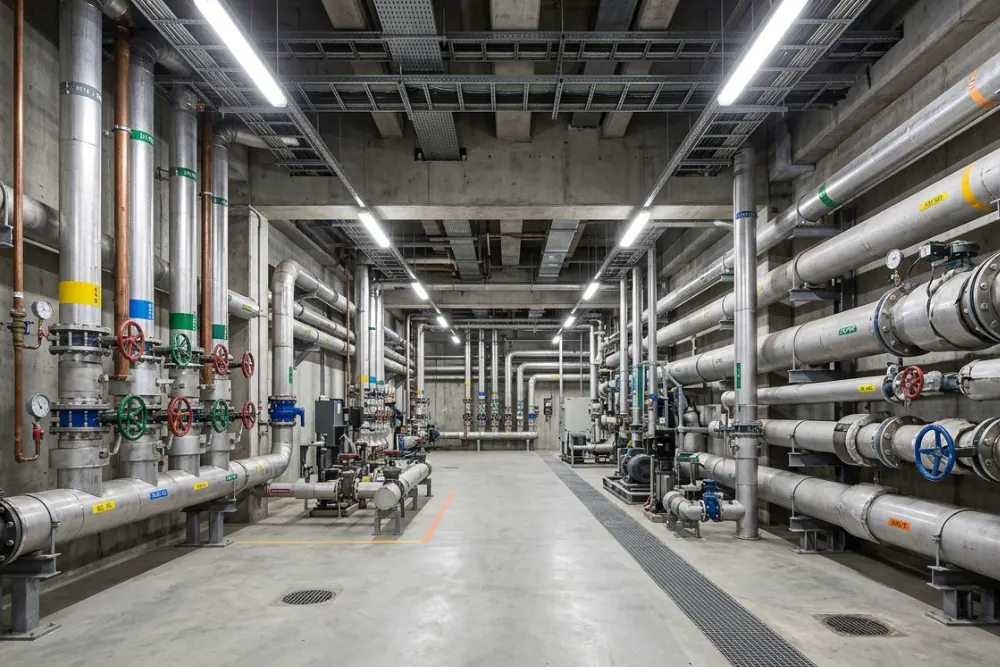
Shafts, risers and plant rooms in Dubai buildings
In many flats the cold and hot risers run in a shaft that the building owns. The shaft is warm, often humid, and shared with chilled water and drain stacks. A cold riser that sweats there drips onto the slab and into the flat below, and the first sign is a stain in someone else's ceiling. We can lag the pipes that serve your own unit, from the isolation valve onward, with your building's agreement. For the riser itself, we advise your building manager what we see and the work goes through them. In a plant room, pipes carry hot or cold water at higher temperatures and pressures, so we check the existing lagging, the pipe underneath and any removable covers over valves before we quote.
Valves and removable covers
A valve is the first place lagging fails and the last place anyone wants to cut it. A permanently wrapped valve gets stripped the first time it needs servicing, and then it stays bare. We fit pre-formed or removable covers on valves, strainers and pump connections, so they can be opened, serviced and closed again without destroying the lagging. Mark the valve cover so the next person knows what is under it. See valves.
A five-minute sweat check you can do yourself
Run your hand along each exposed cold pipe on a humid afternoon. A film of moisture means the pipe is sweating. Check the underside of the pipe, the lagging at each joint and any valves. Dry the pipe with a tissue and watch for twenty minutes. If the wetness returns evenly along the pipe, it is sweat. If it returns at one point, it is more likely a leak, and the next step is on our leak detection page. Do this once in the humid months and once in the cooler ones, and write down what you find so we can see the pattern.
What to tell us when you call
Send a photo on WhatsApp of the pipe, the lagging and the wet area. Tell us whether the pipe is hot or cold, where it runs, whether it is in your unit or in a shared shaft, and whether the problem is worse in humid weather. If a ceiling is stained, include a photo of the ceiling too. A clear photo lets us give you a fixed price before we start.
Permission in Dubai: who decides on lagging
Lagging in your own unit is maintenance. Shafts, risers and plant rooms that serve other units belong to the building, and work there goes through building management. A fire-rated shaft or penetration also follows the building's fire strategy. Tell us what your building asks for and we work to it.
What to leave alone
- Gas flues and hot flue pipes. The heater maker's instructions govern, and gas work is not our work.
- Electrical heating cables or any trace heating on the pipe, unless the cable maker approves the lagging.
- Chilled-water and refrigerant lines of an air-conditioning system. They belong to the air-conditioning system and its contractor.
- Pipes you cannot identify. Gas, fire and fuel lines are outside this page.
When the job is finished
- The material and thickness fitted on each line, written down.
- Photographs of the lagging and the fittings before they are closed in.
- The datasheet of the product, if it is going into a shaft or plant room.
- FAM's workmanship warranty, in writing. The warranty runs for 30 days and covers our labour only. Parts carry the manufacturer's warranty only.
Where we insulate pipes in Dubai
We cover all of Dubai, including Dubai Marina, JBR, Downtown Dubai, Business Bay, Jumeirah Lakes Towers, Palm Jumeirah, Al Barsha, Jumeirah Village Circle, Dubai Hills, Mirdif, Deira and Al Quoz. See the full list of areas.
Where insulation pays back, and where it does not
Not every pipe needs lagging. Some pay back quickly, and others are a waste.
| Pipe | Worth lagging? | Reason |
|---|---|---|
| Hot water pipe from the heater to the far tap | Yes | Saves heat and shortens the wait for hot water |
| A hot line in a hot loft or on a roof | Yes | Keeps the heat in, and protects from sun |
| A cold line that sweats | Yes | Stops drips and damp |
| A cold line in an air-conditioned room that does not sweat | Not needed | No benefit |
| A short branch to a basin | Rarely | Very little to save |
| A pipe that will be inspected often | Use removable covers | Access is needed |
Ask to see the material
Before a large job, ask to see the insulation material, its thickness and its label. Check that it is rated for the temperature of the pipe and for the place it will sit, indoors, outdoors or in a hot void. A thin foam that suits a cold basin line will not last on a roof. Ask how the joints will be sealed and whether the outside will be protected from sun. A good answer is short and specific.
How much does pipe insulation cost in Dubai?
The price follows the length, the pipe and the finish.
- Survey. A visit to identify lines and find the cause of any sweating. The visit fee is AED 50 + VAT, credited if the work goes ahead.
- Length and pipe size. Metres of pipe, and the diameter, since thicker lagging for larger pipe costs more.
- Material and thickness. Closed-cell elastomeric, wool or phenolic, and the thickness chosen.
- Fittings. Valves, elbows and tees take time and covers.
- Access. Open runs are quick. Shafts, ceiling voids and roofs take longer.
- Outdoor finish. Cladding and sealing on exposed runs.
- Removal and disposal of old lagging.
We do not publish a starting price for this job. Send a photo on WhatsApp and we give you a fixed price before we start. Prices exclude 5% VAT.
Pipe insulation FAQs
Do I need to insulate hot water pipes in Dubai?
Whether it is required depends on the building's specification and the landlord, and for a commercial building the consultant's specification governs. In a home it is worth doing on long runs, on pipes near the heater and wherever a bare pipe is in reach, because hot water arrives sooner and less heat is lost to the space.
Why is my cold water pipe sweating?
Its surface is colder than the dew point of the air around it, so moisture condenses on it. The usual causes are thin or missing lagging, unsealed joints, open-cell material, bare fittings and damaged lagging. In humid months the dew point rises. A cold pipe in a humid shaft sweats more than the same pipe in a dry room.
Is a sweating pipe a leak?
No, but the two look alike. Condensation appears along the whole cold surface, worsens in humid weather and re-wets evenly after wiping. A leak comes from one point, continues in any weather, and stops when the supply is closed. If a ceiling is stained, check for a leak first.
What thickness of insulation do I need?
It follows the pipe diameter, the temperature of the water, the humidity and the quality of the insulation. We choose from the maker's chart and state the thickness in the quote.
Which insulation is best for cold pipes?
Closed-cell elastomeric foam with every joint sealed is the usual choice for cold and chilled lines. Mineral wool only works on a cold line with a sealed vapour barrier. Check the datasheet for the vapour resistance and the temperature range of the specific product.
Can I insulate pipes myself?
For a short exposed run, yes, with the right-size tube, adhesive on every joint and covers on the fittings. The mistakes that cause failure are thin lagging, open joints, bare valves and crushed supports. Concealed lines, roofs, hot lines near a flue and anything in a shaft are better left to a plumber.
Can wet pipe insulation be dried and reused?
No. Saturated elastomeric foam has permanently degraded vapour barrier properties. Find the source of the water, repair it and replace the lagging.
How do I protect rooftop pipes from the sun?
Use UV-resistant insulation or a weatherproof jacket over it, seal the joints and penetrations, and support the pipe so the jacket does not sag. Plastic pipes are also damaged by sunlight, so cladding protects both the lagging and the pipe. See repiping.
Should pipes be tested before they are insulated?
Yes. Insulation hides a weeping joint. A concealed or lagged pipe is pressure tested and passed first, and lagging goes on after.
Do you insulate air-conditioning chilled water and refrigerant pipes?
Those lines belong to the air-conditioning system and its contractor. We insulate domestic water pipework.
How much does pipe insulation cost in Dubai?
It depends on the length, the pipe size, the material and the access. Send photos on WhatsApp and we give you a fixed price in writing, excluding 5% VAT.
Book a pipe insulation survey in Dubai
Tell us which pipes are hot, which are cold, which are dripping or stained, and which sit in the sun. Photos of the pipes, any ceiling stains and the existing lagging help. We will send a plumber to survey the lines, tell you whether it is sweat or a leak, and quote the right insulation for each.
WhatsApp: +971 55 407 7427 · Request a quote
Visit us: Office 871, Oasis Mall, Al Quoz 1, Dubai, UAE
Related services: Repiping · Pipe fittings · Hoses · Water heater repair · Leak detection · Ceiling and wall leak