
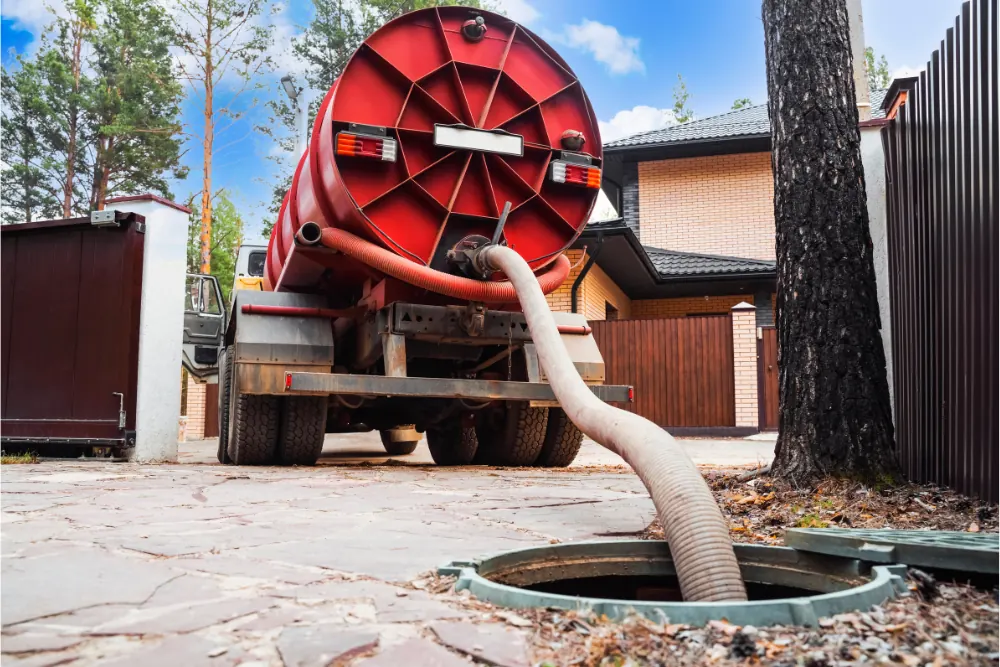
Clean septic tank in Dubai: what we do
- Arranging the pump-out. A licensed tanker empties the tank, and we measure and inspect it.
- Reading the tank before and after. Scum and sludge depths, liquid level, lids, inlet, outlet and filter, with photographs. See septic tank and STP services for the full set of rules and types.
- The outlet filter. Inspecting and rinsing it where the tank has one.
- The pipes either side. The line from the building to the tank, and the line out. See drain jetting and sewer line.
- A leaking or cracked tank. Finding it and quoting the repair.
- Emergency visits. We answer calls and send a plumber 24 hours a day, 7 days a week, including nights, weekends and public holidays.
- Areas. Across Dubai. The list is near the end of this page, and the full list of areas is on its own page.
What cleaning means: eight jobs under one word
Quotes for cleaning a septic tank can mean very different things. These are the eight jobs a quote may include:
| Job | What it is |
|---|---|
| 1. Pump-out | A tanker empties the tank through the main lid |
| 2. Measuring | Scum, sludge and liquid depths recorded before and after |
| 3. Inspection | Looking at the lids, baffles, walls, inlet and outlet from the surface |
| 4. Outlet filter | Lifting and rinsing the filter, where the tank has one |
| 5. Washing the tank | Rinsing the walls with water as the tank empties |
| 6. Pipes either side | Jetting or clearing the line to and from the tank |
| 7. Disposal paperwork | The tanker's permit, load count and where it discharged |
| 8. Repair advice | A written finding if the tank is cracked or leaking |
The practical way to read a quote is to ask which of the eight rows it contains, one by one. A price for the first row only is a pump-out. A price for all eight is a different service with the same name. Scrubbing and disinfecting a tank are sometimes added, and they are not needed on an ordinary septic tank, because the tank works through the bacteria in it.
Leave something in the tank, or take it all out?
For a conventional septic tank, we have everything pumped out so the tank can be measured and inspected. A treatment plant is different, and the maker's manual decides what stays in it, because the biology has to restart. If the tank maker gives an instruction, follow it. See septic tank and STP services.
How many tanker loads is my tank?
A tank is cleaned by the load, and the load count follows from two numbers: the tank's volume and the tanker's.
The tank's volume. For a rectangular tank, length times width times the depth of liquid. For a round tank, pi times the radius squared times the depth.
- A rectangular tank, 3 m by 2 m, liquid depth 1.8 m: 3 times 2 times 1.8 is 10.8 m³.
- A round tank, 2.4 m across, liquid depth 1.8 m: pi times 1.2 squared times 1.8 is 8.1 m³.
The liquid depth is the distance from the bottom to the outlet pipe, because the liquid level sits at the bottom of the outlet pipe. Measuring a tank means opening a lid, which is a gas hazard, and the safety section below covers it.
The tanker's volume. Tankers differ in size, and a tanker may be described in different volume units. Ask the operator for the volume in cubic metres. As an illustration, here are the loads for a 10 m³ tanker and a 20 m³ tanker:
| Tank volume | Loads at 10 m³ | Loads at 20 m³ |
|---|---|---|
| 5 m³ | 1 (half a load) | 1 (a quarter) |
| 10 m³ | 1 (a full load) | 1 (half a load) |
| 20 m³ | 2 | 1 (a full load) |
| 40 m³ | 4 | 2 |
| 60 m³ | 6 | 3 |
The same tank can be one trip or two, depending only on the truck. Two further points:
- A tank is not always full to the brim. Pumping takes out what is there, and the load count follows the contents. A tank that overflows is full.
- A load count is not a price. A quote per tank, per trip, per hour or per cubic metre cannot be compared until you know the number of trips. Ask for the number of loads the operator expects and the volume of its tanker.
Time on site is the other number: a load takes about an hour to pump, and a queue at the disposal point can add to it.
How fast the solids build
Solids build up at a rate set by the number of people, the tank size and what goes down the drains. The same tank used by twenty people fills about five times faster than when it is used by four, and a tank twice the size takes twice as long to fill. Camps, kitchens and offices send different loads, and a kitchen or a garbage disposal adds solids faster. Annual emptying is not always better, because it removes the bacteria that break down solids, and a tank that serves a camp or a restaurant may fill in weeks. A family tank is commonly emptied every one to three years, and the figure differs because the tanks and the loads differ.
The practical answer is a measurement and a record. Measure the scum and sludge at each visit, note the date, and set the next visit from the rate of build-up since the last. For a tank that fills in weeks, the interval is a matter of the tank's volume against the occupants.
Measuring before the pump-out
Three readings, each with a different sign:
| Test | What to know |
|---|---|
| Scum depth | Pump if the scum layer has built up to near the bottom of the inlet baffle or tee. Measured with a stick fitted with a foot, so the layer's underside can be felt |
| Sludge depth | Pump if the sludge is a third or more of the liquid depth. Measured with a stick wrapped in cloth, which shows the sludge line when lifted |
| Liquid level | The liquid should sit at the bottom of the outlet pipe. Above it, pump the tank before touching the screen. Below it, the tank may not be watertight |
One third of the liquid depth:
| Liquid depth | One third of it |
|---|---|
| 1.2 m | 0.40 m |
| 1.5 m | 0.50 m |
| 1.8 m | 0.60 m |
| 2.0 m | 0.67 m |
The stick tests need a lid open, and the open lid is the hazard. Record the readings before the pump-out starts. A tank that reads empty before the tanker arrives is a different problem from one that reads full, and the leak section below says why. Nobody climbs into a tank to measure it.
A pump-out done properly
Before the tanker starts
- Be there. The homeowner or a representative should be present.
- Mark the lids. If the access ports are buried, have risers fitted to the surface, so the tank's position is marked for next time.
- Read the levels. Scum, sludge and liquid depth, with photographs, before anything moves.
While it pumps
- Pumping goes through the large central lid. Not through the small inspection ports, and never with the tank being pumped while a hose is left to push solids back into the drain field.
- Watch the hose and the lid. Nobody leans over the open tank.
After the tank is empty
- Inspect from the lid. Walls, baffles or tees, inlet and outlet, with photographs.
- Clean the outlet filter, if there is one, as the next section describes.
- Check the covers. A bad cover can collapse and be fatal to someone walking over it.
- Secure the lids and leave the area clean.
- Keep the paper. Photos of the levels, the loads and the disposal point.
The outlet filter: cleaning the trap
A filter or screen on the outlet pipe holds back solids that would otherwise leave the tank. The word trap also names a grease trap, which is a different thing with its own page, grease trap.
| When | How |
|---|---|
| Inspect every 6 to 12 months, depending on the filter and the use, and clean it when the tank is pumped | Check the liquid level first. Remove the screen only if the level is at the bottom of the outlet pipe |
| To clean it | Hose it so the solids wash back into the tank. With no hose, use a spray bottle of water with a drop of detergent. A badly clogged filter may need a brush in soapy water |
| At the pump-out | Pull it out through the inspection port above the baffle and hose it off |
A filter that clogs inside six months is telling you about the load: too much grease, hair or paper, or a tank that is too small for its users. Check those before changing the filter.
The rules are plain: do not enter the tank for any reason, and do not remove the screen if the liquid is above the outlet pipe, because the tank has to be pumped first. Wear waterproof gloves and safety glasses, and keep the washings off the ground.
The pipes to and from the tank
Septic tank pipe cleaning is a separate job from pumping, and it has its own pages: drain jetting, sewer line and drain unblocking.
If fixtures back up and the liquid in the tank is low, the blockage is in the pipe between the building and the tank. If the liquid is high, the tank or its outlet is full, and pumping comes first. Jetting a line into a tank that is full pushes water into a tank that cannot take it, so the tank's level is the first reading. The camera and the jetting belong to the pipe visit and not to the pump-out.
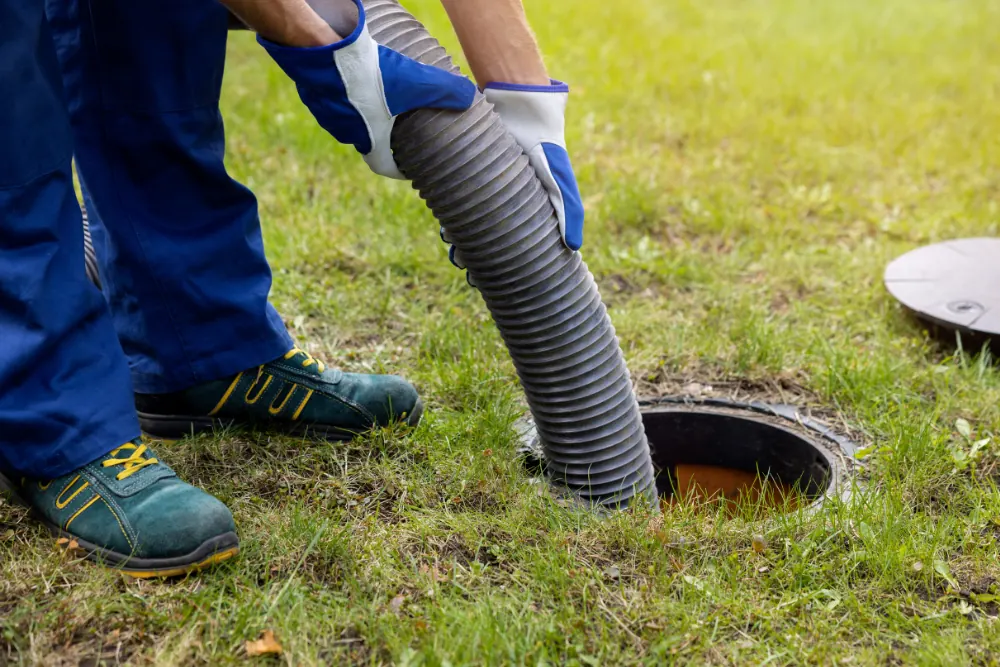
Bio products and tank cleaners
Bio products, enzymes and tank cleaners are sold as a way to avoid pumping. They are not a substitute for it. Sewage already carries the bacteria a tank needs, additives are not needed to help it break down, and relying on them instead of pumping can lead to the whole system failing. Some additives can harm the tank, the drainage field or the environment.
For day-to-day care, use cleaning products labelled as suitable for septic tanks, use them little and often, and keep to the same products each time. Ask any operator who offers an additive to name it and say what it contains.
Septic tank, sealed tank or plant: what cleaning means for each
The same word is used for three different jobs.
| System | What cleaning means |
|---|---|
| Septic tank | A pump-out of the tank, measuring and inspection, and the outlet filter. The liquid leaves through the outlet to a soakaway or a drain |
| Sealed holding tank (cesspit) | A sealed pit with no outlet, so it fills and must be emptied on a schedule set by the fill rate, which can be every fortnight in a busy property |
| Treatment plant (STP) | Pump-out and cleaning follow the maker's manual, because the biology has to keep working. See septic tank and STP services |
A tank that is emptied every fortnight has an interval set by its fill rate, not by the build-up of solids. If you pay by the trip, the number of trips a year is the figure to watch, and a sudden change in it points to a leaking fixture or a leaking tank. A single leaking toilet can waste hundreds of litres a day.
A tank that may be broken
| Sign | What it points to |
|---|---|
| Liquid sits below the outlet pipe | The tank may not be watertight |
| A cesspit needs emptying less often than the expected rate | It is possible the tank is leaking |
| Cracks in the walls, or damaged baffles or tees | Found by inspection after pumping |
| Surfacing sewage | The system is malfunctioning and needs repair or possible replacement. Do not cover it with fill, because that can make it worse |
The tests are a fill, mark and watch, or a camera survey. See leak detection. A repair or a replacement is a quote of its own.
Who may take the waste
Septic waste may only be taken by a licensed tanker and discharged at an authorised point, and an operator that dumps illegally is the one at risk. Our septic tank and STP page has the detail.
Ask the operator for its permit, whether the vehicle is registered and tracked, and the place where each load is discharged. Keep the transfer note or receipt. The owner is responsible for the tank, so if your tanker is unlicensed, you are its customer.
Safety at the lid
The gas risks and the confined-space rules are on sewer line repair and cleaning and are not repeated here.
- Never enter a septic tank. The gases can kill a person in a matter of minutes.
- Covers. A bad cover can collapse under someone walking over it.
- Washings stay in the tank. Never leave screen cleanings on the ground, because raw sewage in the yard is a public health hazard.
Measuring a tank, lifting a filter and checking a baffle are all done from the surface, and the tanker's hose does the work inside.
Permission in Dubai: who decides on a tank pump-out
A pump-out changes nothing in the building, so the permission questions are about who pays and who may instruct. A shared tank in a building is managed by the building, and its management would instruct the tanker. A change to the tank itself, such as a repair, a riser or a replacement, is a change and needs written consent. Tell us what your building asks for and we work to it.
When the job is finished
Ask for these. They cost nothing to produce.
- The levels before and after, in millimetres, with the date.
- Photographs of the lids, the inside of the tank from the lid, the baffles or tees and the filter.
- The number of loads, the tanker's volume and the disposal point.
- The operator's permit, and the vehicle's registration details.
- Findings: cracks, missing caps, a filter state, a level below the outlet.
- The next visit date, set from the build-up since the last visit and not from a calendar.
- FAM's workmanship warranty, in writing. The warranty runs for 30 days and covers our labour only. Parts carry the manufacturer's warranty only.
How we work
- You message us with the tank's position, its approximate size, how many people use it, the date of the last pump-out and photographs of the lid.
- We say what we think is happening, which of a pump-out, a pipe fault or a leak fits the signs, and which operator would attend.
- We give a price in writing, with the loads expected and the tanker's volume.
- Check permission. In a rented or managed property, ask the landlord or building management whether they need to approve this work before the visit.
- We measure first, then the tanker pumps, then we inspect from the lid and rinse the filter where there is one.
- We clear up and leave the lids secure.
- We hand over the levels, photographs, load count, disposal point and the next date.
Where we work in Dubai
We cover all of Dubai, including Dubai Marina, JBR, Downtown Dubai, Business Bay, Jumeirah Lakes Towers, Palm Jumeirah, Al Barsha, Jumeirah Village Circle, Dubai Hills, Mirdif, Deira and Al Quoz. See the full list of areas.
Signs that a tank is full
A full septic tank tells you before it overflows. Basins and showers drain slowly, toilets gurgle or flush weakly, and there is a smell near the tank lid or in the garden. A green, wet or spongy patch on the ground above the tank or the soakaway, or sewage showing at a manhole, means the tank or its outlet can no longer take the flow. If the signs appear in several fixtures together, the tank is the first suspect. If only one fixture is slow, the pipe from that fixture is. We read the liquid level before anything else, because a tank with the liquid above the outlet pipe needs pumping before any pipe is jetted.
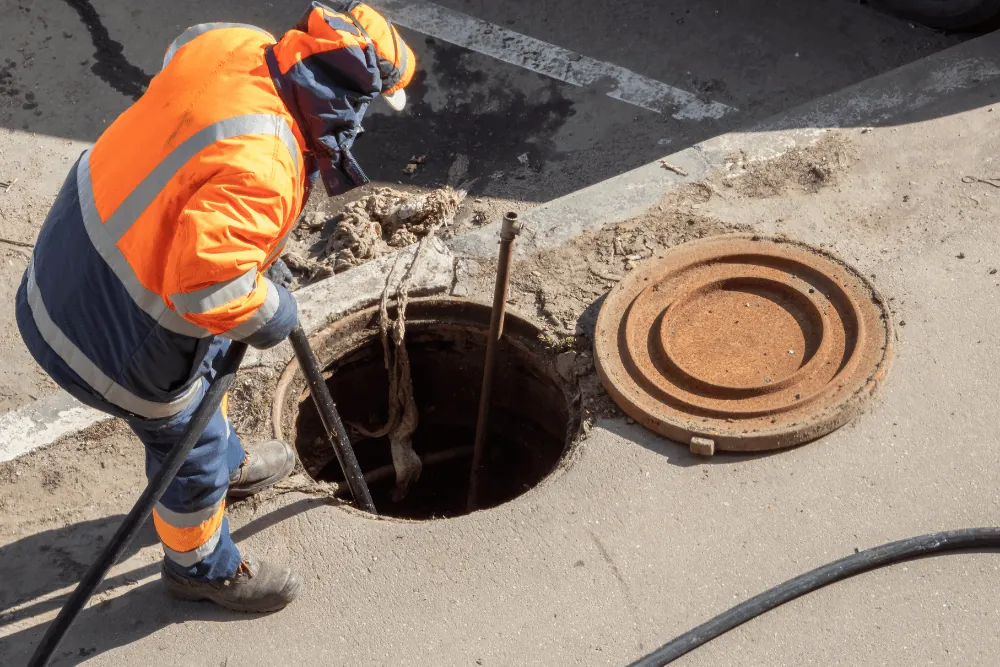
What the tanker crew does, and what you should see
The tanker backs up as close as the hose allows, and the crew opens the main lid and puts the hose in. You should see the hose go through the large central lid and not through a small inspection port. The crew should not stand over the open tank, and you should not either. While it pumps, a good crew lifts the hose to reach the walls and the corners, and watches the level drop. Ask how many loads they expect, and ask them to show you the empty tank from the lid before they close up. A crew that wants to leave a tank part-full, or that does not open the lid properly, has not cleaned it.
Tanks in villas, compounds and labour camps
A villa tank usually serves one family and is emptied at long intervals. A compound or labour camp tank serves many people and fills quickly, so the interval is set by the fill rate and a routine visit schedule works better than waiting for a back-up. Kitchens that wash food waste into the tank, or a camp laundry that drains to it, change the load. If a tank serves a camp, we fit lids or risers at ground level so it can be reached without digging, and we keep a record of each pump-out so the interval can be set from evidence.
The inspection chamber before the tank
Many tanks have a small inspection chamber on the pipe before the tank. It lets us see the flow arriving and rod the pipe if it blocks. If the chamber is full and the tank is not, the blockage is between the chamber and the tank. If the chamber is empty and fixtures back up, the blockage is between the building and the chamber. Finding this takes minutes, and it saves jetting a line that was never the problem. The chamber lid is heavy and the chamber is a gas hazard, so we open it, and you do not.
Lids, risers and finding the tank next time
A buried lid is the reason many tanks go unpumped for years. A riser is a short concrete or plastic collar that brings the lid up to ground level, so the tank can be found, opened and checked without digging. We recommend one where the lid is buried, and we mark the position on the record so the next visit starts at the right place. The lid must close firmly and be heavy enough, or locked, so a child or a pet cannot lift it. A cracked or thin cover is a danger to anyone walking over it, and we flag it on the note. Where the tank is under a driveway, a rated cover is used, and we tell you if the one fitted is not strong enough for a vehicle.
Why a tank was pumped but still smells
If the tank has been pumped and the smell is still there, the source is not the tank contents. A dry trap at a rarely used fixture, a missing vent cap, a cracked inlet pipe or a lid that does not seat all let gas out. We trace the smell by testing each fixture's trap and the vent, and we check the lid seal. A smell only after rain can mean the tank is taking in surface water, which fills it quickly and pushes gas back along the pipe.
Preparing the property for a clean
A pump-out goes smoothly when the property is ready. A few things help:
- Know where the tank and the cover are. If the cover is buried, mark it and uncover it before the tanker comes.
- Clear access for the tanker. Move cars, plant pots and bins. Make sure the gate is open and the tanker can reach within its hose length.
- Tell neighbours. A tanker is large and can smell for a short time.
- Limit water use for a few hours before the visit, so the tank is not being filled as it is emptied.
- Keep children and pets away from the cover and the hose.
- Have the previous record to hand, if you have one.
Odours after a clean
A tank that has just been emptied can smell for a day or two as gas escapes from the open cover and the pipe. A strong smell that continues needs a check of the cover seal, the vent and the inlet. A tank cleaned with chemicals can lose its bacteria, and the smell can worsen. Leave the tank to refill and settle. Do not add products unless a qualified person advises it.
When a tank keeps filling fast
If the tank fills much faster than it should, ask these questions:
- Is there a leaking tap or toilet feeding it constantly?
- Is rainwater or garden water entering it?
- Is the ground water high around the tank, and is water leaking in?
- Is a laundry or a pool backwash draining to it?
- Has the number of people in the house changed?
Finding the extra water costs less than emptying the tank every few weeks. We trace the sources on the plumbing side and tell you what we find.
How much does cleaning a septic tank cost in Dubai?
- Per trip. With the loads table above, a 10 m³ tank is one trip, and a 40 m³ tank is two to four depending on the tanker.
- Per tank. Ask what volume the price covers and what happens if the tank needs a second load.
- Per hour or by the cubic metre. Ask for the hours or the volume you are being charged.
- Waiting at the plant. A queue at the disposal point can add hours, and some operators charge for the time.
- Access. Buried or locked lids, long hose runs, gated plots and building rules.
- Inspection and filter. Whether the visit includes measuring, a look inside and the filter.
We do not publish a starting price for this job. Send a photo on WhatsApp and we give you a fixed price before we start. Prices exclude 5% VAT.
Clean septic tank FAQs
How often should I clean my septic tank?
Measure the scum and sludge each visit and set the next date from the build-up. As a guide, every one to three years is common for a family tank, and a tank serving many people needs it far more often.
What does cleaning a septic tank include?
Pumping out the tank, measuring the levels and inspecting the baffles, walls and lids. Ask which of the eight jobs on this page a quote contains.
How many tanker loads does my tank need?
Divide the tank volume by the tanker volume and round up. A 20 m³ tank is one load of a 20 m³ tanker and two loads of a 10 m³ one. Ask the operator the volume of its tanker in cubic metres.
How long does it take?
A normal domestic tank takes about one to two hours to pump out and wash, depending on its size, how full it is and how close the tanker can park. A large tank, or a treatment plant with several chambers, takes longer.
Should liquid or sludge be left in the tank?
For a conventional septic tank, take everything out so it can be measured and inspected. For a treatment plant, follow the maker's manual, because the biology has to keep working.
Do I need to clean the outlet filter?
If the tank has one, yes. Do not remove it if the liquid is above the outlet pipe. Pump the tank first.
Do bio clean products or enzymes replace pumping?
No. Additives do not replace pumping, and some can harm the tank or the drainage field. Pump on schedule, and ask any operator offering an additive to name it and say what it contains.
How can I tell if my tank is leaking?
Signs are wet ground above the tank, liquid sitting below the outlet pipe, or a cesspit that needs emptying less often than before. A camera survey or a fill, mark and watch test settles it.
Who can legally take the waste away?
A licensed tanker that discharges only at authorised municipal points. Ask for the permit, the vehicle registration and the disposal point.
How much does it cost to clean a septic tank in Dubai?
It depends on the tank size, the number of loads and the access. Ask for the number of loads and the price in writing before the tanker arrives. We give a fixed price on WhatsApp, and prices exclude 5% VAT.
Book a septic tank cleaning in Dubai
Tell us where the tank is, its approximate size, how many people use it, when it was last emptied and whether you own or rent. A photograph of the lid helps. If the tank is overflowing or sewage is rising inside, stop the water use and call. We will find out what is happening, give you a price in writing, arrange the work and hand over a note.
WhatsApp: +971 55 407 7427 · Request a quote
Visit us: Office 871, Oasis Mall, Al Quoz 1, Dubai, UAE
Related services: Septic tank and STP · Sewage treatment · Sewer line · Drain jetting · Drain unblocking · Drains overview · Grease trap · Leak detection · Emergency plumber · how plumbing works in a Dubai home