
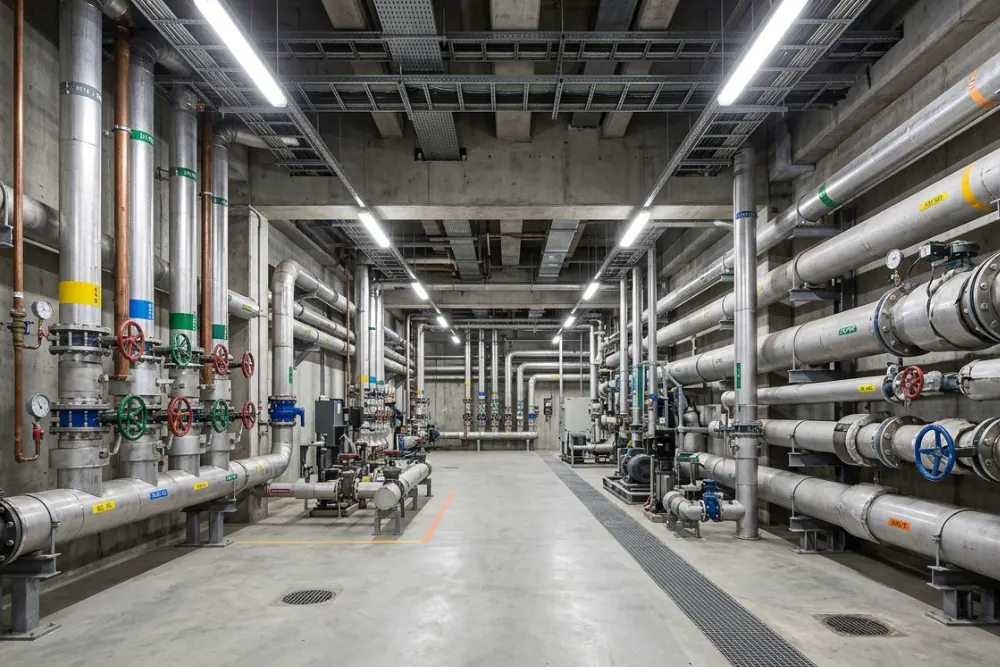
Plumbing maintenance in Dubai: what we do
- A written scope and schedule. We walk the property, list what is in it (tanks, pumps, valves, heaters, drains, fixtures) and agree which items are visited and when.
- Work from our other pages, booked on a date: water tank cleaning, drain jetting, grease trap cleaning, booster pump servicing and leak detection.
- Call-outs between visits, with the rules for them written into the contract, and emergency attendance set out separately. We answer calls and send a plumber 24 hours a day, 7 days a week, and we do not promise an arrival time.
- Records you can show a landlord, building management, an owners' committee or an auditor.
- Terms in writing. Visit frequency, call-outs, parts, exclusions and cancellation are written into the quote, and nothing is left to a verbal promise.
The detail of each system has its own page, and we link to it rather than repeat it. This page is about the contract that sits around the work: what it should say, what it can leave out, who signs it and who pays. We do not carry out gas work or fire-system work, so neither is in a FAM plumbing contract.
What a plumbing AMC is, and what it is not
There is no standard AMC. Two documents with the same title can differ in what is visited, what a call-out costs and who buys parts. Read the paper and not the title.
Planned visits and call-outs are different things
| Planned visit | Call-out | |
|---|---|---|
| Who decides when | The calendar in the contract | A fault |
| What happens | Inspection, testing, cleaning and small adjustments from a list | Diagnosis and repair of what failed |
| What it does | Can find a fault before it fails, and can find nothing | Responds to a fault that has already happened |
| Where the cost sits | In the annual fee, if the contract says so | In the fee, in a per-job charge, or in neither, depending on the wording |
Ask how many call-outs are included and what the response times are. Burst pipes, floods and sewage backups are on the emergency plumber page, and whether an AMC covers them is a clause to read, not an assumption to make.
Three shapes of contract
| Shape | What you pay | What you still pay for | Where it fits |
|---|---|---|---|
| Visits only | A fee for scheduled inspections and cleaning | Every repair, with its labour and parts | A property that needs records and regular checks |
| Visits plus labour | A fee for visits and for call-out labour on covered items | Parts, and anything the contract excludes | A property with a lot of fixtures, where labour is the main cost |
| Visits, labour and parts | A higher fee for all of the above | Excluded items and replacements | A property that wants a fixed annual figure |
Parts, transport and installation can carry separate charges, so check how parts are sourced and at what price. A contract that does not say who buys parts has left the largest variable cost unwritten.
What a contract usually leaves out
- Concealed or hard-to-reach piping. A leak you cannot see is exactly the kind a plumber is called to find, so see leak detection for what finding one involves.
- Swimming pools. The pool side is on pool plumbing.
- Capital replacements. Items such as a new tank, a new pump or a sewer repair should be listed as excluded in writing, with a price on request.
- Pre-existing faults. A fault found on the first visit is usually quoted separately.
Who needs a plumbing AMC, and who does not
A contract suits landlords with several properties, commercial premises and large or problem-prone properties. An owner-occupier of a flat may be better served by occasional professional visits and a record of what was done.
| Property | What a contract adds | What to ask before signing |
|---|---|---|
| Villa you own | Tanks, pumps and drains on a calendar, so recurring jobs have dates | Whether the tank, the pump and the garden lines are all named, and whether a pool is excluded |
| Flat you rent | Less, because the landlord usually looks after the major systems | Whether the landlord already has a contract, and whether you may sign one without consent |
| Landlord with several units | One agreement and one set of records instead of several contractors | Whether each unit is scheduled, and how access is arranged |
| Building run by an owners' committee | A record of the maintenance the management company says it does | Who signs, and how the cost enters the service charge |
| Shop or office | Planned work outside opening hours and a report for the landlord | Which fixtures and which hours |
| Restaurant or café | Grease trap, floor drain and water heater checks on a fixed cycle | The trap interval, and who removes the waste |
| Labour accommodation | A schedule across many fixtures, where a missed fault affects many people | The number of fixtures and the access rules, since more fixtures make a written schedule more useful |
| Vacant or holiday home | Regular flushing, because stagnant water loses its chlorine residual and goes off | Who has the key, and how often someone flushes every outlet |
The vacant case matters in Dubai. Water that sits in a pipe or tank in a home nobody is using can go stale, so outlets are flushed on a schedule. The routine is set out in the water section below.
What a planned visit checks
This table sets out what a visit looks at, and the linked page has the detail.
| System | What a visit checks | Detail |
|---|---|---|
| Water tanks | Cleaning and disinfection. Float valve, overflow and cover checks | Water tank cleaning, tank installation and repair |
| Pumps | A test run, pressure, noise, vibration, leaks at the seal, the controller and the pressure tank | Booster pump, low water pressure |
| Valves and shut-offs | Exercising isolation valves so they turn when needed, and checking for seepage | Valve repair and replacement, pressure valves |
| Backflow devices | Testing with documentation, as an addition for commercial agreements | Backflow prevention |
| Grease traps | Full pumping and not skimming, with service records | Grease trap |
| Leaks | Meter test, joints and fittings, corrosion, dye-testing toilet cisterns | Leak detection, pipe leak repair |
| Fixtures | Taps, washers, seals, sanitaryware, and a look under sinks | Tap repair, toilet repair |
| Water heaters | The relief valve, the anode or element where fitted, the thermostat and the connections | Water heater repair |
A list like this is only useful if the contract says which rows apply to your property. A restaurant has a grease trap row and a flat does not, and a villa has its own tank and pump rows where a flat may share the building's. Ask for the property's list in the contract, not a general description of services.
Keeping the water healthy in a building
A building with tanks, a hot water cylinder, showers and cooling water needs a planned routine for the water itself, and not only for leaks and blockages. Water that sits warm in a tank or a pipe can grow bacteria, so tanks are cleaned, little-used outlets are flushed and showerheads are descaled on a cycle. What your building must do is a question for building management, and this page does not answer it. What follows is what a sensible routine looks like.
| Item | What the routine covers |
|---|---|
| Tanks | Cleaning and disinfection on a set cycle, and again whenever a problem is found, followed by a test of the water |
| Hot and cold pipework | Flushing of little-used outlets, and disinfection after work on the system |
| Showerheads and taps | Cleaning and descaling on a cycle, because scale and slime shelter bacteria |
| Temperatures | Hot water stored hot enough and delivered hot, and cold water kept as cool as the building allows |
| Sampling | Samples from the main tank, the heaters and a spread of taps, tested by a laboratory |
| Records | Test results and maintenance logs kept where building management can see them |
What this means for a maintenance contract:
- The schedule is partly set by the building. A building with tanks, a heater and showers needs more than one visit a year. Ask for the cycle for each item in writing.
- A plumber's visit does not replace the laboratory. Sampling and testing belong with a laboratory, and a contract can arrange for samples to be taken and sent.
- The records are part of the job. A contract should say who keeps the logs.
The tank side is on our water tank cleaning page, and the testing side is on water quality testing.
How often
These are typical intervals. The property, the system and the building's rules set the real ones.
| Item | Typical interval |
|---|---|
| Preventive visit, residential | One or two a year |
| Commercial visits | Quarterly, semi-annual or annual, by building type, system complexity and use |
| Holiday home | Every two months |
| Vacant property | Quarterly |
| Drain jetting, accessible runs | Quarterly |
| Drain camera survey | Annual |
| Kitchen drain hydro-jetting | Quarterly |
| Grease trap | Set by how much the kitchen produces. See below |
| Water heater flush | Annual |
| Tank cleaning | Twice a year is common for building tanks. See below |
Tank cleaning
Twice a year is common for the tanks and filters of a larger building. A contract that books one clean a year is worth questioning, so ask what your premises need and who decided it.
Grease traps
No single interval suits every kitchen. Our grease trap page explains how to judge it. In a contract, the interval for a kitchen is better written as a depth trigger with a maximum number of days than as a single fixed number.
Who is responsible, and who signs
Landlord and tenant
- A landlord can hire a maintenance company, but the landlord stays the one the tenant deals with.
- Small repairs may be a term of your agreement. Some agreements set a limit under which the tenant pays minor repairs. A plumbing AMC signed by a tenant should state the limit it assumes, or it has settled nothing between tenant and landlord.
Who signs in practice
A tenant may arrange an AMC but needs the landlord's approval for work on major systems, and an AMC can give a landlord documented proof of maintenance.
| Situation | Starting point |
|---|---|
| Tenant, tank, pump, heater, internal pipework | Usually the landlord's cost, and the landlord decides who services them |
| Tenant wants a contract for a major system | Ask the landlord first, in writing |
| Owner of a villa | The owner signs and pays |
| Landlord of several units | The landlord signs, and tells each tenant what is scheduled and when access is needed |
We are plumbers, not lawyers, so this is general information.
Buildings with a management company
In a building with shared parts, the management company looks after the common tanks, pumps and risers, and each owner pays a share through the service charge. A contract signed by one owner for a shared tank, pump or riser would cover something the management company is responsible for. For the part inside your unit, your own contract is the right place. Ask management which tanks, pumps and pipes count as common parts.
Permission in Dubai: who has to agree to a maintenance visit
Inspection and cleaning inside your own unit is maintenance. Work on shared parts, or on anything that changes the pipework, brings in other people.
| Job | Starting point |
|---|---|
| Inspecting, testing and cleaning inside your own unit | Maintenance. Tell the landlord and building management, and agree who pays |
| Work on a shared tank, pump, riser or common drain | A common part. The building manager decides access and timing |
| Cleaning a water tank | Tell building management, and ask what proof they want |
| Replacing a part like for like | Maintenance, and a question of who pays |
| Moving pipework, adding a fixture or changing a drain | A change, which needs the landlord's written consent and the building's approval |
| Public sewer chambers | Leave them alone. See manhole and gully |
We cannot say whether your building needs a certificate for a particular job. Building management can, and a request in writing is cheaper than a stopped visit. Tell us what your building asks for and we work to it.
Reading the contract: the clauses that decide what you bought
Read each clause before you sign, and ask for anything missing in writing.
| Clause | What to look for |
|---|---|
| Visit frequency | A number and a month for each item, and what happens when a visit is missed |
| Call-outs included | How many, and whether they are free, reduced or at standard rates |
| Response time | A number, from when to when, with a remedy if it is missed |
| Parts | Who buys them, from whom, at what price, and whether a markup applies |
| Exclusions | Concealed piping, pools, water heater replacement, force majeure, pre-existing faults |
| Cancellation | Notice, any lock-in for the full year, and any refund for missed visits |
| Reporting | A written report with photographs after every visit |
| Disputes | The forum and the order of steps |
Red flags
- A narrow emergency definition that counts only a complete shutdown.
- Verbal promises in place of a written list of inclusions and exclusions.
- No written service level, or a provider that offers none.
- Parts at cost plus a markup with no price list.
- A full-year lock-in with no right to cancel.
- No photographs or written record of a visit.
- Broad exclusions. A contract that excludes concealed piping excludes the leaks you cannot see, which is why leak detection is a separate job.
Response times
Response times in contracts range widely, from a few hours for a priority customer to a day or two for others, and some contracts set no figure. A response time is only a commitment if three things are written beside it: where the clock starts, what counts as an emergency, and what happens if the time is missed.
Our position is stated plainly. We answer calls and send a plumber 24 hours a day, 7 days a week, and we do not promise an arrival time. If a contract of ours includes a response commitment, it is written into that contract, with those three points beside it.
Records, reports and logbooks
A maintenance contract produces records, and they are the evidence of what was done and when.
- After each visit. A completed checklist, notes on problems found and documentation of work done or recommended should follow every visit.
- For the building. Maintenance records and test results should be kept where building management can ask for them.
What a visit report should hold:
- The date, the time in and out, and who attended.
- Each item on the schedule, with what was done and what was found.
- Readings that were taken, such as temperatures, pressures or trap depth.
- Photographs, before and after, of anything repaired or found wrong.
- Recommendations, each marked as urgent, soon or watch.
- What was not accessible and why.
- The next visit date.
What a good first visit looks like
On the first walk-through we do not start by fixing things. We look at the whole property and write down what is there: the tank and its float, the pump and its pressure switch, the heaters, the main and isolation valves, the drains and gullies, and the fixtures. We run each tap, flush each toilet and open each valve once. We note what is worn, what is missing, such as an isolation valve nobody fitted, and what is fine. You get a short written list in three groups: needs attention now, worth doing soon, and watch. From that list we write the schedule, so the contract fits the property and not a template.
Keeping a rented flat or a vacant villa in good order
An empty home is the home most likely to have a bad surprise. Nobody hears a drip, nobody sees a stain and nobody runs the taps. If you are away, close the main valve and switch off the water heater. Ask someone to run each tap and flush each toilet for a minute every week or two, and to pour water into floor drains and balcony gullies so the traps stay full and smells stay out. In summer, ask them to look under sinks and at the ceilings below bathrooms. If a tank feeds the home, have its float and cover checked before you leave. A planned visit while you are away costs less than the cleaning and repair after a slow leak.
What a contract can do for a restaurant or a café
A kitchen is the hardest place for plumbing. Grease, food waste and long hours of use put heavy loads on the drains, the trap and the water heater. A contract built around a kitchen schedules the grease trap and floor drains on a fixed cycle, checks the hot water at the kitchen sink and the dishwasher, looks at the hand-wash basins and staff toilets, and keeps a log you can show the landlord. It also names who calls us when the kitchen backs up during service, and what we do first. A kitchen that closes for a blocked drain loses a day of sales, which is usually more than a year of planned visits would have cost.
Does planned maintenance pay for itself?
It depends on how often your property would otherwise call a plumber, and a contract is not automatically cheaper. A fee is hard to justify where the systems are young and under warranty, and easier to justify where tanks, pumps and kitchens need regular attention and records.
The method is the useful part: add up what you paid for call-outs in the last year, and compare it with the quote. Divide the yearly price of the contract by the price of one call-out, and the answer is the number of call-outs at which the contract breaks even. If the contract also includes planned cleaning and records you would pay for anyway, the break-even comes sooner. If your property rarely has a fault and needs no records, pay-per-job is cheaper.
Warranty and the handover
Beyond the visit reports above, what you should have at the end of the term:
- A repair log that records what was fixed, what was deferred and why.
- A list of what is out of scope and what is recommended, with a price where we can give one.
- A valve map and an equipment list, so the next contractor does not start from nothing.
- FAM's workmanship warranty, in writing. The warranty runs for 30 days and covers our labour only. Parts carry the manufacturer's warranty only.
How we work
- You tell us what you have: the property type, the systems, the age of the building, any tanks, pumps, heaters, pool or kitchen, and who owns it.
- We walk the property and list the equipment, the shut-off points and the problem areas. The visit fee is AED 50 + VAT, credited if the work goes ahead.
- We write the scope and schedule, with what is visited, how often and what is excluded.
- We give the price in writing, with parts, call-outs and after-hours work stated.
- Check permission. In a rented or managed property, ask the landlord or building management whether they need to approve this work before the visit.
- We carry out each visit and give you the report with photographs.
- We review at renewal, with the record of visits and findings, and change the schedule to match.
Where we work in Dubai
We cover all of Dubai, including Dubai Marina, JBR, Downtown Dubai, Business Bay, Jumeirah Lakes Towers, Palm Jumeirah, Al Barsha, Jumeirah Village Circle, Dubai Hills, Mirdif, Deira and Al Quoz. See the full list of areas.
What a good maintenance record looks like
A maintenance record lists the date of each visit, what was checked, what was found, what was done and what needs doing next. It also lists the valves, the heaters, the pumps and the tanks, with their model numbers. A record like this is a useful asset when you sell, rent or claim on insurance.
A maintenance plan by property type
The checks that matter depend on the property. A flat, a villa and a shop need different attention.
A flat. Check angle valves and hoses under each basin, sink and toilet, the washing machine and dishwasher hoses, the water heater and its relief pipe, floor drains and balcony drains, the silicone around showers and baths, and the main valve at the riser. Tell building management about anything on a shared pipe.
A villa. Add the roof tank cover and float valve, the pump and its pressure switch, the garden taps and irrigation, the external drains and manholes, the septic tank or the connection chamber, and the pool plumbing if there is a pool. Check the roof after heavy rain.
A shop or an office. Add grease traps if there is a kitchen, the staff toilets and their flush valves, the hand dryers and taps, and the water heaters for any pantry. Keep a log of cleaning and checks for the landlord.
Each plan works best as a short list, done on a set date each season. A planned visit finds a worn washer or a seized valve while it is cheap. A call-out at midnight finds it when it is not. The price is fixed on WhatsApp before we start. Prices exclude 5% VAT.
If you are choosing who will look after a building's plumbing, how to choose a plumber in Dubai covers the questions to ask and how to read what a plumber tells you.
How much does a plumbing maintenance contract cost in Dubai?
A contract is priced to the property. We do not publish a starting price for this job. After the walk-through, or from photos on WhatsApp, we give you a fixed price in writing before we start. Prices exclude 5% VAT.
What sets the price on a contract
- The number and type of systems. A tank, a pump, a heater and a kitchen each add to the schedule.
- Visit frequency. A quarterly drain visit costs more than an annual one.
- Parts. Whether they are in the fee or billed separately.
- Response commitment and after-hours cover.
- Access. Shared plant rooms, shafts and building rules add time.
Plumbing maintenance FAQs
What is a plumbing AMC?
An AMC, or annual maintenance contract, is a yearly agreement in which a plumbing company inspects and services the system on a schedule and attends call-outs at an agreed rate. The scope, the number of visits and the exclusions are set in the contract, so read them before you sign. Ours are written around your property.
Does an AMC cover emergencies?
Only if the contract says so. Some companies count only a total shutdown as an emergency. Ask how many call-outs are included. Our emergency plumber page covers what to do when water is already escaping.
Are parts included?
Not unless the contract says so. Parts and further call-outs can carry separate charges, so ask who buys parts and at what price. A contract that includes parts costs more per year than one that does not.
How often should a plumber visit?
The frequency should follow the system, not the contract template. One or two visits a year suits a flat or small villa. A building with tanks, a hot water system and showers needs the more frequent intervals in the table above, and a restaurant needs its grease trap on a short cycle.
I rent my flat. Should I sign an AMC?
Ask your landlord first, in writing. The landlord is responsible for the major systems by default, and a tenant's contract should state the repair threshold it assumes. If your agreement already sets out who pays for what, the AMC should follow it.
Who pays for a maintenance contract in a building with a management company?
The service charge usually pays for the shared facilities. The management company looks after the common parts, so a contract for your unit covers your unit.
How much does a plumbing AMC cost in Dubai?
It depends on the systems, the visit frequency, the parts and the response commitment. We give a written price after the walk-through, excluding 5% VAT.
Can I cancel an AMC?
Read the cancellation clause. Notice periods vary, and some contracts lock in the full year with no right to cancel, which is a red flag. We write the notice and any refund for missed visits into the quote.
Does an AMC replace tank cleaning and water testing?
No. They are jobs the contract can schedule. Sampling belongs with a laboratory, so a contract that schedules cleaning still needs the laboratory result. See water tank cleaning and water quality testing.
How do I know the visits happened?
Ask for a written report with photographs after each visit, and for the checklist to be dated and signed. If a visit is missed, the contract should say what you get back.
Book a plumbing maintenance walk-through in Dubai
Call or send a message with the type of property, what is in it (tanks, pumps, heaters, a kitchen, a pool), the age of the building and who owns it. A photograph of the plant room, the tank or the water heater helps. We will walk the property, write the scope and schedule, and give you a price in writing.
WhatsApp: +971 55 407 7427 · Request a quote
Visit us: Office 871, Oasis Mall, Al Quoz 1, Dubai, UAE
Related services: Emergency plumber · Water tank cleaning · Booster pump · Grease trap · Drain jetting · Leak detection · Pressure valves · Backflow prevention · Water heater repair