
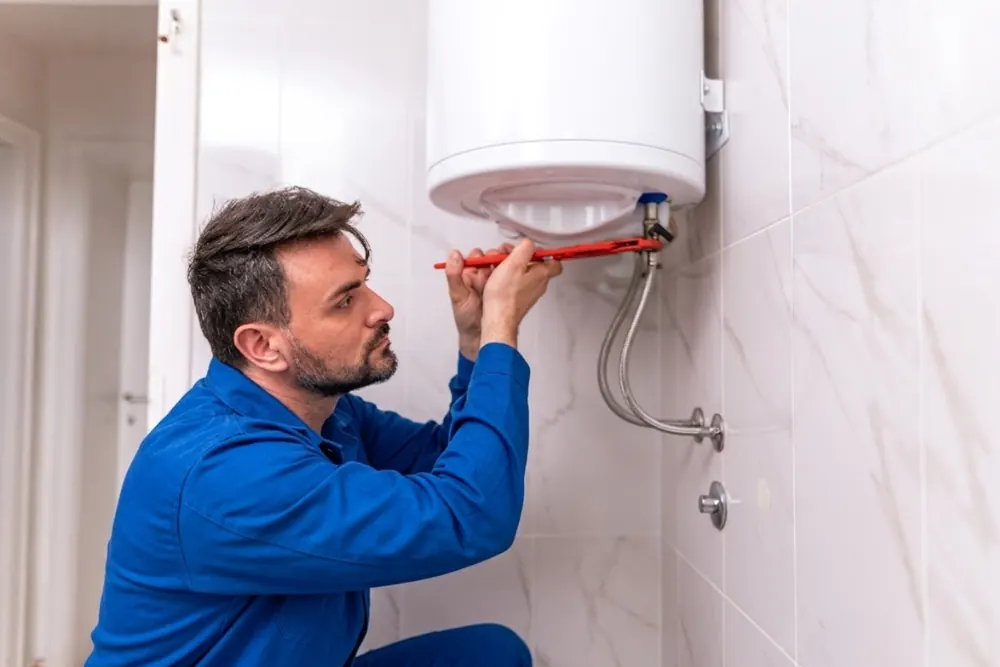
Water heater element replacement in Dubai: what we do
- Diagnosis of the heating circuit. We isolate the heater, test the high-limit cut-out, the thermostats and the elements, and tell you which part has failed and why.
- Element replacement, upper or lower, screw-in or flange type, matched to the label's voltage and wattage.
- Thermostat and high-limit replacement, with the settings recorded and set with you.
- Wiring and terminal checks, including signs of moisture or heat damage. FAM has its own electricians for any electrical work beyond the part.
- Backup elements in solar and heat pump units.
- A written note of the part numbers, the test readings and the settings.
- Emergency visits. We answer calls and send a plumber 24 hours a day, 7 days a week, and we do not promise an arrival time.
Neighbouring topics have their own pages. The fault list for the whole heater, the label, the warranty check and the repair-or-replace decision are on our water heater repair page, and the valves, relief line and scald account on water heater installation. Instant heaters are on tankless water heater. This page is about the parts inside an electric storage heater's heating circuit. We do not do gas work.
How the heating circuit works
The description below is general, and your heater's manual describes your heater.
| Part | What it does |
|---|---|
| Thermostat | A sensor pressed against the outside of the metal tank. It reads the water temperature through the tank wall with a disc of two metals that snaps open or closed as they expand, and it switches an element on or off |
| High-limit cut-out (ECO, energy cut-out) | A safety switch, often in the upper thermostat, that opens and cuts power if the water gets too hot. Many have a red reset button |
| Upper element | Heats the top of the tank, where the hot water is drawn from |
| Lower element | Heats most of the remaining water |
| Terminals and wiring | Carry the supply to the thermostats and the elements |
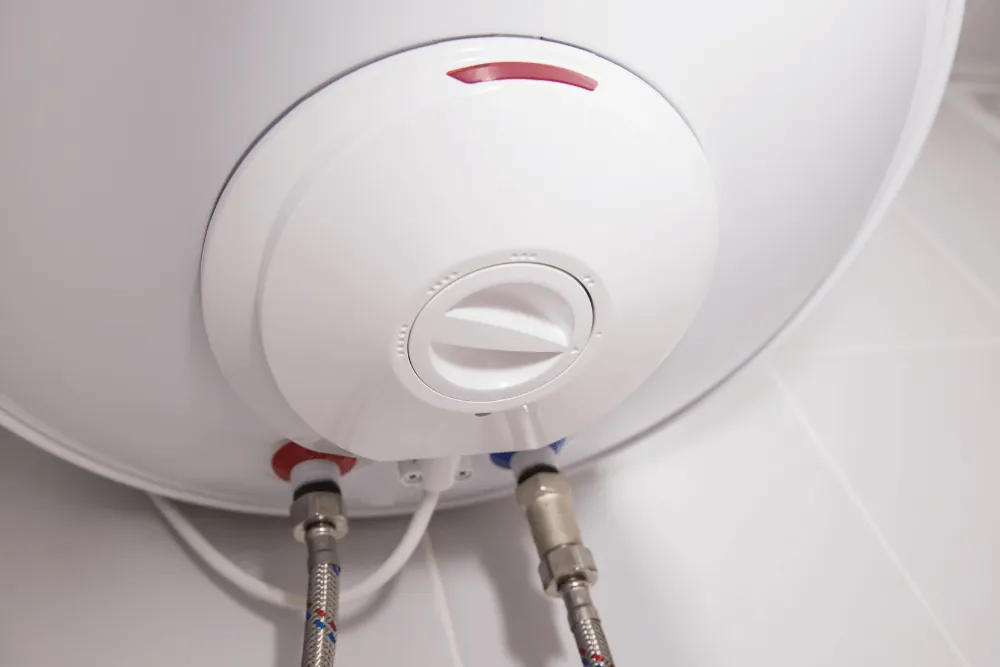
On a heater with a service cover, the upper thermostat sits behind the main access panel and has the large red reset button. Small heaters in Dubai flats often have one element and one combined thermostat, with the controls on a small cover on the side or underneath.
One element or two, and which runs first
Many larger electric tanks have two elements, an upper and a lower, each with its own thermostat, and the upper thermostat has priority and passes power to the lower element once the top of the tank is satisfied.
- Single element. One element and one thermostat, with the high limit in series.
- Double element, non-simultaneous. Only one element operates at a time. The upper heats first, and when the upper thermostat is satisfied, power passes to the lower.
- Double element, simultaneous. Each thermostat and element pair works independently, and both can run together.
A single-element heater has no second element to cover a failed one, so a failure shows up as no hot water and not as less. Our water heater repair page describes tanks with one or two elements.
Which part the symptom points to
A symptom narrows the search, and a test decides it.
| Symptom | What to know |
|---|---|
| Little or no hot water | The upper element, if the heater has two, or the only element if it has one |
| Hot water runs out quickly | The lower element, if the heater has two |
| Sudden loss of hot water | The high-limit cut-out has tripped. Pressing the reset button restores it, with the power off at the breaker first. Rust on the thermostat clip or moisture in the compartment can cause false trips |
| Breaker trips | A cracked element sheath that shorts, or a leak to ground in an element. Inspect both thermostats for moisture or arcing |
| Popping, hissing or kettle-like noise | Sediment and scale around the element |
| Water that loses heat slowly over weeks | A degrading element |
| Water too hot | A thermostat set too high or stuck closed. Switch off and call |
Not every no-hot-water fault is in the circuit. A heater can also run cold because of crossed connections or a broken dip tube, and a loose connection at the breaker can overheat and char wiring. We check the supply, the tank and the wiring as well as the parts.
How the parts are tested
Testing the circuit means working inside a cover that carries mains wiring.
- Thermostat terminals carry live power whenever the breaker is on, so this is not live-circuit work for homeowners.
So this section describes what we test and what the readings mean. It is not a procedure for you to follow. If your heater trips or runs cold, switch it off at its isolator and WhatsApp us.
The order we work in
- Prove the circuit is dead. Turn off the breaker, then confirm with a rated voltage tester or a meter across the thermostat terminals.
- High-limit cut-out. Check it for continuity. No continuity means the thermostat is replaced. If there is no voltage at the thermostat with the power on, the cut-out may have tripped, and with the power off, we press the reset and recheck.
- Thermostats. Check that each closes and opens at its setting and that the sensor is touching the tank wall.
- Elements for continuity. Disconnect both wires and measure across the element terminals. An open reading means a broken element.
- Elements for ground. With the wires disconnected, measure from each terminal to the tank or the flange. Any reading indicates a grounded element, and it must be replaced.
- Wiring and terminals. Look at each connector for scorch marks, moisture or looseness. A scorched terminal is a poor connection that will fail again, so it is cut back or replaced.
What a good element reads
An element is a coil of resistance wire, and its resistance follows from its rating, so each rating has its own expected reading, which the maker gives for the part. A good element reads a steady figure close to that value. A reading of zero across the terminals means a short, an open reading means a break, and any reading between a terminal and the tank or the flange means the element is grounded and must be replaced. We record each reading on the handover note so the next visit can compare.
What we do not do
We do not bypass the high-limit cut-out, we do not reset it repeatedly, and we do not leave a heater with a grounded element in service. A cut-out that trips again and again is telling you something is wrong, and it needs diagnosis, not a stronger reset finger.
Matching the replacement: voltage, wattage, fitting and material
A replacement element has to match the old one in these ways:
| Check | Why it matters |
|---|---|
| Voltage | The same voltage as the heater's label. A wrong voltage changes the power drawn |
| Wattage | Matches the heater's rating. A higher wattage draws more current than the circuit and the cable were chosen for |
| Fitting | Screw-in or flange, thread size or flange pattern, and the gasket |
| Length and shape | The element has to fit the tank without touching the wall |
| Sheath material | Copper, incoloy or stainless. Hard or aggressive water attacks some sheaths faster than others |
The way to know how the water treats an element is to test it. See water quality testing.
Voltage and wattage on the label
Voltage and wattage are printed on the heater's label and on the element, and we match both. An element built for a different voltage draws the wrong power, and one built for a much lower voltage would draw far more than the heater's wiring was chosen for. A higher wattage draws more current than the circuit and the cable were chosen for, so we never fit one to heat faster.
Replace one or both
Check the thermostat at the same time as an element, since both can fail together. On a two-element heater, the second element has seen the same water and the same hours as the first, and the access is already open, so we test it and tell you its reading, and replace it if it is near the edge of the range.
Scale, sediment and dry-firing
Scale is the usual reason an element is replaced twice. Limescale forms on the hot surface of the element, and it insulates the coil from the water, so the element runs hotter and burns out sooner. Sediment at the bottom of the tank can bury a lower element and overheat it.
An element that is switched on without being covered by water, a dry-fire, burns out within moments. That is why we fill the tank, clear the air at a hot tap, and only then switch on. A heater that burns out its element repeatedly is telling you about the water or the sediment, and a new element alone will not change that. We flush the tank and, where the water calls for it, recommend treatment. See water softener.
How we replace an element
- Isolate. Switch off at the breaker, prove the circuit dead, and close the cold inlet.
- Release the pressure and drain. Open a hot tap, then drain the tank to below the element. We plan where the water goes before we start, because a drained tank in a ceiling void is a wet job.
- Disconnect and remove. Take photos of the wiring, disconnect the wires and unscrew or unbolt the element.
- Inspect. Look at the tank interior, the scale on the old element and the thread or the flange.
- Fit the new element, with a new gasket, and tighten it to the maker's torque, without overtightening.
- Reconnect the wires as photographed, with tight terminals.
- Refill and bleed. Open the cold inlet, open a hot tap and let the tank fill until water runs steadily with no air, and check the element joint for a weep.
- Switch on only when the tank is full, and watch the first heating cycle.
- Set the thermostat and record it.
- Check the safety devices: the cut-out, the relief valve and the water temperature at a tap.
Step 8 is the one we hold to most firmly. We watch the water run steadily from a hot tap, and we only then switch on. A heater in a ceiling void means a ladder, a limited reach to the element, a wet drain-down above a finished ceiling, and hot water to manage in a small space, which our water heater repair page covers.
When the part is the thermostat
A thermostat is a control, not a heating part, and it has its own page: water heater thermostat covers the dial marks, the settings, how to measure the real temperature and how a thermostat is replaced. Come back here when the test shows a dead element. If you are unsure which of the two it is, the test sequence further down this page tells them apart, and a photo of the heater label and the dial helps us confirm it on WhatsApp before a visit.
Reading a burnt element
A failed element usually tells you how it failed. A white crust on the sheath means scale held heat in and the element cooked itself. A split or blistered sheath with a dark patch means it ran dry or the water level fell below it. A clean element that reads open on the meter has failed inside, which is wear. A tripped reset button with a sound element points back to the thermostat or the supply. We keep the old element and show it to you, because the way it failed decides whether a new one will last: scale needs descaling and a check of the water, a dry-fire needs the tank and the fill checked, and plain wear needs only the part.
Replace like for like in voltage, wattage, length and fitting, and refit the gasket or seal that came with the new part. Do not reuse an old gasket. After the job we refill the tank fully before power goes back on, bleed the air at a hot tap, and watch the heater run through a first heating cycle if the visit allows it, or ask you to message us if the water is not hot at the usual time.
Backup elements in solar and heat pump units
An element does more than heat a plain electric tank.
- Solar. A solar water heater has an electric backup element that supplies hot water when the sun is not enough, controlled so that the sun does the work first. Faults there are the same circuit faults, and the controls are on our solar water heater page.
- Heat pump. The element backs up the heat pump when demand is high or the air is outside the unit's range. In element-only mode it costs more to run than the heat pump does. See heat pump water heater.
The electrical supply behind the heater
An element draws a steady, heavy load, so a new part is only as good as the circuit feeding it. Our tankless water heater page sets out supply needs for the larger loads. What we do:
- Read the label for the element rating, voltage and phase.
- Check the breaker, the cable and the isolator against that rating.
- Look at the terminals for heat damage, moisture and loose connections.
- Use our own electricians where the work goes beyond replacing a part on a suitable existing supply.
- Check earthing and the disconnection before the heater is energised.
Repair the part or replace the heater
The decision table, with the heater's age and the tank's condition, is on our water heater repair page.
A part on a sound tank is worth fixing, and a leaking tank is not made sound by a new element. A leak at the element flange or the thermostat pocket is a gasket or an element fault, and a leak from the tank body is a reason to replace the heater, as our water heater repair page sets out.
Permission in Dubai: who decides on element work
Replacing a part in a rented flat is a repair, and fitting a different rating or changing the heater itself is an alteration. Where an element or thermostat job falls:
| Job | Starting point |
|---|---|
| Replacing a failed element or thermostat with the same rating | A repair. Tell the landlord first and get the decision in writing |
| Fitting a different rating, such as a higher wattage | A change to the electrical load, so an alteration. Written landlord consent, and a circuit check first |
| Replacing the whole heater | An alteration if the type or position changes. See water heater installation |
Tell us what your building asks for and we work to it.
Signs the element is going before it fails
An element rarely dies without warning. Look for these:
- Water takes longer to heat and is only lukewarm at the usual time.
- Hot water runs out sooner than it used to, or sooner than before on a two-element heater.
- A rumble or crackle from the tank as it heats, which is scale breaking off the element.
- The breaker trips now and then, not every day. An element leaking current to the tank may trip only when it is hot.
- A burning smell or discolouration at the cover plate.
- Rust-coloured or cloudy water from the hot taps only.
Acting early saves the tank. A failing element left in service can pit through its sheath and leak into the tank.
Hot water through the year in Dubai
In summer the cold water arriving from a rooftop or ground tank can already be warm, so the heater has less to do and a thermostat setting left high from winter can give hotter water than you expect. In winter the inlet water is colder, the heater works harder, the elements run longer and a weak element shows up first. A heater that seemed fine in summer may fall short in the first cool weeks, and that is usually when we are called. We note the setting and the inlet conditions at the visit, so the readings mean something.
Heaters in ceiling voids and cupboards
Many heaters sit in the ceiling void above a bathroom or in a kitchen cupboard. Before an element job in either place, we plan:
- Where the water goes. A hose to a floor drain or the bathroom drain, and buckets for the last of it.
- What needs protecting. Ceiling boards, the floor below and anything stored near the heater.
- The cold inlet valve. It has to close fully. If it does not, replacing it comes first.
- Reach. A full tank is heavy, and an element is long, so the work needs a ladder, a second pair of hands and room to withdraw the part.
If the element cannot be pulled out in position, the heater has to come down, and that changes the job and the price. We tell you at the visit and not after.
Questions to ask any plumber before they change an element
- Will you test the element and the thermostat before replacing anything?
- Will you show me the old element and say how it failed?
- Will the tank be full before the power goes on?
- Will you write down the readings and the settings?
- Will you fit the same voltage and wattage as the label?
- What does your warranty cover, and for how long?
Our answers to all six are on this page, and we give them in writing.
Warranty and the handover
What you should have when the job is finished:
- A written note of the old and the new part: rated voltage and wattage, the fitting type, and the part number if there is one.
- The test readings, the resistance of each element, the ground checks and the thermostat checks, so the next visit can compare.
- The thermostat settings as found and as left.
- The old element, if you want to see it. Scale on it or a burn through the sheath tells you what happened. It is the best evidence of the cause, and a part that failed in the same way twice points to the water or the sediment.
- The part's warranty terms. These are the manufacturer's or the supplier's, and not ours. The heater's own warranty status is read from its label, as on our water heater repair page. An oversized element can void the heater's warranty, which is a reason to match the rating.
- FAM's workmanship warranty, in writing. The warranty runs for 30 days and covers our labour only. Parts carry the manufacturer's warranty only.
How we work
- You tell us what the heater is doing, and send photos of the heater, its label and any code or marking on the covers on WhatsApp.
- We visit, isolate the heater and prove it dead, and test the cut-out, the thermostats and the elements, recording each reading. The visit fee is AED 50 + VAT, credited if the work goes ahead.
- We tell you which part has failed and why, and whether the cause is scale, sediment, moisture or the wiring.
- We give options and a price in writing.
- Check permission. In a rented or managed property, ask the landlord or building management whether they need to approve this work before the visit.
- We replace the part, fill the tank, clear the air, and switch on only when the tank is full.
- We test the heater and the safety devices, and hand over the written note.
Where we work in Dubai
We cover all of Dubai, including Dubai Marina, JBR, Downtown Dubai, Business Bay, Jumeirah Lakes Towers, Palm Jumeirah, Al Barsha, Jumeirah Village Circle, Dubai Hills, Mirdif, Deira and Al Quoz. See the full list of areas.
Why elements burn out early
| Cause | What happens | Prevention |
|---|---|---|
| Scale | A crust insulates the element, which overheats | Flush the tank, and use a descaling routine |
| Dry firing | The element is switched on with no water | Never power the heater before it is full |
| A faulty thermostat | The element stays on and overheats | Test the thermostat when replacing the element |
| Voltage surges | Overheating and breaks | A surge protector on the circuit |
| Corrosion | The sheath is eaten away | A sacrificial anode check, where fitted |
| A loose connection | Heat at the terminal | Tighten and check at each visit |
Anode rods and tank life
Many storage tanks have a sacrificial anode, a rod that corrodes in place of the tank. When the anode is used up, the tank corrodes instead. Checking and replacing the anode extends the life of the tank. Heaters in hard water use up anodes faster. If your heater has one, ask us to check it when the element is replaced.
What to send us
A photo of the heater, its label and the wiring behind the cover; the fault and when it began; whether the water is cold, lukewarm or too hot; and whether the breaker trips. We tell you what we expect it to be, and give you a fixed price on WhatsApp before we start. Prices exclude 5% VAT. The 30-day workmanship warranty covers our labour. Parts carry the manufacturer's warranty only.
After the replacement
After the new part is fitted, note the date, the part and the setting on a label near the heater. Check the water temperature after a day, and look for drips at the flange. Tell us at once if the breaker trips, if there is a smell of burning or if the water is hotter than set. The 30-day workmanship warranty covers our labour. Parts carry the manufacturer's warranty only.
How much does element replacement cost in Dubai?
The price follows the part, the access and what the testing finds.
- The part. An element, a thermostat or a high-limit assembly, by rating and fitting. A part for an older model can take longer to find.
- Diagnosis. The visit and the testing. The AED 50 + VAT visit fee comes off the bill when you go ahead with the repair.
- Labour. Draining, removing, fitting, refilling and testing.
- Access. A ladder, a hatch, or work in a ceiling void above a finished ceiling.
- A second part. The other element or the thermostat, if the readings call for it.
- Gaskets, terminals and wiring, where heat or moisture has damaged them.
- Flush and descale, where sediment caused the failure.
- Anode, if the check calls for one.
- Electrical work. A breaker, cable or isolator, if the supply is the fault.
We do not publish a starting price for this job. Send a photo on WhatsApp and we give you a fixed price before we start. Prices exclude 5% VAT.
Water heater element FAQs
How do I know whether it is the element or the thermostat?
Only a test decides. A cut-out that trips again and again is often linked to a grounded element. We isolate the heater and read each part, because a symptom can come from several.
Why does the reset button keep tripping?
Something is overheating the water or leaking current. Do not keep pressing it. Switch the heater off and WhatsApp us.
Can I replace the element myself?
We advise against it. The cover carries mains wiring, a drained tank is hot and heavy, and a heater in a ceiling void adds a ladder and a drain-down. In a rented flat the landlord also decides.
How long does the job take?
The time follows the access and the draining. A thermostat swap is quicker than an element, because the tank stays full. We give the time after the visit.
Can I fit a higher-wattage element for faster heating?
No. A higher wattage draws more current than the heater's wiring and breaker were chosen for, and it can overheat the tank and void its warranty. Match the rating on the label.
What reading should a good element give?
Switch off the power and disconnect the element's wires first. On a multimeter set to ohms, a healthy element reads a low, steady figure that matches the maker's value for its rating. An open or infinite reading means a broken element, and any reading between the element and its metal sheath means it has failed. We record the figures for each element.
Why did my new element burn out?
The usual causes are scale or sediment, a dry-fire from switching on before the tank was full, or the wrong rating. We fill the tank first, we look at the sediment and the water, and we say if the water is the real problem.
Why is my water scalding hot?
The thermostat is set too high or stuck closed. Switch the heater off at its isolator and WhatsApp us. Scalding water is a safety risk, particularly for children.
Do you drain the whole tank to change an element?
We drain to below the element, and we plan where the water goes before we start. A thermostat change does not need a drain-down.
Who pays for the repair in a rented flat?
That is settled between you and your landlord, and your contract is the place to look. Tell the landlord before the visit and get the decision in writing. Changing the heater's rating is an alteration and needs written consent.
How much does element replacement cost in Dubai?
The price follows the part, the access and what the testing finds. We do not publish a starting price for this job. Send a photo of the heater and its label on WhatsApp and we give you a fixed price before we start. Prices exclude 5% VAT.
Book a water heater element or thermostat replacement in Dubai
Tell us what the heater is doing, whether it trips the breaker, and whether you rent or own. Photos of the heater and its label help. If the breaker keeps tripping, the water is scalding or you can smell burning, switch the heater off at its isolator and call. We will test the circuit, tell you which part failed and why, replace it, test the heater, and give you a written note.
WhatsApp: +971 55 407 7427 · Request a quote
Visit us: Office 871, Oasis Mall, Al Quoz 1, Dubai, UAE
Related services: Water heater repair · Water heater installation · Solar water heater · Heat pump water heater · Tankless water heater · Water softener · Emergency plumber