
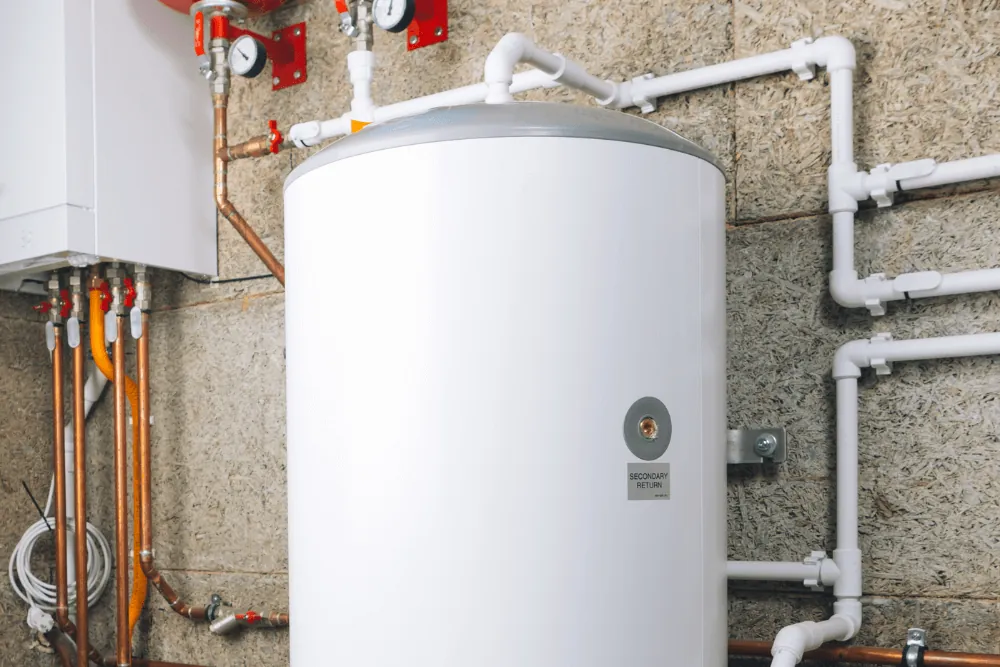
Water heaters in Dubai: what we do
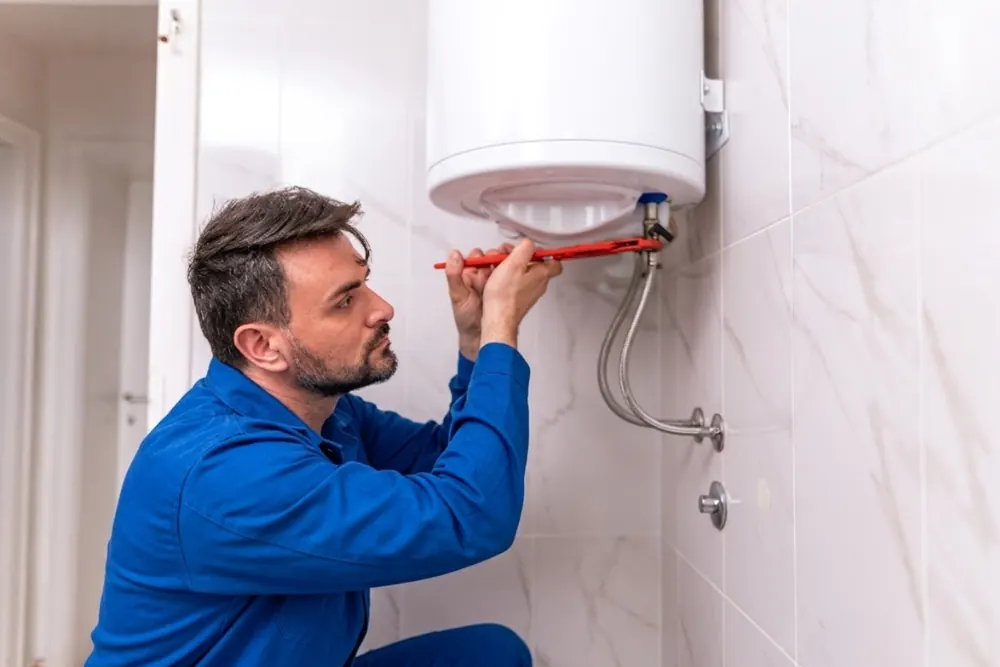
- Installation and replacement. A new heater, or a like-for-like swap, with the valves, relief line and electrical connection. See water heater installation.
- Repair. No hot water, lukewarm water, a tripping breaker, a dripping valve or a leaking tank. See water heater repair.
- Elements and thermostats. Testing and replacing the parts that heat and control. See element and thermostat replacement.
- Instant, solar and heat pump heaters. See tankless water heaters, solar water heaters and heat pump water heaters.
- Boilers and central systems. See boiler repair.
- Supplying the heater. We supply and fit, and we also fit items you have bought.
- Emergency visits. We answer calls and send a plumber 24 hours a day, 7 days a week, and we do not promise an arrival time. We do not do gas work, so our heater work is electric, solar or heat pump.
If water is escaping
If the water is escaping faster than you can stop it, switch off the heater's power at the breaker, close the cold-water isolation valve if there is one, and call. Our emergency plumber page covers what to do before anyone arrives. For a heater that is not hot, trips the breaker or drips, our water heater repair page has the checks in order.
What people call a water heater: geyser, boiler, cylinder, calorifier
The same appliance has many names. In Dubai it is called a water heater, a boiler or a geyser, and the storage vessel is called a tank or a cylinder, direct or indirect depending on how it is heated.
| Word | What to know | What to ask |
|---|---|---|
| Water heater | The general term for any appliance that heats water for taps, showers and appliances | Which type: storage, instant, solar or heat pump? |
| Geyser | The common name in Dubai for a storage water heater | Litres and power rating |
| Hot water tank or cylinder | The insulated vessel that stores heated water | Litres, and whether it holds an electric element or a coil from another heat source |
| Calorifier | An indirect heater: a storage tank with heat-exchanger coils fed by an external heat source such as a boiler or solar collectors, with no heating element of its own | Where the coil's heat comes from. It is a building-plant term and not a household one |
| Boiler | In Dubai often a central plant heating water for several floors | Whether it serves one flat or a building |
A quote that says "boiler" for a flat's single tank, or "heater" for a boiler serving several floors, is a quote to ask about before you pay a deposit. The sizes, parts and prices of a 50-litre bathroom tank and a building's plant are not comparable.
The types side by side
| Type | How it heats | What to know |
|---|---|---|
| Electric storage | An element heats a tank of water and a thermostat holds the temperature | The common type in Dubai flats and villas. Simple to fit and repair. The tank has standing heat loss |
| Instant (tankless) | A powerful element heats water as it flows | No tank and no wait for a refill, but a high electrical load. See tankless water heaters |
| Solar | A roof collector heats water in a tank, with an electric backup | Low running cost. Needs roof space and a collector. See solar water heaters |
| Heat pump | A compressor moves heat from the air into the water | Uses less electricity per litre. Costs more to buy. See heat pump water heaters |
| Central boiler | A plant room boiler or calorifier heats water for a building | A building system. See boiler repair |
A villa from the last decade may already have a solar collector on the roof, which is worth knowing before you replace a tank. Our solar water heaters page sets it out.
Five things to take from the table and the label:
- Litres are the storage, not the supply. A 50-litre label means the tank holds 50 litres. It does not say how many showers that gives. The sections below explain how litres turn into showers.
- Kilowatts decide the wait. Power is the rate at which the element adds heat. A 1.5 kW element and a 2 kW element take different times to heat the same water, and the heating section below explains it.
- The tank warranty and the electrical warranty are different. The tank figure is usually the longer one.
- The warranty can carry conditions. A maker's warranty can depend on an anode check, a relief valve or who installs the heater. The one in your heater's manual is the one that governs your claim.
- Installation is not in the price. Our installation page lists what goes into that bill.
What a heater costs to buy
Storage heaters are priced by litres and by quality. A small household heater costs far less than a large one, and the larger sizes usually cost less per litre than the small ones. A shop's price is the heater only, and installation is a separate line. We do not publish a starting price for the work. See the cost section at the end of this page.
How long a heater takes to heat
Heating water takes energy, and the energy depends on three things: how many litres are in the tank, how far the temperature has to rise and how much power the element has. Power is the rate, so a bigger element adds heat faster. The time is the energy needed divided by the power.
Two examples show the scale. Heating 50 litres from 25°C to 60°C takes a little over 2 kilowatt-hours, so on a 2 kW element it takes about an hour. Heating 80 litres by the same rise takes about 3.3 kilowatt-hours, so it takes about an hour and a half on 2 kW and a little over an hour on 3 kW. A real heater takes a little longer, because the tank loses heat to the room while it heats.
What the wait means in practice
- A heater switched on only when hot water is wanted makes the household wait. On a small element that wait can be well over an hour.
- A bigger tank is slower to recover, not faster, on the same element. It holds more water and has no more power. Litres and kilowatts have to be read together, and a tank that is large and low-powered is slow after a heavy morning.
- Recovery decides the second shower. After the first person uses the tank, the heater needs time to be ready again, in proportion to the litres drawn. Our element and thermostat page lists hot water that runs out quickly among the symptoms of a failed lower element, which is a fault and not a sizing problem.
How much hot water you really get
A shower is not taken at tank temperature. The tap mixes tank water with cold water, so a tank at 60°C delivers more than its litres at the shower's temperature. Two things follow.
- Warmer incoming water stretches the tank sharply. If the water arriving is warm, as water from a rooftop tank can be in summer, the same heater serves a larger household than it does in winter. That is the reason we size for the cooler months.
- A lower thermostat setting costs showers. Dropping a tank from 60°C to 55°C gives noticeably less shower-temperature water, because each litre from the tank can be stretched less. For a household that is already short, a lower setting is the first thing that shows.
Our water heater installation page covers sizing a heater to a household.
The setting is a safety decision
Water at 60°C scalds in seconds, and a young child or an older person burns faster than an adult. Where the heater serves a bath or a child's shower and there is no thermostatic mixer at the tap, the tank setting is the only protection. Our bathtub and shower installation pages cover thermostatic mixers.
What a heat costs to run
Running cost is energy times price. Electricity in Dubai is charged per kilowatt-hour on a banded tariff, and the rate depends on the month's total use, so we do not quote a per-heat figure. Your bill shows your own rate.
To work it out for your home: heating 80 litres by 35 degrees takes about 3.3 kilowatt-hours. Multiply that by the rate on your bill, then by the number of full heats a day and the days in the month. The figure leaves out the heat the tank loses while it stands, so a well insulated tank, a sensible setting and a timer that keeps the heater off when nobody needs hot water all cut the bill. Our heat pump page applies the same thinking to a heat pump.
Choosing a size
Hot water use depends on people and habits, so size is a judgement, and we confirm it at the visit. As a starting point:
- A kitchen sink or a single basin is served by a small unit near the tap.
- One bathroom with one or two people is usually served by a tank in the 50 to 80 litre range.
- Two bathrooms or a family needs a larger tank, or two heaters, one near each bathroom.
- A villa with several bathrooms is better served by more than one heater placed near the bathrooms than by one large tank far from them, because a long pipe wastes water and heat while you wait.
Check the element rating as well as the litres. A large tank on a small element is slow to recover, and a high-rated element needs a circuit that can carry it.
Where a heater is fitted
In Dubai homes we find heaters in the ceiling void above a bathroom, high on a bathroom wall, in a kitchen cupboard, on a balcony or in a utility room, and on the roof for solar tanks. Whatever the place, five things matter:
- Weight. A full tank is heavy, and the wall or the support has to carry it.
- A tray and a visible drain, so a failing heater does not damage the ceiling below.
- Access for service, with the isolation valve, the relief valve and the electrical isolator within reach.
- A short run to the taps. Every metre of pipe is water and heat wasted before the hot water arrives.
- Ventilation and clearance around the tank and its controls.
Where a heater leaks from
Water on the floor under a heater is not always the heater, and not every leak means a new heater.
| Where the water appears | What it indicates | Repair or replace |
|---|---|---|
| Around an element, on an electric heater | A failed element gasket | Repair. Replace the gasket |
| From the relief valve or its discharge pipe | The valve is opening because of pressure or temperature, or it is worn | Check the pressure and the thermostat. Replace the valve if it is worn |
| At the inlet or outlet pipes or hoses | A loose fitting, a worn washer or a corroded connection | Repair. Re-make the joint or replace the hose |
| From the tank body or seam | Corrosion has gone through the tank | Replace the heater. A tank cannot be repaired |
| Under the heater, but wet only at times | Condensation on cold pipes, or a drip from above | Rule out condensation before opening anything |
Three points about the table.
- A dripping relief valve is not a dripping tank. The valve is doing its job when it opens, and a drip means something is wrong with the pressure, the temperature or the valve. Our pressure valves page covers the pressure side. The relief valve's discharge line should end somewhere visible, which is how a drip gets noticed.
- Condensation takes patience to rule out. Put a dry paper towel at the suspect spot and look again when the heater has been on for an hour and has cooled. If the towel is wet again, it is a leak.
- A heater in a ceiling void leaks into the flat below. The stain on the ceiling is the late sign. Our ceiling and wall leaks page covers tracing it, and our leak detection page covers pressure testing a line without opening the wall. The heater's tray and its drain are the first things to check.
For an electric heater, switch off at the breaker first, then close the isolation valve.
Repair or replace
The decision on a tank that leaks turns on age and cost. If the heater is still inside its warranty period, check the terms and the invoice before anyone opens it, because an unapproved repair can affect cover. A repair that costs most of the price of a new heater, on an old tank, buys little.
A leak from the tank body cannot be repaired, so the question is only which heater replaces it and how soon. A leak from a fitting, a valve or a gasket is a repair on any age of tank that is otherwise sound. We say which it is on the visit, before we propose anything.
Looking after a heater
A little attention each year extends the life of a heater.
- Lift the relief valve lever briefly and let it snap back. Water should run out and stop. A valve that stays open or drips afterwards needs replacing.
- Flush the tank to clear sediment, more often where the water is hard.
- Check the anode at the interval in your heater's own manual, where the heater has one.
- Look at the hoses and joints for weeping, rust and white scale.
- Check the thermostat setting against what you want.
- Look at the tray and its drain. A wet tray is an early warning.
When a heater is past repair
A part on a sound tank is worth fixing. These point to replacement instead:
- Water from the tank body or seam. A tank cannot be repaired.
- Rust-coloured hot water that persists after a flush, with no cold-water rust.
- Repeated element or thermostat failures on an old tank with heavy scale.
- A tray that is wet again and again with no fitting at fault.
- A tank that groans and bangs when heating, which points to heavy scale.
- Repairs that add up to most of the price of a new heater.
Questions to ask before you buy
- What does the price include: installation, valves, relief line, tray, removal of the old heater?
- How long is the tank warranty, and what conditions does it carry?
- Is the heater rated for the supply pressure in your building?
- Does your circuit carry the element's power rating?
- Does the warranty depend on who installs it?
- Where do spare parts for this model come from?
The fittings around the heater
A heater is a tank plus the parts that make it safe to run. The names appear on quotes, and the table translates them.
| Part | What it does | More on |
|---|---|---|
| Isolation valve | Stops the cold feed so the heater can be drained, repaired or replaced without shutting the flat's supply | Valve repair and replacement |
| Non-return valve | Stops hot water from travelling back into the cold supply | Backflow prevention |
| Temperature and pressure relief valve | Opens when the tank is too hot or too high in pressure, and sends the water down a discharge line | Pressure valves |
| Pressure reducing valve | Lowers the supply pressure before the heater when the supply pressure is higher than the heater is rated for | Pressure valves |
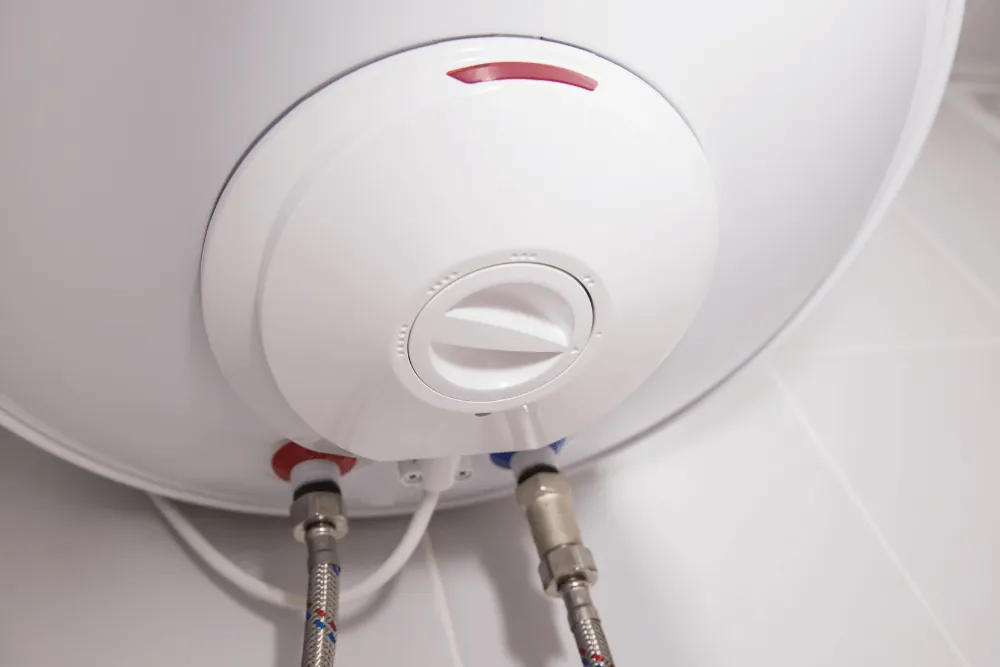
| Flexible hoses | Connect the heater to the pipework. A slow leak can start at them or at their connections | Hoses |
| Tray and drain | Catches a leak and carries it to a visible drain, so a failing heater does not damage a ceiling | Installation |
| Element and thermostat | The heating part and the part that switches it | Element and thermostat replacement |
The quote should name every one of them. A quote that lists only the heater and labour omits the parts that make it safe, and the missing ones are the first to ask about.
Hot water at a distant tap: recirculation and insulation
Water in a pipe cools when nobody is drawing it. The first litres at a far bathroom run cold or lukewarm until fresh hot water arrives, and the cold water that ran down the drain is wasted.
A recirculation loop keeps hot water moving in a circuit between the heater and the far taps so that hot water is at the tap sooner. A loop that runs all day, every day, wastes pumping and heating energy, so a timer or a thermostat on the pump helps, and insulated pipes cut the standing heat loss.
A loop adds a pump, a return pipe and a continuous heat loss, so it earns its place only where the heater is far from the bathrooms. Where the heater sits next to the outlet, insulating the hot pipe does more and costs less. Our pipe insulation page covers that.
Scale, water quality and the tank
Scale builds up fastest on hot surfaces, so an element and the bottom of a tank are where it collects. Tank temperatures above 60°C speed it up. Scale lowers efficiency, shortens the life of the element and can harbour bacteria, which is one reason we set tanks at a sensible temperature and flush them on service. Building tanks and old pipework add their own deposits, so the condition of the water matters. See water softener and water testing.
Permission in Dubai: who decides on a heater
A heater touches the landlord and the building. Where a heater job falls:
| Job | Starting point |
|---|---|
| Replacing a failed heater with a similar one | A repair. Tell the landlord in writing before you book |
| Upgrading to a larger or different type at your request | An alteration, so written consent from the landlord and the building's management |
| A new position, a new circuit or a roof unit | Landlord consent and building management |
| A heater in a shared ceiling void or riser | Building management |
| You own the flat or villa | Facility management or the owners' association for a flat, the master developer for a villa |
Tell us what your building asks for and we work to it.
What to note before you call
A few details let us say more on WhatsApp and bring the right parts.
- The label. Litres, power rating, voltage and the model name, photographed straight on.
- Where the heater is. Ceiling void, wall, cupboard, balcony or roof, and whether there is an access hatch or a ladder is needed.
- What it is doing. No hot water, lukewarm, runs out fast, trips the breaker, drips or makes noise, and when it began.
- What changed. A power cut, a pump service, a new appliance or a recent plumber's visit.
- Whether you own or rent, so we can tell you who to ask before we start.
A photograph of the area around the heater, with the pipes and the isolation valve visible, usually saves a visit.
Warranty and the handover
What you should have when the job is finished:
- A written note of the heater's brand, model, litres, power rating, serial number and manufacture date, the thermostat setting, and the tests run.
- The manufacturer's warranty terms. Read them before anyone opens the heater.
- Photographs of the connections, the relief line and the tray before the heater is closed in.
- The date of the first anode and valve check, from your heater's own manual.
- FAM's workmanship warranty, in writing. The warranty runs for 30 days and covers our labour only. Parts carry the manufacturer's warranty only.
How we work
- You tell us what you have and what is happening on WhatsApp: the heater's label, what you see, where the water appears, and whether you own or rent. Photographs of the label and the area save a visit.
- We visit, check the heater, its position, valves, supply and circuit, and find the part at fault before proposing anything. The visit fee is AED 50 + VAT, credited if the work goes ahead.
- We give options and a price in writing, with what each option leaves untouched.
- Check permission. In a rented or managed property, ask the landlord or building management whether they need to approve this work before the visit.
- We do the work, protect the surfaces and test the heater before leaving.
- We hand over the written note, show you the isolation valve and the relief lever, and take the old heater away if it is being replaced.
Where we work in Dubai
We cover all of Dubai, including Dubai Marina, JBR, Downtown Dubai, Business Bay, Jumeirah Lakes Towers, Palm Jumeirah, Al Barsha, Jumeirah Village Circle, Dubai Hills, Mirdif, Deira and Al Quoz. See the full list of areas.
How much does a water heater cost in Dubai?
Two prices make up the bill: the heater and the work.
- The work. Installation is not in a shop's price. Fitting, the valves and relief line, the tray, the electrical connection, access and removal of the old heater are separate. Our installation page lists them.
- A repair. The cost follows the part: a valve, a gasket, an element or a thermostat. Our repair and element and thermostat pages explain what each involves.
We do not publish a starting price for this job. Send a photo on WhatsApp and we give you a fixed price before we start. Prices exclude 5% VAT.
Water heater FAQs
What is the difference between a water heater and a geyser?
Nothing. A shop or a quote in Dubai may use either word for the same appliance. If a quote says "boiler" or "calorifier", ask which type of heater it means, because those words also name larger plant.
How long does a water heater take to heat?
It follows from litres, the temperature rise and the power. An 80-litre tank on a 2 kW element takes about an hour and a half to rise by 35 degrees, and the same tank on 3 kW takes a little over an hour. See the heating section above.
How do I work out what size of heater I need?
It depends on how many people use hot water and when. Our water heater installation page covers sizing to a household. As a quick guide, a flat bathroom is usually served by a small tank, and a villa with several bathrooms by a larger one or by more than one heater. Send us the number of bathrooms and people and we say what to look at.
How much does a water heater cost in Dubai?
The price depends on the capacity and the type, and on whether you supply the heater or we do. We can do either. We do not publish a starting price for this job. Send a photo of the heater or the space on WhatsApp and we give you a fixed price before we start. Prices exclude 5% VAT.
How much electricity does a water heater use?
Heating 80 litres by 35 degrees takes about 3.3 kilowatt-hours, before the heat the tank loses while standing. Multiply by your bill's rate and the number of heats a day. A lower setting and a timer cut the figure.
Why is water dripping from the pipe near my heater?
If the pipe is the relief valve's discharge line, the valve is opening. Switch off the heater at the breaker and have the valve and the supply pressure checked. Our pressure valves page covers the pressure side.
What do I do if my heater leaks?
Switch off the power and close the cold inlet to the heater, then message us a photo of where the water is coming from. Whether it can be repaired depends on where it leaks, and that is set out on our water heater repair page.
Who pays when a water heater breaks in a rented flat?
That is settled between you and your landlord, and your contract is the place to look. Tell the landlord in writing before you book.
Where can I read about thermostat settings?
The dial marks, the safe range and how to measure the real temperature are on our water heater thermostat page. In short, the setting is a safety decision as well as a comfort one, because a high setting scalds and wastes power.
Is installation included in the price of a heater?
Not in a shop price. Ask whoever sells it what the price includes, and ask whoever fits it for the valves, relief line, tray and electrical work in writing.
Book a water heater visit in Dubai
Tell us the heater's brand and litres from its label, what is happening, and whether you own or rent. Photographs of the label and the area around the heater help. If water is escaping, switch the heater off at the breaker and close the isolation valve, then call. We will find the cause, give you the options and a price in writing, do the work and hand over a note.
WhatsApp: +971 55 407 7427 · Request a quote
Visit us: Office 871, Oasis Mall, Al Quoz 1, Dubai, UAE
Related services: Water heater installation · Water heater repair · Element and thermostat replacement · Tankless water heaters · Solar water heaters · Heat pump water heaters · Boiler repair · Leak detection · Pressure valves