
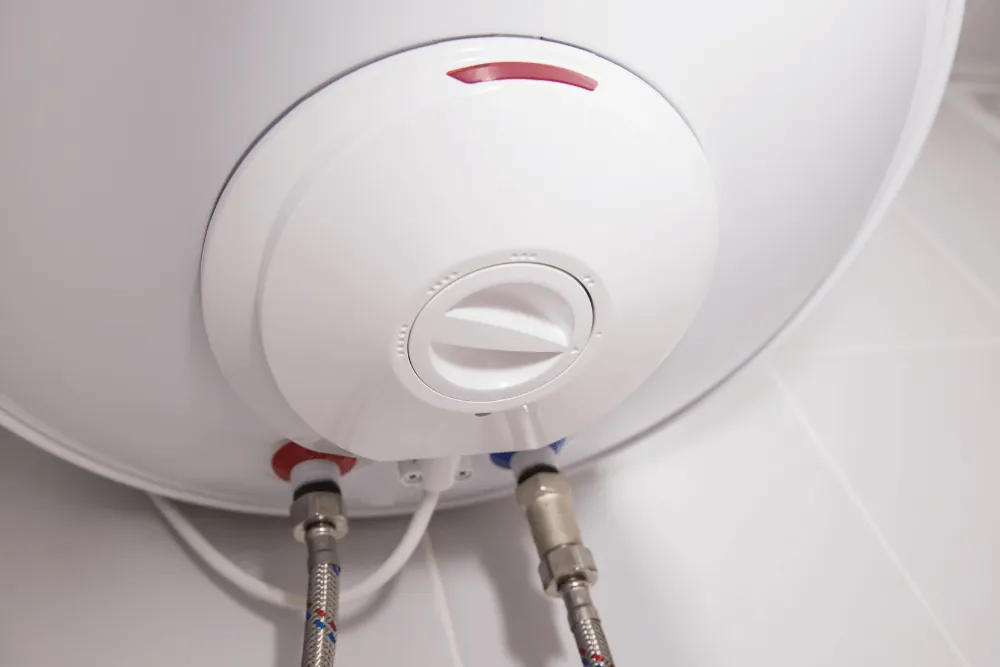
No hot water in Dubai: what we do
- Finding where the hot water stops. One tap or every tap, heater or pipe or mixer, before anything is replaced.
- Electric storage heaters. Power, controls, thermostats and elements. See water heater repair and element and thermostat replacement.
- Instant, solar, heat pump and boiler systems. See instant and tankless heaters, solar water heaters, heat pump water heaters and boiler repair.
- Mixers, cartridges and shower valves. See shower repair and leaking tap repair.
- Weak, lukewarm or too-hot water. The causes are set out below, and the pipework behind them is on repiping and pipe insulation.
Where the hot water stops: the order we check in
Hot water passes through five places: the source (a heater, a solar tank, a boiler or a building system), the supply behind it (power or gas, and the cold feed), the hot pipe, the valve at the outlet (a mixer, a cartridge or a shower valve), and the outlet itself (an aerator or a shower head). The first tests tell you which of the five holds the fault.
| Step | What you do | What the result points to | Who |
|---|---|---|---|
| 1. Run the hot in three places | Open the hot at a basin, the kitchen and a shower | One tap cold and the rest hot points to that tap's mixer or pipe. All cold points to the source | You |
| 2. Compare with the cold | Open the cold at the same places | If the cold is weak or absent as well, the fault is the supply, not the heater. See low water pressure | You |
| 3. Check the rest of the home | Look at the lights, sockets and the main supply | If the power is off in the home, the fault is the building supply, as our water heater repair page sets out | You |
| 4. Check the heater's controls | The switch, the breaker, the isolator, the thermostat dial and the reset button | A switched-off heater, a tripped breaker or a dial turned right down explains most no-hot-water calls | You |
| 5. Isolate the power | Switch off at the heater's isolator or breaker before anything is opened | Nothing is tested or opened with the power on | Us |
| 6. Test the heater's circuit | Meter tests on the power, the cut-out, the elements and the thermostats | The order in the next section | Us |
Step 5 is ours and not yours for a reason. Closing the cold feed and opening a hot tap draws down the tank, and an electric heater powered with its tank not full can burn out its element. We isolate the power first.
The order we check a storage heater in
The table lists the checks in the order we run them on a visit, with the reason for each.
| Order | The check | Why it comes there |
|---|---|---|
| 1 | Check for mains voltage at the top screws of the upper thermostat. If it is not there, check the circuit breaker and wiring | No power, no heat. This test costs nothing in parts |
| 2 | Press the red reset button. If it clicks, the heater overheated and tripped its energy cut-off | A tripped cut-off explains a sudden loss of hot water, and its cause still has to be found |
| 3 | Test the upper element with the power off. If it fails, replace it. If it is good, replace the upper thermostat | The upper element heats first |
| 4 | Check for a shorted or earthed element | An earthed element trips the cut-off again |
| 5 | Test the lower element and the lower thermostat the same way | They heat the rest of the tank once the top is hot |
| 6 | If elements and thermostats test good, check for a leak on the hot water side | A leak drains the tank faster than it can heat |
The repair side of each step is on water heater repair and element and thermostat replacement, and we do not repeat it here.
Hot water that is there but wrong
Lukewarm or runs out fast: where to look first
Two different causes look the same from the shower. One is a fault: the dial set low, a failed lower element or a failing thermostat. The other is arithmetic: a tank of a given size holds only so many litres of mixed water. Our water heaters in Dubai page works that arithmetic with the incoming water temperature, and shows that warmer incoming water stretches a tank. Do that sum first. A heater that always ran out after the same number of minutes is a size question. A heater that used to last longer is a fault.
Too hot: what to check before you call
A dial set too high, or a faulty thermostat that never switches off, gives scalding water. Water at 60°C can scald an adult in a few seconds, and at 50°C in a few minutes. Children and older people burn faster than that, so a heater that delivers very hot water is a safety matter, not just a comfort one. A heater that is too hot at the dial setting needs a new thermostat, not a lower dial. If steam or very hot water comes from a tap, switch the heater off at the isolator and call us.
Weak hot flow, with normal cold
When only the hot side is weak, the fault is in the hot system. The heater's own isolation valve and inlet strainer are the first places to look on a storage heater, and a valve left part-closed costs nothing to open. If both sides are weak, use low water pressure.
Cold water in the hot line
A mixing valve fault almost always shows up first as inconsistent hot water temperature at the tap, from almost completely cold to a degree or two short. A mixer that passes cold into the hot line is usually a non-return valve that has failed or was never fitted. The fix starts with servicing and rebalancing the valve, and can be a check valve on the hot pipe directly below the faulty fitting. Our shower repair page covers the cartridge and the diverter. A sudden blast of cold water in a warm shower is among the crossover symptoms.
The cold tap runs hot in summer
If the cold tap is hot, the heater is not the cause. A tank in the sun and a pipe across a roof both warm the water in them, and a cold tap that runs warm for the first litres and then cools points to the pipe, while one that stays warm points to the tank. The tank, its cover and its position are on water tank installation, and the pipe is on pipe insulation.
Hot and cold water dispensers: what the name covers
A hot and cold water dispenser is a product with four forms, and they need different people.
| Form | How it is supplied | Who fits it |
|---|---|---|
| Floor-standing, bottle-fed | A water bottle on top or inside, with a plug-in electric heater and cooler | Nobody. It needs a socket and a level floor |
| Floor-standing, plumbed-in | Connected to the water line, often with a filter | A plumber for the water, and an electrician if a socket is needed |
| Countertop or tabletop | A small unit filled by bottle or by hand, or plumbed in | Usually nobody if it is bottle-fed |
| Instant hot tap at the sink | A small heating tank under the sink, with a tap on the worktop that gives near-boiling water | A plumber for the water, and a socket under the sink |
The faults and the safety points below apply to all four.
How hot the hot tap is
The hot tap on a dispenser runs far above a heater's setting. Instant hot taps and many dispensers deliver water close to boiling, so check the temperature the maker states for your model. Water that hot burns in a second or two. A dispenser at a child's height, or a tap with the lock off, is the risk, and the lock is the control. Keep the lock on, and keep a floor-standing unit where a child cannot reach the hot tap.
Can the label's hot water output be true?
A small heating element can only make so much hot water an hour, because heating water takes a fixed amount of energy. A unit of about a kilowatt and a half, heating from room temperature to near boiling, makes only a few litres of hot water an hour at best, and a unit whose label claims many cups an hour is making a statement about small cups or a lower temperature. A tank of two or three litres takes about ten minutes to heat from cold, with no losses. Treat a claim that sounds too large as one, and ask the maker for the figure and the conditions.
What the water supply must give a plumbed-in unit
A plumbed-in unit needs these, and the maker's data sheet gives the exact figures:
- Supply pressure. The tap is made for a stated range, commonly from about 1.7 to 8.6 bar. Check yours is inside it.
- A hole in the sink or worktop of the size the tap needs, commonly 35 to 38 mm.
- A socket close to the tank. It needs the rated current, a grounded plug, and a position near the appliance.
- An optional in-line filter, with a shut-off valve built into the filter head.
- A warranty, and what it covers, in writing.
The pressure is the one you can check before you buy: a gauge on an outdoor tap or any threaded tap reads it, as the low water pressure page shows. A reading under the minimum sends you to that page and the booster pump page. A reading over the maximum sends you to the pressure reducing valve page. The socket is a job for an electrician when the cabinet has none, because a socket under a sink sits near water. Our own electricians make the electrical connection. Ask for the maker's manual for the UAE model before installation.
A bottle-fed unit needs none of this. It needs a socket and a level floor.
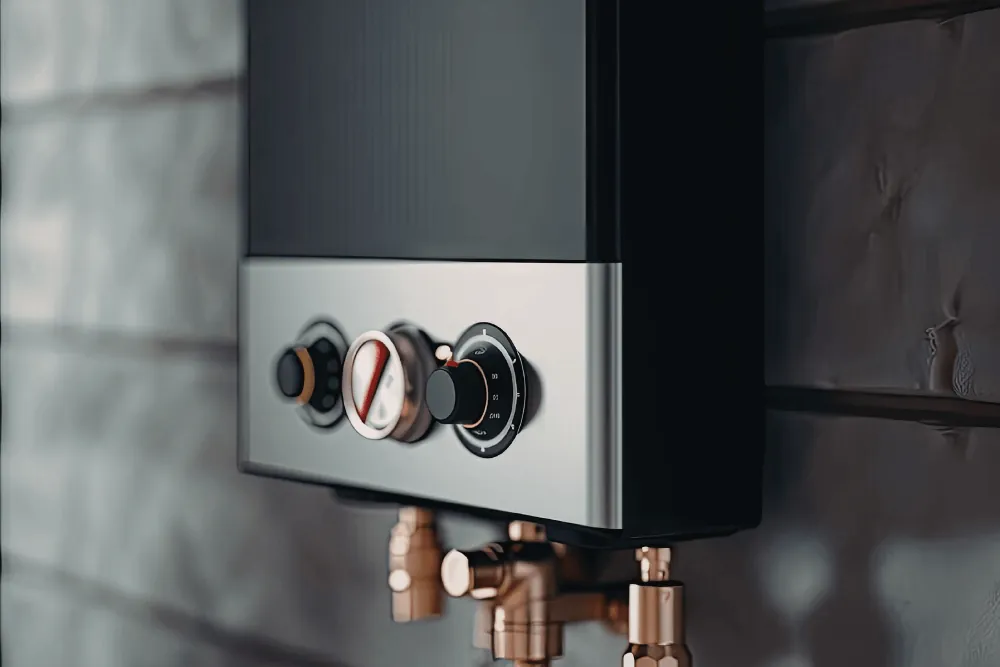
When the dispenser gives no hot water
Unplug a unit before you do anything beyond these checks. The last rows involve mains parts inside a sealed unit, and those go to the maker's service team.
| What you see | Likely cause | What to do |
|---|---|---|
| Cold water only, a unit just switched on | It has not had time to heat | Wait the time the manual gives, often several minutes |
| No hot water, the lights are off | Not plugged in, the socket is off, or the switch is off | Check the plug, the socket and the hot water switch |
| No hot water, the lights are on | The hot water switch is off, or the child lock is on | Turn the hot switch on and release the child lock |
| A tap that gives only a little hot | The water supply is low, or a filter is blocked | Check the supply and change the filter |
| Hot water that stops after a short while | Scale in the heating tank | Descale to the maker's instructions. Hard water scales any heating tank |
| Hot water that never comes, with power on | A tripped thermal cut-out, a failed element or a failed thermostat | Stop and call the maker's service team. These are mains parts in a sealed unit |
Cleaning is the maker's schedule, and our tankless water heater page covers scale in a flow-through heater.
The valves behind hot water
Four valves matter when hot water stops or runs wrong, and each has a home on another page:
- The isolation valve on the heater's cold feed. It is the valve to close in a leak, and the valve we close for the crossover test. Our valves overview covers choosing one.
- The non-return valve on the hot line. A check valve on the hot pipe directly below a passing fitting can be cheaper than replacing a mixer that works otherwise. Our heat pump page lists a non-return valve among the fittings every storage tank needs.
- The temperature and pressure relief valve and its discharge pipe. See water heater installation.
- The thermostatic mixing valve. See shower installation.
The valve under the kitchen sink that serves the hot tap is a small isolation valve of the same kind. Valve repair and replacement covers replacing one that will not turn.
Dishwashers and washing machines on a hot supply
Many dishwashers and washing machines can connect to hot or cold water, and the installation manual says which. On a cold supply the machine heats the water itself.
A hose is rated for a temperature, and our hoses page covers the ratings. A hot-fill hose is made for hot water, and the maximum temperature the machine accepts is often about 60°C. A feed from a storage heater set at 60°C is at that limit. A feed from a source that runs hotter needs the machine's manual first. The machine's limit is the lower figure that matters, and the hose is the second. Hoses and connections are on washing machine plumbing.
A heater in a ceiling void or a cupboard
Many Dubai flats have the water heater in a false ceiling over a bathroom or in a tight cupboard, and that makes every fault harder. A heater you cannot see is a heater you cannot check: a drip from the relief pipe, a stain on the board or a wet floor beneath may be the first sign. If hot water stops, the isolator, breaker and reset button are the first things to look at, so know where they are. If a heater is in a void with no access panel, ask us to fit one, because the next repair will otherwise need a section of ceiling cut out. A tray under the heater with a drain pipe to a visible point catches a slow leak before it reaches the ceiling below. See water heater installation.
Hot water after a power cut
When the power returns after a cut, an electric storage heater may not come back on by itself. A tripped breaker, a reset button that has popped or a tank that drained during the outage can all keep it cold. Check the breaker first, then the isolator and the reset button, and give a full tank several hours to heat. If the heater was off for a long time and the pipes were warm, the first water may be lukewarm while the tank catches up. A heater that trips repeatedly after a power surge may have a damaged element or thermostat. Do not keep resetting it. See element and thermostat replacement.
Hot water that is cold in the morning
A heater that works all day and is cold in the morning points to a timer, a thermostat that cuts out early or a tank too small to recover. Some homes have a timer on the heater to save electricity, and the timer may have drifted or been reset after a power cut. A tank that has lost heat overnight and is slow to reheat may have a failed lower element, so only the top is warm. Heaters in a hot loft or a poorly insulated void lose more heat, and a lagged tank and pipe help. A heater that is warm in the morning but runs out quickly is a different problem: sediment, a failed element or a tank too small for the household.
Hot water at a distant bathroom
A bathroom far from the heater waits a long time for hot water, because the cold water standing in the pipe must run off first. That wastes water and patience, and the longer and wider the pipe, the worse it is. Lagging the hot pipe keeps the water in it warm longer, a smaller pipe holds less cold water, and a small heater near the far bathroom removes the wait. A hot water circulation loop solves it in a large property at a cost of energy. We look at the pipe run and the use of the bathroom before we suggest anything. See pipe insulation.
What to have ready when you call
The quickest hot water visits are the ones where we know the facts before we arrive. Note which taps are cold and which are hot, whether it began suddenly or slowly, and whether anything changed that day, such as a power cut, a building shutdown, a new appliance or work in the bathroom. Take a photograph of the heater's label and of any light, display or code on it. If the heater is in a cupboard or a ceiling void, clear the way to it. If you rent, tell the landlord at the same time, because the heater is usually the landlord's to repair.
Permission in Dubai: who decides on hot water work
Replacing a part like for like and changing a system are different questions, and the building and the landlord decide them. We do not guess, and we ask before we book.
In practice: for a repair like for like, such as an element or a mixer cartridge, tell the landlord what failed and send our diagnosis. For a new plumbed-in dispenser or an under-sink hot tap, which needs a hole in the worktop, a connection to the water line and a socket, get the landlord's written approval first. If the hot water comes from a building system, the boiler, riser and common-area pipework belong to the building, and we do not touch them without management. Tell us what your building asks for and we work to it.
Warranty and the handover
What you should have when the job is finished:
- A written note of what failed and what was done: the part, the model, the test readings and the settings.
- A photograph of the heater's label, so the next visit starts with the rating, the voltage and the model.
- The position of every valve we closed or changed, written down.
- For a plumbed-in dispenser: the supply pressure we measured, the filter fitted and the date to change it, and where the shut-off valve is.
- FAM's workmanship warranty, in writing. The warranty runs for 30 days and covers our labour only. Parts carry the manufacturer's warranty only.
How we work
- You tell us what is happening on WhatsApp: which taps, whether the cold is normal, what the heater is and whether you own or rent. A photograph of the heater's label saves a visit.
- We visit, run the ladder above and find where the hot water stops before proposing anything.
- We give options and a price in writing, repair and replacement side by side where both are possible.
- Check permission. In a rented or managed property, ask the landlord or building management whether they need to approve this work before the visit.
- We do the work, isolate the power and the water, protect the surfaces and test the hot at every tap that was affected.
- We hand over the written note and show you the heater's controls and its isolation valve.
Where we work in Dubai
We cover all of Dubai, including Dubai Marina, JBR, Downtown Dubai, Business Bay, Jumeirah Lakes Towers, Palm Jumeirah, Al Barsha, Jumeirah Village Circle, Dubai Hills, Mirdif, Deira and Al Quoz. See the full list of areas.
A short checklist before you call
- Is the heater switched on at the isolator and the breaker?
- Is the water from the hot tap cold at every tap, or only one?
- Has there been a power cut or a tripped breaker?
- Is there a leak near the heater?
- Is there a code or a light on a gas, solar or instant unit?
- How long has the problem lasted?
Send us the answers, a photo of the heater and its label, and the make and model. It speeds the diagnosis. We answer calls and send a plumber 24 hours a day, 7 days a week, and we do not promise an arrival time. Prices exclude 5% VAT, and the price is fixed on WhatsApp before work starts.
Hot water for a busy household
If a household has more demand than the heater can supply, no repair will fix it. Add up the showers, the washing and the kitchen use in the busiest hour. Compare that with the heater's size and its recovery rate. A bigger tank, a second heater or an instant unit for a distant bathroom may be the right answer. We help you work it out and quote it. Prices exclude 5% VAT.
How much does it cost to fix no hot water in Dubai?
The bill is the part and the work. The work depends on what the ladder finds.
- The part. The pages on element and thermostat replacement and water heater repair cover the parts and what each costs to replace.
- The work. Finding the fault, isolating the power and water, replacing the part and testing.
- What moves the price. The type of heater, the access to it, whether it sits in a ceiling void, and whether the fault is at a single tap or the heater.
We do not publish a starting price for this job. Send a photo on WhatsApp and we give you a fixed price before we start. Prices exclude 5% VAT.
Hot water FAQs
Why is there no hot water but the cold water works?
The hot side has its own source, and the fault is in that source, its supply or the hot pipe. Run the hot at three places and compare it with the cold. If one tap is cold and the others are hot, the heater is working and the fault is that tap's mixer or pipe. If all are cold, check the rest of the home's power, the breaker and isolator for the heater, and the thermostat dial. We run that test with the power off.
Why is there hot water at one tap only?
The fault is at that tap or its pipe, not the heater. A worn mixer cartridge, a blocked aerator or a closed or blocked valve on that tap's hot feed are the usual causes. Our shower repair and leaking tap repair pages cover the cartridge and diverter.
Can I use hot water to unblock a toilet?
Hot tap water poured into the bowl can soften a blockage, but boiling water can crack porcelain, especially a cold bowl. Pour from waist height into the bowl. For a blockage that does not move, use the steps on our toilet unblocking page.
How hot is the water from a hot and cold water dispenser?
Much hotter than a heater, often 85 to 98°C, so it can cause a serious burn in a second or two. Use the child lock and keep the hot tap out of a child's reach.
How much does a hot and cold water dispenser cost in Dubai?
It depends on the form (bottle-fed, plumbed-in, countertop or under-sink), the maker and the features. If you need one fitted, send us the model and a photo of the space and we give you a fixed price for the fitting in writing, excluding 5% VAT.
Does a hot water dispenser need a plumber?
A bottle-fed dispenser needs a socket and no plumber. A unit on the water line does. We measure the pressure with a gauge before we fit one.
Why is my dispenser not giving hot water?
Check that it is plugged in, that the hot switch is on, that the child lock is released, and that it has had time to heat. A unit may release a short burst of room-temperature water at start-up, which is not a fault. If it still gives none, the fault is a tripped cut-out, an element or a thermostat, and that goes to the maker's service team.
Why does the hot water run out after one shower?
The usual suspects are a tank that is too small for the household, a failed lower element, or a tank full of sediment. A quick test is to note how long it lasts and whether the last water is lukewarm or cold. The full causes and fixes are on our water heater repair page.
Why is my hot water pressure lower than my cold?
A single fixture points to its aerator or shower head, and a whole house points to valves and restrictions. If the cold is weak too, use our low water pressure page.
Can I connect a dishwasher to the hot water supply?
Many machines can connect to hot or cold water, and the installation manual says which. If hot is allowed, use a hot-fill hose designed for hot water, and keep within the maximum temperature the manual states, which is often about 60°C. On a cold supply the machine heats the water itself. The manual for your model decides.
Book a hot water visit in Dubai
Tell us which taps have no hot water, whether the cold is normal, what the heater is and whether you own or rent. A photograph of the heater's label helps. If water is escaping, close the nearest valve upstream, or the main if you do not know which, and call. We will find where the hot water stops, give you the options and a price in writing, do the work and hand over a note.
WhatsApp: +971 55 407 7427 · Request a quote
Visit us: Office 871, Oasis Mall, Al Quoz 1, Dubai, UAE
Related services: Water heater repair · Element and thermostat replacement · Water heater installation · Instant and tankless heaters · Solar water heaters · Boiler repair · Shower repair · Leaking tap repair · Low water pressure · Emergency plumber