
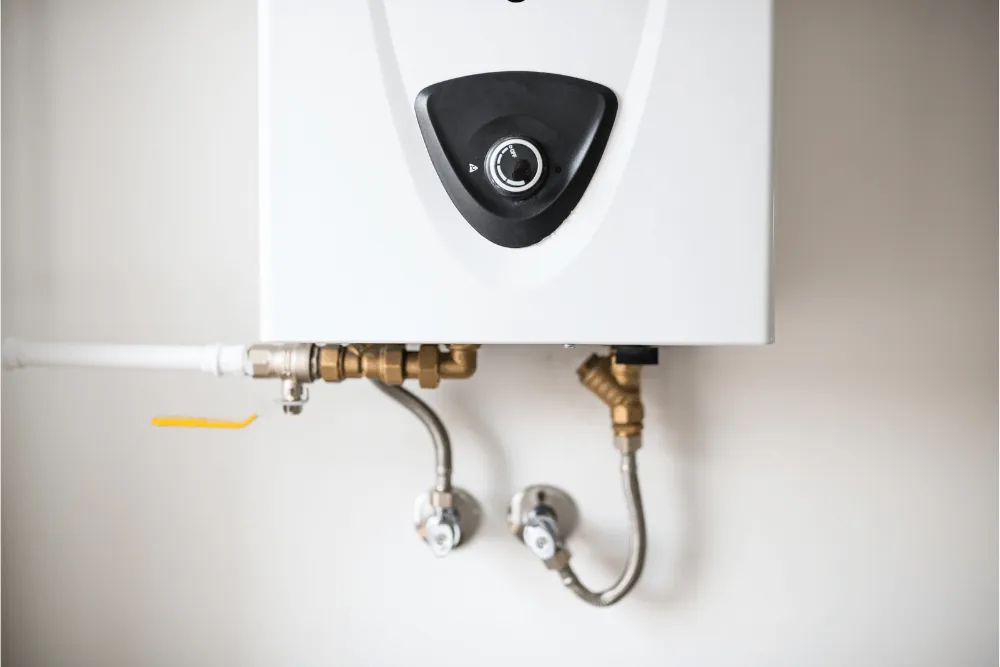
Tankless water heater installation and repair in Dubai: what we do
- Advice on whether tankless suits the property. Flow, temperature rise, electrical supply and the number of outlets, checked before a heater is chosen.
- Point-of-use and whole-home electric units. Installed close to the outlet or at a central position, with isolation and flush valves.
- Electrical connection. Checked against the unit's rated load, with a dedicated breaker and earthing, by our own electricians.
- Faults. No hot water, lukewarm or swinging temperature, error codes, noise, tripping breakers and leaks.
- Descaling and servicing. Flushing the heat exchanger, cleaning the inlet screen and checking the flow and temperature controls.
- Replacement of a failed unit, or a change to a storage heater where tankless does not fit.
- A written note of the model, rating, settings and the tests we ran.
- Emergency visits. We answer calls and send a plumber 24 hours a day, 7 days a week, and we do not promise an arrival time.
Neighbouring topics have their own pages. Storage heaters, including the valves, relief line and tray that a tank needs, are on our water heater installation page, and faults in storage heaters on water heater repair and element and thermostat replacement. Other types are on the solar, heat pump and boiler pages. We do not do gas work, so gas-fired units are outside what we install. Scale and water testing are on our water softener and water testing pages.
How an instant heater works
An instant heater heats water as it flows. The parts differ by model, so your unit's manual describes your unit.
| Part | What it does | What it means for faults |
|---|---|---|
| Flow sensor or flow switch | Detects water moving through the unit and starts the heating | If flow is below the unit's turn-on level, it does not heat |
| Heating element or heat exchanger | Transfers heat to the water as it passes | Scale on it reduces heat transfer and flow |
| Temperature sensor and control board | Measures the outlet temperature and adjusts the heating to hold the setting | Faults appear as swinging or wrong temperature, or an error code |
| Over-temperature cut-out | Switches off the heating if the water or the unit gets too hot | A tripped cut-out means a cause to find, not a button to press |
Which kind: point-of-use, shower unit or whole-home
| Kind | What it is | What to know |
|---|---|---|
| Point-of-use mini heater | A small unit serving one basin or sink | Install as close to the point of use as possible, for the shortest time to temperature |
| Instant shower unit | A heater built into a shower, heating as it flows | See our shower installation page for the shower side |
| Whole-home electric unit | A large unit serving several outlets | Needs a large electrical supply, which is the main limit |
| Gas tankless | A gas-fired unit with a burner, a flue and a gas line | Outside our work, because we do not do gas work |
The rest of this page is about electric instant heaters.
Sizing: flow, temperature rise and kilowatts
Sizing a tankless heater means finding the flow you will run at once and the rise you need.
- Add up the flow of the fixtures that may run at the same time. A shower and a basin together, for example. The flow figure for each is on its data sheet, or you can time a jug.
- Find the temperature rise. Subtract the incoming water temperature from the temperature you want.
- Match the unit's rated rise at that flow. The unit's data sheet gives it.
From rise and flow to kilowatts
The power needed follows from the heat needed to warm water. The more litres a minute you run, and the bigger the rise, the more kilowatts the unit needs. The table shows the size of the numbers for a 20°C and a 30°C rise.
| Case | Flow | Power at a 20°C rise | Power at a 30°C rise |
|---|---|---|---|
| Showerhead alone | 9.5 L/min | 13.3 kW | 19.9 kW |
| Basin alone | 2.8 L/min | 3.9 kW | 5.9 kW |
| Shower and basin together | 12.3 L/min | 17.2 kW | 25.7 kW |
These are illustrations of the method and not measurements for any Dubai property. Our water heater repair page notes that water in rooftop tanks is already warm in summer. The rise, and so the power, is smaller in summer and larger in winter, and a heater sized for a warm month will fall short in a cool one. We size for the cooler months and measure the incoming temperature at the property.
A heater must be sized for the performance required, not for the existing wiring available. The table shows why that is a problem for a whole-home electric unit, and the next section shows what it means for the electrical supply.
The electrical load
The kilowatts a heater needs turn into current in the wiring. A small basin unit draws a modest current. A shower unit draws a heavy one, and a unit big enough to run a full shower and a basin together draws a very large one.
| Power | Roughly what it draws at 230 V |
|---|---|
| 3.5 kW | 15 A |
| 5.5 kW | 24 A |
| 9.5 kW | 41 A |
| 13.3 kW | 58 A |
| 19.9 kW | 87 A |
A heater that warms a full flow by a big rise needs a very large supply, with special wiring and breakers, and that is beyond most flats. Electric tankless units suit very small loads, such as a basin or a single shower with a strong supply. Larger loads need a three-phase supply or a storage heater.
What we check on the electrical side
The sequence we follow:
- Read the unit's label and data sheet for its kilowatt rating, voltage and phase.
- Work out the amps and compare with the breaker, the cable and the supply at the board.
- Decline or change the plan if the supply cannot carry the load. A smaller point-of-use unit, a storage heater, or a different type is better than an overloaded circuit.
- Have the electrical work done by a qualified electrician where it goes beyond connecting to a suitable existing supply. Our own electricians make the electrical connection.
- Check earthing and the disconnection before the unit is energised.
What this adds up to for the circuit:
- The heater has its own circuit from the board, with a double-pole switch. It is not taken from a socket or a lighting circuit.
- The circuit has earth-leakage protection. A tripping breaker on a heater circuit points to a fault in the heater, usually an element or a seal, and not to a nuisance. See water heater repair.
- The control switch is not in the bathroom. Where the switch goes for a heater mounted in a bathroom is the electrician's call.
- The unit's full load counts. A large heater is a large share of a flat's supply, and the electrician works out whether the main supply can carry it.
Minimum flow, waiting time and the cold-water sandwich
A tankless heater only heats while water flows, and three behaviours follow from that.
Minimum flow
A unit needs a minimum flow to start heating. Typical turn-on flows run from about 1 to 4 litres per minute depending on the model, and a unit that is rated lower can still fail to fire at a low-flow fixture. The right figure is the one on your model's data sheet. A tap that is nearly closed, an aerator that restricts the flow or a single-lever mixer used at low flow can fall under the turn-on level, so the water stays cold or cuts in and out. We check the unit's turn-on flow against the lowest flow you will actually use before we fit it.
Waiting time
Install units as close to the point of use as possible for the shortest time to temperature. A unit at the far end of a flat from the bathroom spends that time warming the pipe, so a unit near the outlet, and insulated pipe between the two, shorten the wait. See pipe insulation.
The cold-water sandwich
The cold-water sandwich is a short burst of cold water in the middle of a hot flow. It happens when you close the tap briefly and open it again: the water that was heated sits in the pipe, the unit stops, and when flow restarts the unit takes a moment to fire, so cold water reaches you after the hot. If it is frequent, we look at the flow, the pipe run and the unit's settings.
Pressure and flow limits
The pressure drop is on the model's data sheet. A heater in line adds resistance, so a shower that is weak before the heater will be weaker after it. We ask for the figure before choosing a model for a rain head or a bath mixer, and a weak supply is dealt with at its source. See low water pressure.
Scale and hard water
Scale is a long-term problem for an instant heater. The heat exchanger is small and the water in it is hot, so a thin layer of deposit matters more than it would in a large tank.
- How it forms. Scale forms as calcium and magnesium minerals come out of solution when water is heated. It insulates the heat exchanger, reduces flow and makes the unit work harder.
- What it does to warranty. Some manufacturers recommend or require water treatment above a stated hardness level, and a lack of treatment can affect warranty coverage. Scale-inhibitor cartridges are an alternative to softeners.
Our water softener page says how hardness is measured and what a reading does and does not tell you. The way to know is to test the water at the property. See water quality testing.
Installing an instant heater
The installation of a storage heater, with its relief valve, discharge line and tray, is on our water heater installation page and is not repeated here. These points are specific to an instant unit.
- Position. Close to the outlet it serves, and where it can be reached for service. A point-of-use unit goes in the cupboard or void under or beside the fixture. A whole-home unit goes where the pipes and the supply allow.
- Isolation and flush valves. Units with service valves can be flushed by isolating the heater and circulating descaling solution. Units without them need plumbing work, so adding a valve kit is commonly recommended. We fit the valves at installation so the first flush does not need pipework.
- The inlet screen. Clean the screen at each flush. We leave it reachable.
- Pipe connections. Metal or flexible connectors as the manual specifies. See pipe fittings and hoses.
- Relief and expansion. Where the manufacturer requires a relief valve or other control on the unit, we fit it and run its discharge to a safe place. The manual decides, and the principle is set out on the storage installation page.
- Electrics. A dedicated breaker, correct cable, earthing and a disconnection, as above.
- Commissioning. We open the taps to clear the air from the unit before it is energised, check every joint under pressure, and measure the outlet temperature at a tap at a known flow.
Tankless against storage
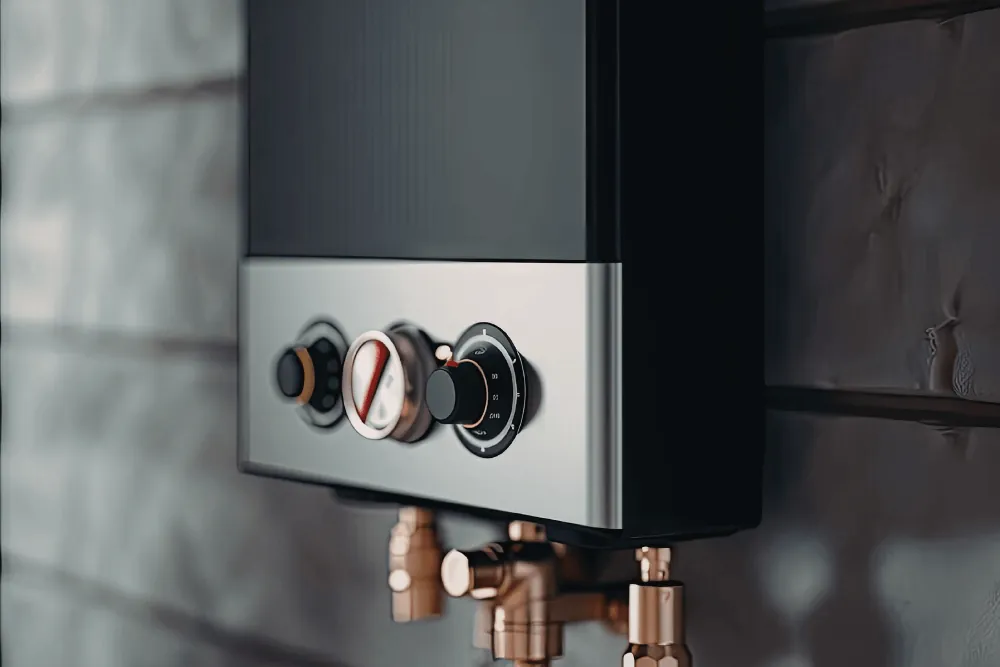
Opinions differ. Storage heaters tend to cost less, have fewer mechanical problems, can use off-peak electricity and put a built-in limit on hot water use. Tankless units take less space, never run out while the supply holds, and are said to last longer, though claimed savings depend on conditions and are usually quoted for gas units. For an electric unit the practical limit is the electrical supply, and electric tankless suits very small loads best.
Choosing:
| Situation | Our view |
|---|---|
| A single shower, with the supply to feed it | Possible, if the electrical supply can carry the load in the sizing table above |
| Several outlets used at once, or a bath | A storage heater is the safer choice. See water heater installation |
| Low or fluctuating flow at the fixtures | The unit may not start. Resolve the flow first |
Common faults in an instant heater
The fixes for the parts common to all electric heaters, including thermostats and elements, are on water heater repair and element and thermostat replacement.
| What you see | Possible cause |
|---|---|
| No hot water | No power, or flow below the turn-on level |
| Lukewarm or fluctuating water | Flow restriction or overload, such as scale or a clogged inlet screen |
| Cold burst in a hot shower | The cold-water sandwich |
| Banging or rumbling | Scale and kettling |
| Error code on the display | A safety or sensor fault |
| Breaker trips | An overload, or an earth fault in the unit |
| Drips or mineral crust at connections | A leaking joint or valve |
If the fault returns, stop. Persistent error codes that do not clear after a reset may mean a failed circuit board or temperature sensor. Do not open the cover of an electric unit, and do not reset a tripping breaker repeatedly, since both can hide an earth fault.
Descaling and maintenance
Descaling means isolating the heater and circulating an approved descaling solution through the heat exchanger, then flushing, and cleaning the inlet screen. An unapproved product can damage components, and the model's manual sets the actual interval. In hard water the interval is shorter. We follow the manual and write the date of the next flush on the handover note.
Scald safety
An instant heater has no stored hot water, so the outlet temperature is whatever the setting and the flow produce. It can be set low at the unit, and a household with young children or elderly people can set it lower still. The cold-water sandwich above means temperature can swing, so for a shower we recommend a thermostatic mixer at the outlet. See shower installation and bathtub.
Shower and bath demand
A shower is a modest continuous draw and a bath is a large one. A bath filled at a good flow with a 30°C rise would need a very large heater and a supply to match. A bath is a poor fit for an electric instant heater unless the supply is exceptional, and the bath page covers fill time and the heater that suits it. A whole-home unit for a property with baths and rain showers asks for a supply the property may not have. We check this on the visit before we quote.
Permission in Dubai: who decides on an instant heater
By default the landlord is responsible for a broken heater in a rented flat, and adding a new unit is an alteration. This is general information, not legal advice. The fuller account is on our shower installation and water heater installation pages. Where a tankless job falls:
| Job | Starting point |
|---|---|
| Replacing a failed heater with a similar unit | Landlord's responsibility by default, unless your contract says otherwise. Tell the landlord first and get the decision in writing |
| Adding a point-of-use unit at a basin or shower | An alteration, since it adds a heater and an electrical connection. Written landlord consent, and building management |
| Replacing a storage heater with a whole-home electric unit | An alteration, and possibly a change to the electrical supply. Written consent and building management approval |
We cannot say whether your building needs a certificate for a particular job. Building management can, and a request in writing is cheaper than a stopped job. Tell us what your building asks for and we work to it.
Warranty and the handover
What you should have when the job is finished:
- A written note of the model, kilowatt rating, voltage and phase, serial number and manufacture date, the temperature setting, and the tests we ran.
- The manufacturer's warranty terms. These are the manufacturer's and not ours.
- FAM's workmanship warranty, in writing. The warranty runs for 30 days and covers our labour only. Parts carry the manufacturer's warranty only.
How we install and repair an instant heater
- You tell us what you have and what you want, and send photos of the unit, its label, the board and the outlets it serves on WhatsApp.
- We visit, measure the flows and the incoming water temperature, check the supply and the board, and look at the pipe run. The visit fee is AED 50 + VAT, credited if the work goes ahead.
- We work out the load and tell you whether tankless fits. If it does not, we say so and what does.
- We give options and a price in writing.
- Check permission. In a rented or managed property, ask the landlord or building management whether they need to approve this work before the visit.
- We install or repair, with isolation and flush valves, a dedicated circuit and earthing, and test the flow, the temperature and every joint.
- We hand over the written note and, for a service, the dated flush record.
Where we work in Dubai
We cover all of Dubai, including Dubai Marina, JBR, Downtown Dubai, Business Bay, Jumeirah Lakes Towers, Palm Jumeirah, Al Barsha, Jumeirah Village Circle, Dubai Hills, Mirdif, Deira and Al Quoz. See the full list of areas.
Is a tankless heater right for your home?
An instant heater suits some homes very well and others badly. Ask four questions before you choose.
- How many outlets will run at once? A single bathroom basin or a shower is easy. Two showers at once needs a large unit, and a whole villa with several bathrooms is usually better served by a storage tank or several point-of-use units.
- What is the electrical supply? Large instant heaters draw a heavy current. A flat with a limited supply may not allow it, and a new circuit and cable might be needed. Our own electricians assess this before you buy.
- How hot is the incoming water in summer and winter? Water from a roof tank in August can be warm already. In winter it is much cooler, and the heater has to work harder.
- Do you want hot water instantly or a large volume? An instant heater gives endless hot water at a limited flow. A storage heater gives a larger flow for a limited time.
What a heater that struggles tells you
| Symptom | What it points to |
|---|---|
| Water is warm, not hot, at full flow | The heater is too small for the flow, or the incoming water is colder than assumed |
| Water is hot at low flow and cool at high flow | The heater is at its limit. Reduce the flow or choose a bigger unit |
| The heater does not switch on at low flow | The flow is below the minimum the sensor needs |
| The heater clicks on and off | Low flow, scale on the sensor or an air pocket |
| The breaker trips | An overload, a shorted element or a wet connection |
| Water temperature swings | Pressure changes on the supply, or a scaled element |
| Water runs hot then cold | The cold water sandwich, where a short gap of cold water arrives between uses, or a sensor fault |
Showers, kitchens and basins: matching the unit
- A basin or a small kitchen sink needs a small unit with a low flow. It is cheap to run and quick to fit.
- A single shower needs a unit sized for the shower flow and the temperature rise, and usually a dedicated circuit.
- A master bathroom with a bath is a heavier demand, and a storage tank may fill a bath more easily.
- A whole flat can use one large unit if the supply allows it, though many choose a storage heater for the extra capacity.
A good rule is to size for the greatest simultaneous demand, not the average. A heater that copes with one shower but not two will annoy a family every morning.
Installation details that matter
The heater must be fixed to a solid wall, with space around it for the cover to be removed. The pipe connections need isolation valves, so the unit can be removed for service. A strainer on the inlet protects the unit from grit. A pressure relief arrangement is needed where the maker requires it. The electrical supply has to be protected with the right breaker and a suitable isolator, with the cable sized for the load. A heater in a bathroom must be placed where it is not splashed, and must have the right protection rating for the zone.
We check each of these on a visit, and our own electricians do the electrical side. The price is fixed on WhatsApp before we start, and prices exclude 5% VAT.
Reading the label
The label on an instant heater gives the voltage, the power in kilowatts, the maximum pressure and the protection rating. Use the power to work out what the heater can do. A heater of a given power raises a given flow by a given number of degrees, so a larger flow means a smaller rise. Also check the maximum pressure and the protection rating, because a splash-proof unit is not the same as one safe in a shower spray. If the label says 5.5 kW, it will not give a hot shower in winter at a high flow rate. Choose with the real use in mind. The name on the box is marketing and the rating plate is the fact: instant, on-demand and tankless electric heaters are all the same idea, a flow-activated element with no storage.
Looking after an instant heater
- Clean the inlet filter and the shower head every few months, because scale reduces flow and the sensor needs a minimum.
- Have the heater descaled when the flow drops or the temperature falls.
- Do not alter the flow with a tap partly open for long periods, because it strains the sensor.
- Switch off at the isolator if you go away for a long time.
- Never use the heater if water has got into the cover.
Voltage, phase and the supply
Heater labels carry a voltage, and it has to match the supply at your property. Most flats and villas in Dubai have a single-phase supply for the home, and some larger villas and commercial units have three-phase. The label of a heater says which it is built for.
- Match the label to the supply. A unit built for a different voltage will give less or more power than its label states, and a unit built for a much lower voltage can fail at once. Never connect a heater built for another country's supply without checking the label and asking us first.
- Ask for the power at your supply. The same model is sold with slightly different kilowatts by different sellers, because the rating changes with the supply voltage. Read the rating plate on the unit in the box, and ask which voltage the figure is for.
- A supply that sags lowers the output, and the output is what heats the water. A unit that gives lukewarm water on a long cable run, or when the building's load is high, may be telling you the voltage at the unit is low.
- Single-phase or three-phase. A large heater spread over three phases draws far less on each than the same heater on one. Whether your property has three phases is a fact about its connection, and the main breaker tells you. If a property is single-phase and the load is more than the main breaker leaves free, the answer is a smaller unit, and a bigger supply is a larger job that is not ours to promise.
- Check the electronics. The flow sensor and control board should be built for the supply frequency in Dubai. A plain element does not care, but a board might.
The cable size and the breaker are set by the electrician against how the cable is installed. They are not read across from a table, and we do not quote a circuit until we have seen your board.
Reading the claims on a heater sheet
You will meet these claims on a sheet or a shop page, and each needs reading:
| Claim | What it means |
|---|---|
| A very high efficiency figure | An electric element turns nearly all its electricity into heat, so a high figure is normal. It does not mean the heater is cheap to run |
| "Endless hot water" | Water runs hot for as long as the tap is open, but the flow is set by the kilowatts. A unit that can warm 3 litres a minute cannot warm 8 |
| "Zero standby loss" | True of a unit with no tank, because it keeps no hot water in reserve. Heat is still lost from the pipe between the unit and the tap, so the closer to the tap, the better |
| A flow figure with no stated rise | Tells you nothing. Ask the inlet and outlet temperature it assumes |
| Marketing comparisons with a tank | Not rated values. An electric tankless unit uses about the same energy to warm the same water as an electric storage heater. The saving is the standing loss it does not have |
Where an instant heater can go
A heater is made for a protection class, and the class decides where it may go. A small electric heater is often splash-resistant, which is not the same as safe in a shower spray and does not make the unit waterproof.
- Bathroom. The position of the heater and of its switch is the electrician's call, because the rules about switches and sockets near water apply. A unit inside a shower cubicle is a different case from one on the far wall.
- Outdoors. A unit outdoors takes sun, dust and the occasional hose. Check that the protection class covers the place, and that the unit is made for the heat of a Dubai summer.
- Accessories. The class can change with a mounting frame or a cable entry. Ask the maker.
Send us the model and the place you have in mind, and we check it against the label before you buy.
Checks before you buy an electric heater
- The voltage on the rating plate matches your supply. Ask for the power at your voltage in writing.
- The phase. Single-phase or three-phase, and the amps on each.
- The breaker and the cable. The electrician sets the circuit against the property's supply, and the maker's figure is an input to that and not the answer.
- The flow, at a stated rise. A flow with no inlet and outlet temperature is not a flow.
- The protection class, and whether it changes with an accessory. Where the unit goes decides what class you need.
- The connections. Check the water connection size and thread type before you buy, because the wrong thread needs an adapter.
- Stock, seller, VAT and warranty. Warranty terms are the maker's, so ask who honours them in Dubai, and keep the invoice.
- Reviews. Reviews of a heater often describe the installation or the supply and not the heater, so treat a rating built on a handful of reviews with care.
How much does tankless heater installation or repair cost in Dubai?
The price follows the unit, the electrical work and the access.
- The heater. Its type, kilowatt rating, brand and warranty. If you supply your own, tell us before you buy so the flow, the rise and the supply are checked first.
- Labour for the installation. Mounting, plumbing connections and commissioning.
- Electrical work. A dedicated breaker, cable, isolator, and any change to the supply. This is the largest variable for a whole-home unit.
- Isolation and flush valves, and the strainer.
- Water treatment, if the water test calls for a softener or an inhibitor.
- Pipe insulation or repiping, if the run is long or old.
- Diagnosis and repair, for a fault, with parts quoted separately.
- Descaling service, per unit.
- Removal and disposal of the old heater.
- Building fees. Any fees charged by the building for contractor access or a deposit are separate from our price.
We do not publish a starting price for this job. Send a photo on WhatsApp and we give you a fixed price before we start. Prices exclude 5% VAT.
Tankless water heater FAQs
How do I size a tankless water heater?
Add the flow of the fixtures that run together, then find the temperature rise you need, and match a unit rated for that rise at that flow. More flow and a bigger rise both mean more kilowatts, as the table above shows.
Can I run my whole flat on a tankless heater?
Usually not on an electric unit, because the current needed is large. A shower and a basin together can need a very large supply. We check the supply at your board before we advise.
Why does my tankless heater give cold water at a low tap setting?
It may be below the turn-on flow. A restricted aerator or a nearly closed tap can fall under it. Open the tap further, clean the aerator, and tell us the model.
What is the cold-water sandwich?
A short burst of cold water between two hot flows, when the unit takes a moment to fire after you close and reopen the tap. If it is frequent, we look at the flow and the pipe run.
Why does my tankless heater make a banging or rumbling noise?
Scale on the heat exchanger is the usual cause. Descaling is the first step, and the water test says whether the cause is the water.
How often should a tankless heater be descaled?
Your model's manual sets the interval, and an unapproved descaler can damage components. In hard water the interval is shorter.
Does a tankless heater need a water softener?
Test the water first. Some manufacturers recommend or require treatment above a stated hardness level, and a lack of it can affect the warranty. See water softener.
Is tankless better than a storage heater?
Not for every property. Electric tankless suits small loads, and a storage heater is the safer choice for several outlets or a bath. We choose on the load, the supply and the number of outlets.
Who pays for a heater replacement in a rented flat?
By default the landlord, unless your contract says otherwise, and adding a new unit is an alteration that needs written consent. This is not legal advice.
What do I do if the breaker trips when the heater starts?
Do not keep resetting it. A tripping breaker means an overload or an earth fault, and repeated resets can hide it. Switch the unit off and WhatsApp us. See water heater repair.
What is an electric on-demand water heater?
It is a heater with electric elements and no tank that heats water only while a tap is open. How it works and how to size it are set out earlier on this page.
How much hot water does a small electric heater give?
Less than you might expect. A heater around 5.5 kW warms only about 3 litres a minute by 25°C, which is enough for a basin or a low-flow shower on a warm day, but not for a full shower in winter, when the incoming water is colder. Check any flow claim against the kilowatts and ask the temperature rise it assumes.
Can I connect a heater built for another country's supply?
We do not recommend it. A heater built for a different voltage draws the wrong power at ours, and a much lower rated unit can fail at once. Send us the rating plate before you connect anything.
Can an electric instant heater go outdoors or in a bathroom?
A heater is made for a protection class, and the class decides where it may go. A bathroom is a wet area, and the rules about switches and sockets near water apply, so the position of the heater and its switch is the electrician's call. Outdoors, check that the class covers the sun, dust and water. Send us the model and the place.
Book a tankless water heater installation or repair in Dubai
Tell us what the heater is doing or what you want, whether it is one outlet or the whole property, and whether you rent or own. Photos of the unit, its label and the board help. If a breaker keeps tripping or water is leaking, switch the unit off and call. We will measure the load, advise whether tankless fits, install or repair, test it, and give you a written note.
WhatsApp: +971 55 407 7427 · Request a quote
Visit us: Office 871, Oasis Mall, Al Quoz 1, Dubai, UAE
Related services: Water heater installation · Water heater repair · Element and thermostat · Water softener · Shower installation · Pipe insulation · Emergency plumber