
Water heater thermostat in Dubai: what we do
- Diagnosis. We measure the water at the tap against the dial, then test the thermostat, the high-limit cut-out and the element, and say which one is at fault.
- Setting the temperature. We set it with you, write it down and measure the result. The reasons are in the setting section below.
- Thermostat replacement. Like for like, by voltage, rating and fitting, with the old settings recorded. See element and thermostat replacement.
- Digital and smart controls. We tell you what a controller does and does not replace, and fit it in the heater's circuit where it suits.
- Electrical checks. FAM has its own electricians, so the isolator, cable and breaker are checked on the same visit.
- Emergency visits. We answer calls and send a plumber 24 hours a day, 7 days a week, and we do not promise an arrival time.
- What we do not do. We do not do gas work. If your heater is gas fired, the gas control is not ours to adjust or replace.
- Areas. Across Dubai. The list is near the end of this page, and the full list of areas is on its own page.
What the thermostat does, and what it is not
The thermostat measures the water temperature and switches the heating on and off to hold the setting.
| Part | What it does | Where it is covered |
|---|---|---|
| Thermostat | Holds the temperature you choose by switching the element | This page |
| High-limit cut-out | A safety switch, usually built into the upper thermostat, that cuts power if the water gets too hot. It has a reset button | Element and thermostat replacement |
| Temperature and pressure relief valve | Opens to release water if the tank overheats or over-pressurises | Water heater installation |
| Thermostatic mixing valve | Blends hot and cold at the outlet to limit the temperature at the tap. A different part on a different pipe | Shower installation and bathtub |
Two names cause confusion:
- "Thermostatic water heater." Ask which part is meant, the thermostat inside the heater or a thermostatic mixer at the outlet.
- "Calorifier thermostat." A calorifier is an indirect heater fed from a boiler or solar loop, as our water heaters overview explains. Its heat comes from an external source, so ask what is being controlled.
If the heater has two thermostats, an upper and a lower, the lower one carries most of the heating load. The wiring diagram on your heater shows which arrangement you have.
The types
| Type | How it works | What to know |
|---|---|---|
| Mechanical (rod or bimetal) | A metal strip or rod expands with heat and opens a switch | Simple and cheap. Accuracy drifts with age and scale |
| Capillary (liquid-filled bulb) | A sealed bulb and thin tube sense the temperature and move the switch | Common on tank heaters. A broken tube means replacement |
| Digital (electronic sensor) | A sensor feeds a control board, with a display | Narrower temperature swing. More sensitive to surges and moisture |
| Instant-heater controls | A flow switch and a temperature limit | No tank to hold temperature. See tankless water heaters |
| Gas control | A dial on a gas valve | Not our work. See the gas heaters section |
Two points apply to every type. First, a thermostat has a differential: the gap between the temperature at which heating switches off and the temperature at which it switches back on. A wider gap means fewer starts and a bigger swing in the tank. Second, the temperature at the tap can sit anywhere in a band around the dial, and the band is wider than the marks suggest. Set the dial, then measure.
Reading the dial
Dial marks come in four styles: degrees, letters, words and an arrow. Letters and words mean something different on each make, so the marks only make sense against a thermometer. Three things follow:
- Neighbouring positions overlap. A part's real switching point can sit several degrees either side of the mark, so a heater on one step and a heater on the next can deliver the same temperature. The marks are a rough guide.
- The low end of one step can be hotter than the high end of the step below it. Do not assume that the next step up is always hotter.
- The higher the setting, the faster the water burns skin. A few degrees at the top of the range cut the time to a serious burn from minutes to seconds, which is why we start low and work up.
These are temperatures at the heater's outlet and not at the tap. A mixed tap, a thermostatic valve or a long pipe run changes what reaches the skin. The next sections cover what to set and how to measure.
A thermostat's range is the limit of the part and not a recommendation. A part that can be set far higher should still be set far lower.
What to set it to
Two ways to reach a safe tap temperature, and the choice depends on whether a mixer is fitted:
| Setting | Reason |
|---|---|
| About 49 to 50°C at the heater | Scald risk is lowest. Bacteria in the tank are controlled less well, and the tank gives fewer litres of mixed water |
| About 60°C at the heater, with a thermostatic mixing valve limiting the tap to about 49°C | The tank controls bacteria, and the mixing valve carries the scald protection. The mixer has to be fitted, working and in the line |
| The lowest setting that still gives you the hot water you need | Scald risk rises with temperature, and so do heat loss and scale |
With children or elderly people in the home and no mixer, stay near 49°C. With mixers at each outlet, the tank can run hotter, since the mixer holds the tap temperature.
A lower setting costs litres. Our water heaters overview works out how much storage you lose when the setting drops by 5°C, and it is a noticeable amount. The setting is a safety choice first and a capacity choice second.
We set the thermostat with you at the end of the job, record it and measure the water.
Measuring the real temperature
The dial states what the thermostat is asked to hold. The tap shows what arrives.
- Do not use hot water for about an hour, so the tank is full and at its setting.
- Run the hot tap at full flow for a minute or two.
- Put an instant-read digital thermometer in the stream. Do not fill a cup first, because a cup cools the water quickly.
- After changing a setting, recheck a few hours later.
Take the reading at the hot tap nearest the heater, and then at a distant one. A long pipe run adds a delay and a heat loss that the thermostat does not control. Our pipe insulation page covers the loss.
| Tap reading against the dial | What it means | What we do |
|---|---|---|
| Well below the dial | A thermostat set low, a weak or partly failed element, a faulty mixer, or a non-return valve letting cold water into the hot line. See water heater repair | Test the heating circuit, then the mixer. See no hot water |
| Close to the dial, and hotter than you want | The setting, not a fault | Lower it, and measure again |
| Well above the dial | A thermostat stuck closed or out of calibration | Switch the heater off at its isolator and WhatsApp us |
| Climbing, with steam or water from the relief valve | The relief valve is the last protection. See installation | Switch it off at the isolator, keep clear and WhatsApp us |
Comparing the tap with the dial catches a drifting thermostat before the cut-out is the only thing between the tank and a scald.
Adjusting the setting
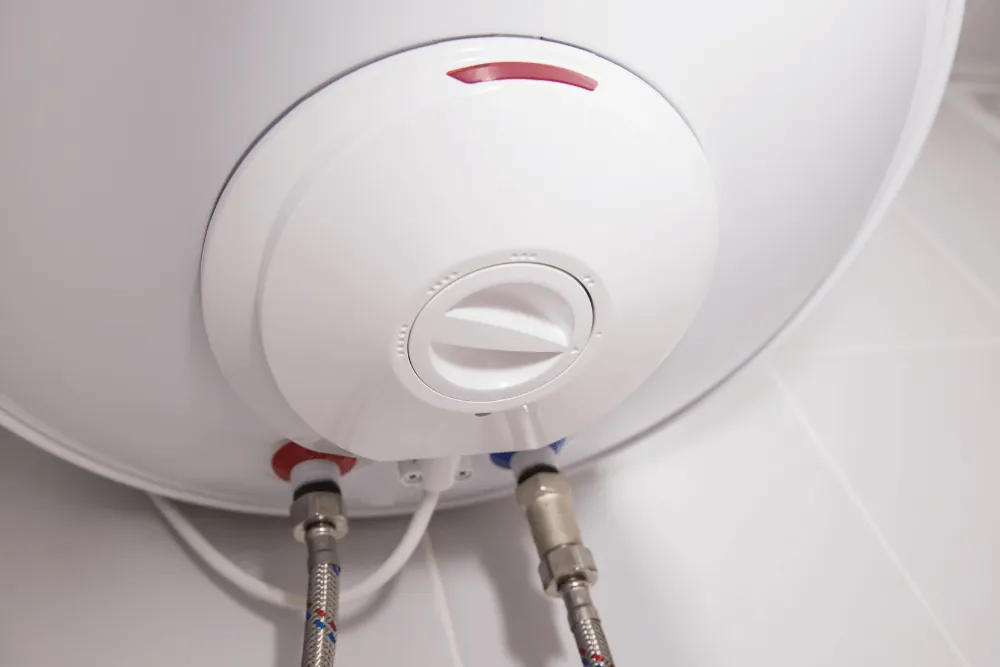
An external dial on a small heater. The dial is on the outside, so turning it down from there is a job for the owner. Measure at the tap afterwards.
A dial or screw behind a panel on a tank. Switch the power off at the breaker first, then remove the panel. The dial is usually near the bottom of the front of the unit and may show degrees or words such as low, hot or very hot. Some units have a holiday setting that lowers the temperature while you are away. A change behind a panel is for a plumber or electrician. The checklist we follow:
- Record the original settings before changing anything.
- Never bypass the high-limit cut-out, and do not press its reset button repeatedly. A cut-out that keeps tripping is telling you about another fault, covered on the element and thermostat page.
- Refit the covers before restoring power, and measure at the tap.
In a rented flat, a change that alters the wiring or replaces the part is for the landlord to agree.
Gas heaters
If your heater is gas fired, the dial sits on the gas control, which holds the pilot, the burner and the temperature setting in one valve.
- We do not do gas work. We do not adjust, repair or replace gas controls, connections, pilot assemblies or flues.
- The gas control is not a field-adjustable part. The maker's instructions for your heater say who may service it.
- A gas smell is an emergency. Leave the property, do not touch electrical switches, and call the gas supplier's emergency line and the emergency services. Then call us for the water side once you are safe.
We can still help with the water side of a gas heater, such as the isolation valve, the relief valve and the discharge line. If you are thinking of changing to an electric heater, see water heater installation.
Digital and smart controllers
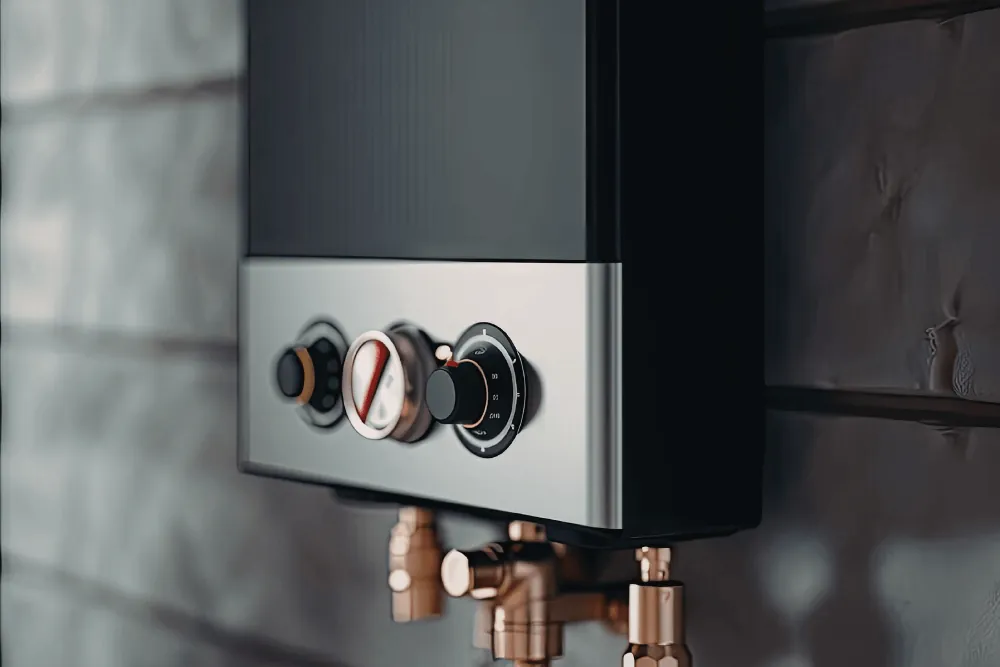
A digital thermostat replaces the dial with a sensor and a display. Digital units hold a narrower range and cycle less, and they are more sensitive to surges and moisture.
A Wi-Fi switch is a different thing from a thermostat. It sits in the heater's circuit, with remote control, schedules and sometimes energy monitoring and an optional temperature sensor. The original thermostat stays in the circuit.
A switch in the heater's circuit carries the heater's full current, so:
- A controller's relay has to be rated above the heater's current. Read the product sheet and not the advert.
- A schedule or sensor sits in front of the thermostat and the high-limit, not in their place. Leave both in the circuit.
- A change to the heater's circuit in a rented home is an alteration and needs the landlord's written consent.
Permission in Dubai: who decides on thermostat work
Changing a thermostat touches the heater's wiring, and in a rented home it touches the landlord and the building.
- Landlord. A like-for-like thermostat on a heater inside your own unit needs a message to the landlord.
- Alteration. Fitting a smart controller, moving the heater's circuit or adding a mixing valve is an alteration and needs written consent in a rented home.
- Building management. In a flat, a shared hot water plant or riser belongs to the building. We do not change its controls without management.
Tell us what your building asks for and we work to it.
When the job is finished
Ask for these. They cost nothing to produce.
- The setting as found and as left, in °C, with the date.
- The tap reading, taken with a thermometer at the nearest and the farthest hot tap, with the time after the last use.
- The part's make, model, rating and range, with a photograph of the label.
- The high-limit cut-out tested, and a note that it was not bypassed.
- FAM's workmanship warranty, in writing. The warranty runs for 30 days and covers our labour only. Parts carry the manufacturer's warranty only.
How we work
- You message us with the heater's make and model if you know them, a photograph of the label and the dial, and what the water is doing.
- We say what we think the cause is, and whether the heater should be isolated until we arrive.
- We visit. The visit fee is AED 50 + VAT, credited if the work goes ahead.
- We give a price in writing, with the part and the work shown separately.
- Check permission. In a rented or managed property, ask the landlord or building management whether they need to approve this work before the visit.
- We measure first: the tap against the dial, then the thermostat, the high-limit and the element, with the power isolated and proved dead.
- We replace or set the part, then measure again after the tank has reheated.
- We hand over the settings, the readings and the part details.
Where we work in Dubai
We cover all of Dubai, including Dubai Marina, JBR, Downtown Dubai, Business Bay, Jumeirah Lakes Towers, Palm Jumeirah, Al Barsha, Jumeirah Village Circle, Dubai Hills, Mirdif, Deira and Al Quoz. See the full list of areas.
Signs the thermostat is the problem, and signs it is not
A heater that gives no hot water, or water that is too hot or too cold, is often blamed on the thermostat. Sometimes the blame is right. Often it is not, and replacing the wrong part wastes a visit.
| Symptom | Thermostat likely? | What else to check |
|---|---|---|
| Water is cold, heater has power | Possible | A burnt element, a tripped cut-out, or a failed contactor |
| Water is lukewarm and never gets hot | Possible | A scaled or partly failed element, or a set point turned down |
| Water is far too hot, steam at the taps | Yes, urgent | The safety cut-out and the relief valve are also at risk |
| Heater clicks on and off quickly | Possible | A scaled tank, a failing element or a loose connection |
| Breaker trips when the heater switches on | Not usually | A shorted element or water in the wiring |
| Hot water runs out fast | Not usually | A failed dip tube, a mixing fault or a smaller tank than the household needs |
| Water temperature swings | Possible | A slow thermostat, or a mixer or a shower valve that is not stable |
A thermostat is a simple switch that opens and closes with temperature. When it fails, it fails open (no heat) or fails closed (heat that does not stop). The second is dangerous, and the reason a safety cut-out and a relief valve sit alongside it.
A visit for a thermostat, in order
On a normal visit, the work follows a safe order.
- Switch off at the breaker and prove it is dead with a tester, not just the heater's switch.
- Look before touching. Check for water in the cover, burnt wires, scorch marks and melted insulation.
- Read the label on the heater for the voltage, the wattage and the type of thermostat fitted.
- Test the thermostat and the cut-out with a meter, and test the element too. A good thermostat on a burnt element wastes a visit.
- Replace the failed part with one of the correct rating and the same type of fitting, with the sensor in firm contact with the tank wall. A loose thermostat reads wrongly, and a part that is close but not the same can be unsafe.
- Reassemble, restore power and test. We check that the heater heats, that the thermostat cuts out at the set point, and that nothing leaks.
- Set the temperature and tell you what we set and why.
If the tank is scaled, the element is burnt or the cut-out has operated, we tell you, because repeat failures have a cause.
The safety cut-out and what it tells you
A thermostat sits with a second device called a safety cut-out, which operates if the temperature rises too far. In many heaters it has to be reset by hand with a small button. If the cut-out has operated, something has failed: a stuck thermostat, a scaled element or a blocked circuit. Pressing the reset button without finding the cause only delays the next trip. We find out why, replace the part and check that the water cannot overheat.
Why the dial and the tap disagree in Dubai
The dial is only one of the things that set the water temperature at a tap. In Dubai homes, four others matter:
- Inlet water temperature. Water from a rooftop tank can arrive warm in summer, so a heater on a low setting still gives hot water, and in winter the same setting feels weaker.
- Position of the heater. A heater in a hot ceiling void loses less heat to the room than one in a cool cupboard, and the pipe run to the tap changes the reading.
- Stratification. Hot water sits at the top of a tank. Right after heavy use, the outlet can be hot while the lower tank is still cold, and a reading taken at once misleads.
- Mixers and long runs. A thermostatic mixer or a long pipe run sits between the heater and the skin.
That is why we measure at the tap, at the nearest and the farthest outlet, after the tank has reheated.
Settings for different households
- A home with children or older people and no mixer. A low setting near the safe end, measured at the tap.
- A home with thermostatic mixers at every outlet. The tank can run hotter, since the mixers hold the tap temperature.
- A shop or an office with a small heater feeding handwash basins. The lowest setting that gives warm water, and a timer so the heater is off overnight and at weekends.
- A guest room or a holiday let that stands empty. A holiday setting or a timer, and a check of the tap temperature on the first use.
- A heater that serves a bath. A bath draws a lot of hot water at once, so we check the size of the tank before raising the setting.
Questions to ask before a thermostat is replaced
- Will you test the element and the cut-out as well as the thermostat?
- Will you fit the same type and rating, and show me the label?
- Will you record the setting as found and as left?
- Will you measure at the tap after the tank has reheated?
- Will you leave the high-limit cut-out in place and working?
Our answers to all five are on this page, and we give them in writing.
Thermostat or timer?
Some households ask whether to fit a timer. A timer switches the heater off when the family is out or asleep, and saves power. It is worth it when the tank is large and well insulated and the household has a regular pattern. It is less useful for a small tank that reheats quickly. A timer does not replace a thermostat and a cut-out. It sits ahead of them in the circuit. If you want a timer, the electrical work is done by our own electricians with a correctly rated device.
After a power cut or a trip
When the power returns, a mechanical thermostat simply carries on. A digital one may go back to a default setting, and a smart switch may lose its schedule. After any long cut, or after a breaker trip, check three things: that the heater is on and heating, that the setting is where you left it, and that the water at the tap is not hotter than you expect. If the breaker tripped when the heater came back on, leave it off and message us, because a heater that trips on restart has a fault that the cut only exposed.
Looking after the thermostat
- Do not turn the dial to maximum to get more hot water. It only raises the risk and the scale.
- Keep the cover on and the area dry.
- Flush the tank as advised, to remove sediment that forms hot spots at the element.
- Check the relief valve each year by lifting its lever briefly with a bucket under the discharge pipe. If it does not flow, or does not seat after, it needs replacing.
- Note the setting after any service, so you can tell if it drifts.
Rented homes
In a rented home, tell the landlord first. Send a photo of the fault and the heater label, and ask in writing for approval of the repair. A heater that gives scalding water is urgent, and you should turn it off while waiting.
Thermostat noise and clicking
A faint click when a heater switches on or off is normal. A loud, repeated click, or a buzz from the thermostat compartment, is not. It can mean the contacts are worn and arcing, a connection is loose and heating, or the thermostat is hunting because the tank is scaled. Switch the heater off at the breaker and leave the cover on until it is checked. A smell of burning plastic, a brown mark on the cover or a hot casing are reasons to isolate the heater at once. We test the thermostat, the connections and the element, and replace the part that has failed. Prices exclude 5% VAT, and the price is fixed on WhatsApp before work starts.
How much does thermostat work cost in Dubai?
- The work. Measuring, isolating, replacing and testing.
- What moves the price. Whether the fault is the thermostat, the element or the wiring, the type of thermostat and the availability of the part, and access, particularly a heater in a ceiling void.
We do not publish a starting price for this job. Send a photo on WhatsApp and we give you a fixed price before we start. Prices exclude 5% VAT.
Water heater thermostat FAQs
Where is the thermostat on an electric water heater?
Behind a cover on the side of the tank, usually near the bottom, with a second one higher up on larger tanks. A small heater may have a single thermostat. The wiring diagram on yours shows which. Do not open the cover with the power on.
What temperature should I set it to?
The lowest setting that gives the hot water you need. With children or older people and no mixer, stay near 49°C. With a thermostatic mixer at the outlets, the tank can run near 60°C.
What do the letters or words on a heater dial mean?
They differ from make to make and the steps overlap, so read yours against a thermometer at the tap and not against the marks.
Why is my water not as hot as the dial says?
A long pipe run cools the water before the tap, and a dial is only a rough guide. Measure at the tap nearest the heater first. If it is still well below the dial, the element, thermostat or a mixer may be at fault.
Why is my water scalding when the dial is low?
A thermostat stuck closed or out of calibration keeps the element heating past the setting. Switch the heater off at its isolator and WhatsApp us. The cut-out and the relief valve are the last protection, and a heater that relies on them needs a new thermostat.
What is the difference between the thermostat and the reset button?
The thermostat holds the temperature you set. The reset button belongs to the high-limit cut-out, a safety switch that opens if the water gets too hot. A cut-out that keeps tripping points to another fault. Do not press it repeatedly or bypass it. See our element and thermostat page.
Can I adjust the thermostat myself?
An external dial on a small heater, yes, then measure at the tap. Anything behind a panel is for a plumber or electrician, with the power isolated first.
Does lowering the thermostat save money or cost litres?
Both. It reduces heat loss and scale, and it also reduces the litres of mixed water the tank gives. Our heaters overview works out the loss for a typical tank.
Can a Wi-Fi switch or smart controller replace my thermostat?
No. It adds scheduling to the circuit. The relay must be rated above the heater's current, and the thermostat and high-limit stay in place.
Do you work on gas water heater thermostats?
No. We do not do gas work. We work on electric heaters, and on the water side of any heater.
How much does a water heater thermostat cost in Dubai?
The price follows the part, the access and whether the fault is the thermostat, the element or the wiring. We do not publish a starting price for this job. Send a photo of the heater label on WhatsApp and we give you a fixed price before we start. Prices exclude 5% VAT.
Book a water heater thermostat visit in Dubai
Tell us what the water is doing, the heater's make and model if you know them, and whether you own or rent. A photograph of the label and the dial helps, and a thermometer reading from the tap helps more. If the water is scalding or the heater trips repeatedly, switch it off at its isolator and call. We will measure, give you the options and a price in writing, do the work and hand over the settings.
WhatsApp: +971 55 407 7427 · Request a quote
Visit us: Office 871, Oasis Mall, Al Quoz 1, Dubai, UAE
Related services: Element and thermostat replacement · Water heaters overview · Water heater repair · No hot water · Water heater installation · Tankless water heater · Shower installation · Pressure valves · Emergency plumber