
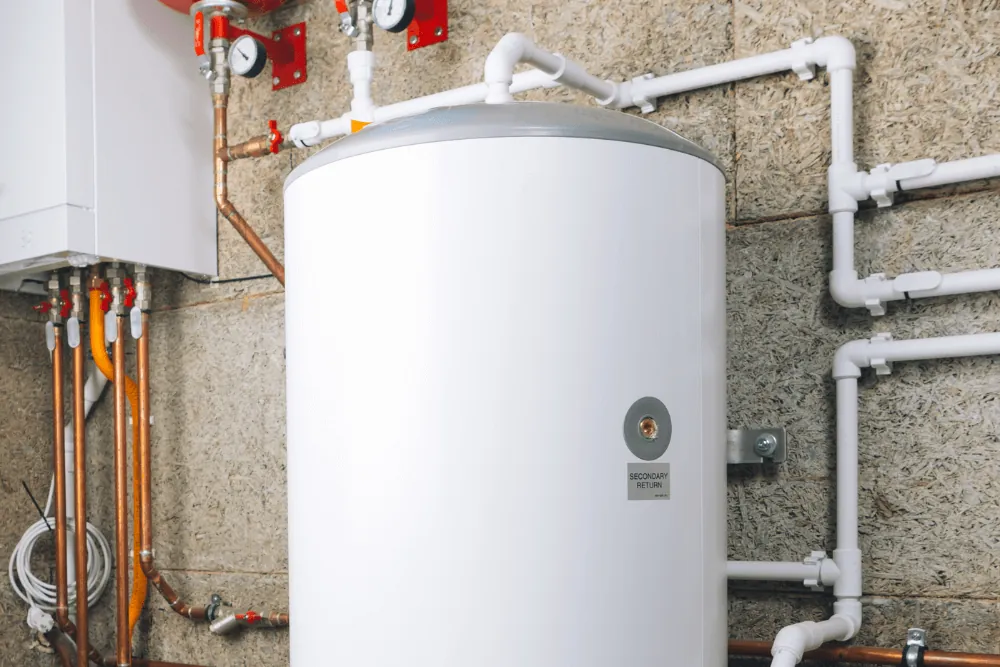
Heat pump water heater installation and repair in Dubai: what we do
- Advice on whether a heat pump suits the property. The room it would sit in, the air around it, the drain route, the electrical supply and the household's hot water use.
- Installation of integrated units, with the plumbing connections, the condensate drain, the valves and the electrical connection.
- Faults. Error codes, no hot water, a compressor that does not start, a unit that runs on its element, noise, water on the floor and a tripping breaker.
- Servicing. The air filter, the evaporator coil, the condensate drain and trap, the anode and the tank flush.
- Replacement of a failed heat pump unit with another, or with an electric storage heater where the space does not suit.
- Refrigerant-side faults, which we handle through a qualified refrigeration technician.
- A written note of the model, the settings and the tests we ran.
Neighbouring topics have their own pages. The valves, relief line, tray and scald settings that any storage tank needs are on our water heater installation page and are not repeated here. Instant heaters are on tankless water heater, roof systems on solar water heater, and element and thermostat faults on element and thermostat replacement and water heater repair.
How a heat pump water heater works
- A fan pulls room air across refrigerant-filled tubes, the evaporator. The refrigerant absorbs heat, and the air leaves cooler.
- A compressor raises the refrigerant's pressure and temperature.
- A coil wrapped around the tank, the condenser, passes that heat to the water.
- An expansion valve lets the refrigerant cool and return to the evaporator.
| Part | What it does | What it means for faults |
|---|---|---|
| Compressor | Drives the refrigerant cycle | With the compressor out, only the element heats. A sealed-circuit part, so a refrigeration technician's job |
| Condenser coil | Passes heat to the tank water | Sealed in the unit, not a plumber's part |
| Air filter | Keeps dust off the evaporator | A dirty filter triggers a code on most models and is the first thing to clean |
| Condensate pan and drain | Collects the water removed from the air | A blocked drain can trigger a code and put the unit on its element |
| Tank, anode and backup element | Store the heat and supply it when the heat pump cannot | The same faults as any electric storage heater. See water heater repair |
| Temperature sensors and control board | Choose between heat pump and element, and hold the setting | Sensor faults have their own codes in the manual |
The element supplies hot water when demand exceeds the heat pump's capacity or when the air is outside the range the heat pump works in. When the air sensor reads outside that range, most units switch to electric-only mode until it comes back.
Integrated, exhaust-air and split units
An integrated unit has the heat pump on top of the tank and takes its air from the room. An exhaust-air or split unit moves the evaporator or the air to another place, with ducting or refrigerant pipework between them. The air the evaporator sees is the air that sets the limits in the next section, so a unit in a conditioned room and a unit on a balcony or a roof meet different temperatures. We install integrated units, and we tell you if the position needs a different arrangement.
What the efficiency figures mean
Efficiency for a heat pump is stated as a coefficient of performance (COP): the heat delivered to the water divided by the electricity used. A COP of 1 means one unit of heat per unit of electricity, which is what an element gives. A COP of 2 means two, so the same hot water takes half the electricity. At 3 it takes a third.
Claims about heat pump water heaters vary a lot, and the figures depend on the climate, the room, the hot water use and the model. The COP a brochure quotes is measured in set conditions, and in a real home it is usually lower, particularly in a small or hot space or when the element has to help. We do not quote a saving for a particular home. What we can say is that the saving is real only while the heat pump is the one doing the heating. When the unit falls back on its element it heats at a COP of 1, as an ordinary electric heater does, and the saving is gone.
Recovery: why the element is there
A heat pump is slow. Its compressor uses a few hundred watts, and even at a good COP it delivers heat far more slowly than a 4.5 kW element, so refilling a tank after a heavy draw takes several hours on the heat pump alone and about two on the element. A heat pump unit can still supply hot water as well as an electric tank, as long as the tank is large enough and the element covers the peak. So the first-hour rating and how often the element runs are what to ask about, not the tank size alone. The method for reading a first-hour rating is on our water heater installation page.
Heat pumps in a hot climate: the air temperature limits
A heat pump water heater takes its heat from the air around it, so the temperature of that air sets where it works. Most integrated units work within a stated range of air temperature, and the efficiency rises as the air gets warmer up to the top of that range. Your model's data sheet gives its own limit, and we read it before we fit.
In Dubai the question is not the cold end but the hot end, and where the unit stands:
- A conditioned room sees the room's air temperature, which sits inside the working range while the air conditioning runs.
- An unventilated cupboard or plant room can get much hotter than the flat around it, and the unit adds its own cooling effect to a space that is too small. We measure the air in the position on a summer afternoon before we fit.
- A balcony, terrace or roof sees outdoor air, which in a Dubai summer can be at or beyond the top of the range.
- A unit outside its range switches to its element. In that mode it heats at a COP of 1, as an ordinary electric heater does, so the saving disappears.
Cooling, dehumidifying and where the cold air goes
A heat pump cools the air it takes the heat from, and it dries it too.
- A unit in an air-conditioned room removes a little of the cooling load the air conditioner is already carrying.
- A unit in a cupboard with no opening to a room cools the cupboard and gives the household nothing, and it cools itself, which lowers the temperature the evaporator sees and the efficiency with it.
- A thermostat in the cold exhaust path reads cooler than the room it controls, so check where the room thermostat is relative to the unit.
- In humid air the unit removes more water, so it makes more condensate. Dubai summers are humid, so expect a steady trickle to the drain.
Siting: space, airflow, access and noise
A heat pump needs air. Manufacturers state a minimum room volume or a minimum free opening for a full-size integrated unit, and the data sheet gives the figure. In a smaller space, a louvred door, a grille at the top and the bottom, or a duct to the next room can supply the air. A confined space gives a lower COP than the data sheet suggests, because the unit cools its own air. A utility room of 2 metres by 2 metres with a 2.4 metre ceiling is under 10 cubic metres, and a unit there would need air from the next room through a grille or duct. We measure the cupboard.
The other siting points:
- Clearance. The filter and control panel must stay reachable, and the unit needs room above for the air path.
- Noise. Compressor and fan noise is real, and some households find it a problem. Hard walls and bare floors can amplify it. A cupboard shared with a bedroom wall in a flat is a worse position than a plant room.
- Weight and the ceiling void. The unit sits on the tank, so the weight and the access of a ceiling void apply as on our water heater installation page. A heat pump unit also needs the air, which a closed void does not give.
The condensate drain
Because the unit removes water from the air, it needs a way to dispose of it. The water collects in a pan under the evaporator and leaves by gravity or through a small pump. Drain pans and condensate pumps protect the unit and the floor, and the drain and strainer need an occasional clear-out.
In a flat the drain goes to a floor trap, a basin waste or an air conditioner condensate line, and each needs permission from whoever owns that pipe. A blocked line is a common cause of water on the floor, and on most units a blocked drain pan port triggers a code and puts the unit on its element until it is cleared. We route the drain with a fall to a visible point where we can, keep the trap clear, and tell you where it ends. See drain unblocking for a blocked waste, and ceiling and wall leak for water that has already reached the ceiling below.
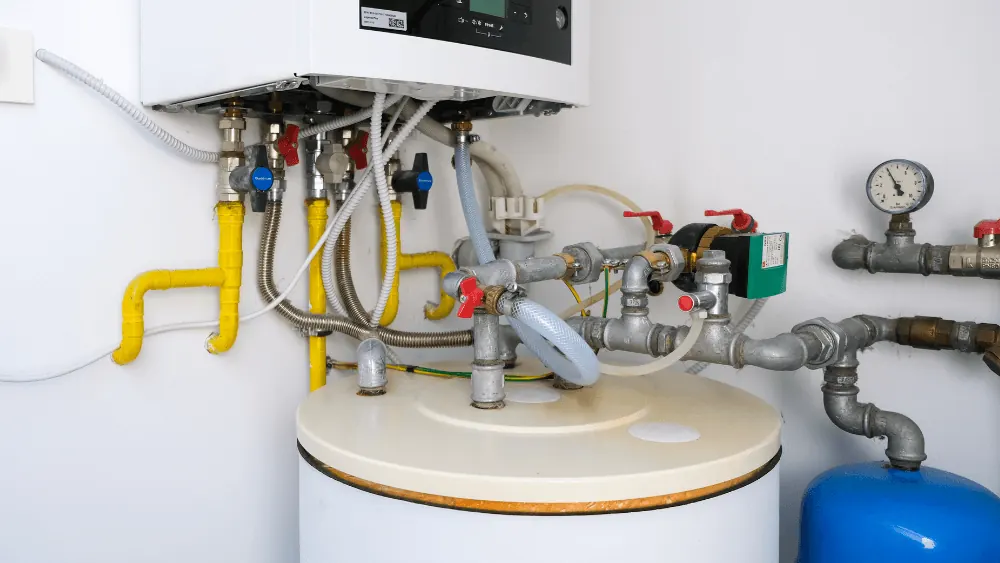
The electrical connection
The element is the largest electrical load in the unit. A heat pump unit needs a dedicated circuit with a breaker, an isolator within reach of the unit and earth leakage protection, all sized to the rating on the unit's label and checked against the panel for breaker space.
The circuit, the isolator and the earth leakage protection are covered on our tankless water heater page. What we do:
- Read the unit's label for its element rating, voltage, phase and maximum current.
- Check the existing circuit, its breaker, cable and isolator, against that label.
- Do the electrical work with our own electricians. Where the existing circuit is not suitable, they run a new one.
- Check earthing and the disconnection before the unit is energised.
Refrigerant: the sealed circuit
A sealed refrigerant circuit is a refrigeration technician's work and not a plumber's. Codes that point to low suction pressure, a high discharge temperature or a compressor that will not run mean the refrigerant side, and the manual's remedy is to contact a qualified technician. Refrigerant must never be released into the air, which is another reason the circuit is left to a qualified technician.
We do not open the circuit. We bring in a refrigeration technician for any refrigerant-side fault, and we record the refrigerant type from the label on the handover note so that the next technician knows it.
How we install a heat pump water heater
- Check the position. Air volume or an opening to a larger room, the air temperature on a summer afternoon, clearance, filter access, the drain route, noise towards neighbouring rooms, and the weight.
- Choose the unit from the first-hour rating and the position, as on the installation page.
- Fit the plumbing to the manual, with the valves and relief line described on our water heater installation page.
- Run the condensate drain with a fall to a visible point, or fit a pump, and test it with water.
- Connect the electrics to a circuit checked against the label.
- Commission. Watch the heat pump start, listen for noise, check the drain, read the display for codes, and measure the water at a tap. Record the mode and the setting.
- Hand over the written note, including the model, the refrigerant on the label, the settings, and the date of the first filter and anode check.
Sizing the tank
The recovery arithmetic above is why the rating matters more than the litres. A heat pump alone refills a tank slowly, and the element covers a peak. A unit that keeps falling back on its element is either too small for the draw or outside its air range. Thermostatic mixing valves can increase a system's capacity, because the stored water is hotter than the shower and is blended with cold. Our shower installation page covers thermostatic mixers from the scald side.
Valves, relief line and scald settings
A heat pump unit is a storage tank, and it needs the same isolation valve, non-return valve, expansion control and temperature and pressure relief valve with a discharge line, and the same tray where a leak would do damage. We do not repeat that account here.
Scale, the anode and maintenance
The tank is an ordinary electric storage tank, so scale and the anode apply as they do to any storage heater. The scale account is on water heater repair and the water test on water testing.
| Item | What to know |
|---|---|
| Air filter | Clean at least once a year, and more often in a dusty position |
| Tank flush | Once a year, to remove sediment |
| Anode rod | Inspect every year and replace it when it has worn down |
| Condensate strainer and drain | Clear them from time to time and check for leaks |
| Evaporator | A dirty evaporator coil cuts the heat the unit can take from the air |
| Annual service | Filter, drain, anode, tank flush and a check of the codes |
We set the first service from the position and the water test, and we write the date on the handover note.
Common faults in a heat pump water heater
Fault codes differ by brand, and your model's manual gives its own. The table lists what the usual codes point to.
| What you see | Likely cause |
|---|---|
| An error code on the display | A sensor, compressor, filter, drain or fan fault |
| Filter code | Dirty air filter |
| Drain code | Blocked drain pan port. The unit runs electric-only until it is cleared |
| Condensate pump code | An accessory pump unpowered, blocked or failed |
| Compressor starting and stopping | Airflow, a fan fault or the wiring |
| Compressor not functioning | A compressor-side fault, which needs a refrigeration technician |
| Sensor codes | A coil, tank, discharge or suction sensor fault |
| High discharge temperature or low suction pressure | Refrigerant-side faults |
| Runs on the element only | Air outside the heat pump's range, a filter or drain code, or a heat pump fault |
| No hot water | A tripped breaker, a failed element or thermostat, or no power |
| Water on the floor | A blocked condensate drain, or a leak from the tank, a joint or the relief line |
| Louder than before | A fan, a dirty filter or a loose fitting |
| Breaker trips | An overload or an earth fault |
Two things you can try: switch off at the breaker and clean the air filter, and check that a condensate pump, where fitted, has power and a clear outlet. Beyond those, stop. Do not open the cover of a unit with a sealed refrigerant circuit and a mains element.
Heat pump against solar, tankless and electric storage
| Option | What to expect |
|---|---|
| Heat pump | Lower electricity for the same heat at a COP above 1, by the arithmetic above. Needs air, a drain and a position where the noise is acceptable |
| Solar with electric backup | Works well on a villa roof in Dubai sun. Needs roof space and a roof that carries the load. See solar water heater |
| Tankless (instant) | No tank and a heavy electrical load at the unit. See tankless water heater |
| Electric storage | The simplest, with no drain and no air requirement, at a COP of 1. See water heater installation |
We choose from the position, the supply, the permission and the household's draw.
Heat pump or electric storage heater: which suits which home
A heat pump earns its keep where hot water use is steady and the unit sits in a space with free air that is already cooled. A family flat with an air-conditioned utility room, a villa with a plant room that has a louvred door or an office with a kitchenette and constant daily use all suit it. It suits a home less where the hot water is used in short, heavy bursts, because the element ends up doing the work, or where the only space is a closed cupboard or a hot balcony. A holiday let that stands empty for weeks gains little, because the saving only appears on the hot water that is used. We ask about the daily pattern, how many people and how many showers back to back, before we suggest one. If an ordinary electric storage heater fits the home better, we say so.
What a heat pump does to the room around it
An integrated unit blows cool, dry air out of its top or its side while it heats. In a utility room this is welcome, and in a small bedroom cupboard it may be an irritation. The fan runs at times you do not choose, because the thermostat decides, and a unit that heats overnight can be heard through a thin wall. Ask where the unit's outlet air goes and what it will blow on. A paper towel on the outlet and a hand on the discharge tells you more than a data sheet. We check these things on the visit and tell you what we expect before the unit is bought.
First week with a new unit
A new heat pump heater takes several hours to heat its first tank, so do not judge it by the first shower. Check the display for the mode and the set temperature, and confirm it is in the heat pump mode and not the element-only mode. Listen to the fan and compressor at start-up, watch the drain for water, and look under the unit for damp. After a day, note the time it takes to reheat after a bath. If the element is running long in the first week with the air in range, tell us, because a set-up fault such as a wrong mode or a blocked filter is easier to cure early. We call or message after the first week to hear how it behaved.
Permission in Dubai: who decides on a heat pump unit
Installing or replacing a heater in a rented flat involves the landlord first, and the building second. This is general information and not legal advice. The fuller account is on our shower installation and water heater installation pages. Where a heat pump job falls:
| Job | Starting point |
|---|---|
| Replacing a failed heat pump unit with a similar one | Usually the landlord's responsibility, unless your contract says otherwise. Tell the landlord first and get the decision in writing |
| Replacing a storage heater with a heat pump unit | An alteration, since it adds a condensate drain, a fan and possibly a new opening or louvre. Written landlord consent, and building management |
| A unit on a balcony, terrace or roof, or a duct through a wall | Written landlord consent and building management's approval. Ask what else your building needs |
We cannot say whether your building needs a certificate for a particular job. Building management can, and a request in writing is cheaper than a stopped job.
Warranty and the handover
What you should have when the job is finished:
- A written note of the model, serial number and manufacture date, the refrigerant type on the label, the element rating, the mode and temperature settings, the drain route, and the tests we ran.
- The manufacturer's warranty terms. These are the manufacturer's and not ours. Ask separately what the warranty says about the compressor, the tank and the parts, and what it needs in service records.
- Photographs of the connections, the drain route and the electrical connection before the unit is closed in.
- The date of the first filter, drain and anode check.
- FAM's workmanship warranty, in writing. The warranty runs for 30 days and covers our labour only. Parts carry the manufacturer's warranty only.
How we work
- You tell us what you have and what you want, and send photos of the space, the old heater and its label, and the nearest drain on WhatsApp.
- We visit, measure the air volume and the temperature, and check the drain route, the supply and the circuit. The visit fee is AED 50 + VAT, credited if the work goes ahead.
- We tell you whether a heat pump suits the position, and what the alternatives are.
- We give options and a price in writing.
- Check permission. In a rented or managed property, ask the landlord or building management whether they need to approve this work before the visit.
- We install or repair, and test the unit and the drain.
- We hand over the written note and the date of the first service.
Where we work in Dubai
We cover all of Dubai, including Dubai Marina, JBR, Downtown Dubai, Business Bay, Jumeirah Lakes Towers, Palm Jumeirah, Al Barsha, Jumeirah Village Circle, Dubai Hills, Mirdif, Deira and Al Quoz. See the full list of areas.
How much does heat pump water heater installation or repair cost in Dubai?
The price follows the unit, the position and what has to be built around it.
- The unit. Capacity, brand, first-hour rating, refrigerant and warranty. If you supply your own, tell us before you buy so the air, the drain and the supply are checked first.
- Labour for the installation. Mounting, plumbing, drain and commissioning.
- Valves and fittings. Isolation, non-return, relief and temperature and pressure relief valves, and the discharge line.
- The condensate drain. A gravity route, or a pump.
- Airflow work. A louvre, a grille or ducting for a small space.
- Electrical work. A circuit, breaker, isolator and cable.
- Removal and disposal of the old heater.
- Servicing, per visit, with filter, drain and anode.
- Refrigerant-side repair, through a refrigeration technician where needed.
- Permits and documents. Fees charged by the building or an authority are separate from our price.
We do not publish a starting price for this job. Send a photo on WhatsApp and we give you a fixed price before we start. Prices exclude 5% VAT.
Heat pump water heater FAQs
How does a heat pump water heater work?
A fan pulls room air across a refrigerant coil, and the refrigerant absorbs heat. A compressor raises its temperature, and a coil around the tank passes the heat to the water. An electric element backs it up when demand is high or the air is outside the range.
How much electricity does a heat pump water heater save?
It depends on the COP the unit reaches in your home. At a COP of 2 the same heat takes half the electricity of an element, and at 3 it takes a third. Real COPs are lower in a small or hot space and when the element runs often, so we do not quote a saving before we have seen the position.
Will it work in Dubai's summer heat?
It works while the air around it is inside the range on its data sheet. In an air-conditioned room it does. In a hot cupboard, a plant room or outdoors in summer it may fall back on its element, and then it uses as much electricity as an ordinary heater. We measure the air in the position before we recommend it.
Where can it be installed?
In a space with enough air and a drain. A small cupboard needs a louvre or ducting. We measure the space first.
Does it cool the room?
Yes. In an air-conditioned room that is a small help to the air conditioner, and in a closed cupboard it does nothing for the household. It also takes moisture out of the air.
Where does the water from the unit go?
To a drain. The unit removes water from the air and collects it in a pan, which drains by gravity to an approved point or through a small pump. We route and test the drain at installation.
Why is my heat pump heater running on its element?
Look at the display. Most units switch to electric-only when the air is outside their range, while the drain port is blocked, or when a sensor or compressor fault is logged, and a dirty filter has its own code. Switch off at the breaker and clean the filter, and if the code stays, WhatsApp us. In element mode the unit heats at a COP of 1.
Is a heat pump water heater noisy?
It has a compressor and a fan, so it makes more noise than a plain tank. Hard surfaces can amplify it. We position the unit away from bedroom walls where we can.
Who pays for a heater replacement in a rented flat?
Replacing a failed heater with a like-for-like unit is usually the landlord's cost, and the contract can say otherwise. Changing to a different type of heater is an alteration that needs written consent. This is not legal advice.
Book a heat pump water heater installation or repair in Dubai
Tell us what the heater is doing or what you want, where it would sit, and whether you rent or own. Photos of the space, the old heater and its label help. If the unit is leaking, switch it off at its isolator and close the cold feed, and call. If a breaker keeps tripping, leave it off and call. We will measure the space and the air, advise whether a heat pump suits, install or repair, test, and give you a written note.
WhatsApp: +971 55 407 7427 · Request a quote
Visit us: Office 871, Oasis Mall, Al Quoz 1, Dubai, UAE
Related services: Water heater installation · Water heater repair · Solar water heater · Tankless water heater · Element and thermostat · Water softener · Drain unblocking · Emergency plumber