
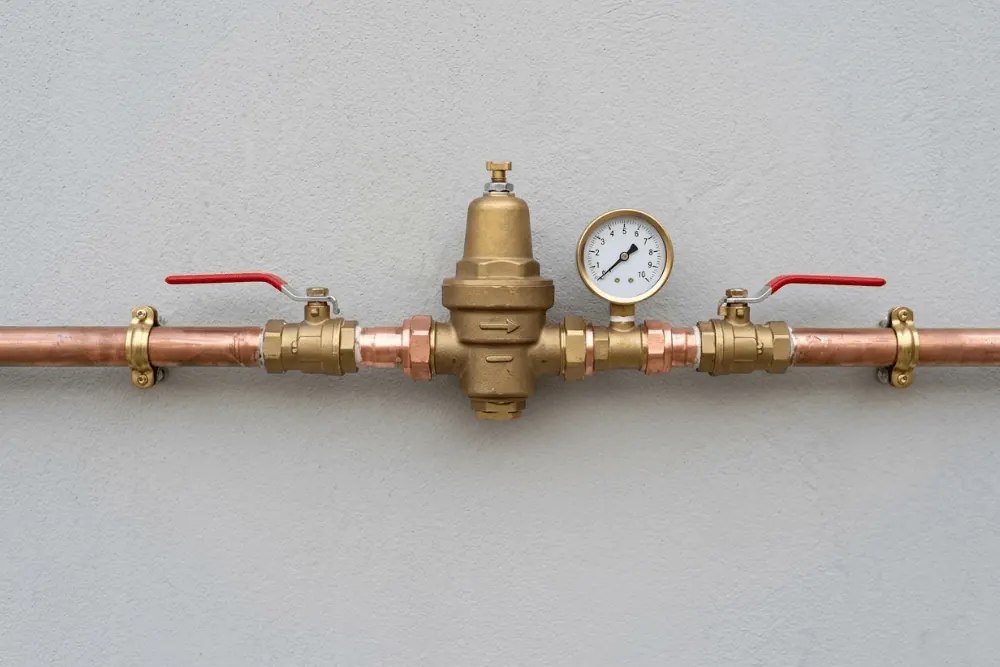
Pressure reducing valve in Dubai: what we do
- Pressure test. A gauge on a tap outside or on the washing machine connection, read with the water off elsewhere and again at other times of day.
- Adjustment. Setting the outlet pressure with a gauge in place, not by feel.
- Cleaning. Taking out and clearing the strainer screen where the valve has one.
- Cartridge and seal replacement where the valve is built for it.
- Full replacement. A new valve of the right size and range, with isolation valves, a union and a gauge either side where the pipework allows.
- New installation. Villas where pressure at the meter is high, and any property where fittings and hoses are failing early.
- Heater protection. Checking that a closed system has somewhere for heated water to expand.
- Fault finding. Telling a failed regulator from a pump, a tank float or a blocked line.
- Emergency visits. We answer calls and send a plumber 24 hours a day, 7 days a week.
Neighbouring topics have their own pages. Valves in general, including seized mains and stop valves, are on our valve repair and replacement page. Weak flow and how to read a gauge are on our low water pressure page, and pumps on our booster pump page. Devices that stop dirty water flowing back are on our backflow prevention page. Heater faults are on our water heater repair page, and flexible hoses on our hoses page.
What a pressure reducing valve does
A PRV takes a high, variable pressure at its inlet and delivers a lower, steadier pressure at its outlet. A household PRV uses a spring and a diaphragm to hold the outlet at a set level even when the supply spikes.
The mechanism is simple. Outlet pressure pushes up on a diaphragm. A spring pushes down. When the outlet pressure rises above the spring setting, the diaphragm lifts and the valve closes down. When it falls, the spring opens the valve. The adjusting screw sets the spring force, which is why turning it changes the outlet pressure.
A direct-acting valve loses a little outlet pressure as flow increases, a behaviour called fall-off. Too much fall-off means high velocity through the valve, noise and rapid wear. For a domestic line, the lesson is to size the valve to the pipe and the flow, and not to fit a small valve on a large flow.
Why too much pressure matters
Static pressure loads every joint, seal and appliance in the property whether or not a tap is open.
| Effect | What to know |
|---|---|
| Hoses | A flexible connector is only as strong as its rating. See our hoses page for the rating on the label |
| Taps and cartridges | Washers and cartridges wear faster, and a tap that once shut off fully starts to drip |
| Toilet fill valves | A fill valve that cannot close against high pressure keeps the cistern running |
| Water heaters | The relief valve opens more often, and the tank and its connections are loaded all day |
| Appliances | Washing machines and dishwashers have a maximum inlet pressure on the label, and the inlet valve is the part that fails |
| Pipes and joints | Every joint is loaded, and a weak one eventually lets go. See pipe leak repair |
| Noise | Pipes bang when taps close, because a faster flow stops harder |
| Water use | The same tap runs more water for the same time at higher pressure, so the bill rises too |
Does a villa need one?
A villa supply can arrive at a high pressure, and the fittings inside were not made for it. There is no single figure that decides it. We measure with a gauge on an outside tap, at several times of day, and compare the reading with the rating on the weakest fitting in the house: the heater, the mixers, the washing machine hoses. If the supply is above what they are made for, or if the signs below are showing, a regulator is the fix. A flat is different, because the building controls most of the supply, and the regulator on your own branch is yours to look at with the landlord's agreement.
Signs a pressure reducing valve is failing
| What you see or hear | What it points to | What we check |
|---|---|---|
| Water is suddenly stronger and taps splash | The valve is passing more than its setting. Debris in the seat or a worn diaphragm | Gauge reading against the setting |
| Banging when a tap closes | Excess pressure, a failing valve, or loose pipes | Pressure first, then pipe supports. See valve repair and replacement |
| Whistling or noise at the valve | Fall-off too high, a worn seat or a valve too small for the flow | Valve size against flow |
| Taps and toilet fill valves failing early, new drips at supply lines | Long exposure to high pressure | Gauge reading, then the fittings |
| Water heater relief valve dripping | Thermal expansion in a closed system, covered below | Heater pressure with the water heated |
| Weeping at the valve body or adjusting bolt | A failed seal or cracked body | Replace |
| Pressure that creeps up overnight | A seat that no longer closes, so the downstream pressure rises toward the supply | A gauge left connected for several hours |
We take age as a prompt to test, not as a reason to replace.
How to test your own pressure
A max-reading gauge, which holds the highest value it has seen, also records spikes. A simple gauge on a tap shows only the moment.
- Switch off water use in the property: taps, washing machine, dishwasher, irrigation.
- Screw the gauge onto an outdoor tap or the washing machine cold connection, as close as you can get to where the water enters.
- Open the tap fully and read the gauge once the needle settles.
- Repeat at other times, including late at night and early morning.
- Leave a max-reading gauge connected for several hours to catch spikes.
- Compare the reading with the label on your weakest fitting. Our low water pressure page explains how to read a gauge.
Static pressure, with no flow, is the load on the fittings. Pressure with a tap running is lower and shows how well the line delivers.
A second test shows whether the PRV is the problem. With two gauges, one on each side of the valve, the difference is what the valve is taking off. If the downstream gauge matches the upstream one, the valve is passing everything or is set at its maximum. If both are low, the problem is elsewhere. In a villa with a PRV near the meter and a tap before it, a single gauge moved from one tap to the other does the same job.
A leak check uses the same gauge. A steady reading means the pipes downstream are holding. A falling one means a leak or a draining line. For the meter test, see our leak detection page.
What outlet pressure to set
There is no single correct number. The label on the weakest fitting governs, and the number is the property's decision. What decides it:
- The weakest component. A heater, a mixer or a washing machine with a lower rated pressure sets the ceiling. Check the label.
- The highest outlet. A shower on the top floor needs enough pressure to run properly. A regulator set too low there brings back the complaint on our low water pressure page.
- The pump. In a tank-fed property with a booster, the order of settings matters. Our booster pump page explains that the pump's cut-in has to sit above the valve's set point or the valve hunts.
- The supply. The reading at the meter tells you how much the valve has to take off.
A good household setting gives a comfortable flow at the top of the house without loading the fittings all day. Many valves leave the factory set to a general figure, which is a starting point and not a setting for your property. We set the pressure with a gauge in place, then recheck after a day, not on the day we fit it.
Adjust, clean or replace
| Situation | What we do |
|---|---|
| Reading is off but steady | Adjust. Loosen the locknut, turn the screw a little at a time, recheck the gauge, tighten the locknut |
| Pressure creeps up when no water is used | Clean the strainer and seat if the valve allows it. Replace if it still creeps |
| Noise or whistle at the valve | Check the valve size against the flow, then the seat. Replace a worn valve or an undersized one |
| Leaks at the body | Replace |
| Strainer blocked, flow weak | Clean the screen with isolation valves closed on both sides |
| Valve more than 10 years old | Test. Replace if it drifts, creeps or cannot hold its setting |
The direction to turn the adjusting screw varies by make. Read the valve's own instructions, and watch the gauge to confirm which way the setting moved.
Do not turn the screw to cure weak flow without a gauge. If the weak flow comes from a blocked strainer, a half-open isolation valve or a pipe fault, turning up the regulator pushes pressure higher without fixing the cause.
The strainer and debris
Many regulators have a strainer screen ahead of the seat. Sand or scale that gets past, or builds up, lodges on the seat. The seat cannot close fully, and the downstream pressure rises toward the supply.
A strainer can also make a weak-pressure complaint. A screen packed with scale chokes the flow before the seat is reached. Cleaning it is a quick job if there are isolation valves on both sides. Without them, cleaning means shutting the whole property's supply.
In a tank-fed property, sediment settling in a dirty tank can travel through the pump to a regulator downstream. See our water tank cleaning page.
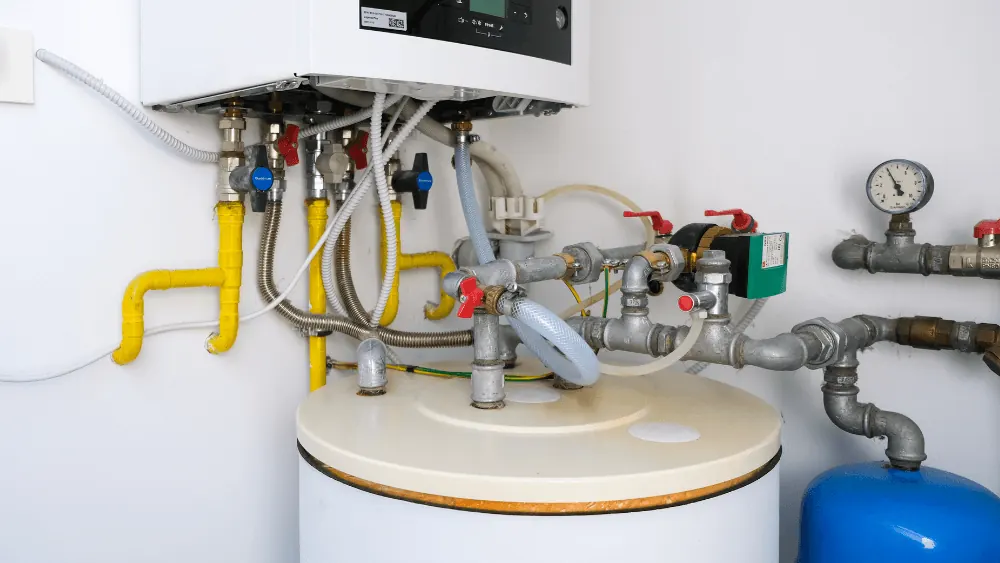
Heaters, closed systems and thermal expansion
A PRV, or any one-way valve upstream of a storage heater, leaves heated water with nowhere to go but the pipework. A storage heater heats water, and water expands as it warms. From 20 °C to 60 °C it grows by about 1.5 per cent, so an 80 litre tank pushes out roughly 1.2 litres (80 × 0.015). In an open system the extra water flows back down the supply pipe. In a closed system it cannot, and the pressure rises until something gives, usually the heater's relief valve.
The signs show up after hot water use followed by a pause:
- The heater's relief valve or a tap drips as the tank recovers.
- Hot water pipes creak.
- Water surges.
- Heaters and fittings fail early.
Because the expansion happens after the PRV, the pressure gauge at the regulator can read as if nothing has changed. Our method is to read the pressure on the heater side of the system with the water hot, not only at the regulator.
The remedy is a thermal expansion vessel: a small membrane tank fitted on the cold feed to the heater, between the PRV and the heater, that takes the extra volume. Size it for the tank and the pressure, and charge it to the system pressure. The heater's temperature-and-pressure relief valve is an emergency device, and it is not the thing to rely on to handle expansion. Some PRVs have an integral bypass that lets expanded water back, and where a backflow preventer is fitted, a relief valve or expansion vessel should be added downstream.
It reflects how a closed system behaves, so it applies in Dubai wherever a PRV or a one-way valve sits ahead of a storage heater. Our water heater repair page covers the heater itself, and the NRV valve page covers the one-way valve.
Where a regulator is installed
| Property | Where the regulator sits | What matters |
|---|---|---|
| Villa, mains-fed | Downstream of the meter and the main isolation valve | The property's own isolation, and the pressure reading |
| Villa with a tank | On the supply from the meter. If the internal system also has one, it sits after the tank and pump | Pump cut-in above the regulator's set point |
| Flat | Varies by building: a regulator may serve one unit or a whole zone | The building decides. Ask management |
| Tall building | High-rise buildings are divided into pressure zones, each with its own regulation and a backup | Building services, not the unit |
| A single appliance | A small regulator on the machine's feed | Only where the appliance specifies one |
Fit the valve with room to work. A good installation has:
- An isolation valve on each side, so the valve can be removed without shutting off the property. Our valve repair and replacement page covers the type to use.
- A union or removable joint, so the valve comes out whole.
- A pressure gauge on the outlet, so the setting can be read without a tool.
- The flow arrow pointing the right way.
- A drain or test tap upstream or downstream, where practical, so the valve can be flushed.
An open pipe around a regulator defeats its purpose, because it lets full pressure through. We do not fit one. In a home, a single correctly sized valve is the norm.
Flats, villas and who controls pressure
In a flat, the building controls most of the supply. Risers, common pumps and zone regulators belong to the building, and a change to them affects other units. A regulator on your own branch is yours to look at, with the landlord's agreement if you rent. A tenant should tell the landlord in writing before a regulator is changed.
A villa owner can have the regulator tested and replaced. Anything on the supplier's side of the meter is not ours to alter. Tell us what your building asks for and we work to it.
How we replace a pressure reducing valve
- Test first. A gauge reading before and after, so the old valve's performance is on record. The visit fee is AED 50 + VAT, credited if the work goes ahead.
- Confirm the cause. A regulator is not replaced for a fault that is really the pump, the tank float or a half-closed valve.
- Plan the water-off window with you and, in a flat, with management.
- Isolate and drain the line, and switch off the heater and any pump.
- Remove the old valve and check the pipe ends and threads. Joint detail is on our pipe fittings page.
- Fit the new valve in the correct direction, with isolation valves, a union and a gauge.
- Refill slowly and bleed air from the highest tap, so the line does not surge.
- Set the pressure with the gauge, tighten the locknut and mark the setting.
- Test with the water heated, so any thermal expansion shows.
- Return a day later or ask you to send us a photo of the gauge, to confirm the setting has held overnight.
We give you the old valve's make and the new setting in writing, so the next person knows what was set and why. FAM's workmanship warranty runs for 30 days and covers our labour only. Parts carry the manufacturer's warranty only.
After a period of high pressure: what else to inspect
Fixing the regulator does not repair what the pressure has already worn.
| Part | What to look for | Where to go |
|---|---|---|
| Tap cartridges and washers | New drips, or a tap that will not shut off fully | Tap repair |
| Flexible hoses | Bulging, rust at the crimp, weeping at the nut | Hoses |
| Water heater relief valve | Dripping after hot water use | Water heater repair |
| Hidden leaks | A water meter that moves with everything off | Leak detection |
We check these on the same visit if you ask, so one call covers the cause and the damage.
Where we work in Dubai
We cover all of Dubai, including Dubai Marina, JBR, Downtown Dubai, Business Bay, Jumeirah Lakes Towers, Palm Jumeirah, Al Barsha, Jumeirah Village Circle, Dubai Hills, Mirdif, Deira and Al Quoz. See the full list of areas.
What changes after a regulator is fitted
The household notices three things in the first week. Taps and showers feel gentler, which is the point. Noise from the pipes drops, and a cistern that hissed after filling goes quiet. Over the following months the drips and hose failures stop appearing. A shower on the top floor may feel weaker, and if it does, the regulator was set too low or the pump and regulator settings clash, and we adjust it with a gauge. Keep the note we give you with the setting and the date, and send us a photo of the gauge a week later if you want us to check. A regulator that is working properly is the one you forget about.
A regulator on a house with a roof tank and a pump
Many Dubai villas have a roof tank, and some have a pump feeding a header. In these houses pressure comes from height and from the pump, and a regulator sits where the supply is high enough to hurt the fittings. On a tank-fed supply, the pressure may already be modest, and a regulator is not needed on the roof feed. On a mains-fed supply or a pump-fed header, one may be. The honest answer comes from the gauge, not from the type of house. We read the pressure at several points, find where it is highest and put the regulator where it protects the most.
A case from a typical villa
A villa has a good supply, a roof tank and a pump. The owner notices that taps bang when they close, the cistern hisses after filling, and a washing machine hose has burst twice in a year. The shower is strong, and nobody complains about pressure. The cause is the opposite of what people expect: the pressure is too high. A gauge at the main line shows a figure well above what the fittings are made for, and there is no reducing valve in the house. A valve of the right size is fitted after the main isolation valve, set to a sensible figure, and the noise, hose failures and cistern hiss stop. The shower is still good, because the setting is high enough for it.
This pattern is common. High pressure shows as noise, wear and leaks, not as a strong shower.
Choosing the size of a valve
A reducing valve is chosen by the pipe size and the flow it has to carry, not just by the connection size. A valve too small chokes the flow at peak demand and the pressure drops. A valve too large chatters at low flow and wears quickly. As a rule, choose a valve whose flow range covers the smallest and the largest use in the property. For a villa with several bathrooms, a three-quarter or one-inch valve is typical, but we confirm on site.
What goes upstream and downstream
A good installation has a set of parts in order:
- An isolation valve before the strainer, to shut off the supply.
- A strainer, to catch grit before it reaches the valve.
- The reducing valve itself.
- A gauge connection after it, to read the outlet pressure.
- A second isolation valve after it.
- A bypass only where the building rules allow, since a bypass lets high pressure past the valve.
- A relief arrangement where a heater is fed, to deal with expansion.
Skipping the gauge connection or the isolation valves makes later service harder and more costly.
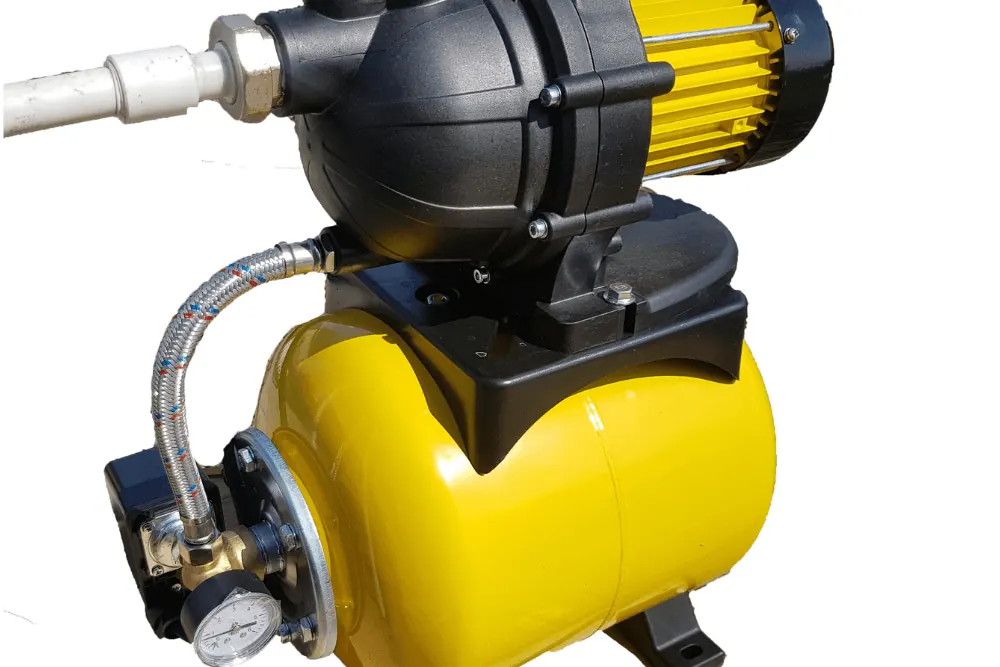
After the valve is fitted
Check each tap, shower and appliance for pressure and noise. Let the system run for a day. Check the gauge in the morning, with no use overnight, to see that the pressure does not creep up. Tell the household that taps will feel different, and that some might notice a lower flow at the top of the house. If the water heater has a relief valve that was dripping before, see whether it has stopped.
Common mistakes
- Setting the pressure by guess, without a gauge.
- Fitting a valve with no strainer, so grit wears the seat.
- Fitting it with no isolation valves, so it cannot be serviced.
- Fitting a valve where the arrow points the wrong way.
- Forgetting the heater's relief valve, which can weep once a check valve is upstream.
- Ignoring the valve for ten years.
We record the setting and the date on a note for you. Prices exclude 5% VAT, and the price is fixed on WhatsApp before work starts.
What PRV means
The table separates the names you meet.
| Name | What it does | Where it sits | Covered |
|---|---|---|---|
| Pressure reducing valve | Takes a higher inlet pressure down to a set lower outlet pressure. A spring and a diaphragm do it in a house valve | On the supply line, after the meter | This page |
| Pressure relief valve | Opens to let water out when pressure rises above a limit, and closes again | On a heater, a boiler or a closed line | Water heater repair |
| Pressure sustaining or back-pressure valve | Holds the pressure upstream of it at a minimum | Plant room and pump lines | Building services |
| Hose-end regulator | A small regulator with a hose thread, sold for campers and garden hoses | On a tap, not on the house supply | Garden taps for the threads |
If you are asking a supplier for a PRV, say reducing or relief in the same sentence.
A reducing valve is chosen for the water that arrives, and a relief valve for the water that is stored. A reducing valve fitted where a relief valve was meant leaves a heater with no way to release expansion. The water heater side of this is covered under thermal expansion earlier on this page, and on NRV valves.
Sizes: what the label says and what it leaves out
The size on a regulator label is the size of the connection. A connection size does not state how much water the valve will pass. Two rules are both sound and need to be read together:
- The connection matches the line. A valve for a 3/4 inch line has a 3/4 inch connection.
- The valve is chosen from the flow, and not from the pipe diameter, because an oversized valve regulates badly and an undersized one chokes the flow.
A house does not draw all its taps at once, so its design flow is a fraction of the sum of the taps. Water that is pushed too fast through a small valve is noisy and wears the valve quickly, so we choose a size that keeps the speed reasonable at the busiest time. The limit for each model is on the maker's chart, so we read the chart for the model we fit and for your flow, and we do not choose by guesswork. Two makers publish different kinds of limit, one by flow at a stated pressure drop and another by a maximum water speed, so they have to be compared on the same footing.
What to compare between two valves of the same size
The same size is not the same specification. A quotation that says "3/4 regulator, brass, adjustable" does not say which you are getting.
| What to compare | What to ask |
|---|---|
| Outlet range | The range on the datasheet, and where your setting falls in it |
| Factory setting | That it will be reset to your setting with a gauge |
| Maximum inlet pressure | That it is above the highest supply you will see |
| Maximum water temperature | The figure, and whether the valve is on a hot or recirculating line |
| Strainer | Whether a screen is included and can be cleaned |
| Expansion bypass | Whether the valve has one, since a closed heater system needs a remedy |
| Flow chart | The chart for your model, at your flow |
| Connections | That they match your pipework. See pipe fittings |
Ask for the datasheet and read the figures for your model.
Flow, pressure drop and noise
A reducing valve cannot take off as much as you ask at any flow. Three limits matter: how much of the pressure it is asked to remove, the pressure the valve loses as flow rises, and the heat of the water.
How much one valve can take off
Taking a very high pressure down to a low one in a single step makes bubbles form and collapse in the fast water. That is called cavitation, and it is a cause of noise, vibration and wear in a valve. Where the reduction is large, the job is split between two valves in series, so each takes a share. That is a building matter more than a house matter, and it is why a tower's riser and a plant room are designed differently from a villa.
Pressure drop and fall-off
A direct-acting valve delivers less pressure as the flow increases. If the drop is too large, choose a larger or different valve. A flow chart is usually drawn at a stated pressure difference, so read it for your own pressures and not for the chart's.
Hot water
A valve on a cold line and a valve on a hot line are different purchases. Read the temperature on the datasheet of the model you buy, and do not fit a cold-rated valve on a hot or recirculating section.
Noise
Noise can indicate wrong working conditions, with cavitation and incorrect sizing the main causes. Hot water carries a higher cavitation risk. The signs of a failing valve, and the gauge test on either side of it, are set out earlier on this page. A bang when a tap closes is a different fault. See NRV valves for slam, and water hammer arrestors.
Three things called a bypass
The word is used for three different arrangements, and one of them is a design feature while another is a fault.
| Name | What it is |
|---|---|
| Thermal expansion bypass | A small path inside the valve that lets water flow back toward the supply when heating raises the outlet pressure |
| A second, smaller valve for low flow | A parallel valve that takes the small flows, set a little above the main valve, so the main valve opens only as demand rises |
| An open pipe around the valve | Water goes around the valve at full pressure. We do not fit one on a house line |
The small parallel valve has its own setting, a little above the main valve's, so it is a valve with a set point. The open pipe has none. Check which one a drawing or a quotation means before agreeing to it.
Spring valves and pilot-operated valves
The house valve is a spring and diaphragm unit. A pilot-operated type has a main valve controlled by a small regulating valve in a side circuit. Pilot valves can hold the downstream pressure steady even when the flow varies a lot, which suits plant rooms and large risers. A pilot senses the downstream pressure and controls the main valve, and each pilot comes for a stated range of settings, so the range has to match the setting you need. Ask for the range that puts your setting comfortably inside it, and state it in the order.
Pressure reducing stations in buildings
A tower is divided into pressure zones, and each zone has its own regulating station. Two layouts are common:
- Cascade. The riser runs through a series of regulators, each lowering the pressure for the zone below. A failure high up can affect every zone beneath it.
- Parallel zoning. The main riser is unregulated and each zone has its own station branching from it, so a fault in one zone does not travel to the others.
Stations may also use parallel regulators with isolation valves, so one can be serviced while the other works. Different designs aim at different outlet pressures, so we do not quote a figure.
A tenant on a high floor is on the outlet of someone else's station. Pressure that is too high or too low there is a message to building management, with the date and a reading, and the valve is not yours to open. The building's services contractor holds the station.
Points to settle when you fit one
A few installation points differ between makers, and the model's own sheet decides them.
| Point | What to know | Why it matters |
|---|---|---|
| Orientation | Some valves may be installed in any position, and others only upright, never upside down | A valve fitted the wrong way regulates badly and wears fast |
| Where to fit | After the meter and main shut-off, before the line branches. Not on a section where hot water recirculates | A cold-rated valve on hot water fails early |
| Adjusting | Whenever a reducing valve is adjusted, a pressure gauge must be used downstream to verify the setting | A setting by feel is a guess |
Both are common to every maker: a gauge on the outlet when the valve is set. The orientation rules differ, so read the sheet for your model before you pipe it.
How much does a pressure reducing valve cost in Dubai?
The price follows the valve, the access and the shutdown.
- Testing and diagnosis. Gauge readings and finding the cause.
- The valve. Size, make, pressure range and whether it has a replaceable cartridge.
- Isolation valves, a union and a gauge if the old installation had none.
- Access. A valve in the open costs less to reach than one behind a wall or in a shaft.
- An expansion vessel if the heater needs one.
We do not publish a starting price for this job. Send a photo on WhatsApp and we give you a fixed price before we start. Prices exclude 5% VAT.
Pressure reducing valve FAQs
What does a pressure reducing valve do?
It lowers a high, variable incoming pressure to a lower, steady one. It protects pipes, taps, hoses and appliances from constant strain.
Does my villa need one?
Possibly. A villa supply can arrive at a pressure that is too high for the fittings inside. Measure with a gauge. Your own reading, and the rating of your fittings and appliances, decide. We test and tell you what we find.
What is a safe water pressure for a home?
There is no single figure. The label on your weakest fitting sets the ceiling, and the top-floor shower sets the floor. We measure, and we set the valve between the two.
My pressure rises overnight. Is the regulator faulty?
It may be. A reading that climbs over several hours, especially overnight, can mean a regulator leaking through, or thermal expansion from the heater. We leave a gauge connected, then isolate the heater to see which it is.
Can I adjust the regulator myself?
The risk is adjusting without a gauge. We would test first, set it with the gauge in place and recheck the next day. A regulator that will not hold its setting is replaced, not adjusted again.
Why does my water heater's relief valve drip?
One cause is thermal expansion in a closed system. The heated water has nowhere to go, so the pressure rises until the relief valve opens. The relief valve is an emergency device and should not be relied on to handle expansion. We check the heater pressure while the water is hot, then fit or service an expansion vessel if needed.
How often should a regulator be replaced?
There is no fixed interval. Heat, water quality and the pressure it works at all change a valve's life. We test it and replace it when it drifts, creeps or cannot hold its setting.
Is a regulator the same as a booster pump?
No. A regulator lowers pressure. A booster raises it. A property can have both, and their settings must be coordinated. See our booster pump page.
Will a regulator fix banging pipes?
It fixes banging that comes from excess pressure. Banging from a fast-closing valve or loose pipes needs other work, covered on our valve repair and replacement page.
Do I need landlord permission to replace a regulator?
Tell the landlord or management in writing first. A like-for-like swap on your own branch is maintenance, and a regulator on a shared riser or a building zone is the building's. If you own a villa, you can have yours tested and replaced.
What does PRV mean on a valve?
On a water supply line it means pressure reducing valve, a valve that takes a higher inlet pressure down to a set outlet pressure. It can also stand for pressure relief valve, which is a different part. The table under 'What PRV means' separates them.
Is a PRV the same as a pressure relief valve?
No. A reducing valve holds the pressure downstream of it at a set level. A relief valve opens to let water out when pressure exceeds a limit.
What size PRV valve do I need, 3/4 or 1 inch?
The connection matches the pipe, and the flow decides whether that size is right. The maker's chart for the model gives the pressure drop at your flow, and we read it before we fit.
Why is my PRV noisy?
Cavitation and incorrect sizing are the main causes, and hot water carries a higher risk. A valve asked to take off too much pressure in one step is a common trigger. The gauge test on either side of the valve is set out earlier on this page.
Can a hose pressure regulator work as a house PRV?
No. A small regulator sold for campers and hoses has a hose-thread outlet and a bore smaller than its label suggests, so it chokes the flow of a house. It belongs on a tap. See garden taps.
Can one PRV serve a whole tower?
No. A tower uses zones, each with its own station, and not one valve down the whole height. A flat's own pressure is a question for building management.
Book a pressure reducing valve test or replacement in Dubai
Tell us the property type, whether you have a tank or a pump, and what you have seen: banging, early tap failures, a heater relief valve dripping or a gauge reading. A photo of the valve and its label helps. We will send a plumber to measure the pressure, find the cause, and adjust, clean or replace the regulator with the setting recorded.
WhatsApp: +971 55 407 7427 · Request a quote
Visit us: Office 871, Oasis Mall, Al Quoz 1, Dubai, UAE
Related services: Valve repair and replacement · Low water pressure · Booster pump · Water heater repair · Backflow prevention · Hoses · NRV valve