
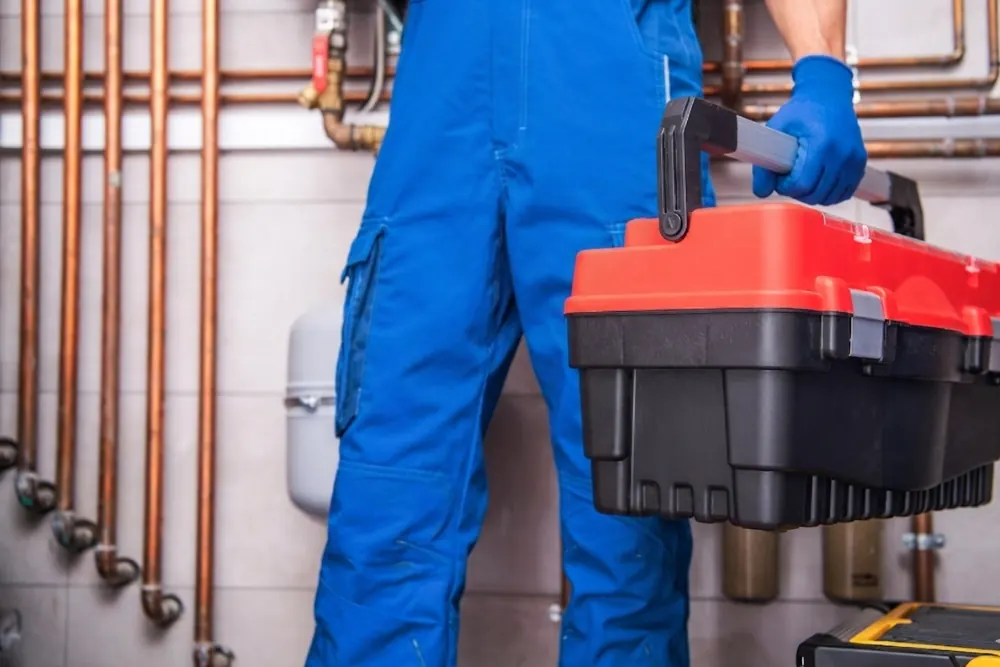
Repiping and pipe replacement in Dubai: what we do
- Survey and diagnosis. We trace the fault, check the pipe material and condition, and read pressure and flow before we recommend anything.
- Repair-or-replace advice. A written recommendation that says which sections to replace, which to keep and why.
- Partial and full repiping. One run, one bathroom, a riser branch, a floor or the whole property.
- PPR, CPVC, PEX, copper and uPVC supply lines. The right material for hot and cold, for walls, ceilings and roofs.
- Galvanised (GI) pipe replacement. Removing corroded steel lines and reconnecting to the new pipe correctly.
- Concealed work. Opening walls and floors, routing new pipe, pressure-testing before closing, and reinstating the finish.
- Supply-line installation for fit-outs. PPR, CPVC and uPVC water lines for shops, offices and restaurants, installed to the fit-out drawings.
- Testing and handover. Pressure test, flush, a pressure and flow check at the fixtures, and photos of the concealed runs.
Neighbouring topics have their own pages. Finding a hidden leak is on our leak detection page. Fixing a leak without replacing the pipe is on our pipe leak repair page. Brown, yellow or smelly water is on our smelly or discoloured water page. Hot water faults are on our water heater repair page. Joints and connectors are on our pipe fittings page, flexible connectors on our hoses page, and lagging on our pipe insulation page.
Repair or repipe: how to decide
Repair when the pipe is sound and the fault is local. Replace when the pipe itself is the fault. Most of the work in between is a judgement about how many failures there have been, where they are and what the pipe is made of.
| What you see | What it may mean | Answer |
|---|---|---|
| One leak at a joint, valve or fitting on otherwise sound pipe | A local failure: a bad joint, a loose connection, a worn fitting | Repair. See pipe leak repair |
| A second leak on the same run, in the same material, soon after the first | The pipe or its joints are failing along their length, not at one point | Price replacing the run against a third repair |
| A concealed leak where the wall or floor must be opened anyway | The access cost is already being paid | Replace the exposed length of pipe while the opening is there |
| Brown or orange water at every tap, in an older building with steel pipes | Rust from corroding galvanised or iron pipe | Replace the steel sections. See smelly or discoloured water |
| Pinholes in copper pipe | Corrosion from the inside, which can be linked to the water chemistry | Test the water, then replace the affected run |
| Pressure low at every tap, not just one | Scale or rust narrowing the bore, a failing valve, or a pump problem | Rule out the pump and valves first. See low water pressure |
| Hammering or banging when taps close | Flow stopping suddenly, or loose pipe clips | Not a repiping job by itself. See valve repair and replacement |
| Pipe sweating or dripping with condensation | Cold pipe in warm air | Insulation, not replacement. See pipe insulation |
| Pipes made of a material you want out, such as GI | A planned upgrade, not a failure | Phase it room by room or all at once |
Several of these look alike, which is why we diagnose before we quote. Replacing pipe that was never the problem is the most expensive way to learn that.
Five questions we ask on the survey
- What is the pipe made of? Steel and copper corrode from the inside, so age and water chemistry matter. Plastic pipe does not rust, so when it leaks, look first at the joints, then at heat or sunlight damage.
- How many failures, and where? One leak is an event. Several leaks on one run is a pattern. Leaks scattered across unrelated runs point away from one old pipe and toward something shared, such as high pressure or the water chemistry. New pipe will not fix either on its own.
- Where is the pipe? A pipe exposed in a riser shaft is easy to reach and replace. A pipe embedded in a slab means breaking concrete.
- What does the building's history say? Previous repairs, a refit by a past owner, or a mix of materials joined together.
- What does the water do to the pipe? Acidic water can pinhole copper, and stagnant water can corrode new copper. Testing the water first settles which material to avoid. See water quality testing.
A repipe does not fix high pressure, a dirty tank, a failing pump or aggressive water, so we check those before we price.
Partial or full repipe
| Scope | When it fits | The trade-off |
|---|---|---|
| One run or one bathroom | The failures are confined to one area and the rest of the pipework is sound | Lowest cost and disruption, but the rest of the old pipe stays |
| A zone or a floor | One level or one riser branch is failing, as in a two-storey villa with problems upstairs only | Planned around the isolation valves, so the rest of the property keeps water |
| The whole property | The material is at the end of its life throughout, or failures keep moving from run to run | Highest cost, one disruption, one set of tested pipework and one set of records |
| Surface or ceiling re-route | The old pipe is buried in a slab or wall and reaching it would do more damage than the leak | Visible boxing or a ceiling route instead of breaking out finished walls. The old pipe is capped and left |
A phased repipe is reasonable when the budget requires it, and we plan the sequence so each stage is tested and left working. What we avoid is a patchwork where new PPR is joined to old galvanised steel with the wrong fitting, which creates a new failure point at every joint between materials.
Which pipe goes where: PPR, CPVC, PEX, copper, uPVC and GI compared
No single pipe is best. Each suits some jobs and fails at others. Two mistakes are easy to make and costly to find later: putting a cold-water pipe on a hot line, and leaving a plastic pipe in the sun.
The pipe in your wall has its own datasheet, and that governs.
| Material | Hot water | Cold water | Joined by | Main watch-point |
|---|---|---|---|---|
| PPR | Yes, in the hot-rated wall | Yes | Heat fusion | Expands when heated. Degrades in sunlight |
| CPVC | Yes | Yes | Solvent cement | Indoor use. Sunlight breaks it down. Needs cure time |
| PEX | Yes | Yes | Crimp or cold-expansion fittings | Indoor use only. UV damages it |
| Copper | Yes | Yes | Soldered or brazed | Cost. Pinholes in aggressive water |
| uPVC / PVC | No | Yes | Solvent cement | Cold only. Not for hot lines |
| GI (galvanised steel) | Corrodes | Corrodes | Threaded | Rusts from inside. Narrows over time |
PPR (polypropylene random copolymer)
PPR is widely used for hot and cold water inside buildings. It is joined by heat fusion, with no glue and no solder: the pipe end and the fitting are heated and pushed together and become one piece. A correctly fused joint becomes part of the pipe. One made with the wrong heating time or a crooked push can look sound and still fail under pressure or heat.
PPR comes in pressure classes set by wall thickness and marked on the pipe. A higher class means a thicker wall and a higher pressure and temperature rating, so hot lines use the thicker classes. Our PPR pipe page explains how to read the marking.
Two properties decide how PPR is installed.
It grows when it heats. A long hot run can lengthen by several centimetres between cold and hot. A pipe fixed rigidly at both ends has nowhere to go, so it bows, loads its joints or pulls out of its clips. Installers allow for the growth with expansion loops, offsets and clips that let the pipe slide. Fibreglass-reinforced PPR, which has a glass-fibre layer in the wall, expands much less and suits long hot runs.
Sunlight damages it. In Dubai's sun this is a design decision. PPR belongs inside walls, ceilings and shafts. Where a pipe must run on a roof or an outside wall, it is protected, boxed or clad, or a different material is used.
Ask the installer for the datasheet and for the pressure class marked on the pipe itself.
CPVC (chlorinated polyvinyl chloride)
CPVC carries hot and cold water and is joined with solvent cement, which needs time to cure before the joint is pressurised. Depending on the pipe size and the temperature, this can take up to about 24 hours. We follow the cement manufacturer's cure time for the temperature on site, and we do not pressure-test early to save time. A joint that has not set can fail under test pressure, or worse, pass a short test and weep later behind a finished wall.
CPVC is for indoor use. Prolonged sunlight can break it down. It suits internal hot and cold branches in flats and fit-outs.
PEX (cross-linked polyethylene)
PEX is flexible tube. It bends round corners, runs long distances with few joints, and fewer joints means fewer places to leak inside a wall. PEX is for indoor use because UV light damages it. Some people notice a change in taste or smell in new PEX systems, so we flush new lines before use.
PEX is a reasonable choice for concealed runs where the saving is access: it can be pulled through ducts and sleeves. The question to settle before choosing it in Dubai is acceptance. A building's management, its master developer or a fit-out reviewer may specify the materials they allow, and PEX is not on every list. Ask first.
Copper
Copper handles hot and cold water and is joined by soldering or brazing. Copper pipes can develop pinholes in acidic water. Copper corroding in stagnant water can also turn the water blue-green, especially in new pipe. So the first step before specifying copper is to check the water. See water quality testing.
Copper is the more expensive option. Sunlight does not degrade it the way it degrades plastic, so it suits exposed runs, and it suits jobs where the client or consultant specifies it.
uPVC and PVC
PVC and uPVC are cold-water pipes, joined with solvent cement. They are not for hot water.
The rule that matters is simple: uPVC never goes on a hot line. It is not rated for the temperature and can deform. Sunlight exposure also ages PVC, so exposed outdoor runs are protected or the pipe is sleeved. Drain and waste pipes are a different system, covered on our drain unblocking page.
GI (galvanised iron or steel)
Galvanised steel pipe is steel with a zinc coating, joined by threads. It rusts from the inside as the coating wears, and rust and scale narrow the bore and discolour the water. Galvanised steel was a common material until around the 1980s and has been largely replaced because of its short life and its corrosion.
You may still meet GI in an older building. A magnet is the quick test: it sticks to steel, but not to copper or plastic. If the magnet sticks to a domestic cold or hot water line, that line is a candidate for replacement.
Joining one material to another
Every change of material is a transition, and transitions are where repipes fail. Copper joined directly to galvanised steel sets up galvanic corrosion at the joint, so a dielectric union or a plastic transition fitting separates them. PPR meeting a metal thread needs a fusion fitting with a metal insert made for the purpose. CPVC and PPR do not weld to each other. They meet at a threaded or compression transition. We list every transition on the job so none is buried by accident. Connectors have their own page: pipe fittings.
Which pipe where
This is the pairing we use as a starting point. The site, the drawings and the building's rules then change it.
| Location | A sensible choice | Why |
|---|---|---|
| Hot water branches inside walls | Hot-rated PPR, fibreglass-reinforced PPR on long runs, CPVC or copper | Rated for the temperature, and PPR is fused with no solvent |
| Cold water inside walls | PPR, CPVC, PEX or uPVC | Lower stress, so the lighter classes work |
| Long straight hot runs | Fibreglass-reinforced PPR or copper, with expansion loops | Expansion is smaller or accommodated |
| Roofs and outside walls | Protected or clad pipe, or metal | Sunlight degrades PPR, CPVC, PEX and PVC |
| Slab-embedded or buried runs | Continuous pipe with the fewest joints, sleeved, and recorded | A joint you cannot reach is a future leak you cannot fix |
| Near a heater connection | Rated pipe and a proper connector, insulated | Heat is highest at the outlet. See water heater repair |
A pipe's temperature rating is a limit the heater should never reach. If a heater overshoots, repair the heater: a pipe that is rated for hot water is not protection against a thermostat fault.
Hidden and concealed pipework: walls, slabs, shafts and ceilings
Most of the cost, the mess and the risk in a repipe sits in the pipes you cannot see. They run inside block walls behind tile, in floor screed, in slabs, in riser shafts and above false ceilings. Getting to them, replacing them and closing up without a new leak is the real craft in this job.
Three ways to deal with a hidden pipe
| Approach | How it works | Gain | Cost |
|---|---|---|---|
| Replace along the old path | Open the wall or floor along the pipe, take out the old pipe, lay the new one in the same channel | Nothing visible changes afterwards | Broken tile, dust, and wet-area waterproofing to redo |
| Re-route | Run new pipe through a ceiling void, a duct, a boxed corner or a shaft. The old pipe is disconnected and capped | Far less demolition, no damage to finished walls | A visible boxing or a changed route. The old pipe stays in the wall |
| Line the old pipe | A coating or liner is applied inside the existing pipe, offered by some contractors as an alternative to replacement | Avoids opening the wall | Check that the product is approved for drinking water and that your building accepts it. |
The best choice follows the damage. If the old pipe is leaking inside a finished bathroom wall, re-routing along a ceiling can save the tiles. If the wall must be opened anyway to reach a failed joint, replace the pipe in the opening. The access cost is already being paid.
Working inside finished spaces
- Trace before we cut. The pipe is located from the plans and by tracing, so the opening is as small as the job allows. Finding a leak is covered on our leak detection page.
- Protect the room. Floors and furniture are covered, dust is contained and openings are kept small.
- Respect the building. We check with management before we book.
- Sleeve and support. Pipes passing through walls and slabs go through sleeves so movement does not load them, and clips hold the pipe where it should be. Unsupported plastic pipe sags and rattles.
- Leave access. Every isolation valve and every union that might need service gets an access panel or an open position. A valve behind tile is a valve nobody can close in an emergency.
- Reinstate properly. Where a wet area has been opened, waterproofing and tiling are redone to the right sequence. Water damage already done to ceilings and walls is on our ceiling and wall leak page.
Record what is behind the wall
Before any run is closed, we photograph it with a tape or a marker in frame, and we sketch the route with measurements from fixed points such as a door frame or a corner. You keep the photographs. The next plumber, tiler or electrician then knows where the pipe is, and nobody drills through it.
Repiping a Dubai flat: what is different
In a flat, most of the repipe is inside your unit, but the water arrives through a riser the building owns. A good repipe starts at your isolation valve and works inward. If there is no isolation valve at the entry point of your flat, we fit one early in the job, because without one every future repair needs the riser shut off for the neighbours. We confirm the shutdown window with building management, tell the flats below, and plan the work in stages so the kitchen or one bathroom keeps working while another is done. Working hours and noise rules in a tower limit what can be done when, so we plan the loudest work, such as breaking out, for the hours the building allows.
Repiping a Dubai villa: what is different
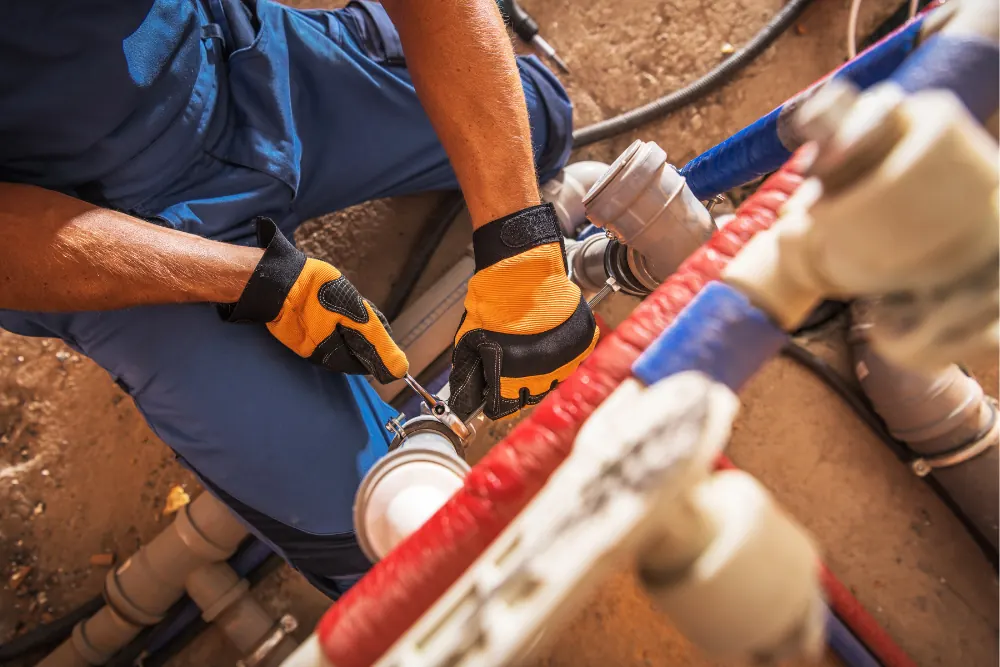
A villa has more pipe, longer runs and several systems: the mains or tank feed, the pump, a roof tank, the water heaters, the garden lines and sometimes a pool. Pipes run in block walls, in slabs, through the roof and in the garden. A repipe of a villa is usually done by zone, so the rest keeps water, and it is a good moment to look at the tank outlet, the pump pipework and the roof lines, which carry the most flow and bake in the sun. Because villa pipes are long, the choice of material and the allowance for growth matter more than in a flat, and so does the position of every isolation valve.
What the old pipe tells us
When we cut out a section, the inside tells the story. A smooth, clean bore on a leaking pipe points to a joint or a knock. Rust nodules or a bore choked with scale point to age and water chemistry, and the whole run is suspect. A thin wall at one point with a pinhole points to local corrosion. Cracking or whitening on plastic points to sun or heat. A pipe that is clean inside and out but has a split along its length points to pressure or freezing, and in Dubai, to pressure. We photograph what we find and keep the cut piece for you to see if you ask. It is the best way to understand whether you are paying for one repair or for the start of many.
How a repipe runs, step by step
- Survey and readings. We inspect the existing pipework, identify the material and measure pressure and flow. Where a fault is suspected we trace it.
- Written scope and quote. The quote names the runs to replace, the material and pressure class, the fittings, what is reinstated and what is excluded.
- Permissions. Landlord, building management or owners' association agree to the work where they need to. See the next section.
- Schedule and isolation. We agree a water-off window with you and the building, and isolate only the section being worked on where the isolation valves allow it. Neighbours below are told when work starts, since noise and the risk of drips travel downward.
- Drain down and strip out. The section is drained, the old pipe is cut out and the exposed ends are capped.
- Install. New pipe is routed, clipped and jointed to the manufacturer's method: fusion for PPR, solvent cement for CPVC and uPVC, crimp or expansion fittings for PEX. Expansion allowances go in. Hot and cold lines are labelled.
- Pressure test with the pipe still visible. Nothing is concealed until the test is passed. The next section covers this.
- Close and reinstate. Chases are filled, waterproofing is redone, screed and tile go back.
- Flush and commission. The new lines are flushed to clear cuttings and debris, air is bled from the system, every fixture is opened hot and cold, and aerators are cleaned. We check pressure and flow at the fixtures.
- Handover. You get the test record, the route photographs and sketch, and the list of what was replaced.
If the lines include solvent-cement joints, the test waits until the joints have cured for the time the cement maker specifies. Testing early to save an afternoon risks a joint that fails behind a finished wall.
Pressure testing before anything is closed
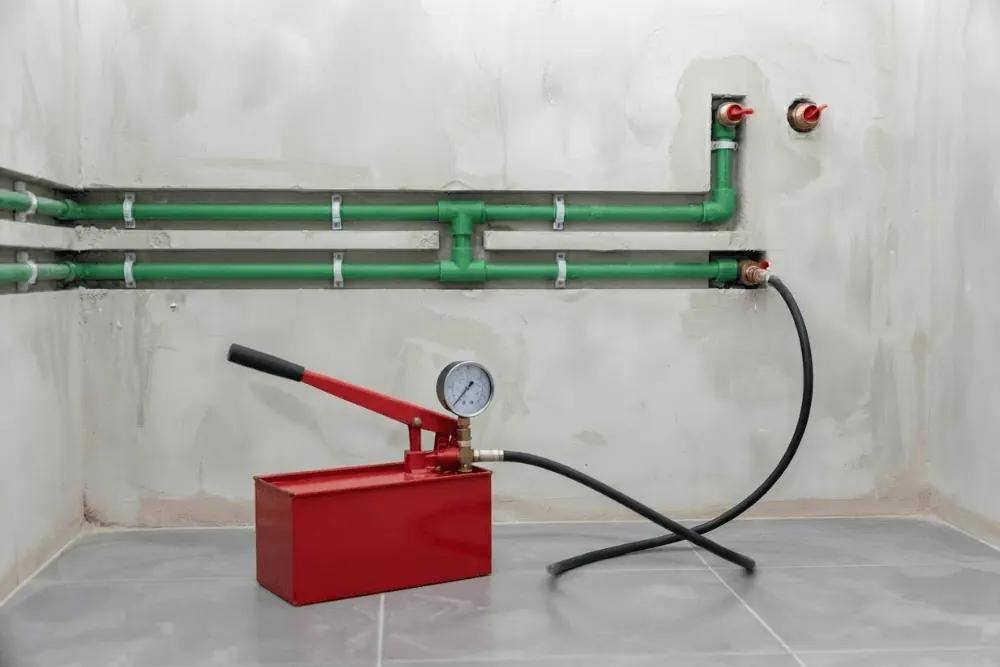
A pressure test fills the new pipework with water, removes the air, raises the pressure and holds it while the gauge and every joint are watched. A bad joint shows itself here, in front of the plumber, with the wall still open.
We test at a pressure above the working pressure and below the rating of every part in the line, and hold it for the time the pipe maker and the building require, before the piping is concealed. The test pump and the method are on our pump pressure page.
What a test result tells you:
- A steady gauge for the full hold means the section is tight at that pressure.
- A falling gauge means a leak somewhere in the section. We find it before going on.
- A dry pipe with a wet joint means a weep that is too slow for the gauge to catch. We inspect joints by eye and by touch, not only by gauge.
- A rising gauge in a sealed run can be warmth, not a fault. A pipe in the sun heats and the pressure climbs, so a falling gauge is the one that counts.
We test again at the end, after fixtures are reconnected, at the working pressure of the building.
Approvals, landlords and who pays
Whether a pipe replacement needs approval is decided by the building. We do not guess, and we ask before we book.
Approvals
We are plumbers, not lawyers, so this is general information. The rules differ by building and by community, so we ask before we book.
- Flats. Facility management or the owners' association may need to approve work on pipework, and will always control risers and common areas.
- Villas. A villa community's master developer may have its own rules for alterations and for access.
- Rented property. A tenant needs the landlord's written approval first, and the landlord may want the property restored at the end of the lease.
In practice, the sequence is: tell the landlord or building management in writing what you plan, with our survey report and quote, get their answer in writing, and give us the approval or reference before we start. Risers and common-area pipework belong to the building, not to a single unit. We do not touch those without management. Tell us what your building asks for and we work to it.
Who pays: landlord or tenant
Who pays depends on your agreement and on whether the pipe failed from age or from misuse. Many agreements leave minor repairs with the tenant and major repairs with the landlord. For a tenant, that means: report the fault in writing, attach the survey findings and photographs, and ask the landlord to approve the replacement. For a landlord or manager deciding whether to approve the work, our written scope states what failed, why repair will not hold and what we propose to replace.
What drives the price of a repipe
We do not quote by guesswork. The price follows the scope, and the scope follows the survey.
| Factor | Why it moves the price |
|---|---|
| Number of points and length of pipe | Each fixture, branch and metre adds material and labour |
| Material and pressure class | Copper costs more than plastic. A higher PPR class has thicker walls |
| Concealed or exposed | Opening and closing walls and floors brings in more trades: breaking out, waterproofing, tiling and painting |
| Finishes to reinstate | Tile, stone, wet-area waterproofing, paint and joinery add trades and cure time |
| Access | Shafts, tight ceilings, upper floors and no lift all add time |
| Occupied or empty | Working around people, furniture and water-off windows takes longer than an empty unit |
| Size and complexity | A single bathroom, a villa with two heaters and a booster pump, and a tower riser are different jobs |
| Approvals | Building fees, consultant drawings and management deposits are separate costs |
| Out-of-hours work | Night or weekend work to avoid shutting water in an occupied building |
| Testing and records | Pressure testing, flushing and photographs take time but are not optional |
We do not publish a starting price for this job. Send a photo on WhatsApp and we give you a fixed price before we start. Prices exclude 5% VAT.
Comparing repiping quotes
A repiping quote that fits on one line cannot be compared with anything. Ask each contractor for the same things in writing:
- Which pipes, from where to where. A list of runs, not "repipe bathroom".
- Material, make and pressure class. For hot water, the rating at working temperature.
- Whether breaking out and making good is included. And to what standard: patching, screed, waterproofing, tile.
- Whether approvals are included. Who applies, who pays.
- Whether the pressure test and flush are included. And the record you will receive.
- What the guarantee covers and for how long.
- What is excluded. Matching old tile, painting, drainage or electrical work are the usual exclusions.
A much lower quote deserves the same seven questions. Check which of these it leaves out, because it is cheaper to ask now than to find out after the wall is closed.
Repiping for fit-outs and new supply lines: PPR, CPVC and uPVC installation
Shops, offices, restaurants, clinics and salons need water lines from the building's water point to sinks, pantries, toilets, heaters and equipment. FAM installs these lines for fit-out contractors, tenants and owners.
- First fix to the drawings. We route pipes to the consultant's or contractor's drawings, around cable trays, ducts and ceiling grids, and before ceilings close.
- Material to specification. PPR or CPVC for hot and cold, uPVC for cold-only lines where the specification allows, copper where it is called for.
- Isolation by zone. Valves on each branch, so one fixture or one area can be shut off without losing the whole unit. See valve repair and replacement.
- Hot lines sized and insulated. Heater outlets, long hot runs and return lines are specified for the temperature and lagged. See pipe insulation.
- Equipment connections. Dishwashers, coffee machines, ice makers and washing machines connect through flexible hoses, which have a limited life. See hoses.
- Test before the ceiling closes. The pressure test is done and recorded while the pipes are in view.
- As-fitted drawing. A marked-up drawing of what was installed, for the landlord, the consultant and the next contractor.
- Approvals. The landlord or developer sets the fit-out procedure, so ask for it early. In a flat, facility management or the owners' association may need to approve. We work to the building's procedure.
Drainage and waste pipes are a separate system with different pipe, falls and venting. Water supply and drainage are specified separately, and drainage is on our drain unblocking page.
Replace these at the same time
When the pipe is open, the cheapest moment to replace the parts attached to it has arrived.
| Part | Why now |
|---|---|
| Isolation valves | Old gate valves seize or leak. A new pipe with a failed valve in front of it is not a finished job. See valve repair and replacement |
| Flexible hoses | A hose as old as the pipe is due for replacement. See hoses |
| Pressure-reducing or relief valves | New pipe does not remove a pressure problem. See pressure valves |
| Hot-line lagging | Insulation goes on the pipe once it has passed its test. See pipe insulation |
| Heater connections | The connections and relief valve at the heater take the heat and the thermal cycling. See water heater repair |
| Tank outlet and pump pipework | These lines carry the most flow. See water tank installation and booster pump |
Getting your property ready
- Find your shut-off. Know where the main isolation valve is and that it closes.
- Tell the building. Management, security and the neighbours below should know the dates.
- Clear access. Empty the cupboards under sinks, the areas around risers and the walls to be opened.
- Store water. Fill drinking water containers for the water-off window.
- Photograph the existing condition. Tiles, ceilings and fixtures, before work starts.
- Keep spare tile. Matching a discontinued tile can be difficult. If you have leftover tile from the original fit, tell us where it is.
- Decide on the finish. Agree whether patched paint and grout are acceptable or whether a full wall is repainted.
After the job: what to check
- Run every tap, hot and cold, and look for cloudy or discoloured water in the first minutes. Air makes water cloudy and clears from the bottom of a standing glass. Grit or debris does not.
- Clean the aerators and any filters after the first few days, since cuttings and debris collect there.
- Check the water meter. With every tap and appliance off, the meter should not move. The steps are on our leak detection page.
- Look at the ceilings and walls below and beside the work over the next few weeks for any damp patch.
- Keep the test record and photographs. They matter if you sell, rent out or make a warranty claim.
- Test the water if it matters. After new pipework in a home with a baby, an elderly person or someone with weak immunity, or in a food business, test for turbidity and bacteria. See water quality testing.
Where repipes go wrong
These are the failure points to check for in any repipe. Each one is avoidable.
- No allowance for expansion on long hot PPR runs, so pipes bow and joints take load.
- Fusion done by feel instead of the heating and joining times set for the pipe size.
- A solvent-cement joint pressurised too soon.
- Plastic pipe in the sun, where PPR, CPVC, PEX and PVC all degrade.
- Copper joined straight to galvanised steel, with no dielectric separation.
- Hot and cold lines strapped together uninsulated, so the cold line warms and the hot line cools.
- A smaller pipe than the one it replaced, which lowers flow and pressure at the far fixtures.
- Unsupported runs that sag, rattle and put load on the joints.
- Dead legs left behind when old branches are abandoned but not disconnected at the source.
- No pressure test, or a test after the wall is closed.
- No record of where the concealed pipe went.
Where we repipe and replace water pipes in Dubai
We cover all of Dubai, including Dubai Marina, JBR, Downtown Dubai, Business Bay, Jumeirah Lakes Towers, Palm Jumeirah, Al Barsha, Jumeirah Village Circle, Dubai Hills, Mirdif, Deira and Al Quoz. See the full list of areas.
Repiping and pipe replacement FAQs
How do I know whether I need a repair or a full repipe?
Count the failures, look at the material and check where the pipe is. One leak on a sound pipe is a repair. A second leak on the same run, brown water from steel pipes, or pinholes in copper point to replacement. We diagnose first, because low pressure and discoloured water have causes that new pipe will not fix, such as a pump, a valve or a dirty tank.
How long does a repipe take?
The quote states the schedule. It is driven by the number of fixtures, how much of the pipe is concealed, the water-off window your building allows and how long waterproofing, screed and tile take to cure. A run that can be re-routed through a ceiling is quicker than one that must be chased out of a finished wall.
Which is better for hot water, PPR or CPVC?
Both are made for it. PPR is fused with no solvent, and fibreglass-reinforced PPR copes better with long runs because it expands less. CPVC is solvent-cemented and needs its cure time. Both belong indoors. Neither is better in every case. The building's specification and the pipe's datasheet settle it.
Can I use uPVC or PVC for water supply?
For cold water, yes. PVC is not for hot water. Everything on the hot side of a heater should be a hot-rated pipe, with a proper transition from any uPVC cold feed.
Do I have to break my walls and tiles?
Not always. If the old pipe can be re-routed through a ceiling, a duct or a boxed corner, much of the demolition is avoided, and the old pipe is disconnected and capped. If the pipe is leaking inside a wall and must be reached, the opening is kept as small as we can and the finish is reinstated. We tell you the options and what each costs before we start.
Do I need landlord or building permission?
Often, yes. Whether a like-for-like pipe replacement counts as an alteration is for the building to say. In a flat, ask building management. In a villa community, ask the master developer. In a rented home, ask the landlord. Ask in writing before work is booked, and tell us what the building asks for.
Who pays for pipe replacement, the landlord or the tenant?
Your agreement may allocate minor repairs. Check it, report the fault in writing, and ask the landlord to approve the replacement. We give a written report of what failed and why, which helps both sides.
Can I keep using water during a repipe?
Not on the section being worked on. Where the property has isolation valves, we shut off only that section and the rest keeps running. Where it does not, the water goes off for a window we agree with you. Store drinking water beforehand. Fitting isolation valves during the job means the next repair will not shut off everything.
Is PEX pipe used in Dubai?
PEX is a flexible, few-joint option for indoor runs. Whether a given building accepts it is for the building's management, master developer or fit-out reviewer to say, so ask before specifying it. PEX is not for outdoor or sunlit runs, because UV damages it.
Do you replace galvanised (GI) pipes, and how do I tell if mine are galvanised?
Yes. Galvanised pipe is steel with a dull grey zinc coating and threaded joints, and a magnet sticks to it. It does not stick to copper or plastic. Rust-coloured water, rust stains at joints and falling pressure are the usual signs of an old line. We replace the corroded sections, and the transition to the new material uses the right fitting so the two metals do not corrode each other.
Book repiping or pipe replacement in Dubai
Tell us what the pipes are made of if you know, where the leaks or discolouration are, how old the building is and whether it is rented or owned. Photos of exposed pipework and of any damp patches help. We will send a plumber to survey the pipes and give you a written scope and quote. The visit fee is AED 50 + VAT, credited if the work goes ahead.
WhatsApp: +971 55 407 7427 · Request a quote
Visit us: Office 871, Oasis Mall, Al Quoz 1, Dubai, UAE
Related services: Leak detection · Pipe leak repair · Smelly or discoloured water · Water heater repair · Pipe fittings · Valve repair and replacement