
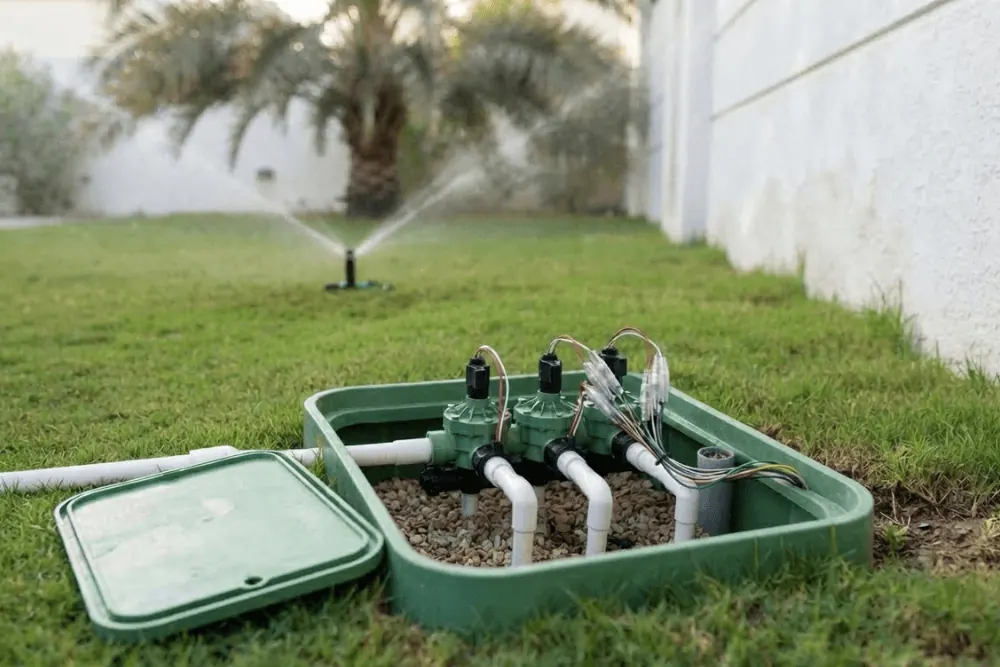
Irrigation pump in Dubai: what we do
- Choosing a pump for a garden zone, from the heads' flow and pressure and the water source.
- Installing a pump on a ground tank, a roof tank feed or a borehole supply, with the suction line, check valve and isolation valves. See transfer pumps and submersible and borehole pumps.
- Connecting the pump to the irrigation controller, through a start relay or a pressure switch.
- Fixing a pump that will not start, will not prime, cycles on and off or runs without delivering. See low water pressure and pressure tank pressure.
- Sprinkler and drip faults after the pump. Heads, valves and tubing are on irrigation system repair.
- Emergency visits. We answer calls and send a plumber 24 hours a day, 7 days a week, including nights, weekends and public holidays.
- Areas. Across Dubai. The list is near the end of this page, and the full list of areas is on its own page.
The names: one word for different pumps
The words irrigation pump appear on pumps that do different jobs. The table says where each is covered.
| What the shop calls it | What it is | Where it is covered |
|---|---|---|
| Garden pump or surface pump | A centrifugal or jet pump that sits on the ground and draws from a tank or sump | This page, and transfer pumps |
| Pressure set or booster | A pump with a pressure tank and a pressure switch that holds a steady pressure on a line | Booster pump |
| Submersible or borehole pump | A pump that sits in the water, in a tank or a well | Submersible and borehole pumps |
| Transfer pump | A pump that moves water from one tank to another | Transfer pump |
| Petrol or diesel pump | An engine-driven pump for farms and sites, with a high flow | Not a house garden pump. We do not size or fit them for a villa zone |
The zone's duty, not the title, decides whether the pump fits.
What the heads ask of the pump
Different heads work at different pressures and flows. These are typical figures, and the head's own performance chart, on or inside its box, gives the exact numbers.
| Head or line | Pressure | Flow per head |
|---|---|---|
| Spray heads | About 1.4 to 2 bar | About 2 to 11 litres per minute |
| Rotating nozzles | About 2 bar | Varies with the nozzle |
| Rotors | About 2.8 to 4 bar | About 4 to 38 litres per minute or more |
| Drip systems | About 1 to 2 bar, with a regulator | About 2 to 8 litres per hour per emitter |
A drip line also needs a filter and a pressure regulator that the pump does not provide, and the filter's mesh has to be fine enough for the emitters.
One example fixes the idea. A typical rotor nozzle uses about 12 litres per minute at 2.4 bar. A designer loads a zone to about 75 per cent of the available flow, to leave a margin. If a supply gives 38 litres per minute, 75 per cent is about 28, and two such rotors fit on one zone. That is why a big garden is split into zones that run one after another.
A worked sizing example
A zone has three heads at 11 litres per minute and two at 19 litres per minute, which totals about 72 litres per minute at 2.4 bar.
- Total dynamic head is the pumping lift, plus friction loss in pipe and fittings, plus the operating pressure, plus any rise or fall between the pump and the discharge.
- The operating pressure converts at 1 bar to 10.2 m of head. So 2.4 bar is about 24.6 m.
- Water power in watts is 0.1635 times the flow in litres per minute times the head in metres. The pump must take in more than this, because no pump is 100 per cent efficient.
- Efficiency for a good centrifugal pump at its best point is around 75 per cent. Small garden pumps are often much lower, so the 50 per cent case below is a realistic one.
The lift, rise and friction figures below are assumptions for the example, not measurements of any garden. Yours will differ.
| Step | Figure | Basis |
|---|---|---|
| Suction lift | 2 m | Assumed |
| Rise to the zone | 2 m | Assumed |
| Friction in pipe and fittings | 4 m | Assumed |
| Operating pressure | 24.6 m | 2.4 bar |
| Total dynamic head | 32.6 m | Sum of the four |
| Water power | 383 W | 0.1635 times 71.9 times 32.6, the multiplier on the water pumps page |
At 75 per cent efficiency the pump needs about 511 W of input (0.69 HP). At 50 per cent it needs about 766 W (1.03 HP). So a 1 HP motor covers this zone only if the pump delivers 72 litres per minute at 32.6 m on its own curve, and runs at about 50 per cent efficiency or better. That is a statement about the pump's curve and not about its horsepower. Two pumps with the same HP label can deliver very different flows at the same head.
Pipe size and water speed
The pipe from the pump decides how much of the head goes to friction. On the suction side of a centrifugal pump, keep the speed between about 0.6 and 0.9 m/s to avoid cavitation and air drawn in. On the delivery side, up to about 1.5 to 2 m/s is usual before friction and noise climb.
For speed in metres per second, use 21.2 times the flow in litres per minute divided by the inside diameter in millimetres, squared. For the 72 litres per minute zone above:
| Inside diameter | Speed | Use |
|---|---|---|
| 50 mm | 0.61 m/s | Suitable for the suction line |
| 40 mm | 0.95 m/s | Borderline for suction, fine for delivery |
| 32 mm | 1.49 m/s | Suitable for delivery |
| 25 mm | 2.44 m/s | Too fast. Expect friction loss and noise |
The suction pipe is sized larger than the delivery pipe, because its speed limit is lower. Metric pipes have their own inside diameters, so check the datasheet before applying the table. See water hammer arrestors for what high speed does at the valves, and NRV valves for the check valve on the pump's discharge.
Which pump for which water source
The water source decides the pump family before the zone's duty does. The detail for each family is on its own page.
| Water source | Pump family | What to watch for |
|---|---|---|
| A ground tank or sump | A surface centrifugal or jet pump | The suction lift, the strainer and the check valve. See transfer pumps |
| A roof tank feeding the garden by gravity | Often no pump, or a small booster | The pressure from the tank's height may be too low for rotors. See booster pump |
| A borehole or well | A submersible pump | Approvals, and the check valve rule on the submersible and borehole pump page |
| The network supply | Usually no pump, or a pressure set | Check the pressure at the garden tap against the heads. See irrigation system repair |
| Treated or non-potable water for the garden | As for the network supply | Keep it separate from drinking water pipes. Filters and drip emitters block more easily, so plan for more cleaning |
A pump fed from a tank in the sun is a case for reading the maximum liquid temperature on the datasheet before buying. See garden taps for the same effect at a hose.
Start relays, pressure switches and dry running
A pump motor draws far more current than a controller can switch. The controller's job is to tell something else to start the pump.
| Method | How it works |
|---|---|
| Pump start relay | An electrical device that lets the irrigation timer communicate with the pump. The controller switches the relay and the relay switches the pump |
| Pressure switch with a pressure tank | The switch turns the pump on when pressure in the pipes drops, and the tank keeps the pump from cycling rapidly. Switches adjust within a limited range, about 1.4 to 3.1 bar |
| Timer through a relay | A timer starts and stops the pump on a schedule |
Compare the switch range with the heads above, and match the switch setting to the heads on the zone. A switch set high for a house boost may be too high for a spray zone.
The relay and the controller
Do not connect the controller directly to the pump, because the controller's output can only switch a small current and the pump will damage it. Follow the controller maker's instructions on where the relay sits, because a relay mounted too close to the controller or the pump can pick up interference and cause a malfunction. Do not hook the controller up to an existing relay circuit either, because a controller has its own low-voltage supply.
A relay's contacts carry the pump's current at the pump's voltage, so ask for the contact rating at 230 V and the motor's running current before you buy. The UAE supply is 230 V at 50 Hz, as on the water pumps page. Our own electricians do the wiring.
Protecting the pump
Low pressure may mean a broken pump, a clogged intake screen, a dirty filter, a failed valve or a broken pipe. Low flow may mean a failed valve or a dirty filter. High flow may mean a broken pipe or sprinkler or a stuck-open valve. A controller with a pressure sensor can shut the system down, for example if the pressure stays below a set low figure for more than two minutes, with the delay there to avoid a false alarm while the pump starts.
A pressure switch can shut off the pump in the same way. It sits after the check valve, and it works the opposite way from a household pressure switch: it stops the pump when the pressure stays low. A low-pressure cut-out set higher than the zone's normal working pressure stops the pump every time the zone starts, so set it below what the zone runs at. See NRV valves for the check valve.
A low-pressure shutdown is the protection that reacts if a pump loses its prime and stops delivering. A float switch in the tank, or a flow switch on the delivery, does the same job by a different route, and either one is worth having on a pump that runs unattended.
Where to put the pump
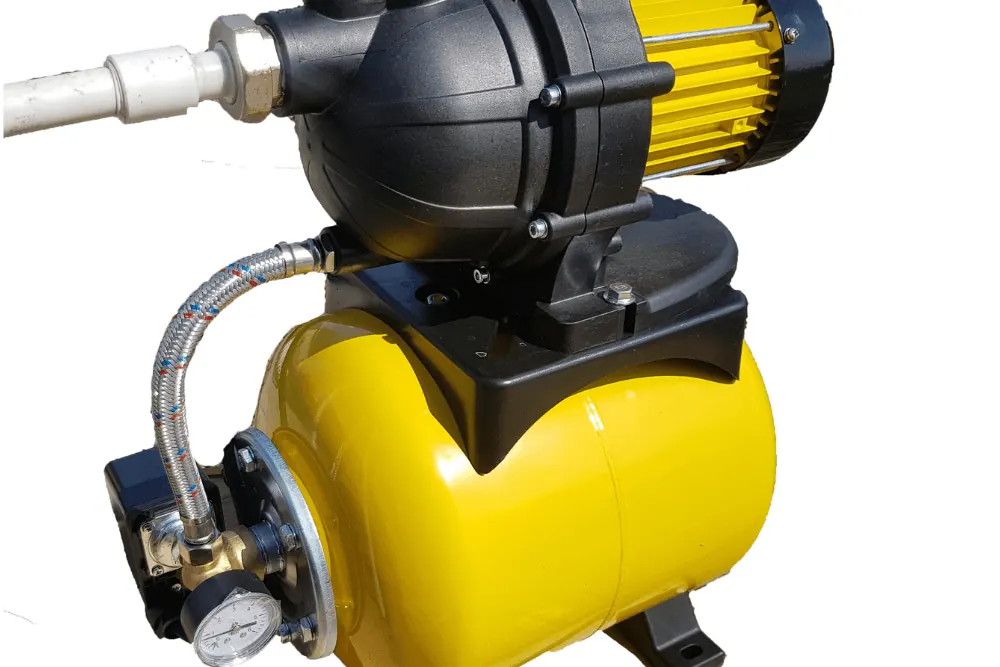
A garden pump lives in the heat, the dust and the irrigation spray, so where it stands matters as much as which one it is. Put it in shade, on a raised, level base so that a leak or a washed-out sprinkler does not flood it, with a cover that lets air through. Keep it as close to the tank or sump as the layout allows, because a short suction line gives a stronger prime and less friction. Leave room round it to reach the priming plug, the nameplate and the electrical box. A pump in a closed box in the sun runs hot, and a motor that runs hot fails early. In a villa the usual spot is beside the ground tank or in the pump room, and where the pump stands in the open it needs a roof and a drain. See water pumps.
Noise and neighbours
A garden pump that starts at 5 a.m. is heard through a boundary wall. Mount the pump on a rubber pad, use flexible connectors so the vibration does not travel down the pipe, and face the pump away from a neighbour's bedroom where you can. Set the timer so the pump does not start before the hours your community expects. A pump that is louder than it was is a sign of a worn bearing or air in the suction, and is a reason to call before it fails.
What to do with an old pump
When a pump is replaced, the old one should leave the site. A pump left beside the tank with its pipes still connected is a source of leaks and a hazard for anyone who tries to reuse it. We close the isolation valves, drain the pump, cap the open ends and take it away, or leave it with you if you want to keep it. We write the model of the old pump on the handover so the new one is chosen against a real duty and not a guess.
Permission in Dubai: who decides on an irrigation pump
A pump sits in a plant room, a tank room or a garden, and its pipe may cross a boundary. The fuller account for the irrigation side is on the irrigation system repair page, and the borehole permits are on the submersible and borehole pump page.
- Building management. A tank room, a shared pump room or a shared garden that belongs to the building or the community goes through building management, and so does work that needs the water shut off for other units.
Replacing a failed pump with the same type in the same place is maintenance and needs a message to the landlord. Adding a pump to a supply that had none, tying a pump into a shared tank or a treated water line, or boring a borehole is an alteration, and needs written consent in a rented home and the owner's or community's approval. Tell us what your building or community asks for and we work to it.
When the job is finished
Ask for these. They cost nothing to produce.
- The pump's nameplate, photographed: maker, model, voltage, frequency, running current and rated flow and head.
- The duty point, written down: the zone's flow, the total dynamic head and the pump curve with the mark on it.
- The suction line, shown to you: the pipe size, the strainer or foot valve and the check valve, with the arrow against the flow.
- The control, named: relay, pressure switch, pressure tank or drive, with its settings written down.
- A pressure and flow reading at the zone with the pump running, before and after the job.
- The dry-run protection, or a note that none was fitted and why.
- FAM's workmanship warranty, in writing. The warranty runs for 30 days and covers our labour only. Parts carry the manufacturer's warranty only.
How we work
- You message us with a photograph of the pump's nameplate, the tank or the well, the zone's heads or drip lines, and what the pump does or fails to do.
- We say what we think is needed, whether a repair, a replacement or a new pump, and whether it is work we do.
- We give a price in writing, with the pump, the controls, the pipework and the work shown separately.
- Check permission. In a rented or managed property, ask the landlord or building management whether they need to approve this work before the visit.
- We check the duty first: the source, the lift, the pressure at the zone, the flow and the pipe size. The visit fee is AED 50 + VAT, credited if the work goes ahead.
- We fit the pump, the check valve, the isolation valves and the control, and prime and test it against the duty.
- We hand over the nameplate photograph, the settings, the readings and the warranty.
Where we work in Dubai
We cover all of Dubai, including Dubai Marina, JBR, Downtown Dubai, Business Bay, Jumeirah Lakes Towers, Palm Jumeirah, Al Barsha, Jumeirah Village Circle, Dubai Hills, Mirdif, Deira and Al Quoz. See the full list of areas.
Checking the suction side before blaming the pump
More irrigation pumps fail from the suction side than from the pump itself. A pump can lift only so far, and any air that gets in the suction line breaks the prime.
- Is the foot valve sealing? If it leaks, the pump loses its prime each time it stops.
- Is the suction hose collapsed? A soft hose that flattens under suction restricts the flow.
- Is there an air leak? A loose clamp or a cracked fitting on the suction side draws air. Pumps that hiss, surge or lose prime often have one.
- Is the inlet screen blocked? In a tank with sand, leaves or algae, a screen can clog in days.
- Is the water level high enough? A pump that draws from a tank that is nearly empty will suck air.
- Is the suction pipe wide enough? The suction pipe should be at least the size of the pump inlet, and shorter and straighter is better.
A pump that does not prime is not always broken. Check the above before replacing it.
Running dry, and how to avoid it
A pump that runs without water overheats quickly, and the seal and impeller are damaged within minutes. A dry run protection device stops the pump when the flow stops or the pressure falls. In an irrigation system that draws from a tank or a well, dry running is the commonest cause of early failure.
- A float switch in the tank stops the pump at a low level.
- A flow switch on the outlet cuts the pump if no water is moving.
- A pressure controller with a dry-run feature does both jobs in one unit.
- Regular checks of the tank level avoid the problem if no device is fitted.
If your pump has failed once from dry running, fit protection before you replace it.
Matching the pump to the zones
A system with several zones runs one at a time. The pump has to give the flow and the pressure the biggest zone needs, not the total of all of them. A common mistake is to size the pump for every zone together and end up with an oversized pump that short-cycles on a small zone. Another is to run two zones at once on a pump meant for one, which leaves both starved.
Use the table in the sizing section above to find the flow for each zone, then pick the pump for the largest. If you want to run two zones together, size for the pair.
Controls that protect the system
| Control | What it does | When it helps |
|---|---|---|
| Pressure switch | Starts and stops the pump at set pressures | Systems with a pressure tank |
| Pressure controller | Starts the pump on demand and protects from dry run | Systems without a tank, or small systems |
| Timer or controller | Opens zones at set times | Any automatic system |
| Float switch | Stops the pump at low tank level | Systems drawing from a tank |
| Non-return valve | Stops water draining back to the tank | Systems with a lift or long pipe |
| Filter | Protects nozzles and drippers from grit | Any system using tank or borehole water |
Seasonal habits that save pumps
- Summer: water in the early morning or evening. A pump running in the heat of the day loses more to evaporation and runs warmer.
- After a dusty period: clean the filters. Sand and dust reach the system through tank vents.
- Before holidays: check the tank level, the timer and the pump. A system left to run unchecked can fail while you are away.
- After a storm: look at the valves, the boxes and the electrical connections. Water in a pump panel is dangerous.
What to send us for a diagnosis
A photo of the pump, its label and the pipework; the tank or source it draws from; a note of what the pump does and does not do; the size of the garden and the number of zones; and a short video of the pump running. With that, we can tell you whether it is a pump, a pipe, a valve or a control fault, and quote the work. We do not publish a starting price for this job. Send a photo on WhatsApp and we give you a fixed price before we start. Prices exclude 5% VAT.
When to replace and not repair
An irrigation pump that has run dry several times, has a worn impeller, a leaking seal and a noisy bearing is usually cheaper to replace than to repair. A newer pump may be more efficient and come with a warranty. We tell you honestly which is the better choice and give a fixed price on WhatsApp before we start.
How much does an irrigation pump cost in Dubai?
- The pump. The price follows the flow and head it delivers, the family (surface, submersible or pressure set) and the maker. Pumps with the same HP label can differ a lot in price and in how much water they move.
- The work. Fitting the pump and the suction line, wiring the control, priming and testing.
- What moves the price. The pump family, the duty, the suction lift, the pipework, the control, the access, and building approval.
We do not publish a starting price for this job. Send a photo on WhatsApp and we give you a fixed price before we start. Prices exclude 5% VAT.
Irrigation pump FAQs
What size irrigation pump do I need?
Size it from the zone: add the flow of each head at its operating pressure, add the pump's lift, pipe friction and any rise, and read the pump's curve at that flow and head. A 72 litre per minute zone at 2.4 bar needs about 32.6 m of head in the example above.
How large a zone can one pump run?
The number of heads is set by the pump's flow at the heads' pressure. A usual design rule loads a zone to about 75 per cent of the available flow. On a supply of 38 litres per minute, that is about 28 litres per minute, which is two rotors that use 11.8 litres per minute each. The head's performance chart gives exact figures.
What pressure does a sprinkler or a drip line need?
Drip lines normally run at low pressure, roughly 1 to 2 bar, and need a filter and a pressure regulator on a stronger supply. Spray heads usually need about 1.4 to 2 bar and rotors about 2.8 to 4 bar. Check the data sheet of the head or emitter. The pump has to deliver that pressure at the furthest zone with the flow the zone needs.
Is a 1 HP pump enough for irrigation?
The horsepower does not say. For our example zone, 511 to 766 W of input is 0.69 to 1.03 HP, so 1 HP covers it only if the pump's curve delivers 72 litres per minute at 32.6 m. Ask for the flow and head from the maker's curve and not just the HP label.
Do I need a pump start relay?
If a controller starts the pump, yes. The relay lets the timer communicate with the pump, and connecting the controller directly to the pump can damage the controller. A pressure switch with a tank starts a pump without the controller. See the start relay section above.
Why does my irrigation pump keep switching on and off?
A pressure tank keeps the pump from cycling rapidly, and a pressure switch turns it on when pressure falls. Frequent cycling points to a tank that has lost its air charge, a switch with too narrow a gap, or a leak after the pump. See pressure tank pressure.
Why will my irrigation pump not prime?
Usual causes are an empty tank, air getting in at a suction joint, a foot valve or check valve that is stuck or leaking back, a blocked strainer, or a suction lift that is too high for the pump. Check the tank level first, then the joints and the strainer. See transfer pumps and NRV valves.
Can I run irrigation off my house booster pump?
You can, but the garden zone and the house draw from the same pump, so if the zone runs while a shower is on, the flows add and the pressure in the house drops. A separate irrigation pump or a timer that runs the zone when the house is quiet avoids that. See booster pump installation and repair.
Can I use a petrol or diesel pump for irrigation?
An engine-driven pump moves far more water than a home zone needs. Our example zone uses 72 litres per minute, which is a small fraction of what such a pump delivers, and the engine adds fuel storage, fumes and noise. For a villa garden an electric pump sized to the zone is the better choice.
How much does an irrigation pump cost in Dubai?
It depends on the pump family, the flow and head you need, and the work to fit it. Send the nameplate, the tank or well and the zone details on WhatsApp and we give you a fixed price in writing before we start, excluding 5% VAT.
Book an irrigation pump visit in Dubai
Tell us what water source the pump draws from, the pump's nameplate if you can read it, the zone's heads or drip lines, what the controller does, and whether you own or rent. A photograph of the pump and the tank helps. We will identify what you have, say whether it is work we do, give you the options and a price in writing, and hand over the readings and the settings.
WhatsApp: +971 55 407 7427 · Request a quote
Visit us: Office 871, Oasis Mall, Al Quoz 1, Dubai, UAE
Related services: Water pumps · Booster pump · Transfer pump · Submersible and borehole pumps · Irrigation system repair · Pressure tank pressure · Low water pressure · NRV valve · Garden taps · Emergency plumber