
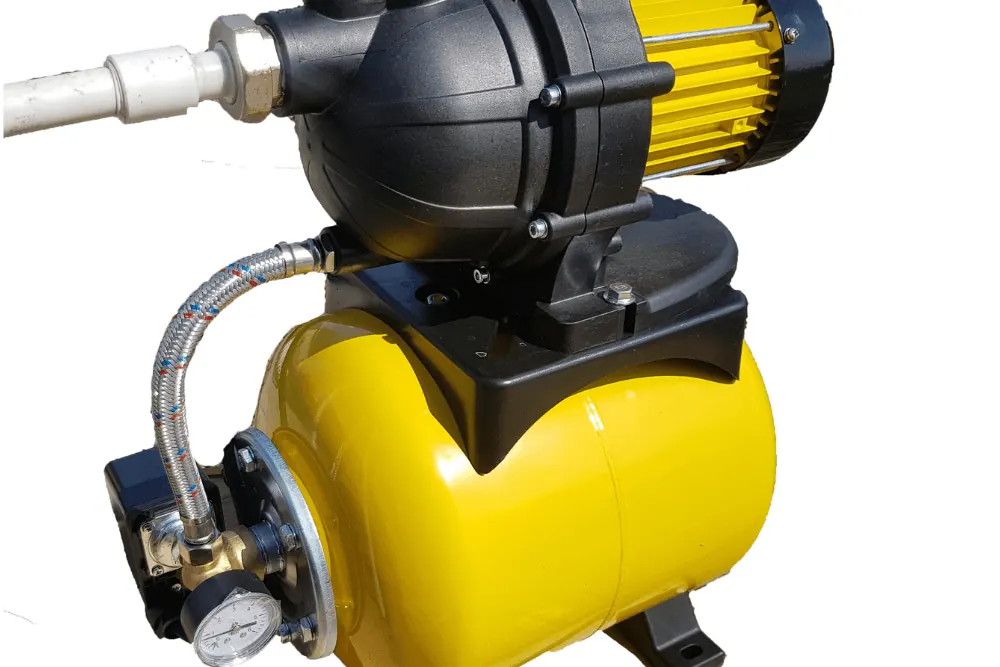
Pressure tank in Dubai: what we do
- Checking the precharge and the tank. Air pressure with the water side released, a test for a split membrane, and the cycle time of the pump. See pump pressure for the switch and the gauge.
- Sizing a tank for a pump. From the pump's flow and the switch settings, as set out below.
- Replacing a tank. Isolating, draining, fitting a new vessel with a tee, unions, gauge and relief valve, and setting the precharge before it is connected.
- Booster sets and villa pumps. The tank is one part of the set. See booster pump and pumps overview.
- Reverse osmosis storage tanks. Checking the small precharge tank under the sink. See RO purifier.
- Emergency visits. We answer calls and send a plumber 24 hours a day, 7 days a week, including nights, weekends and public holidays.
- Areas. Across Dubai. The list is near the end of this page, and the full list of areas is on its own page.
Which vessel you have: one name on different tanks
| Name used | What to know |
|---|---|
| Captive-air tank, also pre-charged, diaphragm or bladder tank | A rubber or plastic membrane separates the water from the air. The air side is charged to a pressure just below the pump's cut-in, and it is checked with the water side completely empty |
| Conventional tank, also hydro-pneumatic or galvanised | A sealed vessel with no membrane. Air sits on the water and is absorbed into it, so the air must be replaced regularly |
| Vertical bladder-type vessel on a booster set | A replaceable membrane, usually a few hundred litres. The nameplate gives the pressure rating and the factory air charge |
| Hot water expansion vessel | A small membrane vessel that takes the extra volume as water heats. See pressure valves |
| Reverse osmosis storage tank | A small tank under the sink, with a much lower air charge than a house tank |
| Break tank | A pressureless closed water tank with an air gap, which isolates the mains and splits a tall building into zones. It is not a vessel under pressure |
Two points from the table. A vessel for a drinking-water pump set should say so, with a pressure rating, a membrane material and a stated use. And the same word, tank, covers vessels that are charged to very different pressures, so the nameplate and not the name is the guide.
What the tank does, and the one number it controls
Without a tank, the pump starts when the pressure falls at the first open tap and stops when the taps close. With a tank, the air side supplies the first litres at each tap, and the pump runs only when the pressure has fallen to its cut-in setting. The water drawn from the tank between the pump stopping and the pump starting again is what decides how often the pump starts. A bigger tank, or a wider gap between the cut-in and the cut-out, gives more water between starts.
The cycling fault is covered on pump pressure. The cut-in and cut-out are set on the pump's switch. The tank's size and its air charge set how much water you get between them.
How big a tank should be
The label volume of a tank is not the volume you can use. A tank labelled 100 litres gives only a part of that, often between a quarter and a third, between the pump stopping and starting, because the air is already compressed when the pump stops. Three things follow.
- A higher pressure setting gives less usable water from the same tank, because the air is more compressed.
- A wider gap between cut-in and cut-out gives more usable water. Most household switches allow only a modest gap, so the tank carries the difference.
- A tank that has lost its air gives only a fraction of the water it should, and the pump starts several times as often.
We size a tank from the pump's flow at its working pressure and the switch settings. The aim is a pump that runs for about a minute each time it starts, which keeps the motor from overheating, and a bigger tank gives longer cycles still. The pump's flow comes from its curve, as the booster pump page explains. A conventional tank gives less usable water for its size than a captive-air tank, so the two are not the same size for the same job. We give you the tank size and the reason on the quote.
The air charge: what it should be
The switch settings are on pump pressure.
- Charge a captive-air tank to just below the switch's cut-in pressure, with the water chamber completely empty.
- Release or add air only at the tank air valve, with a hand pump and an accurate gauge.
- Check the charge with the water side at zero. A reading taken with water in the tank is not the charge.
- A charge that is too high reduces the water the tank holds, and one that is too low lets the pump cycle.
The trap is the factory charge. A new tank is delivered set for a particular switch, and fitted to a switch with a lower cut-in, it has to be lowered before it is connected. Check the nameplate on yours and the cut-in on your switch, and set the tank to match.
Air goes in at the valve and nowhere else. Never add air through the water connection.
A waterlogged tank: three different faults with one name
Waterlogged means the tank holds water where air should be, and the pump starts and stops repeatedly. The name covers three different faults:
- Lost precharge. The membrane is sound but the air has slowly leaked or was never set. Adding air fixes it.
- A split membrane. Water has entered the air side. Adding air does not hold.
- A leaking shell. Water weeps from a seam, the base or the water fitting.
How to tell which:
- Release the water pressure. Switch the pump off, open a tap and let the system drain to zero.
- Read the air valve with a tyre gauge, then press the pin. Air only: the membrane holds. Water at the valve: the membrane has failed.
- Add air if it reads low, to the correct precharge, and watch the pump cycle time over the next few hours.
- Soapy water. Check the valve and the seams for bubbles. A leak in the tank means a new tank. Small leaks near the water fitting can be condensation, so dry the area and look again.
Release the pressure first, because every test above needs the water side at zero. Read the valve before pressing it, because pressing it releases air. If the valve reads low and gives air only, add air and watch the cycle time. If it gives water, the question is the next section. A tank that reads correct and still short cycles points away from the tank, to the switch or the gap between the settings, as the pump pressure page sets out. Spurting taps usually mean air in the pipework and not the tank.
The bladder or the whole tank
Whether a failed membrane can be replaced depends on the tank. Some vessels have a replaceable membrane held by a flange, and many small domestic tanks are sealed, so the whole tank goes. Before deciding, ask:
- Is the shell sound, with no rust, weeping seams or corrosion at the base?
- Is the membrane replaceable on this model, and is the part available?
- Is the part cheaper than a new tank, once labour is counted?
- Is the tank still under warranty? Damage from freezing, corrosion, misuse or unauthorised repair usually voids a manufacturer's warranty.
If the answer to any is no, the price of the part is academic. A tank's life depends on the water, the membrane material, the heat and how well it has been looked after, and no maker gives a service life we can quote here.
Piping, rating and the relief valve
A tank is fitted on a tee on the pump's delivery line, with a union so it can be removed, a gauge, an isolation valve and a drain. A relief valve on the line protects the system from a stuck switch.
The tank's rating must be above the highest pressure the pump can make, and the relief valve must open below the tank's maximum. The relief valve and the switch are what stand between the pump's maximum pressure and the vessel, and a booster set's maximum pressure comes from its curve, not its switch. A typical household switch sits well inside the rating of a standard vessel, and we check the nameplate to be sure.
Heat and the vessel
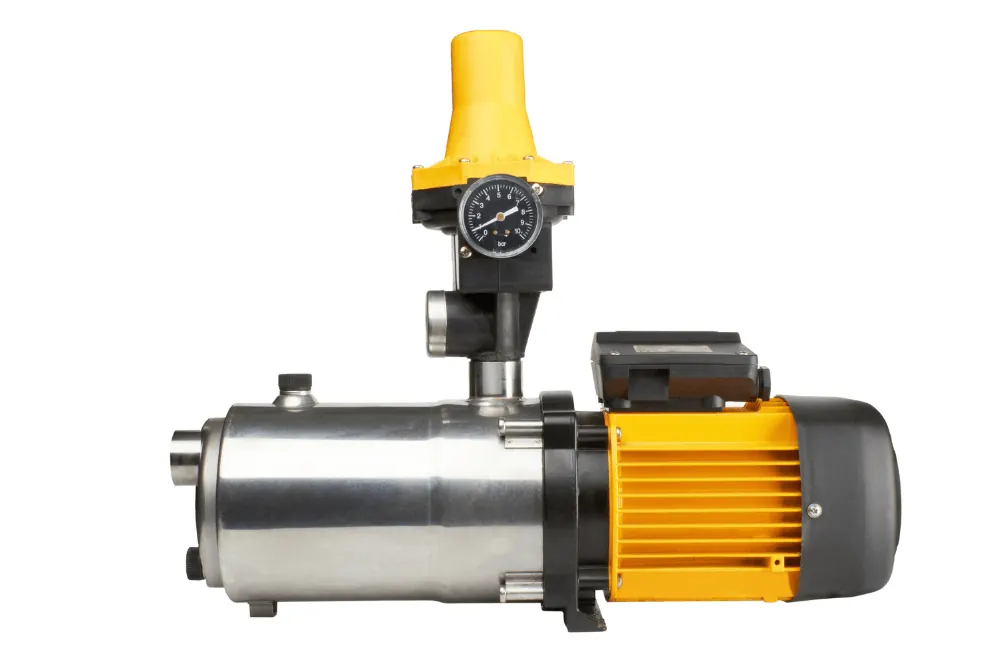
Dubai's heat affects tanks in two ways. Water in an unshaded roof tank or exposed pipe can be warm in summer, and a membrane has a maximum temperature on its nameplate. Vessels on the cold potable side should be shaded or insulated, and their feed pipes insulated to limit heat gain. Stored water that sits in a vessel can also grow bacteria if it stagnates, so water should enter at low level and leave at high level where the design allows, and large vessels should have drain connections.
Check the nameplate temperature of the vessel and its membrane against the hottest water the system will see, shade and insulate the supply, and do not put a vessel on a hot water line unless its label says it is for one.
The reverse osmosis tank
The small storage tank under an RO purifier is a captive-air tank with a much lower air charge than a house tank. The label on the tank governs. To check it:
- Shut off the feed water, close the tank valve and open the RO faucet to drain the system.
- Remove the tank and drain it until only a trickle remains.
- Push out the last of the water by pressing on the tank, slowly.
- Read the pressure of the empty tank at the air valve.
- Release air a little at a time if it is too high, or add air if it is too low.
- Reconnect the tank, restore the water and let it refill.
Too much pressure reduces the water the tank holds, shuts off the automatic shut-off valve sooner and wastes more water in purification. Never charge an RO tank to a house tank figure. For the filter side and the purifier itself, see RO purifier.
Other tanks with the same name
- A break tank. It buffers supply when the mains falls short, isolates the mains from pump surges, and splits a tall building into pressure zones. A break tank has no air cushion and no precharge. See booster pump and water tank installation.
- An air receiver. It holds compressed air, not water, and a membrane tank is not an air receiver.
- A hot water expansion vessel. A small vessel fitted on a storage water heater takes the extra volume as water heats. See pressure valves and water heater installation.
Safety around a charged vessel
A pressure tank stores compressed air and pressurised water. The usual safety rules are:
- Do not exceed the maximum working pressure on the nameplate.
- Always fit a pressure relief valve to match the system pressure rating and the maximum flow.
- Disconnect the power and bleed off the water pressure before servicing.
- Do not puncture, weld or heat the tank, and do not chain it.
- Inspect regularly. If corrosion or damage is visible, have a qualified professional remove the tank from service immediately.
A stuck switch is why the relief valve, the vessel rating and the pump's maximum pressure have to be checked together.
A tank in a Dubai villa pump room
Most villa pressure tanks sit in a pump room or a garage next to the pump, often in heat and sometimes in dust. Check that the tank is standing on a dry, level base, that there is room to reach the air valve and the gauge, and that the pipes to it are supported and not pulling on the tank. Look for rust at the base, which water on the floor can cause. A pump room that floods in rain or from a tank overflow ruins a tank early. If your tank has a bulge, a leaking seam or rust through the shell, it is finished, and no top-up of air will help. We tell you what we see, whether the tank can stay, and what the replacement involves.
What to do when the pump short-cycles in the middle of the night
If the pump starts and stops again and again at night, the cause is often a small leak somewhere in the system that drops the pressure slowly until the pump starts. A tank that has lost its air makes it worse. Switch the pump off at the isolator if the noise is a problem or the cycling is rapid, close the valve to the house if you can, and send us a message in the morning with a video of the gauge and the pump running. A running meter with all taps closed points to a leak. A steady meter and a rapid cycle point to the tank or the switch. Do not keep resetting a trip, and do not leave a pump cycling unattended for hours, because it can overheat.
Replacing a tank without a long shutdown
A tank swap can usually be done in a few hours when the tank has isolation valves on both sides and a drain. Without them, the whole system has to be shut down and drained. We fit isolation valves, a union and a drain so the next job is quicker, and we set the air charge before the tank is connected. In a villa, the work is normally done in a morning. In a building with a shared booster room, we plan it with building management and tell residents when the water will be off.
Signs a pressure tank is failing
A tank rarely fails all at once. The early signs are small. The pump starts more often than it used to, and each run is shorter. Taps spit air when you open them first thing in the morning. The gauge swings fast between its highs and lows, where it used to move slowly. There is a damp patch or a rust stain at the base of the tank. When you press the air valve, a little water comes out with the air. Each of these means the air side is losing its job. The earlier it is caught, the cheaper the fix, because a tank that only needs air costs a visit and a tank that has been cycling for months can leave the pump worn too.
What to look for in a replacement tank
Match the connection size and the pressure rating to the old tank, or better. Check that the maximum temperature on the label suits your water, which matters for a tank that sits in a hot plant room. Look for a membrane that is made for drinking water, and a replaceable one if you want to repair the tank later. Choose a volume that suits the pump and the switch, and not simply the largest that fits, because an oversized tank holds more water that can sit warm and stale. Ask whether the maker's warranty covers the tank, and keep the paperwork. If a tank is cheaper because its parts are not available, that saving can disappear the first time the membrane fails. We recommend, and we tell you why.
The air valve and the gauge: the two small parts that matter
The air valve on the tank looks like a car tyre valve, and it is the only place air should go in or come out. A cap on it keeps dust out and stops slow leaks, so replace a missing cap. A valve that hisses is leaking air, and the core can be replaced. The pressure gauge on the line is your window on the system. A gauge that sticks, or reads the same whatever the pump does, is not telling you anything, and a cheap replacement gives the next visit something to work from. We check both whenever we look at a tank.
Noise from a tank or pump line
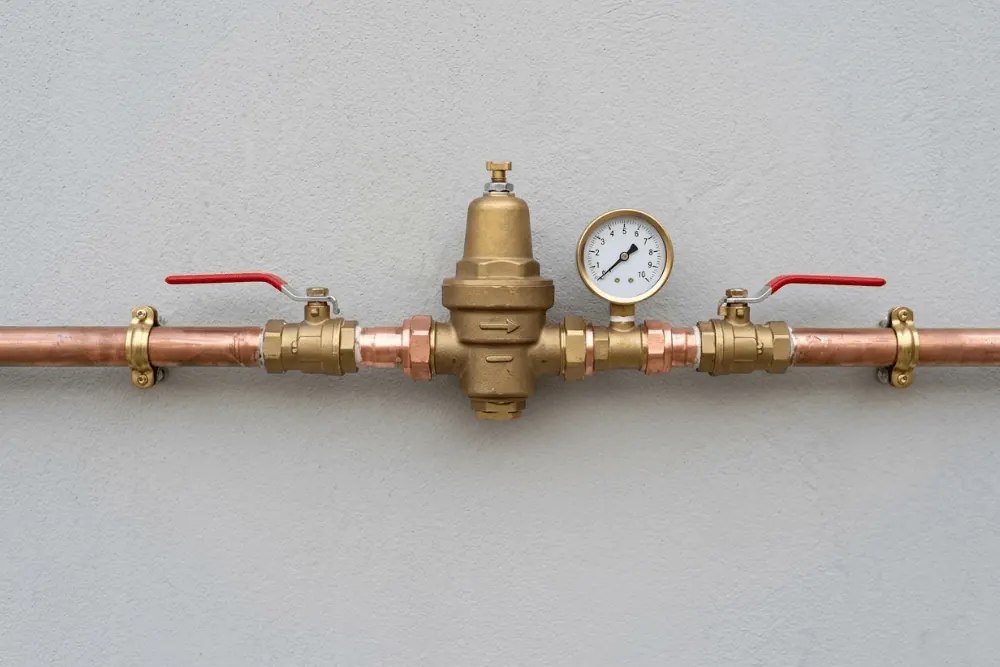
A rattle or hum that comes from the tank or the pipes around it is worth tracing. A tank sitting on a hard base can carry pump vibration into the floor and the walls, and a flexible connector or a rubber pad stops it. A knock when the pump stops can be water hammer, which a tank does not cure on its own. A gurgle when the pump starts can be air in the line. A squeal can be the pump bearings and not the tank at all. When you call, tell us when the noise happens: at the start, at the stop, or all the time, and we narrow it down before we arrive. See water hammer arrestors.
Permission in Dubai: who decides on tank work
Swapping a pressure tank touches the pump's piping, and in a rented home it touches the landlord and the building.
- Building management. A booster room that serves a whole building belongs to the building, and its management decides who touches it.
A like-for-like replacement of a tank on a pump you own is a repair that needs a message to the landlord. Changing the set, adding a vessel, moving the pump or altering a shared booster is an alteration and needs written consent in a rented home. Tell us what your building asks for and we work to it.
When the job is finished
Ask for these. They cost nothing to produce.
- The settings as found and as left: cut-in, cut-out and air charge, in bar, with the date.
- The tank's nameplate, photographed: volume, maximum pressure, maximum temperature and membrane type.
- The relief valve rating and where it discharges.
- The cycle time: the minutes between starts at a normal draw.
- A note of any leak, corrosion or condensation found.
- FAM's workmanship warranty, in writing. The warranty runs for 30 days and covers our labour only. Parts carry the manufacturer's warranty only.
How we work
- You message us with the pump and tank make if you know them, a photograph of the tank's label, the gauge and the switch, and what the pump is doing.
- We say what we think is happening, whether it is the air charge, the membrane, the switch or the size, and whether to switch the pump off until we arrive.
- We give a price in writing, with the tank and the work shown separately.
- Check permission. In a rented or managed property, ask the landlord or building management whether they need to approve this work before the visit.
- We measure first: the cut-in and cut-out on the gauge, the air at the valve with the water side released, and the time between starts. The visit fee is AED 50 + VAT, credited if the work goes ahead.
- We charge or replace, set the precharge to the switch, and check the relief valve and the unions.
- We hand over the settings, the nameplate, the cycle time and the warranty.
Where we work in Dubai
We cover all of Dubai, including Dubai Marina, JBR, Downtown Dubai, Business Bay, Jumeirah Lakes Towers, Palm Jumeirah, Al Barsha, Jumeirah Village Circle, Dubai Hills, Mirdif, Deira and Al Quoz. See the full list of areas.
Checking a tank yourself, safely
A few checks can be done by anyone, without opening or adjusting the tank.
- Look at the tank. Rust at the base, a bulge, a leak at the connections or water around it means it needs attention.
- Look at the gauge. Note the pressure when the pump is running and when it stops. Write it down.
- Count the starts. Note how many times the pump starts in ten minutes during normal use. A pump that starts every few seconds suggests a waterlogged tank.
- Tap the tank. Tap it with a knuckle from top to bottom. The upper part should sound hollow (air) and the lower part dull (water). A tank that sounds dull all over may be full of water.
- Check the pressure relief valve for drips.
Do not open the air valve on a charged tank to bleed it, and never work on a tank that is under pressure. Isolate the pump and drain the tank before any adjustment.
Reasons the pump cycles too often
| Cause | What it looks like | Remedy |
|---|---|---|
| Low precharge | Frequent short cycles | Recharge to the correct figure |
| A burst or leaking bladder | Water from the air valve, or a tank full of water | Replace the bladder or the tank |
| A tank too small | The pump cycles even when the precharge is right | Add a tank or fit a larger one |
| A leaking foot valve or check valve | Pressure falls fast when the pump stops | Replace the valve |
| A leak in the line | Pressure falls slowly with no use | Find and fix the leak |
| A pressure switch with a narrow gap | Short cycles at a set pressure | Adjust or replace the switch |
When to replace the tank
A tank that has a ruptured bladder, rust through the shell, or leaks at the seams needs replacing. Do not weld or patch a pressure vessel. A new tank should match the pressure rating, the connection and the volume of the old one, or be better. Fit a relief valve and a gauge, and isolation valves on both sides. Recharge before the pump goes on. We quote for the tank, the labour and the fittings, and fix the price on WhatsApp before we start. Prices exclude 5% VAT.
How much does pressure tank work cost in Dubai?
- The tank. The price follows the volume, the pressure rating and whether it is a plain domestic tank or a larger booster-set vessel.
- The work. Isolating, draining, fitting, setting the precharge and testing.
- What moves the price. The tank's size and rating, whether the membrane or the whole tank is replaced, the switch, gauge and relief valve fitted at the same time, access, and particularly a tank in a tight pump room.
We do not publish a starting price for this job. Send a photo on WhatsApp and we give you a fixed price before we start. Prices exclude 5% VAT.
Pressure tank FAQs
What pressure should a pressure tank be set to?
Just below the pump switch's cut-in, with the water side empty. A new tank often arrives set for a different switch, so it has to be checked and adjusted before it is connected.
How big should a pressure tank be?
It depends on the pump's flow and the switch settings. We aim for the pump to run about a minute each time it starts. A tank's label volume is more than the water you can use between starts, so we size from the flow and not from the label.
How do I tell if a pressure tank is waterlogged?
Release the water pressure, read the air valve with a tyre gauge, then press the pin. Water coming out means the membrane has failed. Air only means the membrane is holding and the charge may be low.
Can the bladder be replaced?
Sometimes. On a vessel with a replaceable membrane it can be changed, and on a sealed domestic tank the whole tank is replaced. The tank model decides, and we check before we quote.
Why does my pump start and stop every few seconds?
Check the tank's air first, since a lost precharge or a split membrane makes the pump cycle fast. If the tank is sound, the switch or the gap between its settings is the next suspect. See pump pressure.
How long does a pressure tank last?
Usually several years, and often more than ten. The membrane and the air valve are the wear points. A tank that makes the pump start and stop too often has lost its air charge or has a split membrane. Check the precharge with a gauge at the air valve while the tank is empty of water.
Will a bigger pressure tank raise my water pressure?
No. The pressure is set by the pump and the switch, and the tank only stores water under that pressure and cuts the number of starts. For low pressure, see low water pressure.
What is the difference between a pressure tank, an expansion vessel and a break tank?
A pressure tank and an expansion vessel are both membrane vessels, one on a pump line and one on a heater. A break tank is pressureless, with an air gap. A compressed air tank holds air, not water.
What pressure should a reverse osmosis tank be?
Much lower than a house tank, and the label on the tank governs. Check it with the tank empty of water, and do not charge it to a house tank figure.
How much does a pressure tank cost in Dubai?
It depends on the volume, the rating and the work. We give a fixed price on WhatsApp before we start. Prices exclude 5% VAT.
Book a pressure tank visit in Dubai
Tell us what the pump is doing, the pump and tank make if you know them, and whether you own or rent. A photograph of the tank's label, the gauge and the switch helps. If water is leaking from the tank or the relief valve, switch the pump off and call. We will measure, give you the options and a price in writing, do the work and hand over the settings.
WhatsApp: +971 55 407 7427 · Request a quote
Visit us: Office 871, Oasis Mall, Al Quoz 1, Dubai, UAE
Related services: Pump pressure · Pumps overview · Booster pump · Low water pressure · Water hammer arrestor · Pressure valves · RO purifier · Water tank installation · Water heater installation · Emergency plumber