
Shower repair in Dubai: what we do
- No hot water and temperature faults. We decide whether the fault is the water heater or the shower valve before anything is replaced.
- Valve and cartridge repair. Dripping, stiff handles, swinging temperature and failed diverters, on exposed and concealed mixers.
- Showerhead, arm and hose faults. Descaling, replacement and leaks at the connections.
- Leaks. Around the handle and spout, at the head, behind the wall, through the tray and at the door.
- Seals and silicone. Re-sealing the joints where the shower meets the wall, tray, glass and floor.
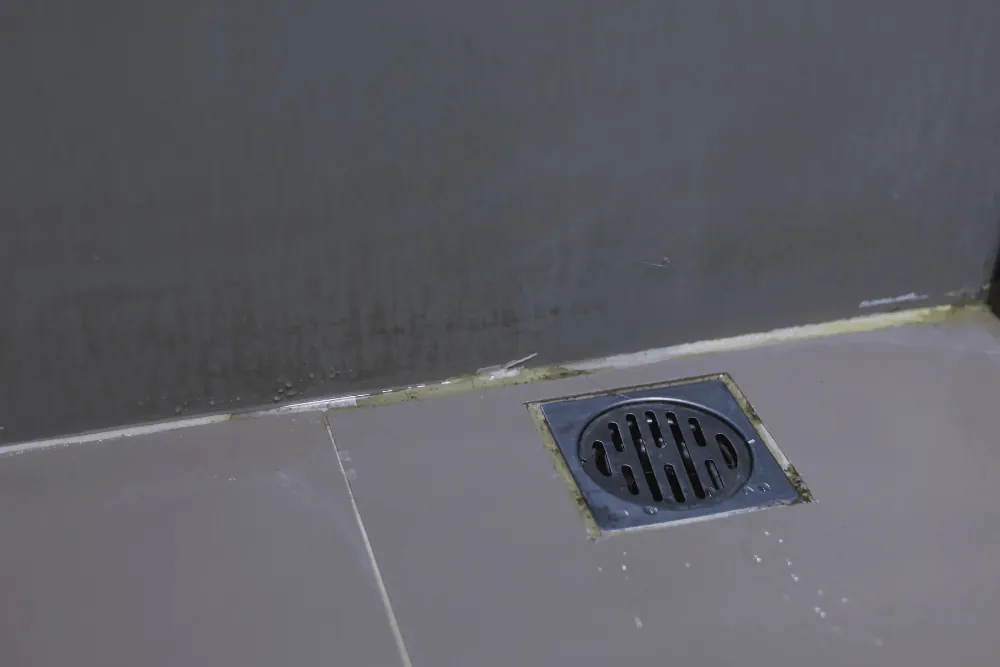
- Slow drains. Cleared, or handed to the drain team with the cause identified.
- Testing. Every repair is run hot and cold, checked for leaks under pressure, and watched for drips after shut-off.
- A written finding with photos, for your landlord, building management or insurer.
Neighbouring topics have their own pages. The cartridge, washer and seat work on a basin or kitchen tap is on our leaking tap repair page. Weak pressure across the whole property is on our low water pressure page. A heater that is failing is on our water heater repair page. Flexible hoses are on our hoses page. Blocked drains are on our drain unblocking page. A stain on the ceiling below is on our ceiling and wall leak page. A new shower or enclosure is on our shower installation page, and baths on our bathtub page.
Start with the symptom
Most shower faults can be narrowed to one or two suspects before anyone picks up a spanner. This table sets out the first suspect for each complaint.
| What you see | First suspect | How to tell | More on |
|---|---|---|---|
| Cold at the shower and at every hot tap | The water heater | Nothing about the shower itself is wrong | Water heater repair |
| Hot water, but never cold enough | The cartridge, or a limit stop set too far to hot | The valve is not letting cold in | This page |
| Weak flow from every tap | The supply | Not a shower fault | Low water pressure |
| Water at the base of the handle or the spout | Seals in the valve, or a leak behind the trim | Needs the trim off to see | This page |
| Water sprays from where the arm meets the wall | The arm thread or the plate gasket | See the leaks section below | This page |
| Leaking hose or connector | The hose, washer or nut | Replace the part | Hoses |
| Water on the bathroom floor, shower tray dry | The door, the seal or the silicone | Run the door test below | This page |
| Water level rises in the tray | The drain | Hair, soap scum, or a blocked line | Drain unblocking |
| Damp wall, musty smell, or a stain on the ceiling below | A leak behind the surface | See the wall and ceiling sections | Ceiling and wall leak |
The most useful single test costs nothing. Run the basin hot tap and the shower hot side together. If the basin tap is hot and the shower is cold, the heater is not the fault.
Shower types and why they fail differently
The parts that fail depend on the type of shower, so the first thing we do is identify it.
| Type | What it is | Where it fails | Repair note |
|---|---|---|---|
| Exposed mixer | A valve on the wall with the pipes and body in view, and a bar or rail above | Washers and seals at the visible joints, the head and the hose | The whole assembly can be seen and reached |
| Concealed (in-wall) mixer | A plate and handle on the tile; the valve body and pipes are inside the wall | The cartridge, its seals, and the connections behind the tile | The cartridge is reached through the trim. Anything behind it is another job |
| Manual mixer | One or two handles that set the hot and cold mix by hand | The cartridge, plus the limit stop that caps the hot side | Cartridge replacement is the standard repair |
| Diverter (bath and shower) | A valve or lever that sends water to the spout or the head | A worn seal that lets water dribble from the wrong outlet | On some valves the diverter is part of the cartridge and on others it is a separate part. We find out when the trim is off |
| Rain shower (ceiling or fixed head) | A large head on a fixed arm or from the ceiling | Scale across a large nozzle face, and a connection that is hard to reach | Needs a ladder, or the ceiling access, and a large head needs enough flow to work |
| Hand shower | A head on a flexible hose | The hose, its ends, the holder and the washers | See hoses |
| Electric or instant shower unit | A small heater that warms water as it flows | The heating element, flow sensor or scaled waterways | A heater fault, covered on water heater repair. Switch the unit off at its breaker before touching a leaking one |
| Steam or jacuzzi | A separate generator or pump system | Specialist components | See our bathtub page. We assess these before quoting |
A shower valve does three jobs: it opens, it mixes, and, on some models, it controls temperature. The cartridge is the part that does all three, so most valve faults are cartridge faults. The cartridge sits inside a body that is fixed to the pipes, so replacing the cartridge does not disturb the plumbing. Replacing the body does.
Thermostatic valves
A thermostatic mixing valve blends hot and cold to a set outlet temperature and holds it when the supply changes. That reduces the risk of scalding and, because the hot side can be stored hotter, helps keep bacteria from growing in the system. The valve's data sheet says what supply it is built for, and we go by that.
No hot water: the shower or the heater
If only the shower is cold.
- The cartridge may be worn or clogged.
- The anti-scald limit stop may have been set too low. On valves that have one, it is a ring or stop behind the handle that limits how far the handle turns toward hot.
- Cold may be leaking into the hot side through a faulty valve. If the hot water is lukewarm only at the shower and fully hot at the basin, the valve is mixing when it should not be.
If every hot tap is cold or lukewarm. The heater, its power supply or its thermostat is the suspect. That work, including elements, thermostats and tanks, is on our water heater repair page.
If the water is hot for a minute and then fades. On a storage heater this can mean the tank is too small for the demand, or the element is weak. With a long pipe run from the heater, it can mean the pipe is cooling the water on the way, which is a layout problem and not a fault.
The shower valve and its cartridge
The cartridge is a cylinder inside the valve body, with ports for hot and cold water, rubber O-rings that seal it, and a spindle that the handle turns. When the spindle turns, the cartridge opens the ports in a ratio that sets the temperature. When any of those parts wears, the symptoms in the table appear.
What kills a cartridge
- Scale and grit. Mineral deposits and debris score the sealing faces and jam the spindle.
- Worn O-rings. The rubber seals harden and flatten with age and heat, and the cartridge drips round the spindle.
- Heavy use and age. A cartridge turned several times a day wears like any moving part.
- Forcing the handle. A cartridge that is stiff is being asked to move against scale or a dry seal, and forcing it chips the stem.
- Debris after plumbing work. New or disturbed pipework sends fragments into the cartridge.
We look at the one in your hand and say which of these has happened.
Replacing a cartridge: the sequence
The sequence we follow:
- Shut off the water to the shower, at the isolation valve if the shower has one, or at the main. Open the shower to confirm the water has stopped. If there is no isolation valve, that is a finding in itself, and our valve repair and replacement page covers fitting one.
- Remove the index cap, handle and trim plate (escutcheon). The index cap is the small button that hides the screw.
- Pry out the retaining clip, the small metal clip that holds the cartridge in the body.
- Pull the cartridge, with a cartridge puller or pliers, without forcing it. A cartridge that will not move is a sign to stop and reassess.
- Match the replacement to the old one on length, diameter, stem splines and port positions.
- Apply silicone grease to the O-rings, align the new cartridge and reseat the clip.
- Apply silicone behind the trim plate, refit the handle and test. If removal is difficult or the leak continues after the swap, we stop and reassess.
Identifying the right cartridge
We take the old cartridge out and compare it with the new one on four points: the overall length, the diameter, the shape and number of splines on the stem, and the position of the hot and cold ports. A cartridge that is close but not exact can fit and still leak or give the wrong temperature range. Where the brand is marked on the body or the trim, that narrows the choice. Where it is not, the old cartridge is the evidence.
A cartridge ordered from a photograph of the handle is a guess. A cartridge ordered after the old one has been pulled and measured is a match.
Repair or replace the cartridge?
Where a kit exists and the discs are sound, a kit can be the cheaper route. Where the cartridge is plastic, scored or has no kit, the whole cartridge is replaced. We tell you which before we start.
The same cartridge principles apply to a basin tap, which is covered on our leaking tap repair page and not repeated here.
Limescale on the showerhead, and what hard water does to a shower
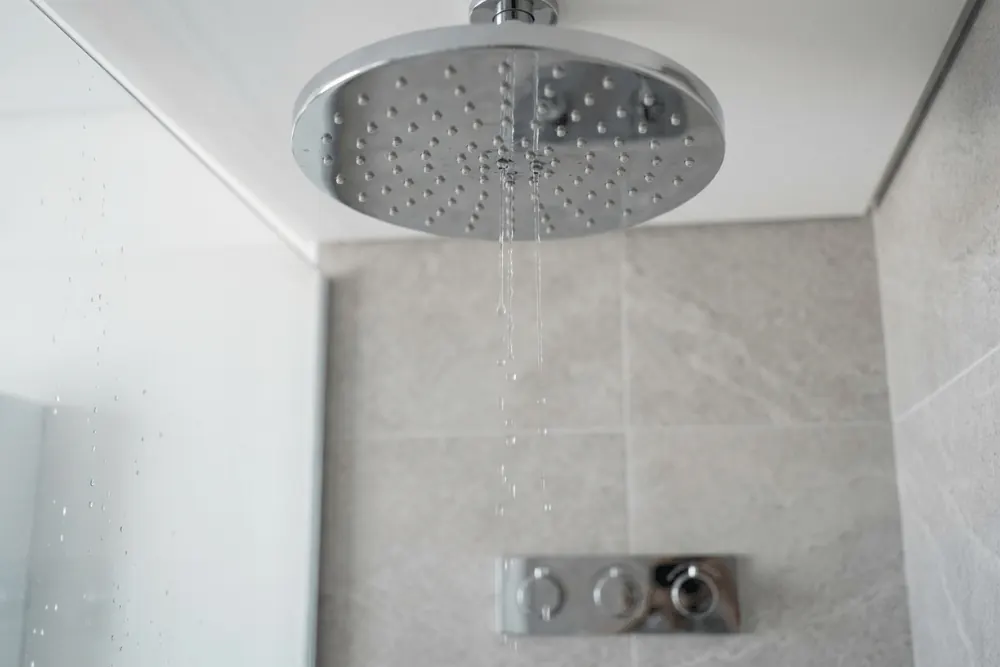
White crust on the nozzles, spray that goes sideways and a head that has slowly lost its force point to scale. Scale is the deposit that hard water leaves on surfaces. A showerhead is a good place for it to collect, because the outlet is a set of small holes that stay wet between showers.
To descale a head, soak it in white vinegar for at least 30 minutes, and up to about an hour for heavy scale. A detached head goes in a bowl. A fixed head can be covered with a bag half-filled with vinegar tied round it.
- Keep the rubber washer when a hand-held head is detached, because it stops the connection leaking.
- Brush the nozzles. An old toothbrush does it. Rubber nozzles can be rubbed clean with your fingers.
- Rinse and flush. Run the shower for a short time with the head on to clear loosened deposits.
- Drain the head after use. Tilt the head so excess water runs away.
Vinegar is an acid and some coatings are not made for it, so we check the manufacturer's care instructions before soaking a decorative head, and we replace a coated head whose finish is already pitted. A head whose nozzles are fused, or whose body is cracked, is cheaper to replace than to treat.
When scale is in the valve
If the head is clean and the flow is still weak, or the handle has become gritty, the scale is inside the valve, and descaling the head will not reach it. A cartridge seized by scale is harder to pull, which is one reason not to force it.
Hard water in Dubai: what we can and cannot say
Our water softener page sets out how hardness is measured. Where the water starts does not tell you the hardness at your tap, because your own tank, pipes and heater sit between the meter and the shower. We do not quote a hardness figure for Dubai, and we do not guess one for your flat.
What you can do with that:
- Test first. A hardness reading at your own shower settles whether scale is the problem. See water quality testing.
- If scale is confirmed, a water softener is the equipment that removes hardness from the whole property. A whole-house filter catches particles and chlorine and does not remove hardness, so it will not stop limescale on its own.
- If the hot side clogs faster than the cold, heating is part of the cause, because heat makes scale come out of the water. See water heater repair.
Hose, arm and head connections
A hand shower's hose is bent, twisted and pulled every day, so the braid, the crimped ends, the washers and the swivel are all places to leak. The detail, including how to choose a replacement, is on our hoses page.
The other joints are on the fixed pipework:
- Head to arm. A thread, with a washer or tape. Tightening a leaking connection with pipe tape and a wrench is covered on our tap repair page.
- Arm to wall. A threaded joint hidden by a flange or plate. A sealed plate hides a leaking arm joint, and the water finds its way into the wall.
- Hose to outlet. A threaded elbow with a washer, on the wall.
A leak that does not show at any of these joints is covered in the next section.
Where a shower leaks
We test in the order that rules out the cheap, visible ones first.
| Step | Test | What a result means |
|---|---|---|
| 1 | Seals and silicone. Look and press at the joints between wall, tray and glass | A gap, black mould or a soft patch is a path for water |
| 2 | Head and arm. Run the shower and look at every joint from the head to the wall | A drip at a joint is a washer or thread |
| 3 | Valve and handle. Run hot and cold separately and watch the trim | Water at the handle or spout base is a seal inside the valve |
| 4 | Cap the arm | If the leak stops, it was the arm or what is downstream |
| 5 | Tile and grout. Water poured on the wall and floor, watched at the joints | A spot that goes dark is a path for water |
| 6 | Drain flange. Block the drain and fill the tray a little, then watch below | A leak with the tray full and no shower running points to the drain seal or the tray |
| 7 | Tray flood test. Described below | A leak through the tray or the waterproofing |
The flood test
A flood test blocks the drain, fills the tray to a set level, marks the water line and waits. A short test can find a large failure and may miss a slow one. A long test left overnight can find a slow leak, and it also leaves water sitting over the thing you are testing for hours. A curb, the raised edge of the tray, is not covered by a test that stays below it.
Our practice:
- Go long only when the evidence points to the tray, and only with the area below checked and protected. If the tray leaks, a long test sends water into the ceiling below.
- Test the curb separately. The long test does not cover it.
Silicone, caulk and grout
The repair is the same in every case. The old material is cut out. The joint is cleaned and dried. New silicone is run along it and smoothed, and the shower is left until the silicone has cured to the manufacturer's time. New silicone does not bond well to old silicone, which is why a patch peels off. A corner or a change of surface is a movement joint and is sealed with silicone, not grout.
Door and screen leaks
Water on the floor with a dry tray points to the door or screen. It can get out at the bottom seal, the side seal, the hinge side and the gap between the door and the wall profile. The fix is a new seal, a re-hung door or a new profile, and we say which after the spray test.
Behind the wall: concealed valves and the risk of opening it
A concealed shower valve sits in the wall, and the part you see is the trim. Most valve faults are reached through the trim: the handle, the plate and the cartridge come out and the body stays. That is the repair we described above.
A leak from the body, the pipe connections behind it or the pipe in the wall is a different job. It needs the tile, the board and sometimes the masonry opened.
How we decide whether to open the wall
Most bathroom walls in Dubai are block or concrete finished in tile, so opening one means cutting through tile and render, and the cut cannot be neatly hidden. Our approach:
- Measure before cutting. A moisture meter and, where the equipment is available, thermal imaging narrow the area. The methods are on our leak detection page.
- Eliminate the trim and the arm. The caps and tests above are cheaper than a hole.
- Pressure-test the supply to the valve, isolated from the rest of the pipework, so the pipe is shown to be sound or not before the wall is opened.
- Open once, in the right place, by the smallest cut that reaches the joint, and prefer a place where an access panel can stay.
- Repair, test, then close. Nothing is closed until the repair has held under pressure.
The reasons not to open a wall by guesswork are practical. Matching tile can be hard, a membrane behind the tile may be cut, and a landlord's consent may be needed. If the valve is old and has failed, we raise the question of whether the body should be replaced now, since the wall is already open. That decision is yours, and we give the price of each option in writing. A pipe that has failed in the wall is a pipe leak repair, and a run that keeps failing is a repiping question.
Waterproofing, the floor and the ceiling below
Tile and grout shed most of the water. What holds back the rest is the waterproofing layer under them, and the tray, the drain seal and the floor fall that move the water to the outlet. When that layer fails, water can travel through the slab and appear on the ceiling of the flat below.
A stain on a ceiling below a bathroom that grows after showers, and not after other water use, points to the wet area above. The test and the repair of that ceiling are on our ceiling and wall leak page, which also covers drying, the board and who is responsible. If the cause is a failed waterproofing layer, the repair is a waterproofing job, which means lifting tile. We tell you that before any work, because the cost is a different order from a washer.
Scald safety
- Hot water that is stored hot is mixed down at the shower, and a thermostatic mixing valve is the part that limits the outlet temperature. Hotter water can scald quickly, and a child's skin burns far faster than an adult's.
- Thermostatic mixing valves reduce scald risk because they hold the set temperature when the supply changes.
Our water heater installation page is the place to read about the heater end of this. Here we add three points about the shower end:
- The heater setting is not the only scald control. A heater setting changes the temperature everywhere, while a mixing valve limits the temperature at the shower.
- A limit stop is a safety setting. If we reset one to deal with a cold shower, we tell you the new setting.
- Test after any valve work. Before we leave, we run the shower at its hottest and measure the temperature.
Pressure and the heater: two things that change the shower
A shower is where heater and supply faults show up, because it blends the two.
- Pressure. A weak shower on the whole property is a supply problem, not a valve problem. See low water pressure and, if a pump feeds the property, booster pumps. Too much pressure is a separate problem. In villas, a pressure reducing valve is normally fitted downstream of the meter where the supply pressure is high. See pressure reducing valves.
- The heater. If the shower goes from hot to cold without any change at the handle, the heater is the first suspect. If the hot side is slow to arrive, the pipe run from the heater may be long. See water heater repair.
- Both sides changing. A mixer blends two supplies. When one supply drops because a tap or machine starts elsewhere, the blend changes. A thermostatic valve is built to compensate for this. We check that the supply to both sides is steady before blaming the valve.
The slow shower drain
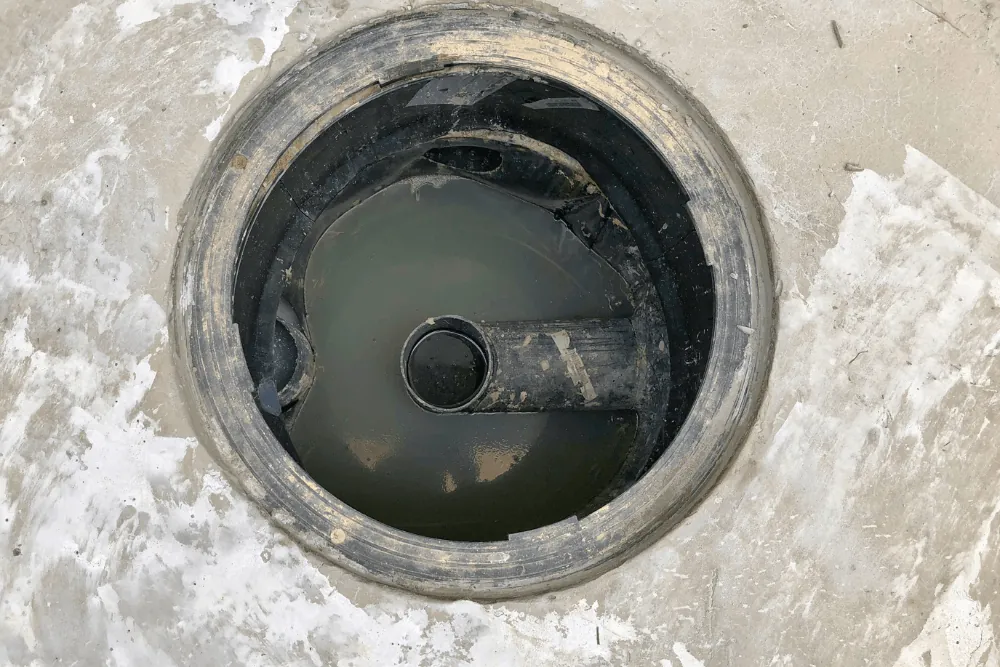
If the water rises round your feet, the fault is the drain and not the shower. Hair and soap scum are the common causes, and clearing them is a drain job. See drain unblocking. If the drain clears and the tray still holds water, the tray may be out of level, and we say so after a check.
Repair or replace: the shower
| Situation | Our view | Why |
|---|---|---|
| Drip or stiff handle, valve otherwise sound | Repair: new cartridge | A cartridge is the part that wears. See the sequence above |
| Scaled or cracked head, worn hose | Replace the part | A treated head can be re-used. A cracked one cannot |
| Valve body leaking inside the wall | Replace the body, with the wall open | A cartridge swap will not fix a leaking body |
| Trim is damaged and the model is discontinued | Replace the trim, or the whole valve | A trim has to match the body |
| Tray or waterproofing failed | Replace or re-waterproof | Silicone does not fix a failed membrane |
| Old shower, many faults | Replace the shower | See shower installation |
Access is a cost of its own beside the part, which is why we price the part and the access separately.
Who pays for a shower repair in a rented Dubai flat
Who pays depends on your tenancy contract. Many contracts leave small repairs under a set amount with the tenant and larger ones with the landlord, so look for a threshold in yours. For a leak into the unit below, the cause and who looks after the failed part decide who answers for the damage. This is general information, not legal advice.
For a shower, the starting points are:
| Situation | Starting point |
|---|---|
| Cartridge, hose or head worn out | Maintenance. Look at your contract for a threshold. Photograph the fault and tell the landlord before paying |
| Leak inside the wall or from waterproofing | Usually a landlord matter, since the system is internal plumbing or building fabric. Send the report in writing |
| Water into the flat below | Stop the water, report to building management and the landlord, and keep the evidence |
| Replacing a shower with a different type | An alteration. Ask the landlord in writing first |
How we diagnose, repair and test a shower
- You tell us the symptom, and, if you can, send a photo of the shower, the handle and the trim on WhatsApp. We give you the possible causes and the questions we will ask on the visit.
- We visit and run it. We test hot and cold at the shower and the basin, check the heater and the supply, and look at the drain. The visit fee is AED 50 + VAT, credited if the work goes ahead.
- We identify the valve. Brand, type, exposed or concealed, and whether the cartridge can be reached through the trim.
- We give the options and the price in writing before opening anything that cannot be closed again the same day.
- We repair. The water is isolated, the cartridge, head, hose or seal is replaced, and the joint is sealed.
- We test. Hot and cold at full flow, the full range of the handle, a check for drips after shut-off, a look at the joints under pressure, and the temperature at the outlet. For a concealed valve we also check the wall and the ceiling below.
- We leave a written note of the fault, the cause and what we replaced, with photos.
Where we work in Dubai
We cover all of Dubai, including Dubai Marina, JBR, Downtown Dubai, Business Bay, Jumeirah Lakes Towers, Palm Jumeirah, Al Barsha, Jumeirah Village Circle, Dubai Hills, Mirdif, Deira and Al Quoz. See the full list of areas.
How much does shower repair cost in Dubai?
The price follows what has failed, how much has to be reached and what the part costs.
- Call-out and diagnosis. Time to find which of the suspects is responsible.
- Access. A repair through the trim is a short job. A repair behind the tile adds opening, closing and re-tiling.
- Sealing and finishing. Silicone, grout, tile matching and any waterproofing.
- Other trades. A heater, a pump, a drain or a ceiling repair is a separate item.
- Out-of-hours work. We answer calls and send a plumber 24 hours a day, 7 days a week.
We do not publish a starting price for this job. Send a photo on WhatsApp and we give you a fixed price before we start. Prices exclude 5% VAT.
Shower repair FAQs
Why is my shower cold when the basin tap is hot?
If the basin tap is also cold, the heater is the suspect. We run both before replacing anything.
Why does my shower go hot and cold?
Usually a worn cartridge, a scaled valve or a heater that cycles. Check whether the swings follow a tap or machine starting elsewhere, since that changes the supply and not the valve. A thermostatic valve is built to compensate for it, and we check the supply to both sides before blaming the valve.
Why does the shower drip after I turn it off?
The cartridge is not closing, or the diverter seal is worn. The cartridge is replaced.
Can you fit a cartridge without opening the wall?
Yes, where the cartridge can be reached through the trim. A leak from the body or the pipes behind it is different, and needs the wall opened.
How do you know which cartridge to buy?
We pull the old one and compare it with the replacement on length, diameter, the stem splines and the port positions. We do not order from a photograph of the handle.
How long should a shower cartridge last?
It depends on use, water quality and the cartridge itself, so we do not predict a lifespan. A cartridge that drips, is stiff or gives swinging temperature is due, and we replace it when it shows those signs.
How do I remove limescale from my showerhead?
Soak the head in white vinegar for 30 minutes to an hour, brush the nozzles and rinse. If the finish is coated, check the manufacturer's care guidance first, and replace a head whose nozzles are fused or whose body is cracked.
Do I need a water softener for my shower?
Test first. Hardness is dissolved calcium and magnesium, and the reading at your own tap decides it. Our water softener page says how hardness is measured and what a reading does and does not tell you.
Who pays for a shower repair in a rented flat?
It depends on your contract. Small repairs often fall to the tenant up to a stated amount, and internal plumbing faults usually sit with the landlord. Check yours, and tell the landlord in writing before you pay for anything. This is not legal advice.
Is a leaking shower an emergency?
A shower leaking into a ceiling below, a wet wall that is growing, or any leak near electrics is. Stop the water at the valve, switch off the power to the room if the leak is near wiring, and WhatsApp us. See our emergency plumber page.
Book a shower repair in Dubai
Tell us what the shower does, which hot taps are working, whether the valve is on the wall or behind a plate, and whether there is a stain below. Photos of the handle, the trim and any marks help. If water is reaching a neighbour, stop it at the valve and call. We will find the cause, repair it, test it hot and cold, and give you a written note.
WhatsApp: +971 55 407 7427 · Request a quote
Visit us: Office 871, Oasis Mall, Al Quoz 1, Dubai, UAE
Related services: Shower installation · Bathtub · Leaking tap repair · Water heater repair · Low water pressure · Ceiling and wall leak · Drain unblocking