
NRV valve in Dubai: what we do
- Identifying the valve you have. The type, the size, the rating and which way it is fitted.
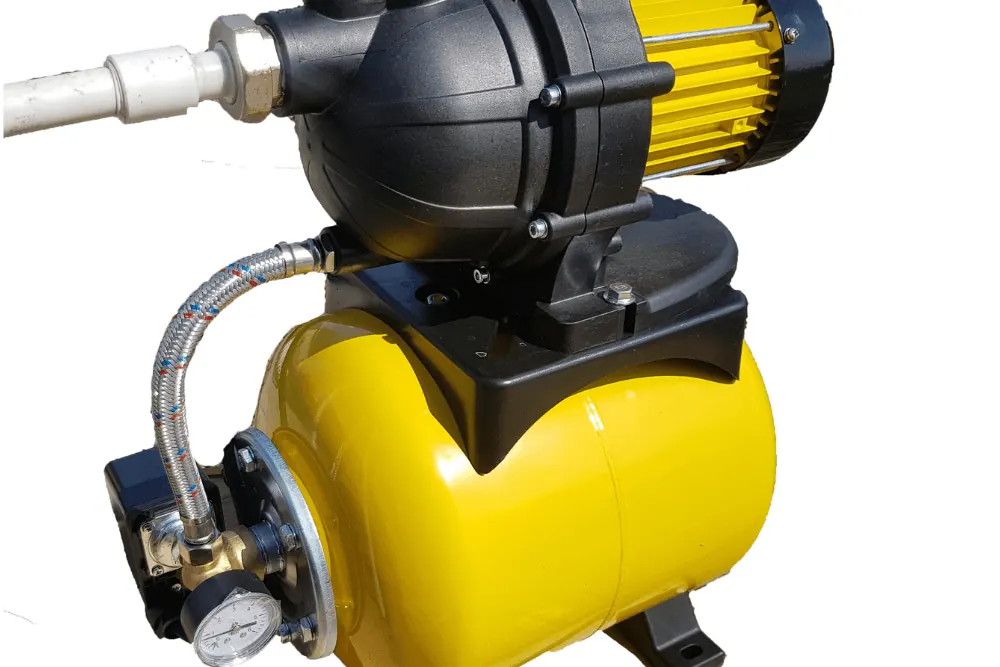
- Fitting and replacing non-return valves on pump discharges, tank and heater feeds, appliance lines and boosters. See booster pump installation and repair.
- Foot valves and borehole checks on suction lines and submersible pumps. See submersible and borehole pumps.
- Fixing banging, chatter and drain-back that trace to a check valve. See water hammer arrestors and valve repair and replacement.
- Emergency visits. We answer calls and send a plumber 24 hours a day, 7 days a week, including nights, weekends and public holidays.
- Areas. Across Dubai. The list is near the end of this page, and the full list of areas is on its own page.
NRV, check valve, one-way valve: the names
The same valve carries different labels, and a few of the names people type are different things.
| Name | What it is | Where to read more |
|---|---|---|
| Foot valve | A check valve with a strainer on its inlet, fitted at the bottom of a pump's suction line to hold the prime. It is needed at the bottom of a well suction line on jet pump installations | This page |
| Backwater valve | A one-way flap in a drain line against sewer backflow | Drain services |
| Backflow preventer | A device rated for a hazard level, with test points on the higher grades. A single check is the weakest option | Backflow prevention |
| NRV ball valve, ball check | A check valve that uses a free ball, and not a ball valve with a handle | This page, and ball valves |
| NRV gate valve | Two different valves share the name, a gate valve and a check. A gate valve has a handwheel and shuts both ways | Valves |
| AC NRV | A check valve on the pump of a chilled water system. A split air conditioner's refrigerant circuit belongs to the AC contractor | This page |
| NRV gas valve | A gas valve is a gas-rated part. A water NRV is not approved for gas | Gas safety |
The ball-valve page records that a water-oil-gas rating does not approve a valve for fuel gas, and the same caution holds here.
The types and how each one closes
The designs differ in how the closing part moves, and that sets how fast it shuts, how much pressure it takes and how it behaves when flow stops.
| Type | How it works | What to know |
|---|---|---|
| Swing check | A hinged disc swings open with the flow and falls shut when it stops | Low pressure drop and simple. Needs a steady flow, and can slam on a line where the flow reverses before the disc closes |
| Spring-loaded in-line (lift or poppet) | A spring presses the disc onto its seat, and flow lifts it | Works in any orientation and closes quickly. The spring sets a cracking pressure, and a little more pressure drop |
| Wafer or dual-plate | Two spring-loaded half-discs fold open between flanges | Compact and fast closing, suited to pump discharges |
| Silent or non-slam | A spring closes the disc as flow falls to zero | Fastest closure and the shortest travel, with a higher pressure drop. Built to cut slam. Spring fatigue and corrosion are the failure modes |
| Nozzle | A spring-assisted disc in a venturi-shaped body | Lower head loss than a silent check, and unsuited to water with suspended solids |
| Ball check | A free ball is pushed off its seat by the flow | Tolerates dirty water, so it is used on sewage and sump lines |
| Foot valve | A check valve with a strainer on its inlet | At the bottom of a suction line |
For a house or a flat the choice narrows to three. A spring in-line valve for appliance and small branch lines, a swing check on a large line with steady flow, and a silent or dual-plate valve on a pump that starts and stops. Swing-type check valves are not suitable on a submersible pump, as the submersible and borehole pump page records, which is a rule for that job and not for all.
Which way up
The question asked first is whether an NRV may go on a vertical pipe. It depends on the design:
- A spring-loaded in-line check can usually go in any orientation, because the spring and not gravity closes it.
- A swing check is made for a horizontal pipe, or for a vertical pipe with the flow going up, and then only where the maker allows it and the hinge and weight are suited to it. On a vertical downflow it will not close reliably.
- A foot valve goes at the bottom of a suction line.
The valve's own datasheet governs, and the arrow cast on the body shows the direction of flow.
Cracking pressure and the flow that holds it open
Two numbers decide whether an NRV works on a given line. Cracking pressure is the pressure difference needed to push it open. Minimum flow is the speed of water needed to keep it open without flutter.
| Type | Cracking pressure |
|---|---|
| Large swing check | Very small, a hundredth of a bar or less |
| Small spring-loaded in-line | A fraction of a bar, commonly 0.03 to 0.2 bar |
| Spring-loaded designs for hydraulics and similar duties | Up to 1 bar or more |
The words cracking pressure mean little until the design is known, because a large hinged disc and a spring-loaded valve are different.
It matters on lines fed by gravity. One metre of water is 0.098 bar, so a roof tank 3 m above the valve gives about 0.3 bar. A spring valve with a cracking pressure of 0.2 bar would leave little margin, so on a gravity line choose a swing check or a spring valve with a low cracking pressure. Replace a chattering valve that needs more pressure to crack than the system provides.
Minimum flow, maximum speed and why an oversized valve chatters
A check valve needs a minimum flow to hold the disc fully open. Below it the disc flutters on and off its seat, which is chatter, and the hinge, the spring and the seat wear fast. The force that holds a disc open depends on the design, so the minimum flow comes from the maker's data for the valve and not from the pipe size. The upper limit is the speed of water through the valve, above which wear and noise climb, and the maker states it too.
So size the valve to the actual flow and not to the line size. Oversized check valves with too little flow chatter and wear. Fitting a valve of the same size as the pipe is fitting by line size, and on a small flow through a large pipe it is the wrong answer.
Slam, chatter and water hammer
Slam is a closing problem. A check valve must be fully closed before the flow reaches zero, or the water starts to run backwards, gathers speed and slams the disc onto its seat.
A silent or non-slam valve closes as the flow reaches zero, before reverse flow develops. That is the reason for the silent, nozzle and dual-plate designs in the types table. A fast-acting spring check can prevent water hammer.
How hard the shock is depends on how fast the water was running backwards when the disc hit. A slow reverse flow gives a mild slam. A faster one gives a hammer that can be considerable, and a faster-closing valve is advised. Even a modest flow stopped suddenly in a metal pipe can give a surge of several bar, and a plastic pipe gives a smaller one, but still a significant one.
What you hear
| What you notice | What to know | Next step |
|---|---|---|
| One bang when the pump stops | Slam: the disc closes after reverse flow starts | A faster-closing type, or an arrestor if the cause cannot be removed. See water hammer arrestors |
| Bangs on taps closing, with no pump involved | No pump check valve is involved. The water hammer page covers quick-closing taps and appliance valves | Water hammer arrestors and pressure valves |
| Pump loses prime or air in the line after a stop | A foot valve or suction check that no longer seals | Foot valves and borehole checks, below |
| Relief valve drips after hot water use | A one-way valve ahead of the heater, where heated water has nowhere to go | An NRV ahead of a water heater, below |
Chatter and banging have different causes. Chatter is a valve that cannot settle, either because flow is too low for its size or because pressure pulses. A bang is a valve that closes late. The second points to a faster-closing valve type. The first points to a mismatch between flow and valve size.
How far from the pump and the bends
Turbulence from a pump or a bend upsets the flow at a check valve and makes it flutter. Keep a run of straight pipe before the valve, usually several pipe diameters, and the maker's data gives the exact figure. Place the valve as close to the pump discharge as practical, so the surge is smaller when the pump trips.
The booster pump page lists the non-return valve among the parts of a set and says not to cut it out to save money.
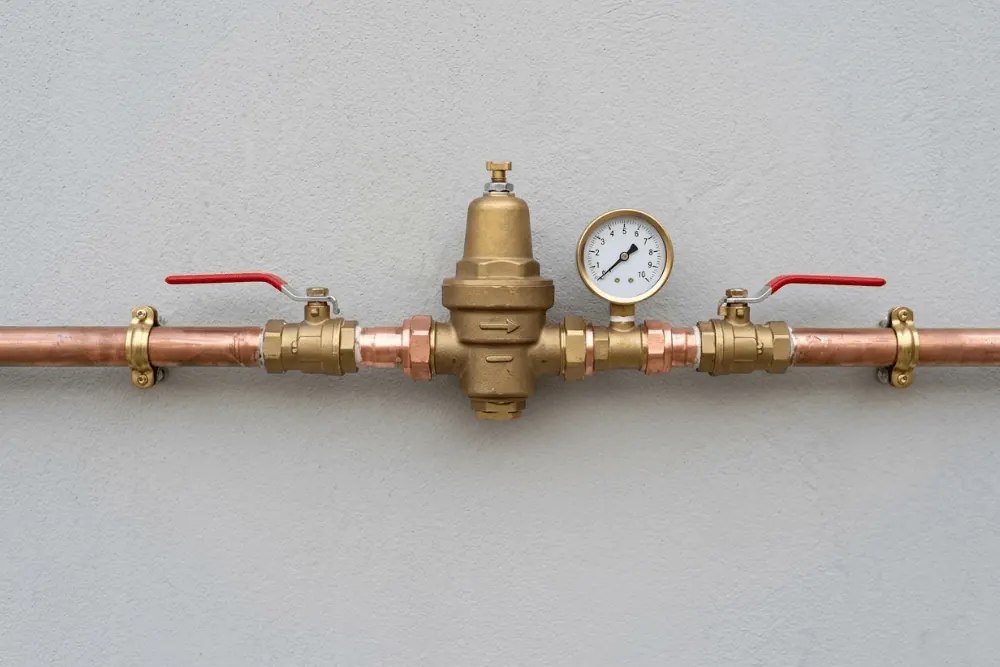
The check valve goes between the pump discharge flange and the isolation valve, so the check valve can be serviced with the isolation valve shut. In a horizontal line, a small drain valve goes downstream of the check valve and upstream of the isolation valve, so the section can be depressurised for maintenance.
Foot valves and borehole checks
A foot valve is a check valve with a strainer on its inlet, fitted at the bottom of a pump's suction line. It holds the prime so the pump does not have to refill the line each time it starts, and it is needed at the bottom of the well suction line in shallow and deep well jet pump installations. A check valve, by contrast, sits in the piping with threads or flanges on both sides and no strainer. A drop in system pressure or a pump that loses prime is a sign to check for a clogged strainer or a foot valve that no longer seals.
A pump on a suction line is a different job from the submersible pump in a borehole, which carries its own check valve on the delivery. The transfer pump page covers a pump moving water between tanks.
An NRV ahead of a water heater
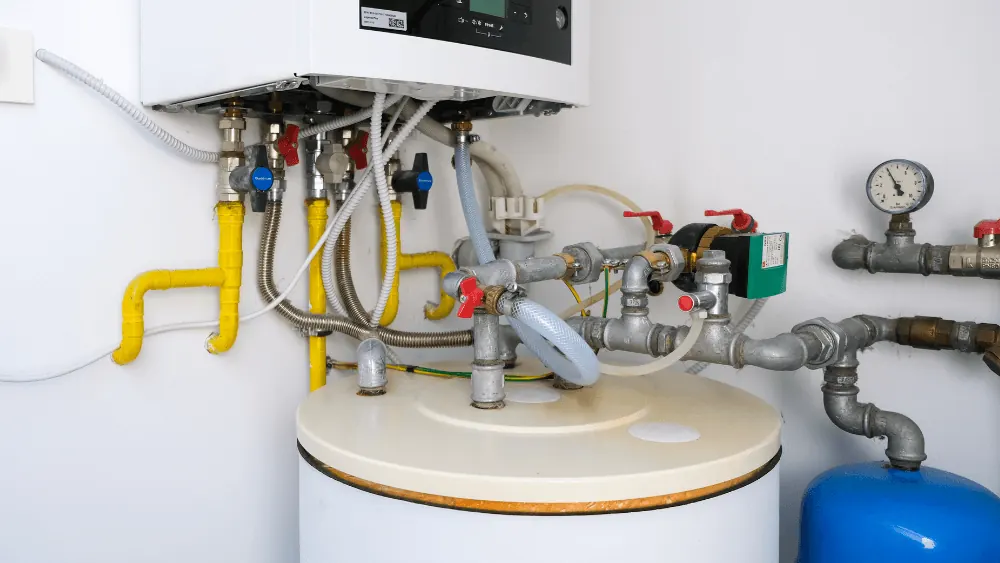
A one-way valve on the cold feed to a storage heater leaves heated water with nowhere to go. Check valves at the meter and pressure reducing valves can turn an open supply into a closed one, and in a closed system water has no room to expand as it heats, so the pressure can climb from the working pressure to the relief valve's setting with a rise of only a few degrees. The signs are a relief valve that drips after hot water use, creaking pipes and early failures. The pressure valves page sets out the figures and the expansion-tank remedy, and the backflow prevention page covers the check valve as drinking-water protection.
An NRV anywhere between the supply and the heater has the same effect as those valves, since it stops expanded water travelling back. It should not be the first thing blamed for a dripping relief valve, and it should not be taken out to cure one, because the cold-feed check may be the backflow protection described on the backflow page. See water heater repair for the heater itself.
Materials, ends and ratings
| Point | What to know |
|---|---|
| Bronze or brass | Common for small valves up to about DN50, with a metal or rubber seat. Suited to hot and cold water |
| Cast iron or ductile iron | Used for larger valves and pump discharges, with the pressure class marked on the body |
| Stainless steel | For aggressive water or hygiene duties |
| Plastic (PVC, CPVC, PP) | Light and corrosion-free. PVC is for cold water, and CPVC and PP for higher temperatures. Check the temperature rating |
| Pressure class | The body marks a class such as PN10 or PN16. It must be above the highest pressure the line can see, including the pump's shut-off pressure |
| Seat and seal | Rubber or metal. Rubber seals the best on clean water and wears on grit and heat |
| Ends | Threaded for small valves, flanged or wafer for large ones. The thread type matters when the valve meets a fitting |
The pipe fittings page has the rules on BSP and NPT, and the ball valve page records that a water-oil-gas marking does not make a valve gas-approved. For drinking water, ask whether the valve carries an approval for contact with drinking water.
Failure symptoms
| Symptom | Likely cause | What to do |
|---|---|---|
| Vibrating or chattering | Loose internal parts, low or sudden pressure drops, wrong installation or the wrong valve | Find the cause. Repair or replace loose parts, or replace the valve if it needs more pressure to crack than the system gives |
| Loud banging | Rapid closing after a sudden pressure change | Confirm the valve suits the job. Consider arresters, check for air pockets, or fit pressure-limiting valves |
| Unusual pressure changes | Reverse flow or surges. Debris or low pressure may be the cause | Clean the pipes and filters, check the system pressure against the cracking pressure, and consider a spring-loaded valve |
| Sticking | Debris, worn or corroded rubber parts, or a sticking ball | Remove debris and find where it came from. Replace the part or the valve |
| Leaking back | Seat seals, cracked housings or debris on the seat. Air leaking past the seal is bypass | Locate the leak before assuming the seat is at fault |
| Wear and damage | Age, corrosion, worn rubber parts, heat and incompatible materials | Match the valve to the cracking pressure and the fluid. Investigate wear that is excessive for the age |
Corrosion on a foot valve can cause it to leak or malfunction.
We do not give a fixed replacement interval for a valve in Dubai, because its life depends on the water, the pressure and how often it slams. Replace it on the symptoms above.
Common mistakes with non-return valves
- Fitting it backwards. The arrow shows the flow, and a valve in backwards stops the line or damages the pump.
- Choosing by pipe size alone. A valve sized to a large pipe but passing a small flow will chatter.
- A swing check on a vertical downflow. It will not close reliably.
- A spring valve on a gravity line with a cracking pressure higher than the head available.
- Removing it to stop a noise. A valve taken out to cure a bang leaves the pump to run backwards and the tank to drain, and the noise moves somewhere else.
- Using it as the only backflow protection on a line that needs a proper device.
- Forgetting to label it. A valve nobody can identify is replaced with the wrong one the next time.
Reading a pump room walk
A walk through a pump room is the quickest way to judge the state of the check valves. Look for a valve with its arrow still readable, no rust streaks at the joint and no drip at the body. Put a hand on the pipe after the valve when the pump stops: a tap or a shudder points to a late closing valve. Listen for a rattle while the pump runs, which points to a valve that is too large or too lightly loaded. Check the gauge after the pump stops to see how fast the pressure falls. A gauge that falls to zero in seconds points to a valve that no longer seals or a leak beyond it. We photograph each valve and note the findings on the same sheet as the records. See booster pump installation and repair.
NRV or full backflow preventer
A single non-return valve is a mechanical device, and it can fail by leaking back like any other. On a line where contaminated water could flow back into the drinking supply, a single check is not enough, and a proper backflow device that can be tested is the right answer. A garden tap, a pool top-up, an irrigation line, a boiler fill and a connection to a tank are all cases where we look at the hazard before we choose. For an ordinary pump discharge, a heater feed or an appliance line, a good NRV is what is needed. We tell you which you have and which you need. See backflow prevention.
Permission in Dubai: who decides on a valve
A pump discharge, a heater feed and a riser valve sit on pipework that belongs to the owner, the landlord or the building. The fuller account is on the repiping page.
- Building management. A riser, a tank room or a pump room shared with other units is the building's, so work that reaches it, or that needs the water shut off for other units, goes through building management.
Replacing a failed check valve in your own unit with the same type and size, in the same place, is maintenance and needs a message to the landlord. Adding a valve, changing the type on a shared pump or touching the riser is an alteration, and needs written consent in a rented home and the building's approval. Tell us what your building asks for and we work to it.
When the job is finished
Ask for these. They cost nothing to produce.
- The valve's markings, photographed before it is lagged or boxed in: maker, size, rating and the flow arrow.
- A photograph of the valve in place, showing the arrow against the direction of flow.
- The type and the reason: swing, spring, silent or foot, and why it suits the line.
- The orientation, with the datasheet line that allows it.
- A test that the valve holds, and the pressure at which it was tested. The test pressures that makers use are on the pressure testing pump page.
- The distance from the pump and the bends, measured and written down.
- FAM's workmanship warranty, in writing. The warranty runs for 30 days and covers our labour only. Parts carry the manufacturer's warranty only.
How we work
- You message us with a photograph of the valve, any marking on the body, the pump or pipe it sits on, and what you hear or see.
- We say what we think is needed, whether a repair, a replacement or a new valve, and whether it is work we do.
- We give a price in writing, with the valve and the work shown separately.
- Check permission. In a rented or managed property, ask the landlord or building management whether they need to approve this work before the visit.
- We check the line first: the flow, the pressure, the type of valve fitted and the direction of the arrow. The visit fee is AED 50 + VAT, credited if the work goes ahead.
- We fit the valve in the orientation its maker allows, with the arrow matched to the flow.
- We hand over the markings, the photograph of the arrow and the warranty.
Where we work in Dubai
We cover all of Dubai, including Dubai Marina, JBR, Downtown Dubai, Business Bay, Jumeirah Lakes Towers, Palm Jumeirah, Al Barsha, Jumeirah Village Circle, Dubai Hills, Mirdif, Deira and Al Quoz. See the full list of areas.
Testing an NRV in place
A non-return valve that has failed passes water backwards, and the symptoms are easy to miss. A simple test on a pump line is to stop the pump and watch the pressure gauge. If the pressure falls quickly to zero, water is running back through the valve or the line. If you close the valve after the NRV and the pressure holds, the NRV is leaking. If it falls with that valve closed, the leak is elsewhere.
A chattering or slamming sound when the pump stops points to an NRV that closes too late, or a spring type that suits the line poorly.
Replacing an NRV
Close the isolation valves on each side, relieve the pressure, and note the direction of the arrow on the body. Remove the old valve, clean the pipe ends, and fit the new valve with the arrow pointing with the flow. Use new seals. Open the valves slowly, check for leaks, and test the system under load. We give a fixed price on WhatsApp before we start. Prices exclude 5% VAT.
Records for a pump room
Keep a simple sheet in the pump room with the position and type of each NRV, the size, the date fitted and the date last checked. When a pump fails, the first question is whether the NRV is the cause. A record answers it in a minute, and a label on the valve shows the direction of flow.
NRV or no NRV: where one is needed in a home
A non-return valve is not needed everywhere, but in some places a home is better with one.
| Place | Why an NRV helps |
|---|---|
| After a booster or transfer pump | Stops water running back to the tank when the pump stops |
| Between the main and a roof tank line | Prevents the tank draining back into the mains in a pressure dip |
| On the cold feed to a storage water heater | Stops hot water expanding back into the cold line, with an expansion arrangement |
| Before a pressure tank | Keeps the pressure in the tank |
| On a borehole or well pump line | Holds the water in the rising main |
| At a washing machine or dishwasher inlet | Prevents wastewater being drawn into the supply |
In a place where the NRV makes the heater relief valve drip, an expansion vessel or a relief arrangement is needed. An NRV is not a fix for a bad design, and a valve fitted without thought can cause new problems. We look at the system as a whole and tell you whether one is needed. Prices exclude 5% VAT, and the price is fixed on WhatsApp before work starts.
How much does an NRV valve cost in Dubai?
- The valve. The price follows the size, the type, the material and the pressure rating. A silent or dual-plate valve costs more than a basic swing or spring check.
- The work. Removing the old valve, fitting the new one, testing and making good.
- What moves the price. The size, the type, the pressure rating, access, whether the water must be shut off for other units, and building approval.
We do not publish a starting price for this job. Send a photo on WhatsApp and we give you a fixed price before we start. Prices exclude 5% VAT.
NRV valve FAQs
Is an NRV the same as a check valve?
Yes. NRV is short for non-return valve, and check valve and one-way valve are the same thing. A backflow preventer is a different device, rated for a hazard level. See backflow prevention.
Which way does an NRV go?
With the flow arrow on the body pointing the way the water flows. If there is no arrow, the maker's datasheet shows the direction. Fitting a valve backwards stops the flow or, on some designs, causes pressure build-up and damage.
Can an NRV be fitted vertically?
It depends on the type. A swing check is made for a horizontal pipe, or a vertical pipe with the flow going up where the maker allows it, and a spring-loaded in-line type works in any orientation. The datasheet for the valve decides.
What is the cracking pressure of an NRV?
The cracking pressure is the smallest pressure difference across the valve at which it starts to open. A spring-loaded valve has one, usually a fraction of a bar, while a swing check opens at very low pressure. Choose a valve whose cracking pressure is well below what the pump or supply provides.
Why does my NRV bang or chatter?
A bang means the valve closes late, after the water has started to run backwards, so it needs a faster-closing type or an arrestor. A chatter means the valve is larger than the flow needs, or the pressure pulses, so it never settles. See water hammer arrestors.
How far from the pump should an NRV be?
As close to the pump discharge as practical, with a run of straight pipe before it. The maker's data gives the exact figure.
What is a foot valve, and is it an NRV?
It is a check valve with a strainer on the inlet, fitted at the bottom of a pump's suction line to hold the prime. A drop in system pressure is a sign to check for a clogged strainer. A check valve sits in the pipework and has no strainer. See submersible and borehole pumps.
How long does an NRV last?
There is no fixed life. In clean water a good valve lasts for years. Dirty water, scale and slamming from water hammer wear the seat and the spring. Replace it when it lets water flow back, chatters or slams. A simple test is to shut the valve downstream and watch whether the pressure on the pump side falls.
How much does an NRV cost in Dubai?
It depends on the size, the type and the rating, and on the work to fit it. Send a photo of the valve on WhatsApp and we give you a fixed price in writing, excluding 5% VAT.
Can a water NRV be used on a gas line?
No. A water, oil and gas marking on a valve is not a gas approval, as the ball valve page records. Gas pipework is not our work, and it is covered on the gas safety page.
Book an NRV valve visit in Dubai
Tell us what the valve sits on, what you hear or see, the marking on the body, the size, and whether you own or rent. A photograph of the valve and the arrow helps. We will identify the valve, say whether it is work we do, give you the options and a price in writing, and hand over the markings and the photograph of the arrow.
WhatsApp: +971 55 407 7427 · Request a quote
Visit us: Office 871, Oasis Mall, Al Quoz 1, Dubai, UAE
Related services: Valves overview · Ball valves · Valve repair and replacement · Pressure valves · Backflow prevention · Booster pump · Water hammer arrestor · Submersible and borehole pumps · Emergency plumber · how plumbing works in a Dubai home