
Valves in Dubai: what we do
- Repair and replacement. Stuck mains, leaking stems, valves that will not close and valves that will not open. See valve repair and replacement.
- Pressure control. Testing and replacing the regulator that keeps supply pressure at a safe level. See pressure reducing valves.
- Backflow protection. Check valves, vacuum breakers and air gaps at shattafs, hoses, tanks and appliances. See backflow prevention.
- Valves around other equipment. The isolation valve at a heater, the valves either side of a pump, the gate valve at a tank. See water heater installation, booster pumps and water tank installation.
- Choosing a valve. This page: types, sizes, ratings and materials.
- Supplying the valve. We supply and fit, and we also fit items you have bought.
- Emergency visits. We answer calls and send a plumber 24 hours a day, 7 days a week, and we do not promise an arrival time.
If water is escaping and you cannot stop it
Close the nearest valve upstream of the leak. If you do not know which that is, close the main. Our emergency plumber page covers the steps, and valve repair and replacement covers a main that will not turn, a stem that weeps, a valve that will not shut, and where valves should sit so you can isolate one bathroom and not the whole flat. A drip from a pipe beside the heater is on pressure reducing valves and water heater repair, and a dripping tap is on tap repair.
What a gate valve is and how it works
The handwheel turns a stem, the stem lifts or lowers the gate, and the gate sits against a seat on each side when closed.
- Body. Connects to the pipe by flanged, welded or screwed ends.
- Bonnet. Holds the moving parts and bolts to the body.
- Trim. The replaceable parts that touch the water: the stem, the gate (also called the disc or wedge) and the seat rings.
- Yoke, packing, gland, handwheel and bonnet gasket. The outer parts. The packing seals the stem where it leaves the body.
What it does well:
- It leaves the flow almost untouched when open. A gate valve has one of the lowest pressure drops of any valve type and is full bore when open, because the gate retracts completely out of the flow path.
- It suits fully open or fully closed duty. On a main, a tank outlet or a pump line that is rarely moved, it does the job for decades.
What it does badly:
- It is not a flow control. A gate valve is not suitable for throttling, because the high-velocity flow makes a partly open gate vibrate and chatter, which speeds up erosion of the gate and seat. A gate valve on a main, a tank or a heater is either fully open or fully closed, and a valve used to turn a flow down is the wrong valve or the wrong job.
- It is slow. It takes many turns to close, which is a protection against water hammer and a nuisance in an emergency.
- Its stem packing is where leaks start. Stem packing is the most common source of external leakage, so a weeping stem is a packing fault before it is a body fault.
- A non-rising-stem valve does not show its position. The next sections explain the difference.
Gate valve, sluice valve, wedge valve: the names
The table records what each name is used for in the trade.
| Name | What it refers to |
|---|---|
| Gate valve | The valve described above |
| Sluice valve | Another name for a gate valve, common in the water trade |
| Wedge gate valve | A gate valve whose gate is a wedge, pressed between inclined seats. The solid wedge is the common low-cost design |
| Parallel slide valve | A gate valve with a flat gate between parallel seats |
| OS&Y valve | A gate valve with an outside screw and yoke: a rising stem |
| NRS valve | A gate valve with a non-rising stem |
| Knife gate valve | A gate valve with a thin blade that cuts through solids, used for sewage and slurry |
A quote that says "sluice valve" is quoting a gate valve. A quote that says "gate valve" for a quarter-turn lever valve is quoting a ball valve under the wrong name, and is worth a question.
Gate valve types
By the stem: rising or non-rising
The stem decides how you read the valve and where it can go.
| OS&Y (outside screw and yoke, rising stem) | NRS (non-rising stem) | |
|---|---|---|
| Stem movement | The stem rises as the valve opens | The stem turns in place and does not rise |
| Position | Readable from the stem height | Needs an external indicator |
| Space | Needs headroom for the stem to rise | Compact, no extra height |
| Threads | Outside the body, away from the flow | Inside the body, in contact with the fluid |
| Maintenance | The exposed threads are easy to lubricate | Internal threads are harder to reach and inspect |
| Where | Above-ground piping | Buried, underground or confined spaces |
| Cost | Slightly higher, because of the longer stem and yoke | Lower |
A rising stem visibly rises as the valve opens, which is the quickest way to read its state. A valve in a ceiling void, a riser cupboard or a pump room where you will need to tell open from closed at a glance is easier to live with as a rising-stem valve or, better, a quarter-turn ball valve whose handle shows the position. A valve in a manhole or under a slab has the space constraint that suits the non-rising type. In a villa, a gate valve is often placed near the tank, sometimes in a separate chamber with a cover. Our valve repair and replacement page sets out the villa arrangement.
By the gate: wedge, parallel and knife
- Solid wedge. The most common and lowest-cost type, and it can be installed in any position. On a household water line it is the usual choice.
- Split wedge. Two wedge halves that align themselves to the seats.
- Resilient-seated. A gate valve with resilient seats, which seal better at low pressure.
- Knife gate. A thin, sharp-edged blade, with a limited pressure range. A knife gate belongs on a sewage or sludge line, which is plant and not a home. If a quote for a house fits one, ask what it is isolating.
Valve sizes decoded: inches, DN and the thread
A valve is sold by the size of the pipe it fits, and the size is a label, not a measurement. Valves are named in inches or in metric DN sizes, and neither is the pipe's outside diameter. A valve called 1 inch fits a pipe whose outside diameter is larger than an inch, because the label is a nominal size that dates from older pipe. A tape measure on a pipe therefore gives you the outside diameter, not the valve size, and you read from the diameter to the label. A pipe sold in millimetres needs the same step, because the valve is sold in inches or DN. If you are unsure, send us a photograph of the pipe with a ruler beside it, and we say which valve fits.
The thread is a second specification
Size does not fix the thread. Two thread families are common on small valves: a tapered thread that seals by wedging, and a parallel thread that seals with a washer or an O-ring. They look alike and do not seal together. Match the thread of the fitting the valve screws into, or say what the pipe is made of and let us match it. Thread and sealing detail is on our pipe fittings page.
Pressure ratings: what the number on the body says
A valve carries a pressure rating, often written PN followed by a number, which is the approximate rating in bar. The datasheet states the pressure rating and the temperature it applies to, and it is the document to ask for on a heater line.
A household supply is usually a few bar, so a valve rated well above that has a wide margin. The rating that needs checking is the temperature rating on a heater line, which our water heater installation page deals with, and the pressure the regulator is set to, which our pressure valves page deals with.
Brass, bronze, stainless steel or iron
| Material | What to know |
|---|---|
| Brass | The usual material for small valves. Good value, but some waters remove the zinc over time |
| Bronze | A copper and tin alloy, stronger against corrosion, used on larger and marine valves |
| Stainless steel | Corrosion-resistant and strong. Costs more and suits aggressive water or hygienic duty |
| Cast iron or ductile iron | Used on large valves in plant rooms and mains. Heavy, and can corrode from inside |
| Plastic (PVC, PPR) | Light, corrosion-free, for cold water and irrigation. Not for hot lines |
The failure that brass valves have
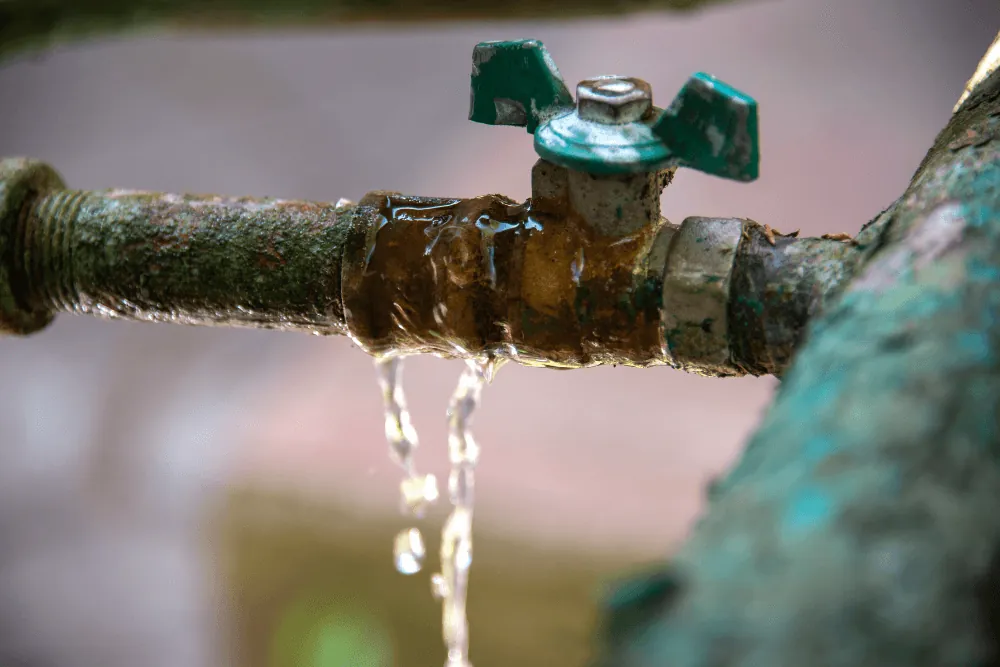
Brass is an alloy of copper and zinc, and some water removes the zinc. The affected layer ranges from green to red and resembles brass rust, and early signs are hard to catch because fittings are hidden. Once the damage is advanced the part has to be replaced.
The remedy is dezincification-resistant brass: DZR brass contains small amounts of arsenic or nickel that form a protective film. Valves marked "DZR" or "CR" are made against this failure. A valve you cannot see should be one that is rated against it, so we ask for DZR or CR marking on concealed valves.
Gate, ball, butterfly, globe or check: choosing the valve
The valves differ in how the closing element moves and what that does to flow, speed and wear.
| Valve | How it closes | What to know | Where it fits |
|---|---|---|---|
| Gate | A gate slides across the pipe | Low flow resistance, slow, multi-turn, not for throttling | Mains, tank outlets and pump lines on fully open or closed duty |
| Ball | A ball with a hole turns a quarter turn | Seals tightly, fast, the handle shows the position, not for throttling | Isolation at fixtures, branches, heaters and pumps |
| Butterfly | A disc turns a quarter turn across the pipe | Light and compact for large pipes, a little flow resistance even when open | Larger pipes, plant rooms and tank lines |
| Globe | A plug closes on a seat in a globe-shaped body | Controls flow well, but resists flow even when open | Throttling and flow control, not a main |
| Check (non-return) | Flow opens it and reverse flow shuts it | Stops water flowing backwards. Our backflow prevention page compares a check valve with a backflow device | After a pump, at a heater inlet, on an appliance line |
For the isolation valve at a fixture, a branch, a heater or a pump, a brass ball valve is our first choice, because it is a quarter turn and its handle shows whether it is open. We fit a gate valve where the design asks for one, such as a tank-side valve in a villa, and where a seized gate valve is being replaced like for like. We quote that work after seeing the plant.
Gate valve faults and what each one means
The faults of a gate valve follow from how it is built. Our valve repair and replacement page has the full repair-or-replace comparison and the steps for a seized main.
| Symptom | What to know | What we do |
|---|---|---|
| Water weeps from around the stem or handwheel | Stem packing is the most common source of external leakage | Packing replaced or tightened. If the stem is scored or the body corroded, the valve is replaced |
| The valve will not close fully, and water passes | Scale or debris on the seats, or a worn gate | Cycle gently to clear debris. If the seats are damaged, replace the valve |
| The handwheel spins and nothing moves | The stem has separated from the gate, often from corrosion or force | Replace the valve |
| The valve will not turn | Scale, corrosion or packing that has set | Do not force it. We free it gently, or replace it |
| Water at the body or bonnet joint | A bonnet gasket that has failed, or a cracked body | Replace the gasket, or the valve if the body is cracked |
Lapping and grinding the seats is difficult on a small gate valve, so a worn seat usually means a new valve. We give both prices on the visit.
Valves known by other names
Several valves are asked for by name. Each has a short answer.
- Lockable or key-type valve. A key-type isolation ball valve is operated with a removable key, and is tamper-resistant. It earns its place on a line that others can reach, such as a shared plant space or an irrigation supply.
- Regulator valve. A pressure regulator or pressure reducing valve, which is a different job from isolating. See pressure reducing valves.
- Washer valve. The washer valve in a tap. A drip from the spout is a tap repair. See tap repair.
- Check valve and non-return valve. The same thing. See backflow prevention.
- Buried or concealed gate valve. Non-rising-stem valves suit buried, underground and confined-space installations. A concealed valve is the one we ask to be DZR-marked, and the one to put on a valve map. See valve repair and replacement.
- Knife gate valve. A sewage and sludge valve, as above.
- Float valve. The filling valve in a tank or cistern. See water tank installation and toilet repair.
What to tell a shop, or us, when you need a valve
A valve that fits the pipe but not the job is the mistake to avoid. These are the facts that settle the order.
| Fact | Why it matters | Where to read it |
|---|---|---|
| Pipe size and material | Sets the valve size and the connection (screwed, compression, press, soldered) | The pipe, and the size table above |
| Thread family | Tapered and parallel threads are different and do not seal together | The fitting the valve screws into |
| Cold, hot or both | Sets the temperature rating. A heater line needs a valve rated for hot water | The datasheet. On a heater line, the heater's manual |
| Pressure rating (PN) | Must exceed the pressure the line sees, including the regulator's setting | The valve body or datasheet |
| Brass, bronze or DZR | Decides how the valve ages in water that attacks zinc | The marking on the body; "CR" or "DZR" if present |
| Stem type | Decides whether you can read the valve's position | Rising stem, non-rising stem or quarter-turn |
| Where it will sit | A valve in a ceiling void, a manhole or a riser needs access, a label and sometimes a lock | The visit |
| Suitability for drinking water | Valves on drinking water should be suitable for it | The datasheet |
Send a photograph of the old valve, its markings and the pipe either side on WhatsApp, and we will say what the replacement should be before you buy anything.
Permission in Dubai: who decides on a valve
A valve touches three parties: the water supplier, the building and the landlord. This is general information, not legal advice.
- The water supplier. The meter and the valves either side of it belong to the supplier's installation. We do not alter valves on the meter side without the supplier's agreement.
- Building management. In a flat, the building's risers and common valves belong to the building. Closing or replacing one affects other units, and we do not work on riser valves without management.
Where a valve job falls:
| Job | Starting point |
|---|---|
| Replacing a seized valve inside your flat or villa with a like-for-like valve | The landlord's responsibility by default. Tell the landlord in writing before the work |
| Adding branch valves or a valve map | An alteration. Written landlord consent |
| A valve on a riser or in a common shaft | Building management |
| Valves at the meter | The water supplier |
| Fire-system valves | The building's fire-protection arrangements. We do not work on fire systems |
We cannot say whether your building needs a certificate for a particular job. Building management can, and a request in writing is cheaper than a stopped job. Tell us what your building asks for and we work to it.
Warranty and the handover
What you should have when the job is finished:
- A written note of each valve fitted: type, size, material, pressure rating, thread, and its position in the system.
- The manufacturer's data sheet or label details for any valve on a heater line or a pump line.
- A label or a valve map showing which valve controls which part of the property, and the open and closed positions.
- Photographs of the valves before they are closed in.
- FAM's workmanship warranty, in writing. The warranty runs for 30 days and covers our labour only. Parts carry the manufacturer's warranty only.
How we work
- You tell us what is happening on WhatsApp: which valve, what it does, where it sits, and whether you own or rent. Photographs of the valve, its markings and the pipe either side save a visit.
- We visit, operate the valve, and find whether the fault is the packing, the seat, the stem or the pipe. The visit fee is AED 50 + VAT, credited if the work goes ahead.
- We give options and a price in writing, with what each option leaves untouched.
- Check permission. In a rented or managed property, ask the landlord or building management whether they need to approve this work before the visit.
- We replace or repair, isolate the supply upstream first, protect the surfaces and test the valve open, closed and under pressure.
- We hand over the written note, label the valve and show you which way is open.
Where we work in Dubai
We cover all of Dubai, including Dubai Marina, JBR, Downtown Dubai, Business Bay, Jumeirah Lakes Towers, Palm Jumeirah, Al Barsha, Jumeirah Village Circle, Dubai Hills, Mirdif, Deira and Al Quoz. See the full list of areas.
Fitting a valve so it can be used in an emergency
A valve that nobody can reach or understand is not much use at two in the morning. When we fit or replace one, we think about the person who will have to close it.
- Reach. The handle should clear the wall and the pipe by a full quarter turn, and a wheel should be reachable without a ladder where we can manage it.
- Label. A tag on the valve says what it controls, and the handle shows open and closed. For a household with several people, a printed map beside the main saves the first minute.
- Lock or key. Where the valve is in a shared space, a key-type valve stops it being opened or closed by mistake.
- Union and support. A union beside the valve lets the valve be changed later without cutting pipe, and a clip each side stops the pipe pulling on the valve body.
- Test. We close and open the valve twice with you watching, so you know how much turn it takes and which way is closed.
- Warn the household. We tell everyone who lives there where it is. A valve that only one person knows about is a single point of failure.
A valve walk-through for a villa
A villa has more valves than most owners realise, and knowing where they are makes a leak a small event.
| Valve | Where to look | What it controls |
|---|---|---|
| Main stopcock | Near the meter or where the supply enters the plot | The whole property |
| Roof tank inlet valve | On the roof beside the float valve | The refill of the roof tank |
| Tank outlet valve | At the base of the roof tank | The supply down to the house |
| Pump suction and delivery valves | In the pump room | Either side of the pump |
| Heater isolation valves | Above or beside the heater | The cold feed and hot outlet |
| Bathroom branch valves | In a cupboard or in the bathroom wall | One bathroom |
| Angle valves | Behind each toilet and under each basin and sink | One fixture |
| Garden and irrigation valves | In boxes in the ground or on the wall | The outside supply |
Go round once and label each valve, then open and close it fully and gently to check that it moves. A valve that has not moved in years may need freeing before an emergency, not during one. Photograph each label with its location and keep the photos on your phone. If a valve will not turn, do not force it with a long bar, because a snapped spindle turns a small job into a large one. Tell us which valve it is and we quote the repair or replacement, with the price fixed on WhatsApp before we start. Prices exclude 5% VAT.
How much do valves cost in Dubai?
Two prices make up the bill: the valve and the work.
- The work. Isolating the supply, removing the old valve, fitting and sealing the new one, testing, and making good.
- The valve. Its type, size, material and rating. A brass ball valve for a basin costs far less than a large flanged gate valve.
- What changes the price. How many need replacing, the access, and whether the supply can be isolated upstream or the building has to arrange it.
- The visit. The visit fee is AED 50 + VAT, credited if the work goes ahead.
We do not publish a starting price for this job. Send a photo on WhatsApp and we give you a fixed price before we start. Prices exclude 5% VAT.
Valve FAQs
What is the difference between a gate valve and a sluice valve?
Gate valves are often called water gate valves or sluice valves. A shop or a quote may use either name for the same valve: a gate that slides across the pipe. Ask for the size, the material and the pressure rating, which the name does not give.
Is a gate valve better than a ball valve?
They suit different jobs. A gate valve has very low flow resistance and is full bore when open, but it is slow, multi-turn, and unsuited to partial opening. A ball valve is a quarter turn and its handle shows the position. We fit a ball valve as our first choice for isolation and a gate valve where the design asks for one.
What does OS&Y mean on a gate valve?
Outside screw and yoke: a rising-stem gate valve. A non-rising-stem (NRS) valve has its threads inside and needs an external indicator.
What size gate valve do I need?
The size of the pipe, in the valve's own labelling. Measure the outside diameter of the pipe and we read across to the valve size, or send us a photograph with a ruler beside the pipe.
What does PN16 mean?
PN stands for pressure nominal, and the number is the approximate rating in bar, so PN16 is 16 bar. For a heater line, ask for the datasheet's temperature rating as well.
How much does a gate valve cost in Dubai?
It depends on the size, the material and the pressure rating, and fitting is separate. We do not publish a starting price. Send a photo on WhatsApp and we give you a fixed price before we start. Prices exclude 5% VAT.
Can I use a gate valve to reduce water flow?
No. A partly open gate vibrates and wears. Use a valve built for flow control, or fit a pressure reducing valve if the problem is high pressure.
Why won't my gate valve close fully?
Scale or debris on the seats, or a worn gate. Do not force it. If cycling does not work, the valve is opened and cleaned or replaced.
Should I choose brass or bronze?
Brass can lose its zinc in some water, and bronze is a different alloy that resists corrosion better and costs more. For a concealed valve we ask for DZR or CR brass.
Do I need my landlord's permission to replace a valve?
Adding valves is an alteration and needs written consent. Replacing a failed valve like for like is maintenance, and the landlord's by default. Tell the landlord in writing before you book. This is not legal advice.
Book a valve visit in Dubai
Tell us which valve it is, what it does, where it sits, and whether you own or rent. Photographs of the valve, its markings and the pipes either side help. If water is escaping, close the nearest valve upstream, or the main if you do not know which, and call. We will find the cause, give you the options and a price in writing, do the work and hand over a note.
WhatsApp: +971 55 407 7427 · Request a quote
Visit us: Office 871, Oasis Mall, Al Quoz 1, Dubai, UAE
Related services: Valve repair and replacement · Pressure reducing valves · Backflow prevention · Hoses and flexible connectors · Pipe fittings and connectors · Water heater installation · Booster pumps · Emergency plumber