
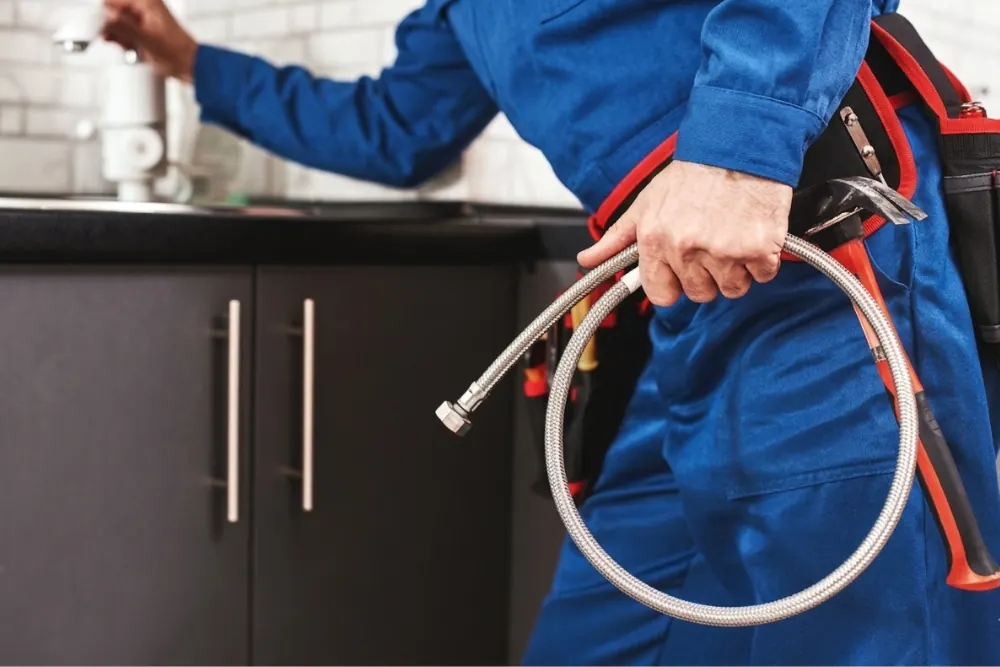
Flexible hoses in Dubai: what we do
- Inspection. We check every flexible hose in the property, both ends, the angle valve behind it and the floor under it.
- Tap and basin connectors. The pair of hoses under a mixer tap, in kitchens and bathrooms.
- Toilet and cistern hoses. The supply hose from the wall valve to the fill valve.
- Washing machine and dishwasher hoses. Inlet hoses, with the tap or valve they connect to.
- Water heater connectors. Hot-rated flexible connectors at the heater inlet and outlet.
- Shattaf and bidet hoses. Hoses, sprayer heads and the T-valve that feeds them.
- Angle valves. Replacing the small isolating valve behind a hose when it will not close.
- Replacement dates. We note the date on the hose so the next inspection has something to go on.
Neighbouring topics have their own pages. Thread types, sealing and the other fittings are on our pipe fittings page. Fixing a leak on rigid pipe is on our pipe leak repair page. Replacing old pipe is on our repiping page. Dripping taps are on our tap repair page, and cistern faults are on our toilet repair page. Isolation valves are on our valve repair and replacement page.
Why a hose fails suddenly
A hose is the one part of the system built to bend, so it is made of layers, and the layers age. Rubber loses its flexibility and cracks. The liner inside a braided hose can harden or split. The metal end fittings can corrode where water seeps under the crimp. Pressure surges when a washing machine valve snaps shut add a small fatigue load every cycle.
Three things set the risk in any building:
- The material. Plain rubber loses flexibility and cracks. Braided stainless steel resists bursting better, but still ages.
- The age. A hose with no date on it is a hose of unknown age.
- The shut-off. A hose that fails is stopped by the valve behind it. If the valve is seized, the only way to stop the water is to close the main.
A failed hose can release a lot of water. A split supply hose is under full line pressure and it runs until someone finds it, so a hose that bursts while the flat is empty can empty a tank into the floor.
In a Dubai flat there is a further factor: a burst hose does not stay in your flat. Water goes through the floor to the unit below. Liability for a leak into the flat below usually follows where the leak started and what the tenancy contract says. The point for a hose is practical: replace it before it becomes an issue between neighbours.
Which hose goes where
Hoses are named by where they go. Each has a different end, length and temperature duty.
| Location | What the hose does | What to know |
|---|---|---|
| Basin and kitchen mixer | A pair of short braided hoses from the angle valves to the tap tails | Usually a compression end at the valve and a threaded end at the tap. Replace the pair together |
| Toilet cistern | Connects the wall valve to the fill valve | Cold water only. The end at the cistern is often a plastic coupling that can crack if over-tightened |
| Washing machine | Inlet hose from the tap to the machine | Longer, with flat-washer ends. Often under pressure for days at a time |
| Dishwasher | Inlet hose from the valve to the machine | Some are double-walled or have a built-in shut-off that closes if the hose bursts |
| Water heater | Connects the heater inlet and outlet to the pipework | Must be rated for hot water and for the heater's pressure |
| Shattaf and bidet | Hose from the T-valve to the sprayer head | Carries supply pressure up to the sprayer head. See the shattaf section below |
| Shower | Connects the handheld to the wall outlet | Covered on our shower repair page |
Sizes differ between products, so the end sizes must match the tap, the valve and the fitting on the other side exactly. Universal connectors reduce sealing reliability over time. Thread details are on our pipe fittings page.
Braided stainless, rubber and plastic: what the hose is made of
A braided hose is a flexible inner tube inside a woven stainless steel jacket. The braid protects the tube against abrasion and kinking and helps it resist bulging. It is not the part that carries water, and it is not immortal.
Braided hoses can still burst. The braid is a better cage than plain rubber, but a braided hose is an upgrade and not a lifetime part. It fails differently from a rubber one: the first sign can be rust at the end fitting, a broken strand or a braid pulling away from the crimped ferrule, before any water shows.
The rating on the hose matters. A hose has a pressure rating and a temperature rating, and both should be read off the label or the datasheet. Many stainless braided hoses are made for hot water lines and for working pressures of several bar, with a test pressure well above that as a margin against surges. A hose with no marking cannot be checked. A cold-rated hose on a heater connection is the clearest mismatch.
PVC-braided hoses are for cold water and not for use near heat sources. A flood-stop or shut-off hose adds a valve that closes when the flow surges. For a washing machine or any hose left under pressure in an unattended flat, that feature is worth asking for.
Reading the numbers on a hose label
A hose label carries a pressure rating and a temperature rating, and different makers print them in different units, bar or MPa. Reading them against the pressure in your pipes is the check most replacements skip. One MPa is 10 bar, so a box that says 0.4 MPa means 4 bar. The pressure in your building is a number you can read with a gauge, and the hose has to be rated above it.
Look for these on the hose or its packaging:
- Pressure rating and whether it is a working or a burst figure.
- Temperature rating, and whether it is continuous or peak.
- Size and thread at each end.
- Material, including the liner.
- Water-contact approval, where a hose carries drinking water. Ask the supplier what approval a hose holds.
If a hose carries no rating, you cannot compare it with anything. If the shattaf box gives a rating below what your supply delivers, the box has the wrong rating for that bathroom.
How long does a hose last?
There is no single figure that fits every hose, because the life depends on the material, the pressure, the water and how often the hose is moved. As a working rule:
| Type | Our rule |
|---|---|
| Washing machine and dishwasher supply hoses, rubber | Replace every three to five years, and look at them monthly |
| Rubber fill hoses | About five years, even if they look fine |
| Braided stainless hoses | Inspect every year, and replace at about seven to ten years, sooner if the ends show rust or broken strands |
| Hoses on a water heater | Replace on any sign of deterioration, and on every heater replacement |
| A hose with no date | Treat as old and replace at the next visit |
None of these is a guarantee. Our approach is to combine age and condition. A hose is replaced at the end of its maker's stated life or, if there is none, on a conservative date, and sooner if it shows any of the signs below. Look for a date stamp near the fitting, and record the replacement date on the hose or in a log. We do the same.
A hose audit for a flat, villa or office
A property has more flexible hoses than most owners count. A list turns "check the hoses" into a task that can be done in ten minutes and repeated each year.
For a flat with one kitchen, two bathrooms, each with a basin, a toilet and a shattaf, a washing machine, a dishwasher and a storage water heater, the count is:
| Position | Hoses |
|---|---|
| Kitchen mixer | 2 |
| Dishwasher | 1 |
| Washing machine | 2 |
| Two basin mixers | 4 |
| Two toilet cisterns | 2 |
| Two shattafs | 2 |
| Water heater | 2 |
| Total | 15 |
The number is an example, and your property will differ. Write each hose, its position, its type, its date and its condition into a log. Fridge or ice-maker lines are extra.
A log has uses beyond maintenance.
- At tenancy start and end. A dated record of the hoses at handover helps settle whether a failed hose was old when the tenant moved in.
- For a building manager. One list per unit shows which hoses are due before the next summer shutdown, and which valves behind them need replacing.
- For an office or shop. Staff kitchens and washrooms have the same hoses, and the same log applies.
We can inspect every hose in a property, replace the ones due and leave a dated list.
Signs a hose needs replacing
Most of these can be seen with a torch and a minute under the sink.
| What you see | What it means | What to do |
|---|---|---|
| Cracks or a stiff, brittle hose | Rubber that crumbles or cracks when bent is past its life | Replace |
| Bulges or soft spots | The liner is failing and the hose is about to split | Replace now |
| Rust, green deposits or white crust at the ends | Water is seeping past the crimp or the washer | Replace |
| Broken strands in the braid | The braid is failing, so the liner is unsupported | Replace |
| Permanent kink creases | The inner tube has been bent past its limit | Replace |
| A hose with no date and no marking | Age and rating unknown | Replace at the next visit |
| Reduced flow at the tap | A kinked or partly collapsed hose, or a blocked aerator | Check the hose before blaming the tap. See low water pressure |
| Water on the floor of a cabinet after a washing cycle | Hose, valve or machine | Isolate the machine and check each end |
A simple routine: wipe both ends and the length of the hose dry, wrap a piece of dry kitchen paper round each connection, and look again after a few minutes. Paper shows a slow weep that a glance would miss.
What to do if a hose is dripping
- Close the valve behind it. If it will not close, see the section on angle valves.
- Check the washer. A small rubber washer seals the end of a flat-washer hose, and a worn washer is a common cause of drips.
- Do not over-tighten. More force can crush the washer or crack a plastic coupling.
Do not wrap tape round the end of a hose to stop a drip. A hose with a flat washer seals on the washer, not the thread, and tape in the way can prevent the washer from seating. The reason is explained on our pipe fittings page.
The angle valve behind the hose
A hose is only as safe as the valve behind it. The small isolating valve in the wall or under the basin is the one you close to change a hose, and the one you close in an emergency. If it is stuck open, the whole flat's water has to go off instead.
We fit one when we replace a hose behind a seized valve, because a new hose behind a valve that will not close has the same emergency problem as the old one. See valve repair and replacement.
Check yours now: turn each angle valve under the sinks and behind the toilet to the closed position and back. If it does not move, or drips at the spindle when it moves, tell us before the hose fails. Do not force a seized valve.
How we replace a flexible hose
- Close the valve behind the hose, or the main if the valve will not close.
- Relieve the pressure by opening the tap, and catch the residual water.
- Note the ends. Which end goes to the valve, which to the tap or appliance, and which thread each has.
- Remove the old hose without twisting the pipe or the valve.
- Match the new hose to both ends, the length, the temperature and the pressure rating. The hose maker's minimum bend radius is on the datasheet.
- Seat the washers. Make sure the rubber washers are seated. A flattened or missing washer is replaced, not reused.
- Hand-tighten, then a part turn with a spanner. Enough to seal and no more.
- Turn the water on slowly and check both ends. We check again for dripping after the system has been used.
- Mark the date on the hose, and replace both hoses of a pair together, since they age at the same rate.
Where a flexible connector joins a rigid pipe through a threaded adapter, the thread and sealing details are on our pipe fittings page.
Washing machines and dishwashers
A washing machine and a dishwasher take water under pressure through a valve that opens and closes electrically. The rapid pressure change when the solenoid valve shuts gradually weakens rubber hoses, and many machine manuals say to turn the taps off when the machine is not in use.
Practical rules:
- Close the machine's taps when it is not in use. A hose left under pressure is a hose under load.
- Check behind the machine when it is moved. Hoses that were kinked or pinched against the wall are a failure waiting to happen.
- Measure before you buy. Most machine hoses are 1.5 to 2 metres. Measure from the wall valves to the machine inlets, with a little slack.
- Hot and cold are different hoses. A hot supply to a washer or dishwasher needs a hose rated for it.
Check your own machine's manual for its supply. If the dishwasher end has a 90 degree elbow, the washer inside it is the usual drip point.
Shattaf and bidet hoses
A shattaf is a handheld sprayer for personal hygiene. It is fed from the cold supply through a T-valve, and the hose runs from the T-valve to the sprayer head.
That arrangement has three consequences for the hose.
- It is a supply line. The hose is connected to the mains supply through the T-valve. When the sprayer is closed, the hose still carries supply pressure up to the sprayer head, so a split hose floods like any other supply line.
- Pressure rating. Check the pressure rating on the box against the pressure your supply delivers. If the supply is higher than the set is rated for, a pressure-reducing valve is the fix. See pressure valves.
- Wear points. A hose handled daily is flexed at both ends, at the sprayer head and at the T-valve. Check both for cracks, corrosion and weeps. A cracked hose, a weep at the sprayer head or a leak at the T-valve is replaced, not taped.
We replace shattaf hoses, sprayer heads, T-valves and holders. A separate isolation valve on the shattaf feed means the sprayer can be shut off without stopping the cistern.
If a hose has burst
- Shut off the water. Close the angle valve, then the machine's tap, then the flat's main. Know where your main is.
- Switch off electricity in a wet area if water is near sockets or appliances, and do not step into standing water near live electrics.
- Photograph everything before cleaning: the burst hose, the floor, the walls, the ceiling below.
- Tell building management and the neighbour below, so they can check their ceiling.
- Keep the burst hose. It shows the break, the label and the age.
- Dry the area and WhatsApp us to replace the hose and the valve. Water damage inside walls and ceilings is on our ceiling and wall leak page.
- Check your insurance. Read your own policy wording, including contents cover for a tenant.
Who pays
Liability turns on where the leak started and what the tenancy contract says. A common first step is to ask building management to contact the owner of the unit where the leak started, and to check whether either side has insurance that responds. This is general information and not legal advice.
Mistakes to avoid
- Reusing a flattened washer. A worn washer is a common cause of drips.
- Tape on a washer-sealed end. The washer is the seal.
- A hose too short and under tension, or one coiled tight behind a machine. Leave slight slack and no kinks.
- A cold-rated hose on a hot line. PVC braid is for cold water and not for use near heat sources.
- A new hose on an old, seized valve. The valve is replaced with the hose.
- Leaving the machine's tap open while away.
Buying hoses yourself
If you are replacing a hose, bring or note these details.
- Where it goes. Basin, kitchen, toilet, washing machine, dishwasher, heater or shattaf.
- Both end types and sizes. Thread size and whether the end is flat-washer, compression or cone.
- Length. Measure the route the hose will take, with a little slack.
- Hot or cold. And the temperature rating.
- Pressure rating. On the label or the box.
- Material. Braided stainless steel for most positions, with the liner type noted.
- The washers. Included, and the right size.
- The old hose. Take it with you, or a photograph of both ends.
If the label is missing or unreadable, do not rely on it.
Flexible connectors on pumps and tanks
Flexible hoses are not only under sinks. A booster pump, a transfer pump or a pressure vessel is often joined to the rigid pipework by short flexible connectors, because they take up vibration and small misalignment and stop the noise travelling down the pipe. They are under pressure all day, so they age faster than a hose under a basin. Look at them with the pump running: a hose that shivers visibly, a weep at the end, rust on the braid or a bulge near the pump end means it is due. Replace both connectors of a pump together, with a hose rated for the pump's working pressure, and keep the bend gentle so the pump is not pulling on the pipe. A pump that vibrates hard may have a worn bearing or a loose mounting, and a new hose will not cure that. See booster pump and transfer pump.
Hoses behind built-in appliances and vanity units
The hoses that fail without warning are the ones nobody can see. A washing machine or dishwasher built into a cabinet, a vanity unit with a solid back and a toilet with a boxed-in cistern all hide the connections. If a hose cannot be reached without taking the unit apart, it will not be checked, and the first sign of a failure is a wet floor or a stain on the ceiling below. When we fit or replace a hose in a hidden position, we ask for a removable panel or a small access hatch and a shut-off valve you can reach. A kitchen refit is the cheapest time to put those in, and a note on the handover says where they are.
Before you go away
A flat or villa left empty for a week or more is where a hose does the most damage, because it can run for days before anyone notices. Before a holiday, close the angle valves behind the washing machine and the dishwasher, and if the building allows, close the flat's main. If you cannot close the main, ask a neighbour or the building's security to look in. Replace any hose that is old, hard or unmarked before you leave, not when you return. A fixed price on WhatsApp and a visit the day before travel is a quicker job than a ceiling to repair. See ceiling and wall leak.
Where we replace flexible hoses in Dubai
We cover all of Dubai, including Dubai Marina, JBR, Downtown Dubai, Business Bay, Jumeirah Lakes Towers, Palm Jumeirah, Al Barsha, Jumeirah Village Circle, Dubai Hills, Mirdif, Deira and Al Quoz. See the full list of areas.
A short guide to hose lengths and bends
A flexible hose is not a rope. It has a minimum bending radius, and a hose bent tighter than that kinks, restricts the flow and cracks at the fold. When a hose is chosen, leave a gentle curve, not a tight loop or a straight pull.
- Too short: the hose is stretched, the connections are pulled and the nut loosens.
- Too long: the hose lies in a coil, folds on itself and may be crushed by a door or a drawer.
- Twisted: a hose that is twisted when fitted tries to untwist and loosens the nut. Fit it with the hose hanging free.
- Rubbing on a sharp edge: the braid or cover is worn through. Route it clear.
- Hot surfaces: a hose next to a heater or a pipe carrying hot water ages quickly.
Questions people ask about hoses
How many hoses are in a typical flat? More than people think: a hose for each basin and kitchen tap (often two each), one for each toilet, one for each shower, one for the water heater (two), one for the washing machine (two), one for the dishwasher and one for each filter. In a flat, that is easily twenty hoses, each a possible leak.
Does the colour mean anything? On many hoses, a red or blue ring marks hot or cold. It does not show the quality.
Is a longer hose better because it is more flexible? No. A longer hose has more length to fail and can hold a kink. Use the shortest that fits without strain.
Can I reuse a hose when I move a tap? Only if it is sound and the right length. A hose that has been bent and kinked once is weaker than a new one. Replace it. It is the cheapest part.
A yearly check
Once a year, look at every hose in the property. Look for rust at the nuts, bulging or cracking, damp at the ends, and a stiff or flattened cover. Photograph each and note the date printed on them. Replace those past their date or in doubt. Our price for hose replacement is fixed on WhatsApp before we start, and prices exclude 5% VAT.
How much does it cost to replace flexible hoses in Dubai?
The price follows the number of hoses and what sits behind them.
- Call-out and inspection. A visit to check every hose and valve. The visit fee is AED 50 + VAT, credited if the work goes ahead.
- The hoses. Number, length, material and rating. A hot-rated or flood-stop hose costs more than a basic one.
- Valves. An angle valve replaced behind a seized one.
- Appliances. Moving a washing machine or dishwasher to reach the connections.
- Shattaf work. A T-valve, a new set or a repositioned holder.
We do not publish a starting price for this job. Send a photo on WhatsApp and we give you a fixed price before we start. Prices exclude 5% VAT.
Flexible hoses FAQs
How often should I replace flexible hoses?
As a rule, every three to five years for rubber hoses and seven to ten for braided stainless, and sooner if a hose bulges, cracks, corrodes at the ends or leaks. Put a date on the hose. A hose of unknown age should be treated as old.
Is a braided stainless hose better than rubber?
For most positions, yes. The braid resists bursting and kinking better than plain rubber. It costs more, and it still ages, so it still needs a date and a check.
Can a braided hose burst?
Yes. The braid protects the liner, but the liner and the crimped end fittings can still fail. Rust at the ends, broken strands and a braid pulling from the ferrule are warning signs. Replace on those signs and on age.
What size hose do I need?
The size follows the tap, the valve and the fitting at each end. Typical sizes for kitchen taps and toilets are BSP 1/2 inch or 3/8 inch. Send us a photo of both ends, or bring the old hose, and we will match it.
Can I replace a hose myself?
A like-for-like swap is a simple job if the angle valve closes properly and you match the ends and the washers. If the valve is seized, the hose is on a heater, the ends are different from the old hose, or the connection is behind a fitted appliance, WhatsApp us. Forcing a seized valve is how a small job becomes a leak.
The hose still drips after I tightened it. Why?
The washer may be worn, flattened or missing, or the end may be damaged. Further tightening can crush the washer or crack a plastic coupling. Replace the washer or the hose. Do not use tape on a washer-sealed end.
Which hose is right for a water heater?
One that is rated for hot water and for the pressure at the heater. Check the rating on the hose. Faults at the heater itself are on our water heater repair page.
Can you replace a shattaf hose?
Yes. We replace the hose, the sprayer head, the T-valve and the holder. Check the set's pressure rating against your supply.
Who pays if a hose bursts and floods the flat below?
It turns on where the leak started and what the tenancy contract says. Photograph the damage, tell building management, read your policy, and keep the burst hose. This is not legal advice.
Do you supply the hoses, and which brands do you use?
Yes. We supply and fit, and we also fit hoses you have bought. We choose the brand to suit the position, the pressure and the temperature, and we tell you what we have fitted.
Book a flexible hose replacement in Dubai
Tell us where the hoses are, how old they are if you know, and whether anything is dripping or corroded. A photo of both ends and of the valve behind helps. We will send a plumber to inspect every hose, replace the ones that need it and fit new valves where the old ones will not close.
WhatsApp: +971 55 407 7427 · Request a quote
Visit us: Office 871, Oasis Mall, Al Quoz 1, Dubai, UAE
Related services: Pipe fittings · Valve repair and replacement · Pipe leak repair · Tap repair · Toilet repair · Water heater repair