
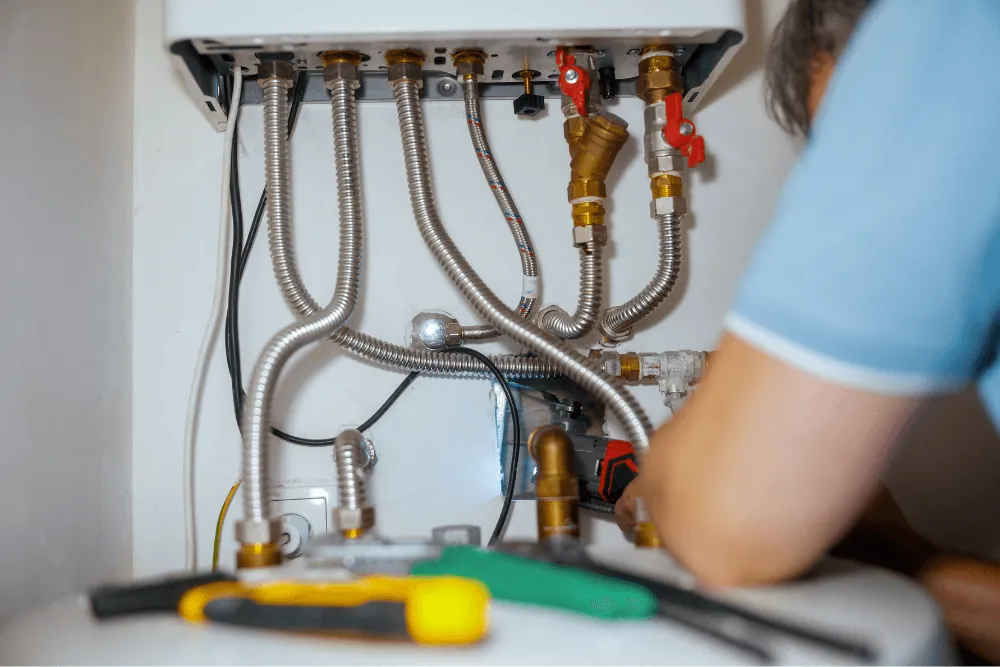
Boiler repair in Dubai: what we do
- Diagnosis. No hot water, a boiler that locks out, low pressure, leaks, noise, a relief valve that discharges, and error codes.
- Pump, valve and control repairs. Circulation pumps, zone and diverter valves, thermostats, sensors and control boards.
- Scale and water-side work. Descaling and flushing of the heat exchanger and the storage cylinder, and the water test that shows why it scaled.
- Servicing. The visual, safety, water-side and combustion checks set out below, on a written record.
- Replacement of a failed boiler, cylinder or pump, and advice on whether repair is worth it.
- Gas-side work is not ours. FAM does not do gas work, and we pass it to your gas supplier or a licensed gas contractor.
Neighbouring topics have their own pages. Electric storage heaters are on water heater repair, and their elements on element and thermostat replacement. Valves, relief lines and scald settings are on water heater installation. Instant, solar and heat pump units are on tankless water heater, solar water heater and heat pump water heater. Gas supply work is on gas safety, and scale on water softener and water testing.
What counts as a boiler here
A boiler heats water in a closed vessel with a burner or an electric element and sends it on, either to a storage cylinder or straight to the taps. In Dubai, boilers are mostly found in villas, compounds and commercial premises, where they serve a cylinder or a central hot water circuit. Most flats use an electric storage heater instead, which is covered on our water heater repair page.
How a hot water boiler works
The parts differ by make and fuel, and your boiler's manual describes your boiler.
| Part | What it does | What it means for faults |
|---|---|---|
| Burner (gas) or element (electric) | Makes the heat | A burner that will not light or stay lit is an ignition fault. An element fault is covered on our element and thermostat page |
| Heat exchanger | Passes the heat to the water | Scale on it makes the boiler noisy, slow and inefficient |
| Circulation pump | Moves hot water round the cylinder or circuit | A failed pump gives a hot boiler and cold taps |
| Diverter or zone valves | Direct the heated water to the cylinder or the circuit | A stuck valve sends heat the wrong way |
| Expansion vessel | Absorbs the growth in water volume as it heats | A failed vessel makes the pressure jump and the relief valve discharge |
| Thermostat, sensors and control board | Hold the temperature and switch the boiler off when something is wrong | A faulty sensor gives lockouts or no heat |
| Relief valve | Opens if pressure or temperature goes too high | A valve that discharges is reporting a fault. Never plug it |
| Storage cylinder | Holds the hot water | A corroded cylinder leaks and is replaced, not repaired |
What the symptom points to
Our water heater repair page has the fault list for an ordinary storage heater, and this table is the boiler side.
| What you see | What to know |
|---|---|
| No hot water | A faulty pilot light, leaks or low pressure. Check pressure and thermostat first, then call an engineer |
| The boiler locks out | A lockout is a safety shutdown. Causes include a flame-sensor fault, a blocked flue or condensate pipe, insufficient fuel and incorrect pressure |
| Pressure drops | A recently bled system, a system off for a long time, or a leak. A sudden drop signals a leak, and topping up in that case does not help |
| Banging or whistling (kettling) | Limescale, a faulty thermostat, overheating, low pressure or leaks |
| Gurgling | Trapped air |
| Water leaking | Old corroded washers or other worn parts. A trained engineer must open the boiler |
| Relief valve discharging | Over-pressure or overheating |
| An error code | Manufacturer-specific. Check the manual |
Error codes and resets
Codes differ by make, so a code means what the manufacturer says it means. An overheating code means a safety device has acted, and we find out why before the boiler runs again. Pressing the manufacturer's reset once, as the manual allows, is reasonable. A boiler that locks out again is telling you something, and resetting it again and again hides the cause.
Pressure figures
A sealed system works at a set pressure when cold, shown on the boiler's gauge, and the manual gives the figure for yours. A reading lower than that may indicate a problem. The pressure rises a little as the water heats, and it should settle back when cold.
Separate a slow drop after the system has been bled from a sudden one. A sudden drop signals a leak, and topping up in that case does not help. In both cases a leak that continues needs an engineer. We do not ask owners to adjust a boiler's pressure.
Gas, flues and carbon monoxide
A gas boiler adds a fault that no electric heater has: incomplete combustion, which produces carbon monoxide. Carbon monoxide has no smell. Headaches, dizziness, nausea, tiredness and confusion while a gas appliance is running are warning signs.
A boiler in a cupboard or a plant room that shares air with a bedroom, kitchen extractor or bathroom fan needs its air supply and flue checked together. If anyone has these symptoms and the boiler is running, switch it off, go outside into fresh air and call the emergency services.
Gas work and pressure vessels
FAM does not carry out gas work. Gas supply and gas-side repairs go to your gas supplier or a licensed gas contractor. See gas safety.
A large central boiler is a pressure vessel, and whether it needs an inspection certificate, and how often, is a question for the building's management, your consultant or your insurer. What we do on a service:
- Read the boiler's data plate for its working pressure, capacity and any certificate or registration number.
- Ask the building's management whether the boiler has an inspection certificate on file, particularly for a central plant that serves more than one unit.
- Test the relief valve and the safety controls on every service.
- Record what we find on the handover note, so an inspector or a facility manager can see it.
Hot water temperature and scalding
A boiler and its cylinder hold heat, and the temperature they hold it at pulls two ways. Stored water that is too cool is not safe to leave sitting, and water that is too hot scalds a child in seconds. The usual answer is to store the water hot and deliver it mixed through a thermostatic mixing valve, with no long dead legs where water sits. Water that is stored warm, or a cylinder that is rarely used, is the case to watch, and we set the stored temperature on the visit and write it on the note.
The valves are on our water heater installation page and the lost heat in long hot pipes on pipe insulation. Pressure and relief valves are on pressure reducing valves.
What a service checks, and how often
| What a service covers | How often |
|---|---|
| Visual check for damage, corrosion and leaks, with the casing off. Controls, electrics and venting. Heat exchanger connections | Once a year, and the manufacturer's interval takes priority |
| Safety devices. Relief valve, high-limit control, thermostat and the expansion vessel pressure | At every service |
| Water side. Scale, corrosion, the cylinder and the circulation pump | Every year, and more often in hard water or heavy use |
| Combustion (gas boilers). Flame, flue and air supply, with readings recorded | Every year, by a licensed gas contractor |
A manufacturer's interval governs a warranty, and the boiler's load and water govern the rest, so we set the first interval from the visit and write the next date on the handover note.
Repair or replace
A repair is worth it when the fault is a part, such as a pump, a valve or a sensor, in a boiler that is otherwise sound. Replacement is worth comparing when the boiler is old, scaled and failing repeatedly, or when parts are no longer available. A newer high-efficiency boiler burns less fuel for the same heat. An electric boiler turns almost all its power into heat, but electricity usually costs more than gas where gas is available. We do not quote a running cost or a saving without knowing your fuel, tariff and use.
When a repair is not worth it:
| Situation | Our view |
|---|---|
| A scaled heat exchanger or cylinder | Descale, test the water, and add treatment if the test calls for it |
| A corroded cylinder or boiler shell | Replace, since a corroded pressure vessel is not a part repair |
| A repeated lockout with no found cause | Find the cause before spending on parts. A reset hides it |
| A boiler that cannot be serviced because its parts are unavailable | Compare replacement. We ask for the part lead time first |
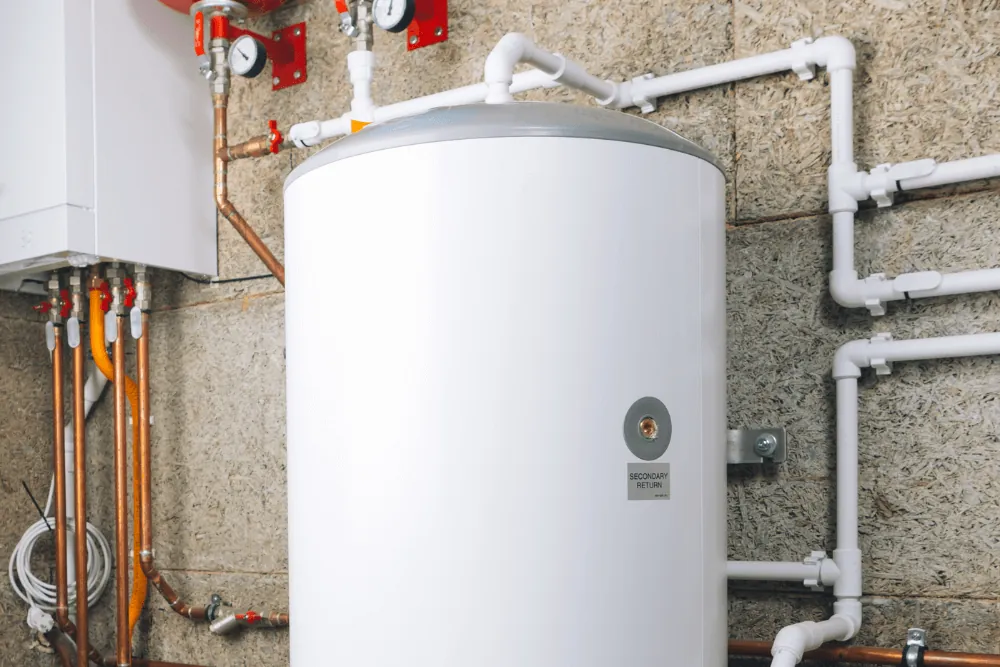
Permission in Dubai: who decides on boiler work
Repairing a boiler in a rented flat or villa is maintenance, and replacing it or changing its fuel, flue or position is an alteration. This is general information, not legal advice. Tell us what your building asks for and we work to it.
| Job | Starting point |
|---|---|
| Repairing a failed pump, valve, sensor or control board | A repair. The landlord's responsibility by default, unless your contract says otherwise. Tell the landlord first and get the decision in writing |
| Descaling and servicing | Maintenance. Who pays follows the contract |
| Replacing a boiler with the same fuel, size and position | Ask the landlord, since the cost is larger than a repair |
| A shared or central boiler serving several units | Building management or the owners' association, not an individual tenant |
The circulation pump: air locks, noise and bearings
The pump moves hot water round the cylinder or the circuit, so when it fails the boiler heats while the taps stay cold. The common pump faults are an air lock, where the pump spins in a pocket of air and moves nothing, a seized or worn bearing that makes a grinding or humming sound, and a blocked impeller from scale or debris. An air lock is cleared by bleeding the pump at its vent screw, which is quick. A pump that hums but does not turn is seized, and the repair is a new pump, not a stronger one. We check that the replacement matches the old pump's flow and head, and that it is fitted with its isolation valves so the next change is easier.
The expansion vessel
Water grows when it heats, and the expansion vessel is a small tank with an air cushion that takes the extra volume. When the cushion loses its charge, the pressure jumps as the boiler heats and the relief valve opens. To test it, the system is cooled and the vessel's air valve is checked with a gauge against the pressure on its label. If the vessel has lost its charge it can often be topped up with air, and if its membrane has failed, water comes out of the air valve and the vessel is replaced. A relief valve that weeps every time the boiler heats is more often a vessel fault than a valve fault.
The cylinder and its anode
A storage cylinder corrodes from the inside, and many carry a sacrificial anode, a rod of softer metal that corrodes first so the tank does not. A worn anode is replaced. A cylinder that already leaks from the shell is not repaired, because a corroded pressure vessel is replaced. Brown or rust-coloured hot water with clear cold water points to the cylinder or the pipes beyond it, and it is a reason to have the tank looked at. If your cylinder has an anode access point, we check the anode at a service, and tell you when it is nearing the end.
The relief valve and its discharge pipe
The relief valve opens if the pressure or temperature goes too high, and its discharge pipe carries the water or steam to a safe place. The pipe must run downhill, must not be reduced in size and must never be capped or blocked, because a boiler with a blocked relief line has no protection. If you find the pipe has been plugged, or the valve has been replaced by a plain fitting, tell us at once. A valve that has discharged once and reseated is reporting a fault, and we find the cause. A valve that never reseats is replaced.
Waiting for hot water in a villa
In a large villa the boiler and cylinder may be far from the taps, and the long pipe between them holds cold water that has to run off before hot arrives. A return loop with a small pump keeps the hot water moving so it arrives quickly, at the price of heat lost from the loop all day, which is why the loop's pipes should be insulated and its pump put on a timer. If the wait for hot water has grown longer, the return pump may have failed or its check valve stuck. See pipe insulation for the pipes, and water heater installation for how the loop is connected.
Warranty and the handover
What you should have when the job is finished:
- A written note of what was found, what was changed, and the part numbers.
- The readings. System pressure before and after, the relief valve test result, and for a gas boiler the combustion and flue readings where they were taken.
- The settings as found and as left: stored temperature, outlet limit and any control settings.
- The old part, if you want to see it. It is the best evidence of the cause, and a part that failed the same way twice points to the water or the installation.
- The next service date and what that service will cover.
- The part's warranty terms. These are the manufacturer's or the supplier's, and not ours.
- FAM's workmanship warranty, in writing. The warranty runs for 30 days and covers our labour only. Parts carry the manufacturer's warranty only.
How we work
- You tell us what the boiler is doing, and send photos of the boiler, its data plate, any error code and the pressure gauge on WhatsApp.
- We visit and make the boiler safe first: gas isolated if there is any smell, carbon monoxide questions asked, and the electrical supply isolated before the casing is opened.
- We diagnose. We check the controls, the pump, the valves, the relief valve, the expansion vessel and the water side, and for gas the flame, the flue and the air supply, recording each reading.
- We tell you what failed and why, and whether the cause is a part, the water or the installation.
- We give options and a price in writing, including whether repair is worth it.
- Check permission. In a rented or managed property, ask the landlord or building management whether they need to approve this work before the visit.
- We repair or replace, test the safety devices, and hand over the written note.
Where we work in Dubai
We cover all of Dubai, including Dubai Marina, JBR, Downtown Dubai, Business Bay, Jumeirah Lakes Towers, Palm Jumeirah, Al Barsha, Jumeirah Village Circle, Dubai Hills, Mirdif, Deira and Al Quoz. See the full list of areas.
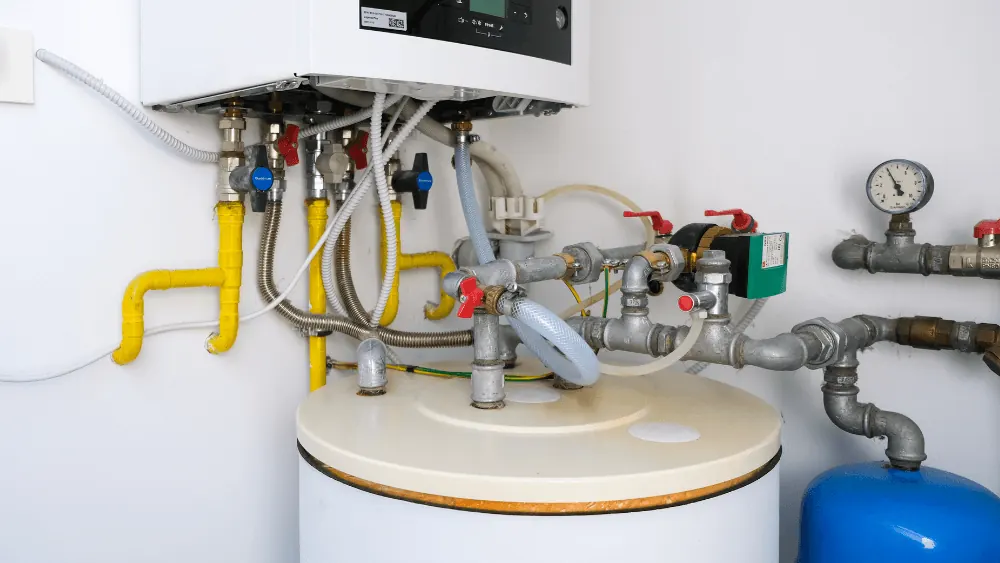
A fault, step by step: no hot water from a boiler
When a boiler stops giving hot water, a calm order of checks saves time and avoids unsafe guesses.
- Is there power? Check the switch, the isolator and the breaker. A tripped breaker that trips again as soon as you reset it is not something to keep resetting.
- Is the boiler showing a code or a light? Photograph the display. The code tells us more than a description does.
- Is the pressure gauge in range? Many sealed boilers need a pressure within a band set by the maker. A low reading with a wet floor beneath the boiler points to a leak.
- Are the taps or the radiators cold? If the radiators or the coil are hot but the taps are cold, the fault is in the cylinder or the mixing, not in the boiler.
- Is the room cold or the supply low? A boiler that runs and gives lukewarm water may be scaled, undersized for the demand, or running at a low set point.
- Is anything leaking? Look at the pipework, the pressure relief outlet, the base of the boiler and the wall behind it.
If steps one to six do not give an answer, send us the photos and the make and model, and leave the boiler off if you smell gas or see soot, scorching or a yellow flame. For any gas smell, leave the building and call 997. We do not carry out gas work.
Scale and kettling in a Dubai boiler
Dubai's water is hard in many supplies, and a boiler that heats it every day collects scale on every hot surface. Scale does three things. It insulates the heat exchanger so the boiler works harder for the same output. It narrows pipes so flow drops. It breaks off in pieces and blocks valves and sensors.
The signs build slowly. The boiler takes longer to heat. A kettle-like rumble starts as water boils in the scaled passages. Fuel or power use creeps up. A thermostat reads high at the heat exchanger and cuts out, even though the taps are only warm.
The heat exchanger and the cylinder are cleaned by the method the manufacturer allows, and we do not use a strong chemical clean on a hot water boiler without its manual. The water test shows whether the cause is the water: see water quality testing, and water softener for scale treatment. What helps is regular descaling by a competent person, a lower set temperature where the use allows it, and a water treatment device where the water is very hard. A lower set temperature slows scale formation because most deposits form fastest at higher temperatures. It must still be high enough to keep stored hot water safe, so do not turn it down without reading the section on temperature above.
Boilers in Dubai flats and villas: practical points
- Heat. A boiler in a hot plant room or a closed cupboard runs hotter than one in a ventilated space. Electronics fail earlier. Keep the area clear, and do not store things against the unit.
- Dust and sand. Fine dust gets into fans, filters and boards. A boiler in a ground-floor utility area near a door or vent collects more. Ask for the cover and vents to be cleaned at each service.
- Humidity. Coastal flats see condensation on cold pipework and in the unit. Moisture is a common cause of board faults.
- Power quality. Voltage dips and surges damage boards and pumps. A surge protector on a boiler circuit is a modest cost for a costly part.
- Rented property. The boiler and its repair are usually the landlord's responsibility unless the contract says otherwise. Report faults in writing with photos.
What to prepare for a visit
Send us the make, model and age of the boiler from the label on the casing, the error code or light pattern, photos of the pressure gauge and any leak, and the last service date. Tell us whether it is a gas, electric or other type, and who maintained it before. We check what is within our work, and tell you honestly where a job needs another trade or the supplier.
Planning a service around the season
In Dubai, hot water demand is lower in summer and higher in the cooler months, and boilers that are not used for months can seize. A good time for a service is before the cooler months, when the boiler will be needed most. Ask for the visit to include descaling where the water is hard, a check of the relief valve, the expansion vessel, the pump, the controls and the electrical connections, and a test of the thermostat and the cut-out. Keep the service record with the property file.
Signs a boiler room needs attention
A boiler room is easy to forget. Look for damp on the floor, rust on pipes and fittings, scorch marks, a smell of burning, a blocked vent or a room used as a store. A boiler hemmed in by boxes has no air and no access. Clear the room, keep it dry and keep the door and vents free.
After a repair
After a boiler repair, run the boiler through a full cycle, watch the pressure gauge and check every joint for drips. Make a note of what was done, which part was replaced and when. Check again after a day and after a week. If an error code returns or the pressure drops again, tell us within the 30-day workmanship warranty. Parts carry the manufacturer's warranty only.
How much does boiler repair and service cost in Dubai?
The price follows the fault, the boiler and the access.
- Diagnosis. The visit and the testing. The AED 50 + VAT visit fee comes off the bill when you go ahead with the repair.
- The part. A pump, valve, sensor, control board, expansion vessel or relief valve, by make and availability. A part for an older boiler can take longer to find.
- Labour. Draining, removing, fitting, refilling and testing.
- Fuel. A gas boiler adds flue and combustion checks, and gas-side work may be passed to a licensed contractor.
- Descaling and flushing, where scale caused the fault.
- Water treatment, if a water test calls for it.
- A service visit. Priced separately from a repair.
- Access. A plant room, a roof, a ceiling void or a cupboard with little space.
We do not publish a starting price for this job. Send a photo on WhatsApp and we give you a fixed price before we start. Prices exclude 5% VAT.
Boiler repair FAQs
How often should a boiler be serviced?
Once a year, and the manufacturer's recommendation takes priority. We follow the manufacturer's interval and the warranty, and write the next date on the handover note.
What does a boiler service include?
A visual check of the casing, controls and connections, a test of the relief valve and safety controls, a water-side check for scale and corrosion, and the combustion check for gas boilers, done by a licensed gas contractor. What we found and the readings go on the handover note.
Why does my boiler keep losing pressure?
Do not keep topping up a boiler that keeps dropping. A slow fall can be an expansion vessel that has lost its charge, a relief valve that is weeping or a small leak, and a fast fall is a leak. Switch the boiler off and call us.
Why is my boiler banging or making a kettle noise?
A banging or rumbling sound like a kettle usually means scale on the heating element or the heat exchanger, which makes the water boil in pockets. Descaling often cures it. If the noise comes with low pressure or a leak, switch the unit off and call us.
What does a lockout mean?
A lockout is a safety shutdown. If the boiler locks out again, switch it off and WhatsApp us.
Can I just reset it?
Pressing the manufacturer's reset once, as the manual allows, is not a repair. If the boiler locks out repeatedly, or shows an overheating code, leave it off and call us.
Is a faulty boiler dangerous?
A gas boiler can be, because of carbon monoxide. If anyone has headaches, dizziness, nausea or tiredness while the boiler runs, switch it off, go outside into fresh air and call the emergency services. An electric boiler's main dangers are scalding, a relief valve that is blocked, and electrics that have got wet.
Does a boiler in Dubai need a pressure vessel certificate?
A large central boiler can fall under inspection rules, and building management, your consultant or your insurer can tell you whether yours does. Read the data plate and ask them if the building has a large boiler.
Is a gas or an electric boiler better?
Most Dubai homes heat water electrically, because many buildings have no gas supply. Where gas is available, a gas boiler heats faster but needs a flue and a licensed gas fitter, and FAM does not carry out gas work. For electric units we repair or replace the element, the thermostat and the safety valves.
Who pays for a boiler repair in a rented property?
A change to the boiler, its fuel or its flue is an alteration that needs written consent. This is not legal advice.
Book a boiler repair or service in Dubai
Tell us what the boiler is doing, whether it shows a code, whether it uses gas or electricity, and whether you rent or own. Photos of the boiler, its data plate and the pressure gauge help. If you smell gas, switch the boiler off, open windows, leave the property and call your gas supplier's emergency line or the emergency services. If the boiler locks out or the relief valve is discharging, switch it off and WhatsApp us. We will find the cause, repair or replace the part, test the safety devices, and give you a written note.
WhatsApp: +971 55 407 7427 · Request a quote
Visit us: Office 871, Oasis Mall, Al Quoz 1, Dubai, UAE
Related services: Water heater repair · Water heater installation · Gas safety · Water softener · Pressure reducing valves · Pipe insulation · Emergency plumber