
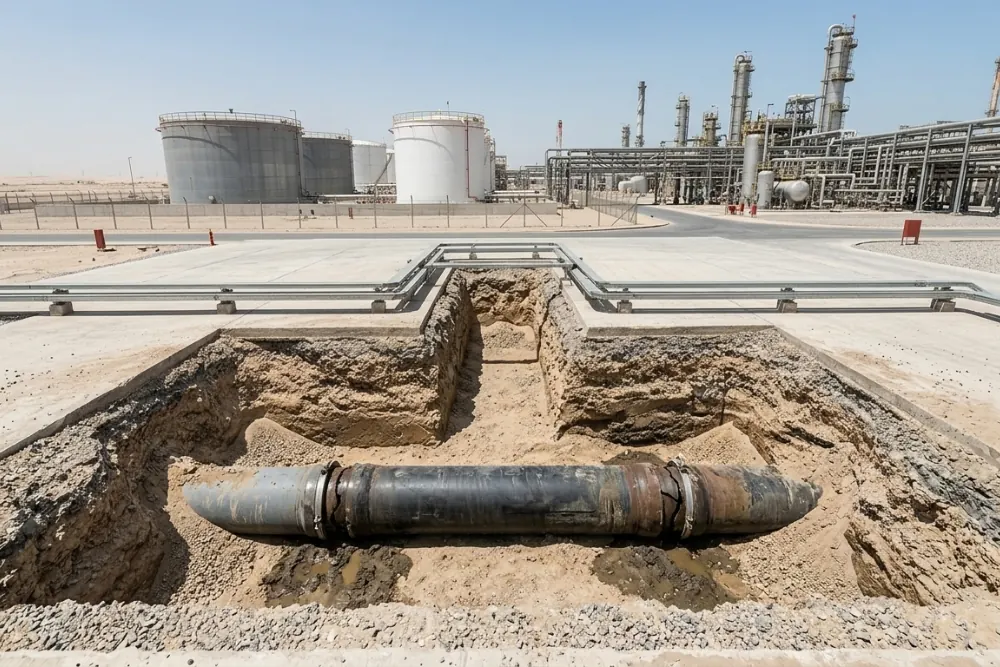
Gas pipe in Dubai: what we do
- Gas work. Installing, altering, moving, capping and testing fuel gas pipework is regulated work. FAM does not carry out gas work.
- Water pipework next to a gas line. Supply, drain and appliance connections in the same kitchen. See pipework and pipe fittings.
- Leak checks and advice. If you smell gas, the steps are on the gas safety page and come before anything on this one.
- Emergency visits. We answer calls and send a plumber 24 hours a day, 7 days a week, including nights, weekends and public holidays.
- Areas. Across Dubai. The list is near the end of this page, and the full list of areas is on its own page.
Which gas pipe you mean
The same two words cover products that differ in material, pressure and purpose.
| What people mean | What it is | What to know | Where to read more |
|---|---|---|---|
| Pigtail | A short hose from the cylinder to the regulator | At full cylinder pressure, so it is rated for a high working pressure | Gas safety |
| Cooker hose | A flexible hose from the regulator or wall point to the cooker | Low pressure. It has a marked life and a date, and it is replaced on a schedule | This page |
| Fixed kitchen pipe | Steel or copper pipe on the wall or in a shaft | Chosen and approved by the designer for the system | Gas safety |
| Buried service pipe | A yellow polyethylene pipe in the ground, from the street main to the building | Part of the gas distribution design. A household does not buy it | This page |
| Compartment or manifold pipe | The welded steel pipe in a cylinder store | Designed, tested and certified | Gas safety |
| AC gas pipe | The larger copper refrigerant pipe on a split air conditioner | It carries refrigerant and no fuel. Installation manuals name the two lines liquid and gas | This page |
| Welding and industrial gas hose | Hose for oxygen, acetylene or argon on a torch or a welder | Made for the specific gas by the maker | This page |
The first question for any gas pipe is what runs through it. A fuel gas hose, a refrigerant line and a welding hose share no parts, and a part sold for one is not a part for another. The second question is the pressure on the pipe, because hoses and pipes are chosen by pressure.
LPG hose: what to look for on the cover
A hose for cooking gas is a rubber or reinforced hose made for propane and butane, and the cover carries printed marks. Look for the maker's name, the gas it is made for, the pressure it is rated for, the bore and a date. A hose with no marks on it has no way to be checked, and it is replaced.
There are two kinds of hose in a cylinder set-up. The short pigtail between the cylinder and the regulator carries full cylinder pressure, so it is a reinforced, high-pressure hose. The hose after the regulator, running to the cooker, carries low pressure and is a lighter hose, usually about 8 mm bore. Ask the supplier which one you are holding, and never swap one for the other, because a light hose on the high-pressure side can burst and a heavy one on the low side may not seal on the cooker's nozzle.
How long a hose lasts
A hose has a life, and the date on the cover is the date to follow. Suppliers give different intervals, and the shorter figure is the safe one. A hose that shows damage or ageing is replaced at once, whatever the date says: cracks, hardness, bulges, kinks, flattened spots, signs of heat or a sticky surface. An unmarked hose has no date to rely on, which is a reason to replace it. A hose on a hot, sunlit balcony ages faster and is checked more often. The replacement is done by the supplier or a licensed gas fitter, not by us.
Natural gas and LPG hoses are not the same
A hose made only for LPG is not made for natural gas, and whether one hose can serve both depends on the hose, so do not assume it. A cooker on central gas and a cooker on a cylinder are different installations, and the gas supplier or the appliance maker decides what connects to what. See gas safety for the two routes in Dubai.
What the colours mean
Colour alone is not a safe way to tell what a pipe carries. A cooking gas hose is usually orange, or black with an orange line, but a seller's colour list is a product claim, and the hose maker's own marking is the authority. Welding hoses for oxygen and other gases follow their own colours, and a yellow pipe in the ground may be a gas service pipe. None of these are household parts, and if you cannot tell what a pipe carries, treat it as live and ask the supplier or the building.
Sizes decoded
A gas pipe is sold under different labels, and the label tells you which system it belongs to. A hose is named by its bore, the inside diameter, commonly 8 mm for the low-pressure hose to a cooker. A steel pipe is named by a nominal size in inches or millimetres, and that size is not what a ruler shows: a 15 mm steel pipe is about 21 mm across the outside, because the label names the bore it was designed around. A polyethylene pipe is named by its outside diameter. Copper tube has its own sizes, which is why 22 mm appears on neither list of steel sizes.
Do not convert a pipe size by dividing by 25.4. Read the size from the maker's table, or put calipers on the pipe. For the full discussion of metric and inch labels on water pipe, see pipework, and for threads and sealing, pipe fittings. The gas fitter's instruction for a gas joint comes before any general advice.
Polyethylene service pipe
Polyethylene (PE) pipe, usually yellow, is used for buried gas service pipes from the street main to the building. It is not used for piping inside a building. It belongs to the gas distribution design, which the designer specifies and the authority approves, and a household buys neither the pipe nor the choice. If you dig in a garden and find a yellow pipe, stop, do not cut it and ask the supplier or the building.
The AC gas pipe
An air conditioner has a "gas pipe" that carries no fuel. A split air conditioner joins its indoor and outdoor units with two copper refrigerant lines, and installation manuals name them the liquid pipe and the gas pipe. The gas pipe is the larger of the two. Both are insulated, and the larger one is the one that sweats in humid weather.
The sizes of these copper lines overlap with the numbers on fuel gas pipe, which is the reason to ask what a pipe carries before buying a fitting for it. A refrigerant line joins with flared ends tightened to a set torque, which is a different joint from a fuel gas one. The common faults on an AC gas pipe are torn or sun-rotted insulation, an oil stain at a flare that points to a refrigerant leak, and a pipe that is crushed or kinked in a bend. These belong to the AC contractor, because a refrigerant leak needs a recharge and a pressure test with the right equipment. What we do is the plumbing side: the condensate drain from the indoor unit, which blocks and overflows, and the insulation where a refrigerant line shares a shaft with water pipes. See pipe insulation and drain unblocking.
Eight checks before you buy a hose or a regulator
- What it will carry: LPG or natural gas, and the seller's statement of it.
- The marking printed on the hose or the regulator, and the maker's name.
- Which side of the regulator it serves: the high-pressure side or the low-pressure side.
- The date printed on the hose, and how long the supplier says it lasts.
- The pressure, in mbar for a regulator outlet and in bar for a hose, against what the appliance needs. It is on the cooker's data plate.
- The connection: the cylinder valve, the regulator thread, the hose bore and the clips, with what is in the box.
- New, not used. A regulator is a pressure device. Without a record of its history, a used regulator is one to have inspected before use.
- The seller: whether it ships from inside the UAE, whether returns are accepted, and whether the part is new.
Gas parts are fitted by the gas supplier or a licensed gas fitter, and these checks help you buy the right one.
Gas pipe or water pipe? Tracing before you drill
A pipe in a wall is not water because it is thin and metal. Steel and copper pipes are used for both, and a gas pipe behind a kitchen cabinet or in a shaft can look like a water line. Before anyone drills, chases or hammers a nail into a kitchen wall, the pipe is traced to where it starts and ends. A pipe that runs to the cooker point or to a meter is gas until the supplier or the building says otherwise. Do not cut a pipe to see what comes out. If a drill or a chisel has touched a pipe and you smell gas, leave at once and follow the steps on the gas safety page.
We help with this on a kitchen job. Before we chase for a water pipe or a waste, we ask where the gas point is, trace the pipes we can see, and mark the line so the tiler and the carpenter see it. If we cannot tell what a pipe carries, we stop and ask the building or the supplier, and we do not carry on by guesswork. Leak detection covers finding water pipes behind walls.
The cooker's data plate
Every gas cooker has a plate, often inside the door, under the hob or on the back, that states the gas it was made for and the pressure it expects. A cooker set up for one gas does not work safely on another without a conversion kit and new jets, and that is the gas fitter's work, not a swap of a hose. Before a cooker moves from a cylinder flat to a central gas flat, or the reverse, read the plate and send the gas fitter a photograph of it. The hose, the regulator and the cooker must agree, and if one of them does not, the job stops until it does.
A gas hose behind a cabinet or an oven
A hose that is hidden is a hose nobody checks. A cooker pushed tight to the wall can pinch or kink its hose, and an oven that sits against it heats it. Pull the cooker out gently once a year, with the gas off at the isolation valve, look at the hose along its length and push it back so the hose hangs in a loose curve. A built-in hob with the hose behind a drawer needs an access panel, because a hose that cannot be reached cannot be inspected, and the gas contractor can say where one must go. Keep the water off the hose too: a leaking sink trap above a gas connection is a reason to fix the leak at once, because wet rubber ages faster and a fitting that stays damp corrodes.
The same kitchen, three trades
In a kitchen with a gas hob, the pipes run in the same few metres: gas to the hob, water to the sink and dishwasher, and a waste. The gas contractor sets the point and tests it, we run the water and waste, our own electricians do the extraction and sockets, and the civil work follows. We do not mix the jobs. Each one is isolated, tested and recorded on its own, and the gas test happens before any wall or cabinet is closed up. See pipe fittings for the water side.
Gas pipe in a villa: outdoor kitchens and barbecue points
Villas often have a gas point outside, for a barbecue or an outdoor kitchen, and it is the one most often added without a plan. An outdoor gas pipe sits in sun, dust, salt air and heat, and a hose left outside ages faster than one in a cupboard. Keep the isolation valve of an outdoor point reachable and closed when the barbecue is not in use. A pipe that crosses a path or a lawn needs protection, because a pipe that is stepped on or hit by a mower fails. A new outdoor point is an alteration for the supplier and a licensed gas fitter to design and test, and the landlord's consent comes first in a rented villa. We handle the water side of an outdoor kitchen, the sink supply, the waste and the hose tap, and we say where the gas contractor must sit in the order of work.
What we can tell from a photograph
A clear photograph of a gas connection tells us a good deal. We can see whether the hose has a printed date and how it hangs, whether the clip is a proper clip or a wire twist, whether the regulator is rusted, whether the valve is reachable and whether the pipe is steel, copper or a hose. We cannot tell if there is a leak, and no one can by looking. What we do is tell you in writing what we can see, which of it is a concern, and who to call for the gas work. Send the photograph with the cooker's data plate and a wide shot of the cupboard or wall. That is enough for us to identify the parts and advise on what to ask for.
Common mistakes with gas hoses
- A hose that is too long, looped on the floor or kinked behind the cooker.
- A hose that is too short, pulled tight, which strains the connection every time the cooker is moved.
- A hose clipped with a wire twist or a jubilee clip not made for it.
- A hose run over a hot surface, across the oven door or past the burners.
- A hose of the wrong kind, a light low-pressure hose on the cylinder side or the other way round.
- A hose kept past its date because it looks fine from the outside.
- A hose hidden behind a sealed panel, where nobody can look at it.
- Testing for a leak with a flame. Soapy water on a joint shows bubbles, but a smell of gas means leave, not test.
Each of these is a reason to call the gas supplier or a licensed fitter, and none is something to fix with tape.
Cutting, moving and capping a gas pipe
Do not cut a gas pipe, move it or cap it yourself. A licensed fitter tests for escaping gas afterwards and gives you the record, and unauthorised changes put people at risk.
Three situations:
- A capped or disused pipe in a wall. Treat it as live until a licensed fitter has tested it.
- A pipe that has to move for a new cooker or a kitchen refit. The move is gas work and needs the supplier's or building's approval first.
- A corroded pipe. It is a replacement for a licensed fitter, not a repair with tape or paste.
If you smell gas, the steps are on the gas safety page. FAM does not attend gas leaks. Follow the steps on that page and call the gas supplier.
Permission in Dubai: who decides on a gas pipe
A hose or regulator on a cylinder touches the appliance, and a fixed pipe touches the wall, the supply and the building. In a rented home both touch the landlord.
- Building management. A central gas supply into a flat belongs to the building, so work on the pipe that feeds your flat is for building management and the gas supplier.
Replacing a worn hose with an equivalent one, done by the supplier or a licensed gas fitter, is maintenance and needs a message to the landlord. Moving a fixed pipe, adding a point or changing between a cylinder and a piped supply is an alteration, and needs written consent in a rented home and the supplier's approval first, as the gas line page sets out. Tell us what your building asks for and we work to it.
When the job is finished
Ask your gas fitter or supplier for these. They cost nothing to produce.
- The hose's marking, photographed: the standard, the class, the internal diameter and the date.
- The regulator's marking, photographed: the outlet pressure and the standard, if printed.
- The connections, shown to you with a leak check at every joint, and the method named.
- The isolation valve, shown to you, with where it is and which way is closed.
- The next replacement date, written on the hose or on a label beside it.
- Any certificate or test record for fixed pipework, and who issued it.
- A clear warranty, in writing, from whoever did the work.
For the plumbing work we do around a gas job, FAM's workmanship warranty runs for 30 days and covers our labour only. Parts carry the manufacturer's warranty only.
How we work
- You message us with a photograph of the hose, the regulator and the cooker connection, the printed markings, and whether the supply is a cylinder or central gas.
- We say what we think is happening, whether a worn hose, a wrong part or a fixed-pipe job. Gas work is outside what we take on, so we tell you in writing to use the gas supplier or a licensed gas contractor.
- We tell you what to ask for: the markings, the date and the test record, so you can check the work.
- Check permission. In a rented or managed property, ask the landlord or building management whether they need to approve this work before the visit.
- We do the water, drain and electrical work around the gas job, and coordinate timing with the gas contractor.
- We hand over a written note of what we found, what we did and who we referred the gas work to.
Where we work in Dubai
We cover all of Dubai, including Dubai Marina, JBR, Downtown Dubai, Business Bay, Jumeirah Lakes Towers, Palm Jumeirah, Al Barsha, Jumeirah Village Circle, Dubai Hills, Mirdif, Deira and Al Quoz. See the full list of areas.
Reading a gas hose before it is used
Because FAM does not do gas work, the following is a guide to what to check when a licensed gas contractor connects a hose, and what to look at yourself afterwards.
- The printed marking. A hose has its maker, the type of gas it is for, a pressure rating and a date printed on the cover.
- The date. Hoses have a life. A hose past its date should be replaced, even if it looks fine.
- The condition. Look for cracks, hardness, bulges, kinks, flattened spots and signs of heat. Bend it gently. A stiff or cracked hose is finished.
- The ends. The fittings should be crimped tight and free of rust, and the threads clean.
- The length. A hose should be no longer than needed and should hang in a gentle curve, not pulled tight or looped on the floor.
- The route. It should be clear of hot surfaces, sharp edges, doors and drawers.
- The clips. A hose clip must be the right type for the hose and must sit properly.
If any of these fail, the hose needs replacing by the gas contractor.
What a bad connection looks like
| Sign | What it may mean |
|---|---|
| A smell of gas near the connection | A leak at the fitting or the hose |
| Bubbles when soapy water is applied to a joint | A leak |
| A hose that looks scorched on one side | It sits too close to a burner or a hot surface |
| A hose that is stretched or tight | It is too short for the position |
| A hose with rust at the fitting | It is old, damp or poorly fitted |
| A regulator that hisses or is stiff to turn | A worn part |
Do not test for gas with a flame. A smell of gas means leave and call 997.
Where we stop, and what we do instead
We do not cut, move, extend or cap a gas pipe, and we say so in writing before any other work starts. If you need that work, we refer you to the licensed supplier or contractor. What we do is tell you what pipe you have from your photos, explain what to ask for, and coordinate the water, drain and electrical work around the gas job, so the trades do not get in each other's way.
How much does gas pipe work cost in Dubai?
FAM does not carry out gas work, so we do not quote for it. Gas pipework is done by your gas supplier or a licensed gas fitter, and the price depends on the type of connection, whether the part is a hose, a regulator or fixed pipe, access behind the cooker, the isolation valve, and the building's approval. Ask for the price in writing, with the parts named and any approval or inspection fee shown separately.
For the plumbing work around a gas job, send a photo on WhatsApp and we give you a fixed price before we start. Prices exclude 5% VAT.
Gas pipe FAQs
What do the marks on an LPG hose mean?
They give the maker, the gas the hose is made for, its pressure rating and a date. The rating also tells you which side of the regulator the hose belongs on: a reinforced hose on the cylinder side at full pressure, a lighter hose after the regulator. A hose with no marks has no way to be checked and is replaced.
What gas pipe is used in a kitchen?
It depends on the building. Cylinder installations usually use a pigtail and a cooker hose, and central gas uses fixed steel or copper pipe to a cooker point. The building's designer and the supplier decide which one a building uses, and a licensed fitter does the work.
What colour is a gas pipe or hose?
It depends on what it is. A cooking gas hose is usually orange, or black with an orange line, and a buried gas service pipe is usually yellow. Colour alone is not proof of what a pipe carries, so read the maker's marking and ask the supplier if you are unsure.
Can I use an LPG hose on natural gas?
Not unless the hose says so. A hose marked for LPG is for LPG only, and a hose marked for natural gas as well says so on its cover. The appliance maker and the gas supplier decide. See gas safety for the two routes in Dubai.
What size gas pipe do I need?
A cooker hose is named by its bore, normally 8 mm, and steel pipe by a nominal size that is not the outside diameter: a 15 mm steel pipe is about 21 mm across. The load of the appliances sets the size, and a designer or licensed fitter calculates it.
When should I replace a gas hose?
Replace it on the earlier of its marked date and the supplier's advice, and at once if it is cracked, hardened, kinked or damaged. A licensed gas fitter or the supplier does the replacement.
Is the AC gas pipe the same as a cooking gas pipe?
No. It is the larger copper refrigerant line on a split air conditioner, and it carries no fuel. The AC contractor looks after it.
Can I cut, move or cap a gas pipe myself?
No. Gas work is regulated, and FAM does not do it. The position on who may do the work is set out on the gas safety page. If you smell gas, leave the area first.
Is polyethylene pipe allowed for gas in Dubai?
Polyethylene is for buried supply lines and not for pipework inside a building. The designer and the authority decide for a particular system.
How much does a gas pipe cost in Dubai?
FAM does not carry out gas work, so we do not quote for it. Gas pipework is done by your gas supplier or a licensed gas fitter, and the price depends on the building and the supply contract.
Book a gas pipe visit in Dubai
Tell us what the pipe connects, the markings printed on the hose and the regulator, whether you have a cylinder or central gas, what it is doing and whether you own or rent. A photograph of the connection helps. If you smell gas, do not use a switch or a flame. Leave the area and follow the steps on the gas line page. We will identify the part, say whether it is work we do, give you the options and a price in writing, and hand over the markings and the replacement date.
WhatsApp: +971 55 407 7427 · Request a quote
Visit us: Office 871, Oasis Mall, Al Quoz 1, Dubai, UAE
Related services: Gas safety · Pipework overview · Pipe fittings · Pipe insulation · Water heater installation · Kitchen sink · Leak detection · Emergency plumber · how plumbing works in a Dubai home