
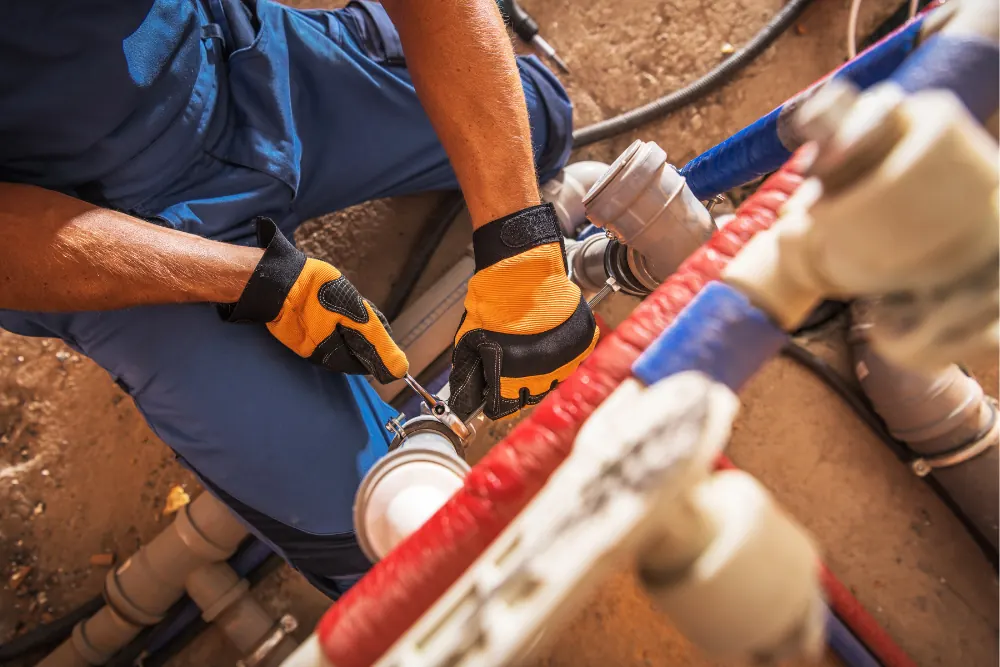
Pipes and piping in Dubai: what we do
- Repiping and pipe replacement. Replacing failed water supply pipework, in PPR, CPVC, PEX, copper or uPVC. See repiping and pipe replacement.
- Pipe leak repair. Finding and fixing a leak in a wall, floor or ceiling. See pipe leak repair and leak detection.
- Fittings and connectors. Joints, threads, unions and the fitting that weeps. See pipe fittings and connectors.
- Flexible hoses. The braided and rubber hoses behind taps, heaters and appliances. See hoses.
- Pipe insulation. Lagging for sweating cold lines and heat-losing hot lines. See pipe insulation.
- Drain, waste and sewer pipes. See drain repair, drain unblocking and sewer lines.
- Appliance, irrigation and pool pipes. See washing machine plumbing, irrigation and pool plumbing.
- Supplying the pipe. We supply and fit, and we also fit items you have bought.
- Emergency visits. We answer calls and send a plumber 24 hours a day, 7 days a week.
We do not carry out gas work. Gas pipework is described on the gas safety page for safety only.
Washing machine pipes: inlet, outlet and extension
Three pipes serve a washing machine, and each has its own questions. Our washing machine plumbing page covers all three in full.
| Pipe | What it does | The questions people ask | Where it is answered |
|---|---|---|---|
| Inlet pipe (inlet hoses) | Carries water from the taps to the machine, one hose for cold and one for hot | How long, which connector, how often to replace | Washing machine plumbing and hoses |
| Outlet pipe (drain hose) | Carries used water from the machine to a standpipe or wall outlet | How high, how long, how deep into the standpipe | The next two sections |
| Extension pipe | A length added to the drain hose, or a longer inlet hose, when the machine is far from the tap or drain | How far can it be extended | The next two sections |
How far can the drain hose be extended
The machine's manual states the longest drain hose it allows, and the pump is sized to that. Past it, the pump struggles to push the water up and out, and the machine may drain slowly or throw a drain fault. If you are moving a machine to a new spot, measure the route from the back of the machine to the standpipe or outlet before you buy any hose, and add the length that goes into the standpipe.
How high and how deep
| Point | What to know |
|---|---|
| Outlet height, top-load machines | Commonly about 90 to 100 cm above the floor. If the drain is lower, the hose should arch up to that height first |
| Standpipe connection height | Commonly 40 to 100 cm, with a downward slope toward the drain. A wrong height or no downward slope can let used water run back into the machine |
| Depth of the hose in the standpipe | No deeper than about 15 cm. A hose pushed in deep can let water siphon back into the washer |
The heights differ by machine type, and the manual for the machine states the one to use. Our washing machine plumbing page sets out what we check on the visit.
Inlet hoses and extensions
Taps should be within about 1.2 m of the back of the machine to suit the hoses supplied with it. If the tap is further than the supplied hose reaches, the options are a longer hose of the right connector and pressure rating, or moving the tap, which is a plumbing job. Each joint added between two hoses is another place to leak. Our hoses page covers hose pressure ratings and lifespan.
Which pipe is in your wall
A home carries several pipe systems, each in the material chosen for its job.
| System | Usual materials | Where to read more |
|---|---|---|
| Cold and hot water supply | PPR, CPVC, PEX, copper, and older galvanised steel | Repiping |
| Drain, waste and soil | uPVC, with cast iron in older buildings | Drain repair and sewer lines |
| Gas | Materials and tests specific to gas, not covered by this page | Gas safety |
| Chilled water and air conditioning | The chilled-water and condensate pipes belong to the air-conditioning system | The AC contractor or building management |
| Irrigation and garden | PE and uPVC, laid shallow outdoors | Irrigation |
| Pool | uPVC, often buried or set in the plant room | Pool plumbing |
Colour is a hint and not an identification. The printing along the pipe states its material, size and pressure class, and a photograph of that printing is the quickest way for us to tell you what you have.
What each supply material does
| Material | Good for | Watch for |
|---|---|---|
| PPR | Hot and cold supply, heat-fused joints that become one piece | Expands when hot, so it needs room to move. Sunlight degrades it |
| CPVC | Hot and cold supply, solvent-cemented joints | Sunlight degrades it, and joints need their full cure time |
| PEX | Flexible runs and manifold layouts, indoors | UV damages it, so it stays indoors |
| Copper | Visible runs and where a rigid, durable pipe is wanted | Pinholes in aggressive water, and electrochemical corrosion where it meets other metals |
| uPVC | Cold water, drains and irrigation | Never on a hot line |
| Galvanised steel | Older buildings only | Rusts from the inside and narrows over time |
Read the repiping page before choosing a material for a replacement.
Pipe sizes decoded: millimetres, inches and the wall you cannot see
A pipe's size is a label, and the label differs by system. Plastic pipe is sold by outside diameter in millimetres. Steel pipe and threads are named in inches by a nominal size that is not the real diameter. The pipe-specific problem is that shops put both labels on the same pipe, so a 25 mm plastic pipe is often called 3/4 inch, a 20 mm pipe 1/2 inch and a 32 mm pipe 1 inch. The labels are close and not equal: a nominal 3/4 inch steel pipe is about 26.7 mm across, against 25 mm for the plastic. A threaded 3/4-inch valve or adapter therefore joins a 25 mm PPR pipe through a fitting made for the purpose and not by eye. Our valves overview has its conversion table for valve sizes, and our pipe fittings page covers the transition fittings and threads.
Do not divide by 25.4
An inch is 25.4 mm, and dividing a metric size by 25.4 gives a number that looks like an inch size and is not one. A 75 mm uPVC pipe divides to just under 3 inches, but a nominal 3-inch pipe measures noticeably larger across. A 110 mm pipe divides to about 4.3 inches, while a nominal 4-inch pipe is a little larger again. When the size matters, match the outside diameter, or the thread, and not the label.
The wall decides how much water fits
The wall thickness is what the pressure rating buys, and it comes out of the inside of the pipe. A typical 25 mm PN20 PPR pipe has a 4.2 mm wall, which leaves a bore of about 16.6 mm. That is much less than the 3/4-inch label suggests, roughly three quarters of the flow area. A 25 mm PPR pipe therefore carries less than the label implies, and the next section turns that into litres.
What a pipe carries: bore, velocity and flow
Flow is cross-section times velocity. The bore of 16.6 mm has a cross-section of 216 mm². Designers commonly keep water in a domestic supply pipe at about 1 to 2 m/s, and lower where noise matters.
| Velocity in the 16.6 mm bore | Flow in litres per minute |
|---|---|
| 0.5 m/s | 6.5 |
| 1.0 m/s | 13.0 |
| 1.5 m/s | 19.5 |
| 2.0 m/s | 26.0 |
| 2.5 m/s | 32.5 |
Take a basin tap at about 6 litres per minute and a shower at 9 to 12. Together they use 15 to 18 litres per minute, which is about 1.2 to 1.4 m/s through one 25 mm PPR pipe. That is inside the usual range, and one more fixture running at once pushes it towards the top.
Three cautions. The wall thickness differs by pressure class, so a thinner-walled 25 mm pipe has a larger bore than the 16.6 mm used here. The velocity ranges are a general engineering reference. And a pipe is only one part of a supply: the pressure at the tap, the pump and the fittings decide what arrives. Our low water pressure page covers measuring the flow at a tap with a bucket and a timer. When a bathroom is added to an existing run, the pipe size feeding it is the first thing to check, because this arithmetic shows how much of a 25 mm pipe's capacity a bathroom uses.
Pressure ratings on pipe: PN10, PN16, PN20 and PN25
PN means pressure nominal, and the number is the pressure in bar the pipe is rated for at 20 °C. The rating falls as the water gets hotter, so a pipe that is fine for cold water at 10 bar is not fine for a hot run at the same pressure.
| Marking | Typical use for PPR | What to know |
|---|---|---|
| PN10 | Cold water | Thinner wall, larger bore. Not for hot lines |
| PN16 | Cold and some hot service | Check the datasheet for the hot-water limit |
| PN20 | Hot and cold supply | The usual domestic choice, with the 4.2 mm wall at 25 mm |
| PN25 | Fibre-composite pipe for hot service and lower expansion | A different construction, with its own fittings and its own datasheet |
The printing along the pipe and the maker's datasheet state the class. Ask for the datasheet before you buy, and ask us before you buy pipe for a hot run.
Pipe tapping: adding a branch to a pipe that is in use
"Pipe tapping" means two things. In a workshop it can mean cutting a thread. In plumbing it means connecting a new branch to an existing pipe, and the question is whether the line has to be shut down.
In industry, a hot tap adds a branch to a live steel pipe with special equipment. It needs a minimum wall thickness and a careful procedure, and it is not a method for household PPR, CPVC or copper.
A new branch to a household water pipe is made with the line shut off and drained. We isolate the supply, cut in a tee or a branch fitting made for the pipe's material, restore the supply and test. For a villa the isolation point may be the tank-side valve, and for a flat it may be a riser valve that building management controls, as our valve repair and replacement page explains. The joint types are on our pipe fittings page.
Old pipe materials: galvanised, brass and lead
- Galvanised iron. Galvanised steel rusts from the inside and narrows over time, and it corrodes on both hot and cold service. Our repiping page covers when to replace it.
- Brass. Brass fittings and valves can lose their zinc from the inside in some water. Our pipe fittings page and valves overview cover dezincification and the marking that shows a resistant alloy.
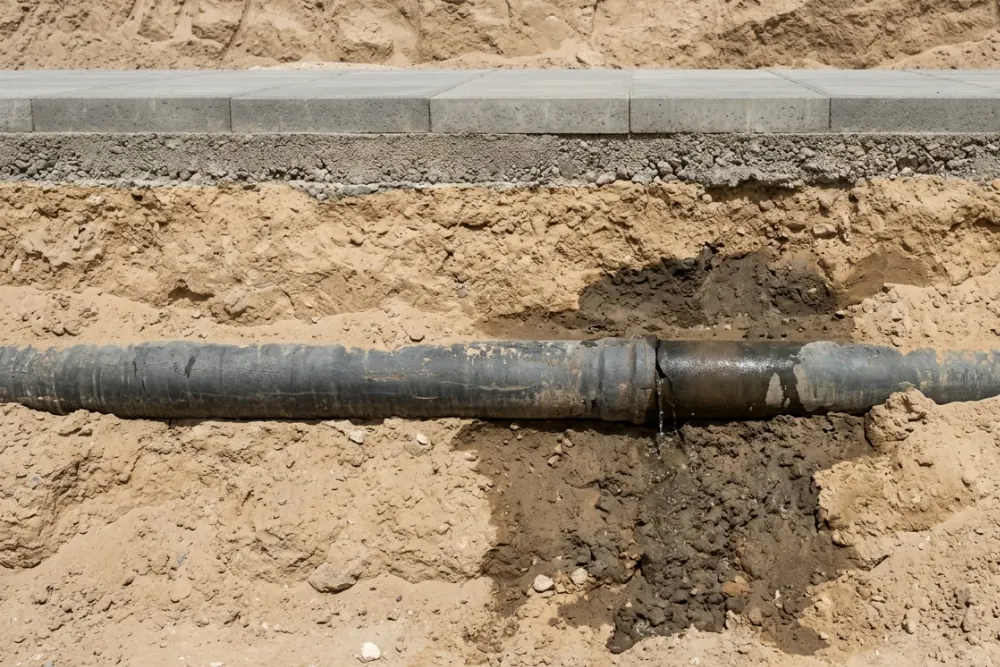
- Lead. Lead pipework is found in very old buildings and is not common in modern Dubai construction. Lead in drinking water is harmful, above all to children. A laboratory test of the water is the only way to confirm it, and our water testing page covers testing. If you suspect old lead pipework, send us a photograph of the pipe, and we say what it is.
Testing and inspecting pipe
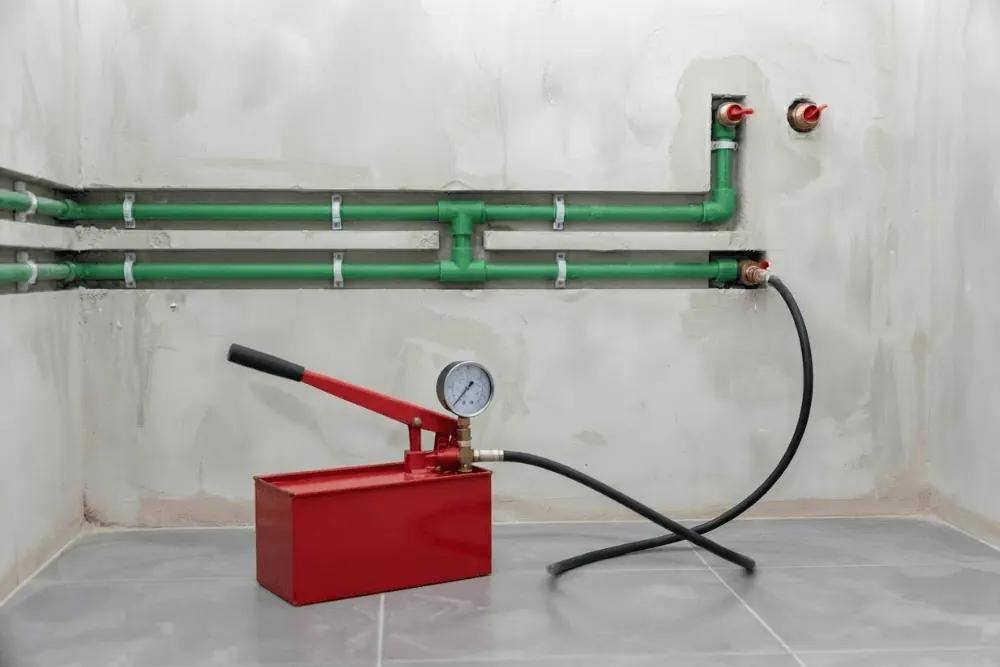
A hydrotest is a pressure test with water: fill the pipe, remove the air, raise the pressure and watch the gauge and every joint. Our repiping page covers the test in full. We test to the pressure and hold time the pipe maker's data gives, and before the pipe is concealed.
Two points matter for any pipe job:
- A falling gauge is the one that counts. A pipe in the sun warms and its pressure climbs, so a rising gauge in a sealed run can be warmth and not a fault. A falling gauge means a leak.
- A wet joint on a steady gauge is a slow weep. The gauge cannot catch it, so we check joints by eye and by touch.
Drain pipe is inspected differently. A camera survey shows the pipe's condition from inside, and our drain jetting and sewer line pages describe what it shows and when we use it. A leak inside a wall is found by leak detection before anything is opened.
How each pipe fails
Our repiping page has the full comparison.
| Material | The failure | What to know | What follows |
|---|---|---|---|
| PPR and CPVC | Sunlight | Both degrade in sunlight | Shade or relocate a rooftop run |
| uPVC | Hot water | Cold only | Never on a hot line |
| Copper | Pinholes | Pinholes in aggressive water | Repipe the section, and look at the water |
| Galvanised steel | Rust inside | Narrows over time | Repipe. A repair does not restore the bore |
| Any concealed joint | A slow weep | Shows as a stain or a damp patch, not a drip | Leak detection, then repair |
Expansion, in numbers
Plain PPR grows by about 0.15 mm for every metre of pipe and every degree of temperature rise. A 10 m run heated by 50 °C grows by 0.15 × 10 × 50 = 75 mm. A fibre-composite PPR pipe grows much less. A pipe fixed rigidly at both ends has nowhere to go when it grows, so it bows or loads its joints. That is the reason expansion is planned before the pipe is clipped. The datasheet for the pipe in your wall states its own coefficient.
Choosing the size for a bathroom or a kitchen branch
When a new bathroom or kitchen is added, the pipe size matters more than the material. A single 20 mm branch can serve a basin and a toilet, and a shower and a basin together are better on 25 mm. A whole bathroom with a bath, a shower, a basin and a toilet on one run asks for a 25 mm feed at least, and a kitchen with a dishwasher and a washing machine as well as the sink is better on a short 25 mm branch off a main. The mistake we see most is a long 20 mm run from a distant riser feeding everything, which gives a weak shower when the kitchen tap is open. We look at how many fixtures run at once, how far the branch is from the main and what the main itself is, before we suggest a size. See low water pressure.
Pipes in the open: roofs, balconies and facades
A pipe outside a building lives a hard life. It sits in sun, dust and salt, and it is walked on, leant on and hit. Plastic pipe in direct sun softens and ages, so an exposed run should be shaded, boxed or replaced with a material that suits the sun. A metal pipe on a facade heats the water inside it, so a cold line on a roof can run hot for the first litres. Pipes on a balcony are exposed to the wash water and the air conditioner drip. We box, lag or move exposed pipes where we can, label the isolation valve and make sure the pipe is clipped so it does not rattle or sag. See pipe insulation.
Noise in pipes: what it means
A noisy pipe is a clue. A bang when a tap closes is water hammer, from pressure that is too high or a fast-closing valve. A whistle or hiss at a tap is a restriction, a partly closed valve or high velocity. A tick or crack as hot water starts is a pipe moving against a clip as it expands. A rattle is a loose clip. A gurgle in a drain is air pulled through a trap. Each has its own cause and fix, and a noise that is new is worth a look before it becomes a leak. We trace the noise to the part and tell you whether it is a clip, a valve, the pressure or the pipe. See water hammer arrestors.
Permission in Dubai: who decides on pipework
Replacing a pipe like for like and changing a layout are different questions, and the building and the authority decide them. We do not guess, and we ask before we book.
In practice: tell the landlord or building management in writing what you plan, with our findings and quote, and give us their answer before we start. Risers and common-area pipework belong to the building, and we do not touch them without management. Tell us what your building asks for and we work to it.
Warranty and the handover
What you should have when the job is finished:
- A written note of the pipe fitted: material, outside diameter, wall or pressure class, and where it runs.
- The pipe's datasheet or printing, photographed, and the test pressure and result.
- Photographs of the pipe and joints before they are closed in.
- A drawing or photograph of the route, so the next person knows what is behind the wall.
- FAM's workmanship warranty, in writing. The warranty runs for 30 days and covers our labour only. Parts carry the manufacturer's warranty only.
How we work
- You tell us what is happening on WhatsApp: where the water appears, what the pipe is if you know, and whether you own or rent. Photographs of the pipe's printing and the area around it save a visit.
- We visit, identify the material and size, and find the fault before proposing anything. The visit fee is AED 50 + VAT, credited if the work goes ahead.
- We give options and a price in writing, with what each option leaves untouched.
- Check permission. In a rented or managed property, ask the landlord or building management whether they need to approve this work before the visit.
- We do the work, isolate the supply, protect the surfaces and pressure-test before anything is closed.
- We hand over the written note and photographs, and show you the isolation valve for that line.
Where we work in Dubai
We cover all of Dubai, including Dubai Marina, JBR, Downtown Dubai, Business Bay, Jumeirah Lakes Towers, Palm Jumeirah, Al Barsha, Jumeirah Village Circle, Dubai Hills, Mirdif, Deira and Al Quoz. See the full list of areas.
Choosing a pipe for a new job
A pipe is picked for the use, the place and the budget. Some rules of thumb:
| Use | Good choices | Poor choices |
|---|---|---|
| Cold water in a wall | PPR, PEX, copper | Thin plastic that is not rated for pressure |
| Hot water in a wall | PPR, CPVC, copper, PEX | PVC, which is not for hot water |
| A garden supply | PE, UPVC buried properly | Exposed pipe in strong sun, with no cover |
| A waste line | uPVC for drainage | Pressure pipe for waste, which has the wrong wall and fittings |
| A pool line | uPVC, with correct solvent cement | Thin or poorly glued joints |
| A vent | uPVC drain pipe | A flexible pipe that collapses |
The choice also depends on how the pipe is joined. Copper is soldered, PPR is welded, uPVC is cemented and PEX is crimped. Each method has its own tools, and each needs care. A pipe is only as good as its joints.
Reading the marks on a pipe
A pipe is marked along its length with its size, its material, its pressure class and the maker. On a plastic pipe, the markings show whether it is rated for hot or cold water, and its pressure. On a metal pipe, the markings may show the wall thickness. A pipe with no markings is a risk, because you cannot tell what it is. When we repair or extend, we match the existing pipe from the marks or, where the marks are missing, from a sample.
Supports, clips and sleeves
A pipe must be supported along its run. Without supports, it sags, vibrates and wears. Spacing depends on the pipe type and size. Plastic needs closer spacing than metal, and hot pipe closer still. Where a pipe passes through a wall or a slab, a sleeve protects it and lets it move. Where it is fixed to a hard surface, a clip with a soft lining prevents rattles. A good job looks neat, with pipes straight, parallel and fixed.
Frost is not the worry here, heat is
In Dubai, the issue is heat, not frost. Pipes on a roof or a facade in direct sun can reach high temperatures. Plastic softens, joints loosen and water inside becomes hot. Shade, lag and use pipe rated for the conditions. Pipes in a wall behind a hot surface, such as a kitchen, also see heat.
What to send us for a pipe job
A photo of the pipe and its markings; where it runs; the fault; the size if you know it; whether the pipe is hot or cold; and a video if it leaks. We tell you what the job involves and fix the price on WhatsApp before we start. Prices exclude 5% VAT.
How much does pipework cost in Dubai?
Two prices make up the bill: the pipe and the work.
- The pipe. The price follows the material, the diameter and the pressure class. A fibre-composite or copper pipe costs more per metre than basic PPR or uPVC.
- The work. Isolating the supply, cutting out the old pipe, fusing or cementing the new, supporting it, pressure-testing and making good.
- What moves the price. The length and size, the material, whether the pipe is exposed or concealed, the access, and whether walls must be opened and closed.
We do not publish a starting price for this job. Send a photo on WhatsApp and we give you a fixed price before we start. Prices exclude 5% VAT.
Pipework FAQs
Why do washing machine pipes appear on this page?
A washing machine connects to the plumbing through a supply hose and a drain hose, and the sizes of the pipes they meet are in the tables above. The hoses themselves, the heights and the lengths are on our washer drain and washing machine plumbing pages.
What is the difference between a 25 mm pipe and a 3/4 inch pipe?
A 25 mm plastic pipe is sold by its outside diameter, while 3/4 inch is a nominal label whose steel pipe measures 26.7 mm outside. They are close and not equal. Match the outside diameter, and use a fitting made for the transition when you join a metric pipe to an inch thread.
How much water can a 25 mm PPR pipe carry?
With a typical 4.2 mm wall, the bore is 16.6 mm. At 1 to 2.5 m/s it carries 13 to 32.5 litres per minute. A thinner-walled pipe carries more, and noise limits the top of that range in a home.
What does PN20 mean on a pipe?
PN stands for pressure nominal, and the number is the approximate pressure rating in bar at 20 °C, so PN20 is 20 bar. The rating falls as the water gets hotter. Read the printing on the pipe and the datasheet.
Where do I find the cost of a particular pipe?
Which pipe is better for hot water, PPR or uPVC?
uPVC is for cold water only. Our repiping page compares PPR, CPVC, PEX and copper for hot lines, including the expansion allowance PPR needs.
Can I join two different pipe materials?
Yes, with the right fitting, because a joint between two plastics or between plastic and metal has its own rules. Joining one material to another is covered on our repiping page. Do not join with a general-purpose adhesive, and send a photo of the joint if you are not sure.
What is pipe tapping?
It is adding a branch to an existing pipe. On a household water pipe the line is shut off and drained first, and the branch is cut in with a tee made for the pipe's material. Live hot tapping is an industrial method for steel pipe and is not used on household lines.
How do I know if my pipes are lead?
Lead pipework is rare in modern Dubai buildings. A laboratory test of the water is the only way to confirm lead in drinking water. Send us a photograph of the pipe and we will say what material it is, and use our water testing service for the water.
Can plastic pipe be left on a roof?
A plastic pipe in the sun degrades, so it needs shade or a material suited to it. If your rooftop pipe is already exposed, send us a photograph and we will say what it is and what to do.
Book a pipework visit in Dubai
Tell us where the water appears, what the pipe is if you know, and whether you own or rent. Photographs of the pipe's printing and the area around it help. If water is escaping, close the nearest valve upstream, or the main if you do not know which, and call. We will find the cause, give you the options and a price in writing, do the work and hand over a note.
WhatsApp: +971 55 407 7427 · Request a quote
Visit us: Office 871, Oasis Mall, Al Quoz 1, Dubai, UAE
Related services: Repiping and pipe replacement · Pipe fittings and connectors · Hoses and flexible connectors · Pipe insulation · Pipe leak repair · Washing machine plumbing · Valves · Drain repair