
Nitrogen pressure regulator in Dubai: what we do
- Telling you which regulator you have or need, from a photograph of the label and the cylinder valve: nitrogen, propane, compressed air or water.
- Pressure-testing plumbing pipework, water supply and drain lines, with a regulator, a relief device and gauges, using air or nitrogen where the job calls for it, and giving you a written record.
- Water pressure regulators on a villa or flat supply. See pressure reducing valve.
- Leaks found by a test. See leak detection and pipe leak repair.
- What we do not do. We do not do gas work, so we do not replace an LPG regulator or pressure-test gas pipework. Those go to the gas supplier or a licensed gas fitter.
- Emergency visits. We answer calls and send a plumber 24 hours a day, 7 days a week, including nights, weekends and public holidays.
- Areas. Across Dubai. The list is near the end of this page, and the full list of areas is on its own page.
Which regulator is which
The word regulator covers at least five devices. The table says what each is for and where it is covered.
| Device | What it does | Covered |
|---|---|---|
| Cylinder regulator for nitrogen and other inert gases | Reduces cylinder pressure to a set delivery pressure, with a gauge on each side | This page |
| Compressed air regulator | Sets the pressure of air to tools and machinery, and can be sold with a filter | The propane, air and water section |
| Propane or LPG regulator | Reduces the pressure of LPG to the appliance's pressure, in millibar | Not our work. See gas safety |
| Water pressure regulator, PRV | Reduces the pressure of the supply to the property | pressure reducing valve |
| Back pressure regulator | Controls the pressure on its inlet side by opening to release excess. A pressure-reducing regulator controls downstream pressure and a back pressure regulator controls upstream pressure | The propane, air and water section |
Relieving and non-relieving
A non-relieving regulator cannot vent. If its delivery pressure creeps up, the pressure stays trapped downstream until something uses it or a relief device opens.
A relieving regulator vents downstream pressure as part of regulating. A relief valve is a safety device that opens above a set pressure. A regulator does not replace a relief valve, and a relieving regulator is not a safety device on its own.
The numbers on a nitrogen regulator
A cylinder regulator has an inlet side, where the cylinder pressure is, and a delivery side, where the pressure you set is. Each has its own gauge, and the gauges have their own scales.
- The inlet gauge has a scale that covers the cylinder's full pressure, typically 200 to 300 bar. It describes the gauge's maximum and the regulator's maximum inlet rating, not how full your cylinder is. The pressure in a given cylinder is on its label and from the gas supplier.
- The delivery gauge has a much smaller scale, such as 0 to 27 bar, or lower. The range the regulator can deliver is stamped on its label. A regulator whose delivery range is above what the downstream equipment is rated for is the wrong regulator, however well it holds pressure.
Single-stage and two-stage
A single-stage regulator reduces the pressure in one step, and a two-stage regulator does it in two.
- Single-stage. As the cylinder empties and its pressure falls, the delivery pressure rises a little, so frequent adjustment is needed to hold a constant pressure. It suits jobs where the pressure is watched and adjusted, and it is the cheaper unit.
- Two-stage. The second stage evens out the rise, so the delivery pressure stays steady as the cylinder empties. It is recommended where a consistent pressure is needed over the life of a cylinder, where the pressure has to be right, or where cylinders are remote or hard to monitor.
A pressure test fills a pipe to a set pressure and then holds it with the cylinder valve closed, so the regulator's drift matters while the pipe is being filled and not during the hold. A long, supervised filling from a cylinder that is nearly empty is where a two-stage regulator earns its higher price. With a single-stage regulator, the reason to watch the delivery gauge while the cylinder empties is that the pressure drifts up.
CGA 580 and DIN 477-1 outlets
The inlet connection decides whether a regulator fits a cylinder's valve. Valve outlet standards differ by gas and by the cylinder's origin. Inert gases such as argon, helium and nitrogen share one family of connection, and other gases have their own, so that the wrong regulator cannot be fitted by mistake. Cylinders from some suppliers use a different connection standard, so read the marking on the valve and the regulator before buying.
CGA 580 and DIN 477-1 are two different connection standards, and one regulator does not convert between them. The cylinder valve you hold decides, so photograph its outlet before you buy and ask the gas supplier which standard their nitrogen cylinders use. Do not force a thread that does not turn freely by hand, and do not use an adapter unless the gas supplier confirms it is made for that pair of connections.
Delivery range and test pressure
The test pressure is set by the rating of the equipment and the approved procedure for the job, not by the regulator. A pipe test follows the approved procedure for the job and the engineer or inspector who witnesses it. Procedures differ in detail, but they share some points:
- Check the manufacturer's maximum allowable pressure for every component in the line before testing, and isolate anything that is not rated for the test.
- Raise the pressure in stages, with a leak check between steps, and not in one jump. A common pattern is a low-pressure check first, then steps toward the test pressure with a leak check at each.
- A pneumatic test is usually above the working pressure, often 110 per cent or more of the design pressure, and it is held for a set time that the procedure states. The time ranges from minutes to hours.
- The relief device must lift above the test pressure and below the pressure that would damage the weakest component.
- Use nitrogen or dry air only, never oxygen. Nitrogen is dry and inert, which is why it is chosen for higher pressures.
- Where the test has to be witnessed and certified by a professional engineer or a third-party inspector, that is arranged before the test.
The durations differ because the procedures differ, so use the one written for your job. Take the real number from the rating of the equipment under test, and check that the regulator's delivery range covers it with some margin.
The pressure moves with the temperature
A gas in a closed pipe changes pressure with temperature, by about 0.34 per cent for each degree Celsius near room temperature. A 10 °C swing between morning and afternoon changes a pressure of 10 bar by a few tenths of a bar, with no leak at all. A reading that falls steadily while the temperature does not is a different matter, and points to a leak. We note the air and pipe temperature with each reading.
Stored energy and the medium
A pipe filled with compressed gas stores a lot of energy. If a joint or a component fails, it releases that energy at once, which is why the test area is cleared and why nobody stands in line with a joint or a blank. A gas leak does not limit itself the way a refrigerant leak can, where evaporation cools the remaining liquid and lowers its pressure. Clear the risk area during the test.
Compressed air is avoided at higher test pressures because of the energy it stores and any oil it carries, and oxygen is never used.
Safety
| Topic | What to know |
|---|---|
| Opening | Turn the regulator's adjusting screw out, counter-clockwise, until it feels loose, before opening the cylinder. Then open the cylinder valve slowly, standing to the side of the gauges and not in front of them |
| Leak test | Close the regulator and the cylinder valve and drain the downstream line. A pressure drop indicates a leak, to be repaired or replaced before use |
| Purging | Purge the regulator and the connecting line by repeating a fill and vent cycle three to five times, so air is cleared from the line |
| Where nitrogen is vented | Nitrogen displaces oxygen. Vent outdoors, away from air intakes and low spots, and never in a confined space such as a plant room or a shaft |
| Cylinders | Keep them upright and secured, with the valve cap on when not in use |
| Service and testing | Inspect and test regulators at regular intervals, following the maker's schedule, and have only qualified repairers service, test and clean them |
Propane, air and water regulators
Propane
A propane regulator is set in millibar and is made for the low pressure a gas appliance needs. An adjustable one can be turned across a wide range, and the hose, the clips and the appliance must be rated for the highest setting the regulator can be turned to. An adjustable regulator on a household cooker is a different purchase from a fixed one. Propane regulators and LPG hoses are gas work, which we do not do. See gas safety.
Compressed air
An air regulator is rated for a low maximum, around 10 bar, while nitrogen cylinder regulators are rated for inlet pressures of more than 200 bar. An air regulator is not a cylinder regulator, whatever else it can regulate.
Back pressure
A back pressure regulator is a process-plant part, outside the plumbing of a home.
Water
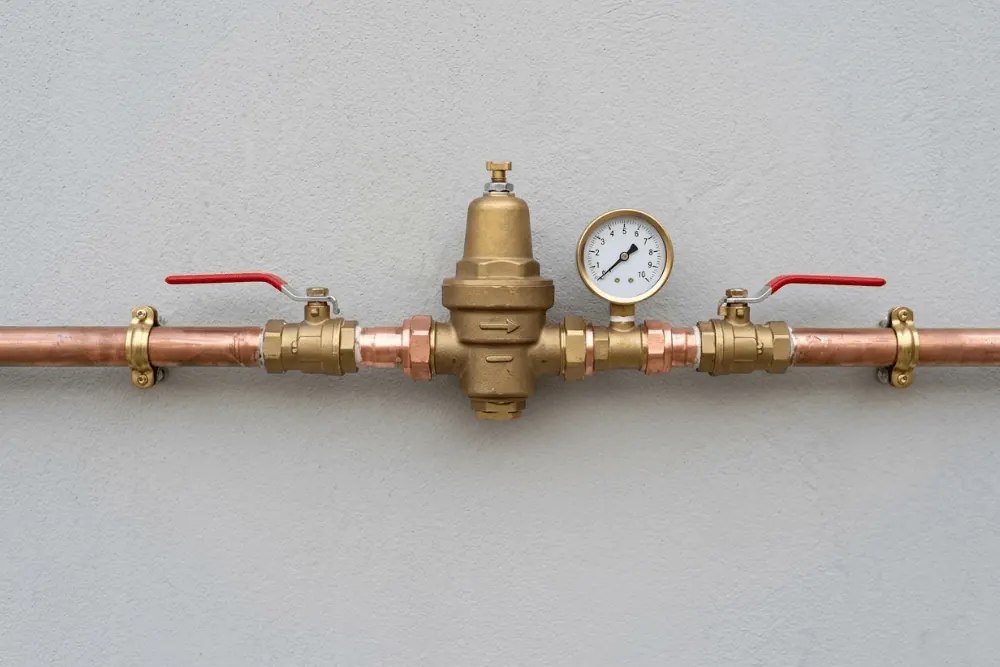
A house water regulator is a pressure reducing valve. Its sizing, noise and flow are on pressure reducing valve. A hose-end regulator is on garden taps.
Match the regulator to the gas and the pressure
A regulator is built for one gas family and one outlet pressure range. Before you buy or fit one, read the cylinder label, the outlet connection and the gauge range, and send us a photo of all three. Do not force a thread that does not turn freely by hand, and do not use tape or sealant on a connection that seals on a face or a cone. A gauge that reads above its range, or a regulator that creeps in pressure with the cylinder valve closed, should be taken out of use.
A water pipe test with air or nitrogen: when we choose it
Most plumbing pipework is tested with water, because water stores little energy and a leak shows as a drip. We use air or nitrogen when water cannot be used: a new line that must stay dry until it is commissioned, a drain or a supply that cannot be filled yet, a building where a water leak during testing would damage finished work, or a line that is too long or too high to fill safely. A gas test needs more care than a water test, because the pipe stores energy, so the pressure is kept low, the area is cleared, and a relief device protects the line. For a normal supply line we prefer water at a steady test pressure, and we say which method we will use and why before we start.
Testing a drain with air
A drain is not pressurised to the levels of a supply line. A low-pressure air test is used on a new drain run, with plugs at each end and a gauge, to show whether the pipe and its joints are sound before it is covered. The pressure is low, so a regulator with a fine delivery range suits the job, and an ordinary cylinder regulator on its higher range is not the right tool. We note the temperature and the time, because a drain that is warmed by the sun while it is tested will show a pressure rise that is not a fault. See pipe leak repair and sewer line repair and cleaning.
Permission in Dubai: who decides on a regulator and a pressure test
A regulator on a cylinder, a regulator on a gas line and a pressure test in a building are different matters, and who decides differs for each. The gas side, with the supplier and a licensed gas fitter, is on our gas safety page.
- Building management. A pressure test in a shared riser or plant room, and the venting of nitrogen inside a plant room or shaft, affect other occupants, so both go through building management.
A pressure test on gas pipework is not ours and follows the supplier's and the gas fitter's procedure. For a pressure test on water or drain pipework in a rented home, tell the landlord, and in a flat tell building management. Tell us what your building asks for and we work to it.
When the job is finished
Ask for these. They cost nothing to produce.
- The regulator's label, photographed: maker, model, gas, inlet connection, maximum inlet and the delivery range.
- The test pressure and duration, written down, with the equipment rating or the procedure it came from.
- The gauge readings, at the start and the end of the hold, with the air and pipe temperature.
- The relief device, named, with its lifting pressure.
- The leak check, joint by joint, with the method.
- The cylinder, secured and capped, with the regulator removed or the line drained and the delivery pressure shown as zero.
- Where the gas was vented, and who was cleared from the area.
- The witness or certificate, where an engineer or an inspector has to certify the test.
- FAM's workmanship warranty, in writing. The warranty runs for 30 days and covers our labour only. Parts carry the manufacturer's warranty only.
How we work
- You message us with a photograph of the regulator, the cylinder valve and the pipework, and what you are testing or fixing.
- We say what we think is needed, whether a regulator replacement, a pressure test or a different part, and whether it is work we do. Gas work is not.
- We give a price in writing, with the parts, the gas and the labour shown separately.
- Check permission. In a rented or managed property, ask the landlord or building management whether they need to approve this work before the visit.
- We set up the test: the isolation of anything not rated for it, the regulator, the relief device and the gauges. The visit fee is AED 50 + VAT, credited if the work goes ahead.
- We pressurise in stages, check the joints, hold the pressure and record it, then release and vent where it is safe to.
- We hand over the label photograph, the test record, the readings and the warranty.
Where we work in Dubai
We cover all of Dubai, including Dubai Marina, JBR, Downtown Dubai, Business Bay, Jumeirah Lakes Towers, Palm Jumeirah, Al Barsha, Jumeirah Village Circle, Dubai Hills, Mirdif, Deira and Al Quoz. See the full list of areas.
Reading the label and the cylinder valve
Before anything is fitted, the regulator and the cylinder must be the right pair. Check three things.
- The gas on the cylinder. It is stamped and labelled on the shoulder. Nitrogen cylinders are not interchangeable with oxygen, air or propane. Do not rely on colour alone, because colours differ between suppliers.
- The outlet of the cylinder valve. The thread or connection shape is different for different gases. A regulator for one gas will not fit another cylinder properly, and a connection that has to be forced is the wrong one.
- The pressure ratings on the regulator. The inlet gauge shows the cylinder pressure and must be rated above the pressure in your cylinder. The delivery gauge shows the working pressure and must have a range that covers the pressure you need.
A regulator that does not match the cylinder or the job should be returned, not adapted.
Setting up for a pressure test of a pipe
A nitrogen or air test on a water or drain line is done to find leaks before the system is put into use. The set-up is short but must be done in order.
- Close and cap the line. All open ends are sealed with test plugs or caps rated for the pressure. Any fixtures that could be damaged are disconnected or isolated.
- Fit a relief device on the test side. It is set below the pressure the pipework can stand, and it protects the pipe if the regulator fails.
- Connect the regulator with the delivery valve closed. The regulator adjusting screw is wound out so no pressure passes.
- Open the cylinder valve slowly. The inlet gauge rises and shows cylinder pressure.
- Wind the adjusting screw in gently. Pressure rises on the delivery gauge in small steps to the test figure.
- Close the supply and watch the gauge. A steady gauge over the test time means the line holds. A falling gauge means a leak.
- Find the leak, repair it and test again. A soap solution on joints shows bubbles where air escapes.
- Release the pressure slowly before any plug is removed. A plug under pressure can be thrown out.
We record the figure, the time and the result, and give you a note.
Why the test pressure is not the working pressure
A water pipe works at the supply pressure, which is far lower than the cylinder. A test uses a figure chosen to show up leaks without stressing the pipe. Testing above what the pipework is rated for can break joints, fittings and appliances that were not meant to take it. This is why we set the figure to the weakest component in the line. Valves, gauges, flexible hoses and appliances are isolated or removed before the test.
Common mistakes with a regulator
- Opening the cylinder valve fast. The sudden pressure can damage the gauge and the regulator.
- Leaving the adjusting screw wound in. The next person who opens the cylinder gets full delivery pressure at once.
- Using thread tape on a seal that does not need it. It can enter the regulator and block it.
- Using oil or grease. On some gases it is dangerous. Do not lubricate a regulator.
- Ignoring a creeping gauge. A delivery pressure that rises with the valve closed means the seat is leaking. Stop using it.
- Dropping the cylinder or leaving it unsecured. A cylinder that falls can break its valve. Keep it chained or strapped upright.
- Using a damaged or very old regulator. A cracked gauge glass, a bent stem or a bad seal means replacing, not repairing.
Storing and moving cylinders
A nitrogen cylinder is heavy and holds gas at high pressure. Keep it upright, fixed to a wall or a trolley, away from heat and out of direct sun. In a hot vehicle or a closed room, the pressure can rise. Move it with the valve closed and the cap on, using a trolley. Never roll or drag it. When it is empty, close the valve, mark it and return it to the supplier.
What to send us to get an answer
If you are not sure which regulator you need, send a photo of the cylinder shoulder and label, a photo of the valve outlet, and a photo of the regulator and its gauges, with the job in a sentence. We will tell you if it is a plumbing test we can do, and if it is gas work, we will say that it is outside what we do and refer it to the right supplier.
Documents and records for a pressure test
A pressure test is only as useful as the record. After a test, the record should list the date, the section tested, the test medium, the test pressure, the duration, the gauge used and the result. Photographs of the gauge at the start and at the end are good evidence. If a leak was found, the record notes where, what was done and the second test. Keep the record with the property file. It is what a landlord, an insurer or a buyer will ask for.
Why a gauge must be checked
A gauge that reads wrongly makes the whole test meaningless. Gauges are delicate and can be knocked or overpressured. Use a gauge whose range suits the test, so the needle sits in the middle of the scale. A gauge that does not return to zero should not be used. We use gauges that are in good condition and tell you when a gauge needs to be replaced.
When to call a specialist instead
Some regulator and gas jobs belong with a specialist supplier: any gas that is flammable, any cylinder with an unknown label, any regulator that creeps or leaks, and any system that is part of a process or medical use. We tell you plainly when that applies. For a plumbing pressure test, we can carry out the test, and we give you a record. We do not do gas work.
Why a regulator should be dedicated to one gas
A regulator is built for a particular gas and pressure range. Its seals, its diaphragm and its materials are chosen for that use. A regulator moved from one gas to another can carry oil, moisture or residue that does not belong, and its seals may not suit the new gas. Keep a nitrogen regulator for nitrogen, label it, store it capped and dry, and do not lend it. When you hand a regulator to someone, tell them what it was used for. A regulator that has been dropped, that creeps, that has a cracked gauge or that cannot hold a setting should be replaced rather than repaired on site. If you are not sure about its history, treat it with caution and ask the supplier.
How much does a nitrogen pressure regulator cost in Dubai?
- The regulator. The price follows the gas, the inlet and delivery ratings, whether it is single or two stage, the gauges and the maker. A two-stage regulator costs more than a single-stage one.
- The work. Setting up and carrying out a pressure test, or replacing a regulator on a plumbing line.
- What moves the price. The pipe's size and length, the test pressure, the gas, the relief device, the access, the certificate, and building approval.
We do not publish a starting price for this job. Send a photo on WhatsApp and we give you a fixed price before we start. Prices exclude 5% VAT.
Nitrogen pressure regulator FAQs
What is a nitrogen pressure regulator?
It is the fitting on a nitrogen cylinder that reduces the cylinder's pressure to a delivery pressure you set, with a gauge on each side.
Which regulator fits a nitrogen cylinder?
The cylinder's valve connection decides. Photograph the cylinder valve and ask your gas supplier which standard it is. CGA 580 and DIN 477 are different, and one regulator does not convert between them.
Can I use a propane or air regulator on a nitrogen cylinder?
No. An air regulator's maximum is about 10 bar, against inlet ratings of more than 200 bar on nitrogen regulators, and a propane regulator is set in millibar. Each is made for another gas and another pressure.
Should I buy a single-stage or a two-stage regulator?
A single-stage regulator's outlet pressure rises as the cylinder empties and needs frequent adjustment, while a two-stage unit stays steadier. Choose two-stage where a consistent pressure is needed over the cylinder's life, and single-stage where the pressure is watched and adjusted.
What delivery pressure do I need to pressure test a pipe?
The equipment's rating and the approved procedure set it, not the regulator. A regulator with a delivery range up to 27 bar is enough for many plumbing tests and far more than a water supply line is rated for, so check the pipe's rating first.
Is nitrogen dangerous?
It is not toxic, but it displaces oxygen, so venting it in a confined space is dangerous, and a pressurised pipe stores a lot of energy. Vent outdoors, away from air intakes, and clear the area during a test.
How do I know a regulator is faulty?
Close the cylinder valve with the regulator shut. If the delivery pressure rises while the line is held, the regulator is leaking through its seat and is replaced. For a leak test, close the regulator and the cylinder valve, drain the downstream line, and watch for a pressure drop.
How frequently should a regulator be inspected or replaced?
Inspect and test at regular intervals, and replace it if it creeps, leaks or shows damage. The maker's schedule comes first.
Does FAM do nitrogen pressure tests?
We pressure test plumbing pipework, water supply and drain lines, and supply, fit and repair water pressure regulators. We do not do gas work, so we do not test gas pipework or fit LPG regulators. For a nitrogen test of another kind of pipe system, send the details on WhatsApp and we will confirm what we can do before you book.
How much does a nitrogen regulator cost in Dubai?
It depends on the gas, the ratings, the stages and the maker, and the work and the gas are priced separately. Ask for the price in writing on WhatsApp, excluding 5% VAT.
Book a regulator or pressure test visit in Dubai
Tell us what the regulator is on, the gas, what the label says, what the gauges read, what you are testing, and whether you own, rent or manage the building. A photograph of the regulator, the cylinder valve and the pipework helps. We will identify what you have, say whether it is work we do, give you the options and a price in writing, and hand over the readings and the test record.
WhatsApp: +971 55 407 7427 · Request a quote
Visit us: Office 871, Oasis Mall, Al Quoz 1, Dubai, UAE
Related services: Pressure reducing valve · Gas safety · Gas pipe and LPG hose · Leak detection · Pipe leak repair · Valves · Garden taps · Emergency plumber