
Washer drain in Dubai: what we do
- Finding which drain has the fault. The machine, the hose, the standpipe and trap, or the house drain beyond.
- Standpipes, traps and outlets. Fitting or correcting the open pipe and the trap a washer drains into.
- Clearing the drain beyond the machine. See drain unblocking and drain jetting.
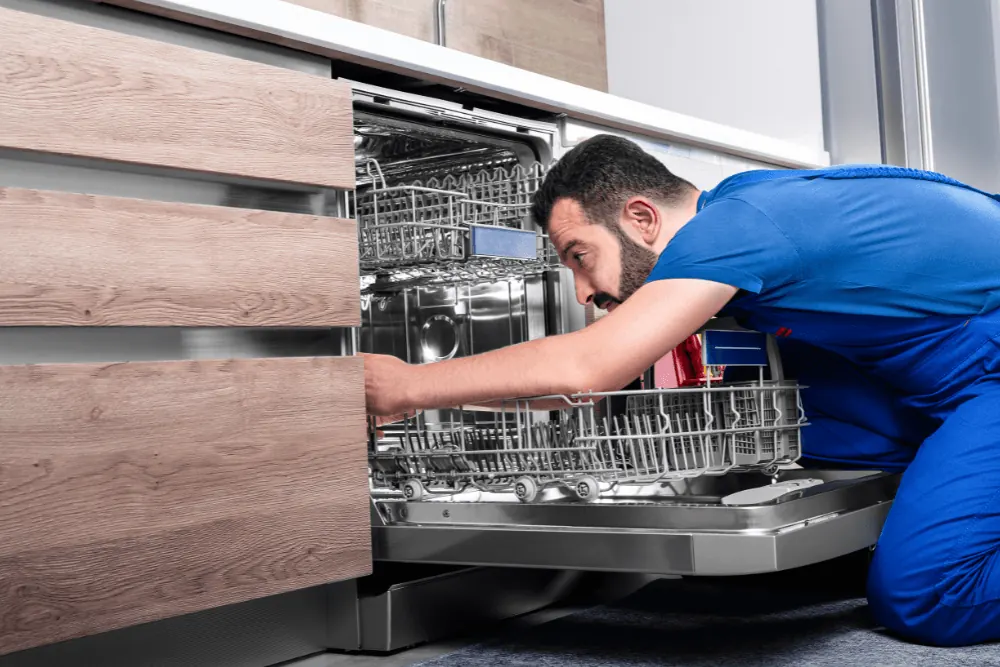
- Dishwasher drain connections at the kitchen sink waste, with the kitchen sink and garbage disposal pages for the fittings around it.
- Leaks and water on the floor. See leak detection.
- Emergency visits. We answer calls and send a plumber 24 hours a day, 7 days a week, and we do not promise an arrival time.
- Areas. Across Dubai. The list is near the end of this page, and the full list of areas is on its own page.
Which washer drain you mean: ten things
| What people mean | What it is | Whose it is | Where to read more |
|---|---|---|---|
| Drain hose | The corrugated hose on the back of the machine that the pump pushes water through | The machine, supplied with it | This page |
| Hose extension | A second length of hose, joined with a connector | The owner of the machine | This page |
| Standpipe | The upright open-topped pipe the hose is pushed into | The building | This page |
| Trap | The bend below the standpipe that holds water to block drain smell | The building | This page |
| Wall box or sink spigot | A wall outlet or a sink-waste fitting that the hose connects to instead of a standpipe | The building | Washing machine plumbing |
| Floor drain or pan drain | A grated drain in the laundry floor, or the outlet of a tray under the machine | The building | This page |
| Drain pump | The pump inside the machine that empties the drum | The machine | This page |
| Drain filter | The filter in front of the pump, behind a panel at the bottom front of front-loading machines | The machine | This page |
| Drain valve | A word used for a part inside the machine and for a valve in pipework | Either | This page |
| Dishwasher drain hose | The hose from the dishwasher to the kitchen sink waste | The dishwasher and the sink waste | This page |
Beyond all ten is the house drain that the water finally enters, and that belongs to the building. When a laundry is slow, the cheapest question to settle first is which of the ten is at fault, because the machine's owner fixes four of them and the building fixes four, with the dishwasher hose shared between the machine and the sink waste.
The spin test: whose fault is it?
Disconnect the drain hose from the house drain and run a spin-only cycle, with the hose end over a bucket or a floor drain. If water comes out of the hose, the machine is pumping and the blockage is in the house drain. If nothing comes out, the fault is in the machine, its filter or its hose.
| Result of the spin test | What it tells you | Who to call |
|---|---|---|
| Water comes out of the hose | The machine and its hose work, and the standpipe, trap or house drain is blocked | A plumber. See drain unblocking |
| No water, and the drum is still full | The filter, the hose or the pump | The machine's maker, or a machine engineer |
| Water comes out slowly | A partial blockage in either place. Compare with the standpipe test below | Test the standpipe, then the filter |
The standpipe test
With the hose out of the standpipe, pour a bucket or run a garden hose into the standpipe. If it takes the water quickly and the level drops steadily, the standpipe, trap and drain are clear. If the water rises or drains slowly, the blockage is between the standpipe and the main drain. Use the two tests together. The spin test clears the machine, and the standpipe test then places the blockage in the building's pipework. Hot water from a wash is a scald hazard in both, so put a shallow pan and towels down first.
The height of the hose end
The hose is pumped through, and the height of its outlet sets how hard the pump works and whether water can siphon back. Makers give different numbers for different machines, so the manual for your model is the figure to use. The common rules:
| Point | What to know |
|---|---|
| Height of the hose end above the floor | The manual gives a range. A hose end set too low can siphon the drum empty during a wash. One set too high makes the pump work hard and can leave water in the drum |
| Insertion depth in the standpipe | The hose end goes in only a short way, not all the way down, and the standpipe has an air gap around it so that water cannot be siphoned out |
| The hose is not sealed in | A tight seal around the hose stops air getting in and invites a siphon. Leave the top of the standpipe open |
| A loop or hook | A hose is often hooked in a loop or in a bracket at the top of the standpipe so that it cannot slip out |
Top-loaders and front-loaders can have different figures. A hose end set well below the limit in the manual is the reverse of right, and it can empty a drum during the wash. The standpipe's own height, measured from the trap, is a separate figure covered below.
Standpipe, trap and drain sizes
These are common plumbing practice and not a building rule. The figure to use is the machine maker's, from the manual for the model, and the layout is the building designer's.
| Item | What to know |
|---|---|
| Standpipe | Open at the top, standing well above the trap, and wide enough for the hose end plus an air gap around it |
| Trap | Placed near the floor, with a water seal that holds smell back |
| Drain beyond | A branch that suits the flow, larger where several machines share it |
| Fall | The drain slopes down towards the stack at a steady gradient |
A standpipe of the right size on a drain of the wrong size looks like a blocked standpipe, and the standpipe test above tells them apart.
How fast a washer discharges
A washer does not drain gently. The pump pushes the water out in bursts, much faster than a basin or a shower empties. That is why a standpipe is tall and open at the top: it gives the burst somewhere to go while the drain below catches up.
A standpipe overflows when the drain below it cannot take the pump's flow for the length of the pumped-out phase. The test is the standpipe test above, run with a garden hose: a pipe that takes the hose water but backs up under the machine points at the drain's capacity and not a blockage. Two machines sharing one drain send their discharges together, and a drain that copes with one may not cope with two. A narrow drain that is also run at a shallow fall is the usual weak point.
Pump, filter and emergency draining
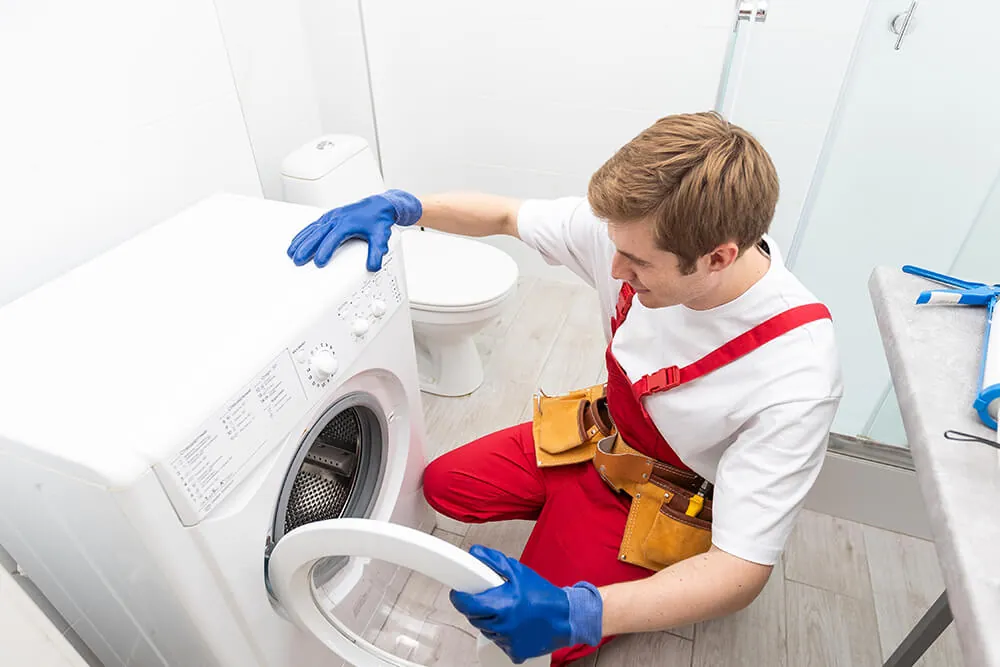
The pump is inside the machine. What an owner can reach is the filter in front of it on front-loading machines and the hose behind it.
| Cause | What to do |
|---|---|
| A blocked drain pump filter | Open the panel at the lower front with a shallow pan beneath, let the water out of the small drain tube, turn the filter anticlockwise, clean it, then refit it. Run the spin test |
| A kinked or pinched hose | Straighten the hose, and check it behind the machine, where it is easily trapped |
| A blocked house drain at the standpipe or floor drain | Run the standpipe test, then call us |
| An unlevel machine, or a hose at the wrong height | Level the machine, and check the hose against the manual |
| An error code on the display | The manual lists the codes. A drain code points to the filter, the hose or the pump |
Top-loading machines often have no removable pump filter. Service is the route if the machine still does not drain after the checks. A machine under warranty should be opened only as far as its manual allows, because opening it further can void the warranty.
Emergency draining of a full drum
The water in a drum that will not empty can be hot. Switch off and unplug the machine, put towels and two flat containers by the filter cover, open the cover, and pull out the small emergency drain tube slowly with its cap closed. Take the cap off the tube and let the water out into the containers, closing the tube when a container is full. Then unscrew the filter, clear the debris, refit it and close the cover. Machines differ, and the manual for yours governs.
Smells, trap seals and dry traps
A washer drain that smells has two possible homes: the drain, or the machine.
| Cause | Fix |
|---|---|
| Lint, fibre, pocket debris and detergent residue build into sludge in the hose and the standpipe | Clean the machine's filter, run a hot empty cycle with a cleaner suited to the drum, and clean the hose and standpipe |
| A dried-out trap | Pour water in until the seal is full again. A trap that dries out lets sewer air up the pipe |
| A floor drain with no water reaching it | The seal dries in days in hot weather. Pour a jug of water in, and consider a trap primer or a seal that closes the drain |
| A blocked or missing vent | A trap that loses its seal after each discharge is siphoned by a poor vent. This is a visit |
| A mouldy drum seal | Wipe the rubber seal, leave the door open, and run a maintenance wash |
The first step is to find where the smell is. A smell from the standpipe opening while the machine is off and the door shut points at the drain: a trap that has lost its seal, a blocked drain, or a vent. A smell on opening the door, with the standpipe odourless, points at the drum and its seal. What a laundry floor drain and a standpipe trap differ in is how the seal is renewed: each discharge from the machine refills the standpipe's trap, while a floor drain is refilled only when water reaches it. A floor drain that no water reaches is the first one to check, and pouring a jug of water into it costs nothing. If the smell returns soon after a refill, the cause is the trap, its fall or the vent, and that is a visit. The vent is the building's pipe, and in a flat it is a matter for building management.
Pans and floor drains
A pan under the machine catches a leak. It does not empty the machine. A pan holds only a small amount, and a machine pumping into an empty pan would fill it in well under a minute if a hose slipped out of the standpipe.
A pan is a leak warning and a few seconds of margin, and the machine's own hoses are what it protects against. A pan with no outlet pipe works only until someone empties it. A pan with a drain connection should be piped to a drain that is trapped and kept wet. Where the building offers no drain for the pan, leave the outlet blocked. The wall pipes behind a laundry are covered under leak detection. A floor drain is wanted in a laundry even where the machine drains to a pipe, so that a leak has somewhere to go.
The dishwasher drain
A dishwasher's drain is a separate connection from the washer's. A dishwasher has no standpipe. Its hose runs to the kitchen sink waste, and the question is how to stop sink water running back into the dishwasher.
- The high loop. The hose is raised in a loop to the underside of the worktop and fixed there, then runs down to the connection. The loop stops sink water running back.
- The air gap. A small fitting on the sink or worktop that breaks the connection with air. Some buildings and some machines call for it.
- The connection. Where the sink has a disposal, the connection is the disposal's inlet, and the garbage disposal page covers the unit. Where the sink has none, the connection is a tee on the tailpiece, and the kitchen sink page covers the waste.
- The hose end height. The makers state a minimum and a maximum height of the hose end above the base of the dishwasher, and the figures depend on the model. Read the manual, because the height is measured from different points in different manuals.
A dishwasher that leaves water in the tub after a cycle, or whose water backs into the sink, is the first case to check the loop and the sink waste.
Extending the drain hose
A longer hose makes the pump push against more resistance, and a long run can leave water in the drum or let the hose slip out. The manual for your machine states a limit on the total length, and the limit is usually a few metres at most.
If the maker allows an extension, use a made coupling and clamps and not tape. If the standpipe is too far for the hose, moving the standpipe or the machine is the repair that leaves the pump alone, and that is a plumbing visit. See hoses for the supply hoses and pipework for pipe sizes.
Checks before you buy a hose, extension or pump
- The machine's full model number, from its label, against the seller's fit list.
- The part number, and the numbers it replaces, which for a pump is the safer match than a machine name.
- The bore and end sizes of a hose or connector. A listing that gives no diameter has not answered.
- The length, against your maker's instructions.
- What is in the box: a joint, clamps, a bracket, or none.
- The voltage of a pump, against your supply.
Permission in Dubai: who decides on a washer drain
A hose and a machine are yours. The standpipe, the trap, the wall box, the floor drain and the stack behind them belong to the building. In a rented home both touch the landlord. This is general information, not legal advice. The fuller account is on the washing machine plumbing page.
- Building management. A laundry drain joins a shared stack or a building drain, so work on the standpipe, the trap or anything behind the wall is for the landlord and building management, and a blocked shared line is theirs to clear.
Replacing a drain hose, cleaning a filter and swapping a pump in your own machine are the machine owner's. Fitting a standpipe, moving a wall box, adding a floor drain or changing the pipe behind them is an alteration, and needs written consent in a rented home. Tell us what your building asks for and we work to it.
When the job is finished
Ask for these. They cost nothing to produce.
- The spin test result, shown to you: water out of the hose, or none, and what that placed the fault in.
- The hose end, photographed in the standpipe, with its height from the floor and the insertion depth measured, against the figure in your manual.
- The trap, shown to you with water in it, and the standpipe's top open.
- A full cycle run with every joint, the standpipe and the floor watched, and the drain phase timed.
- The floor drain and pan drain, poured with water to prove they run.
- The dishwasher loop or air gap, shown to you, with where the hose joins the sink waste.
- Anything left to the maker, written down, with the error code.
- FAM's workmanship warranty, in writing. The warranty runs for 30 days and covers our labour only. Parts carry the manufacturer's warranty only.

How we work
- You message us with the machine's make and model, what it is doing, whether a hose, standpipe, wall box or floor drain is involved, and a photograph of the hose end and the pipe it goes into.
- We say what we think is happening, whether the machine, the hose, the standpipe and trap or the house drain, and whether it is work we do. The visit fee is AED 50 + VAT, credited if the work goes ahead.
- We give a price in writing, with parts and work shown separately.
- Check permission. In a rented or managed property, ask the landlord or building management whether they need to approve this work before the visit.
- We run the spin test first and place the fault before touching anything.
- We fix and test: the hose, the standpipe and trap, the drain beyond or the dishwasher connection, then a full cycle with the drain phase watched.
- We hand over the test result, the measurements and the warranty.
Where we work in Dubai
We cover all of Dubai, including Dubai Marina, JBR, Downtown Dubai, Business Bay, Jumeirah Lakes Towers, Palm Jumeirah, Al Barsha, Jumeirah Village Circle, Dubai Hills, Mirdif, Deira and Al Quoz. See the full list of areas.
Preventing the next overflow
A washer that overflows once will do it again unless the cause is found. Check these in order:
- The drain hose. Is it pushed in far enough, held in place and at the right height?
- The standpipe or trap. Is it clean and the right size for the flow?
- The washer filter. Is it clear of lint, coins and socks?
- The drain line. Does it run freely when you pour a bucket of water into the standpipe?
- The vent. Is there a gurgle that shows a poor vent?
- The load. Is the washer running a very large load that discharges fast?
A pan with a drain below the washer is the best backup. It does not stop the leak but limits the damage.
What a visit for a washer drain involves
We look at the hose, the standpipe, the trap and the wall pipe. We test the discharge with water, clean what needs cleaning and fit or adjust parts where needed. We tell you if the problem is the washer pump or filter, which is for the appliance technician. We fix the price on WhatsApp before we start. Prices exclude 5% VAT.
Laundry layouts we see in Dubai
Where the machine sits changes what can go wrong with its drain.
- A laundry cupboard in a flat. The machine stands in a cupboard with a wall box or a standpipe behind it. Access is tight, so the hose kinks behind the machine and the trap is hard to reach. We pull the machine forward on a first visit and photograph what is behind it.
- A balcony or utility area. The machine drains to a floor drain or a standpipe near an outside wall. Hot weather dries the trap quickly, and the drain can be shared with the balcony, so a blocked balcony drain can show up as a slow washer.
- A kitchen. The machine shares the sink waste through a tee or a spigot. A blocked sink waste then backs up into the machine, and a slow sink and a slow washer have the same cause.
- A villa laundry room. A room of its own, often with a floor drain, a standpipe and a longer run to the house drain. A longer run needs a steady fall, and roots or debris can be the cause outside.
- Staff or maid's room laundries. Small rooms with a machine and a floor drain, where the same drain serves a shower. The smell question is nearly always a dry floor drain.
In each layout we check the same three things in order: the hose end and its height, the trap and its water seal, and the drain beyond.
Choosing a standpipe height
The top of a standpipe should sit above the water level in the washer drum and below the point where the hose would siphon. Too low and water siphons out. Too high and the pump struggles. We set it to the maker's figure and test.
How much does a washer drain job cost in Dubai?
- The parts. A hose, a connector, a standpipe, a trap or a pump, each priced by size and make.
- The work. Placing the fault, fitting a hose or standpipe, clearing the drain beyond, or connecting a dishwasher.
- What moves the price. The job, whether the fault is in the machine or the drain, access behind the machine, the length and fall of the drain, a pump or hose part, and the building's approval.
- The visit. The visit fee is AED 50 + VAT, credited if the work goes ahead.
We do not publish a starting price for this job. Send a photo on WhatsApp and we give you a fixed price before we start. Prices exclude 5% VAT.
Washer drain FAQs
What size is a washing machine drain pipe?
The standpipe is usually a little wider than the hose, and the drain beyond is the building's. A washer can discharge faster than a narrow drain carries, which is why the standpipe is tall and open at the top.
How high should the washer drain hose be?
The makers disagree, so use the manual for your model. A hose end set too low can siphon the drum empty, and one set too high makes the pump work hard.
Why is my washer not draining?
Run the spin test: disconnect the hose from the house drain and spin. Water out of the hose puts the blockage in the standpipe, trap or house drain. No water puts it in the filter, hose or pump.
How do I drain a washing machine in an emergency?
Switch off and unplug it, put towels and containers down, open the filter cover, pull out the emergency drain tube with its cap closed, and let the water out in stages. The water from a hot cycle is hot. Machines differ, and the manual for yours governs.
Why does my washing machine drain smell?
Find where the smell is first: at the standpipe with the machine off points at the drain, and on opening the door points at the drum. A jug of water in a dry floor drain costs nothing and often cures it.
Can I extend my washer drain hose?
A short extension is often allowed. Ask the maker, check the limit in your manual, and use a made coupling and not tape.
Can two washing machines share one drain?
Only if the drain can take both discharges at once. Two machines send their discharges together, which is more than a narrow drain carries. A shared drain needs checking before the second machine goes on.
Does a dishwasher need an air gap or a high loop?
It needs one of them, so that sink water cannot run back into the dishwasher. The manual for your dishwasher states which, and the height of the hose end.
Do I need a drain pan under my washing machine?
A pan catches leaks and overflow. It is not needed in every home, but on an upper floor it is cheap protection. A pan holds only a small amount, so it buys seconds and not minutes in a burst.
How much does a washer drain pump cost in Dubai?
The pump is a small part cost, and fitting it is a short visit. The price depends on the machine's make and model, and whether the filter, the hose or the pump is the fault. We give a fixed price on WhatsApp after you send the model number. Prices exclude 5% VAT.
Book a washer drain visit in Dubai
Tell us the machine's make and model, what it is doing, and whether you own or rent. A photograph of the hose end in the standpipe helps. If water is on the floor, switch off the machine and close the supply tap. We will place the fault, say whether it is work we do, give you the options and a price in writing, and hand over the measurements and the test.
WhatsApp: +971 55 407 7427 · Request a quote
Visit us: Office 871, Oasis Mall, Al Quoz 1, Dubai, UAE
Related services: Washing machine plumbing · Drain unblocking · Drain jetting · Drain services overview · Kitchen sink · Garbage disposal · Hoses · Pipework overview · Leak detection · Emergency plumber · how plumbing works in a Dubai home