
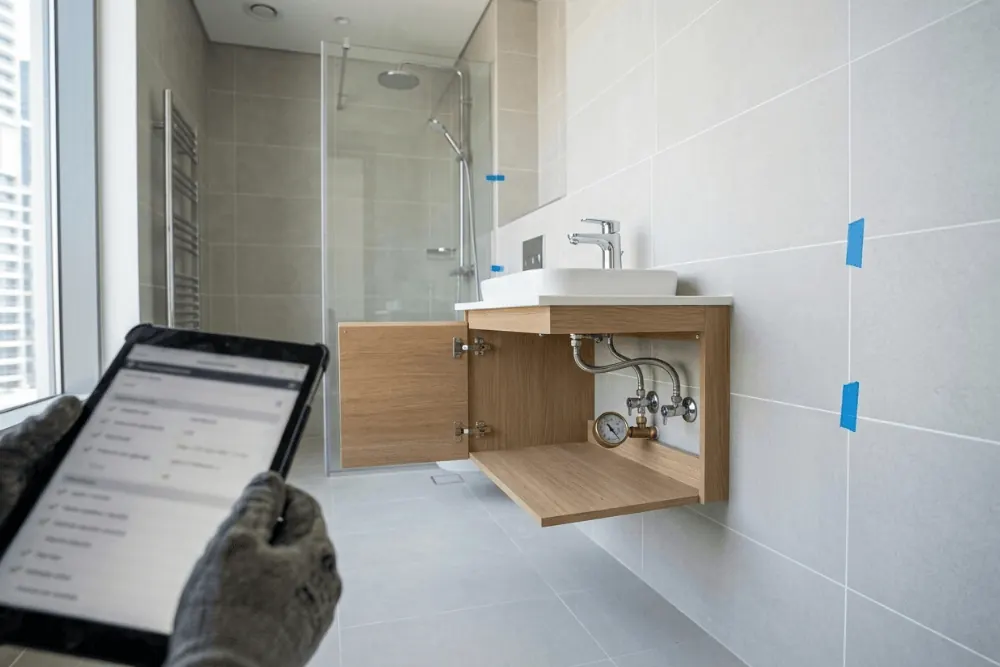
Showers in Dubai: what we do
- New and replacement showers. Concealed and exposed valves, rain heads, columns, trays and walk-in floors. See shower installation.
- Shower repair. Cartridges, drips, temperature swings, scale and leaks. See shower repair.
- Pumps and pressure. Finding out whether a pump is the answer. See low water pressure and booster pumps.
- Electric and instant units. The water side of an instant shower. The electrical side is done by our electricians. See tankless water heaters.
- Shower drains. Blocked, slow or smelly shower drains. See drain unblocking.
- Filters. Shower and whole-house filters. See water filters.
- Supplying the equipment. We supply and fit, and we also fit items you have bought.
- Emergency visits. We answer calls and send a plumber 24 hours a day, 7 days a week, and we do not promise an arrival time.
Mixer, electric or pumped: how each shower gets its water
The three kinds of shower differ in what supplies them, and that decides what can go wrong.
| Kind | How it works | What it needs |
|---|---|---|
| Mixer | A valve blends hot and cold water from the home's own supply to the temperature you set | Both a hot and a cold supply at similar pressure. Flow follows the home's supply, and can be stronger with a pump |
| Electric (instant) | Cold water passes over an electric element and is heated as it flows, much like a kettle | A cold supply and an electrical feed. No hot water system is needed |
| Pumped mixer | A mixer with a pump on the supply to raise flow | A hot and cold supply the pump can draw from, usually from a tank |
What matters is what feeds the hot side (a storage heater, an instant heater or a central system), where the cold side comes from (the main, a booster pump or a roof tank), and whether the two reach the shower at similar pressure. Our shower installation page works through the heater and the supply, and our water tank and booster pump pages cover the cold side.
Height matters on a tank-fed supply. Water pushes harder the further the tank sits above the shower head, so a shower close under a roof tank is weak and one on a lower floor is stronger. That is why a gravity-fed shower in a top-floor villa bathroom can disappoint, and why a pump can help there.
In short:
- Exposed or concealed. An exposed valve sits on the wall surface with a visible rail. A concealed one has its body in the wall, and only a plate and handle show. Concealed designs need cavity depth and more labour, and exposed ones are easier to reach for maintenance.
- Manual or thermostatic. A manual valve is set by hand with one lever or two handles. A thermostatic valve holds the temperature you set when the supply changes. The scald side is on our shower installation page.
- Dual outlet. Two outlets, such as a rain head and a hand shower, with a diverter to choose between them.
- Cartridge. The part inside the valve that opens, mixes and, on some models, controls temperature. See shower repair.
Shower pumps: when one helps, and the two types
A shower pump raises flow at the shower. It is the answer only when the low pressure is at the shower and nowhere else, and when there is stored water for it to draw from. If the flow is weak at the shower and fine elsewhere, a pump is worth considering. Check other plumbing faults first, because low pressure can have a general cause. Our low water pressure page covers the general causes.
Measure the flow first
- Hold a one-litre jug under the shower head and time it. A jug that fills in 6 seconds is 10 litres a minute.
- A jug that takes more than 6 seconds is a weak flow. At that flow your home could benefit from a shower pump, or at least a look at the head and the supply.
- A jug that fills in 4 seconds or less is a strong flow, and a pump will add little.
The test is a guide to a weak supply and not a pass mark for a particular head. Take it with the head on and again with the head removed. If the flow jumps with the head off, the head is scaled or restricted and a pump is not the answer.
Two ways a pump senses water
The two types differ in how the pump starts, and the one you need follows from where your cold tank sits.
| Type | What it does | When it is used |
|---|---|---|
| Flow-switch pump | Starts when water begins to move through it, so it needs the tank to push some water in first | The cold tank sits above the shower |
| Pressure-sensing pump | Draws water from the tank itself and keeps the pipework to the shower pressurised | The shower head is level with or above the tank, so no natural flow reaches the pump |
Each pump states the minimum height it needs between the tank and the pump, so the pump's own instructions decide which type suits the layout.
Pumps also come as single impeller, which boosts one feed (hot, cold or mixed), and twin impeller, which boosts hot and cold together for an equal flow. In a standard bathroom, a modest pump can give a better balance of flow, noise and water use than the biggest one on the shelf.
Fitting rules
The usual installation points:
- Place. Away from the shower tray or basin and from splashes, with air around the motor so it does not overheat, and in a spot where it can be reached for servicing.
- Mounting. On a vibration-damping mount, not rigidly fixed to the floor.
- Pipework. Pipework not narrower than the pump's connections, with a full-bore isolating valve on the cold supply.
- Hoses and flushing. Flexible hoses between pump and pipework, and a flush of the pipework before connecting.
- Electrics. The electrical connection is done by our electricians, with an isolator and protection.
Does it suit a Dubai supply?
A standard shower pump suits a stored hot and cold water system, where water comes from a tank at low pressure. It is not designed to pump directly from a pressurised supply, and it does not suit a mains-fed instant heater.
A shower pump belongs where a roof or storage tank feeds the shower and the pressure is low at that one shower. Where a building boosts the supply for every unit, a second pump on one shower adds a second boost to a pipe that already has one. Check the reading at the shower and the building's arrangement first, and tell management before a pump is fitted, as our booster pump page advises.
Instant electric showers: what a given wattage can heat
An instant shower heats water as it passes, so its output is set by its power and by how cold the water arrives. An electric unit draws cold supply water, needs an electrical feed, needs no hot water system, and has a moderate flow.
What the power means
The heating power decides how much water can be warmed by how much. More power warms more water, a bigger temperature rise needs more power, and the same unit gives a better flow when the cold supply is warm. As a rough guide for a 20 degree rise:
| Power | Flow it can warm by 20°C |
|---|---|
| 3.3 kW | about 2.4 L/min |
| 5.5 kW | about 3.9 L/min |
| 7 kW | about 5 L/min |
| 10.5 kW | about 7.5 L/min |
Compare that with an ordinary shower head, which flows around 8 to 10 L/min. An instant unit either gives a gentle flow at a comfortable temperature or a stronger flow that is only lukewarm. That is the price of heating water on the spot, and it is why an instant unit suits a guest bathroom or a small flat and a mixer on a storage heater suits a family bathroom.
The incoming temperature changes the result. In Dubai the rise is smaller when the cold supply is warm, as our water heater page notes for rooftop tanks in summer, and larger when it is cool. The same wattage gives a better flow in one season than in the other.
What the circuit has to carry
A higher-rated unit draws a heavier current, so it needs a dedicated circuit with its own protection, not a spur off a socket. A 5.5 kW unit draws roughly 24 A and a 10.5 kW unit roughly 46 A. Replacing an older, lower-rated shower with a stronger one can mean new cable and a new breaker. Our electricians size the circuit from the nameplate and the cable run. We do not fit an instant shower until the nameplate is in hand, because a unit that states no wattage cannot be sized. For the heater side of an instant unit, see our tankless water heater page.
Shower drains: the trap, the smell and the backup
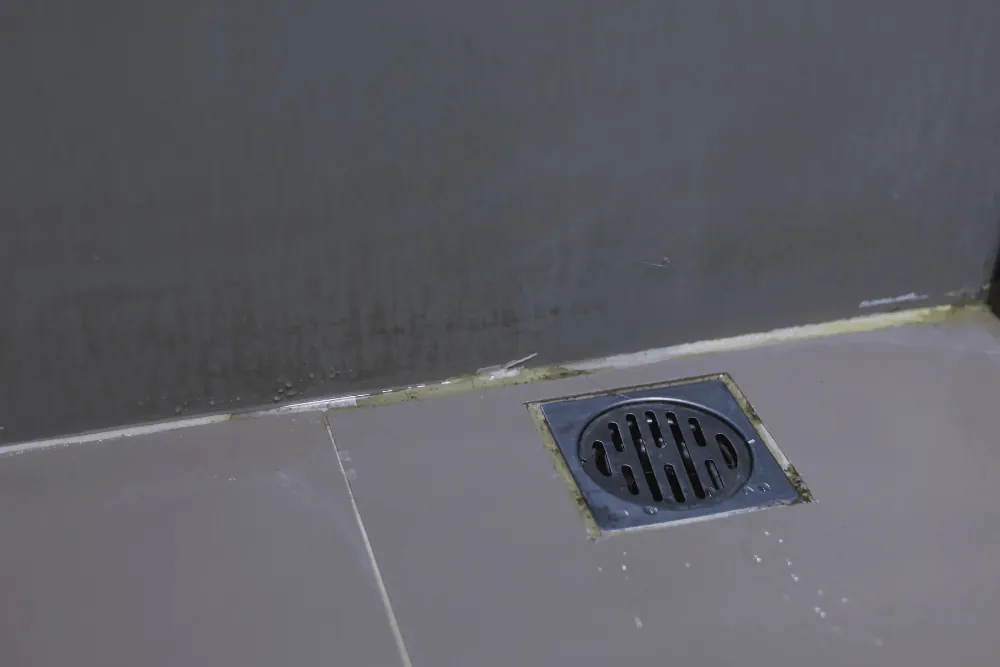
The drain under a shower holds a water seal that keeps sewer air out of the room. A smell means that seal has failed, been bypassed, or that the smell comes from the drain's contents.
The trap seal
Each fixture trap holds a water seal commonly 50 to 100 mm deep. A shower that is rarely used lets the seal evaporate, and Dubai's heat makes that quicker. Floor drains that are used rarely need the seal topped up, by running water into them, or kept topped up by a trap primer, a device that refills the seal automatically.
What a smell points to
| What you notice | Likely cause | What to do |
|---|---|---|
| A sewer smell from a shower that is rarely used | The trap seal has dried out | Run water for a few minutes. Repeat every two weeks or so, or ask us about a trap primer |
| A musty or rotten smell from a shower in daily use | Hair, soap and sludge in the trap or the drain body | Clean the drain cover and trap. See drain unblocking |
| A sewer smell across several bathrooms | A vent or main line problem | Call us. See sewer line |
| A smell that comes with gurgling when other fixtures drain | Partial blockage or poor venting | Call us for a camera check |
| A smell around the edge of the drain or the tray | A leaking seal, or a failed connection under the tray | Inspect and reseal. See leak detection |
The quicker figure is the safer one for a shower in a spare room or a flat left empty, and our smelly water page covers a property that has been empty.
Sewage coming up in the shower
A problem confined to one room points to a secondary line inside the home. If your shower backs up when another unit's water drains, or neighbours have the same fault, the problem sits in a shared stack and not in your drain. Tell building management, and see our sewer line page and our emergency plumber page for the first steps.
Shower filters: what they remove
A shower filter treats water for a few seconds as it passes, so it can do only a limited amount. The usual claims, and what to make of them:
| Claim | What to know |
|---|---|
| Removes chlorine | Filters with the right media reduce chlorine, though contact time is short. This is the main thing a shower filter can do |
| Softens hard water | A filter does not soften water. At best it holds a little scale back for a while. Scale needs a softener |
| Removes fluoride or heavy metals | Often claimed without a test report. Treat it as unproven unless the maker can show a report for the model |
| Gives softer skin and hair | Hard to prove either way. Dry skin in Dubai often comes from scale, air conditioning and hot showers as much as from chlorine |
A shower filter that lists fluoride, heavy metals or scale is making a claim a short contact time cannot back up. Ask for the model's test report before you buy.
Two points for a Dubai buyer. First, whether chlorine is your problem is a reading and not a guess. Our water testing page says how to take it. Second, flow is the other cost. Many filtered heads state no flow rate, and a filter that restricts flow undoes the point of a good shower. Check the flow with the jug test above, with and without the filter fitted. Filter cartridges also need replacing on a schedule, and an old cartridge can slow the flow or grow a film inside, so put the change date in your calendar when you fit one.
Permission in Dubai: who decides on a shower, a pump or a circuit
A new shower valve, a pump or a dedicated circuit changes the building's pipework or electrics, so in a flat the building and the landlord have a say. This is general information, not legal advice.
In practice: swapping a shower head or a cartridge is a repair, and a pump, a new circuit for an instant unit or a moved valve is a change. For a change in a rented flat, get the landlord's written approval and tell building management before the work is booked. Tell us what your building asks for and we work to it.
Warranty and the handover
What you should have when a shower job is finished:
- A written note of what was fitted: make, model, the pump or heater nameplate, the cartridge or valve model, and where each isolation valve is.
- A flow reading at the shower with the jug test, taken before and after, so a pump or a filter can be judged on a number.
- For a pump or an instant unit, a photograph of the nameplate, the invoice kept with it, and the circuit details.
- Photographs of the pipes, valve and drain before the wall or floor was closed.
- FAM's workmanship warranty, in writing. The warranty runs for 30 days and covers our labour only. Parts carry the manufacturer's warranty only.
How we work
- You tell us what the shower does on WhatsApp: the flow, the temperature, the smell or the plan, whether you own or rent, and a photograph of the shower, the valve and any pump or heater.
- We visit, time a jug at the shower, check the supply and the drain, and say what the fault or the plan involves before proposing anything. The visit fee is AED 50 + VAT, credited if the work goes ahead.
- We give options and a price in writing, with equipment and work shown separately.
- Check permission. In a rented or managed property, ask the landlord or building management whether they need to approve this work before the visit.
- We do the work, isolate the water, protect the surfaces, test and take the flow reading again.
- We hand over the note, the photographs and the readings, and show you where to isolate the shower.
Where we work in Dubai
We cover all of Dubai, including Dubai Marina, JBR, Downtown Dubai, Business Bay, Jumeirah Lakes Towers, Palm Jumeirah, Al Barsha, Jumeirah Village Circle, Dubai Hills, Mirdif, Deira and Al Quoz. See the full list of areas.
Matching a shower to the building
A shower works well when the water, the pressure and the heater suit it. In a Dubai home, these three vary a lot.
- Mains-fed flats with a pump set. Pressure is usually good. A thermostatic mixer works well, and a rain head is possible.
- Villas fed from a roof tank. Pressure depends on the height of the tank above the shower. A low pressure may need a shower pump, or a different head.
- Older buildings. Pipes may be narrow or scaled, and pressure may drop at peak times. A shower that disappoints may need a pipe fix rather than a new head.
- Electric instant showers. They depend on a good supply and a minimum flow. They are quick to fit but limited in output.
Always check the pressure and the flow before choosing a head. A beautiful rain head on a weak supply is a disappointment.
Common shower problems
| Problem | Likely cause | Fix |
|---|---|---|
| Weak flow | Scale in the head, a blocked filter, low supply pressure | Descale or replace the head, check the supply |
| Water too hot or cold | A worn cartridge, an unbalanced supply or a thermostat fault | Replace the cartridge, balance the supply |
| Temperature changes when another tap is used | Unbalanced pressures | A thermostatic or pressure-balancing valve |
| A drip after use | A worn cartridge or washer | Replace |
| Water leaking behind the wall | A joint or waterproofing failure | Investigate before it spreads |
| Slow drain | Hair, soap scum or a blocked trap | Clean the trap and the waste |
| A smell from the drain | A dry trap or a dirty trap | Refill and clean |
| The diverter will not switch | Scale or a worn diverter | Replace |
Concealed valves: what sits behind the wall
A concealed shower valve has its body inside the wall, and only the trim shows. That looks clean and it asks for care at the install.
- Depth. The valve body needs a set cavity depth, and the tile thickness has to be allowed for so the trim sits flush. A valve set too deep or too shallow is hard to finish.
- Isolation. Each supply to the valve should have its own isolating valve, or the whole bathroom has to be shut off for a cartridge change.
- Access. The cartridge is changed from the front, but the body and the joints behind it are not reachable once tiled. Joints are made, pressure-tested and photographed before the wall is closed.
- Waterproofing. The wall around the valve is a wet zone. The valve penetration is sealed so water cannot track along the pipe into the wall behind.
- Matching trim. Trim is made for a particular valve body. Changing the handle style later usually means the same maker's body, so choose the trim before the wall is closed.
If you are replacing the trim only, tell us the make and send a photo of the handle. A cartridge or trim swap is a repair, and a new valve body is a re-tile job.
Choosing a shower head and hose
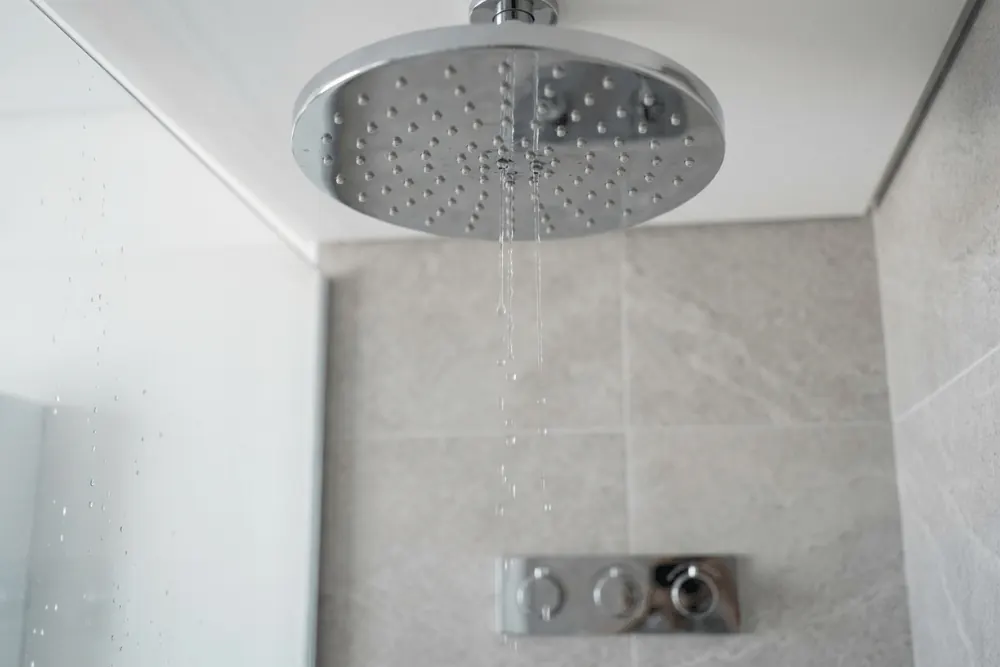
The head decides how the shower feels, and the supply decides what the head can do. A few points that help before you buy:
- Check the stated flow. A head's data sheet should give a flow at a stated pressure. A head with no stated flow is a gamble on a weak supply.
- Rain heads need flow. A wide rain head spreads the water thin. On a weak supply it feels like a drizzle, and a smaller head with a stronger jet suits it better.
- Air-injected heads mix air into the water for a fuller feel at a lower flow, which suits tank-fed supplies.
- Scale. Rubber or silicone nozzles can be rubbed clean, which keeps a head going in hard water areas.
- Hose length and type. A hand shower hose should be long enough to reach the floor of the tray and the wall bracket without strain, and a twist-free joint at the handle saves kinks. See hoses.
- Thread. Heads, hoses and arms all use common thread sizes, but an odd imported part may not fit, so send a photo if you are not sure.
Scalding and the safety of a shower
A shower that can give very hot water is a risk to children, older people and anyone with reduced feeling. A thermostatic mixing valve limits the temperature at the outlet. Set it at a safe maximum. A shower that suddenly turns hot when someone flushes a toilet or runs a tap is unbalanced and needs a balanced valve. Do not use an electric shower that is cracked, wet inside or has a damaged cable.
What a shower visit covers
We look at the head, the valve, the supply and the drain, and ask about the symptoms. We check the pressure and the flow, and test the temperature. We tell you whether the problem is the head, the valve, the supply or the drain. We quote the repair and fix the price on WhatsApp before we start. Prices exclude 5% VAT. For a new shower, see shower installation.
Keeping a shower in good order
Descale the head every few months. Wipe the glass or curtain after use to reduce mould. Clean the drain cover and the trap. Seal gaps in the tile or the tray. Check the sealant for cracks, since water behind a tray causes damage that shows up elsewhere. Report a damp patch outside the shower at once.
When a shower needs a plumber and not a new head
If the flow is poor at several taps, or the shower swings in temperature, a new head will not help. The fault is in the valve, the supply or the heater. We check and quote.
How much does shower work cost in Dubai?
Two prices make up the bill: the equipment and the work.
- The equipment. The valve, head, pump, heater or filter you choose. We supply and fit, or fit what you have bought.
- The work. Fitting a valve, a pump or an instant unit, flushing, testing and making good. Prices for each job are on the pages for shower installation, shower repair and drain unblocking.
- What moves the price. Whether the valve is concealed or exposed, whether a wall or floor has to be opened, the pump type, a new circuit, and access.
We do not publish a starting price for this job. Send a photo on WhatsApp and we give you a fixed price before we start. Prices exclude 5% VAT.
Shower FAQs
What is a mixer shower?
It is a shower valve that blends hot and cold water from the home's own supply to the temperature you set. Mixers come manual or thermostatic, and concealed or exposed. The cartridge inside does the opening and mixing, and our shower repair page covers it.
Should I choose a mixer shower or an electric shower in Dubai?
The choice follows your hot water system and your supply. A mixer suits a home with a reliable hot water supply and good pressure, and an electric unit suits a home with limited hot water, since it draws cold water and heats it itself. The price of that independence is flow: a 5.5 kW unit warms only about 3.2 L/min by 25°C.
Do I need a shower pump?
Only if the flow is low at the shower and fine elsewhere. If every tap is weak, the cause is general, and our low water pressure page comes first.
What are the two types of shower pump?
One starts when water begins to flow through it and suits a cold tank above the shower. The other draws water from the tank and keeps the pipework pressurised, and suits a shower level with or above the tank.
Can a shower pump go on a pressurised supply?
A standard shower pump must not be plumbed straight into a pressurised supply. Where your building boosts the supply, a pump on one shower is a second boost. Tell management and check the reading first.
How much hot water can an instant electric shower give?
Less than a mixer, because the power sets the flow. A 5.5 kW unit warms about 3.9 L/min by 20°C, and a 10.5 kW unit about 7.5 L/min. An ordinary shower head flows 8 to 10 L/min, so an instant unit gives either a gentle flow or a lukewarm one.
Why does my shower drain smell?
Run the shower for a few minutes to refill a dry trap, every two weeks or so for a rarely used one. The table in the drain section matches each smell to its cause.
Why is sewage coming up in my shower?
Backups show at the lowest fixtures first, and sewage in more than one drain at once points to the main sewer line. Stop using water, keep people and pets out, and call a plumber. In a flat, a shared stack can be the cause, so tell building management. See our sewer line page and emergency plumber page.
Does a shower filter remove chlorine, fluoride or hard water?
It reduces chlorine to a degree. Fluoride and heavy-metal claims are often unproven, and a filter does not soften water. Scale needs a softener, and a water test shows whether chlorine is the issue.
My shower water smells like rotten eggs. Is it the drain or the water?
Fill a glass at the shower and smell it away from the bathroom. If the glass smells, the water is the source. If the glass is clean, the smell comes from the drain. See smelly or discoloured water.
Book a shower installation, repair or drain visit in Dubai
Tell us what the shower does, whether you own or rent, and send a photograph of the shower, the valve and any pump or heater. If a drain is backing up with sewage, stop using water first and call. We will find the cause, give you the options and a price in writing, do the work and hand over a note.
WhatsApp: +971 55 407 7427 · Request a quote
Visit us: Office 871, Oasis Mall, Al Quoz 1, Dubai, UAE
Related services: Shower installation · Shower repair · Bathtubs · Low water pressure · Booster pumps · Drain unblocking · Sewer line · Water filters · Water heater repair · Emergency plumber